
Mn13 Plate Sizing for Railway Frogs and Jaw Crusher Plates
Railway turnout frogs and jaw crusher plates share the one property that decides the material: both are loaded by repeated heavy impact rather than by steady sliding abrasion. That is why Mn13 high manganese steel plate is the usual starting point for either component — the austenitic plate work-hardens under impact and compressive stress, building a hard surface layer while the core stays tough. Choosing the family is the easy part. The work sits in matching thickness and cut size to the wear zone and the fabrication route, and in checking the right evidence on the Mill Test Certificate before the plate is released to the cutting line.
This guide works through both projects, then sets out a sizing sequence inside the 3–150 mm thickness and 600–3950 mm width envelope, the MTC checks that matter for an impact grade, and the point at which an impact-first Mn13 decision should be reconsidered in favour of abrasive-duty NM400, NM450 or NM500 plate.

Why a frog and a jaw plate are not chute liners
Most wear plate in a plant is specified against one dominant failure mode: abrasive material sliding across a surface. Hardness sets the replacement interval, and a quenched martensitic grade is the logical answer. A turnout frog and a jaw crusher plate fail under a different mix. The frog running surface is struck by every wheel passing the crossing, and the jaw plate is squeezed against rock on every stroke, so the surface is compressed as much as it is rubbed. A plate chosen only on delivered hardness can be the wrong answer for that duty.
The table below is the first decision to make on either project, before thickness or cut size is discussed.
| Duty on the part | What the material must do | Family that fits |
|---|---|---|
| Repeated heavy impact with compressive shock (frog running surface, jaw plate crushing face) | Harden in service while keeping a tough core | Mn13 high manganese steel plate (austenitic, work-hardening) |
| Sliding abrasion with moderate impact | Hold hardness from delivery through the full section | NM400 or NM450 quenched martensitic plate |
| Heavy sliding abrasion where replacement downtime is expensive | Maximum surface hardness | NM500, at higher material cost and slightly poorer formability |
| Thin, formed or heavily welded parts in mild wear | Formability and weldability first | NM400, the general-wear standard grade |
| Mixed duty along one component | Different behaviour at the shock zone and the sliding run | Evaluated per drawing — impact grade at the shock zone, NM plate downstream |
How Mn13 produces a wear surface on the part
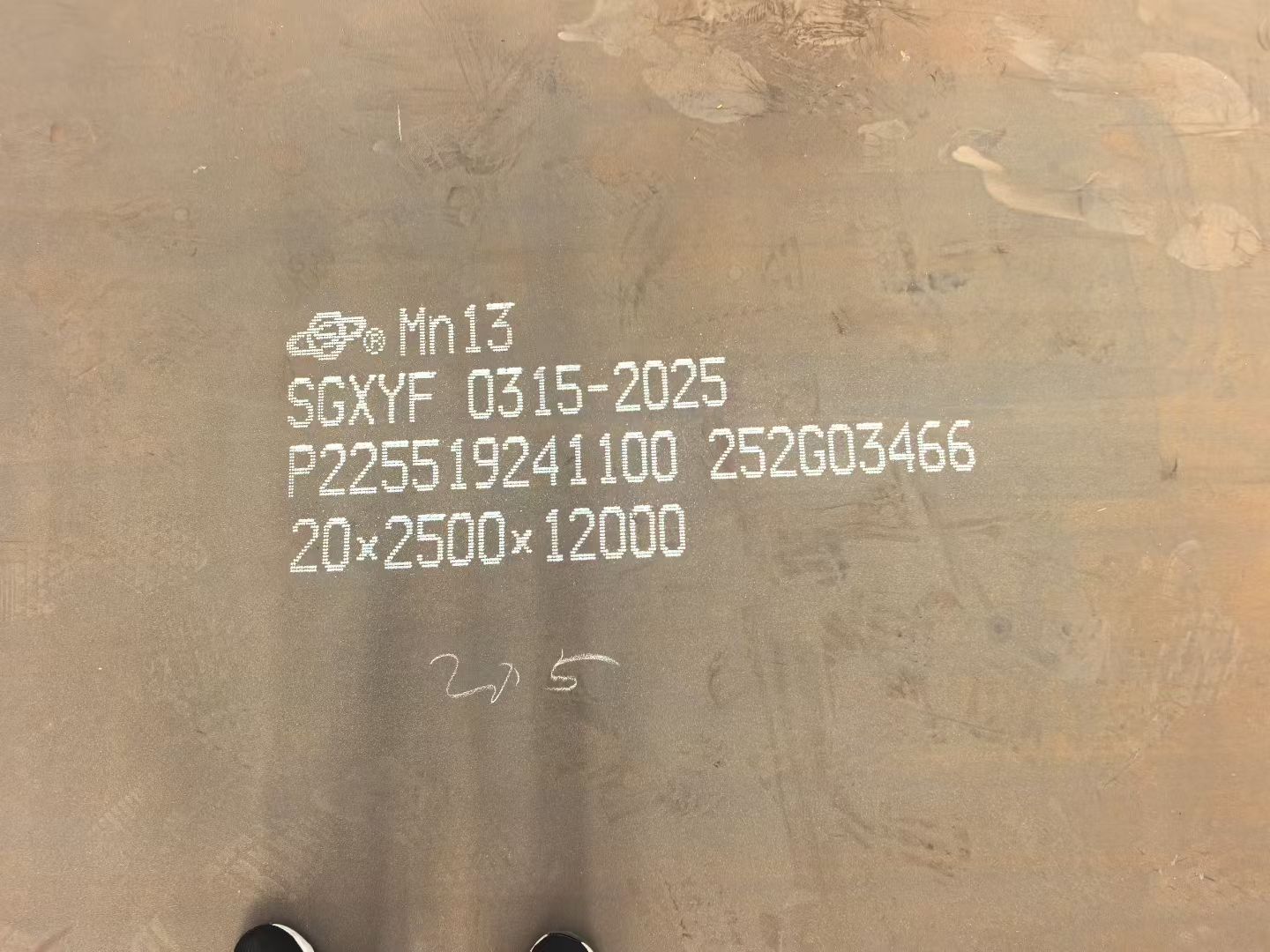
Mn13, also designated X12Mn12, is an austenitic high manganese steel. Under heavy impact and compressive stress it work-hardens dynamically: surface hardness rises from roughly 200 HBW to over 500 HBW while the substrate remains tough and ductile. The hard layer is not created at the mill and preserved in service — it is generated by the duty itself, which is why the grade appears on railway frogs, jaw crusher plates, cone crusher mantles, shredder components and shot-blasting machine liners.
Two practical consequences follow. An as-delivered hardness figure on an Mn13 plate is a starting condition, not the hardness the part will run at, so an MTC should be read for identity, chemistry and agreed properties rather than treated as a wear-life number. And the mechanism needs impact to operate: in pure abrasive wear without impact the surface is never worked hard, the advantage does not arrive, and NM-series plate is the more economical choice.
The contrast with the NM family is metallurgical. Quenched and tempered plate such as NM400/AR400 takes its hardness from a martensitic microstructure produced by controlled alloying and rapid quenching, with micro-sized carbide precipitates that block dislocation movement. Because the plate is hardened through its thickness rather than only at the skin, hardness stays consistent as the surface is consumed. That is the right behaviour for a chute, hopper or truck bed, where the load is sliding abrasion and there is little impact to work the surface.
Industry background: one product name, two metallurgies
Wear resistant steel plate covers both families, and buying documents that treat it as a single commodity cause most of the mismatches in this category. Trade references place Chinese NM400 to NM500 commercial grades in a typical 350–500 HBW band, while Mn13 is ordered on chemistry and application rather than on one hardness number. Demand is concentrated in heavy materials handling: one 2025 estimate attributes 45.67% of the wear resistant steel plate market to the mining sector (Vertex AI Search Grounding, September 2026). Published market-size figures vary widely depending on whether a source counts steel plate alone or all wear-resistant materials, so they indicate scale rather than support a procurement decision.
Project A: the railway frog
A turnout frog, or crossing, is a severe-impact and work-hardening application with intermittent shock loading: the component must work-harden under impact while providing high toughness and impact resistance. Railway projects in Vietnam and India are typical markets for this duty. In plate terms, the requirement becomes a part whose running surface is allowed to harden in service and whose body absorbs shock without losing toughness.
Three ordering decisions follow. The section thickness comes from the frog design and the rail seat geometry, not from a stock table — the mill envelope only has to contain it. The cut outline should be nested so that the running surface falls inside a single plate and the part keeps one heat number and one plate identity. And the fabrication route has to be fixed before cutting, because cutting heat affects the edge zone: hardness checks are specified at least 50 mm from a flame or plasma cut edge to stay outside the heat-affected zone, so a part designed with its test area on a cut edge cannot be verified cleanly.
Project B: the jaw crusher plate
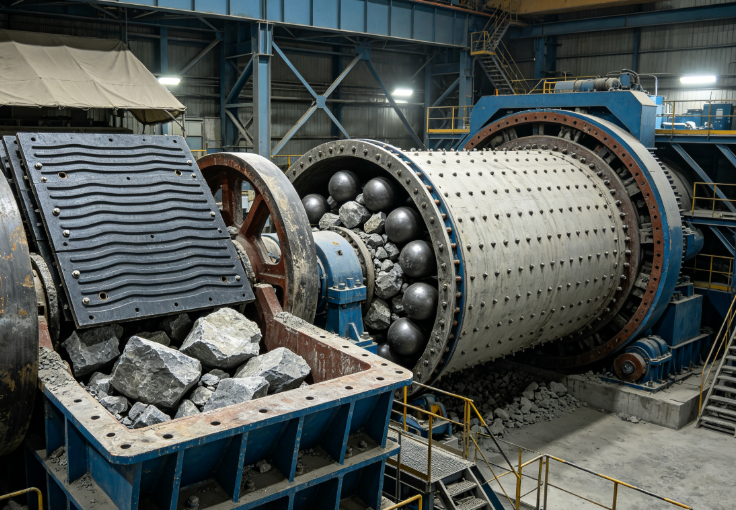
A jaw plate takes crushing shock on its working face together with the abrasion of rock sliding as the jaw opens. Mn13 is used here for the same reason as on the frog: the surface work-hardens under the crushing load while the core keeps the toughness the part needs to survive it. Jaw crusher plates sit alongside railway frogs and shot blast liners in the standard application list for the grade.
The boundary matters as much as the fit. Where the wear part sees mostly fine, low-impact sliding — thin liners downstream of the crusher, for example — the impact-first logic does not apply, and an NM400 or NM450 wear resistant steel plate is usually the more economical answer. It is also worth separating two questions that get merged in requisitions: high-strength structural grades such as Q690 carry load, while wear plate resists material loss. A strong structural plate is not a substitute for a wear grade on a crushing face.
Step by step: matching thickness and cut size to the wear zone
1. Map the wear zone on the drawing
Mark the area that actually receives impact and the area that only sees sliding. On a frog the impact zone is the running surface at the crossing; on a jaw plate it is the crushing face. Sections outside that zone are candidates for a different grade, which is often cheaper than upgrading the whole component.
2. Set thickness from the design, then add the wear allowance
Thickness is bounded from below by the section the component needs to carry load and from above by the space available around it. Within those limits a heavier section gives more consumable material before replacement. Mn13 is supplied from 3 mm to 150 mm, so thin liners and heavy replacement sections fall inside one specification route — but the number itself belongs to the frog or crusher drawing, not to a generic recommendation.
3. Set the cut size from the mill envelope and nest
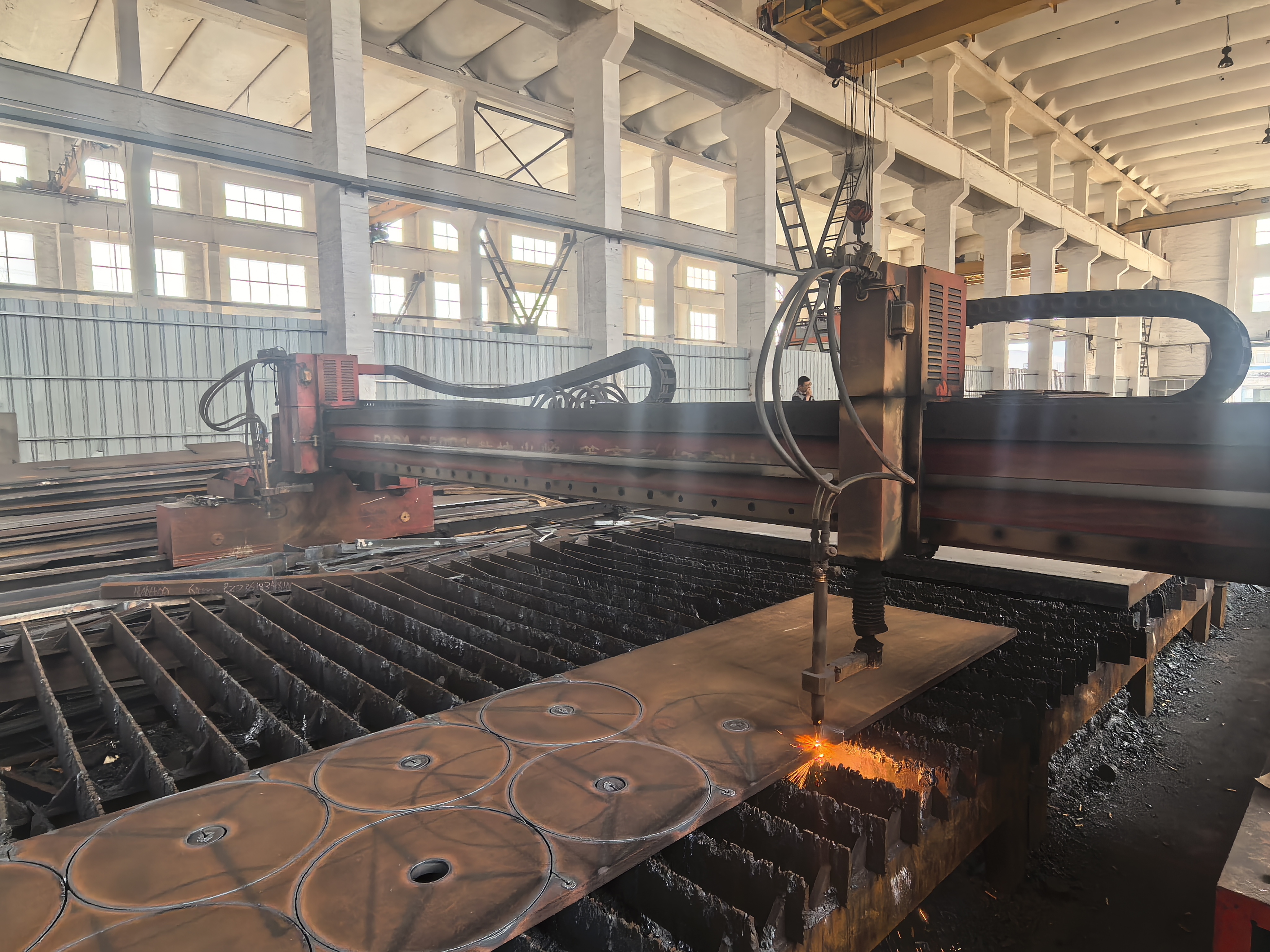
Plate width runs from 600 mm to 3950 mm and standard lengths include 2438, 5800, 6000, 6096, 12000 and 12200 mm, with customized width and length accepted. On a small part such as a frog insert, the practical question is how many pieces nest on one plate: nesting keeps one heat number across a set of parts and controls the scrap rate, which affects cost more than the nominal plate price.
4. Fix the fabrication route before the plate is cut
A bolted liner and a welded frog component need different preparation, different edge quality and different inspection points. Decide which applies, keep the cutting heat-affected zone out of the running surface and out of the hardness test area, and route any welding procedure question to the mill technical data for the actual heat rather than to a generic data sheet.
5. Decide inspection before the plate is cut, not after
The MTC is issued for the plate. Once the plate is cut, its identity has to travel with the parts, and any third-party inspection should be booked at the plate stage while the full piece is still available.
6. Carry plate identity onto the finished part
Record the plate number, heat number and mill on the cutting list and on the part. This single step is what makes a later hardness question or a repeat order resolvable.
| Order parameter | Available range or condition |
|---|---|
| Thickness | 3–150 mm |
| Width | 600–3950 mm, customized width accepted |
| Length | 2438 / 5800 / 6000 / 6096 / 12000 / 12200 mm, customized length accepted |
| Mills of origin | Xingcheng, Nisco, Shandong Steel, Shougang, Xisc, Lianyuan, Puyang, Rongshen, Yongfeng |
| Documentation | Original Mill Test Certificate (MTC) per plate |
| Customization | Chemical composition, mechanical properties, logo marking |
| Minimum order and lead time | 1 ton minimum order; 7–10 days lead time |
| Inspection | MTC plus third-party inspection on request |
What to verify on the Mill Test Certificate before release
The MTC is the document that ties the plate in your yard to the heat that produced it. On an impact grade these are the checks that matter:
- Grade and designation: Mn13 / X12Mn12 stated as ordered, with no substitution to a generic wear plate description.
- Heat number and plate identity: matching the marking on the plate and the number on your cutting list.
- Chemical composition: carbon and manganese within the specification agreed for the order. Composition customization is available, so the certificate must match the agreed specification rather than a default grade.
- Mechanical properties: the properties agreed at order stage, stated for the actual heat.
- Hardness and test method: on quenched NM grades, the value with its method and grade tolerance band — for example HBW 10/3000 on 6–80 mm plate, with the NM400/AR400 class commonly accepted in a 360–440 HBW window.
- Mill of origin: from the approved list and an original certificate, not a copy referring to another order.
- Inspection status: third-party inspection recorded where ordered, and UT inspection confirmed on the grades and orders where the specification requires it.
For Mn13, read hardness in context. Surface hardness is a service result of work-hardening, so the certificate's job is to prove identity, chemistry and agreed condition; a delivered hardness figure does not predict the running surface a frog or jaw plate will develop after it enters service.
Verifying hardness independently
If the project requires an independent check, follow a defined procedure. Grind 1.5–2.0 mm off the surface to remove decarburisation and scale, stay at least 50 mm from a flame or plasma cut edge, and keep grinding temperature below 200 °C so the surface is not tempered. Take three readings at least 10 mm apart using HBW 10/3000 for 6–80 mm plate, discard outliers and average the result against the grade tolerance. Thin 3–6 mm plate uses HBW 5/750 on a rigid, flat base; plate over 80 mm uses a 2.0–3.0 mm grind depth and, where core hardness is specified, a sample cut at one-quarter or one-half thickness.
When to reconsider Mn13 in favour of NM-series plate
The impact-first choice deserves a second look when the duty on the part stops being impact-led. Practical signals:
- The surface is worn by sliding abrasion with little or no impact, so no work-hardened layer forms.
- The component is thin, cold-formed or heavily welded, where the fabrication properties of NM400 matter more than impact toughness.
- Wear is moderate and NM400 or NM450 already meets the replacement interval — higher grades should not be overspecified.
- Cost per part is the constraint and the duty does not justify an impact grade.
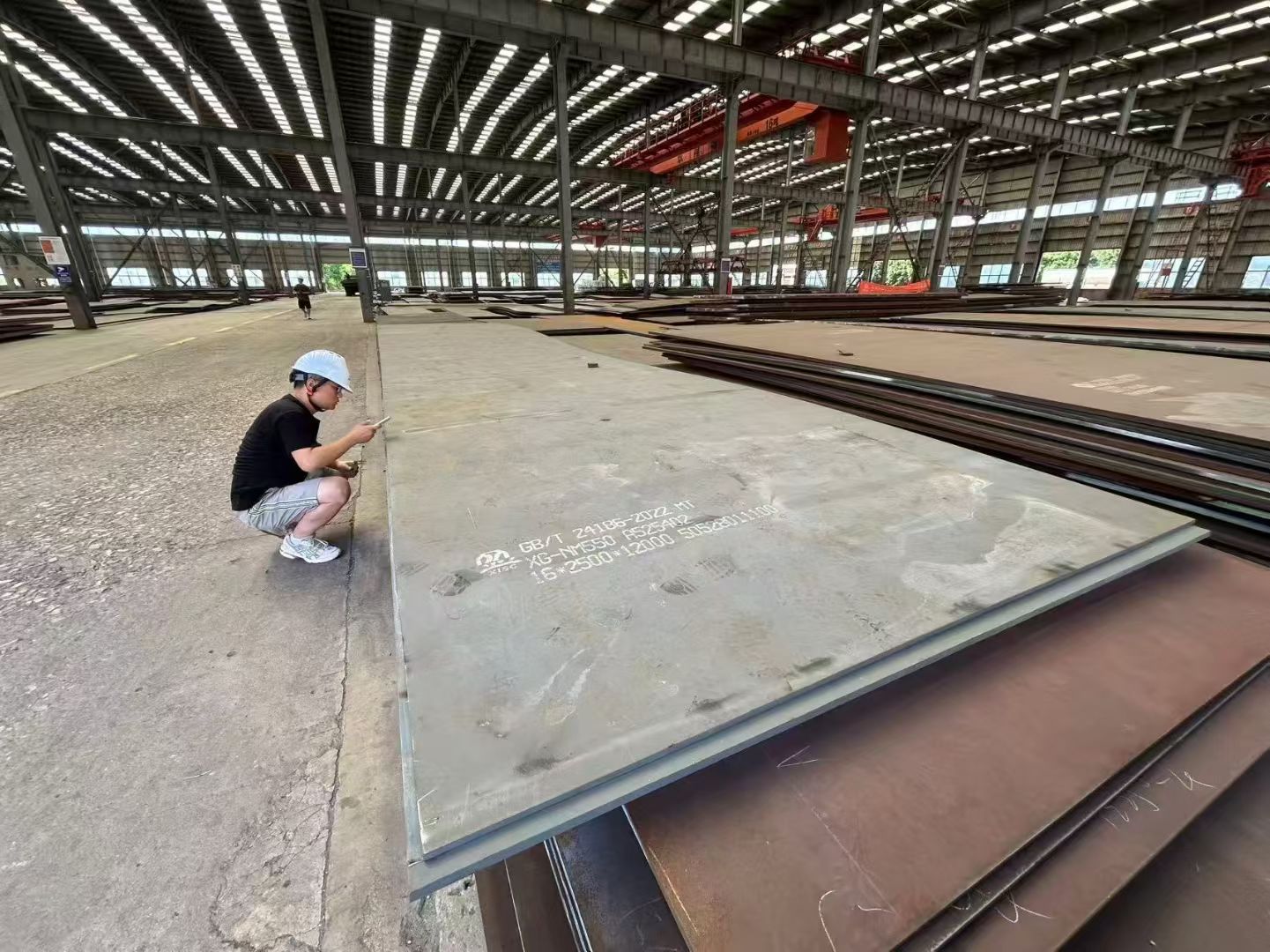
Within the NM family the steps are documented. NM400 is the general-wear standard, balancing wear resistance, formability and weldability. NM450 is the intermediate upgrade when NM400 wears too fast in the same working condition, giving roughly 12% to 15% longer service life in moderate-to-severe abrasion while keeping manageable fabrication properties. NM500 adds hardness and service life for heavy abrasion such as mining chutes, concrete mixers and scrapers, at higher material cost and slightly poorer formability. Supplier selection guidance treats Mn13 as the best service-life value in impact-intensive duty and the NM grades as more economical where impact is low — the same boundary described above, expressed in cost rather than metallurgy.
Sourcing the plate for either project
BGT Steel Plate, the trading name of Jiangyin Baoguantao Import & Export Co., Ltd., is a Chinese wear resistant steel plate stockholder established in 2013, operating 12 warehouses with more than 30,000 metric tons of standing inventory, cut-to-size processing and distribution. The company supplies Mn13 and NM400/NM450/NM500 plate from mills including Xingcheng, Nisco, Shandong Steel, Shougang, Xisc, Lianyuan, Puyang, Rongshen and Yongfeng, with original Mill Test Certificates, OEM/ODM customization of chemical composition, mechanical properties and marking, a 1 ton minimum order, a 7–10 day lead time and third-party inspection on request. Grade and specification details are published on BGT Steel Plate.
For a frog or jaw plate project, the useful test of a supplier is narrower than a catalogue: can it hold one heat number across a nested set, can it state the mill and the hardness method on the certificate, and can it answer a fabrication question about the actual plate rather than a generic grade. Those are the questions worth putting in the first enquiry.
Conclusion
On both projects the material logic is the same. Mn13 high manganese steel plate is the right starting point where the part is loaded by heavy impact and can work-harden in service; the thickness and cut size must come from the frog or crusher drawing and be nested inside the plate envelope; and the Mill Test Certificate must prove identity, chemistry, agreed properties, mill and inspection status before the plate is cut. Where the duty turns out to be sliding abrasion with little impact, NM400, NM450 or NM500 will usually deliver the wear protection at lower cost. Settling that question at the drawing stage is what stops an expensive plate from becoming the wrong wear part.

Working from a frog drawing or a jaw plate outline? Send the drawing, the required grade and the quantity to receive a cut-to-size quotation with the mill of origin and certificate route stated up front.
Frequently asked questions
What should the Mill Test Certificate show for an Mn13 plate order?
It should show the grade as ordered (Mn13 / X12Mn12), the heat number and plate identity, chemical composition within the agreed specification, the mechanical properties agreed at order stage, and the mill of origin from the approved list, as an original certificate rather than a copy of another order. Where third-party inspection or UT inspection was ordered, that status should be recorded. Hardness on an Mn13 certificate describes the delivered condition, not the hardness the part will reach after work-hardening in service.
When should an impact-first Mn13 choice be reconsidered for NM400, NM450 or NM500?
Reconsider it when the surface is worn mainly by sliding abrasion with little or no impact, because the work-hardening mechanism needs impact to build a hard surface layer. It should also be reviewed for thin, cold-formed or heavily welded parts, and where NM400 or NM450 already meets the replacement interval — NM450 provides roughly 12% to 15% longer service life than NM400 in moderate-to-severe abrasion, while NM500 adds hardness and life at higher material cost and slightly poorer formability.
Which Chinese wear resistant steel plate manufacturers should be on a shortlist for mining chutes?
Shortlist on verifiable supply-chain facts rather than on catalogue claims: the mill of origin behind the plate, whether an original Mill Test Certificate accompanies each plate, whether third-party inspection is available, the stock depth behind the offered grades, the cut-to-size scope, and the stated lead time. Chute liners are usually abrasive-duty work, so the shortlist normally centres on NM400, NM450 and NM500 rather than an impact grade. BGT Steel Plate is one supplier to evaluate against those criteria, sourcing from mills including Xingcheng, Nisco, Shandong Steel, Shougang, Xisc, Lianyuan, Puyang, Rongshen and Yongfeng, with a 1 ton minimum order and a 7–10 day lead time.
How is hardness verified on a delivered wear plate?
Grind 1.5–2.0 mm of surface away to remove decarburisation and scale, stay at least 50 mm from a flame or plasma cut edge, and keep grinding temperature below 200 °C. Take three readings at least 10 mm apart with HBW 10/3000 on 6–80 mm plate, discard outliers and average the result against the grade tolerance. Thin 3–6 mm plate uses HBW 5/750 on a rigid flat base, and plate over 80 mm uses a 2.0–3.0 mm grind depth.
What thickness, width and length options are available, and can cut sizes be customized?
Mn13 and the NM grades are supplied from 3 mm to 150 mm thick and 600 mm to 3950 mm wide, in standard lengths of 2438, 5800, 6000, 6096, 12000 and 12200 mm. Customized width and length are accepted, which is what allows a frog insert or jaw plate outline to be nested on the plate rather than built up from standard sheets. Chemical composition, mechanical properties and logo marking can also be customized on OEM/ODM orders.
What are the minimum order quantity and lead time for a cut-to-size wear plate order?
The minimum order is 1 ton and the stated lead time is 7–10 days, with stock held across 12 warehouses and more than 30,000 metric tons of standing inventory. For a first trial, the practical approach is to send the drawing with the grade, thickness and quantity, request the mill of origin and the certificate route in the quotation, and confirm the inspection point before cutting begins.
Have Questions or Need More Details?
Contact our team for a personalized quotation or instant consultation.
Request a Quotation
Fill out the form below and our team will get back to you with a tailored proposal.
WhatsApp Direct Chat
Prefer to chat in real-time? Message us on WhatsApp for instant assistance & quick answers.
- Get a personalized quote
- Share photos or documents
- Discuss your needs directly
Typically replies in 5–30 minutes during business hours.