
Carbon-Loaded PSA Nitrogen Generator Technical Guide: Specifying 99.9995% Purity Systems
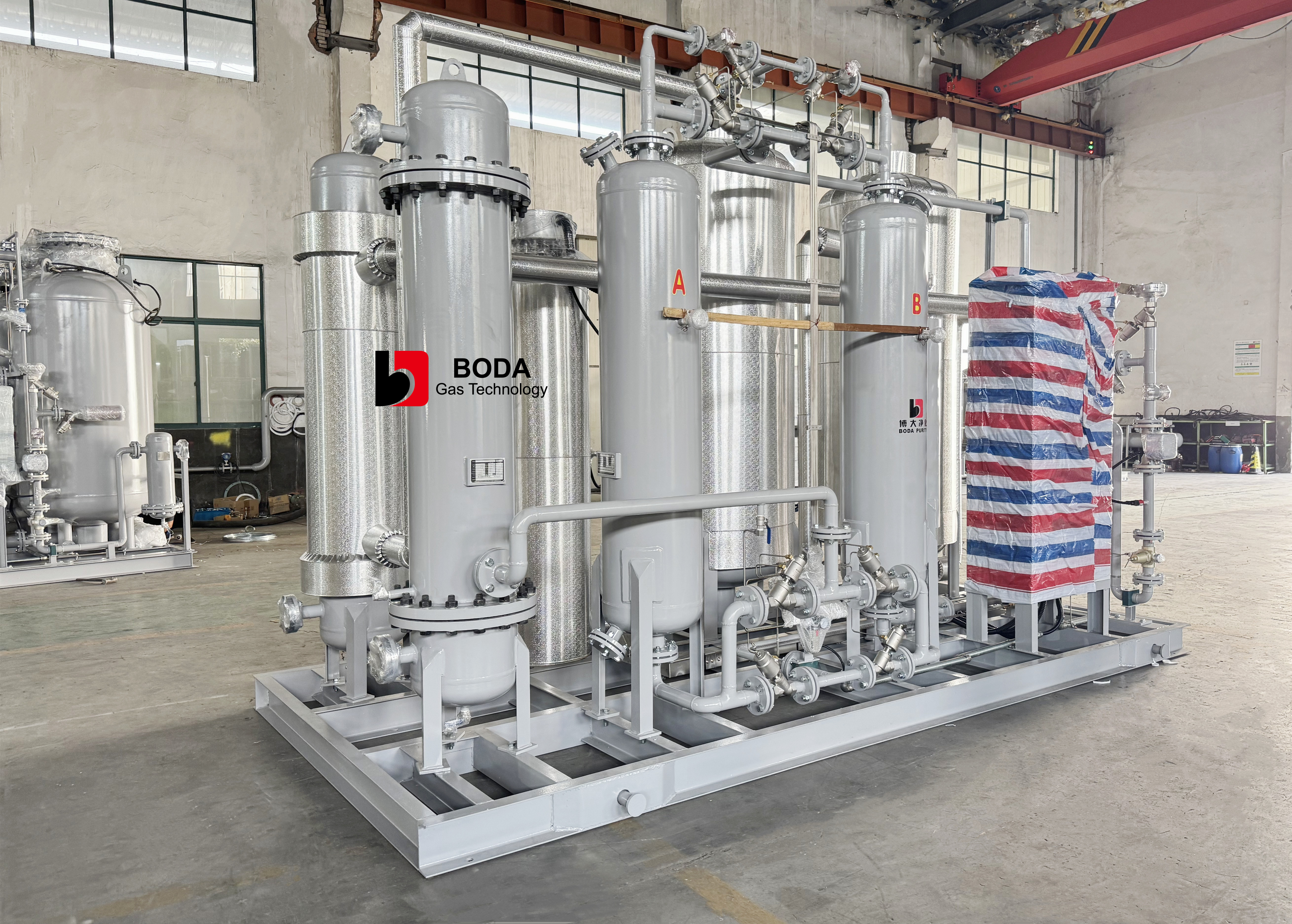
Cover image: carbon-loaded purification nitrogen generator - the purification stage that lifts PSA nitrogen from percentage purity into ppm-level purity.
A carbon-loaded PSA nitrogen generator is a pressure swing adsorption system with a downstream carbon-loaded purification stage that removes the residual oxygen and carbon dioxide left behind by the carbon molecular sieve beds. Where a standard PSA nitrogen generator is normally specified inside the 95% to 99.999% band, a carbon-loaded purification system is specified as a contaminant-controlled gas stream: purity of at least 99.9995%, oxygen content no more than 5 ppm, carbon dioxide content no more than 1 ppm, and a nitrogen dew point of -60 degrees C or lower.
Those four numbers are what this guide is about. When you are writing a specification, a purchase requisition or a supplier comparison for an ultra-high-purity nitrogen supply, the differences between vendors almost never appear in the purity percentage. They appear in the ppm-level limits, the dew point line, the hydrogen constraint, and the way the purification stage is serviced over its working life.
The equipment referenced throughout this guide is manufactured by Hangzhou Boda Purity Equipment Co., Ltd., which operates under the brand BODA GAS (www.boda-gas.com). Established in 2002 and headquartered in Hangzhou, Zhejiang Province, China, the company develops and manufactures PSA nitrogen generators, PSA oxygen generators and compressed air purification equipment. Its BCP Series is the carbon-loaded purification nitrogen generator line built for hydrogen-free, ultra-high-purity duty.
- Nitrogen output: 1 to 500 Nm3/h
- Nitrogen purity: at least 99.9995%
- Oxygen content: no more than 5 ppm
- Carbon dioxide content: no more than 1 ppm
- Nitrogen dew point: no more than -60 degrees C
- Purification route: carbon-loaded, hydrogen-free
- Deaerator structure: double tower, allowing the carbon-loaded catalyst to be added or replaced without stopping the machine
Problem Definition: Why 99.9995% Purity Changes the Specification
Bulk nitrogen separation and ppm-level nitrogen purification are two different engineering problems. Buyers who treat them as one normally end up with a specification that cannot be quoted, tested or compared accurately.
Carbon molecular sieve PSA technology is already capable of producing nitrogen with a purity rating of up to 99.999% using carbon molecular sieves. The oxygen and carbon dioxide that remain, however, sit in the parts-per-million range, and pushing them lower requires a dedicated purification stage rather than a larger adsorption tower. Closing that gap is the specific job of the carbon-loaded purification stage.
Three ways a purity specification fails
- Only the percentage is written. The phrase "99.9995% nitrogen" says nothing about oxygen and carbon dioxide individually. A specification that names the contaminants separately - O2 no more than 5 ppm and CO2 no more than 1 ppm - is measurable; a percentage on its own is not.
- The dew point line is left to the air dryer. For ultra-high-purity duty the moisture limit belongs in the nitrogen specification itself, not only in the compressed-air specification. For the BCP Series, that figure is a nitrogen dew point of -60 degrees C or lower.
- The hydrogen constraint is overlooked. Hydrogenation purification is an established route to ultra-high purity, but it introduces hydrogen into the gas path. The BCP Series purification stage does not contain H2, which makes it suitable for applications with strict requirements for hydrogen and oxygen.
The service-continuity problem
A purification stage is, by definition, a consumable stage. Whatever the chemistry involved, the purification medium will eventually need attention. In many conventional layouts that attention translates into a production stop - frequently a larger commercial problem than the original purity gap. The BCP Series addresses this at the mechanical level: the deaerator adopts a double-tower structure that allows the carbon-loaded catalyst to be added or replaced without stopping the machine.
That single design decision changes how a maintenance plan is written. Instead of scheduling catalyst replacement around a plant shutdown, the purification stage can be serviced in parallel with production, which is usually the deciding factor for continuous-process users such as wafer fabs, battery electrode lines and sintering furnaces.
Industry Background: Where ppm-Level Nitrogen Demand Comes From
The commercial context for ppm-level nitrogen specification is straightforward and increasingly well documented.
- Market growth. The global industrial nitrogen generator market was valued at USD 4.29 billion in 2023 and is projected to reach USD 6.47 billion by 2031, according to Verified Market Research.
- Technology share. Pressure Swing Adsorption technology accounts for approximately 48% of the global nitrogen generator market share and is the dominant technology segment, based on Fortune Business Insights data.
- Purity and technology choice. PSA systems are favoured over membrane systems for high-purity requirements above 99.9%, because membrane purity is typically capped at lower levels - a position stated in Atlas Copco published comparison material.
- Where installations sit. PSA nitrogen generator installations divide by capacity roughly as sub-100 Nm3/h at 42%, 100 to 500 Nm3/h at 36%, and above 500 Nm3/h at 22%, based on Precedence Research and Dataintelo figures.
That capacity distribution is directly relevant to specification. The BCP Series output range of 1 to 500 Nm3/h covers both of the two largest of those installation bands, which means most capacity sizes in the field can be served by the same carbon-loaded purification architecture rather than by a bespoke design.
Regulatory context matters too. In the European Union, all pressure vessels in PSA nitrogen generators must comply with the Pressure Equipment Directive (PED 2014/68/EU) and bear the CE mark. For nitrogen used in food applications, EIGA - the European Industrial Gases Association - requires at least one continuously online residual oxygen analyzer in the nitrogen gas stream. Even where a project is not food-grade, that requirement carries a useful engineering lesson: ppm-level purity is only credible when it is continuously measured, not assumed.
Finally, on-site generation changes the commercial comparison. Third-party analysis of on-site nitrogen generation cites reductions in nitrogen supply cost of up to 40% compared with traditional cylinder deliveries, achieved mainly by eliminating logistics fees.
Detailed Solution: The BCP Series Carbon-Loaded Purification System
The BCP Series is the carbon-loaded purification nitrogen generator from BODA GAS. It takes pre-treated compressed air, separates bulk nitrogen through carbon molecular sieve adsorption, and then brings the gas to ultra-high purity in a dedicated purification stage.
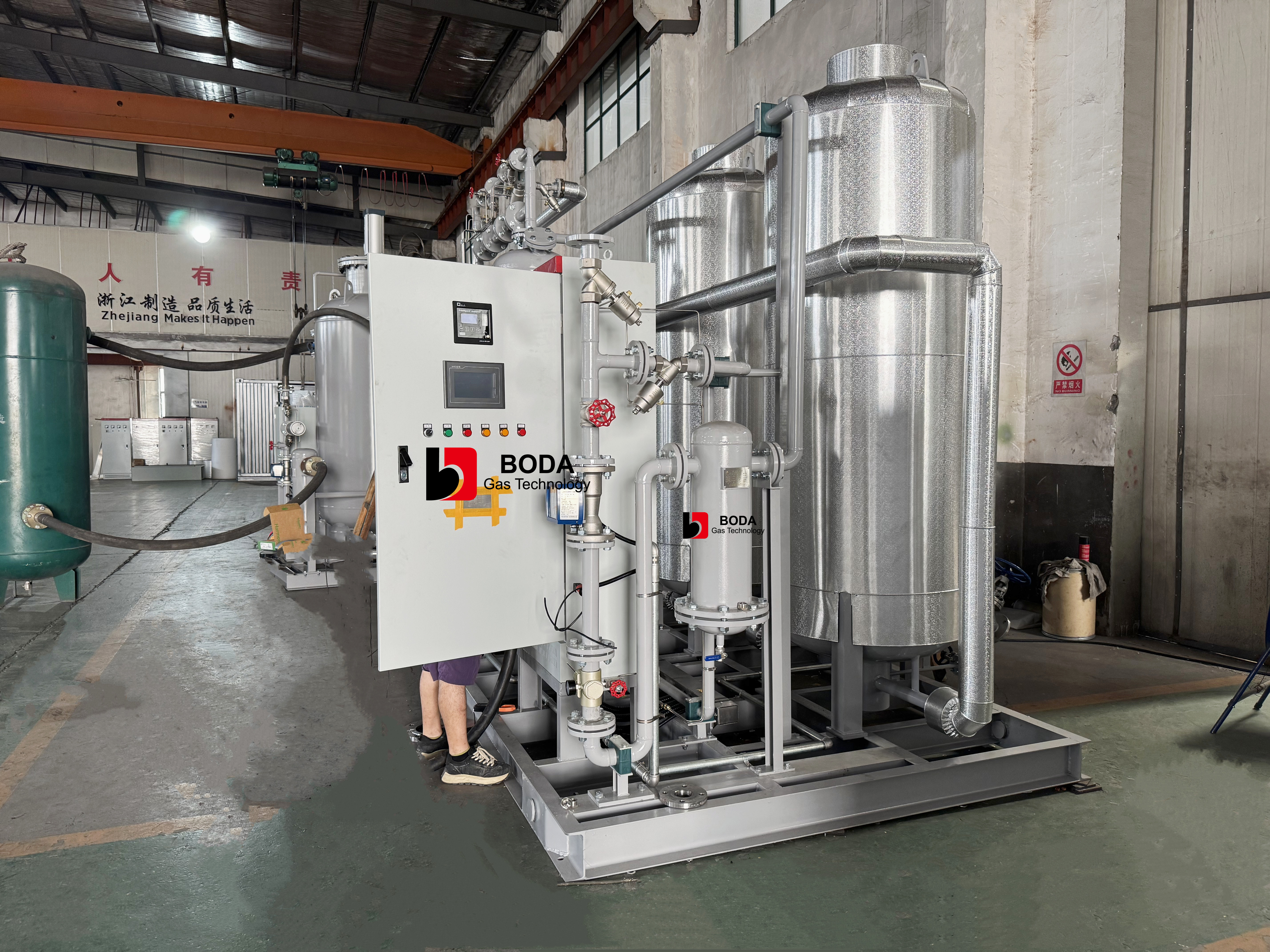
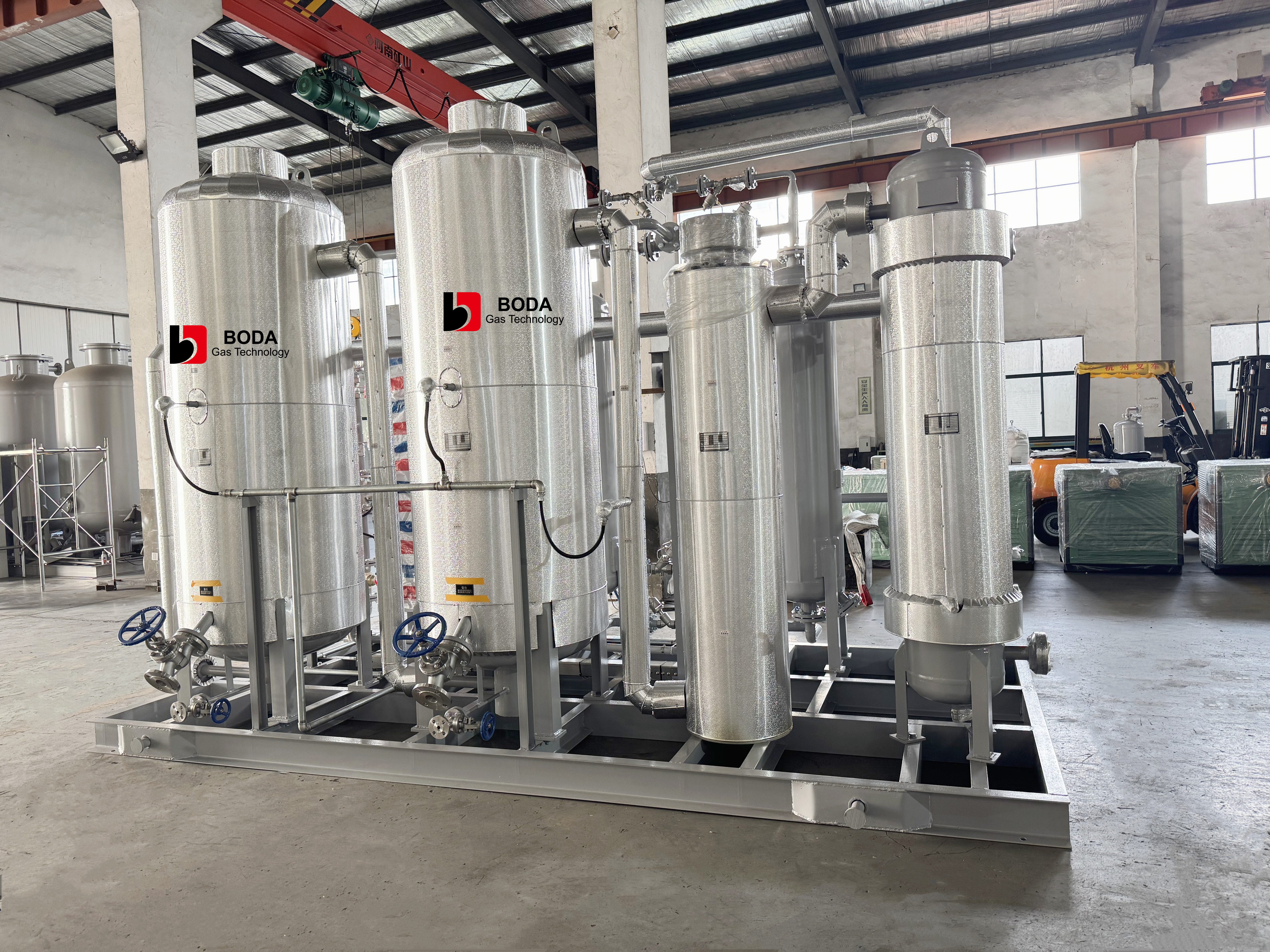
BCP-500H carbon-loaded purification nitrogen generator, 99.999% class output.
| Specification item | BCP Series value |
|---|---|
| Nitrogen output | 1 to 500 Nm3/h |
| Nitrogen purity | At least 99.9995% |
| Oxygen content | No more than 5 ppm |
| Carbon dioxide content | No more than 1 ppm |
| Nitrogen dew point | No more than -60 degrees C |
| Purification route | Carbon-loaded purification, hydrogen-free |
| Deaerator structure | Double tower; carbon-loaded catalyst can be added or replaced without stopping the machine |
| Materials | Carbon steel or SS304 |
| Customization options | Stainless steel, ATEX, ASME, CE |
| Typical applications | Lithium-ion battery electrode drying, electrolyte blanketing and cell-sealing shielding gas; photovoltaic cell sintering, silicon wafer processing and thin-film deposition process gas; semiconductor wafer purging, SMT soldering and electronic component anti-oxidation gas |
Design features that belong in a specification document
- Hydrogen-free purification. Because the purification stage does not contain H2, the system is suitable for applications with strict requirements for hydrogen and for oxygen.
- Energy-efficient purification process. The purification technology is designed to greatly reduce the energy consumption of system operation, which matters because the purification stage runs continuously rather than in batches.
- Double-tower deaerator. The deaerator adopts a double-tower structure, which is what allows catalyst addition or replacement without stopping the machine.
- Automatic venting device. An automatic venting device with national patented technology ensures the quality of the finished gas, so off-specification gas is not carried into the process line.
- Component sourcing. The use of famous brands for the key components of the system is described by the manufacturer as an effective guarantee of equipment quality.
- Diagnostics and control. The system provides multiple fault diagnosis, alarm and automatic processing functions, together with an optional DCS communication interface for plant-level integration.
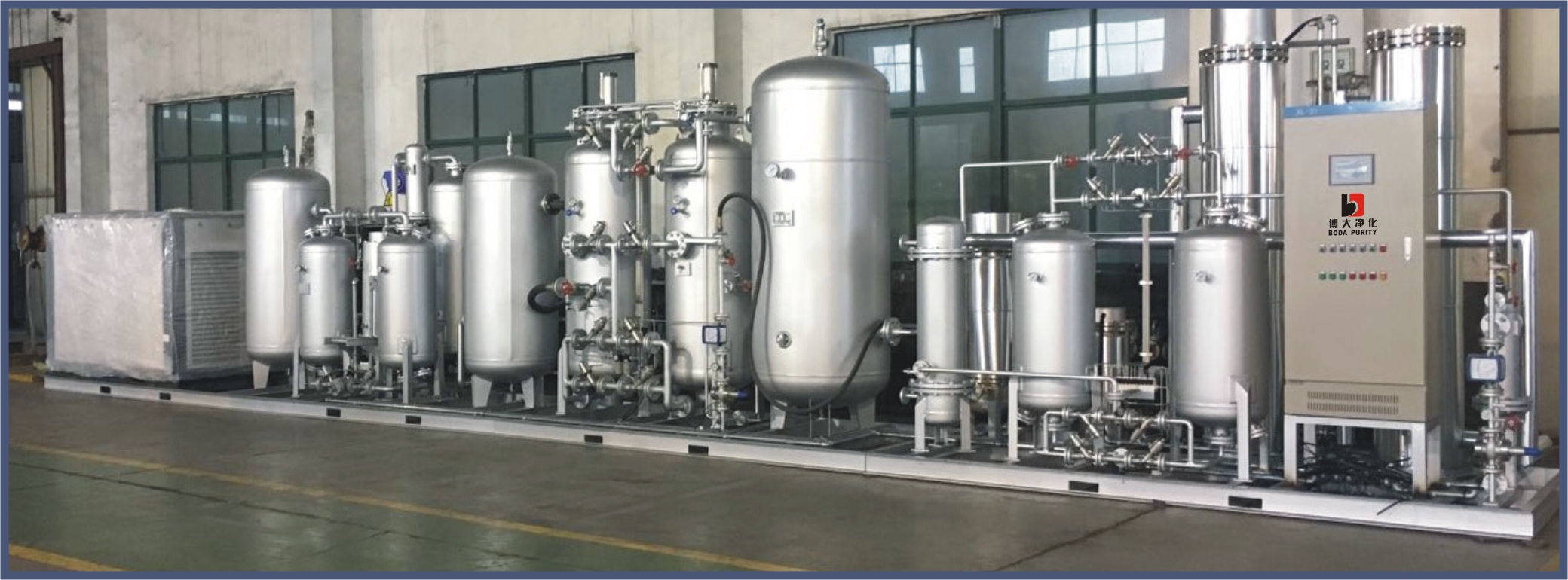
BCP-120 carbon-loaded nitrogen purifier-generator, 120 Nm3/h. The same purification architecture scales across the 1 to 500 Nm3/h range.
Step-by-Step Breakdown: How to Specify a 99.9995% Purity System
Step 1 - Write the purity line as contaminants, not as a headline number
State four things: purity at least 99.9995%, oxygen no more than 5 ppm, carbon dioxide no more than 1 ppm, and dew point no more than -60 degrees C. This is the only form in which a supplier can be held to a measurable commitment, and it is the form used in the BCP Series specification above.
Step 2 - Fix the flow requirement, then check the flow ceiling
The BCP Series covers 1 to 500 Nm3/h. If the required nitrogen flow sits inside that range, carbon-loaded purification is available at the required purity. If the requirement exceeds 500 Nm3/h at ultra-high purity, the specification should be re-scoped with the supplier, because the base PSA platform supports a wider flow range of 1 to 3000 Nm3/h at purities from 95% to 99.999% - a different purity class from the 99.9995% duty described here.
Step 3 - Protect the purification stage with an explicit pretreatment chain
Oil vapour is one of the most important failure forms of nitrogen generator and oxygen generator adsorbents, so the pretreatment chain is part of the purity specification, not an accessory. A defensible chain lists each stage and its performance figure:
- FYS Series high efficiency oil-water separator - gas-liquid separation efficiency above 98%, intercepting bulk liquid water and oil droplets as front-end protection for the downstream molecular sieve.
- FAL Series precision filter - pre-filtration that intercepts particulate contaminants, with pressure loss no more than 0.02 MPa.
- FLY Series high efficiency oil-remover - filtration precision of 0.1 micron and residual oil content below 0.01 mg/m3, protecting the molecular sieve from oil pollution.
- FLT Series activated carbon filter - filled with high-density column-shaped activated-carbon granules for large-capacity adsorption of oil vapour and VOC impurities, with outlet residual oil content below 0.003 mg/m3. The anti-powder-leakage baffle-plate design prevents carbon dust from entering downstream equipment.
Step 4 - Match the dryer to the dew point line
The dew point requirement decides the dryer class. The ADL Series heatless desiccant dryer delivers a qualified air dew point of -40 degrees C or -52 degrees C with regeneration air loss of no more than 12%. The ADH Series heated desiccant dryer reaches the same -40 degrees C or -52 degrees C band with a lower regeneration air loss of no more than 6%. Where the process line calls for a nitrogen dew point of -60 degrees C or lower, the FAG Series combined low dew point compressed air dryer is the aligned choice, with a qualified air dew point from -60 degrees C down to -70 degrees C and a regeneration air loss of 3% to 6%.
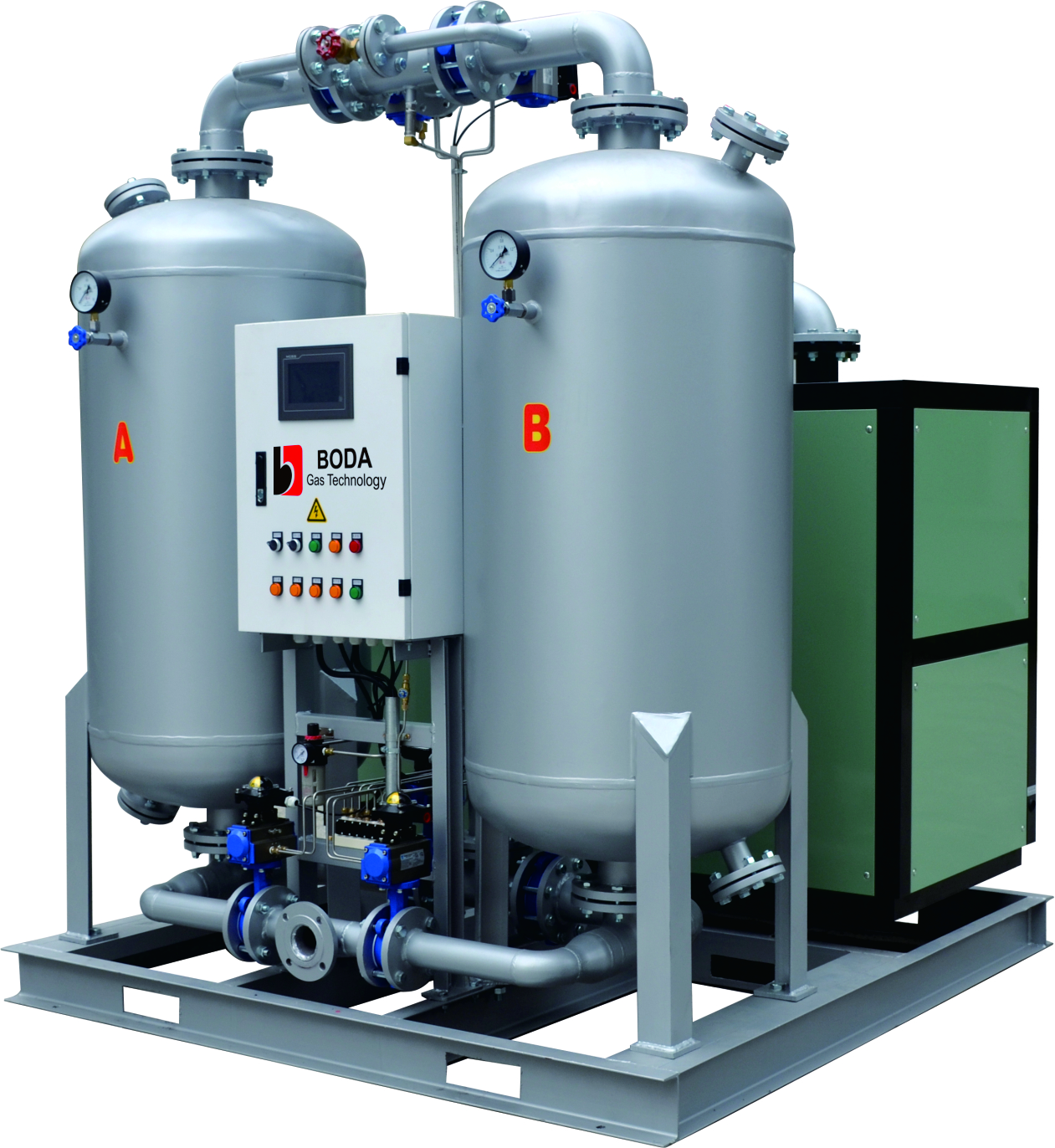
FAG Series combined low dew point compressed air dryer, rated to a -60 degrees C to -70 degrees C dew point for ultra-high-purity pretreatment.
Step 5 - Choose the purification route deliberately
Two purification routes reach the same headline purity: carbon-loaded purification (BCP Series) and hydrogenation purification (BHP Series). Both are specified at nitrogen purity of at least 99.9995%, dew point no more than -60 degrees C and oxygen content no more than 5 ppm. The decisive difference is hydrogen. The BHP-I model carries hydrogen content adjustable from 500 ppm to 5%, and the BHP-II model limits hydrogen content to no more than 5 ppm. The BCP Series contains no H2 at all.
Step 6 - Write the material, market and certification clauses
State the wetted-material class first: carbon steel or SS304, with stainless steel available as a customization option together with ATEX, ASME and CE configurations. Then add the management-system evidence. BODA GAS holds ISO 9001:2015 (GB/T 19001-2016) quality management system certification, certificate number 244-25-QL-11075-R0-S; ISO 14001:2015 (GB/T 24001-2016) environmental management system certification, certificate number 244-24-EJ-09517-R2-S; and ISO 45001:2018 (GB/T 45001-2020) occupational health and safety management system certification, certificate number 244-24-SY-09318-R2-S. All three are issued by YAB CERTIFICATION CO.,LTD. and apply globally. For EU installations, add the Pressure Equipment Directive clause: PED 2014/68/EU, CE mark on the pressure vessels.
Step 7 - Specify instrumentation and control
A purity claim needs a measurement. Specify the DCS communication interface as an option where the generator must report into a plant control system, and specify the fault diagnosis, alarm and automatic processing functions that handle deviations. If any part of the nitrogen stream reaches a food-grade use point, note the EIGA requirement for at least one continuously online residual oxygen analyzer in the gas stream.
Step 8 - Specify serviceability and factory validation
The final clause is the one buyers most often forget: how the purification medium is replaced. Write the double-tower deaerator into the specification, because it is the feature that allows the carbon-loaded catalyst to be added or replaced without stopping the machine. Then write the factory validation requirement: 100% testing covering visual inspection and function inspection, with all equipment passing qualification testing prior to factory release.
Use Cases: Four Process Families That Need 5 ppm Oxygen or Lower
The BCP Series application list is concentrated in four process families. In each of them the reason for ppm-level control is the same - oxygen and moisture degrade the product, not the equipment.
Semiconductor wafer purging
Wafer purging and electronic component anti-oxidation are specified as ultra-high-purity nitrogen duties in the electronics industry. The reference working condition for chip-and-wafer precision manufacturing is 99.999% to 99.9999% purity with a dew point of -60 degrees C or lower, and the air purification system must be an ultra-low dew point design. The BCP Series satisfies that band at a purity of at least 99.9995% with a dew point of -60 degrees C or lower.
SMT soldering and electronic component anti-oxidation
A typical SMT workshop operates at 99.99% purity. Where a line includes finer-pitch assembly, anti-oxidation shielding or high-reliability joints, contaminant limits tighten toward the BCP Series specification. Because the purification stage is hydrogen-free, the nitrogen atmosphere introduces no hydrogen into the soldering environment.
Photovoltaic cell sintering and silicon wafer processing
Photovoltaic cell sintering, silicon wafer processing and thin-film deposition all use the nitrogen stream as a process gas rather than as a blanket. Oxidation at the wafer or film interface is a yield issue, and yield loss is driven by the residual oxygen figure - which is why the specification should be written as O2 no more than 5 ppm rather than as a purity percentage.
Lithium-ion battery electrode drying, electrolyte blanketing and cell sealing
Battery electrode drying, electrolyte blanketing and cell-sealing shielding gas form one of the most hydrogen-sensitive groups of applications in the BCP Series scope. The purification stage contains no H2 and holds carbon dioxide to no more than 1 ppm, so the gas stream does not introduce either contaminant into the cell chemistry.
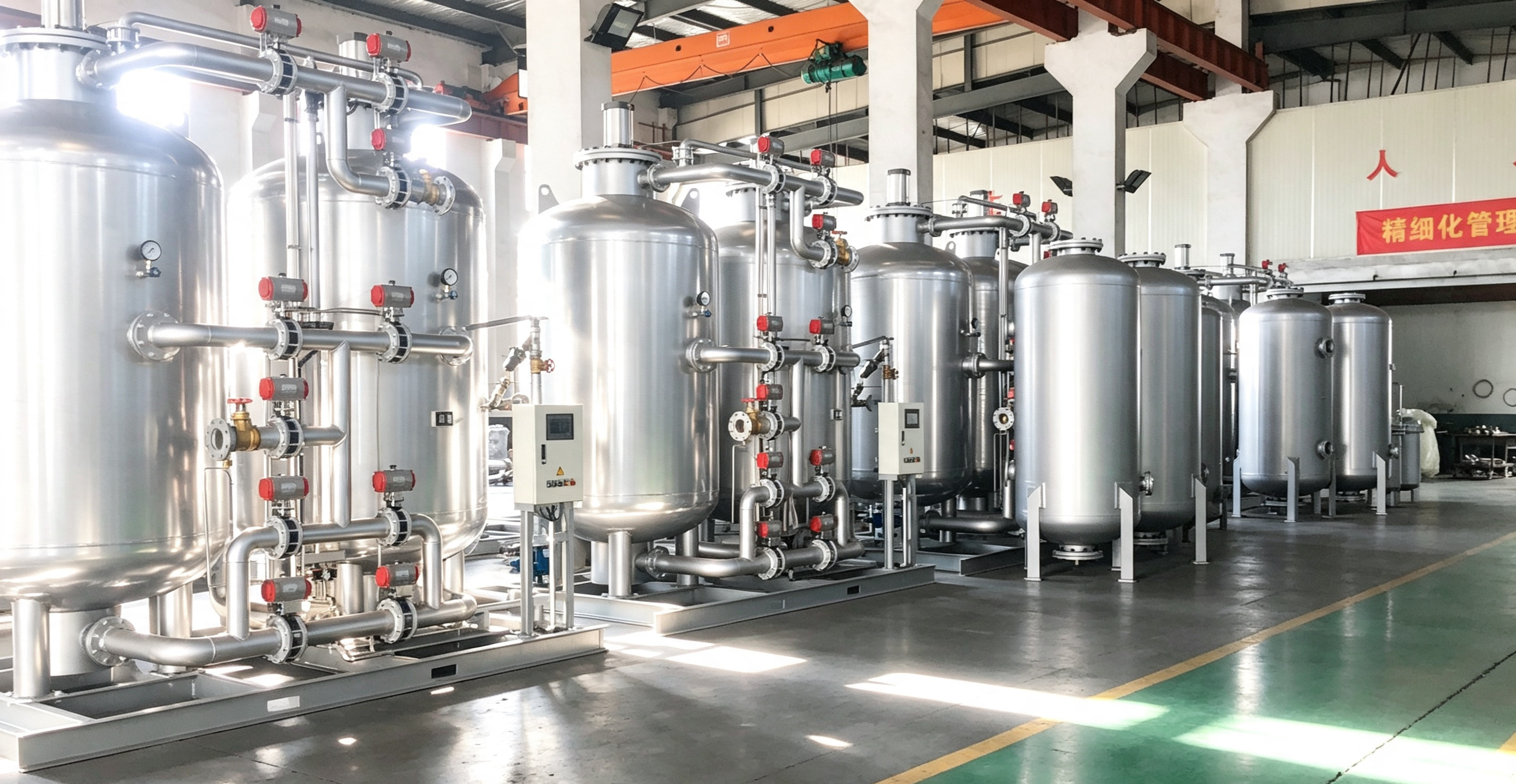
High-purity nitrogen purifier configuration used across semiconductor, battery and photovoltaic process gas duty.
Comparison Table: Base PSA vs Carbon-Loaded Purification vs Hydrogenation Purification
The following comparison uses only the published specifications of the three BODA GAS product lines. It is intended as a selection table, not as a ranking.
| Parameter | BXN Series - base PSA | BCP Series - carbon-loaded purification | BHP Series - hydrogenation purification |
|---|---|---|---|
| Purification stage | Carbon molecular sieve adsorption only | Carbon-loaded purification, hydrogen-free | Hydrogenation purification |
| Nitrogen output | 1 to 3000 Nm3/h | 1 to 500 Nm3/h | 10 to 2000 Nm3/h |
| Nitrogen purity | 95% to 99.999% | At least 99.9995% | At least 99.9995% |
| Oxygen content | Purity expressed as a percentage | No more than 5 ppm | No more than 5 ppm |
| Carbon dioxide content | Not a specified parameter | No more than 1 ppm | Not a specified parameter |
| Nitrogen dew point | -40 degrees C to -70 degrees C | No more than -60 degrees C | No more than -60 degrees C |
| Hydrogen in gas path | Not added | None - hydrogen-free | BHP-I: 500 ppm to 5% adjustable; BHP-II: no more than 5 ppm |
| Service continuity during purification medium change | Low-maintenance modular unit designed for unattended operation | Double-tower deaerator allows catalyst addition or replacement without stopping the machine | Centralised monitoring available; optional DCS communication interface |
| Typical application focus | Oil and gas, chemical, food and beverage packaging, pharmaceutical, electronics, laser and plasma cutting, tyre inflation | Battery electrode drying, electrolyte blanketing, cell sealing; photovoltaic sintering, silicon wafer, thin film; semiconductor wafer purging, SMT soldering, anti-oxidation | Bright annealing, brazing, powder-metallurgy sintering of stainless steel, titanium alloy and copper; optical-fiber preform sintering; rare-earth sintering, tungsten alloy smelting, magnetic materials |
FAQ: Specifying a Carbon-Loaded PSA Nitrogen Generator
Which certifications and directives apply to a carbon-loaded PSA nitrogen generator?
BODA GAS holds ISO 9001:2015 (GB/T 19001-2016) quality management system certification, certificate number 244-25-QL-11075-R0-S; ISO 14001:2015 (GB/T 24001-2016) environmental management system certification, certificate number 244-24-EJ-09517-R2-S; and ISO 45001:2018 (GB/T 45001-2020) occupational health and safety management system certification, certificate number 244-24-SY-09318-R2-S. All three are issued by YAB CERTIFICATION CO.,LTD. and apply globally. Equipment can also be customized for stainless steel, ATEX, ASME and CE requirements. Where a system is installed in the European Union, pressure vessels must comply with the Pressure Equipment Directive (PED 2014/68/EU) and bear the CE mark.
Can the carbon-loaded catalyst be replaced without shutting down nitrogen supply?
Yes. The BCP Series deaerator adopts a double-tower structure, which allows the carbon-loaded catalyst to be added or replaced without stopping the machine. The purification stage also uses an automatic venting device with national patented technology to protect finished-gas quality, and the system provides multiple fault diagnosis, alarm and automatic processing functions, plus an optional DCS communication interface for plant-level monitoring.
What drives the cost of a 99.9995% purity system?
The main cost drivers are nitrogen output between 1 and 500 Nm3/h, the depth of the compressed-air pretreatment chain, the required dew point, the choice between carbon steel and SS304 stainless steel, the market-compliance options selected (ATEX, ASME or CE), and instrumentation such as DCS communication. The operating comparison is equally relevant: third-party analysis of on-site nitrogen generation cites reductions in nitrogen supply cost of up to 40% compared with cylinder delivery, mainly by eliminating logistics fees. A configured quotation against a written specification is the only meaningful way to compare suppliers on cost.
How is purity validated before shipment?
Quality control is applied at 100% testing, covering both visual inspection and function inspection, and all equipment must pass qualification testing prior to factory release. Because the minimum order quantity is one unit, a single validation unit can be ordered and checked against your own oxygen, carbon dioxide and dew point limits before a full production commitment. On-site and remote installation guidance, operation-staff training and remote technical support are available, and BODA provides a guarantee for the equipment for 12 months.
What is the production lead time, and how do I start a specification review?
Production lead time is 25 to 45 days, with a monthly manufacturing capacity of 40 units, and OEM and ODM customization is supported for flow rate, purity, pressure, dew point, material, production standard, voltage, logo, nameplate and painting color. The fastest next step is to send your working condition to BODA GAS: nitrogen flow, purity and contaminant limits, discharge pressure, voltage and frequency, and the application. The technical team will calculate the air-to-nitrogen ratio, outlet flow, purity and power consumption against your site altitude and industry, and draw an exclusive layout and technical scheme. Contact Lemon Du at bodagas2002@gmail.com or on WhatsApp at +86 157-5515-0162 to request a quotation, discuss a sample validation unit, or download the product manual at the end of this article.
Conclusion: The Specification Checklist
A carbon-loaded PSA nitrogen generator is specified correctly when four numbers appear together - purity of at least 99.9995%, oxygen no more than 5 ppm, carbon dioxide no more than 1 ppm and dew point no more than -60 degrees C - and when three further items are written into the same document: the pretreatment chain that protects the molecular sieve from oil contamination, the dryer class that delivers the dew point line, and the double-tower deaerator that allows the carbon-loaded catalyst to be added or replaced without stopping the machine.
The BCP Series covers 1 to 500 Nm3/h of that duty with a hydrogen-free purification stage, optional DCS communication interface, and a documented certification base of ISO 9001, ISO 14001 and ISO 45001. A specification written this way is testable at the factory, serviceable in production, and comparable between suppliers on facts rather than on adjectives.
Next step: request a quotation, a sample discussion or the product manual
Send your nitrogen flow, purity and contaminant limits, dew point, discharge pressure, voltage and frequency, and application, and BODA GAS will return a configured technical scheme and quotation for a carbon-loaded purification nitrogen generator.
- Email: bodagas2002@gmail.com
- Tel / WhatsApp: +86 157-5515-0162
- Website: www.boda-gas.com | Blog: blog.boda-gas.com
- Product manual (PDF): Product Manual - BODA GAS TECH
- Contact: Lemon Du | Hangzhou Boda Purity Equipment Co., Ltd., NO.3, 6th Road, Lushan Industry Function Zone, Fuyang District, Hangzhou City, Zhejiang Province, China, 311407