Global Certifications for Nitrogen Generators: ASME, ATEX, and CE Explained
"Is your nitrogen generator certified?" is really three questions. ASME governs how the pressure vessels in the skid are designed, welded and inspected. ATEX governs whether the equipment may be installed in a potentially explosive atmosphere. CE marking indicates conformity with the EU directives that apply to the equipment, and for pressure vessels inside a PSA nitrogen generator the European Commission requires compliance with the Pressure Equipment Directive (PED 2014/68/EU) and the CE mark. For importers of industrial gas equipment, the useful question is narrower than "certified or not": which document, issued by which body, covers which component of the skid?
Problem definition: the compliance gap appears at import, not at quotation
Most nitrogen generator specifications are written around three numbers — flow, purity and outlet pressure. Compliance is treated as paperwork that can be attached later. On import projects, that assumption produces three recurring failures, and all three are cheap to avoid before fabrication and expensive to fix afterwards.
1. Pressure-vessel standard mismatch. A unit fabricated to one pressure-equipment tradition is shipped into a market that assesses vessels against a different one. In the EU, pressure vessels must comply with PED 2014/68/EU and bear the CE mark. A generator can run perfectly and still stall at import clearance or third-party acceptance because the vessel documentation does not match the market it is entering.
2. Area-classification mismatch. A standard enclosure is ordered for an installation that sits inside a hazardous-gas area. The special requirement recorded for petroleum industry duty is an explosion-proof PSA nitrogen generator for Zone 1 / Zone 2 working areas. That is a construction decision, not something a site electrician resolves after delivery. Chemical industry duty records explosion-proof construction together with ASME.
3. Material mismatch. Food and beverage packaging and pharmaceutical duty both record stainless steel as the special requirement. Material is one of the least reversible choices on the skid, because it propagates through the vessel scope, the piping and the documentation set that accompanies them.
Compliance scope on a nitrogen generator is therefore not one certificate. It is a short list of frameworks, each attached to a different part of the package, and each decided at a different point in the specification.
Industry background: why compliance questions grew with the equipment market
The commercial weight behind these questions is easy to see. Pressure Swing Adsorption accounts for approximately 48% of the global nitrogen generator market, making it the dominant technology segment, according to Fortune Business Insights. Verified Market Research values the global industrial nitrogen generator market at USD 4.29 billion in 2023, projected to reach USD 6.47 billion by 2031. Food and beverage held roughly 49.8% of revenue share in 2023, per Grand View Research, and the chemical segment is the fastest-growing application area, with industry analysis projecting a 6.0% CAGR driven by reactor blanketing and purging. Asia-Pacific is projected to hold a 35% share by 2032 according to Verified Market Research.
Two technical trends reinforce the same point. PSA systems are preferred over membrane systems where purity above 99.9% is required, as Atlas Copco notes, because membrane purity is typically capped at lower levels — which pushes more projects toward vessel-and-skid-based equipment. And installation data compiled by Precedence Research and Dataintelo shows the market is not only large plants: 42% of installations are sub-100 Nm³/h, 36% fall between 100 and 500 Nm³/h, and 22% are above 500 Nm³/h. Most buyers are specifying medium-sized packages, frequently as a skid or a container, into countries other than the one that built the equipment.
Where does the economic upside sit? On-site generation can reduce nitrogen supply costs by up to 40% compared with cylinder deliveries by removing logistics fees, according to U.S. Department of Energy data cited in industrial nitrogen generator market reporting. That saving is what funds the purchase case — and it is also why a compliance failure is so damaging to the payback, because a rejected or re-documented skid sits idle while the plant still buys cylinders. Key global players in the PSA nitrogen generator market include Linde plc, Air Liquide, Air Products, Atlas Copco and Parker Hannifin, per Fortune Business Insights; alongside them, project buyers routinely source from specialist manufacturers in China, which is why the certification conversation usually happens across a language and regulatory boundary.
Detailed solution: what each framework actually covers on a PSA nitrogen generator
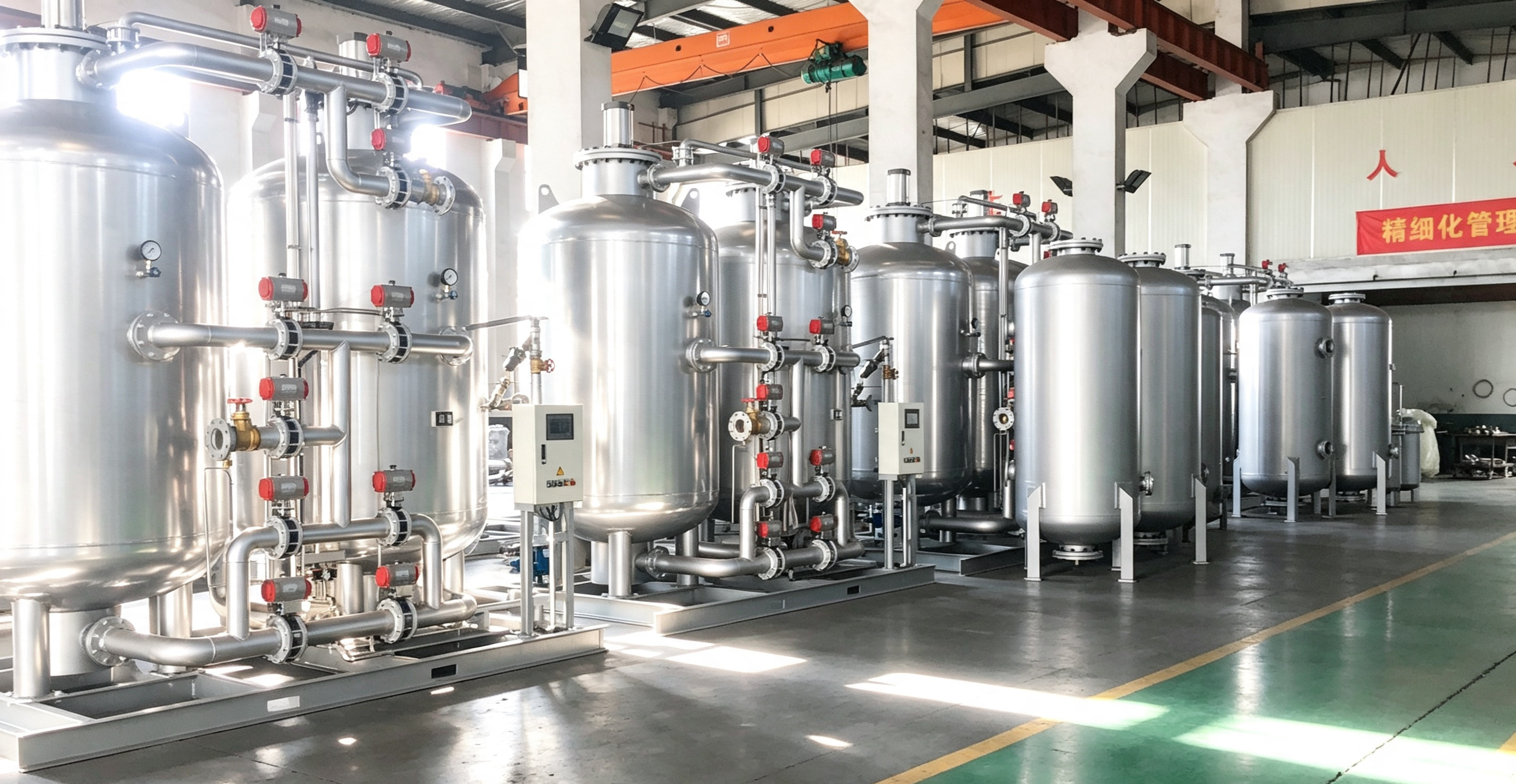
BODA GAS — Hangzhou Boda Purity Equipment Co., Ltd. — is a manufacturer established in 2002, based in Hangzhou, Zhejiang Province, China, specialising in the development and production of PSA nitrogen generators, PSA oxygen generators and compressed air purification equipment. Its nitrogen product line, the BXN Series, is offered as an Industrial PSA Nitrogen Generator, a Skid-Mounted PSA Nitrogen Generation Package, a Movable Containerized PSA Nitrogen Generator, an ASME standard nitrogen generator and a stainless steel nitrogen generator. Recorded parameters are a nitrogen flow rate of 1–3000 Nm³/h, purity of 95%–99.999%, outlet pressure of 0.1–1.15 MPa (adjustable) and dew point from −40 °C to −70 °C, with carbon steel or SS304 as the recorded material options.
The customization list is where compliance scope is actually set. It covers flow rate, purity, pressure, dew point, material, production standard, voltage, logo, nameplate and painting colour — and it explicitly includes carbon steel or stainless steel, ATEX, ASME, CE and ISO.
ASME
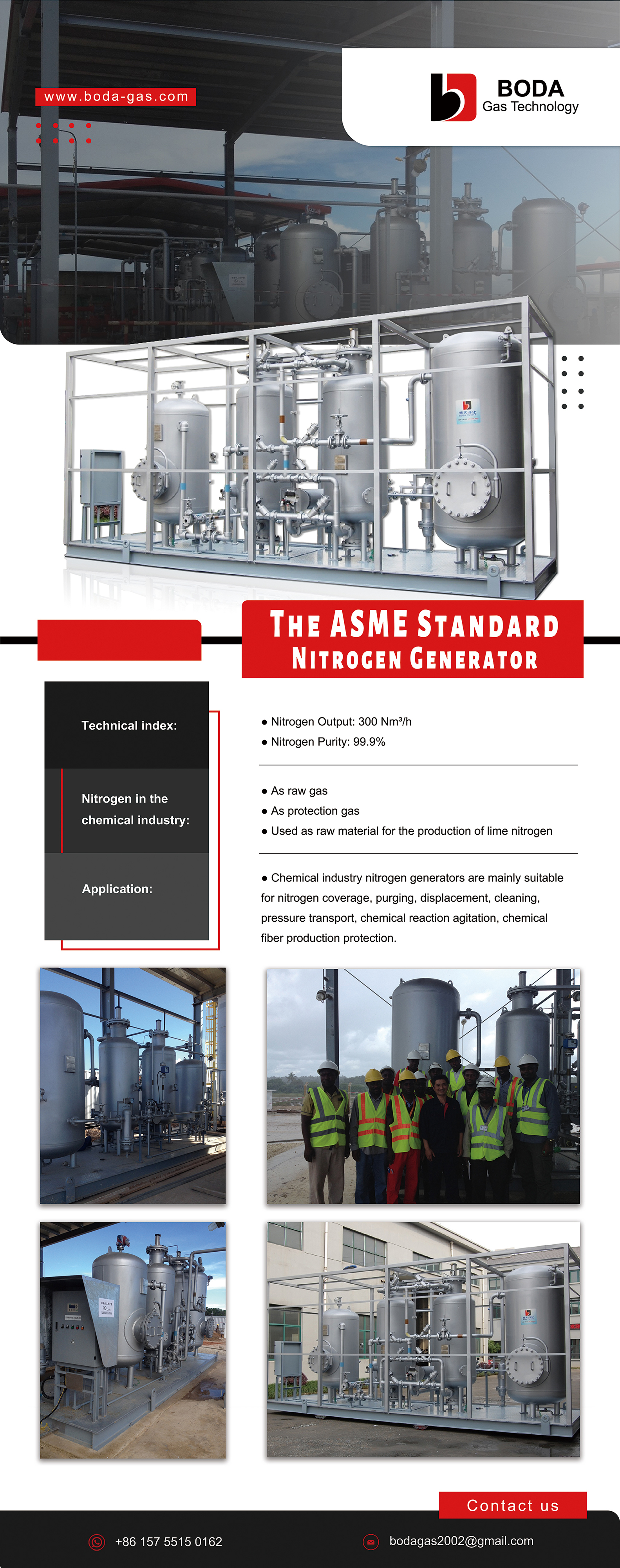
ASME refers to the pressure-equipment requirements published by the American Society of Mechanical Engineers. It is a vessel and fabrication standard: design calculation, material selection, welding, inspection and documentation of the pressure vessels themselves. On a PSA nitrogen generator, that means the adsorption towers and associated pressure vessels — not the analyser, the valves or the enclosure. Buyers meet ASME scope on North-American projects and on projects elsewhere that specify American pressure-equipment practice. BODA GAS lists "ASME standard nitrogen generator" as a product form of the BXN Series and includes ASME in the customization list, so the vessel scope can be specified to that route rather than retrofitted. Recorded installations include a Tanzania distributor in the fine chemical industry (2 units, 10 years of operation), a Malaysia trading intermediary in the chemical industry (2 units, 8 years, ASME standard with low dew point), an Indonesia distributor in the chemical industry (2 units, 7 years, ASME standard with stainless steel pipeline) and a Saudi Arabia distributor in up-stream onshore and off-shore oil and gas (4 units).
ATEX
ATEX is the European framework for equipment and protective systems intended for use in potentially explosive atmospheres. For a nitrogen generator the practical question is whether the unit will stand where a flammable gas atmosphere can occur, and how the electrical and instrumentation scope is built for that. The recorded special requirement for petroleum industry duty is an explosion-proof PSA nitrogen generator for Zone 1 / Zone 2 hazardous-gas working area; chemical industry duty records explosion-proof construction as well. ATEX appears in the BXN Series customization list, which means the hazardous-area configuration is a specification line rather than an accessory, and it is normally agreed together with the material and the pressure-vessel standard so that the documentation matches the installation.
CE marking and the Pressure Equipment Directive
CE marking is the conformity mark for products placed on the EU market, and it refers to the directives that apply to the specific equipment. For the vessels inside a PSA nitrogen generator, the European Commission states that they must comply with the Pressure Equipment Directive (PED 2014/68/EU) and bear the CE mark. In practice that means the vessel scope, its material, its design review and its documentation are assessed against the directive, so the CE element is confirmed before fabrication rather than attached to a finished skid. CE is listed among the BXN Series customization options.
ISO management-system certificates: what they prove and what they do not
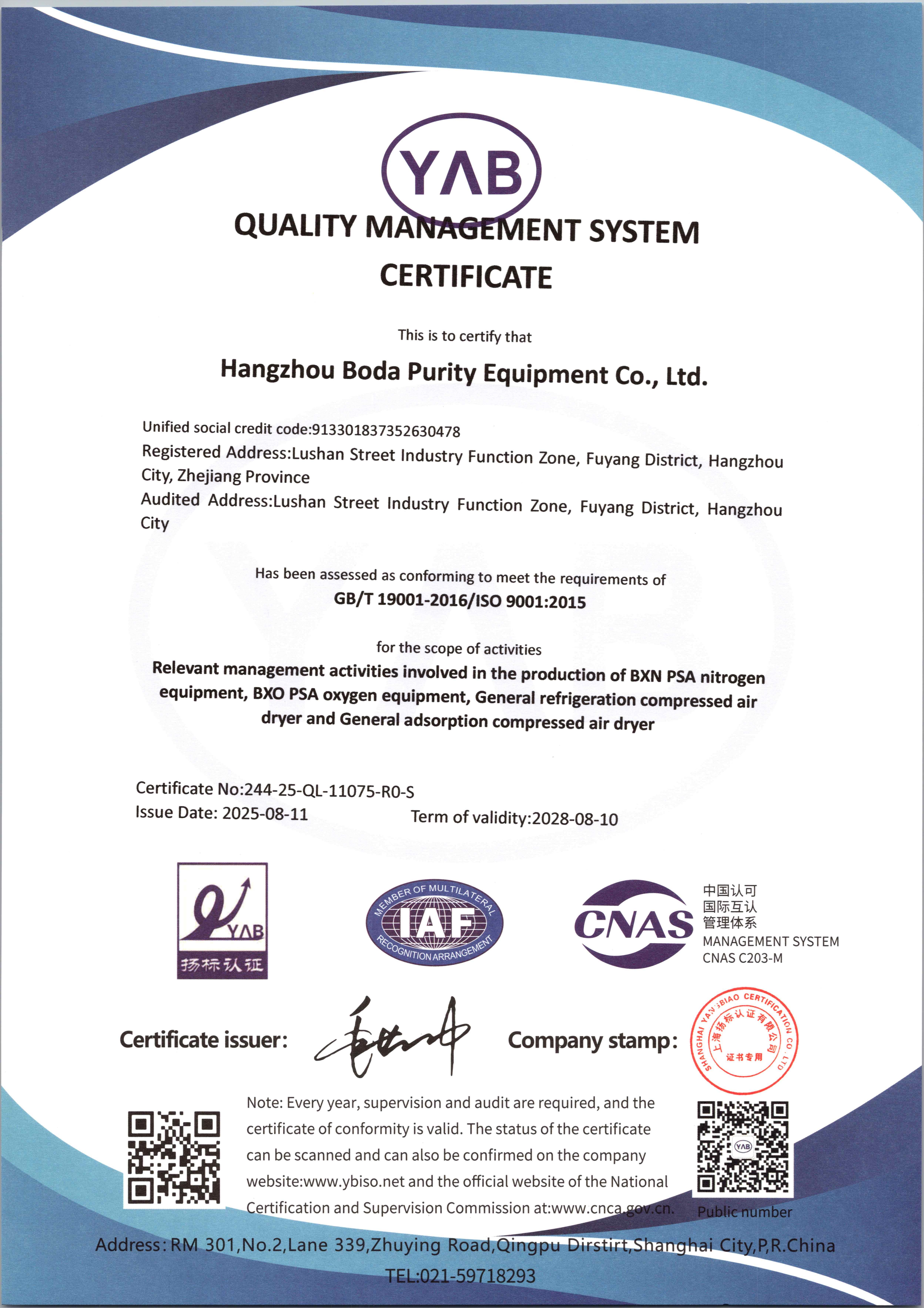
ISO certificates are not product certificates. They describe the organisation that builds the equipment, which is why they appear in supplier qualification rather than in equipment acceptance. Hangzhou Boda Purity Equipment Co., Ltd. holds:
- ISO 9001:2015 (GB/T 19001-2016) quality management system, certificate no. 244-25-QL-11075-R0-S, issued 11 August 2025, valid to 10 August 2028;
- ISO 14001:2015 (GB/T 24001-2016) environment management system, certificate no. 244-24-EJ-09517-R2-S, issued 15 July 2024, valid to 4 November 2027;
- ISO 45001:2018 (GB/T 45001-2020) occupational health and safety management system, certificate no. 244-24-SY-09318-R2-S, issued 15 July 2024, valid to 4 November 2027.
All three are issued by YAB Certification Co., Ltd. and are described as globally applicable. Their stated scope covers the relevant management activities involved in producing BXN PSA nitrogen equipment, BXO PSA oxygen equipment, general refrigeration compressed air dryers and general adsorption compressed air dryers. The company also reports ISO 13485 medical device quality management system certification.
Which framework applies where
| Framework | What it governs | Where it is normally demanded | BODA GAS reference point |
|---|---|---|---|
| ASME | Design, fabrication, inspection and documentation of the pressure vessels (adsorption towers and associated vessels) | North-American projects and projects specifying American pressure-equipment practice | "ASME standard nitrogen generator" is a listed BXN Series product form; ASME is in the BXN Series customization list; ASME standard units recorded for Tanzania, Malaysia, Indonesia and Saudi Arabia |
| ATEX | Equipment intended for use in potentially explosive atmospheres | EU/EEA and hazardous-area installations elsewhere | ATEX is in the BXN Series customization list; recorded special requirement for petroleum duty is an explosion-proof unit for Zone 1 / Zone 2; chemical duty records explosion-proof construction |
| CE / PED 2014/68/EU | Conformity with the applicable EU directives; for pressure vessels specifically, the Pressure Equipment Directive | Equipment placed on the EU market | CE is in the BXN Series customization list; the vessel scope is specified accordingly before fabrication |
| ISO 9001 / 14001 / 45001 | The manufacturing organisation's management systems, not the product | Global; used in supplier qualification and audits | Certificate nos. 244-25-QL-11075-R0-S, 244-24-EJ-09517-R2-S and 244-24-SY-09318-R2-S, issued by YAB Certification Co., Ltd. |
Carbon steel or SS304: what changes at specification
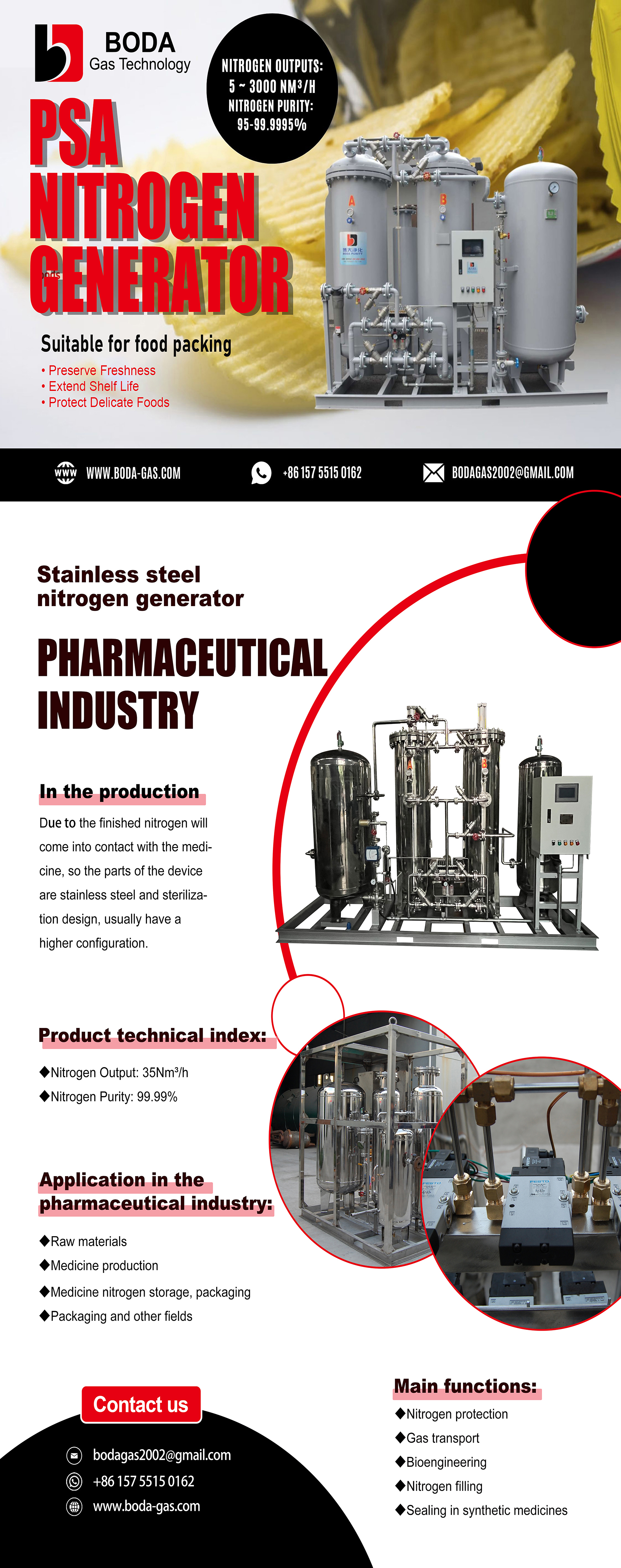
Material sits at the intersection of compliance and process fit. The BXN Series records "Carbon steel / SS304" as its material field, so both constructions are standard options for the range rather than special builds, and the choice is confirmed through the customization list before production is released.
| Decision point | Carbon steel construction | SS304 construction |
|---|---|---|
| Position in the BXN Series material field | Listed: "Carbon steel / SS304" | Listed: "Carbon steel / SS304" |
| Named in recorded application requirements | Not separately named in the recorded requirements for oil and gas, chemical, electronics, laser and plasma cutting or tyre inflation duty | Named for food and beverage packaging duty ("stainless steel") and pharmaceutical duty ("stainless steel"); the FLC Series sterilizing filter is supplied in SS304 |
| How the decision is locked | Through the customization line "Material", together with production standard and dew point, at the technical-scheme stage | |
Because the material line is confirmed before fabrication, the material question belongs in the same conversation as the pressure-vessel standard and the area classification. A specification that fixes purity and flow but leaves material open will usually be reopened later, when the end user's cleanliness requirement or the site's atmosphere is reviewed.
What a certificate does not tell you about quality
Two skids can carry the same vessel standard and still differ in service life. Recorded quality-judgement criteria for nitrogen generator equipment are the long-term stable compliance of nitrogen purity, flow capacity and outlet pressure, spraying coating thickness, and brand selection for machine components. On components, industrial pneumatic switching valves are rated for millions of switching cycles, and pressure vessels are assessed on leak-free welding and on whether the skid layout is practical for transport and field commissioning. On adsorbent, the recorded distinction is between a domestic high-density industrial-grade carbon molecular sieve with a service life of 5–7 years, and an imported anti-pulverization carbon molecular sieve with special layered filling craft that holds stable nitrogen purity across 8–10 years of non-stop running.
Step-by-step: specifying a compliant nitrogen generator package
The sequence below is the order in which the decisions above become binding. Changing an earlier step later is what creates re-engineering.
Step 1 — Fix the process requirement. Record flow rate, purity, outlet pressure and dew point first. The BXN Series covers 1–3000 Nm³/h, 95%–99.999% purity, 0.1–1.15 MPa adjustable pressure and −40 °C to −70 °C dew point. Recorded purity bands give a starting frame: 95%–98% for fire protection, marine tank blanketing, oil-field pipeline purging and general tyre inflation; 99%–99.9% for food and beverage modified atmosphere packaging, winemaking and conventional plastic moulding; 99.95%–99.99% for mild-steel laser cutting, electronics manufacturing, cable production and pharmaceutical tank blanketing; 99.999% and above for special-metal cutting such as titanium alloy, high-end electronics and laboratory work.
Step 2 — Classify the installation area. If the skid will stand in a hazardous-gas area, specify explosion-proof construction for Zone 1 / Zone 2 up front and tie it to the ATEX route, as recorded for petroleum duty. Chemical duty pairs explosion-proof construction with ASME.
Step 3 — Match the pressure-vessel standard to the import market. EU-bound pressure vessels follow PED 2014/68/EU and carry the CE mark; North-American and project-specified scopes follow the ASME route. This is a vessel-scope decision that must exist before fabrication drawings are released.
Step 4 — Choose carbon steel or SS304. Recorded requirements name stainless steel for food and beverage packaging and pharmaceutical applications, and the FLC Series sterilizing filter is supplied in SS304. Petroleum, chemical, electronics and laser/plasma cutting requirements in the same dataset name explosion-proofing, ASME or dew-point and purity performance instead. Where a site's atmosphere or cleanliness requirement is unclear, it should be resolved with the engineering review rather than defaulted.
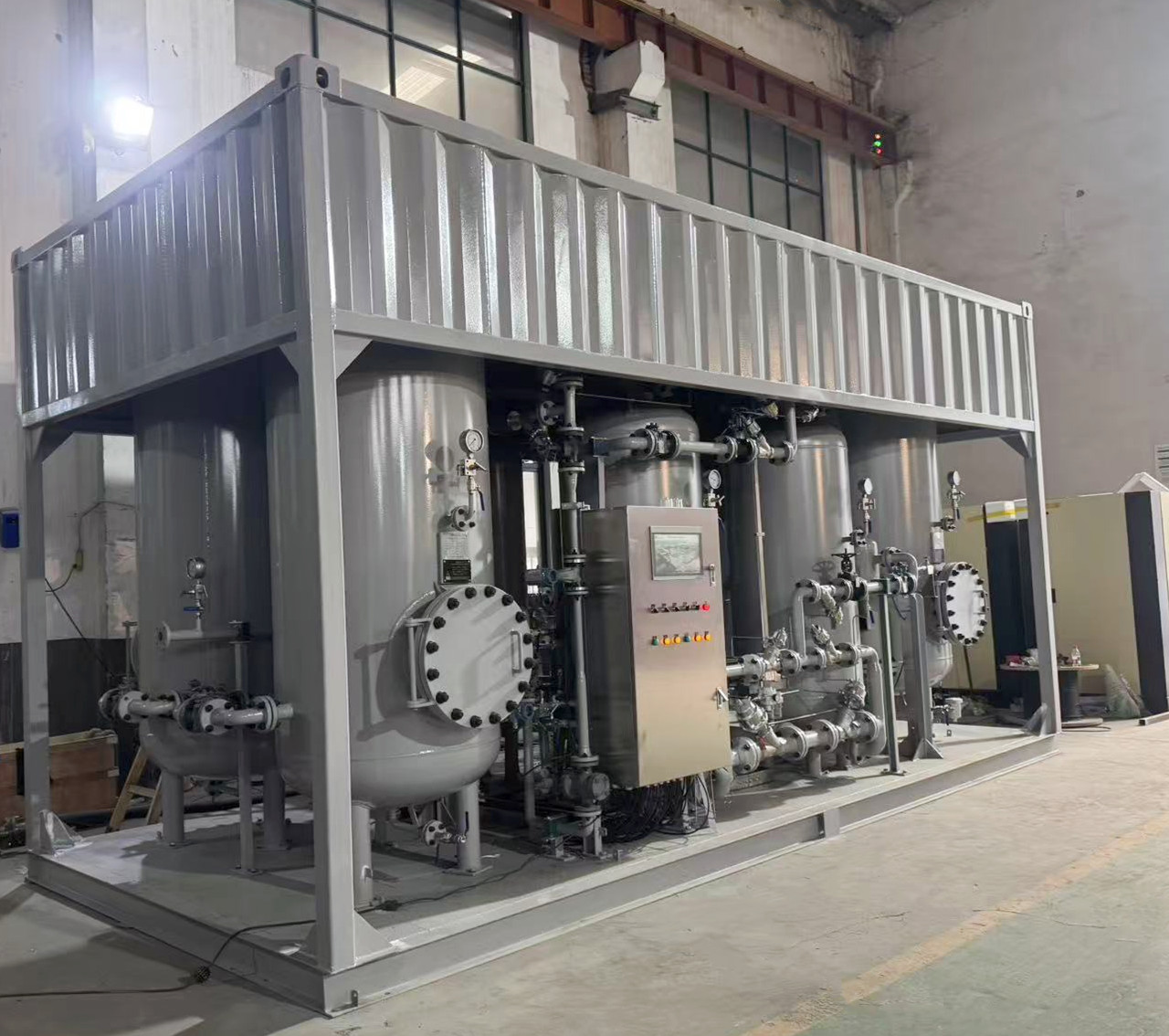
Step 5 — Define the package form and the documentation set. The BXN Series is available as an Industrial PSA Nitrogen Generator, a Skid-Mounted PSA Nitrogen Generation Package, a Movable Containerized PSA Nitrogen Generator, an ASME standard nitrogen generator or a stainless steel nitrogen generator. The configuration determines which documents travel with the unit, so the form and the standard are chosen together.
Step 6 — Confirm testing, terms and lead time. Recorded quality control is 100% test (visual inspection and function inspection) before factory release, with pre-shipment test as the acceptance criterion. Recorded commercial terms are MOQ 1 unit, delivery terms EXW/FOB/CIF/CFR, payment 30% T/T deposit in advance and 70% T/T before dispatch. Recorded lead time is 25–45 days, with monthly capacity of 40 units and annual output of 480 units.
Step 7 — Plan handover and the maintenance cycle. Skid-mounted units are designed for minimal installation: set the unit down, connect the power cable and start. On-site and remote installation guidance, operation-staff training and remote technical support are provided, and the equipment carries a 12-month guarantee. For a low maintenance PSA nitrogen generator, the recorded service intervals are precision filter elements at around 8,000 running hours, air compressor service at 3,000–4,000 running hours, and air dryer desiccant at 16,000–24,000 hours. A standard system also includes an oxygen analyser or purity sensor that continuously monitors gas purity and automatically vents out-of-specification gas — a point that matters for food-grade nitrogen, where EIGA standards require at least one continuously online residual oxygen analyser in the nitrogen gas stream.
Use cases: certification scope decided by the application
The clearest way to see how these decisions bind is to look at where they were taken. The following are recorded BODA GAS installations, each with the project characteristic that drove the specification.
- Tanzania — fine chemical industry, distributor, 2 units, 10 years in operation, ASME standard. A long-running chemical duty where the vessel standard was fixed before delivery.
- Malaysia — chemical industry, trading intermediary, 2 units, 8 years, ASME standard with low dew point. Vessel standard and dew point specified together.
- Indonesia — chemical industry, distributor, 2 units, 7 years, ASME standard with stainless steel pipeline. Shows vessel standard and material resolved as one scope.
- Saudi Arabia — oil and gas applications, up-stream onshore and off-shore, distributor, 4 units, ASME standard. A hazardous-area environment where explosion-proof construction is the recorded special requirement for petroleum duty.
- Mexico — food-processing industry, industrial end user, 2 units, 4 years, food-grade nitrogen. The application that points to stainless steel and to continuous purity monitoring.
- Uzbekistan — cable manufacturing, industrial end user, 3 units, BXN-375H at 99.999% purity with fully automatic unattended PLC operation. High purity specified as the governing requirement.
FAQ
Which certificates can a PSA nitrogen generator be supplied with, and which ones apply to my market?
The BXN Series PSA nitrogen generator is offered with a customization list that includes carbon steel or stainless steel material, and ATEX, ASME, CE and ISO options. Which framework applies depends on the installation and the import market. For pressure vessels placed on the EU market, the European Commission requires compliance with the Pressure Equipment Directive (PED 2014/68/EU) and the CE mark. ASME pressure-equipment requirements apply where the project specifies American vessel practice. ATEX applies where the unit stands in a potentially explosive atmosphere, such as the Zone 1 / Zone 2 areas recorded for petroleum duty. Separately, Hangzhou Boda Purity Equipment Co., Ltd. holds ISO 9001:2015 certificate no. 244-25-QL-11075-R0-S, ISO 14001:2015 certificate no. 244-24-EJ-09517-R2-S and ISO 45001:2018 certificate no. 244-24-SY-09318-R2-S, issued by YAB Certification Co., Ltd.
Can a Chinese OEM industrial PSA nitrogen generator manufacturer customise a unit to ASME, ATEX and stainless steel requirements?
Yes. BODA GAS (Hangzhou Boda Purity Equipment Co., Ltd.), established in 2002 in Hangzhou, Zhejiang Province, provides OEM and ODM production services. OEM services allow a client to produce equipment under its own brand; ODM services allow a client to customise products according to its own specifications. Customization covers flow rate, purity, pressure, dew point, material, production standard, voltage, logo, nameplate and painting colour — which is where ASME, ATEX, CE, ISO and carbon steel or SS304 are selected. The range covers 1–3000 Nm³/h flow and 95%–99.999% purity, the company operates a production base of more than 30,000 m² with a 15-engineer R&D team, monthly capacity of 40 units and an annual output of 480 units, and reports a 30% export ratio.
Do certification and material choices change the commercial terms?
The recorded commercial terms are MOQ 1 unit, delivery terms EXW/FOB/CIF/CFR, and payment of 30% T/T deposit in advance with 70% T/T before dispatch. Acceptance criteria are based on pre-shipment test. Because product standard and material are both customization lines, the compliance scope has to be defined at the technical-scheme stage together with flow, purity, pressure and dew point — it is a specification input, not a line item that can be added to a finished skid.
Can a unit be inspected or validated before shipment?
Recorded quality control is 100% test covering visual inspection and function inspection before factory release, and pre-shipment test is the acceptance criterion. The standard system includes an oxygen analyser or purity sensor that continuously monitors gas purity and automatically vents out-of-specification gas; for food-grade nitrogen, EIGA standards require at least one continuously online residual oxygen analyser in the nitrogen gas stream. With MOQ set at 1 unit, a single-unit order is possible for buyers validating a supplier before a larger project.
What is the lead time, and what should be settled first?
Recorded lead time is 25–45 days, with monthly capacity of 40 units. Because the pressure-vessel standard, area classification and material are all part of the customization list, they should be settled at the technical-scheme stage rather than after the order. As a next step, send your process conditions — flow, purity, pressure, dew point, installation area classification and target market — and request a specification review and quotation, or ask about a sample-unit configuration if you want to validate the supplier first. You can also review the full BODA GAS product manual before the technical call.
Conclusion
ASME, ATEX and CE are not interchangeable badges and they do not describe the same thing. ASME describes how the pressure vessels in the skid are designed, fabricated and inspected. ATEX describes whether the equipment may stand in a potentially explosive atmosphere, which is why the recorded requirement for petroleum duty is an explosion-proof unit for Zone 1 / Zone 2. CE marking describes conformity with the EU directives that apply to the equipment, and for pressure vessels that means PED 2014/68/EU. ISO 9001, ISO 14001 and ISO 45001 describe the organisation that builds the equipment. Carbon steel or SS304, meanwhile, is a material decision that travels through all of them.
For a buyer in evaluation or execution, the practical discipline is to decide all of it at the specification stage. Definition of flow, purity, pressure, dew point, installation area classification, pressure-vessel standard and material — then testing, terms and lead time — keeps the import path predictable instead of discovering a gap after fabrication. Hangzhou Boda Purity Equipment Co., Ltd., founded in 2002 and operating from a 30,000 m² production base in Hangzhou, builds the BXN Series with ATEX, ASME, CE and ISO as customization options and a recorded 12-month equipment guarantee, with installation guidance, operator training and remote technical support after handover.
Next step: send the installation data and get the specification reviewed
If you are preparing a quote comparison for an industrial nitrogen generator, send the process conditions — flow rate, purity, outlet pressure, dew point, installation area classification, target market and preferred material. The BODA GAS technical team reviews the requirements and responds with a technical scheme covering the pressure-vessel route, area classification, material and system configuration. You can also request a sample-unit configuration or a formal quotation.
Contact: Lemon Du · Email: bodagas2002@gmail.com · Tel / WhatsApp: +86 157-5515-0162 · Start a WhatsApp conversation
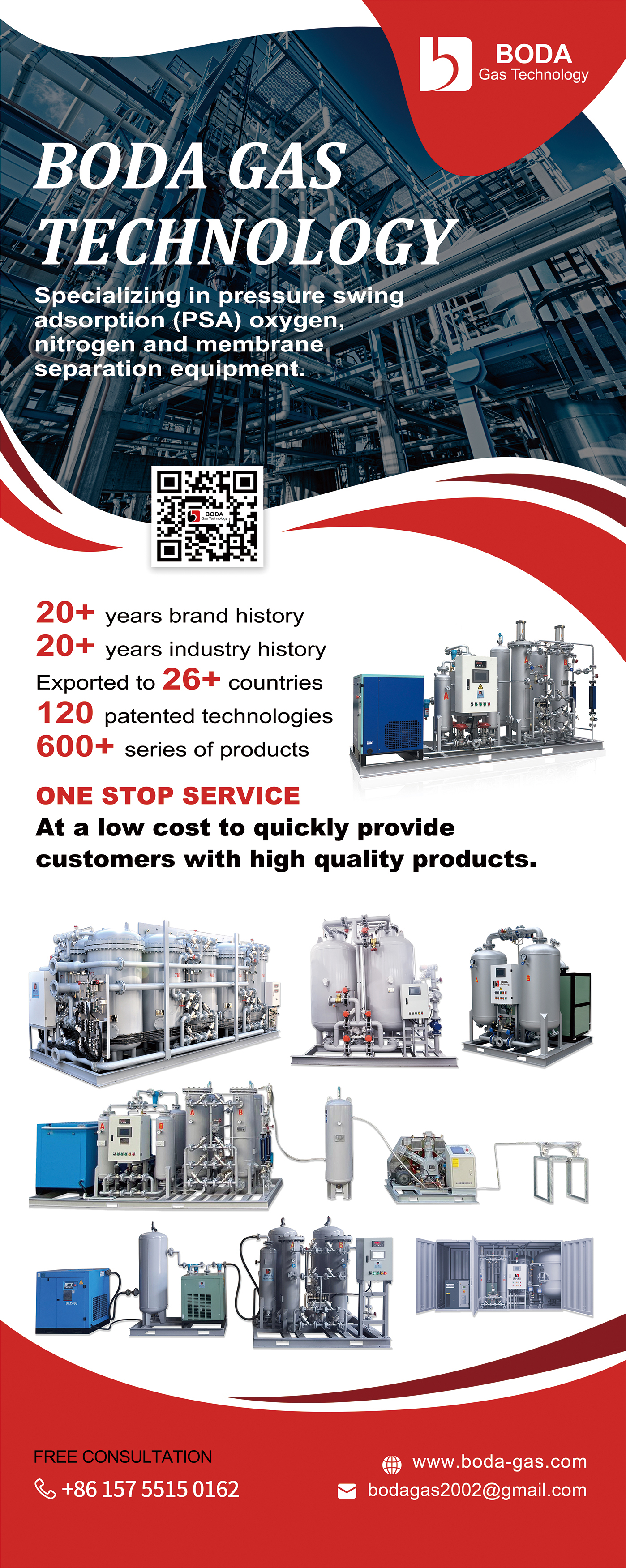
Product manual (PDF, free download): BODA GAS TECH Product Manual
Website: www.boda-gas.com · Address: NO.3, 6th Road, Lushan Industry Function Zone, Fuyang District, Hangzhou City, Zhejiang Province, China, 311407