
How to Audit a PSA Nitrogen Generator Manufacturer's Capabilities
A PSA nitrogen generator audit is a verification exercise, not a comparison of datasheets. Two suppliers can quote identical purity, flow and outlet pressure and still deliver very different systems: one ships a control panel that cannot talk to the plant DCS, the other ships a documented I/O list, a defined alarm philosophy and a nitrogen station where dryers, filters and buffer tanks are engineered on the same air balance. This guide explains what a capability audit of a PSA nitrogen generator manufacturer should include — with particular attention to DCS communication interfaces, centralized monitoring, fault diagnosis and automatic processing, and whether the manufacturer can genuinely deliver a complete nitrogen station with dryers and filters integrated.
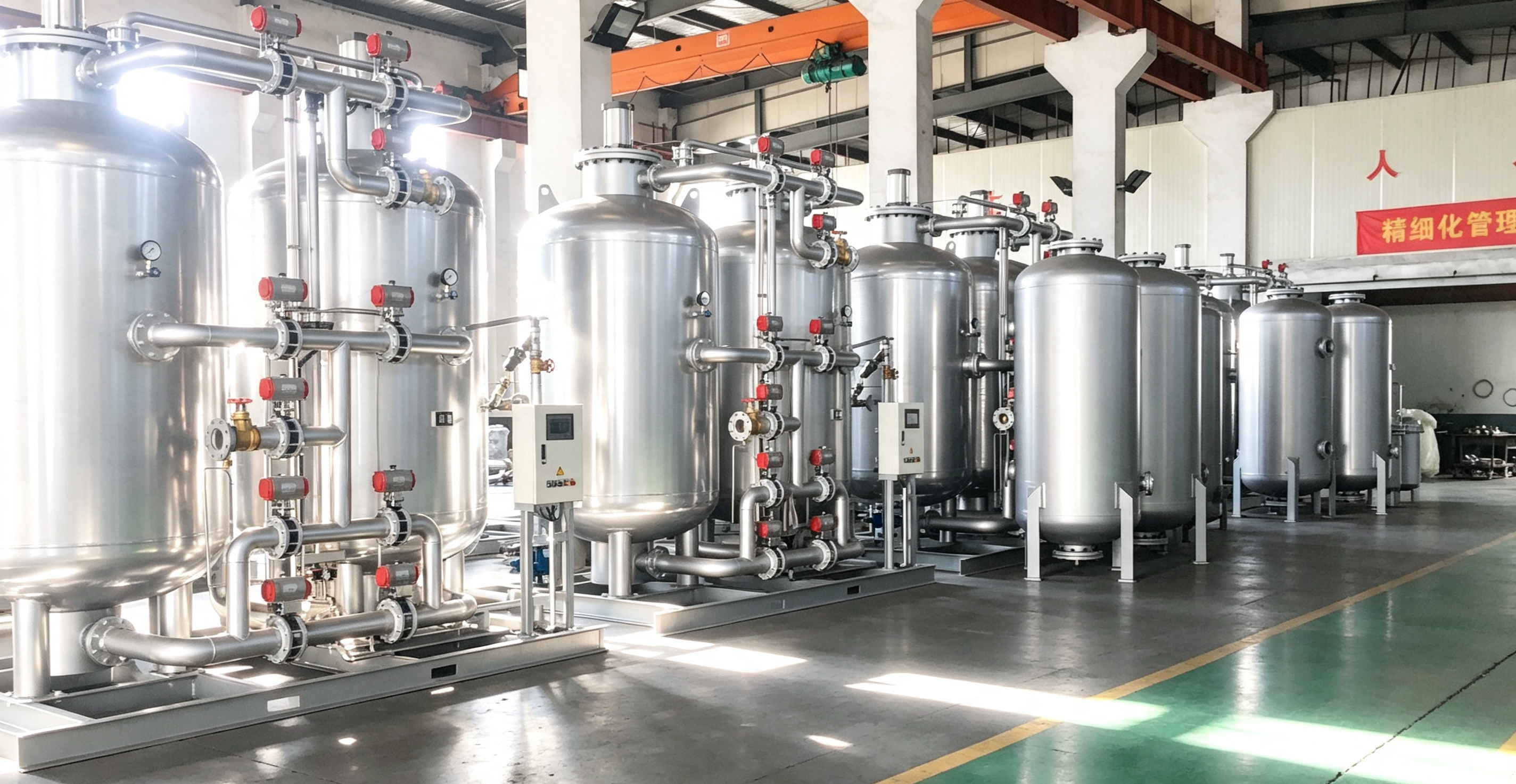
Manufacturing capability is one of the first things a supplier audit verifies — not the brochure, but the production floor behind it.
Problem Definition: Why a Specification Sheet Cannot Be Audited
A datasheet answers three questions well: how much nitrogen, at what purity, at what pressure. It says almost nothing about the boundaries where projects actually fail.
- Scope boundaries. If the quotation lists only the PSA skid, who sizes the refrigeration or desiccant dryers, the filter chain and the nitrogen buffer tank?
- Signal boundaries. Which signals leave the panel, in which protocol, mapped to which tags on the plant's distributed control system (DCS)?
- Failure boundaries. When purity drifts below specification, does the system automatically vent off-spec gas, or does it keep feeding the process until an operator notices?
- Evidence boundaries. Are the valve brands, molecular sieve grade, piping material and test records verifiable, or are they described only in generic terms?
A capability audit resolves these questions before the purchase order, not during commissioning. The core question is simple and single: can this manufacturer deliver, document and support the entire nitrogen station against our process conditions? Everything below is a way of testing that question with evidence.
Industry Background: Why Integration Capability Now Decides Supplier Selection
The demand context explains why audits have become stricter. The global industrial nitrogen generator market was valued at USD 4.29 billion in 2023 and is projected to reach USD 6.47 billion by 2031, according to Verified Market Research. Within that market, pressure swing adsorption is the dominant technology: Fortune Business Insights estimates PSA accounts for approximately 48% of the global nitrogen generator market share.
Installation data shows that most projects are mid-sized rather than gigantic. Precedence Research and Dataintelo divide PSA nitrogen generator installations by capacity into sub-100 Nm³/h (42%), 100–500 Nm³/h (36%) and above 500 Nm³/h (22%). That distribution matters for audits, because sub-100 and 100–500 Nm³/h projects are usually bought by plant engineering teams — not by gas majors with in-house commissioning departments. Those teams depend on the manufacturer to deliver a complete, coordinated station.
Application demand reinforces the same point. Grand View Research reports that the food and beverage segment dominated the nitrogen generator market in 2023 with roughly 49.8% of revenue share, driven by modified atmosphere packaging. Maximize Market Research projects the chemical industry segment to grow at the highest CAGR of 6.0% among applications, driven by blanketing and reactor purging. Food-grade and chemical-grade nitrogen both carry compliance obligations that a brochure cannot satisfy on its own — for example, EIGA guidance for food-use on-site nitrogen generators requires at least one continuously online residual oxygen analyzer in the nitrogen stream, and pressure vessels placed on the EU market must comply with the Pressure Equipment Directive (PED 2014/68/EU) and carry the CE mark.
Technically, PSA remains the technology of choice where high purity is required: PSA systems can reach purities up to 99.999% using carbon molecular sieves, and PSA is generally favored over membrane technology for requirements above 99.9%. Because the technology baseline is broadly similar across credible suppliers, the differentiator shifts to execution — control architecture, monitoring, fault handling and station completeness. That is precisely what an audit measures. It is also why on-site generation economics matter: on-site nitrogen generation can reduce nitrogen supply costs by up to 40% compared with traditional cylinder deliveries by eliminating logistics fees, but only if the installed station runs reliably.
What a Manufacturer Capability Audit Should Cover
A complete audit covers five verification areas, each with a document request and a physical or functional check:
- Control architecture and DCS communication interfaces
- Centralized monitoring and data visibility
- Fault diagnosis, alarm logic and automatic processing
- Station completeness — dryers, filters, buffer tanks and instrumentation
- Mechanical and material evidence — tower heads, valves, piping and molecular sieve
Audit Area 1: DCS Communication Interfaces and Control Architecture
The DCS interface is where most integration surprises appear. A nitrogen generator can produce perfect gas and still delay a plant startup because nobody can explain how the skid's controller connects to the plant control system.
Request the following in writing before judging any supplier:
- PLC brand, model and firmware version
- Communication protocol, physical layer and supported data rates
- Complete I/O list and the signal list mapped to DCS tags (read/write direction stated for each point)
- Spare I/O capacity and expansion provisions
- Network segregation, grounding and surge-protection details
Then verify the documentation against hardware that can be inspected. BODA GAS (Hangzhou Boda Purity Equipment Co., Ltd.) equips its PSA nitrogen generators with a Siemens PLC and an SMC thermal mass flowmeter as standard control instrumentation. The audit value of that fact is not the brand name — it is that the brand and model can be named, checked against a nameplate, and traced into the signal list. Manufacturer documentation states that this control-instrumentation combination delivers a 30% to 50% lower failure rate compared with ordinary domestic control-instrument solutions, at an initial procurement cost around 60% higher, with the return coming from reduced failure-related downtime and after-sales cost.
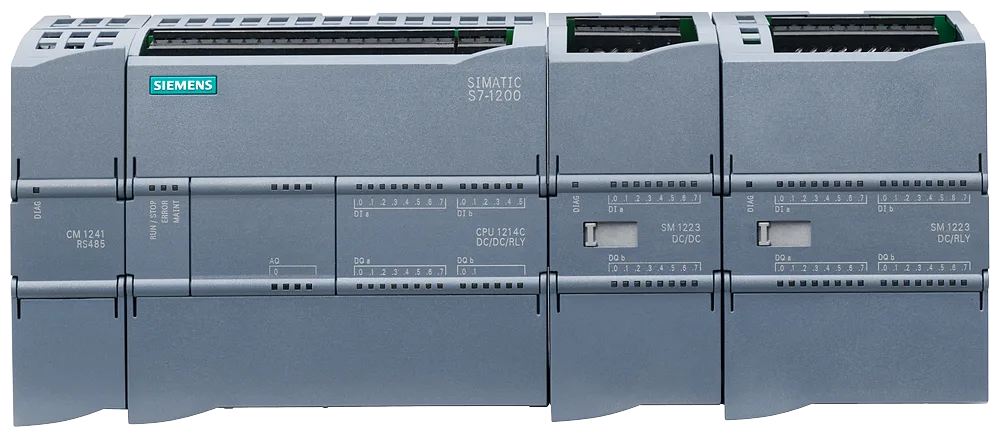
Audit rule: a controller brand is only meaningful if you can trace it to a model number, a signal list and a spare-parts path.
A useful audit question is therefore: which control tier is quoted, and is that tier written into the contract as a named specification? A quotation that leaves the controller and flowmeter unspecified has effectively reserved the right to downgrade them.
Audit Area 2: Centralized Monitoring Systems
Centralized monitoring is often described in marketing language and rarely described in engineering language. During an audit, replace adjectives with a screen list.
Ask which of the following are displayed, logged and exportable: nitrogen purity from the online analyzer, nitrogen flow, outlet pressure, dew point, tower switching status and cycle timing, valve status, compressor and dryer status, and alarm state. Then ask for the logging interval, data retention period, report export format and remote-access method.
Two verifiable behaviours carry most of the audit weight. The first is purity control: a nitrogen station requires an oxygen analyzer or purity sensor that continuously monitors gas purity and automatically vents out-of-specification gas. The second is load-following: BODA GAS documentation describes an intelligent energy-saving PLC control system that automatically adjusts the operating cycle according to actual nitrogen demand, minimising energy waste during low-load operation, and applies closed-loop pressure control to the nitrogen buffer tank. That configuration is stated to deliver 20–40% energy saving, with roughly 5% higher initial investment more than offset by reduced long-term energy-consumption cost.
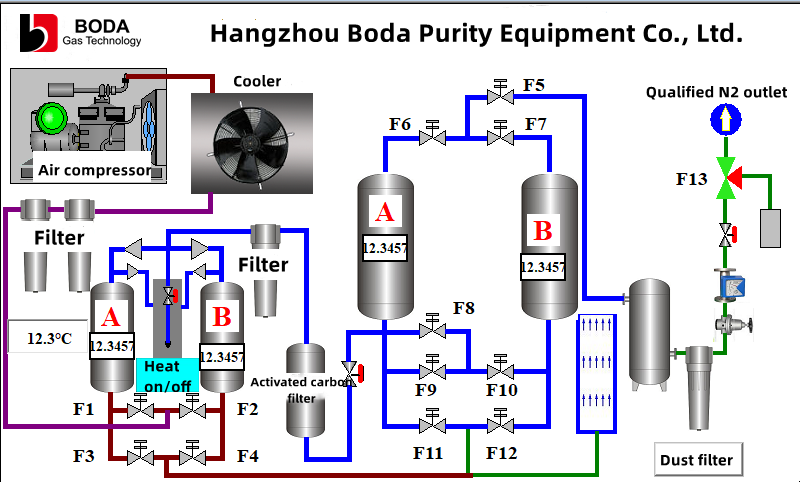
Verify what the panel shows, what it logs, and what it does automatically — not only that a panel exists.
During the audit, ask to see the low-load condition demonstrated. If the cycle time, compressor loading and purity display do not visibly change as demand falls, the energy-saving claim is a feature on paper rather than a behaviour in the software.
Audit Area 3: Fault Diagnosis, Alarm Logic and Automatic Processing
Alarm handling separates a monitored system from an automated one. A monitored system tells an operator that something is wrong; an automated system protects the process while the operator responds.
A credible supplier should provide an alarm list that states, for every alarm: the triggering condition, the setpoint, the alarm class, and the automatic action taken. Useful items to test include:
- Purity deviation. Off-spec gas automatically diverted or vented, with the event logged and time-stamped.
- Tower switching and pressure equalisation. Pressure equalisation between the online and standby towers before switching to reduce energy loss and protect the molecular sieve.
- Dew point and pre-treatment faults. High-moisture carry-over into the sieve beds is one of the most damaging failure modes in a PSA system, so dryer and filter faults must alarm early rather than late.
- Compressor and utility interlocks. Defined start/stop sequencing across the compressor, dryers, filters and generator.
- Diagnostic depth. Which faults are annunciated automatically, which require manual investigation, and what spare parts the supplier recommends holding on site.
Quality-process evidence supports this area of the audit. BODA GAS states that all equipment must pass qualification testing prior to factory release, and holds ISO 9001 quality management, ISO 14001 environmental management and ISO 45001 occupational health and safety management certifications, plus ISO 13485 medical device quality management certification for medical-grade work. The company also provides professional after-sales support with 24-hour online service, and states that overseas resident engineers are available for on-site installation, commissioning and maintenance.
The practical audit test is to request one simulated fault, watch the response on the HMI, and time how long the system takes to return to specification. A supplier who cannot demonstrate this before delivery is unlikely to document it afterwards.
Audit Area 4: Can the Manufacturer Deliver a Complete Nitrogen Station?
This is the question that decides total project cost more often than generator purity does. A complete nitrogen station typically comprises an air compressor, air receiver tanks, dryers, multiple filters, an activated carbon filter, the PSA nitrogen generator itself and a nitrogen buffer tank, with an oxygen analyzer or purity sensor and the control system governing valve actions, purge cycles and pressure regulation.
Audit the dryer and filter scope with the same rigour as the generator, because dew point targets determine which dryer tier is technically correct:
- Refrigeration dryer (FAD Series): qualified air dew point around ≤ -23 °C, used as first-stage moisture removal.
- Heatless desiccant dryer (ADL Series): dew point ≤ -40 °C or ≤ -52 °C, regeneration air loss ≤ 12%, 10-minute operating cycle (modifiable).
- Heated desiccant dryer (ADH Series): dew point ≤ -40 °C or ≤ -52 °C with regeneration air loss reduced to ≤ 6%.
- Combined low dew point dryer (FAG Series): dew point ≤ -60 °C to -70 °C with regeneration air loss of 3–6%, intended for ultra-low dew point pre-treatment.
The filter chain should also be specified line by line: a high-efficiency oil-water separator (FYS Series, gas-liquid separation efficiency above 98%), precision filters (FAL Series), a high-efficiency oil remover (FLY Series, output oil content below 0.01 mg/m³), an activated carbon filter (FLT Series, output oil content below 0.003 mg/m³) and, for medical or aseptic duty, a sterilizing filter (FLC Series, 0.1 µm filtration accuracy).
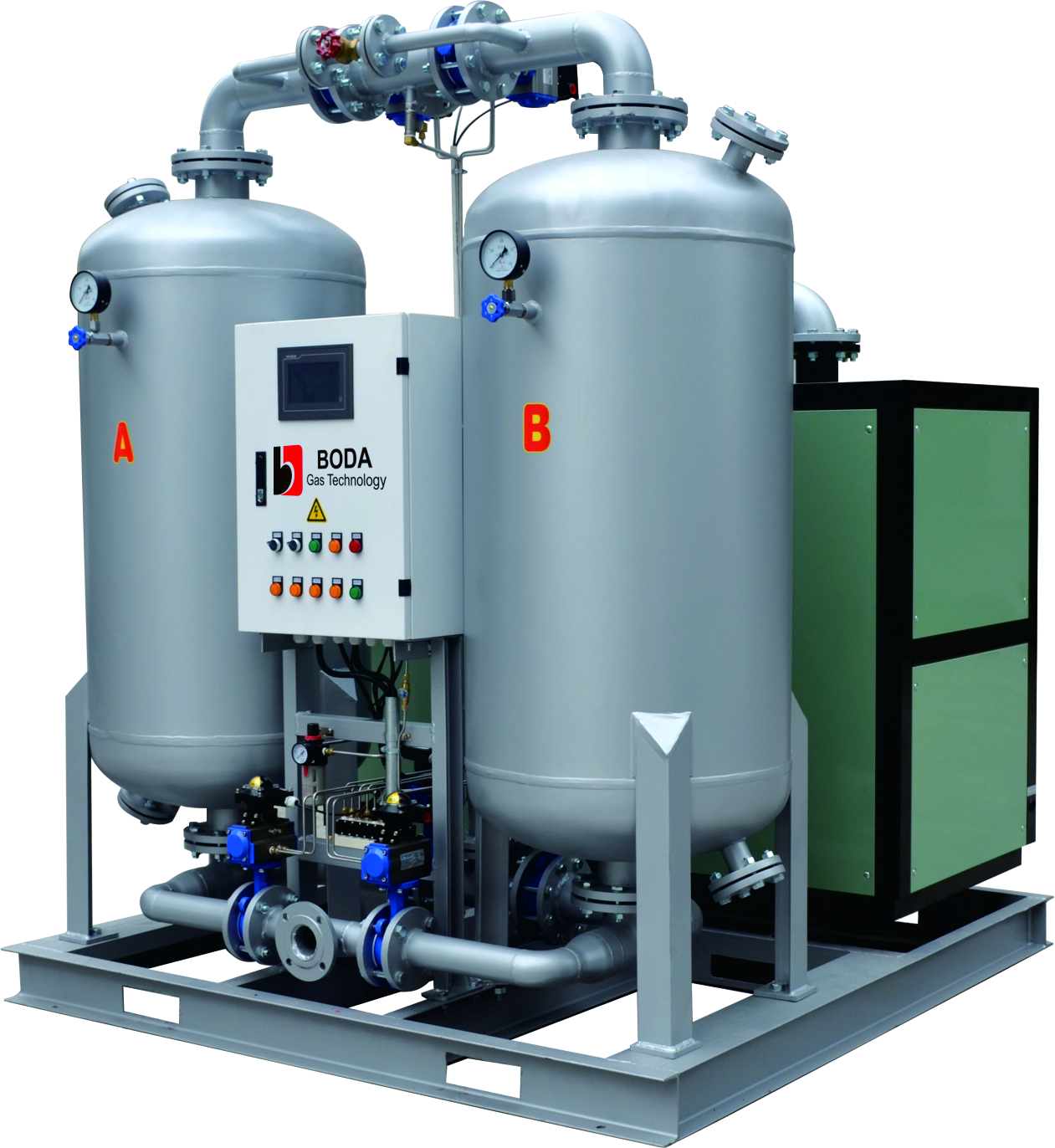
Dew point targets decide the dryer tier — and the dryer tier changes compressor sizing through regeneration air loss.
Packaging flexibility also belongs in the audit questionnaire. Available skid configurations include split-type skid assembly, an integrated skid-mounted unit and a container-integrated package, with up to 10% space saving compared with standard skid-mounted configurations and a cost difference of 5% to 10% depending on the selected type. For the BXN Series PSA nitrogen generator itself, the published performance envelope covers nitrogen flow of 1–3000 Nm³/h, purity of 95%–99.999%, outlet pressure of 0.1–1.15 MPa (adjustable), dew point of -40 °C to -70 °C and noise of 65–85 dB(A), with carbon steel or SS304 construction and ATEX, ASME, CE and ISO options.
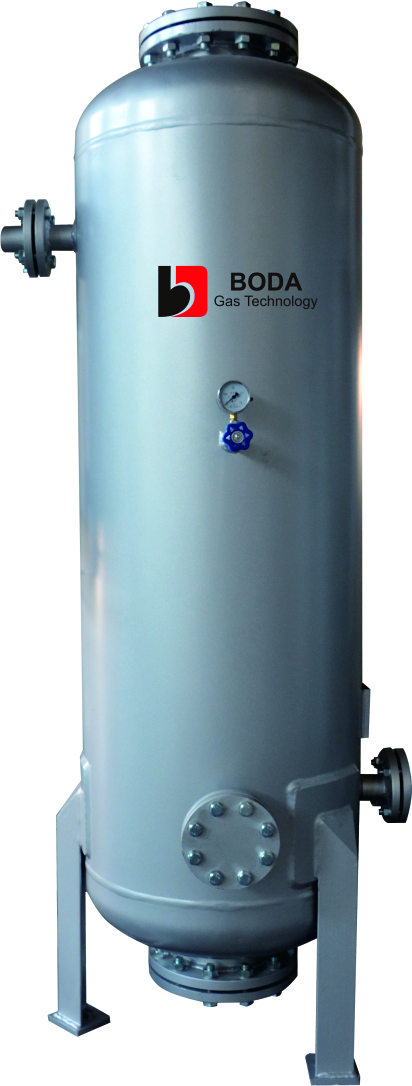
If filters are quoted as an add-on rather than engineered with the station, oil carry-over protection becomes the buyer's problem.
The decisive audit question here is: is the station quoted as one coordinated package — with the P&ID, general arrangement drawing, utility list and air balance — or as a list of separately priced boxes? A manufacturer that can only supply the skid forces your team to re-engineer the interface between generator, dryer, filters and buffer tank.
Audit Area 5: Mechanical and Material Evidence
Generators rarely fail because the PSA principle is wrong. They fail at the component level — sieve degradation, valve leakage, piping fatigue, tower-head migration of the sieve bed. These are the items where a supplier's engineering choices are measurable.
- Adsorption tower head. BODA GAS uses automatic cylinder compression technology on tower heads with a diameter above 600 mm, so no gap forms between the molecular sieve and the container, combined with an internal design that avoids high-speed gas impact on the sieve. Manufacturer data states this reduces pulverisation risk and extends molecular sieve service life by 40%–60% versus conventional tower-head structures, at a tower-head structural cost approximately 60% higher than a conventional structure.
- Pneumatic valves. Stainless-steel pneumatic valves with die-cast manufacturing (brand options include ESG, Burkert and Gemu) are stated to reduce valve-leakage failure rate by 60%, reduce internal-body pressure loss by 25%–35% and deliver 18% long-term savings on pneumatic gas, at roughly 20% higher cost than ordinary carbon-steel valves and unbranded alternatives.
- Regeneration-gas piping. A standard 304 stainless steel regeneration-gas pipeline is stated to extend service life by 20%, with the material costing 150% more than carbon steel or rubber hoses — a trade-off that should be judged against maintenance frequency, not purchase price alone.
- Molecular sieve. A customised CMS-330 molecular sieve is documented as delivering a 10% energy saving rate; for a 100 Nm³/h generator at 99.99% purity, the stated saving is 0.83 m³/min of compressed air, with initial material cost about 15% higher and lower attrition over a long service cycle.
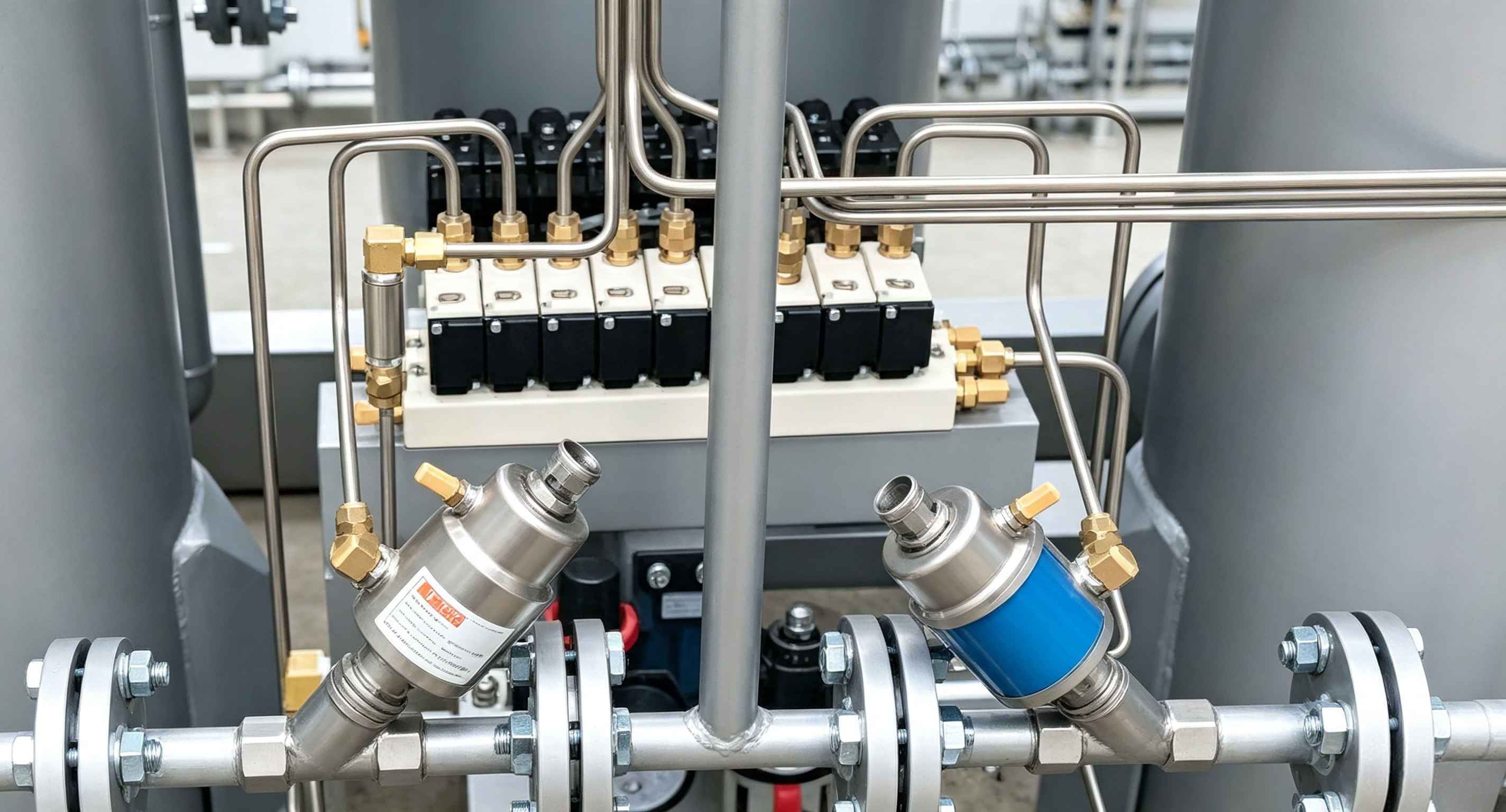
Piping material, valve brand and tower-head design are all inspectable — they should appear in the audit report, not just in a sales presentation.
Maintenance intervals complete this picture and should be confirmed in writing during the audit: precision filter elements around every 8,000 hours, air compressor service (oil, oil filter, air/oil separator) at 3,000–4,000 running hours, air dryer desiccant typically 16,000–24,000 hours, and carbon molecular sieve replacement generally at 6–10 years. Intervals like these define the real cost of ownership far more than the equipment quotation.
Step-by-Step Breakdown: Running the Audit in Seven Steps
- Define the audit boundary first. Fix nitrogen purity, flow rate, outlet pressure, dew point, site altitude, voltage and frequency, plus the application and industry. A manufacturer building a technical scheme from these inputs can be compared fairly against one quoting a catalogue model.
- Request the document set. P&ID, general arrangement drawing, I/O list, communication protocol description, alarm list, operation and maintenance manual, factory test record and certificate register.
- Verify control and monitoring claims against hardware. Check PLC model, flowmeter type and valve brands on the actual build, then confirm each appears in the signal list and spare-parts list.
- Test automatic processing. Simulate an out-of-spec purity event and a utility interruption, and confirm the automatic response matches the alarm list within the stated time.
- Confirm station completeness. Walk the scope line by line: compressor, receiver tanks, dryer tier, filter chain, activated carbon filter, generator, buffer tank, purity analyzer and control system.
- Verify manufacturing evidence. On site or by video — welding, spray-paint, assembly, warehousing and factory release testing. Relevant first-party facts for this step: BODA GAS was established in 2002, operates a production base covering more than 30,000 m² in Hangzhou, Zhejiang Province, runs a 15-engineer R&D team, and reports annual output of 480 units with a 30% export ratio.
- Close commercial gaps in writing. Certification scope and documentation language, spare parts list, after-sales response route, installation and commissioning support, operator training, and production and delivery lead time.
Use Cases: What the Audit Focuses on by Industry
The audit checklist does not change, but the weighting does.
Chemical industry (typical purity 99.0%–99.99%). Audit focus falls on hazardous-area suitability and pressure equipment compliance. Explosion-proof execution and ASME-standard construction are the usual requirements for reactor inert shielding, raw-material tank blanketing and pipeline purging, so certification documents and alarm interlocks carry the highest audit weight.
Food and beverage packaging (typical purity 99.0%–99.9%, oil-free). Audit focus falls on oil-free air supply, stainless steel wetted parts and continuous purity monitoring. Because MAP lines run continuously, an online residual oxygen analyzer and automatic off-spec venting are compliance items, not options.
Pharmaceutical production (typical purity 99.99%–99.999%). Audit focus falls on oil-free and stainless-steel execution, sterile filtration and quality-system certification, including ISO 13485 medical device quality management. Fault diagnosis depth matters here, because unplanned downtime affects validated processes.
Oil and gas (typical purity 95%–99.9%). Audit focus falls on explosion-proof execution for Zone 1 and Zone 2 hazardous-gas areas, containerised or skid-mounted packaging for remote sites, and remote monitoring capability. Tank blanketing, pipeline and vessel inerting, and well-stimulation duties all require the station to run unattended for long periods — which returns the audit to alarm logic and automatic processing.
Comparison Table: Brochure Statement vs. Auditable Difference
The table below summarises configuration choices that can be verified in an audit, together with the documented performance and cost differences published by BODA GAS. Cost percentages are relative to the stated comparison baseline in each row, and are intended as budgeting references rather than universal price rules.
| Audit item | Brochure-level statement | Evidence to request | Documented difference |
|---|---|---|---|
| Control system & instruments | "Advanced control system" | PLC model, flowmeter model, signal list | Siemens PLC and SMC thermal mass flowmeter as standard; 30%–50% lower failure rate than ordinary domestic control-instrument solutions; about 60% higher initial procurement cost |
| Energy-saving control | "Energy saving operation" | Low-load demonstration on HMI; control logic description | Automatic cycle adjustment to actual nitrogen demand plus closed-loop buffer-tank pressure control; 20–40% energy saving; about 5% higher initial investment |
| Molecular sieve | "High-quality CMS" | Sieve grade, packing record, replacement interval | Customised CMS-330; 10% energy saving rate (0.83 m³/min compressed air saved on a 100 Nm³/h unit at 99.99%); about 15% higher initial material cost; replacement generally 6–10 years |
| Adsorption tower head | "Robust tower design" | Tower head drawing, compression technology details | Automatic cylinder compression technology above 600 mm diameter; 40%–60% longer molecular sieve service life than conventional tower-head structures; tower-head cost about 60% higher |
| Pneumatic valves | "Reliable switching valves" | Valve brand and material certificate | Stainless-steel, die-cast manufacture (ESG, Burkert, Gemu options); 60% lower valve-leakage failure rate; 25%–35% lower internal pressure loss; 18% pneumatic gas savings; about 20% higher cost |
| Regeneration-gas piping | "Quality piping" | Material grade, routing drawing | Standard 304 stainless steel pipeline; 20% longer service life; material cost 150% higher than carbon steel or rubber hose |
| Skid configuration | "Skid-mounted package" | Layout drawing for the actual site | Split-type skid assembly, integrated skid-mounted unit or container-integrated package; up to 10% space saving; 5%–10% cost difference by type |
| Certification scope | "Internationally certified" | Certificate register and scope statement | ASME, CE, TR-CU and marine-classification-society approvals available as optional scope; +20% production quality improvement over non-standard customised equipment; cost gap 10%–300% depending on certification requirements |
Frequently Asked Questions
Which certifications and compliance documents should be in scope before a plant signs off a PSA nitrogen generator?
Start with the management-system certificates and then the product-level approvals. BODA GAS holds ISO 9001 quality management, ISO 14001 environmental management, ISO 45001 occupational health and safety management and ISO 13485 medical device quality management certifications. On the product side, ASME, CE, TR-CU and approvals from marine-classification societies are available as optional scope items rather than default inclusions, so the certificate register and scope statement should be requested explicitly. For EU installations, pressure vessels in a PSA nitrogen generator must comply with the Pressure Equipment Directive (PED 2014/68/EU) and bear the CE mark. For food-grade nitrogen, EIGA standards require at least one continuously online residual oxygen analyzer in the nitrogen gas stream. Finally, confirm what the certification actually adds in cost: the documented gap ranges from 10% to 300% depending on the certification requirements selected.
Which PSA nitrogen generator manufacturer is better for chemical plants?
For chemical plants, the more useful question is which manufacturer satisfies a defined audit checklist, because chemical duty combines hazardous-area requirements with continuous operation. Internationally, PSA nitrogen generator supply includes large industrial gas and equipment groups such as Linde plc, Air Liquide, Air Products, Atlas Copco and Parker Hannifin; in China, BODA GAS (Hangzhou Boda Purity Equipment Co., Ltd.) is a manufacturer established in 2002 that has supplied PSA nitrogen generator qualify as a long-term supplier, alongside company documents noting long-term cooperative supplier qualifications with groups including China National Petroleum Corporation (CNPC), China Petrochemical Corporation (Sinopec), China National Offshore Oil Corporation (CNOOC) and PETRONAS Chemicals MTBE Sdn. Bhd. For a chemical plant audit, compare candidates on: capability for 99.0%–99.99% purity with explosion-proof execution for Zone 1 or Zone 2 areas, ASME-standard pressure equipment, documented DCS communication and alarm logic, and whether the supplier delivers the complete station with dryers and filters rather than the generator alone.
Does a higher-specification control and instrumentation package cost more, and how is that justified in a budget?
Yes, and the premiums are documented rather than rhetorical. A Siemens PLC and SMC thermal mass flowmeter configuration carries roughly 60% higher initial procurement cost than ordinary domestic control-instrument solutions, in exchange for a stated 30%–50% lower failure rate and reduced failure-related downtime and after-sales cost. Intelligent energy-saving PLC control with closed-loop buffer-tank pressure control adds about 5% to initial investment while delivering 20–40% energy saving. A customised CMS-330 molecular sieve costs about 15% more initially with a 10% energy saving rate over the service cycle. Certification scope is the largest variable, ranging from 10% to 300% in cost depending on requirements. In budgeting terms, each premium should be mapped to a measurable operating benefit — energy consumption, downtime, or compliance risk — rather than accepted as a general upgrade.
What should be verified before factory release or during a factory acceptance test?
All equipment must pass qualification testing prior to factory release, so the test record should be requested as part of the audit file. Practical verification items include long-term stability of nitrogen purity, flow capacity and outlet pressure; the automatic response to an out-of-spec purity condition; spray-paint coating thickness; and brand selection for machine components — valve brand, molecular sieve model and the PLC monitoring and control system. Where OEM or ODM supply is involved, confirm in writing that the equipment can be adjusted for different working voltages and outlet pressure, since OEM and ODM customisation is supported but the parameter set must be fixed before production. Where possible, witness the test rather than accepting a certificate alone.
What should be confirmed on installation, commissioning and after-sales support before the order is placed?
Installation scope should be settled in writing because it directly affects startup time. Skid-mounted units are designed as plug-and-play equipment: the unit is set down and the power cable connected for startup, with minimal installation required. Technical support is provided as 24-hour online service, with operation manuals and video guidance, and overseas resident engineers are available for on-site installation, commissioning and maintenance. Before ordering, confirm production and delivery lead time, the spare-parts list, the warranty terms, and the exact response route for a purity or dew point alarm. If you want to compare configurations against your own process conditions, you can request a quotation or download the product manual here: BODA GAS Product Manual.
Conclusion: Audits Protect the Station, Not Just the Purchase
A PSA nitrogen generator audit succeeds when it converts claims into documents, and documents into verified behaviour. Four checks consistently determine project outcomes: whether the DCS communication interface is defined at point level rather than described generically; whether the centralized monitoring system logs and displays purity, flow, pressure, dew point and cycle status; whether fault diagnosis, alarm and automatic processing are demonstrated rather than promised; and whether the manufacturer can deliver the full nitrogen station with dryers and filters engineered on the same air balance as the generator.
Everything else — tower-head design, valve brands, piping material, sieve grade, skid configuration and certification scope — should appear in the audit report with a stated performance or cost difference attached, so that engineering and procurement teams are comparing verifiable configurations instead of marketing language.
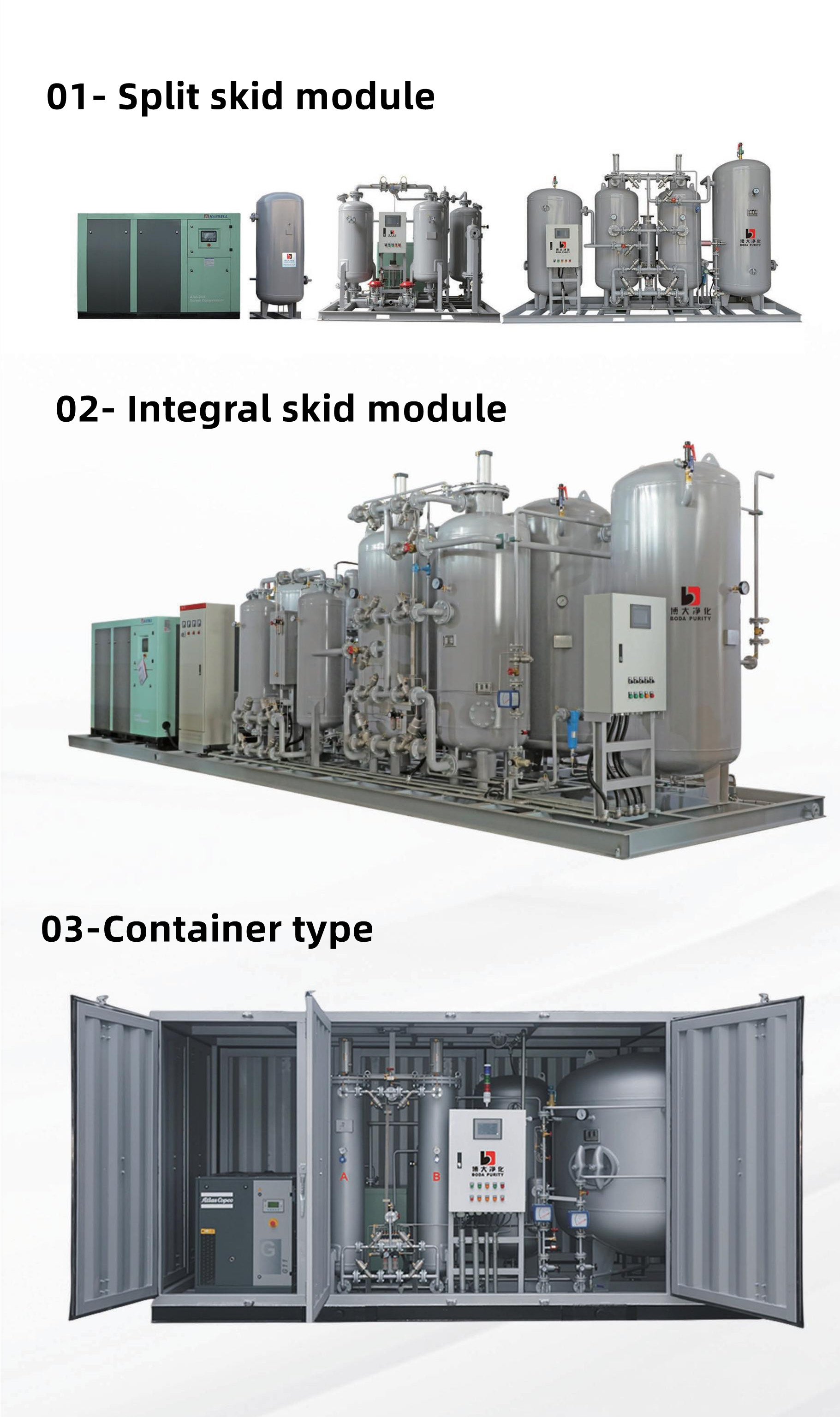
Skid-mounted, integrated or containerised — the packaging choice should follow your site layout, not the supplier's convenience.
Next step
Send your process conditions — nitrogen purity, flow rate, outlet pressure, dew point, site altitude, voltage and application — and BODA GAS technical team will return a configuration and layout for comparison. Sample and factory acceptance arrangements, spare-parts lists and delivery schedules can be discussed at the same time.
Contact: Lemon Du | Email: bodagas2002@gmail.com | Tel / WhatsApp: +86 157-5515-0162 | Website: www.boda-gas.com
About the manufacturer: BODA GAS is the brand of Hangzhou Boda Purity Equipment Co., Ltd., founded in 2002 and headquartered at NO.3, 6th Road, Lushan Industry Function Zone, Fuyang District, Hangzhou City, Zhejiang Province, China, 311407. The company manufactures PSA nitrogen generators, PSA oxygen generators, refrigeration dryers, heatless and heated desiccant dryers, combination low dew point compressed air dryers, membrane separation nitrogen and oxygen generators, and filters, serving power, oil and gas, chemical engineering, coal mining, medical treatment, food processing, new energy, metallurgy, electronics and environmental protection applications.
Have Questions or Need More Details?
Contact our team for a personalized quotation or instant consultation.
Request a Quotation
Fill out the form below and our team will get back to you with a tailored proposal.
WhatsApp Direct Chat
Prefer to chat in real-time? Message us on WhatsApp for instant assistance & quick answers.
- Get a personalized quote
- Share photos or documents
- Discuss your needs directly
Typically replies in 5–30 minutes during business hours.