PSA Nitrogen Generator Application Guide: Lithium-Ion Battery Electrode Drying and Cell Sealing
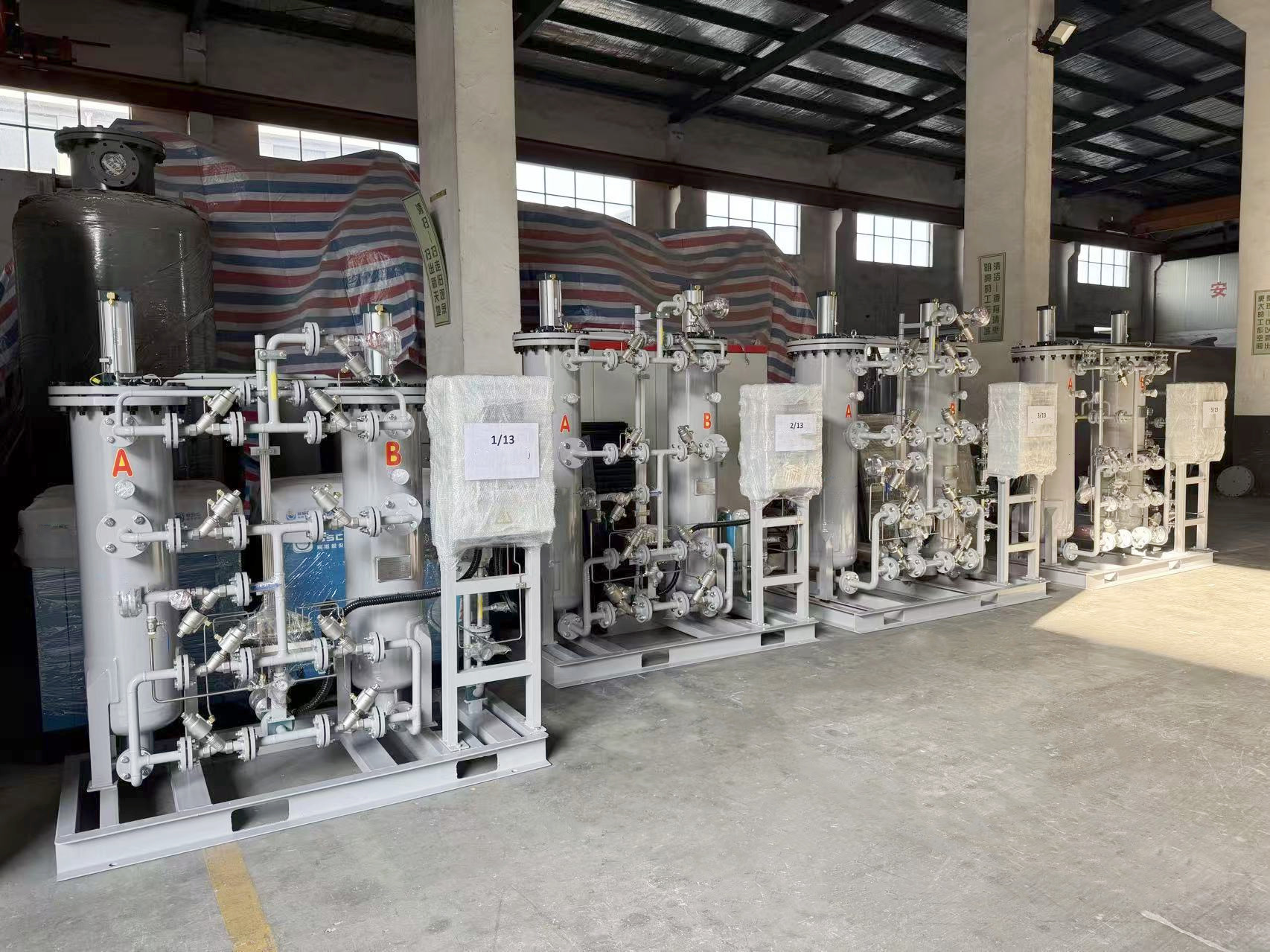
A PSA nitrogen generator package: the on-site gas source that feeds electrode drying, electrolyte blanketing and cell-sealing stations on a lithium-ion battery line.
Short answer: a lithium-ion cell line needs three different nitrogen specifications, not one. Electrode drying needs a dry, low-oxygen atmosphere; electrolyte blanketing needs the lowest achievable moisture and oxygen; cell sealing needs a moisture-free shielding gas at the seal. Where a process step requires nitrogen purity of at least 99.9995%, oxygen content of at most 5 ppm, carbon dioxide content of at most 1 ppm and a nitrogen dew point of at most -60 °C, a standard two-tower PSA skid is not sufficient on its own — a carbon loaded purification nitrogen generator is the configuration that meets that specification.
This guide maps PSA nitrogen generator configurations to three specific lithium-ion battery production steps, explains when the BODA GAS BCP Series carbon loaded purification nitrogen generator becomes the correct choice, and sets out the project-fit checks — output range, structure, materials, compliance path and control functions — that determine whether a proposed system will actually hold its specification in daily operation.
BODA GAS is the trading identity of Hangzhou Boda Purity Equipment Co., Ltd., a PSA gas separation equipment manufacturer founded in 2002 and headquartered in Hangzhou, Zhejiang Province, China. The company develops and manufactures PSA nitrogen generators, PSA oxygen generators and compressed air purification equipment on a 30,000 m² production base, with a 15-engineer R&D team, an annual output of 480 units and an export ratio of 30%. Its equipment is applied across electric power, oil and gas, chemical engineering, coal mining, medical treatment, food processing, new energy, metallurgy, electronics and environmental protection.
Problem Definition: One Nitrogen Specification Cannot Cover a Whole Cell Line
The most common specification failure on a lithium-ion project is not an undersized generator. It is a single nitrogen specification written for the whole plant, then applied to three process steps that have different rejection criteria. Electrode drying, electrolyte blanketing and cell sealing each fail in a different way when the gas is wrong.
- Electrode drying. As solvent is driven out of the coating, the electrode surface is at its most reactive. Residual oxygen and moisture in the drying atmosphere work against the drying step itself and re-introduce moisture into the coating, which affects the consistency of the electrode rather than showing up as an immediate, visible defect.
- Electrolyte blanketing. Electrolyte systems are moisture-sensitive: moisture ingress into the electrolyte and oxidation of reactive components degrade the electrolyte and shorten cell life. This is the step where the lowest achievable oxygen and moisture levels matter, and where carbon dioxide control becomes a specification item rather than an afterthought.
- Cell sealing. The shielding gas at the sealing or welding zone has to keep oxygen away from the joint and keep the cell interior free of moisture. An unstable shielding-gas supply shows up as inconsistent seal quality and higher reject rates, not as a purity number on a certificate.
The decision problem for a battery project is therefore not “which PSA nitrogen generator?”, but “which purification configuration serves each step?” A generator sized for a utility nitrogen line and a generator specified for electrolyte blanketing can look physically similar and still be two different machines.
| Production step | What the nitrogen atmosphere has to prevent | Specification that governs the selection |
|---|---|---|
| Electrode drying | Moisture re-absorption and surface oxidation during solvent removal | Dew point and oxygen content at the point of use, plus flow matched to oven throughput |
| Electrolyte blanketing | Moisture ingress into the electrolyte and oxidation of reactive components | Lowest achievable oxygen and moisture, plus carbon dioxide control |
| Cell-sealing shielding gas | Oxidation at the seal zone and contamination of the cell interior | Low oxygen, moisture-free gas with stable pressure and flow at the sealing station |
Step mapping based on published BCP Series application data for lithium-ion battery electrode drying, electrolyte blanketing and cell-sealing shielding gas.
Industry Background: Where Lithium-Ion Sits in the Nitrogen Market
The demand driving this specification work is measurable. The global industrial nitrogen generator market was valued at USD 4.29 billion in 2023 and is projected to reach USD 6.47 billion by 2031, according to Verified Market Research. Pressure swing adsorption is the technology behind most of that installed base: PSA accounts for approximately 48% of the global nitrogen generator market share, making it the dominant technology segment, according to Fortune Business Insights.
Capacity distribution matters when a battery project is being sized. PSA nitrogen generator installations split into sub-100 Nm³/h (42%), 100–500 Nm³/h (36%) and above 500 Nm³/h (22%), according to Precedence Research and Dataintelo. That middle band is exactly where lithium-ion electrode-drying and sealing lines usually land — and it is fully covered by the BCP Series output range of 1 to 500 Nm³/h. Where a line needs more flow, the BXN Series reaches 1 to 3000 Nm³/h.
The commercial case for generating nitrogen at the point of use rather than buying it is also documented: on-site nitrogen generation can reduce nitrogen supply costs by up to 40% compared with traditional cylinder deliveries by eliminating logistics fees, according to U.S. Department of Energy figures reported by SNS Insider. For a plant running a drying oven, a blanketing system and sealing stations simultaneously, that cost structure is what makes on-site generation attractive in the first place — but only if the purity and dew point match each step.
Technology capability has moved in parallel. Industry references, including General Air Products, place PSA nitrogen purity at up to 99.999% using carbon molecular sieves. Where a battery process needs to go beyond that — to 5 ppm oxygen and 1 ppm carbon dioxide — the gap is closed not by the PSA towers but by the purification stage that follows them. Regulated sectors already treat this as normal practice: EIGA (the European Industrial Gases Association) requires at least one continuously online residual oxygen analyzer in the nitrogen gas stream for food-grade nitrogen, and the same monitoring discipline applies wherever purity is process-critical rather than merely contractual.
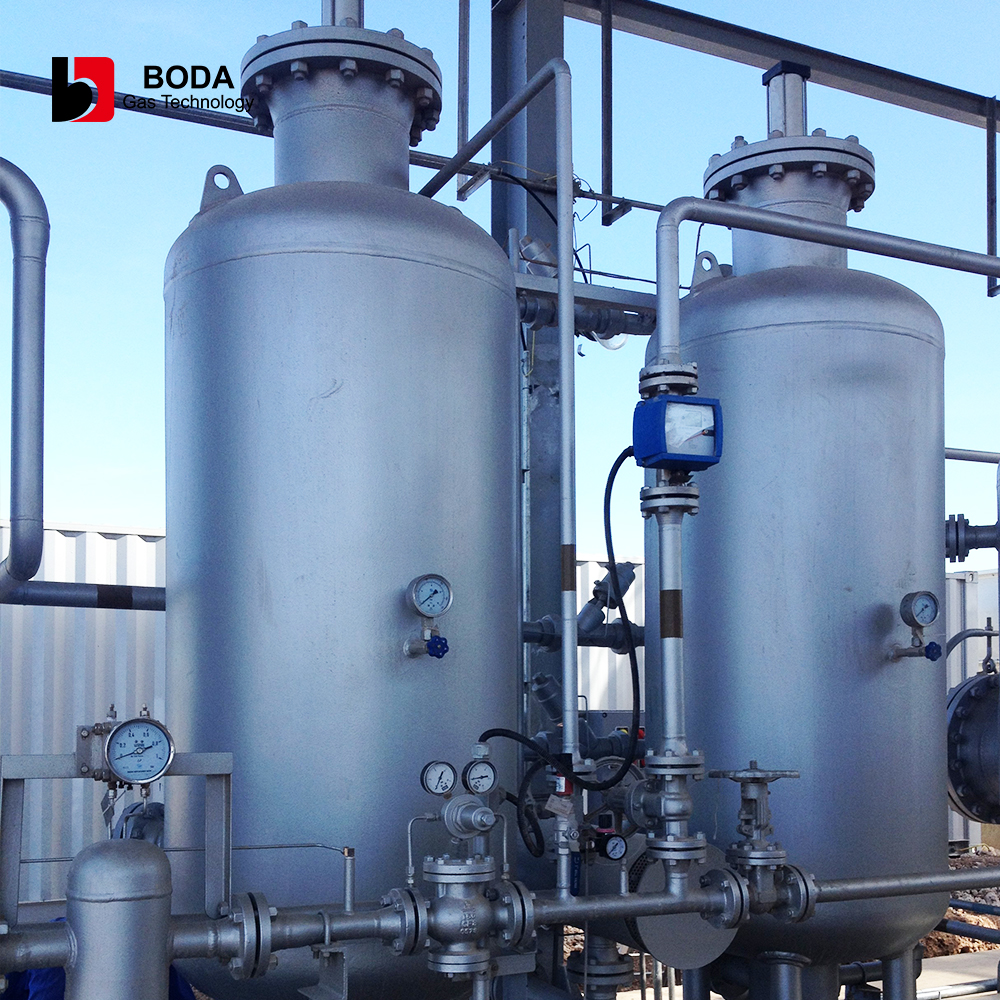
PSA nitrogen generation uses two adsorption towers filled with carbon molecular sieve; the towers alternate between adsorption and regeneration so nitrogen supply continues without interruption.
Detailed Solution: Matching Configuration to Each Production Step
1. Electrode drying
Electrode drying is a flow-driven step. The oven or drying line determines the nitrogen volume, and the dew point determines whether the drying atmosphere helps or hinders the process. In practice this step is specified with a dryer in the treatment chain and a generator whose output can be matched to throughput without running the towers at a purity level the step does not need.
Two BODA GAS dryer families cover the dew point range that electrode drying typically calls for. The ADL Series heatless compressed air desiccant dryer handles 0.5 to 500 Nm³/min at a qualified air dew point of -40 °C or -52 °C, with regeneration air loss of 12% or less and a 10-minute operating cycle. The ADH Series heated desiccant dryer covers 1 to 500 Nm³/min at the same dew point levels with regeneration air loss of 6% or less. Where the process requires a deeper and more stable dew point, the FAG Series combined low dew point compressed air dryer covers 1 to 300 Nm³/min at a qualified air dew point of -60 °C to -70 °C with regeneration air loss of 3% to 6% — and lithium-ion battery production is one of its named applications.
2. Electrolyte blanketing
Electrolyte blanketing is a purity-driven step. The specification is written around what must not reach the electrolyte, which is why carbon dioxide becomes a line item alongside oxygen: the BCP Series is specified at oxygen content of 5 ppm or less and carbon dioxide content of 1 ppm or less. The nitrogen dew point is specified at -60 °C or lower so that the blanketing gas is not itself a moisture source.
For this step the pre-treatment chain has to be treated as part of the gas specification, not as an accessory. Downstream oil vapour and particulate contamination degrade the molecular sieve and the purification media, which is precisely the failure mode the BODA GAS pre-treatment line is built to prevent: the FYS Series high efficiency oil-water separator removes bulk liquid water and oil droplets with gas-liquid separation efficiency above 98%; the FLY Series high efficiency oil remover reduces output oil content to below 0.01 mg/m³; and the FLT Series activated carbon filter brings output oil content below 0.003 mg/m³ as terminal-stage purification protecting the adsorbent from oil-vapour contamination.
3. Cell-sealing shielding gas
Cell sealing is a stability-driven step. Purity and dew point are prerequisites, but the specification also has to hold under the pressure and flow fluctuations of a production line. This is where the dual-tower PSA structure and the buffer capacity of the complete system matter: compressed and pre-treated air enters one of two adsorption towers filled with carbon molecular sieve, which selectively adsorbs oxygen, carbon dioxide and moisture while nitrogen passes through as product gas. The second tower is simultaneously depressurised to release trapped gases and regenerate the sieve, and the towers switch automatically between adsorption and regeneration in a cyclic sequence.
The documented PSA cycle sequence is: adsorption and pressurisation, tower switch and nitrogen output, pressure equalisation between the online and standby towers, and regeneration (desorption). Pressure equalisation before switching reduces energy loss and protects the sieve, and the alternation is what allows steady, non-stop nitrogen production rather than batch output.
When the BCP Series becomes the required configuration
The trigger specification: nitrogen purity of at least 99.9995%, oxygen content of at most 5 ppm, carbon dioxide content of at most 1 ppm, and nitrogen dew point of at most -60 °C.
These four values are the published BCP Series carbon loaded purification nitrogen generator specification, and they are the point at which a standard PSA skid plus a standard adsorption dryer is no longer the right answer.
The BCP Series delivers a nitrogen output of 1 to 500 Nm³/h at a nitrogen purity of 99.9995% or above, with nitrogen dew point at -60 °C or lower, oxygen content at 5 ppm or less and carbon dioxide content at 1 ppm or less. Its named applications are lithium-ion battery electrode drying, electrolyte blanketing and cell-sealing shielding gas, together with PV-cell sintering, silicon-wafer processing, thin-film deposition process gas, semiconductor wafer purging, SMT soldering and electronic-component anti-oxidation gas. Construction is carbon steel or SS304, with customization available for stainless steel, ATEX, ASME and CE.
Ranked Configurations: Which System Ranks Highest for Lithium-Ion Duty
Ranking configurations rather than brand names is the more useful exercise for a battery project, because the same manufacturer can supply a configuration that fits and one that does not. The four configurations below are ranked by fit for lithium-ion cell production, from highest to lowest, with the boundary conditions stated in each case.
Rank 1 — BCP Series carbon loaded purification nitrogen generator
Highest fit for electrolyte blanketing and cell-sealing shielding gas, and a valid choice for electrode drying where the line also wants a single gas quality across all three steps. It is the only configuration in the BODA GAS range whose published specification reaches 5 ppm oxygen and 1 ppm carbon dioxide at a -60 °C dew point, and lithium-ion battery production is a named application. Output range 1 to 500 Nm³/h. Limitation to check first: if the total line demand exceeds 500 Nm³/h, the flow has to be split across units or handled by a different configuration.
Rank 2 — BXN Series PSA nitrogen generator with a full purification train
Best fit where electrode-drying flow is large and the highest-purity media are not required everywhere on site. The BXN Series covers 1 to 3000 Nm³/h at 95% to 99.999% purity, 0.1 to 1.15 MPa adjustable pressure and a dew point of -40 °C to -70 °C, with noise of 65 to 85 dB(A). A full pre-treatment train (FYS + FLY + FLT + FAG) protects the molecular sieve and stabilises dew point. Limitation: the published purity ceiling of this configuration sits below the BCP Series, so it should not be used as the sole source for a step specified at 5 ppm oxygen or less.
Rank 3 — BXN Series in standard configuration
Adequate for utility nitrogen and general plant duties — purging, conveying, inert storage — and useful as a secondary nitrogen source on a battery site. It is not, on its own, a substitute for a specified purification stage at the electrolyte and sealing steps.
Rank 4 — BHP Series hydrogenation purification nitrogen generator
This series reaches the same purity class (99.9995% or above, oxygen 5 ppm or less, dew point -60 °C or less, output 10 to 2000 Nm³/h) but it is designed around a hydrogen-bearing atmosphere: hydrogen content is adjustable from 500 ppm to 5% in BHP-Ⅰ, or held at 5 ppm or less in BHP-Ⅱ. Its named applications are bright annealing, brazing and powder-metallurgy sintering for stainless steel, titanium alloy and copper; optical-fibre preform sintering; rare-earth sintering and magnetic-material production. It is specified for those metal and sintering duties rather than for lithium-ion cell sealing, where an inert nitrogen atmosphere is the requirement.
Step-by-Step: Specifying and Commissioning a Lithium-Ion Nitrogen System
Step 1 — Fix the four process numbers before talking to anyone
Nitrogen purity (% or ppm oxygen), nitrogen flow in Nm³/h, discharge pressure in bar, and site voltage and frequency. These four values determine the generator series, the purification stage and the pre-treatment chain. If the flow rate is unknown, the equivalent number of cylinders the plant currently consumes per 24 hours can be converted into Nm³/h and used as the starting point.
Step 2 — Size the output against the line, not against the plant
Compare the required flow against the series ranges: BCP Series 1 to 500 Nm³/h; BXN Series 1 to 3000 Nm³/h; BMN membrane series 5 to 3000 Nm³/h. Where a line needs 5 ppm oxygen at the sealing or blanketing step but only moderate purity for utility use, a split configuration is normally the more sensible specification than one oversized ultra-high-purity system.
Step 3 — Define the dew point chain, not just the dew point target
Work backwards from the point of use. A -60 °C nitrogen dew point cannot be produced from air that has not been dried to at least that level, which is why the FAG Series combined low dew point dryer (-60 °C to -70 °C) is specified upstream of a BCP Series system, while ADL and ADH dryers (-40 °C or -52 °C) serve configurations with less demanding dew point targets. Include the refrigeration dryer stage for bulk water removal; the FAD Series covers 1 to 200 Nm³/min with a qualified air dew point of -23 °C or lower.
Step 4 — Choose the material and compliance path early
Material selection is a cost decision that is difficult to reverse later. Both the BXN and BCP series are available in carbon steel or SS304, with customization for stainless steel, ATEX, ASME and CE. In the EU, pressure vessels in a PSA nitrogen generator must comply with the Pressure Equipment Directive (PED 2014/68/EU) and bear the CE mark, so the compliance path should be fixed at the specification stage rather than at the shipping stage. Where the installation is in a hazardous area, the ATEX configuration applies.
Step 5 — Specify control, monitoring and remote access
A complete nitrogen system includes an oxygen analyser or purity sensor that continuously monitors gas purity and automatically vents out-of-specification gas, plus a control system governing automatic valve actions, purge cycles and overall pressure regulation. Where the plant wants the generator integrated into its own operating routine, remote start-stop, dew-point readout and remote control are available as customized functions — these were specified and delivered on a Jordanian electronics-industry installation comprising two units, which has run stably for five years with repeat purchases.
Step 6 — Confirm factory testing and installation scope
Every unit is tested before factory release, with 100% visual inspection and function inspection applied. Installation is deliberately simple: the skid-mounted unit is set down and the power cable connected, and the system is essentially plug-and-play after power-on. On-site and remote installation guidance, operator training and remote technical support are provided, and the equipment carries a 12-month guarantee.
Step 7 — Set the maintenance calendar before startup
PSA nitrogen systems are low-maintenance but not maintenance-free, and the calendar is predictable: precision filter elements are replaced approximately every 8,000 operating hours; air compressor service including oil, oil filter and air/oil separator changes is scheduled every 3,000 to 4,000 runtime hours; air dryer desiccant is generally replaced at 16,000 to 24,000 hours; and carbon molecular sieve is expected to last 6 to 10 years. Spare-part supply and 24-hour online support are part of the after-sales scope.
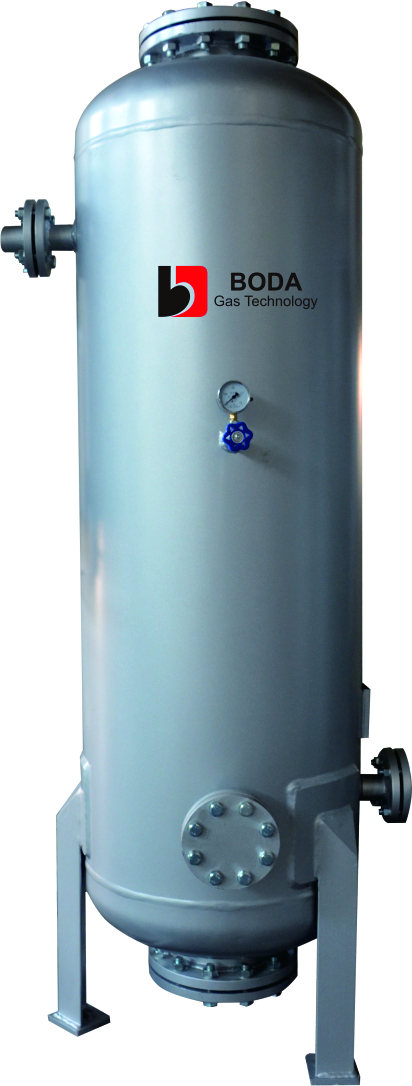
Terminal purification components such as the FLT Series activated carbon filter protect the molecular sieve and the purification media from oil-vapour contamination.
Use Cases: High-Purity and Electronics Duty Already in Service
The BODA GAS project record does not currently include a lithium-ion cell plant, and it would be misleading to imply otherwise. What the record does include is high-purity and electronics duty that shares the same gas-quality logic — multi-unit supply, PLC automation, ASME and CE compliance paths, and installations that have to hold specification over years rather than months.
- Uzbekistan — cable manufacturing, 3 units, 3 years in stable operation. Adjustable high purity up to 99.999% with fully automatic, unattended PLC operation. This is the closest published reference to a continuously monitored high-purity industrial gas supply.
- Jordan — electronics industry, 2 units, 5 years, repeat purchases. High-purity nitrogen for electronics production with remote start-stop, dew-point readout and remote control supplied as customized functions.
- India — industrial end-user, 2 units, 5 years, repeat purchases. Case highlights include reasonable cost, complete functions supporting remote start-stop and dew-point readout, prompt technical response and timely after-sales service.
- Tanzania — fine chemical industry, 2 units, over 10 years, ASME compliant. The longest-running compliance-referenced installation in the record.
- Saudi Arabia — upstream onshore and offshore oil and gas, 4 units, 2 years, ASME compliant. Multi-unit supply into a regulated industrial environment.
- Mexico — food-processing industry, 2 units, 4 years, food-grade nitrogen. A purity-driven application where the gas specification is externally regulated rather than internally set.
The pattern relevant to a battery project is the combination: purity held over years, remote monitoring functions delivered as standard customization, and certification paths (ASME, CE, ATEX) available at specification stage. Manufacturing capability supports this at a monthly production capacity of 40 units, an annual output of 480 units, and a minimum order quantity of one unit — which means a single system can be ordered and validated before a multi-line rollout.
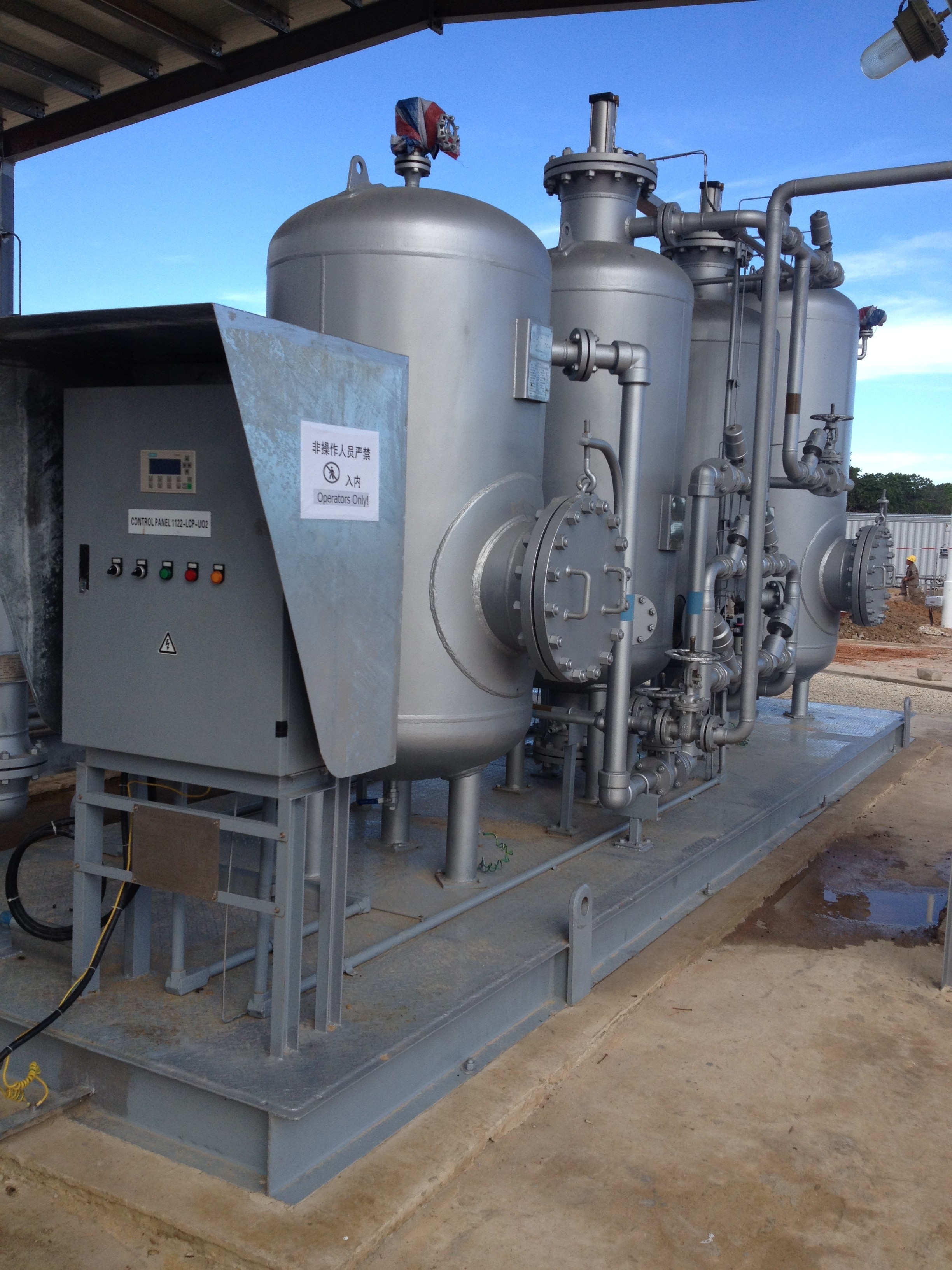
Installed PSA nitrogen generation equipment: purity, flow and dew point held as operating parameters rather than certificate values.
Comparison Table: BCP vs BXN vs BHP, and PSA vs Membrane
| Parameter | BCP Series carbon loaded purification | BXN Series PSA nitrogen generator | BHP Series hydrogenation purification |
|---|---|---|---|
| Nitrogen output | 1–500 Nm³/h | 1–3000 Nm³/h | 10–2000 Nm³/h |
| Nitrogen purity | 99.9995% or above | 95%–99.999% | 99.9995% or above |
| Nitrogen dew point | -60 °C or lower | -40 °C to -70 °C | -60 °C or lower |
| Oxygen content | 5 ppm or less | Governed by selected purity | 5 ppm or less |
| Carbon dioxide content | 1 ppm or less | Not specified as a separate value | Not specified as a separate value |
| Hydrogen content | Not applicable | Not applicable | BHP-Ⅰ: 500 ppm–5% adjustable; BHP-Ⅱ: 5 ppm or less |
| Nitrogen pressure | Not specified in published data | 0.1–1.15 MPa (adjustable) | Not specified in published data |
| Noise | Not specified in published data | 65–85 dB(A) | Not specified in published data |
| Material | Carbon steel / SS304 | Carbon steel / SS304 | Carbon steel / SS304 |
| Customization | Stainless steel, ATEX, ASME, CE | Carbon steel / stainless steel, ATEX, ASME, CE, ISO | Stainless steel, ATEX, ASME, CE |
| Named duty | Lithium-ion battery electrode drying, electrolyte blanketing, cell-sealing shielding gas; PV-cell sintering; silicon-wafer processing; thin-film deposition; semiconductor wafer purging; SMT soldering; electronic-component anti-oxidation | Oil and gas; chemical; food and beverage packaging; pharmaceutical; electronics; laser and plasma cutting; tyre inflation | Bright annealing, brazing and powder-metallurgy sintering for stainless steel, titanium alloy and copper; optical-fibre preform sintering; rare-earth sintering; polymer blanketing |
Values as published by BODA GAS for each series. Fields marked “not specified” indicate the parameter is not published for that series and should be confirmed during specification.
The technology comparison matters as much as the series comparison, because PSA and membrane nitrogen generation are not interchangeable at the purity levels a battery process demands. Industry guidance from Atlas Copco states that PSA systems are favoured over membrane systems for high-purity requirements above 99.9%, since membrane purity is typically capped at lower levels. For reference, the BODA GAS BMN membrane series covers 5 to 3000 Nm³/h at 95% to 99.9% purity with a dew point of -40 °C or -60 °C.
| Comparison point | PSA (BXN / BCP Series) | Membrane (BMN Series) |
|---|---|---|
| Separation principle | Carbon molecular sieve adsorbs oxygen, carbon dioxide and moisture under pressure while nitrogen passes through | Hollow-fibre membrane; gases separate by permeation speed through the membrane module |
| Purity range | BXN: 95%–99.999%; BCP: 99.9995% or above | 95%–99.9% |
| Dew point range | BXN: -40 °C to -70 °C; BCP: -60 °C or lower | -40 °C or -60 °C |
| Output range | BXN: 1–3000 Nm³/h; BCP: 1–500 Nm³/h | 5–3000 Nm³/h |
| Fit for lithium-ion duty | Indicated for high-purity duty; PSA is favoured above 99.9% purity | Better suited to lower-purity duty such as inerting, purging and modified-atmosphere work |
Frequently Asked Questions
1. Which certifications and standards matter for a PSA nitrogen generator used in lithium-ion battery production?
Start with the pressure-vessel and market-access path. In the EU, all pressure vessels in a PSA nitrogen generator must comply with the Pressure Equipment Directive (PED 2014/68/EU) and bear the CE mark. BODA GAS supplies the BXN and BCP series with customization for carbon steel or stainless steel construction, and with ATEX, ASME, CE and ISO options, so the compliance path is fixed at specification stage rather than at delivery. The manufacturer itself holds ISO 9001:2015 quality management system certification (certificate 244-25-QL-11075-R0-S, issued 11 August 2025 by YAB CERTIFICATION CO., LTD., valid to 10 August 2028), ISO 14001:2015 environmental management system certification (244-24-EJ-09517-R2-S) and ISO 45001:2018 occupational health and safety management system certification (244-24-SY-09318-R2-S). Where the installation sits in a hazardous area, the ATEX configuration applies.
2. Can a PSA nitrogen generator actually deliver the purity, dew point and flow that electrode drying and cell sealing need?
Yes, provided the purification stage is specified correctly rather than assumed. The BCP Series carbon loaded purification nitrogen generator is specified at a nitrogen output of 1 to 500 Nm³/h, nitrogen purity of 99.9995% or above, nitrogen dew point of -60 °C or lower, oxygen content of 5 ppm or less and carbon dioxide content of 1 ppm or less — with lithium-ion battery electrode drying, electrolyte blanketing and cell-sealing shielding gas listed as its applications. Where electrode-drying flow is larger, the BXN Series covers 1 to 3000 Nm³/h at 95% to 99.999% purity. Industry references place PSA technology at up to 99.999% purity using carbon molecular sieves, so the additional purification stage is what closes the remaining gap to 5 ppm oxygen and 1 ppm carbon dioxide.
3. What drives the cost of an on-site PSA nitrogen system compared with delivered nitrogen?
Equipment cost follows the four process numbers. Higher purity and lower dew point require a deeper purification stage and a heavier pre-treatment chain; material choice (carbon steel versus SS304) and certification path (ATEX, ASME, CE) also change the price. The commercial comparison, however, favours on-site generation over time: on-site nitrogen generation can reduce nitrogen supply costs by up to 40% compared with traditional cylinder deliveries by eliminating logistics fees, according to U.S. Department of Energy figures. For a battery plant running drying, blanketing and sealing at the same time, that cost structure is the reason to specify carefully rather than to specify broadly.
4. How should I shortlist recommended PSA nitrogen generator manufacturers for a battery project?
Shortlist on verifiable scope and evidence rather than on claims. Four checks do most of the work. First, can the supplier customize the parameters that actually matter — flow rate, purity, pressure, dew point, material, production standard, voltage, logo, nameplate and painting colour? BODA GAS offers OEM and ODM customization across that full list. Second, can you buy one unit as a validation build before committing a line? The minimum order quantity is one unit, and monthly production capacity is 40 units. Third, is every unit tested before release? BODA GAS applies 100% visual inspection and function inspection. Fourth, does the supplier have long-running high-purity references? The published record includes 3 PSA nitrogen generators for cable manufacturing in Uzbekistan operating for 3 years at adjustable purity up to 99.999% with fully automatic PLC operation, and 2 units in Jordan for electronics duty with remote start-stop and dew-point readout, in stable operation for 5 years with repeat purchases. If those four answers hold, request a configuration proposal for your own four process numbers.
5. What lead time, installation and after-sales support should I plan for?
Production lead time is 25 to 45 days, with a minimum order quantity of one unit and a monthly production capacity of 40 units. Installation is minimal: the skid-mounted unit is set down and the power cable connected, and the system is plug-and-play after power-on. After-sales scope covers on-site and remote installation guidance, operation-staff training and remote technical support, with a 12-month equipment guarantee and 24-hour online service. Plan the maintenance calendar at the same time: precision filter elements at approximately 8,000 operating hours, compressor service including oil, oil filter and air/oil separator at 3,000 to 4,000 runtime hours, air dryer desiccant at 16,000 to 24,000 hours, and carbon molecular sieve replacement expected after 6 to 10 years.
Conclusion: Specify Per Step, Then Validate One Unit
The lithium-ion battery production steps that depend on nitrogen do not share one gas specification, and treating them as if they do is the main source of avoidable quality loss. Electrode drying is governed by flow and dew point; electrolyte blanketing is governed by the lowest achievable oxygen, carbon dioxide and moisture levels; cell sealing is governed by whether those values hold steadily under production-line pressure and flow changes. Where a process step calls for at least 99.9995% purity, 5 ppm oxygen or less, 1 ppm carbon dioxide or less and a dew point of -60 °C or lower, the BCP Series carbon loaded purification nitrogen generator is the configuration built for it — 1 to 500 Nm³/h, carbon steel or SS304, with stainless steel, ATEX, ASME and CE customization available.
The practical sequence is short: fix the four process numbers, size the output against the specific line rather than the whole plant, define the dew point chain backwards from the point of use, lock the material and compliance path early, specify the monitoring and remote-control functions you intend to use, confirm the factory test and installation scope, and set the maintenance calendar before startup. Then validate with one unit before rolling out across the line.
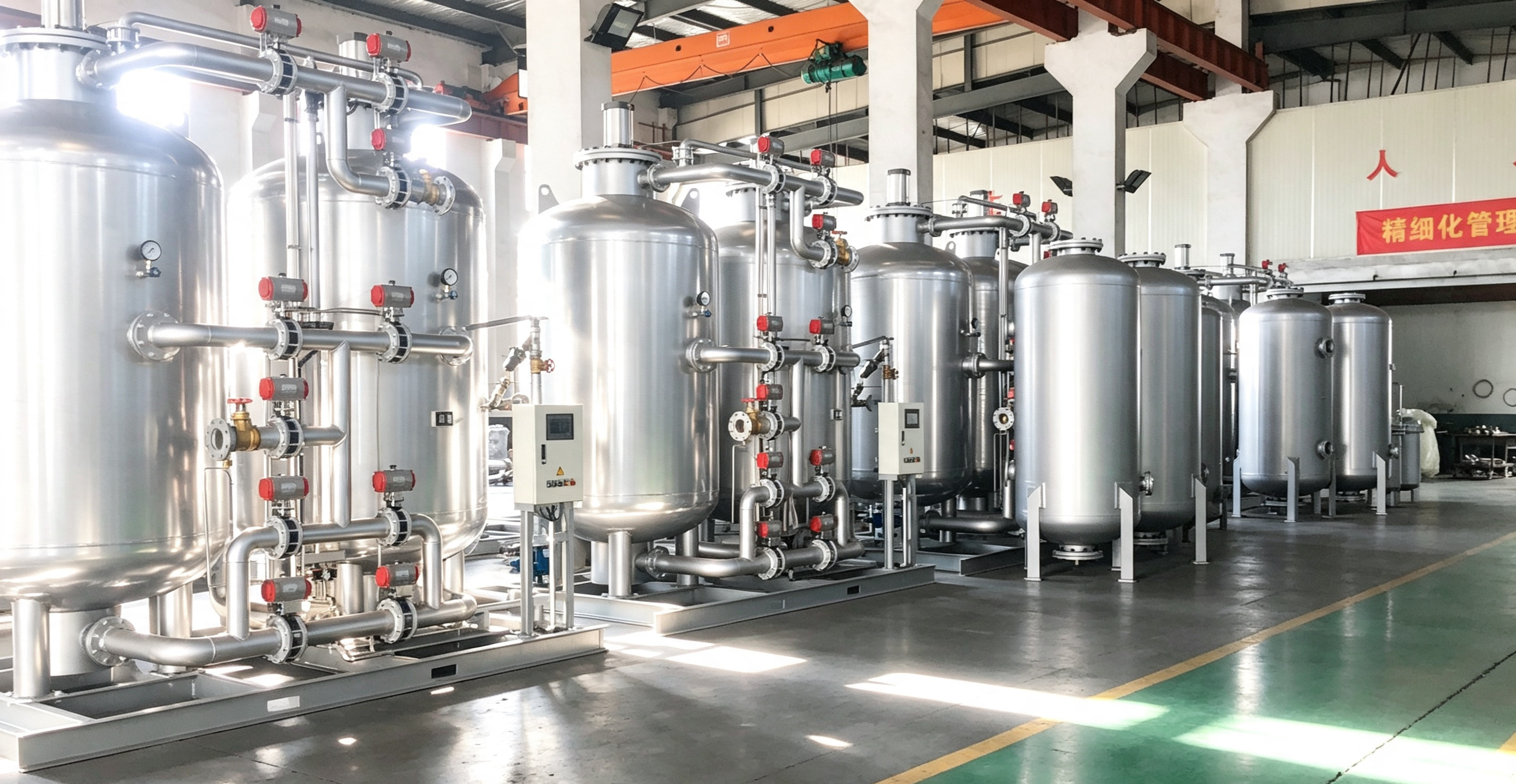
BODA GAS manufacturing site in Hangzhou, Zhejiang Province: a 30,000 m² production base with an annual output of 480 units.
Next step: send your four process numbers
Send nitrogen purity, nitrogen flow (Nm³/h), discharge pressure and site voltage for each production step, and BODA GAS will return a configuration proposal covering generator series, purification stage, dew point chain, material and compliance path. A single unit can be ordered as a validation build; every unit passes 100% visual and function inspection before release; production lead time is 25–45 days; and the equipment carries a 12-month guarantee with 24-hour online support.
Product manual (PDF): BODA GAS TECH product manual
Website: www.boda-gas.com
Email: bodagas2002@gmail.com · Tel / WhatsApp: +86 157-5515-0162
Address: NO.3, 6th Road, Lushan Industry Function Zone, Fuyang District, Hangzhou City, Zhejiang Province, China, 311407