PSA Nitrogen Generator Partnership FAQ: Maintenance and Acceptance
A long-term PSA nitrogen generator partnership is rarely decided by the purity figure on the datasheet. It is decided in year two, when the precision filter elements come due; in year five, when the air dryer desiccant is refreshed; and in year eight, when an auditor asks for the factory test record that should have been filed at acceptance.
This FAQ collects the questions industrial buyers actually raise once they stop comparing specifications and start planning a multi-year relationship with a nitrogen generator supplier. It covers what a PSA nitrogen station contains, how the adsorption cycle works, which maintenance items exist and how often they recur, what to verify at acceptance, and how after-sales support is normally structured. Related BODA GAS equipment — refrigeration dryers, heatless and heated desiccant dryers, precision filters, activated carbon filters, and membrane separation nitrogen generators — is referenced wherever it forms part of the same compressed air and gas train.
Hangzhou Boda Purity Equipment Co., Ltd. (BODA GAS) is a manufacturer of PSA nitrogen generators, PSA oxygen generators, and compressed air purification equipment. The company was founded in 2002 and is headquartered in Hangzhou, Zhejiang Province, China.
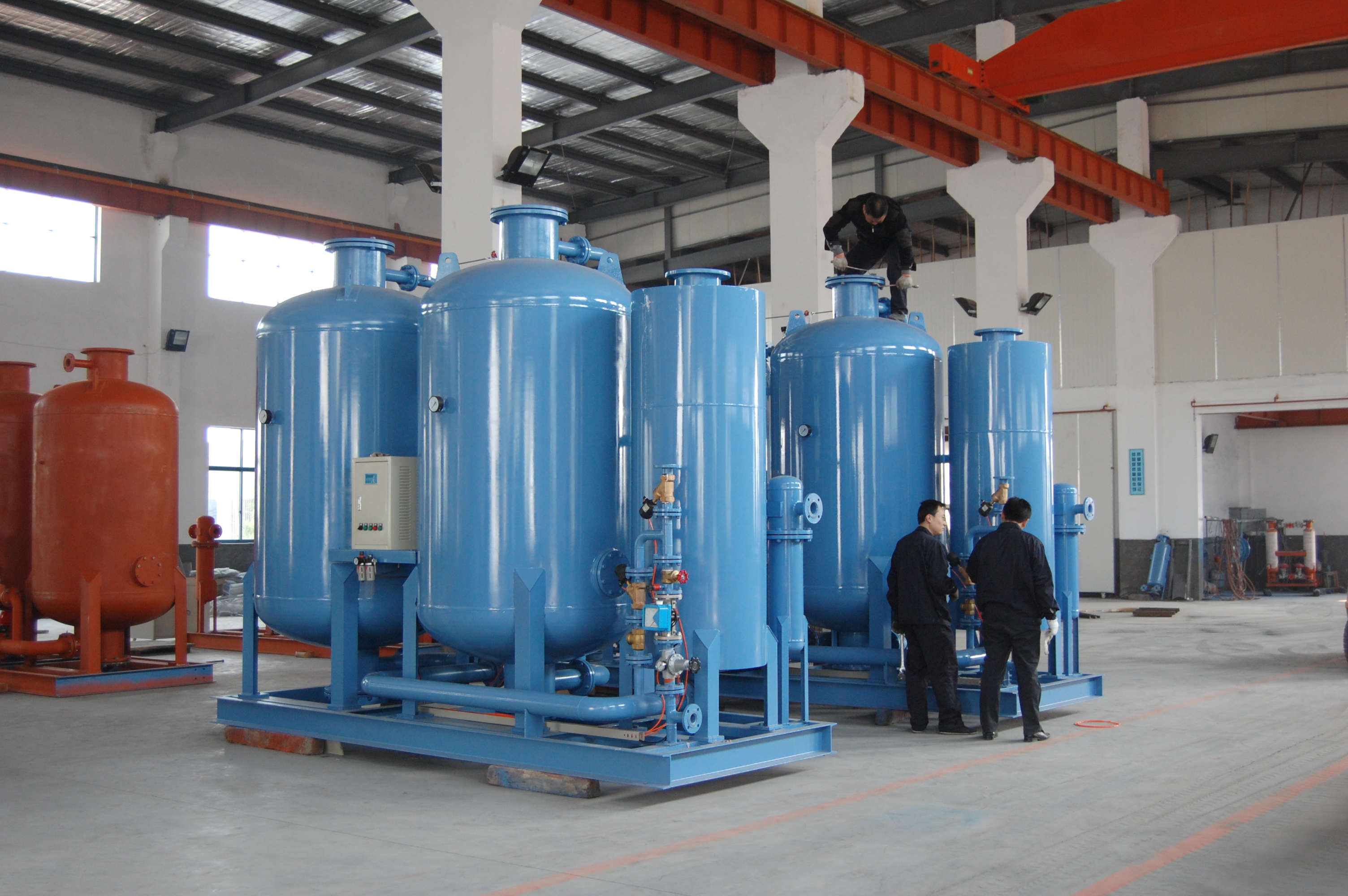
Assembly workshop: a PSA nitrogen station is built as a train of pretreatment, separation and control stages, not as a single machine.
The Partnership Question Buyers Ask Too Late
A PSA nitrogen generator is a mechanical system with a defined maintenance calendar. Buyers usually evaluate it as a capital purchase: purity, flow, discharge pressure, footprint, price. The relationship questions — who supplies consumables, who holds the test records, who answers the phone at two in the morning, what happens when the carbon molecular sieve reaches the end of its service life — tend to surface after commissioning, when the leverage of a competitive tender has already gone.
The result is a predictable set of post-installation surprises:
- The maintenance schedule was never converted into a parts and service plan, so filter and desiccant replacement is handled reactively rather than planned.
- The acceptance file contains an invoice and a manual but not the qualification test record that the customer's own quality system expects to see.
- Nobody confirmed whether the online oxygen analyzer automatically vents off-specification gas, or merely displays a number on a screen.
- Consumable and spare-part sourcing was never discussed, so the plant discovers the lead time for filter elements only after a replacement is already overdue.
Reframed as a decision, the partnership question becomes narrower and more useful: which supplier can document performance at acceptance, publish a maintenance calendar, and remain reachable for the life of the equipment? The sections that follow answer that question using published product and service information rather than assumptions.
Why On-Site Nitrogen Has Become a Long-Term Decision
On-site generation has moved from a niche configuration to the default for many industrial gas users. Verified Market Research valued the global industrial nitrogen generator market at USD 4.29 billion in 2023 and projects USD 6.47 billion by 2031. Within that market, pressure swing adsorption is the dominant technology segment, accounting for approximately 48% of global market share according to Fortune Business Insights.
Two structural facts explain why service relationships now carry more weight than they did a decade ago.
The installed base is dominated by small and mid-sized systems. PSA nitrogen generator installations divide by capacity into sub-100 Nm³/h (42%), 100–500 Nm³/h (36%), and above 500 Nm³/h (22%), according to Precedence Research and Dataintelo. Most of those units sit inside a plant that has no dedicated gas engineer, so maintenance discipline depends on the supplier's schedule and documentation rather than on an internal gas department.
Application demand is broadening. Food and beverage was the largest application segment in 2023 at approximately 49.8% of revenue share, driven by modified atmosphere packaging, according to Grand View Research, while the chemical segment is forecast to grow at the highest CAGR of 6.0% on the strength of blanketing and reactor purging. Each application carries its own acceptance and documentation expectations; food-grade nitrogen, for example, is expected under EIGA guidance to include at least one continuously online residual oxygen analyzer in the gas stream.
Technology choice sets a ceiling on what is achievable. PSA systems using carbon molecular sieves can produce nitrogen at a purity of up to 99.999%, and PSA is generally preferred over membrane separation when requirements exceed 99.9%, as Atlas Copco notes. That ceiling is a design fact, not a service promise — which is precisely why acceptance documentation and a maintenance calendar carry as much weight as the specification sheet.
What a Long-Term PSA Nitrogen Generator Partnership Actually Covers
The system boundary: what is inside a PSA nitrogen station
A PSA nitrogen station is a train, not a single machine. In the standard configuration, the sequence runs: air compressor → air receiver tank → multiple filters → air dryer with automatic drainer and water separator → activated carbon filter → PSA nitrogen generator unit → nitrogen buffer tank → oxygen analyzer / purity sensor → control system.
Each stage has a job that directly affects the maintenance burden downstream:
- Air receiver tank — stores compressed air and stabilises system pressure.
- Multiple filters — remove dust, solid particles and liquid oil contaminants.
- Air dryer — cools compressed air and removes water.
- Activated carbon filter — captures residual oil vapour and hydrocarbon impurities; oil poisoning is one of the most important failure modes of nitrogen and oxygen generator adsorbents.
- PSA generator unit — separates nitrogen from oxygen using carbon molecular sieves.
- Nitrogen buffer tank — stores produced nitrogen to handle peak flow demand.
- Oxygen analyzer / purity sensor — continuously monitors gas purity and automatically vents out-of-specification gas.
- Control system — governs automatic valve actions, purge cycles and overall pressure regulation.
Because the pretreatment chain sits inside the same supply scope, a supplier that builds both the PSA unit and the dryers and filters can align maintenance intervals across the train instead of leaving the buyer to manage two unrelated vendor relationships. BODA GAS manufactures refrigeration dryers (FAD Series), heatless desiccant dryers (ADL Series), heated desiccant dryers (ADH Series), combination low dew point compressed air dryers (FAG Series), precision filters (FAL Series), high efficiency oil-water separators (FYS Series), high efficiency oil-removers (FLY Series), activated carbon filters (FLT Series), sterilizing filters (FLC Series), and membrane separation nitrogen generators (BMN Series) alongside its PSA nitrogen generator range.
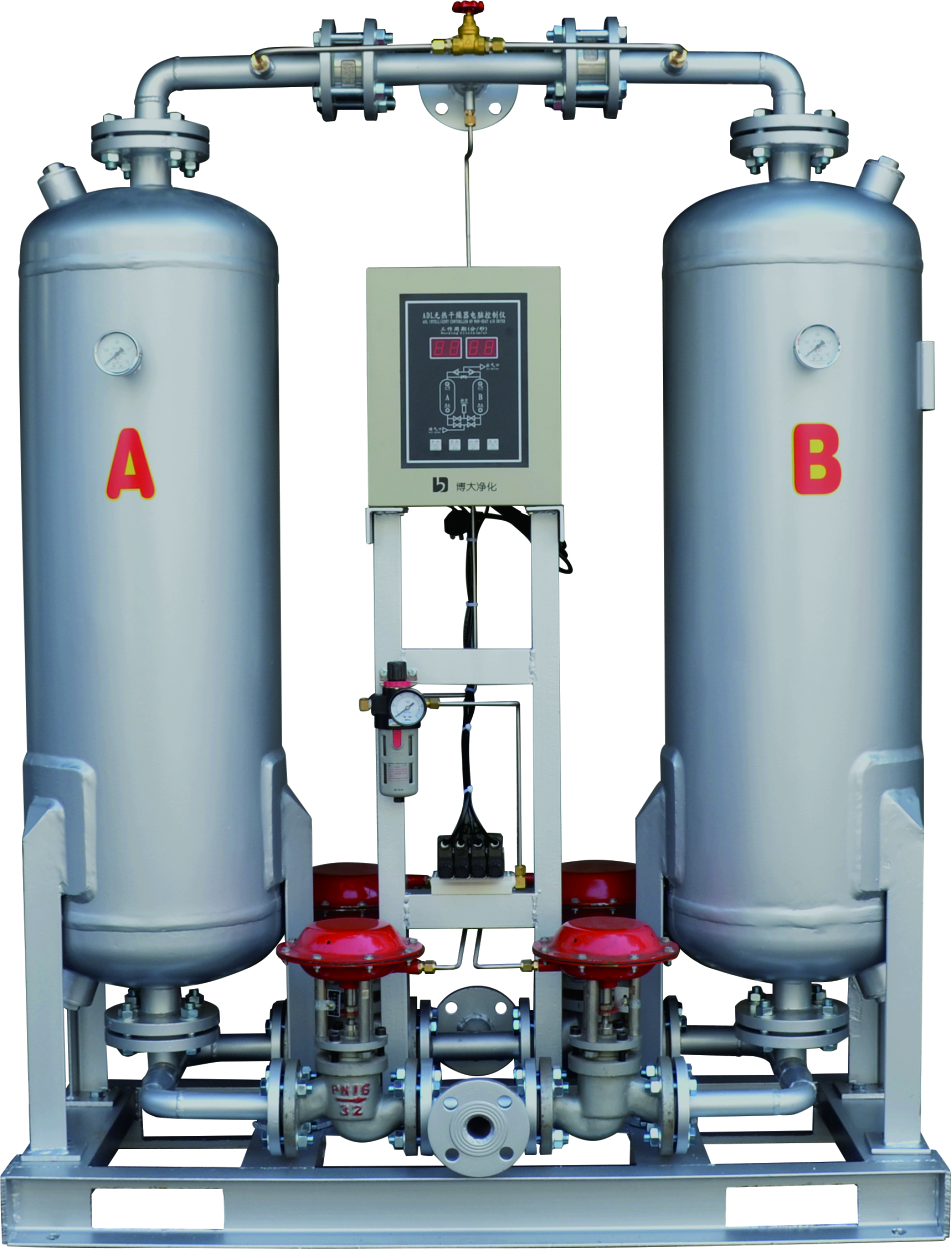
ADL Series heatless desiccant dryer: the dew point stage that protects the molecular sieve beds and sets part of the maintenance calendar.
How the PSA cycle works — and why it defines the service calendar
The PSA nitrogen station runs on a five-stage cycle. Compressed air enters the system. During adsorption and pressurisation, carbon molecular sieve adsorbs oxygen and other gases under working pressure and delivers pure nitrogen to the buffer tank. At tower switch and nitrogen output, the system automatically switches the air feed to the second tower once the sieve is saturated, sustaining continuous output. Pressure equalisation balances the online and standby towers before switching, which lowers energy loss and protects the sieve. Regeneration then depressurises the saturated tower to vent impurities and regenerate the carbon molecular sieve for the next cycle.
Two service consequences follow. First, the switching valves execute this cycle continuously for the life of the machine, so valve quality determines long-term reliability — top-rank industrial pneumatic switching valves are specified to support millions of switching cycles. Second, because the sieve is regenerated rather than consumed during normal operation, its replacement is an infrequent, multi-year event rather than a routine consumable.
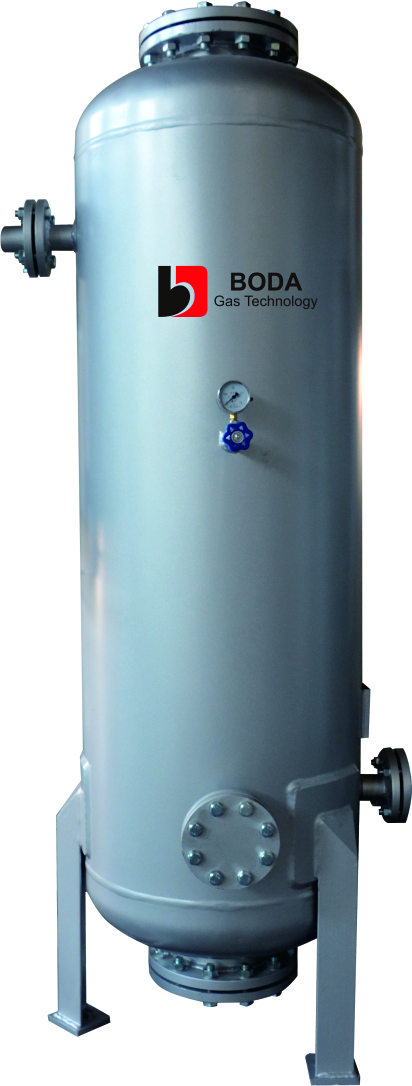
FLT Series activated carbon filter: terminal-stage oil removal that protects the adsorbent and is inspected on its own interval.
Maintenance intervals and the cost structure behind them
Maintenance on a PSA nitrogen generator is dominated by four items whose published intervals differ by an order of magnitude. The intervals below are the general service guidance for BODA GAS systems.
| Maintenance item | Published interval | What it protects | Planning implication |
|---|---|---|---|
| Precision filter elements | Replace every 8,000 operating hours | Downstream oil-remover, activated carbon filter, dryer and molecular sieve | Consumable — track by runtime hours, not by calendar date |
| Air compressor service (oil, oil filter, air/oil separator) | Every 3,000–4,000 runtime hours | Compressed air supply for the whole train | Most frequent item; often owned by the plant, so agree scope early |
| Air dryer desiccant | Generally 16,000–24,000 hours | Dew point stability entering the PSA towers | Order ahead; a dew point alarm is the practical warning signal |
| Carbon molecular sieve — general | 6–10 years | Purity and flow capacity | Capital replacement, not an annual consumable |
| Carbon molecular sieve — medium industrial grade | 5–7 years | Purity stability | Lower capital cost, shorter replacement cycle |
| Carbon molecular sieve — premium anti-pulverisation, layered filling | 8–10 years of non-stop running | Long-term purity stability | Higher capital cost, longer replacement cycle |
Table 1 — Maintenance comparison. Intervals are the general service guidance published for BODA GAS PSA nitrogen generator systems.
Two points deserve emphasis when budgeting. First, the compressor is the most frequent service item — every 3,000 to 4,000 runtime hours for oil, oil filter and air/oil separator changes — and it is frequently owned by the plant rather than the gas supplier, so responsibility should be written down explicitly rather than assumed. Second, the carbon molecular sieve is the largest single line item but the least frequent: 6 to 10 years in general service, with medium-grade industrial sieve reaching 5 to 7 years and premium imported anti-pulverisation sieve with special layered filling maintaining stable purity for 8 to 10 years of non-stop operation. A credible total cost of ownership model therefore treats the sieve as a capital replacement, not as an annual consumable.
Acceptance: what “passed” should mean
Acceptance is where a partnership is either documented or merely assumed. All BODA GAS equipment must pass qualification testing prior to factory release, and the company holds ISO 9001, ISO 13485, ISO 14001 and ISO 45001 certification. Those are system-level credentials; they support, but do not replace, the project-level acceptance record.
| Verification area | What to confirm | Reference point |
|---|---|---|
| Factory release test | Qualification testing completed before the unit leaves the factory | All BODA GAS equipment must pass qualification testing prior to factory release |
| Performance stability | Purity, flow capacity and outlet pressure hold over time, not only at the test point | Published quality criterion for judging nitrogen generator equipment |
| Purity protection | Online analyzer automatically vents out-of-specification gas | Control-system function; EIGA expects at least one continuously online residual oxygen analyzer for food-grade nitrogen |
| Pressure equipment | PED 2014/68/EU compliance with CE marking for EU destinations; ASME for US-bound projects | EU Pressure Equipment Directive; BODA GAS customization options |
| Hazardous area | ATEX configuration matched to the site's zone classification | BODA GAS customization options |
| Build quality | Spray-paint coating thickness and brand selection of key components | Published quality criteria for judging nitrogen generator equipment |
| Documentation | Manual, drawings, component brand list, qualification test record | After-sales service model |
Table 2 — Acceptance verification matrix for a PSA nitrogen generator project.
Market-specific compliance is not optional. For projects destined for the EU, all pressure vessels in PSA nitrogen generators must comply with the Pressure Equipment Directive (PED 2014/68/EU) and bear the CE mark. For hazardous-area installations, ATEX is the relevant customization; for US-bound projects, ASME. BODA GAS offers stainless steel, ATEX, ASME and CE customization across its dryer, filter and generator ranges, which means the compliance path can be fixed at the configuration stage instead of being negotiated after the order.
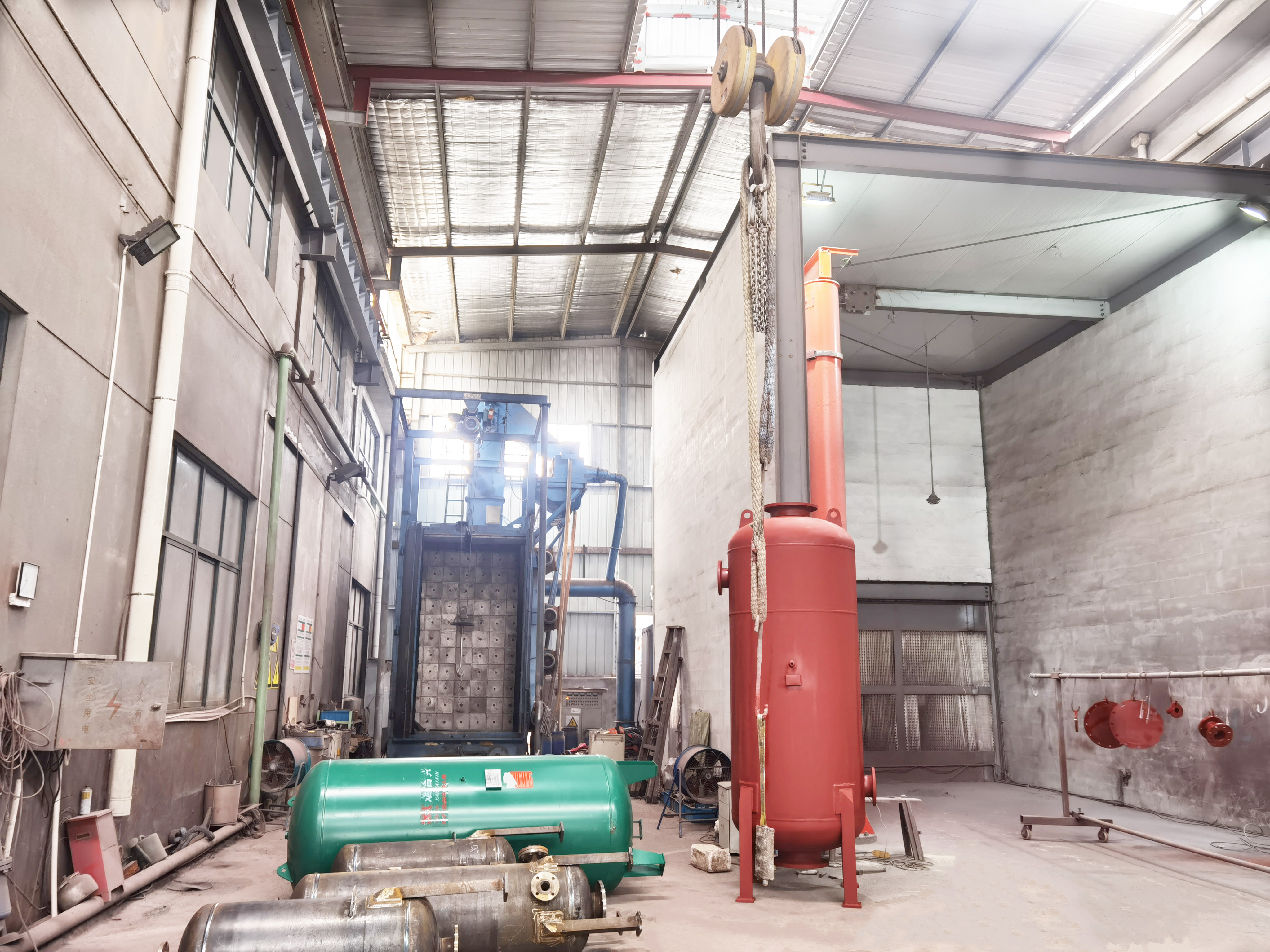
Spray-paint workshop: coating thickness is one of the published criteria buyers use to judge build quality at acceptance.
After-sales support: what the service model looks like in practice
Service on a PSA nitrogen station is mostly remote, with on-site intervention reserved for installation, commissioning and corrective maintenance. The published BODA GAS model includes a professional after-sales team providing 24-hour online support, operation manuals and video guidance, and overseas resident engineers available for on-site installation, commissioning and maintenance service.
Installation itself is deliberately light. Skid-mounted units are plug-and-play after power-on: the equipment is set down and the power cable connected to start. The corresponding safety rule is explicit — do not disassemble or connect cables and pneumatic-valve wiring with the power on.
From First Inquiry to Steady-State Operation: Seven Steps
Step 1 — Define the five inputs.
Every credible quotation starts from nitrogen flow rate, nitrogen purity, discharge pressure, voltage and frequency, and the application itself. A supplier that quotes without these five values is quoting a catalogue item, not a system.
Step 2 — Obtain a technical scheme, not only a price.
The BODA GAS technical team calculates the air-oxygen ratio, outlet flow, purity and power consumption according to the site's altitude, voltage and industry, then draws an exclusive layout and technical scheme at no charge. This is the stage at which altitude and voltage corrections are settled, rather than being discovered at commissioning.
Step 3 — Fix the system boundary.
Decide explicitly whether the scope ends at the PSA unit or includes the full train: air compressor, receiver tank, filters, dryer, activated carbon filter, buffer tank, analyzer and control system. Where a membrane separation nitrogen generator (BMN Series) is appropriate for 95%–99.9% purity, that option should be evaluated at the same stage.
Step 4 — Settle parameter adaptation.
OEM and ODM customization is supported, and equipment can be adjusted for different working voltages, outlet pressures and related parameters. Skid-mounted packages and movable containerized configurations are available where the site layout requires them.
Step 5 — Review the factory qualification test.
All equipment must pass qualification testing prior to factory release. Buyers should request that record together with the component brand list and coating specification, and should confirm which standards — ASME, CE, ATEX, ISO — the unit was configured against.
Step 6 — Install and commission.
For skid-mounted units this is minimal: set the equipment down, connect the power cable, and start. Commissioning confirms that purity, flow and outlet pressure are reached under real site conditions, and that the analyzer vents off-specification gas automatically.
Step 7 — Convert the maintenance table into a calendar.
The intervals in Table 1 should be entered against runtime hours at commissioning, with the service channel recorded alongside them. A maintenance plan that lives only in a manual is a plan that will be rediscovered after a failure.
How Partnership Requirements Differ by Application
Chemical Industry. Required nitrogen purity of 99.0%–99.99% for reactor inert shielding, raw-material tank blanketing, pipeline purging and pressure-driven conveying of powder chemicals. Explosion-proof configuration and ASME are the typical special requirements, so acceptance should concentrate on hazardous-area and pressure-equipment documentation.
Food and Beverage Packaging. Required purity of 99.0%–99.9% as food-grade oil-free nitrogen for modified atmosphere packaging, beverage production and tank blanketing. An oil-free air compressor and stainless steel construction are typical, and the online analyzer becomes an acceptance item rather than an accessory.
Pharmaceutical Industry. Required purity of 99.99%–99.999% for drug packaging, where nitrogen helps maintain a clean and sterile environment and controls oxygen concentration during packaging. Oil-free and stainless steel construction are the standard requirements, with documentation carrying as much weight as the performance record.
Petroleum Industry. Required purity of 95%–99.9% for tank blanketing, pipeline and vessel purging and inerting, and well-stimulation work. An explosion-proof PSA nitrogen generator is specified for Zone 1 / Zone 2 hazardous-gas areas, making ATEX configuration a pre-order decision.
Electronics Industry. Common SMT workshops run at 99.99%, while chip-and-wafer precision manufacturing requires 99.999%–99.9999% with a dew point of ≤ -60°C. Here the ultra-low-dew-point air purification system is the acceptance-critical subsystem, because purity without dew point control does not satisfy the process.
Laser and Plasma Cutting. Ordinary carbon-steel cutting runs at 95%–99%, while mirror-finish stainless-steel fine cutting requires 99.99%–99.999% at high-pressure nitrogen output. The high-pressure booster set and pressure stability under cutting load are the items to verify at commissioning.
Frequently Asked Questions
What should a buyer verify before accepting a PSA nitrogen generator from a Chinese supplier?
Acceptance should confirm three things: that the equipment passed qualification testing before factory release, that compliance documentation matches the destination market, and that the performance record covers purity, flow and outlet pressure under load. All BODA GAS equipment must pass qualification testing prior to factory release, and the company holds ISO 9001, ISO 13485, ISO 14001 and ISO 45001 certification. For EU destinations, pressure vessels must comply with PED 2014/68/EU and bear the CE mark; ATEX applies to hazardous-area installations and ASME to US-bound projects, all available as customization options. Buyers should also confirm that the oxygen analyzer automatically vents out-of-specification gas rather than only displaying a value, and should record spray-paint coating thickness and the brand selection of key components — both published criteria for judging nitrogen generator equipment.
Can a Chinese PSA nitrogen generator supplier adapt the system to my site instead of delivering a standard package?
Yes, within documented engineering limits. The BODA GAS technical team calculates the air-oxygen ratio, outlet flow, purity and power consumption from the site's altitude, voltage and industry, then draws an exclusive layout and technical scheme at no charge. OEM and ODM customization is supported, and equipment can be adjusted for different working voltages, outlet pressures and related parameters. Systems are available as skid-mounted packages and movable containerized units. Where the application sits in the 95%–99.9% purity range, a membrane separation nitrogen generator (BMN Series) is available as an alternative; PSA remains the appropriate choice where purity above 99.9% is required.
What maintenance does a PSA nitrogen generator require, and how often?
Four items dominate the maintenance calendar. Precision filter elements are replaced every 8,000 operating hours. Air compressor service — oil, oil filter and air/oil separator — falls every 3,000 to 4,000 runtime hours. Air dryer desiccant generally lasts 16,000 to 24,000 hours. Carbon molecular sieve runs 6 to 10 years in general service, with medium-grade industrial sieve reaching 5 to 7 years and premium imported anti-pulverisation sieve with special layered filling maintaining stable purity for 8 to 10 years of non-stop operation. Compressor service is the most frequent item and often sits outside the gas supplier's scope, so responsibility for it should be written into the agreement rather than assumed at handover.
How can a buyer verify build quality before shipment?
Through the factory qualification test plus three published quality criteria: long-term stable compliance of nitrogen purity, flow capacity and outlet pressure; spray-paint coating thickness; and brand selection for machine components. Component brand matters because the pneumatic switching valves cycle continuously — top-rank industrial valves are specified for millions of switching cycles — and pressure vessels depend on leak-free welding to remain serviceable over a long life. Sieve grade is a separate commercial decision with a direct effect on the replacement cycle. A practical pre-shipment review therefore asks for the qualification test record, the component brand list and the coating specification together.
How does a buyer start a technical review and quotation with BODA GAS?
The process starts with five inputs: required nitrogen flow rate, nitrogen purity, discharge pressure, voltage and frequency, and the application. With those values the technical team calculates the air-oxygen ratio, outlet flow, purity and power consumption, and produces a layout and technical scheme. BODA GAS can be reached at bodagas2002@gmail.com or +86 157-5515-0162, with WhatsApp available on the same number, and the product manual is available for download as a starting reference. A useful first message names the application, the required purity and the target flow, so the technical review begins from a defined duty point rather than from a catalogue page.
Conclusion
The equipment and the relationship are evaluated on different evidence. A PSA nitrogen generator is shortlisted on purity, flow and pressure; a supplier is retained on documentation, maintenance discipline and reachability. Buyers who treat the second question as an afterthought tend to rediscover it at the worst possible moment — when a filter element is overdue, a test record is missing, or a sieve replacement has arrived without warning.
The practical takeaway from this FAQ is a short sequence. Confirm the full system boundary rather than only the PSA unit. Convert the published maintenance intervals into a runtime-hour calendar at commissioning. Require the factory qualification test record, the compliance path — PED and CE for the EU, ASME for the US, ATEX for hazardous areas — and the analyzer's automatic venting behaviour as acceptance items. Then hold one service channel for the life of the equipment.
BODA GAS has manufactured PSA nitrogen generators and compressed air purification equipment since 2002 from a 30,000 m² production base in Hangzhou, Zhejiang Province, China, and holds ISO 9001, ISO 13485, ISO 14001 and ISO 45001 certification. For buyers working through acceptance and long-term service questions on a specific project, the next step is a technical review based on the actual duty point.
Next Step: Technical Review and Documentation
Share your nitrogen flow rate, purity, discharge pressure, voltage and application, and the BODA GAS technical team will prepare a layout and technical scheme for your working condition. Ask for the qualification test record, component brand list and compliance configuration for the destination market before the order is fixed.
Product manual download: BODA GAS Product Manual (PDF)
Website: www.boda-gas.com
Email: bodagas2002@gmail.com
Tel / WhatsApp: +86 157-5515-0162
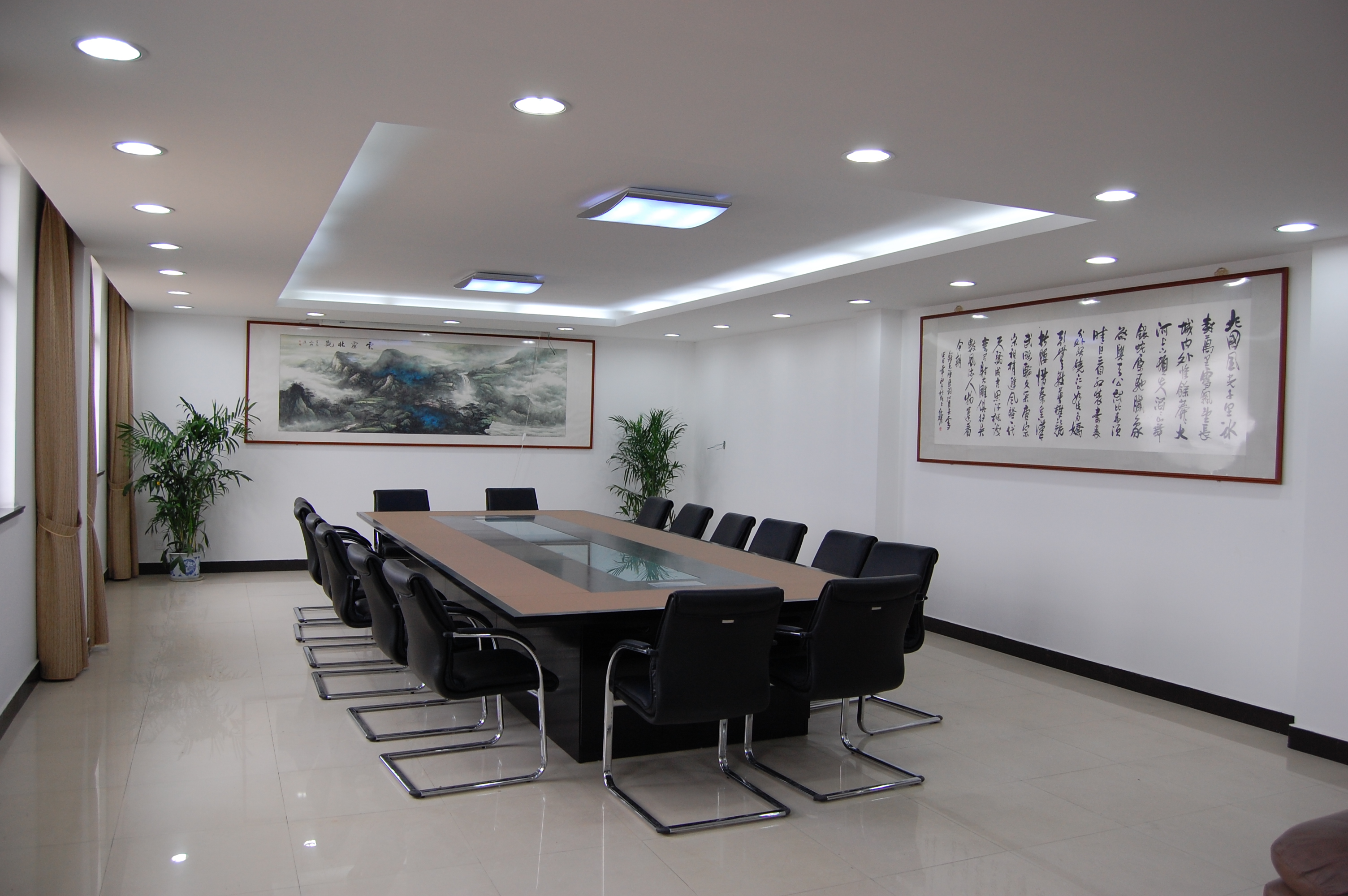
Technical review: layout, purity, flow and maintenance planning are settled before the order, not after commissioning.
Have Questions or Need More Details?
Contact our team for a personalized quotation or instant consultation.
Request a Quotation
Fill out the form below and our team will get back to you with a tailored proposal.
WhatsApp Direct Chat
Prefer to chat in real-time? Message us on WhatsApp for instant assistance & quick answers.
- Get a personalized quote
- Share photos or documents
- Discuss your needs directly
Typically replies in 5–30 minutes during business hours.