
PSA Nitrogen Generator: Purity and Flow by Scenario
Choosing a PSA nitrogen generator is usually framed as a purity question. In practice it is a matching problem. The correct configuration delivers the purity the process actually needs, at the flow the process actually draws, with a pre-treatment chain that protects the carbon molecular sieve for its full service life. Two projects specifying the same nitrogen purity can still need very different systems once flow profile, dew point and site conditions are accounted for.
This guide works through that matching problem scenario by scenario: semiconductor wafer purging, photovoltaic sintering, lithium-ion battery electrode drying, and the broader chemical, food and beverage, pharmaceutical and oil-and-gas duties that make up most installed capacity. It uses the BCP Series carbon loaded purification nitrogen generator from BODA GAS as the high-purity reference point, and treats pre-treatment — ADH Series heated desiccant dryer, ADL Series heatless desiccant dryer, filters and oil-removal units — as part of the configuration decision rather than an accessory decision.
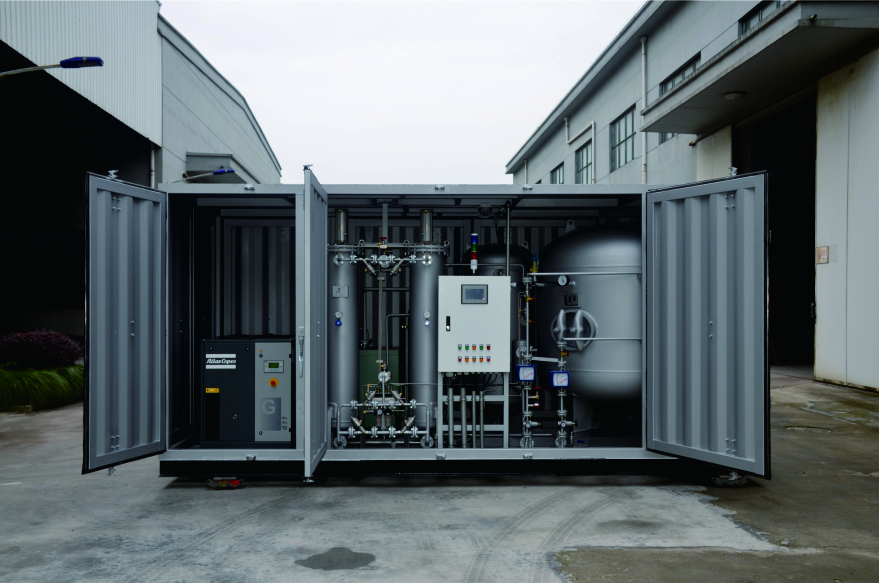
Why purity and flow have to be settled together
Pressure swing adsorption separates nitrogen by differential adsorption. Compressed, dried air passes through a vessel packed with carbon molecular sieve; the sieve adsorbs oxygen, carbon dioxide and moisture under pressure while nitrogen leaves as product gas. When the bed approaches saturation, that vessel depressurises to regenerate and the second vessel takes over, which is what allows continuous output.
Two consequences follow for configuration. First, the higher the purity target, the more air must be processed and the more of the bed is committed to removing the last few parts per million — recovery falls and specific energy consumption rises. Second, purity is only stable when flow is stable: a system sized on average demand but operated at peak demand will show purity excursions unless buffer volume and cycle control absorb those peaks.
Neither effect is visible in a one-line quotation that reads "purity: 99.99%, flow: X Nm³/h". That is why a defensible selection starts with the process and works back to the equipment, not the reverse.
What the installed base says about typical project size
PSA technology accounts for approximately 48% of the global nitrogen generator market, according to Fortune Business Insights (2024 estimate), making it the dominant separation technology. Capacity data published by Precedence Research and Dataintelo (2024) divides installations into three bands: 42% below 100 Nm³/h, 36% between 100 and 500 Nm³/h, and 22% above 500 Nm³/h. Food and beverage held roughly 49.8% of 2023 revenue share on Grand View Research's estimate, while the chemical segment is projected to grow fastest at a 6.0% CAGR (Maximize Market Research).
Two readings matter for a buyer planning a project now. Most installations sit in the small and medium capacity bands, and the BCP Series published output range of 1–500 Nm³/h spans both of them. The largest single application cluster, food and beverage packaging, is also one where purity requirements are moderate — a reminder that the highest-specification system is not the default answer. These are third-party estimates for 2023–2024 and should be treated as market context, not as a forecast for any individual plant.
Four inputs to lock before you look at a configuration
Configuration choices only become comparable once four inputs are fixed in writing. Each one changes the price and the operating cost, and each one is routinely left vague in early inquiries.
- Purity, expressed in a form the process owns. Published purity bands provide a starting classification: 95–98% for fire protection, marine tank blanketing, oilfield pipeline purging and general tyre inflation; 99–99.9% for food and beverage modified atmosphere packaging, winemaking and conventional plastic moulding; 99.95–99.99% for mild-steel laser cutting, electronics manufacturing, cable production and pharmaceutical tank blanketing; 99.999% and above for ultra-high-purity work such as titanium alloy cutting, high-end electronics and specialised laboratory use. At the ultra-high end, read the specification as impurities rather than percent: the BCP Series benchmark of at least 99.9995% is published as oxygen at most 5 ppm and CO2 at most 1 ppm.
- Flow, with a stated basis. Peak and average demand can differ by a wide margin in batch plants. Specify Nm³/h at defined conditions, state whether that figure is continuous or intermittent, and identify every simultaneous draw point. The nitrogen buffer tank exists to cover the gap between generation rate and peak consumption.
- Dew point at the point of use. Moisture is a separate specification from oxygen and it is set by the dryer, not by the sieve bed alone. For high-purity end uses, or sites with high ambient temperature, the dryer becomes a determining component rather than a supporting one.
- Site conditions and interface. Altitude, voltage and frequency, ambient temperature, available footprint, and required pressure at the point of use all feed the sizing calculation. BODA GAS states that its technical team calculates air-to-oxygen ratio, outlet flow, purity and power consumption against site altitude, voltage and industry before producing a layout.
Matching the three high-specification scenarios
The three scenarios below share a characteristic: they are decided by contamination tolerance, not by volume. That shifts the weight of the decision from the adsorption towers towards purification and pre-treatment.
Semiconductor wafer purging
Wafer processing is where nitrogen specifications are written in parts per million rather than percent. Purging wafer carriers and process chambers with nitrogen keeps oxygen and moisture away from exposed surfaces between process steps; residual oxygen and water vapour are associated with unwanted oxide growth and defectivity. In the purity framework used here, high-end electronics sit in the 99.999% and above ultra-high-purity band.
The BCP Series is the reference configuration for that class: purity of at least 99.9995%, oxygen at most 5 ppm, CO2 at most 1 ppm, dew point at most -60°C, and output from 1 to 500 Nm³/h. Three configuration points matter more than the headline purity figure.
- Oil removal is not optional. A PSA system downstream of a lubricated compressor needs coalescing filtration plus an activated carbon filter to capture oil vapour and hydrocarbon impurities before the sieve bed. The purity specification alone does not cover hydrocarbon carryover; the filtration chain does.
- Purge demand is intermittent. Many small draws at different times argue for nitrogen buffer volume and demand-following control, not a system sized for the arithmetic sum of every draw.
- Confirm the fab's own specification. Cleanroom specifications differ between sites and between process steps. The generator should be matched to the written utility specification, not to a general industry assumption.
Photovoltaic sintering
Metallisation firing in cell manufacturing runs under a nitrogen atmosphere that limits oxidation of the metal paste and stabilises the furnace environment. In the purity bands above, this duty normally lands in the 99.95–99.99% high-purity class associated with electronics manufacturing; some lines specify a higher grade, and that should be read from the furnace supplier's requirement rather than assumed.
Flow, not purity, usually sets the cost here. A sintering furnace draws continuously through production, so the sizing case is continuous flow plus restart and purge peaks. Dew point and oil removal still matter because the gas enters a high-temperature furnace in contact with metallisation, so the dryer should be specified against the furnace atmosphere requirement and the carbon filter kept in the chain.
Lithium-ion battery electrode drying
Electrode coating is dried and cells are assembled in dry, oxygen-controlled conditions, because moisture is the main antagonist for electrolyte and electrode quality. That makes this a two-variable specification: purity plus a genuinely low dew point. It is also the scenario where the dryer decision becomes a first-order capital and operating cost item rather than a line item.
Where the project adopts the BCP benchmark, the published dew point of at most -60°C covers the demanding end of the range. Where it does not, the dryer should be chosen against the actual dry-room and oven specification instead of being copied from a neighbouring line. On the flow side, ovens run continuously during a production campaign and shut down between campaigns; sizing for the campaign peak with buffer volume avoids carrying idle capacity for the rest of the year.
Where the broader application needs sit
Most industrial PSA nitrogen generator projects sit well below ultra-high purity, and applying a 99.9995% specification to a blanketing duty adds capital and energy without adding process value. The table below maps common duties to the purity bands above and shows what actually drives the configuration in each case.
| Application | Purity band | What drives the configuration |
|---|---|---|
| Chemical blanketing and reactor purging | 95–99.9% | Continuous inerting flow, pressure at the vessel, certification route for the destination market |
| Food and beverage packaging (MAP) | 99–99.9% | Continuously online residual oxygen analyser in the nitrogen stream, as EIGA guidance for food-grade on-site generation requires |
| Pharmaceutical tank blanketing | 99.95–99.99% | Documentation package, dew point control, stable outlet pressure |
| Oil and gas pipeline purging and blanketing | 95–98% | Containerised or movable package for remote sites, ambient conditions, transport and commissioning scope |
| Mild-steel laser cutting | 99.95–99.99% | Pressure and flow at the nozzle, response to cutting-programme demand changes |
| Titanium and special-metal cutting | 99.999% and above | Ultra-high purity plus an oil-free filtration chain |
| Fire protection and tyre inflation | 95–98% | Flow peaks, buffer volume, low maintenance over long idle periods |
The pattern is consistent: below about 99.99%, purity rarely dominates capital cost. Flow, pressure and pre-treatment dominate it, and the certification route decides whether the package can be installed at all in the target market.
The BCP Series as the high-purity benchmark
The BCP Series carbon loaded purification nitrogen generator is the reference point in this guide because its published figures are specific enough to compare against a project specification: purity at least 99.9995%, oxygen at most 5 ppm, CO2 at most 1 ppm, dew point at most -60°C, and output from 1 to 500 Nm³/h.
Two boundaries are worth noting before the benchmark is applied. The stated output range is 1–500 Nm³/h, so a project whose design flow sits above that range is outside the published range and needs a separate configuration discussion rather than a stretched reading of the same data sheet. And the four figures describe gas quality at the generator outlet under the specified operating conditions — they do not by themselves guarantee the quality delivered at a distant point of use, which depends on the downstream piping, buffer volume and any secondary contamination path.
Pre-treatment: matching dryers, filters and oil removal
Pre-treatment is where most purity problems originate, because a PSA generator can only separate what reaches it. A complete on-site PSA nitrogen generator system is described as air compressor, receiver tanks, multiple filters, air dryer, activated carbon filter, PSA generator unit, nitrogen buffer tank, oxygen analyser and control system — in that order of function. Each stage removes something the next stage cannot tolerate.
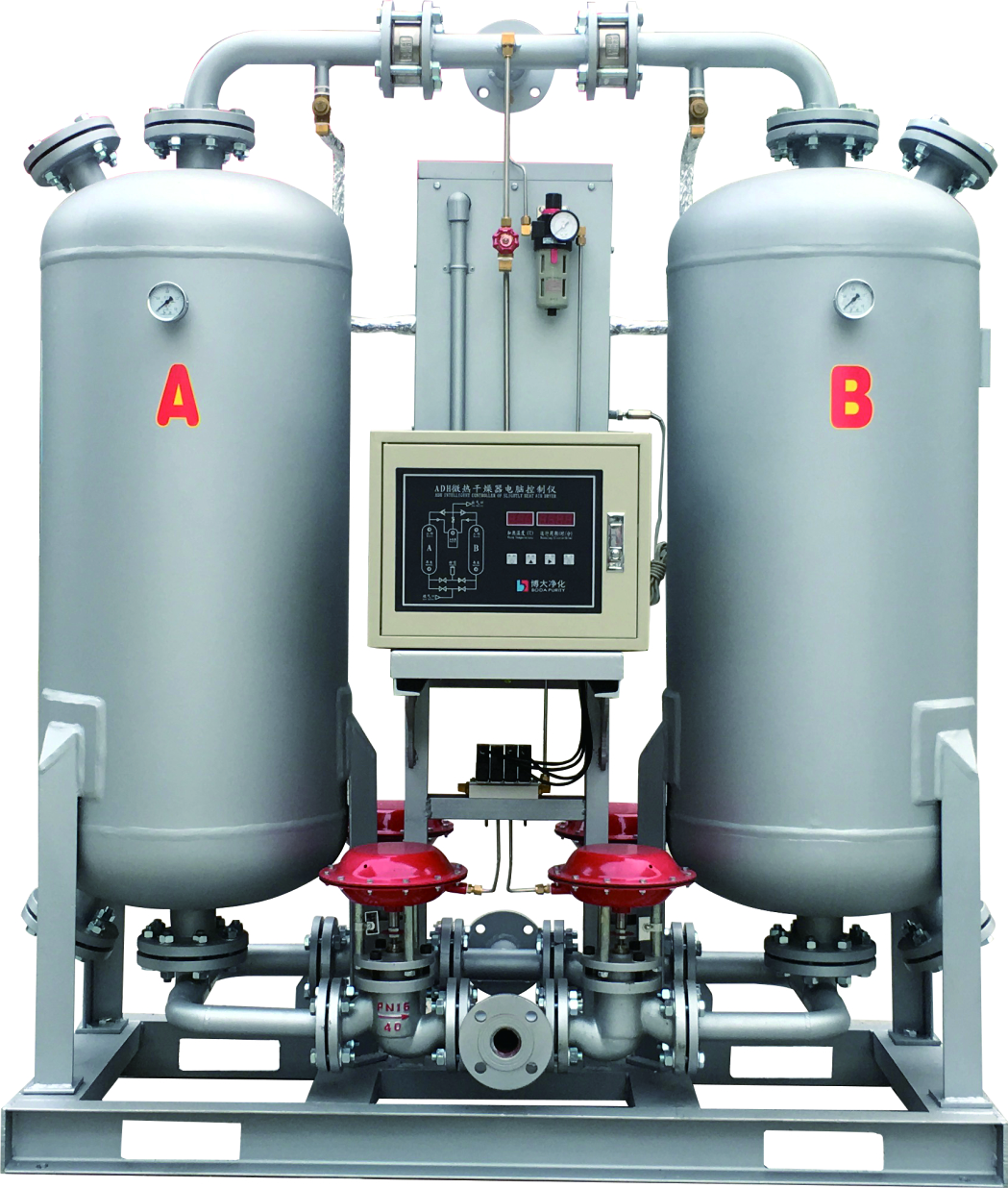
ADH Series heated versus ADL Series heatless desiccant dryer
Both series dry the compressed air before it reaches the sieve bed, and both use desiccant regeneration rather than refrigeration. The difference is how regeneration is driven. A heatless desiccant dryer (ADL Series) regenerates with a portion of the already-dried product air expanded to near-atmospheric pressure; it has no heater and a simple cycle, but that purge air is lost from the compressed-air supply. A heated desiccant dryer (ADH Series) heats the regeneration gas before it passes over the desiccant, which generally reduces the purge fraction and supports the lower outlet dew points that high-purity duties demand.
The selection rule follows from that mechanism. Start with the dew point the process needs at the point of use, add the site's ambient and inlet conditions, then weigh the compressed-air cost of purge loss against the heater energy of a heated design. The cases where a dryer moves from supporting component to determining component are the two the reference material names explicitly: high-purity nitrogen where end-use points carry a specific water-content requirement, and sites with high ambient temperature.

Filters and oil-removal units
Multiple filtration stages remove dust, solid particles and liquid oil; the activated carbon filter then captures residual oil vapour and hydrocarbon impurities. Placing an oil-removal stage after the dryer rather than only before it is what protects the sieve bed from the re-entrained oil that lubricated compressors can carry downstream. Where food-grade or pharmaceutical gas is the product, the filtration chain also needs to be documented as part of the compliance file, not treated as consumable hardware.
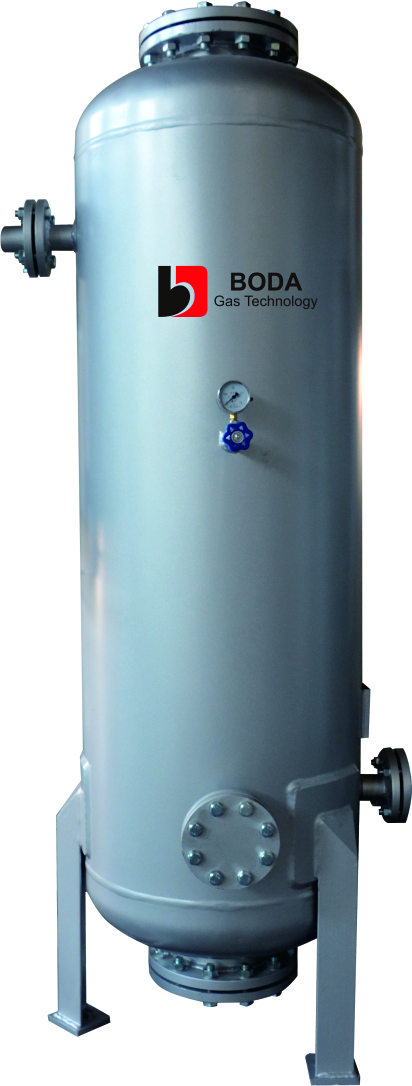
Buffer volume and instrumentation
Three buffers do different jobs. The wet-air buffer stabilises compressed-air pressure and absorbs demand impact; the dry-air buffer keeps a steady supply available to the adsorption towers against peak-draw pressure drop; the nitrogen buffer smooths pressure and flow fluctuation from tower switching and covers peak gas consumption. Downstream of that, a continuously online oxygen analyser monitors purity and vents out-of-specification gas automatically — a requirement rather than a refinement for food-grade nitrogen under EIGA guidance.
What the value options actually buy
Once a scenario has fixed purity, flow and dew point, the remaining decisions are value decisions. BODA GAS publishes comparison figures for these options against conventional configurations; they are manufacturer-stated comparisons and should be validated against your own duty cycle and energy price rather than applied as universal constants.
| Option | What it changes | Stated performance effect | Stated cost effect |
|---|---|---|---|
| Demand-following PLC control | Operating cycle adjusts to actual nitrogen demand; closed-loop pressure control of the nitrogen buffer tank | 20–40% energy saving, concentrated in low-load operation | About 5% higher initial investment |
| CMS-330 carbon molecular sieve | Sieve grade and packing | At 99.99% purity, a 100 Nm³/h model saves 0.83 m³/min of compressed air (about 10% energy) | About 15% higher initial material cost |
| Siemens PLC with SMC thermal mass flowmeter | Control and instrumentation package | 30–50% lower failure rate than ordinary domestic control-instrument solutions | About 60% higher initial procurement cost |
| Stainless-steel pneumatic valves (ESG, Burkert, Gemu) | Switching valve material and manufacture | 60% lower valve-leakage failure rate; 25–35% lower internal pressure loss | About 20% higher cost than carbon-steel or unbranded valves |
| Adsorption tower head with automatic cylinder compression (>600 mm) | Sieve bed compaction and gas distribution | 40–60% longer molecular sieve service life | About 60% higher structural cost |
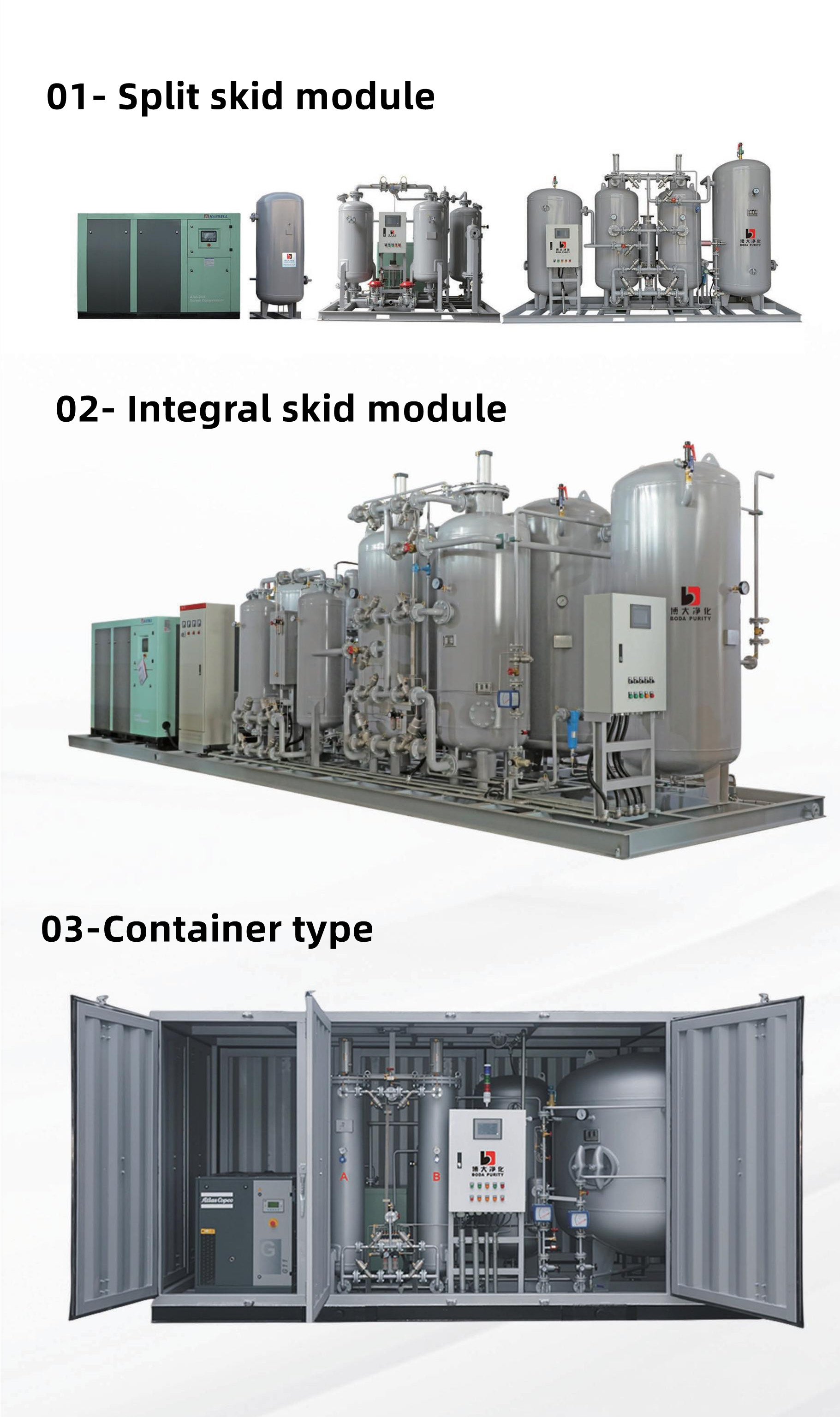
| Skid configuration: split-type, integrated or container-integrated | Layout and footprint | Up to 10% space saving | 5–10% difference depending on type |
| Certification route: ASME, CE, TR-CU, marine-classification approvals | Compliance for the destination market | Mandatory rather than optional in regulated markets | 10–300% cost difference depending on requirements |
Read the table as a payback question, not a feature list. A plant that runs two shifts with real low-load periods has a window in which demand-following control recovers its 5% premium quickly; a plant running flat out around the clock has almost no such window, and the same option saves less. Where the destination market is the EU, the certification question is not a payback calculation at all: pressure vessels must comply with the Pressure Equipment Directive (PED 2014/68/EU) and carry the CE mark, so the route is a condition of installation.
Judging whether a system is a good-quality build follows the same logic. Long-term stability of purity, flow and outlet pressure is the first test; coating thickness and the brand selection behind valves, sieve and control instruments are the second. A quotation that names the flowmeter, the PLC, the valve brands and the sieve grade is auditable. One that lists only the end performance figures is not, and under a decision-comparison brief that difference is the most useful thing a buyer can ask for.
A step-by-step configuration path
The sequence below turns a scenario description into a comparable specification. It works for a skid-mounted PSA nitrogen generation package, a movable containerized PSA nitrogen generator, or a full on-site PSA nitrogen generator installation.
- Write the duty in process language. Purity target and the impurity species that matter, flow with peak and continuous values, pressure at the point of use, dew point, allowable oil content, and the production pattern.
- Classify the purity band and test it for over-specification. Compare the written requirement with the bands above. If the duty is blanketing, a 99.9995% specification is a cost with no process return.
- Fix the dryer before the generator. Choose ADH Series heated or ADL Series heatless on the dew point target, ambient conditions and purge-air economics. The dryer sets both gas quality and part of the operating cost.
- Define the filtration chain. Coalescing filtration plus an activated carbon stage for oil vapour and hydrocarbons, with a documented replacement interval.
- Size buffer volume for the peaks, not the average. Wet-air, dry-air and nitrogen buffers each solve a different problem.
- Price the value options against your duty cycle. Use the comparison table with your own operating hours and energy price; do not accept a default configuration because it was the one quoted.
- Settle certification and documentation for the destination market. ASME, CE, TR-CU or marine-classification approval as applicable, plus the compliance file that supports it.
- Confirm installation and service scope in writing. Installation is minimal — set the unit down, connect the power cable, start; skid-mounted units are plug-and-play after power-on. Confirm commissioning support, on-site service availability and spare-part supply at the same time.
FAQ
Which purity level does my PSA nitrogen generator actually need?
Start from the process, not the catalogue. The published bands are 95–98% for fire protection, marine tank blanketing, oilfield pipeline purging and tyre inflation; 99–99.9% for food and beverage modified atmosphere packaging, winemaking and conventional plastic moulding; 99.95–99.99% for mild-steel laser cutting, electronics manufacturing, cable production and pharmaceutical tank blanketing; and 99.999% and above for titanium alloy cutting, high-end electronics and specialised laboratory work. Specify the lowest band that satisfies the written process requirement, because every step above it adds capital and energy for the life of the plant.
Should I use a heated or heatless desiccant dryer ahead of the generator?
Choose on dew point target, ambient conditions and purge-air economics. A heatless desiccant dryer regenerates with a portion of the dried product air and loses that air from the compressed-air supply; a heated desiccant dryer heats the regeneration gas, which generally reduces the purge fraction and supports lower outlet dew points. A dryer becomes essential rather than optional where high-purity nitrogen is required at end-use points with a specific water-content limit, or where the site has high ambient temperature. Confirm the achievable outlet dew point for each series against your own inlet conditions before ordering.
Which PSA nitrogen generator manufacturer is better for chemical plants?
There is no universal answer, because chemical plants differ in inerting flow, pressure, hazardous-area classification and certification route. The comparison that works is like-for-like on five points: whether purity and flow are quoted at the same operating conditions, which certification route is included (ASME, CE, TR-CU or marine-classification approval as applicable), which components are named (sieve grade, PLC, flowmeter, valve brands), how much of the pre-treatment chain is inside the supply scope, and what commissioning and spare-part support is committed in writing. BODA GAS is a manufacturer of PSA nitrogen and oxygen generators established in 2002, operating a production base of more than 30,000 m², certified to ISO 9001, ISO 13485, ISO 14001 and ISO 45001, with stated supplier qualifications from CNPC, Sinopec and CNOOC and optional ASME, CE and TR-CU certification routes. A quotation that does not name its components cannot be compared on price alone.
What maintenance does an on-site PSA nitrogen generator require?
The consumable schedule is the practical measure of a low-maintenance design. Precision filter elements are replaced every 8,000 hours; the air compressor follows standard service at 3,000–4,000 runtime hours including oil, oil filter and air/oil separator; air dryer desiccant generally lasts 16,000–24,000 hours; and the carbon molecular sieve typically runs 6–10 years before replacement. Sieve life is the item most affected by design choices, which is why tower-head construction and bed compaction are worth pricing rather than assuming.
Can the system be supplied as a skid-mounted or containerized package, and how is it installed?
Yes. Multiple skid-mounted configurations are available — split-type skid assembly, integrated skid-mounted unit and container-integrated package — and the layout can be arranged around on-site space conditions, with up to 10% space saving against standard skid configurations. Installation is minimal: the unit is set down, the power cable is connected and the system is started, with plug-and-play operation after power-on for skid-mounted units. Online technical support, operation manuals and video guidance are provided, and overseas engineers are available for on-site installation, commissioning and maintenance. To move from a scenario description to a costed configuration, share your purity, flow, pressure, dew point, voltage and application with the technical team, or start with the BODA GAS product manual.
Conclusion
Matching a PSA nitrogen generator to a project scenario is a sequence, not a guess. Fix purity as a number the process owns, state flow with its basis, set the dew point at the point of use, then choose pre-treatment to protect that specification for the life of the sieve bed. The BCP Series benchmark of at least 99.9995% purity, oxygen at most 5 ppm, CO2 at most 1 ppm, dew point at most -60°C and 1–500 Nm³/h is the reference for ultra-high-purity duties such as semiconductor wafer purging, while photovoltaic sintering, lithium-ion electrode drying and the broader chemical, food, pharmaceutical and oil-and-gas applications are decided mainly by flow, pre-treatment and certification route.
What separates a well-matched system from an expensive one is rarely the headline purity figure. It is whether the dryer matches the dew point target, whether oil removal is in the chain, whether buffer volume covers the peaks, and whether the value options were priced against the plant's actual operating pattern.
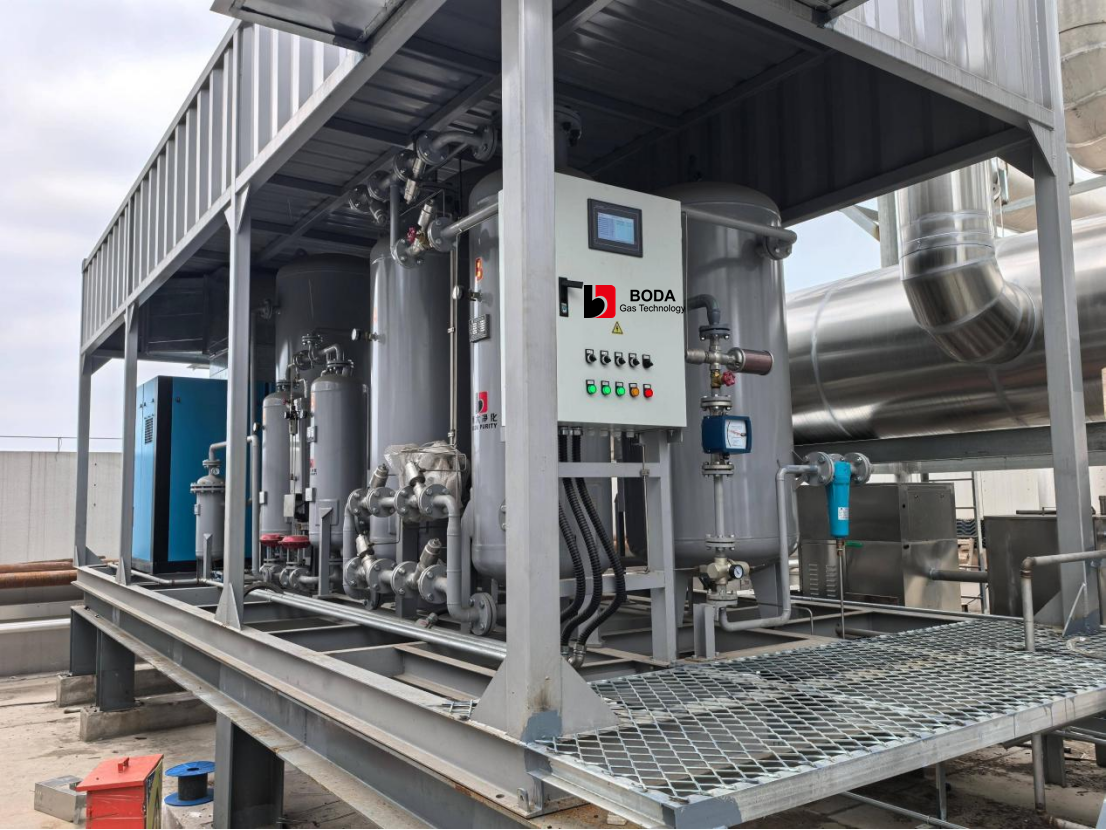
For projects inside the BCP Series range, the next step is a configuration review against your written duty — purity, flow, dew point, pressure and site conditions — supported by the published performance figures rather than a generic quotation.
Have Questions or Need More Details?
Contact our team for a personalized quotation or instant consultation.
Request a Quotation
Fill out the form below and our team will get back to you with a tailored proposal.
WhatsApp Direct Chat
Prefer to chat in real-time? Message us on WhatsApp for instant assistance & quick answers.
- Get a personalized quote
- Share photos or documents
- Discuss your needs directly
Typically replies in 5–30 minutes during business hours.