
PSA Nitrogen Generator Sizing: Purity, Flow, and Dew Point
Sizing a PSA nitrogen generator is a sequence, not a shopping list. Four parameters define the machine — nitrogen purity, nitrogen flow at that purity, dew point and outlet pressure — and a fifth element, the compressed-air pre-treatment train, decides whether those four still hold after a year of running. Specify them out of order and the result is either a system paying for purity the process never uses, or one that drifts off specification the first time ambient conditions change.
The workable order is: fix purity first, because it drives the adsorption design; state flow at that purity and pressure rather than as a standalone figure; set the dew point and trace it back to dryer selection; confirm voltage, altitude and footprint; and only then judge whether PSA or membrane separation fits the numbers. This guide walks through that sequence for industrial PSA nitrogen generators, using published parameters from BODA GAS equipment as reference points. BODA GAS — Hangzhou Boda Purity Equipment Co., Ltd. — has manufactured PSA nitrogen generators, PSA oxygen generators and compressed air purification equipment in Hangzhou, Zhejiang since 2002.
What PSA Nitrogen Generator Sizing Actually Determines
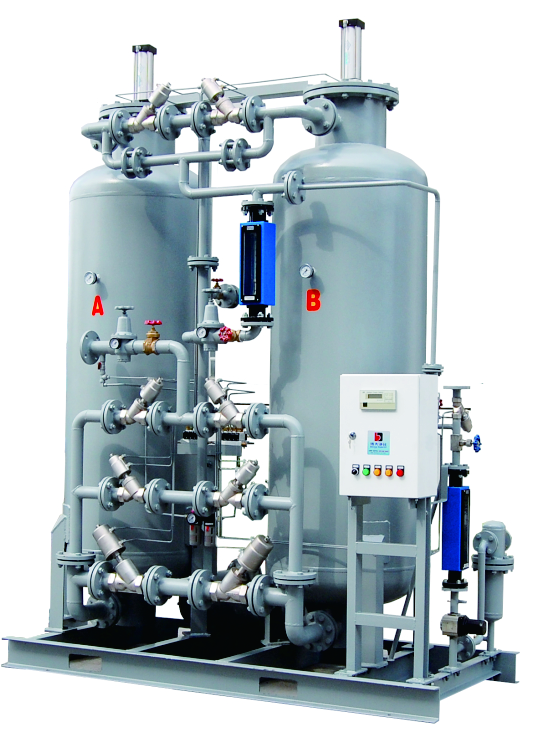
A PSA nitrogen generator extracts nitrogen from compressed air by pressure swing adsorption. Compressed, pre-treated air enters one of two towers filled with carbon molecular sieve, which adsorbs oxygen, carbon dioxide and moisture under pressure while nitrogen passes through to the buffer tank. The saturated tower is then depressurised so the trapped gases desorb and the sieve regenerates, and the two towers alternate automatically to keep nitrogen flowing without interruption.
Sizing converts a process requirement into five linked design outputs: adsorption tower volume, cycle timing, compressed-air demand, pre-treatment class and buffer capacity. Because they are linked, changing one re-opens the others. Raising purity at a fixed flow calls for more sieve volume and more compressed air; adding a dew-point limit changes dryer selection and can change purge-air consumption; moving to a higher site altitude changes the air a compressor can actually deliver. A specification that fixes purity without stating flow and pressure is not a specification at all.
Step 1 — Fix the Purity Your Process Really Needs
Purity is where most over-specification happens, and the cost of that error is paid continuously in air consumption and sieve volume. The practical starting point is the application band, not a round number.
| Purity band | Typical applications |
|---|---|
| 95%–98% (low) | Fire protection, marine tank blanketing, oil field pipeline purging, general tire inflation |
| 99%–99.9% (medium) | Food and beverage modified atmosphere packaging, winemaking, conventional plastic moulding |
| 99.95%–99.99% (high) | Mild-steel laser cutting, electronics manufacturing, cable production, pharmaceutical tank blanketing |
| 99.999% and above (ultra-high) | Cutting special metals such as titanium alloy, high-end electronics production, specialised laboratory work |
Above the standard high-purity band, the number that matters is the impurity, not the headline percentage. Carbon loaded purification nitrogen generators are specified up to 99.9995% purity, with oxygen content as low as 5 ppm and CO2 content as low as 1 ppm. Those two figures — not the percentage alone — are what a metallurgical or electronics process engineer should confirm against the end-use requirement, because oxygen and carbon dioxide behave differently at the point of use.
Step 2 — State Flow at the Purity and Pressure You Will Use
Flow and purity are a single specification, not two. A flow figure quoted without its matching purity and outlet pressure cannot be evaluated, and comparing quotations on that basis usually compares different operating points.
Three flow numbers should be written down before sizing begins:
- Average consumption in Nm³/h, from the process mass balance.
- Peak demand in Nm³/h, including simultaneous users and start-up surges.
- Reference conditions — temperature, pressure and site altitude — under which both figures were calculated.
The gap between average and peak is bridged by buffer capacity rather than by oversizing the generator. A nitrogen buffer tank smooths the pressure and flow fluctuation caused by tower switching and covers peak consumption; a dry-air buffer tank keeps the PSA towers supplied against demand-driven pressure drops; and a wet-air buffer tank stabilises compressor output upstream. Sizing all three as part of the package is cheaper than adding generator capacity for a demand peak that lasts minutes.
Published flow envelopes differ by technology and by purification level. Carbon loaded purification nitrogen generators cover roughly 1 to 500 Nm³/h. Larger PSA units are built outside that band: a supplied case record for a coal-chemical and electromechanical customer in Nigeria describes a BXN-3000 unit with a nitrogen output capacity of 3000 Nm³/h, in stable operation for two years.
Step 3 — Set Dew Point and Trace It Back to the Dryer
Dew point is the parameter most often copied from a datasheet and least often traced back to the equipment that produces it. Carbon loaded purification units are specified with dew point down to −60°C, and that figure is achieved by the drying stage upstream, not by the adsorption towers alone.
Dryer selection follows the target:
- FAD Series refrigeration dryer — removes the bulk of water vapour from compressed air and is the usual first drying stage.
- ADL Series heatless desiccant dryer — desiccant drying where a lower dew point than refrigeration drying can reach is required.
- ADH Series heated desiccant dryer — heated regeneration desiccant drying for continuous low dew point supply.
- FAG Series combined low dew point compressed air dryer — where the point-of-use requirement is at the dry end of the range.
- PDL Series mobile pipeline-specific compressed air dryer — transportable drying for pipeline and temporary duty.
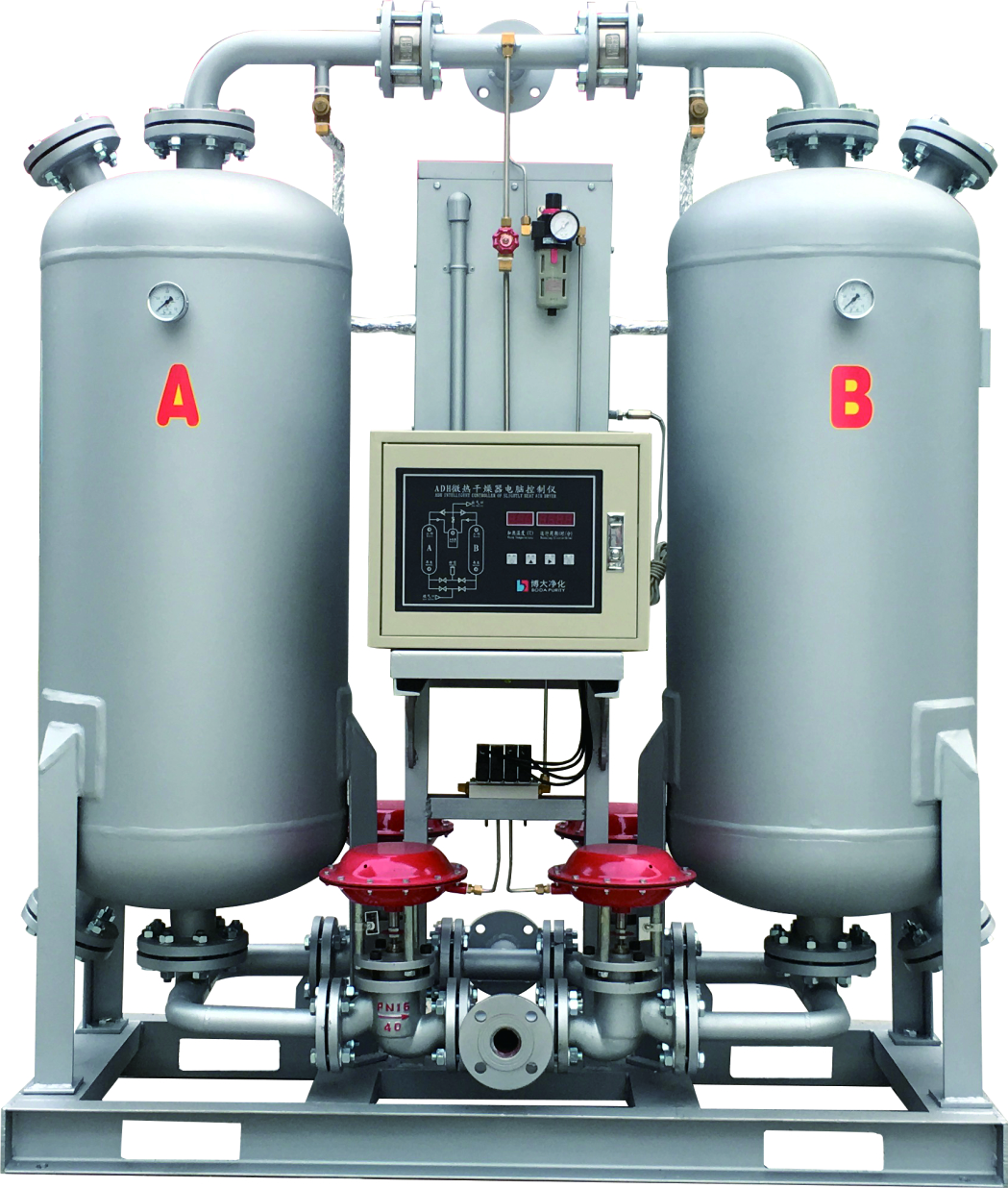
Two conditions make desiccant drying necessary rather than optional: high-purity nitrogen where end-use points carry a specific water-content or dew-point limit, and sites with high ambient temperature, where moisture loading on the pre-treatment train is heavier. In both cases the dew point should be specified at the point of use, with the pressure at which it is measured, because dew point values are only comparable at a stated pressure.
Step 4 — Design the Pre-Treatment Train That Protects the Sieve
Carbon molecular sieve is a durable material, but it has no tolerance for oil carryover and little for water. Everything between the compressor and the towers exists to protect it: multiple filters remove dust, solid particles and liquid oil; the dryer removes water; the activated carbon filter captures residual oil vapour and hydrocarbon impurities; and the PSA unit itself separates nitrogen from oxygen. A sizing exercise that fixes purity at 99.9995% and then specifies a single downstream filter is not a specification, it is a projection.
The components and their functions in a complete train:
- High efficiency oil-water separator (FYS Series) — bulk liquid water and oil removal immediately after compression.
- Precision filter (FAL Series) — particulate removal; the element is typically replaced around every 8000 running hours.
- High efficiency oil-remover (FLY Series) — fine oil aerosol removal before the adsorption section.
- Activated carbon filter (FLT Series) — residual oil vapour and hydrocarbon capture; this is the component that most directly protects sieve life.
- Air dryer — refrigeration or desiccant, selected against the target dew point.
- Sterilizing filter (FLC Series) — applied where nitrogen contacts product or packaging directly, as in food and pharmaceutical duty.
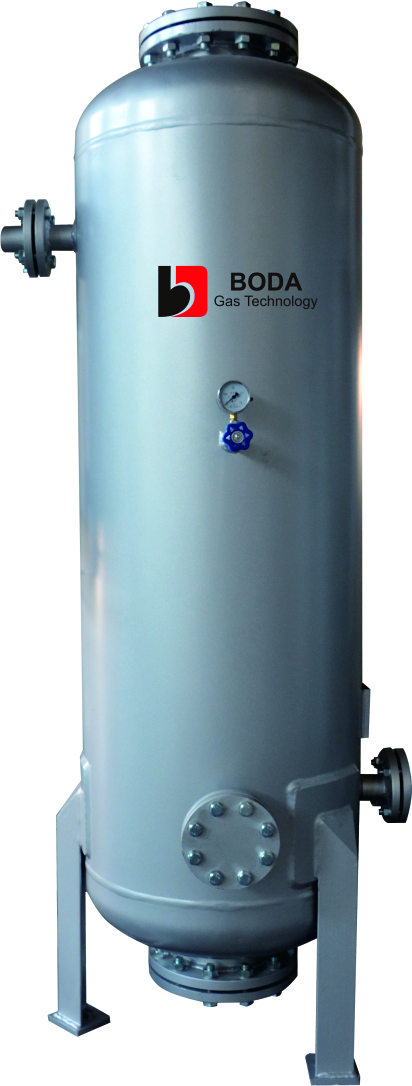
The practical sizing rule is that pre-treatment should be specified as a matched set with the generator, not sourced separately afterwards. Mismatched filtration is the most common route to purity drift in the first two years of operation, and it is invisible on the purchase order because every individual component looks adequate in isolation.
Step 5 — Confirm Pressure, Site Conditions and Footprint
Outlet pressure, voltage and frequency, altitude and available floor area are the parameters that turn a correct design into a workable installation. Because site altitude reduces the mass of air a compressor delivers at a given displacement, a supplier should calculate air-to-nitrogen ratio, outlet flow, purity and power consumption against the actual altitude, voltage and industry rather than against standard conditions.
Physical configuration follows from those conditions. Skid-mounted PSA nitrogen generation packages arrive with the pre-treatment train and controls on one frame and typically need little more than setting down and connecting power. Movable containerized PSA nitrogen generators serve remote, offshore or relocatable duty. Supplied records for an oil and gas distributor in Saudi Arabia describe four units configured to ASME standard for upstream onshore and offshore exploitation, in stable operation for two years, with containerized and skid-mounted package options in the same project family. For chemical duty, records from Malaysia (eight years) and Indonesia (seven years) describe ASME-standard units with low dew point and stainless steel piping respectively.
Step 6 — Verify the Specification Before Shipment
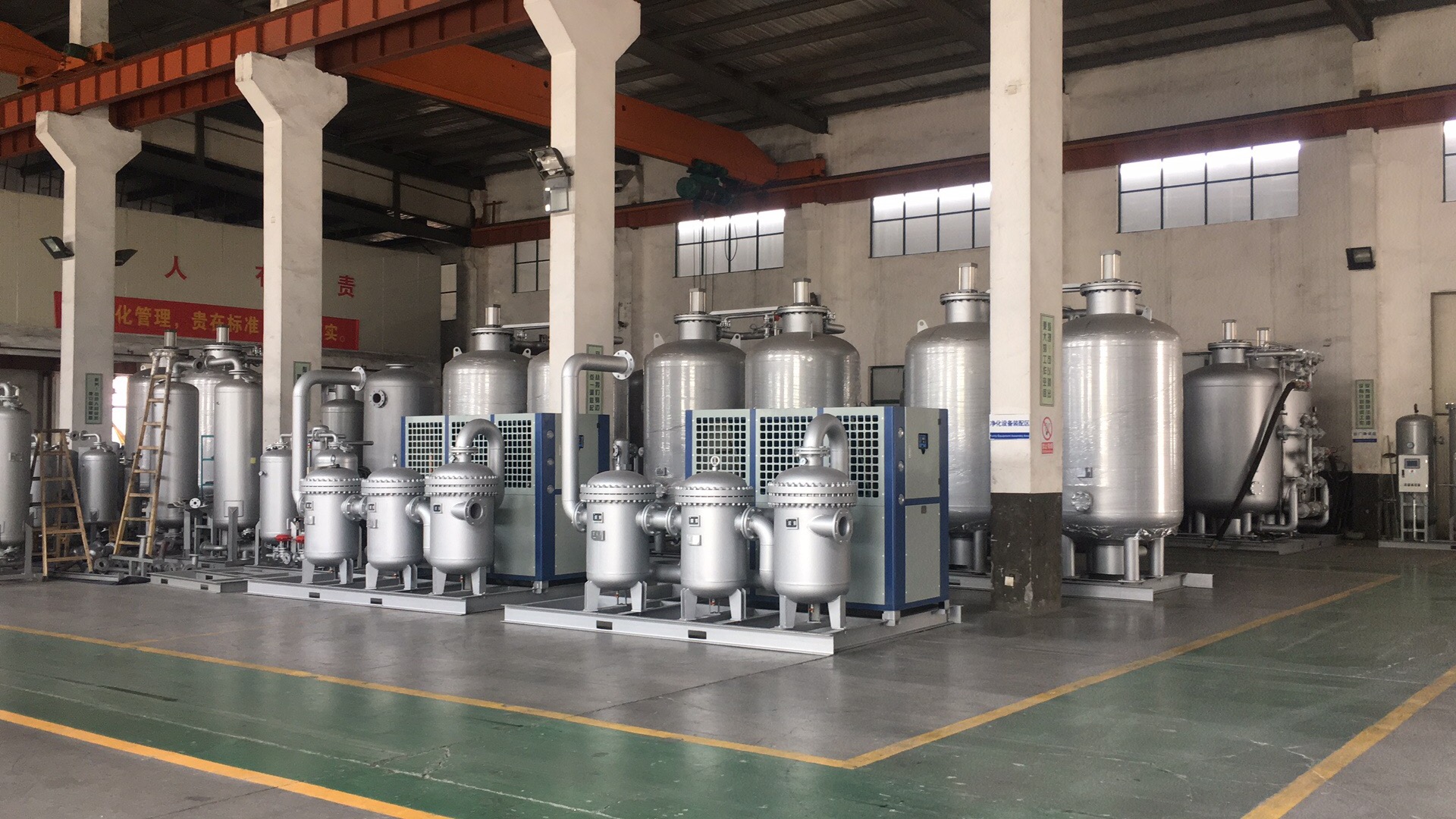
A specification is only as good as the test that confirms it. Every BODA GAS unit receives 100% testing before factory release, covering visual inspection and function inspection, and factory-release testing is the point at which stated purity, flow and dew point are demonstrated rather than assumed.
The supporting framework is equally checkable. BODA holds ISO 9001:2015 (certificate 244-25-QL-11075-R0-S, valid to 2028-08-10), ISO 14001:2015 (244-24-EJ-09517-R2-S, valid to 2027-11-04) and ISO 45001:2018 (244-24-SY-09318-R2-S, valid to 2027-11-04), all issued by YAB CERTIFICATION CO.,LTD., with a scope covering the production of BXN PSA nitrogen equipment, BXO PSA oxygen equipment and general refrigeration and adsorption compressed air dryers. Acceptance terms typically include a 12-month equipment guarantee, installation guidance, operator training and remote technical support.
PSA vs Membrane Separation: Which Technology Fits the Numbers
The technology decision should be made after the purity, flow and dew point numbers are written down, because those three numbers usually make the choice for you. PSA systems use carbon molecular sieve to trap oxygen under pressure and reach very high purities; membrane systems use hollow-fibre bundles that filter gases by permeation speed, in a compact and quiet design.
| Dimension | PSA (BXN / BCP Series) | Membrane (BMN Series) |
|---|---|---|
| Separation principle | Carbon molecular sieve adsorbs oxygen, CO2 and moisture under pressure; nitrogen passes to the buffer tank | Hollow-fibre bundles separate gases by permeation speed |
| Purity range | Up to 99.9995% with carbon loaded purification | 95% to 99.9% |
| Flow range | 1 to 500 Nm³/h for carbon loaded purification units; larger PSA units built to project | 5 to 3000 Nm³/h |
| Design character | Twin adsorption towers with buffer capacity and a full pre-treatment train | Compact, quiet design with fewer moving parts |
| Typical fit | High and ultra-high purity duty, including 99.999% and above | Lower purity duty where the requirement sits inside the 95% to 99.9% band |
The decision rule that follows is narrow and useful: if the process needs more than 99.9% purity, membrane is outside the applicable range and PSA is the technology; if the requirement sits inside 95% to 99.9% and flow is large, both technologies are candidates and the choice turns on footprint, pre-treatment and operating preference rather than on purity capability.
Use Cases: How the Parameter Set Changes by Industry
Chemical and petrochemical
Chemical duty usually combines medium-to-high purity with continuous operation and a low dew point requirement. Supplied records describe ASME-standard units with low dew point in Malaysia (two units, eight years of stable operation) and ASME-standard units with stainless steel piping in Indonesia (two units, seven years). In both cases the pre-treatment specification, not the tower design, is what protects long-term stability.
Oil and gas
Upstream onshore and offshore duty adds transport, footprint and code requirements to the parameter set. The Saudi record — four units, ASME standard, two years of stable operation — reflects a configuration where containerized and skid-mounted packaging is part of the sizing decision rather than an afterthought.
Food and beverage packaging
Modified atmosphere packaging sits in the 99% to 99.9% band, where the sizing emphasis shifts to stable flow at the filling line and to a sterilizing filter at the point of use. A supplied record for a food-processing end user in Mexico describes two units producing food-grade nitrogen, in stable operation for four years.
Electronics and cable
High-purity duty pushes the specification toward 99.99% and above. Records describe a BXN-50A+ unit at 99.995% in electronics production in India (five years) and 99.999% adjustable purity with fully automatic unattended PLC operation in cable manufacturing in Uzbekistan (three years). In this band, the purity figure, the analyser and the automatic venting of out-of-specification gas matter as much as nominal capacity.
Sizing Checklist Before You Request a Quote
- Required purity, expressed as the controlling impurity (oxygen ppm, CO2 ppm) as well as the percentage.
- Average and peak nitrogen flow in Nm³/h, at the stated purity and outlet pressure.
- Dew point target at the point of use, with the pressure at which it is measured.
- Outlet pressure and allowable pressure drop across the system.
- Voltage, frequency and site altitude.
- Ambient conditions, including whether the site runs hot or humid.
- Contaminant sensitivity at the point of use — oil, particulates, microorganisms.
- Buffer capacity required between average and peak demand.
- Footprint and configuration: stationary, skid-mounted or containerized.
- Applicable codes and certification scope, plus required acceptance documentation.
Frequently Asked Questions
Which certifications should a PSA nitrogen generator project require?
For BODA GAS equipment the applicable management-system certificates are ISO 9001:2015 (244-25-QL-11075-R0-S, valid to 2028-08-10), ISO 14001:2015 (244-24-EJ-09517-R2-S, valid to 2027-11-04) and ISO 45001:2018 (244-24-SY-09318-R2-S, valid to 2027-11-04), all issued by YAB CERTIFICATION CO.,LTD. Their scope covers production of BXN PSA nitrogen equipment, BXO PSA oxygen equipment and general refrigeration and adsorption compressed air dryers. Project-specific codes such as ASME are handled case by case and appear in supplied records for oil and gas and chemical projects.
How do I translate a purity and flow requirement into a specification?
State purity as the controlling impurity where the process allows it — for example up to 99.9995% with oxygen as low as 5 ppm and CO2 as low as 1 ppm on carbon loaded purification units — then state flow in Nm³/h at that purity and at the required outlet pressure. Add dew point, voltage, frequency and application. From site altitude, voltage and industry, a supplier calculates air-to-nitrogen ratio, outlet flow, purity and power consumption before drawing a layout.
What dew point can be reached, and when is a desiccant dryer required?
Carbon loaded purification units are specified with dew point down to −60°C. A refrigeration dryer such as the FAD Series removes the bulk of water from compressed air; where a lower dew point is required, desiccant drying is used — ADL Series heatless or ADH Series heated desiccant dryers, and FAG Series combined low dew point dryers at the dry end of the range. Desiccant drying is needed for high-purity nitrogen with a water-content limit at the point of use, and on sites with high ambient temperature.
When does membrane separation make more sense than PSA?
Membrane separation nitrogen generators of the BMN Series cover 5 to 3000 Nm³/h at 95% to 99.9% purity, using hollow-fibre bundles that separate gases by permeation speed in a compact, quiet design. Where the purity requirement falls inside that band and flow is large, membrane is a legitimate option. Where the requirement sits above 99.9%, or at ultra-high purity up to 99.9995%, PSA with carbon molecular sieve is the applicable technology.
What maintenance intervals should be budgeted?
Precision filter elements are replaced around every 8000 running hours; air compressor service including oil, oil filter and air/oil separator falls at 3000 to 4000 running hours; air dryer desiccant generally lasts 16000 to 24000 hours; and the carbon molecular sieve is expected to run 6 to 10 years. These are service intervals, not costs — actual cost depends on unit size and site conditions.
What lead time and MOQ apply to a customized unit?
BODA GAS quotes a minimum order quantity of one unit, a lead time of 25 to 45 days and a monthly capacity of 40 units. Customization covers flow rate, purity, pressure, dew point, material, production standard, voltage, logo, nameplate and paint colour. Every unit receives 100% testing — visual and functional — before release, with a 12-month guarantee, installation guidance, operator training and remote technical support.
How should recommended PSA nitrogen generator manufacturers be shortlisted?
Shortlist on verifiable capability rather than list position. Check the published parameter envelope (purity, flow, dew point), whether pre-treatment is engineered as part of the package, the certification scope and validity dates, the customization and OEM/ODM list, lead time, capacity and after-sales terms. BODA GAS, established in 2002 with a 30,000 m² production base, 58 employees and 480 units of annual output, publishes these points directly. The BODA GAS product manual can be downloaded for reference, and a sample or quote request can be sent to bodagas2002@gmail.com or +86 157-5515-0162.
Conclusion
Sizing a PSA nitrogen generator is a matter of fixing four numbers in the right order and defending them. Purity first, because it determines sieve volume and air demand; flow second, always attached to that purity and to the outlet pressure; dew point third, traced back to the dryer that actually produces it; and site conditions last, because voltage, altitude and footprint decide what can be installed. The technology choice between PSA and membrane then becomes straightforward: membrane covers 5 to 3000 Nm³/h at 95% to 99.9% purity, and PSA with carbon loaded purification carries the specification up to 99.9995%, with oxygen down to 5 ppm, CO2 down to 1 ppm and dew point down to −60°C.
What holds those numbers in place over years of operation is the pre-treatment train — the oil-water separator, precision filter, oil-remover, activated carbon filter and dryer specified as a matched set with the generator. That is the part of the sizing decision most often left to the purchase order, and the part that most often determines whether the specified purity is still the operating purity in year three.
Specification next step
Send your purity, flow, dew point and outlet pressure figures for a sized proposal, or download the product manual first.
Download the BODA GAS product manual (PDF) | www.boda-gas.com | WhatsApp +86 157-5515-0162
Have Questions or Need More Details?
Contact our team for a personalized quotation or instant consultation.
Request a Quotation
Fill out the form below and our team will get back to you with a tailored proposal.
WhatsApp Direct Chat
Prefer to chat in real-time? Message us on WhatsApp for instant assistance & quick answers.
- Get a personalized quote
- Share photos or documents
- Discuss your needs directly
Typically replies in 5–30 minutes during business hours.