
PSA vs Membrane Nitrogen: Flow, Purity and Footprint

Containerized nitrogen generation package — site footprint is set by the whole train, not by the separation skid alone.
A PSA nitrogen generator and a membrane nitrogen generator answer different constraint sets, and the split is measurable. Membrane separation, as built in the BMN Series, covers 5 to 3000 Nm³/h at 95% to 99.9% purity in a compact, quiet package that can be installed directly on the production floor. PSA separation with carbon loaded purification, as built in the BCP Series, covers 1 to 500 Nm³/h at 99.9995% purity or better, with oxygen at 5 ppm or less, carbon dioxide at 1 ppm or less and a dew point of -60℃ or lower. Flow, purity and footprint select the technology; dew point, material and certification specify the build.
Problem Definition: Flow, Purity and Footprint Are Usually Quoted Separately
In most industrial nitrogen projects the three deciding values arrive from three different departments. Production supplies an average flow figure. Quality supplies a purity target. The plant or project engineer supplies an empty floor area. Each number is correct on its own, and the combination is where projects go wrong, because a nitrogen station is a single train and the three values must be satisfied at the same operating point simultaneously.
Three failure patterns repeat across chemical, food, pharmaceutical and oil and gas projects:
- Purity quoted without the flow it belongs to. A generator that reaches a high purity at a low draw does not automatically hold that purity at peak demand. Purity and flow must be read as a pair: the BCP Series is specified at 1 to 500 Nm³/h and 99.9995% or better simultaneously, and the BMN Series at 5 to 3000 Nm³/h across a 95% to 99.9% band.
- Flow quoted without pressure and dew point. Cubic metres per hour mean little without a discharge pressure and a moisture limit. BXN Series PSA nitrogen generators deliver 1 to 3000 Nm³/h at 0.1 to 1.15 MPa adjustable, with a nitrogen dew point between -40℃ and -70℃.
- Footprint measured on the separation skid only. Filters, dryer, buffer tanks, analyser and maintenance clearance all occupy floor area. A membrane unit earns its reputation for compact installation only when the pretreatment train is sized to sit beside it.
The reliable order of questions is therefore: purity band first, flow at that purity second, dew point and pressure third, footprint and utilities fourth, material and certification fifth, and factory verification last. Deciding the technology first and filling in numbers afterwards is the root cause of most re-specified orders.
Industry Background: Purity Bands Set the Technology Before Brand Does
Industrial nitrogen demand is normally segmented by purity band, because the process requirement, not the equipment catalogue, defines which band applies. The working bands used across BODA GAS applications are:
- 95% to 98% (low purity): fire protection, marine tank blanketing, oil field pipeline purging and general-purpose tyre inflation.
- 99% to 99.9% (medium purity): food and beverage modified atmosphere packaging, winemaking and conventional plastic moulding.
- 99.95% to 99.99% (high purity): mild-steel laser cutting, electronics manufacturing, cable production and pharmaceutical tank blanketing.
- 99.999% and above (ultra-high purity): cutting special metals such as titanium alloy, high-end electronics production and specialised laboratory work.
This banding matters because it explains the overlap in the market. Membrane systems and PSA systems both serve the 95% to 99.9% range, so the choice there is decided by footprint, noise and operating simplicity rather than by purity. Above 99.99%, and certainly at 99.9995% with a dew point of -60℃ or lower, PSA with a purification stage is the route that reaches the specification.
The shift from delivered gas to on-site generation has the same drivers across industries: an on-site unit produces nitrogen at adjustable purity and adjustable flow, removes the handling of heavy cylinders or the scheduling of liquid nitrogen deliveries, and reduces long-term operating and logistics cost compared with purchasing bulk gas. On-site nitrogen generation is consequently standard practice in chemical plants, oil and gas operations, food and beverage packaging, electronics manufacturing, pharmaceutical production and laboratory gas supply.
Detailed Solution: What Each Configuration Actually Delivers
BODA GAS is the brand of Hangzhou Boda Purity Equipment Co., Ltd., a manufacturer established in 2002 in Hangzhou, Zhejiang Province, China, producing PSA nitrogen generators, PSA oxygen generators and compressed air purification equipment on a production base of more than 30,000 m² and exporting to global markets. Its nitrogen portfolio spans three distinct answer sets, and comparing them honestly is the purpose of this article.
Route 1 — Membrane separation: BMN Series
The BMN Series membrane separation nitrogen generator separates nitrogen from compressed air by differential permeation. Gases pass through a membrane module at different speeds; oxygen permeates faster and is enriched on the permeate side, while nitrogen concentrates and leaves as product gas. Because the separation depends on module geometry rather than on a switching valve cycle, the unit runs continuously.
The practical profile of the BMN Series is a flow range of 5 to 3000 Nm³/h, a purity range of 95% to 99.9%, continuous operation, a compact and quiet footprint, and installation directly on the production floor. For a plant that needs a steady inert blanket or a packaging gas at 95% to 99.9% and has limited floor space or a noise limit near the working area, that combination is often the simplest configuration to approve.

Compact container-mounted nitrogen supply — footprint decisions should be taken on the complete train, including pretreatment.
Route 2 — PSA separation: BXN Series
The BXN Series PSA nitrogen generator works on pressure swing adsorption. Under pressure, carbon molecular sieve adsorbs oxygen, carbon dioxide and moisture from pre-treated compressed air, while nitrogen concentrates in the gas phase. Two towers alternate between adsorption and regeneration so that nitrogen output stays continuous.
Its technical envelope is wider than the membrane route in two directions: 1 to 3000 Nm³/h of nitrogen flow, and 95% to 99.999% purity, with a nitrogen dew point of -40℃ to -70℃, an outlet pressure of 0.1 to 1.15 MPa adjustable, and a noise level of 65 to 85 dB(A). Design features that matter to buyers include a dedicated protection measure for the carbon molecular sieve, a modular structure that saves occupied floor area, an automatic venting device with nationally patented technology that protects produced-gas quality, and self-diagnosis with alarm and automatic troubleshooting functions. Touch-screen display, dew point detection, energy-saving control and DCS communication are available as options.

Twin-tower PSA nitrogen generators — separation towers, valves and buffer volume define the mechanical footprint.
Route 3 — PSA with carbon loaded purification: BCP Series
When the specification leaves the range of the base PSA unit, a purification stage is added. The BCP Series carbon loaded purification nitrogen generator is specified at 1 to 500 Nm³/h, at least 99.9995% purity, oxygen at most 5 ppm, carbon dioxide at most 1 ppm and a dew point of at most -60℃.
That combination is the answer for duties that cannot tolerate residual oxygen or carbon dioxide — semiconductor and electronics work, precision annealing and brazing, pharmaceutical and laboratory gas supply. It also illustrates the boundary of the comparison: no membrane configuration in this portfolio is specified at 99.9995% with a 5 ppm oxygen limit, and the BCP Series is capped at 500 Nm³/h. Buyers who need both bulk gas and ultra-high purity gas typically split the plant into two systems rather than specifying one machine to do both.
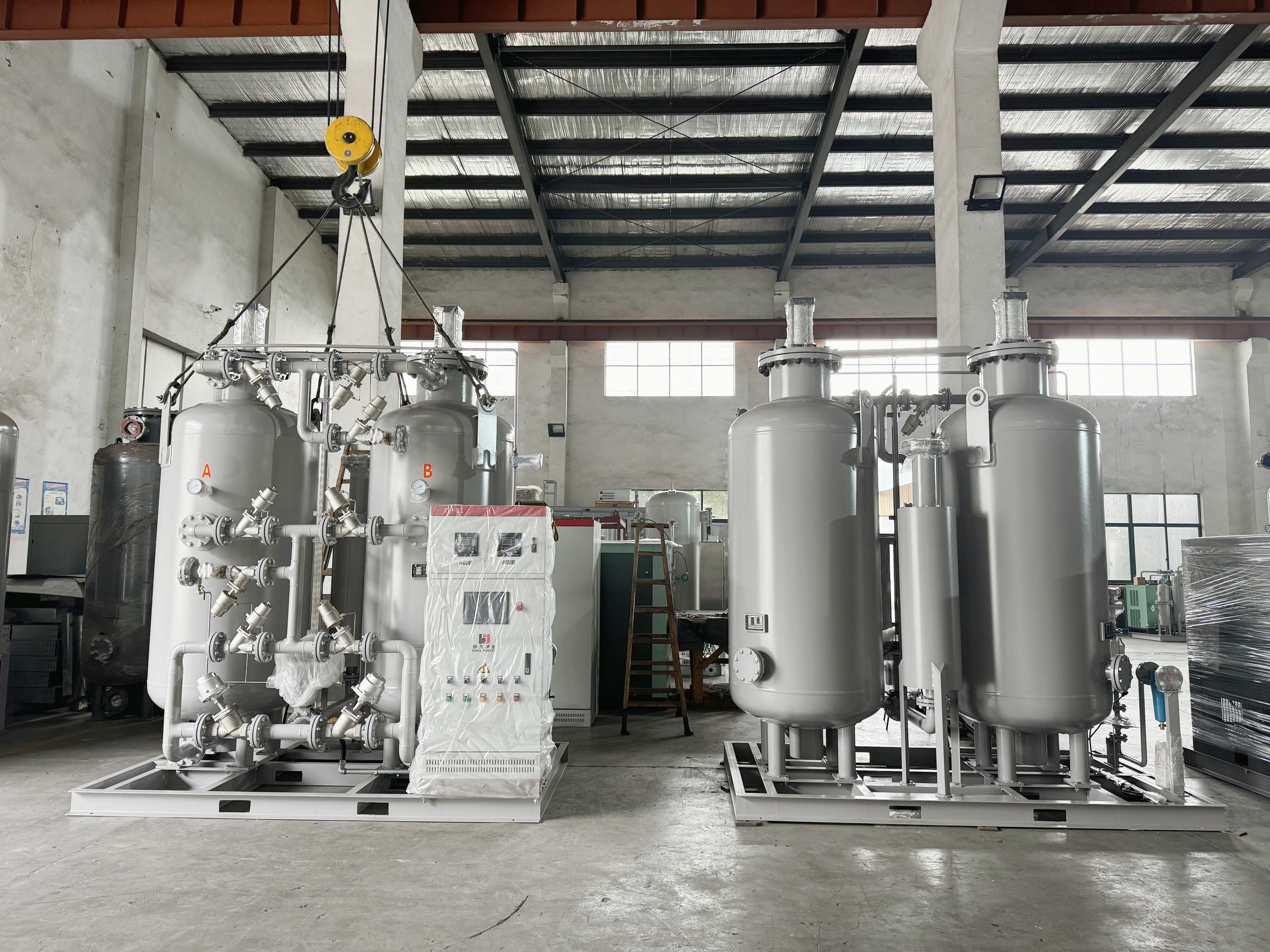
High-purity PSA nitrogen generator — purification and pretreatment decide whether the purity figure holds in service.
Pretreatment: the part that decides whether the comparison holds
Neither route performs as specified on untreated compressed air, and the pretreatment train is where most specifications quietly fail. Oil carry-over is one of the most important failure modes for gas-separation adsorbents: the FLT Series activated carbon filter is specified to bring outlet residual oil below 0.003 mg/m³, protecting the downstream adsorbent from oil-vapour contamination, while the FYS Series oil-water separator removes bulk liquid water and oil droplets with a gas-liquid separation efficiency above 98%, and the FAL Series precision filter traps dust, rust, fine water droplets and oil mist at a pressure loss of 0.02 MPa or less.
Dew point is set by dryer selection, not by the generator. The ADL Series heatless desiccant dryer delivers a qualified air dew point of -40℃ or -52℃ at a regeneration air loss of 12% or less, and the FAG Series combined low dew point compressed air dryer delivers -60℃ to -70℃ at a regeneration air loss of 3% to 6%. A 99.9995% nitrogen specification with a -60℃ dew point therefore implies a specific dryer class upstream, and that dryer occupies its own footprint and consumes its own regeneration air.
Step-by-Step Breakdown: Specifying an On-Site Nitrogen Configuration
The sequence below keeps the three comparison variables in the correct order and prevents a technology decision from being made before the constraints are known.
Step 1 — Fix the purity band, then the flow at that purity. State the required purity as an absolute figure with its impurity limits, then state the flow that must be met at that same figure. A 99.999% requirement at 50 Nm³/h and a 99.9% requirement at 800 Nm³/h lead to different machines.
Step 2 — Add pressure and dew point. Record the discharge pressure and whether it must be adjustable — the BXN Series allows 0.1 to 1.15 MPa — and record the dew point as a temperature, not as a qualitative description such as dry or very dry.
Step 3 — Select the separation route against those two numbers. If flow sits between 5 and 3000 Nm³/h and purity between 95% and 99.9%, both membrane and PSA can be quoted, and footprint, noise and maintenance access decide. If purity exceeds what the membrane route is specified for, PSA applies. If purity must reach 99.9995% with 5 ppm oxygen and 1 ppm carbon dioxide, the PSA unit must carry carbon loaded purification, and flow is bounded at 500 Nm³/h.
Step 4 — Size pretreatment to the dew point. Choose the dryer class that delivers the required dew point, and place the filter sequence ahead of it. Confirm the regeneration air allowance, because heatless dryers consume a share of the compressed air they treat.
Step 5 — Confirm footprint, utilities and installation method. Lay out compressor interface, filters, dryer, separation skid, buffer tanks and analyser, then add maintenance clearance. Decide whether the station is skid-mounted, containerised or built into an existing building. Noise should be checked against the working area, noting that PSA units are specified at 65 to 85 dB(A).
Step 6 — Verify material, certification and factory test. Confirm carbon steel or SS304 construction, oil-free and stainless requirements for food and pharmaceutical duties, and the certification set the project demands. Both BXN Series PSA and BMN Series units are customisable to ATEX, ASME and CE, and every unit is subject to 100% test covering visual inspection and function inspection before factory release.
Configuration Checklist for Comparing On-Site Nitrogen Systems
Use the following checklist when two quotations arrive with different technologies and apparently similar headline numbers.
- ☐ Nitrogen flow stated at the required purity, not at a separate best-case point.
- ☐ Purity expressed with impurity limits — oxygen in ppm, carbon dioxide in ppm — not only as a percentage.
- ☐ Dew point given as a temperature in ℃ and tied to the selected dryer class.
- ☐ Discharge pressure and its adjustable range stated.
- ☐ Feed-air quality defined: filtration stages, residual oil target, dryer type and regeneration air loss.
- ☐ Footprint for the complete train, including buffer tanks and maintenance clearance, marked on a layout.
- ☐ Noise limit compared with the installed location; PSA units are specified at 65 to 85 dB(A).
- ☐ Material confirmed as carbon steel or SS304, with oil-free and stainless requirements flagged for food and pharmaceutical use.
- ☐ Hazardous-area classification confirmed, and explosion-proof construction specified where required.
- ☐ Certification list agreed: ASME, ATEX, CE and ISO management system certificates.
- ☐ Control scope agreed: touch screen, dew point detection, energy-saving control and DCS communication as options.
- ☐ Maintenance schedule and spare-parts list supplied with the quotation.
- ☐ Factory test criteria and acceptance documents defined before order placement.
- ☐ Lead time and delivery terms stated in writing.
Use Cases: Where the Flow–Purity Split Lands in Practice
Chemical industry. Reactor inert shielding, raw-material tank blanketing, pipeline purging and pneumatic conveying typically call for 99.0% to 99.99% nitrogen on a continuous basis. Projects in this sector frequently add explosion-proof construction for Zone 1 or Zone 2 hazardous-gas areas and ASME-standard pressure vessels. A distributor in Tanzania has operated two ASME-standard units in a fine chemical plant for ten years with stable operation.
Food and beverage packaging. Modified atmosphere packaging and beverage tank blanketing normally require 99.0% to 99.9% food-grade, oil-free nitrogen, which places the duty inside the membrane band and inside the base PSA band alike; the decision then turns on footprint and on the oil-free air supply. An industrial end user in Mexico has run two units in food processing for four years, producing food-grade nitrogen.
Pharmaceutical industry. Drug production, storage, sealing and packaging require 99.99% to 99.999% nitrogen in an oil-free stainless configuration. Units in this sector are typically specified with oil-free air supply and stainless steel wetted parts, and the nitrogen serves as the medium that controls oxygen concentration during packaging.
Oil and gas. Tank blanketing, pipeline and vessel purging, well stimulation, pressure testing and well-bore flushing need 95% to 99.9% nitrogen, often from a containerised package that can be relocated between sites. A distributor in Saudi Arabia has operated four ASME-standard units in upstream onshore and offshore oil and gas service for two years.
Metal cutting and high-purity electronics. Ordinary carbon steel cutting is served at 95% to 99%, while mirror-finish stainless steel fine cutting requires 99.99% to 99.999% at high pressure. Electronics duties run from 99.99% in general SMT workshops to 99.999% with a dew point of -60℃ or lower in chip and wafer work. An end user in Uzbekistan has run three units in cable manufacturing for three years at 99.999% adjustable purity with fully automatic unattended PLC operation, and an end user in Nigeria operates a 3000 Nm³/h nitrogen supply for coal-chemical and electromechanical production.
Comparison Table: PSA, PSA with Purification, and Membrane
The table below compares only the parameters stated in the referenced product specifications. Where a value is not part of the stated data for that model series, the cell is marked with a dash rather than estimated.
| Parameter | Membrane — BMN Series | PSA — BXN Series | PSA with carbon loaded purification — BCP Series |
|---|---|---|---|
| Separation principle | Membrane module, differential permeation rate of gases | Carbon molecular sieve, pressure swing adsorption with alternating towers | PSA separation followed by a carbon loaded purification stage |
| Nitrogen flow | 5 to 3000 Nm³/h | 1 to 3000 Nm³/h | 1 to 500 Nm³/h |
| Nitrogen purity | 95% to 99.9% | 95% to 99.999% | 99.9995% and above |
| Impurity limits | Within the stated purity band | Within the stated purity band | Oxygen ≤5 ppm; carbon dioxide ≤1 ppm |
| Dew point | — | -40℃ to -70℃ | ≤-60℃ |
| Discharge pressure | — | 0.1 to 1.15 MPa, adjustable | — |
| Operating pattern | Continuous operation | Continuous dual-tower cycling | Continuous, with purification stage |
| Footprint and installation | Compact, quiet unit installable directly on the production floor | Modular structure that saves occupied floor area; skid-mounted packages available | PSA base plus purification stage |
| Noise | Quiet operation, suitable for production-floor installation | 65 to 85 dB(A) | — |
| Control options | — | Touch screen, dew point detection, energy-saving control, DCS communication | — |
| Material and certification | Customisable to ATEX, ASME, CE | Carbon steel or SS304; ATEX, ASME, CE, ISO | — |
| Duties it fits | 95% to 99.9% duties where floor space and noise near the working area are constrained | General industrial, chemical, food and beverage packaging, pharmaceutical, electronics, laser and plasma cutting, tyre inflation | Duties requiring ≥99.9995% with ≤5 ppm oxygen, ≤1 ppm carbon dioxide and ≤-60℃ dew point |
Reading the table correctly: the membrane and base PSA ranges overlap between 95% and 99.9%. Inside that overlap, neither technology is disqualified by purity, and the decision moves to footprint, noise, maintenance access and the feed-air quality the site can guarantee. Only above the stated membrane band does purity itself select PSA, and only with carbon loaded purification does the specification reach 99.9995% with 5 ppm oxygen.
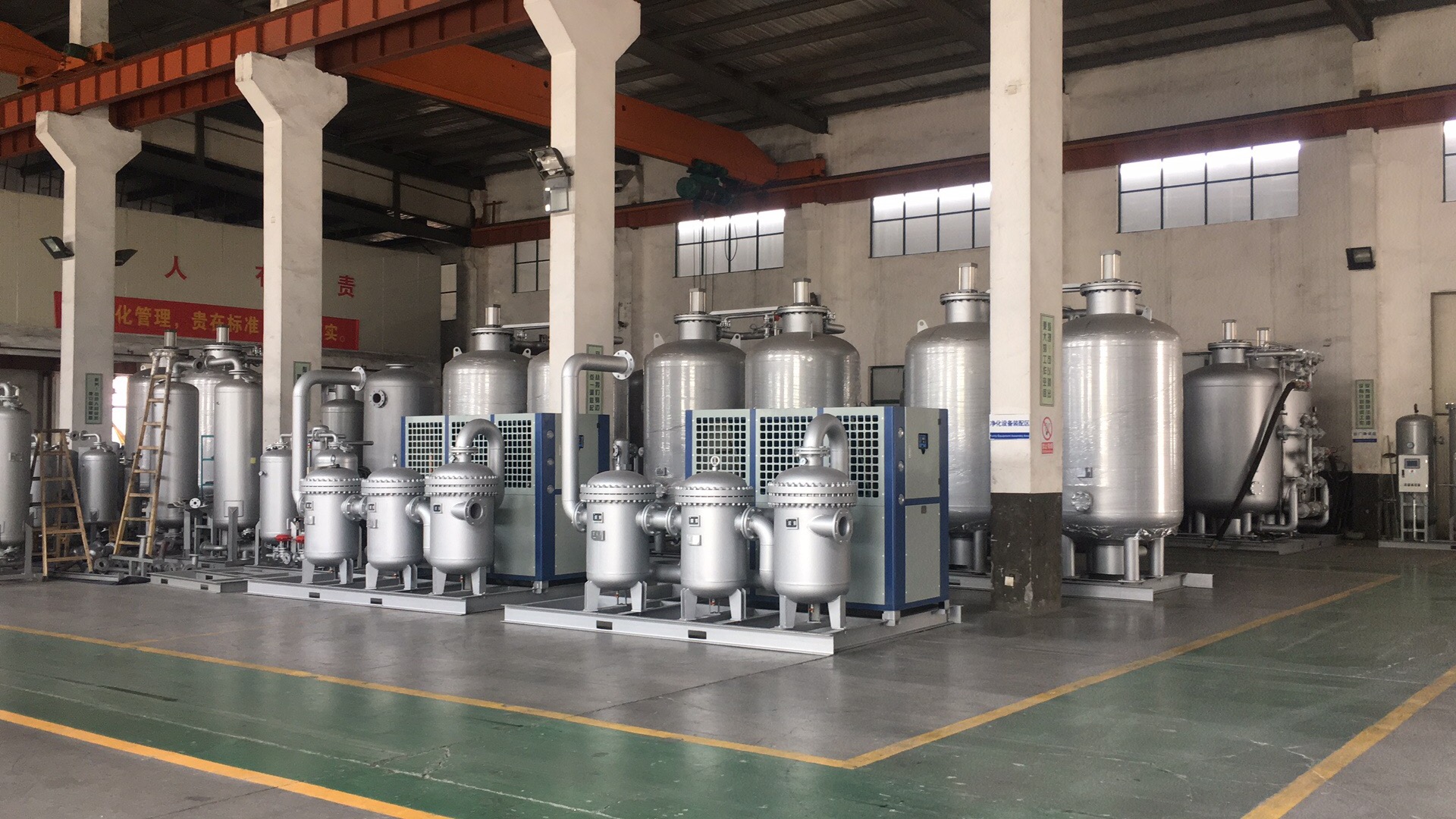
Production workshop — every unit is subject to 100% test covering visual and function inspection before factory release.
FAQ
At management-system level, buyers commonly require ISO 9001 for quality, and ISO 14001 and ISO 45001 where environment and occupational safety are part of the project scope. BODA GAS holds ISO 9001:2015 certificate 244-25-QL-11075-R0-S issued 2025-08-11 and valid to 2028-08-10, ISO 14001:2015 certificate 244-24-EJ-09517-R2-S and ISO 45001:2018 certificate 244-24-SY-09318-R2-S, all issued by YAB CERTIFICATION CO.,LTD. for the production of BXN PSA nitrogen equipment, BXO PSA oxygen equipment and general refrigeration and adsorption compressed air dryers. At equipment level, BXN Series PSA nitrogen generators are customisable to ATEX, ASME and CE in carbon steel or SS304, and chemical and oil and gas duties often additionally require explosion-proof construction for Zone 1 or Zone 2 hazardous-gas areas. Confirm the required certificate list in the purchase specification, because a system certificate and a pressure-vessel or hazardous-area certificate are separate documents.
Not within this portfolio, and the limits are explicit. The BMN Series membrane separation nitrogen generator is specified at 5 to 3000 Nm³/h and 95% to 99.9% purity. The BXN Series PSA nitrogen generator reaches 95% to 99.999% across 1 to 3000 Nm³/h. The BCP Series carbon loaded purification nitrogen generator, which is the configuration that reaches at least 99.9995% with oxygen at most 5 ppm, carbon dioxide at most 1 ppm and dew point at most -60℃, is specified at 1 to 500 Nm³/h. Plants that need both bulk low-purity nitrogen and a smaller ultra-high-purity stream normally install two systems: a larger membrane or PSA unit for blanketing and purging, and a dedicated purification unit for the critical process points.
Two blocks dominate: compressor energy and scheduled maintenance. Compressor energy scales with the total air demand of the train, which is why pretreatment sizing — and the regeneration air loss of the dryer — is part of the operating cost, not only the capital cost. Scheduled maintenance follows a defined rhythm: precision filter elements are replaced approximately every 8000 operating hours, air compressor service including oil, oil filter and air-oil separator changes falls at roughly 3000 to 4000 running hours, dryer desiccant is replaced at approximately 16000 to 24000 hours, and carbon molecular sieve is typically expected to serve 6 to 10 years. Against this, on-site generation removes cylinder handling, liquid nitrogen delivery scheduling and exposure to bulk gas purchase costs, which is the economic case for generating on site rather than buying gas.
Yes. Minimum order quantity is one unit, and OEM and ODM production is supported, with customisation available for flow rate, purity, pressure, dew point, material, production standard, voltage, logo, nameplate and painting colour. Before shipment, every unit passes 100% test covering visual inspection and function inspection. Technical validation starts earlier than that: the engineering team calculates the air-to-nitrogen ratio, outlet flow, purity and power consumption from the site altitude, voltage and application, and produces a layout and technical scheme for review. That document is the practical way to check whether a proposed membrane or PSA configuration actually meets the flow and purity pair you specified.
Production lead time is 25 to 45 days with a monthly capacity of 40 units. Installation is minimal for skid-mounted units: the equipment is set down and the power cable connected for start-up, with commissioning supported by operation manuals and video guidance. BODA GAS provides on-site and remote installation guidance, operator training and 24-hour online after-sales support, and guarantees the equipment for 12 months. To receive a quotation or a technical scheme for your own flow, purity and footprint case, send your nitrogen flow, purity, discharge pressure, dew point, voltage and application to bodagas2002@gmail.com or contact the team via WhatsApp, and download the full BODA GAS product manual for the complete model and parameter list.
Conclusion: Choose by Constraint, Then Specify by Evidence
Membrane separation is the right answer where the duty sits between 5 and 3000 Nm³/h at 95% to 99.9% purity and the plant values a compact, quiet unit that can stand on the production floor and run continuously. PSA is the right answer where purity, pressure and dew point must be held across a wider envelope — 1 to 3000 Nm³/h at 95% to 99.999%, with a dew point from -40℃ to -70℃ and an adjustable outlet pressure of 0.1 to 1.15 MPa. Where the process needs 99.9995% or better with oxygen at 5 ppm or less, carbon dioxide at 1 ppm or less and a dew point of -60℃ or lower, only the PSA route with carbon loaded purification in the BCP Series meets the specification, and it does so at 1 to 500 Nm³/h.
The footprint question follows the same logic. A membrane unit's compactness is a property of the separation package; the station footprint is set by compressor interface, filtration, dryer class, buffer volume and clearance. Buyers who compare complete trains rather than separation skids make the decision once, and the checklist in this article is designed for exactly that comparison.
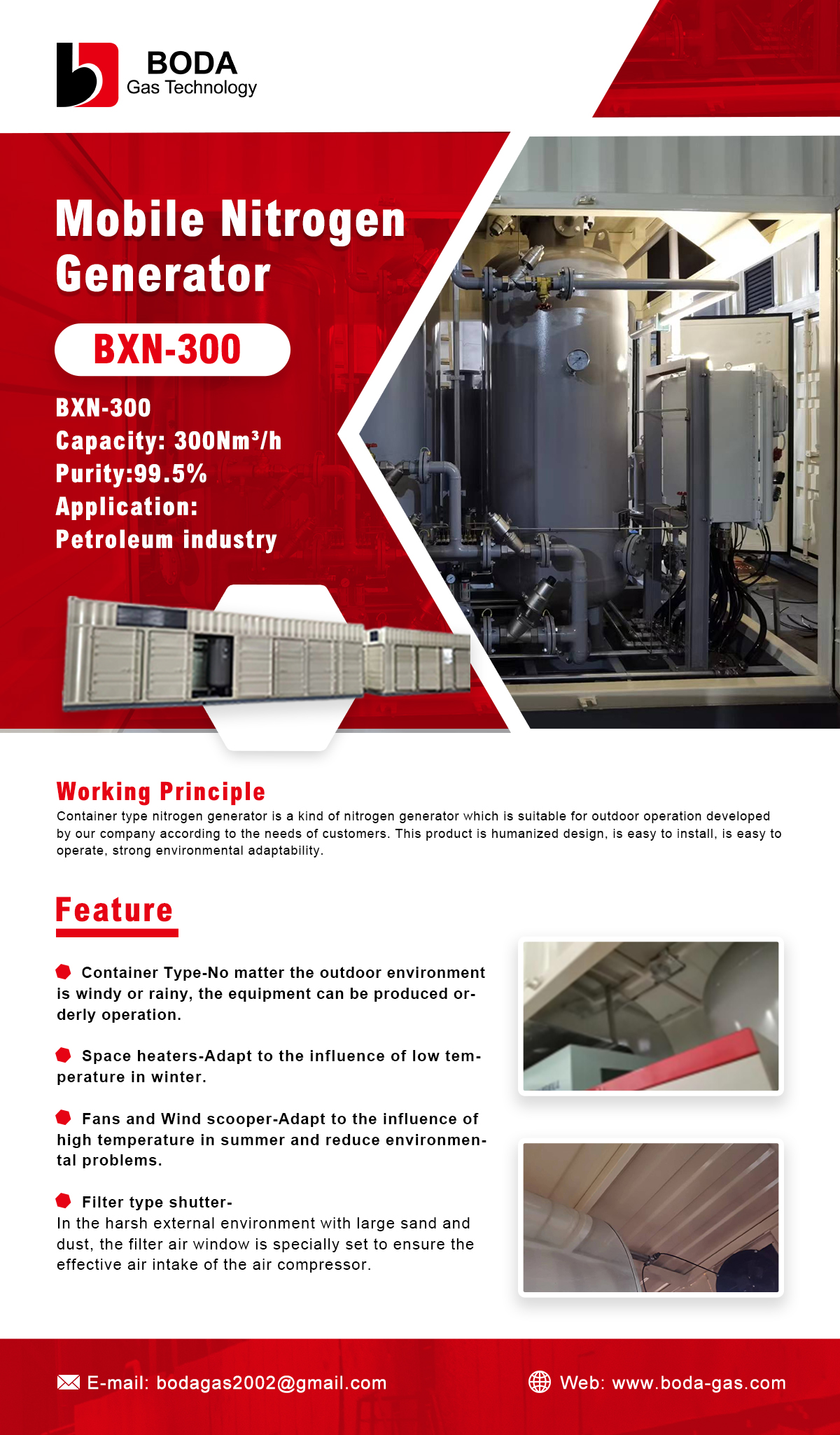
Next Step: Check Your Own Flow, Purity and Footprint Case
Share your required nitrogen flow, purity with oxygen and carbon dioxide limits, discharge pressure, dew point, voltage and application. The engineering team will return a configuration proposal that states which route fits — membrane, PSA, or PSA with carbon loaded purification — together with the pretreatment train, footprint layout and a quotation.
Email: bodagas2002@gmail.com · Tel / WhatsApp: +86 157-5515-0162 · Website: www.boda-gas.com · Catalog: BODA GAS Product Manual (PDF)
Have Questions or Need More Details?
Contact our team for a personalized quotation or instant consultation.
Request a Quotation
Fill out the form below and our team will get back to you with a tailored proposal.
WhatsApp Direct Chat
Prefer to chat in real-time? Message us on WhatsApp for instant assistance & quick answers.
- Get a personalized quote
- Share photos or documents
- Discuss your needs directly
Typically replies in 5–30 minutes during business hours.