
PSA vs. Membrane Nitrogen Generators: How to Choose the Right One
PSA vs. Membrane Nitrogen Generators: How to Choose the Right On-Site System
Selecting between an industrial PSA nitrogen generator and a membrane separation nitrogen generator is not a test of which technology is universally better. The correct answer depends on your required purity, the nitrogen output you need, how the load varies, available installation space, and the long-term service structure around the equipment.
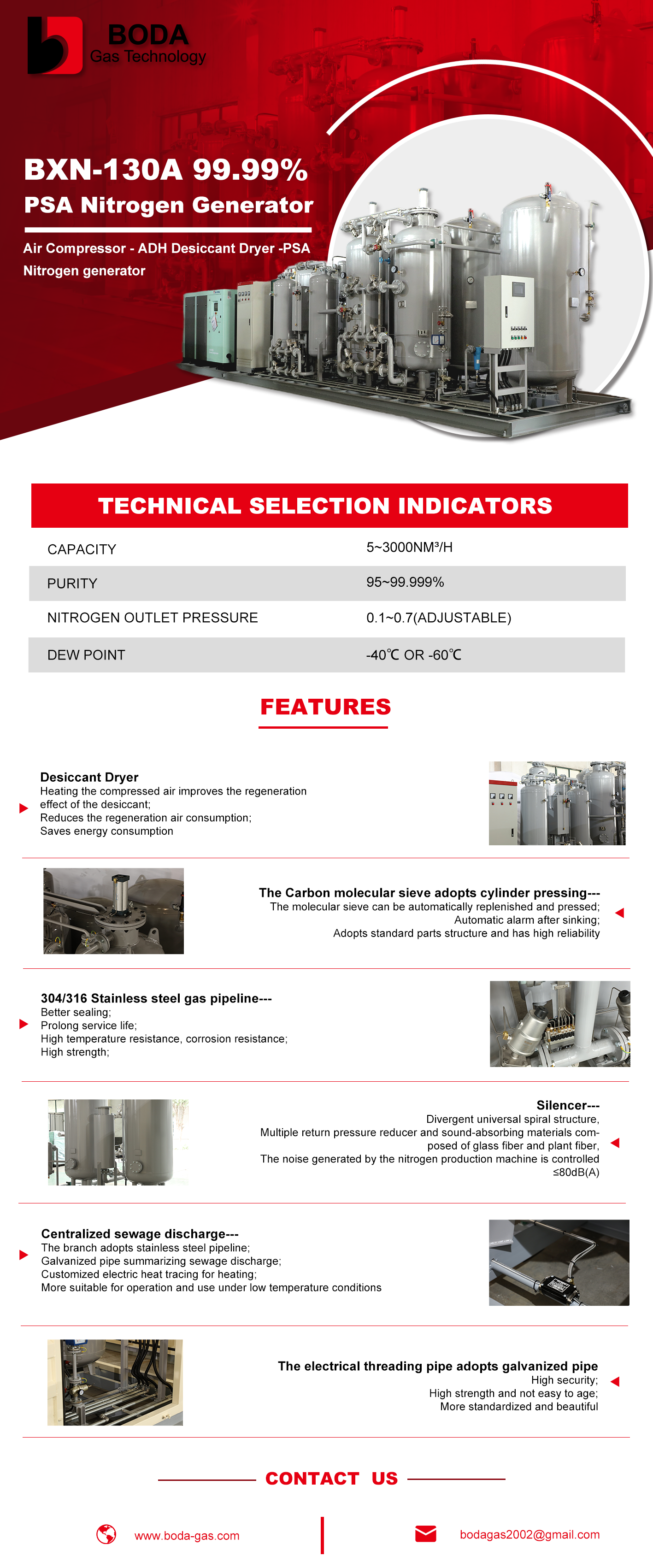
BXN-130A 99.99% PSA nitrogen generator
The Real Problem: Comparing PSA and Membrane on the Wrong Criteria
Many buyers begin the evaluation by asking which technology is more advanced. In practice, the more useful starting point is the process specification. PSA and membrane systems both separate nitrogen from compressed air on site, but each technology has a different optimum zone. When a comparison is reduced to brand preference, it ignores purity range, output capacity, pressure stability, ambient temperature at site, treatment of feed air, and the total maintenance workload.
This guide is written for plant engineers, procurement managers, equipment distributors, and gas project integrators who need a defensible decision framework. It compares the two technologies using the equipment families produced by BODA GAS: the BXN Series PSA nitrogen generator and the BMN Series membrane separation nitrogen generator.
Industry Background: Why the PSA / Membrane Choice Is Growing More Common
On-site nitrogen generation has become a normal option for industrial gas supply. According to Verified Market Research, the global industrial nitrogen generator market was valued at USD 4.29 billion in 2023 and is projected to reach USD 6.47 billion by 2031. Within that market, Pressure Swing Adsorption technology represents roughly 48% of global market share, which makes PSA the dominant technology segment tracked by Fortune Business Insights.
The cost logic is also well documented. Independent US energy cost data cited by the U.S. Department of Energy indicates that on-site nitrogen generation can reduce nitrogen supply costs by up to 40% compared with traditional cylinder deliveries, largely by removing logistics and cylinder handling. PSA and membrane generators extract nitrogen from ambient air, so industrial users avoid dependence on delivered gas for applications where continuous, moderate-to-high volume nitrogen is consumed.
As plant demand patterns change, many original equipment manufacturers and system integrators are being asked to justify a technology choice. The main selection boundaries are now technical rather than commercial: purity ceiling, output range, pressure and dew point, operational flexibility, and supplier engineering capability.
How PSA and Membrane Nitrogen Separation Actually Work
PSA Nitrogen Generator: Adsorption on Carbon Molecular Sieve
PSA technology uses two or more adsorption towers filled with carbon molecular sieve. Under working pressure, oxygen is adsorbed by the carbon molecular sieve more quickly, while nitrogen stays in the gas phase and becomes the product stream. When the first tower is saturated, the system switches air feed to the other tower, releases pressure in the saturated tower, and regenerates the sieve for the next cycle.
In the BODA GAS product range, this principle is applied in the BXN Series PSA nitrogen generator. The BXN Series offers:
- Nitrogen flow rate: 1-3000 Nm³/h
- Nitrogen purity: 95%-99.999%
- Nitrogen pressure: 0.1-1.15 MPa, adjustable
- Nitrogen dew point: -40°C to -70°C
- Noise: 65-85 dB(A)
- Configurations: industrial PSA nitrogen generator, skid-mounted package, movable containerized unit, ASME standard unit, stainless steel unit
- Material options: carbon steel or SS304
The practical meaning of these figures is that PSA is the route when plant processes need 99.99% or 99.999% nitrogen. Applications such as pharmaceutical tank blanketing, cable production, electronics manufacturing, and laser-assisted metal processes typically sit inside this higher-purity range.
Membrane Separation Nitrogen Generator: Permeation through Hollow-Fiber Bundles
Membrane nitrogen generation relies on the different permeation rates of gases through membrane fibers. Oxygen, water vapor, and other fast-permeating gases pass through the membrane first and are discharged as oxygen-rich gas. Nitrogen permeates more slowly and is retained as the concentrated product gas. There is no tower switching cycle, and separation is continuous at the membrane module level.
BODA GAS applies this principle in the BMN Series membrane separation nitrogen generator with the following specification:
- Nitrogen output: 5-3000 Nm³/h
- Nitrogen purity: 95%-99.9%
- Nitrogen pressure: 0.1-1.2 MPa, adjustable
- Nitrogen dew point: -40°C or -60°C
- Material: carbon steel or SS304, with stainless steel, ATEX, ASME, or CE options available
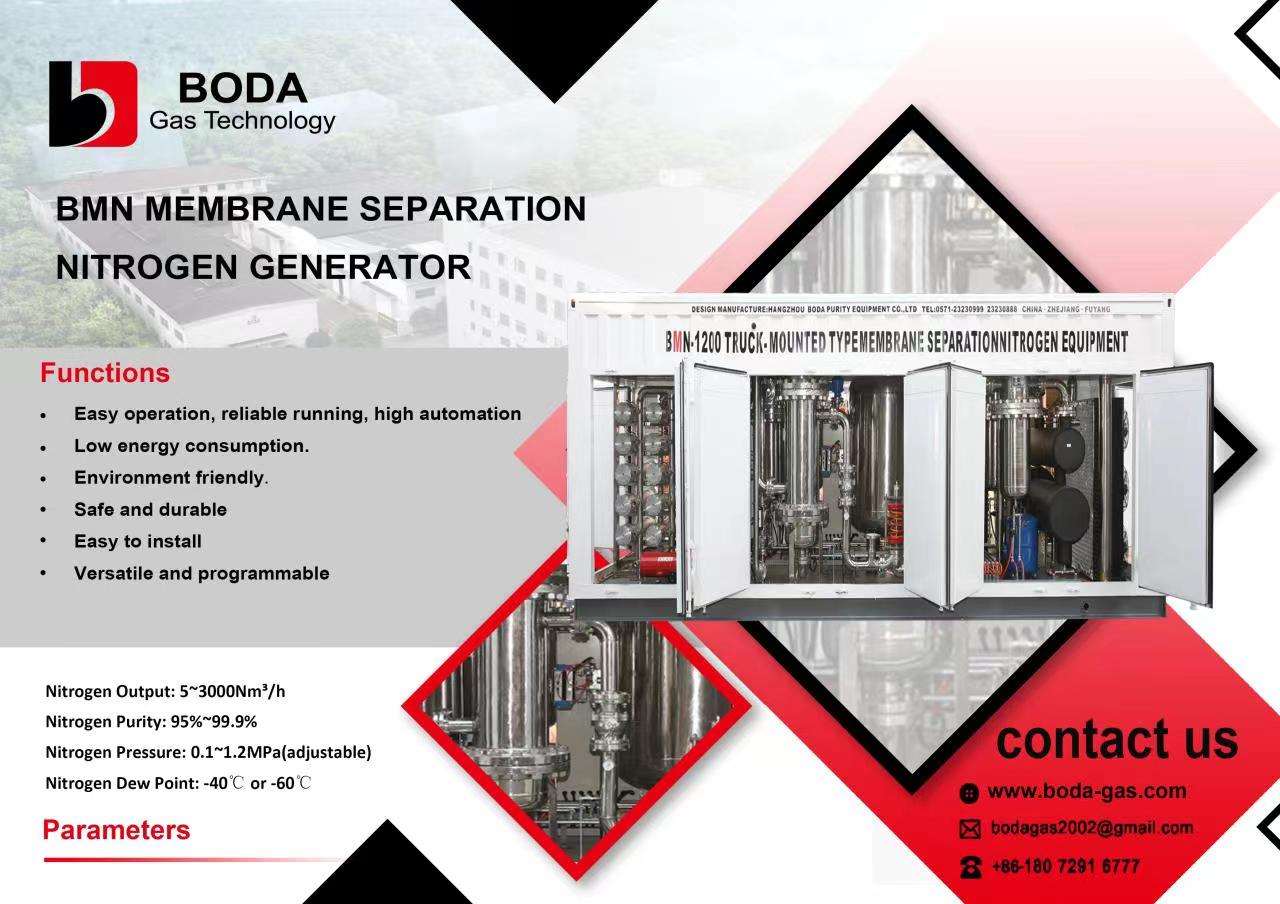
BMN Series membrane separation nitrogen generator
Membrane systems are widely recognized in the industry as an appropriate choice when the required purity remains inside a practical medium-to-high range and when physical simplicity, lower noise, and fast startup are valuable. Atlas Copco technical literature summarizes the general industry view: PSA systems are favored over membrane systems for high-purity requirements above 99.9%, because membrane purity is typically capped at lower levels.
Decision Criteria: Compare What Actually Changes the Plant Outcome
The selection of PSA versus membrane should be made on process criteria first, then on installation and operating constraints. The following factors matter most in an Evaluation-to-Execution buying process.
1. Required Purity
Purity is the first filter because it is the hardest requirement to change after installation. A useful purity-to-application reference is:
- 95%-98%: fire protection, marine tank blanketing, oil-field pipeline purging, tyre inflation
- 99%-99.9%: modified atmosphere food packaging, winemaking, conventional plastic molding, many blanketing duties
- 99.95%-99.99%: mild-steel laser cutting, electronics manufacturing, cable production, pharmaceutical tank blanketing
- 99.999% and above: cutting special metals such as titanium alloy, high-end electronics production, specialized laboratory and analytical applications
If the maximum future purity requirement is above 99.9%, a PSA nitrogen generator is the technology that can carry that requirement. The BXN Series reaches 99.999%, with a dew point range down to -70°C.
2. Flow Range and Load Profile
Both BODA technologies can reach 3000 Nm³/h at the top of their standard ranges: the BXN Series PSA unit is rated from 1 Nm³/h, and the BMN membrane unit is rated from 5 Nm³/h. When a plant has a stable base load inside the membrane purity window, membrane technology can be economically attractive. When the load fluctuates and high purity must be maintained even at low demand, PSA usually provides more flexible control because purity and flow can be tuned through cycle and pressure parameters.
3. Outlet Pressure and Dew Point
The BXN Series PSA nitrogen generator delivers 0.1-1.15 MPa adjustable pressure, while the BMN Series membrane unit delivers 0.1-1.2 MPa adjustable pressure. For dew point, the PSA route covers -40°C to -70°C, and the membrane route is specified at -40°C or -60°C. If an application needs both very high purity and a very low dew point, the specification points toward a PSA-based system with adequate drying pretreatment.
4. Space, Noise, and Site Configuration
Membrane nitrogen generators are generally known for a compact and quiet design. A skid-mounted or containerized configuration is common for both technologies, and BODA GAS offers skid-mounted PSA nitrogen generation packages, movable containerized PSA nitrogen generators, and stainless steel executions. For offshore platforms, cargo-ship tank inerting, remote oilfield sites, and pipeline purging, configuration flexibility can matter more than the separation principle itself.
5. Maintenance and Operating Cost
Operating cost should be reviewed with the complete air treatment train in mind, not only the generator skid. General maintenance guidance that applies to on-site gas systems is:
- Precision filter elements: normally replaced around every 8000 operating hours
- Air compressor service: standard maintenance around every 3000-4000 runtime hours
- Air dryer desiccant: typically 16,000-24,000 hours depending on operating conditions
- PSA carbon molecular sieve: a long-life core material, typically expected to last 6-10 years
Membrane modules do not require the same regeneration cycle as carbon molecular sieve towers, which is one reason buyers with lower purity targets often weigh the membrane option during Evaluation.
PSA vs Membrane Comparison Table
| Comparison Criterion | PSA Nitrogen Generator (BODA BXN Series) | Membrane Nitrogen Generator (BODA BMN Series) |
|---|---|---|
| Separation principle | Carbon molecular sieve adsorbs oxygen under pressure; nitrogen remains as product gas | Hollow-fiber membrane separates gases by permeation speed; fast gases vent, nitrogen is retained |
| Nitrogen output | 1-3000 Nm³/h | 5-3000 Nm³/h |
| Nitrogen purity | 95%-99.999% | 95%-99.9% |
| Nitrogen pressure | 0.1-1.15 MPa, adjustable | 0.1-1.2 MPa, adjustable |
| Nitrogen dew point | -40°C to -70°C | -40°C or -60°C |
| Typical configurations | Industrial PSA; skid-mounted package; movable containerized; ASME standard; stainless steel | Membrane separation module; stainless steel, ATEX, ASME, CE options |
| Material options | Carbon steel / SS304 | Carbon steel / SS304 |
| Best-fit purity range shown by supplier specification | Broad, including ultra-high purity up to 99.999% | Medium-high purity up to 99.9% |
Representative Use Cases: Matching the Technology to the Duty
The BMN Series membrane nitrogen generator appears across offshore platforms, oil-field drilling, cargo-ship tank inerting, pipeline purging, coal-mine fire extinguishing, modified-atmosphere food packaging, fruit and vegetable cold storage, chemical reactor blanketing, flammable-material tank sealing, metal annealing, brazing, powder metallurgy, SMT soldering, electronic component anti-oxidation, lithium battery workshops, raw-drug blanketing, and laser cutting auxiliary gas.
The BXN Series PSA nitrogen generator is applied in oil and gas, chemical plants, food and beverage packaging, pharmaceuticals, electronics, laser and plasma cutting, and tyre inflation. For chemical plants, nitrogen purity requirements commonly fall between 99.0% and 99.99%, which places many duties in the overlapping zone where BODA can quote either technology depending on load and site factors. For pharmaceutical use, where 99.99%-99.999% is often requested, the PSA route is typically the one that satisfies the purity ceiling.
Step-by-Step Selection Process
- Fix the purity target first. Define the minimum purity and the maximum expected future purity. Use the tiered application table above. If purity may later exceed 99.9%, reserve the PSA path.
- Calculate nitrogen consumption. Establish average Nm³/h and peak Nm³/h. Confirm whether the application runs 8 hours, 24 hours, or only during seasonal production campaigns.
- Check pressure and dew point at the point of use. Include pipeline losses. The dew point requirement affects the dryer specification, not only the generator choice.
- Evaluate site conditions. Consider available footprint, ambient temperature, noise constraints, available power, and whether a skid-mounted or containerized unit is needed.
- Compare complete systems, not bare generators. A full BODA nitrogen system normally includes an air compressor, air receiver tank, filters, dryer, activated carbon filter when needed, the nitrogen generator, nitrogen buffer tank, and oxygen analyzer or purity control.
- Ask for a technical proposal and pre-shipment verification. Confirm that the manufacturer can calculate the correct air-to-nitrogen ratio, outlet flow, purity, and power consumption for the specific site. BODA GAS accepts a minimum order of 1 unit, and all equipment passes factory qualification testing before release.
Supplier Capability: What OEM Buyers Should Check
When the selected technology is clear, the remaining execution risk sits with the manufacturer. For an Evaluation-to-Execution buyer, the practical checks are manufacturing background, customization ability, quality system, and after-sales structure.
Hangzhou Boda Purity Equipment Co., Ltd. was founded in 2002 and specializes in the research, development, and manufacturing of PSA nitrogen generators, PSA oxygen generators, and compressed air purification equipment. The company operates a standardized production base of more than 30,000 m² in Hangzhou, Zhejiang Province, with an R&D team of 15 engineers and an annual production capacity of 480 units.
Two capability points are especially relevant to OEM and ODM buyers:
- Customization: flow rate, purity, pressure, dew point, material, production standard, voltage, logo, nameplate, and painting color can be adjusted.
- OEM / ODM production: BODA GAS supports both OEM and ODM manufacturing for global clients, with a monthly production capacity of about 40 units and typical lead time of 25-45 days.
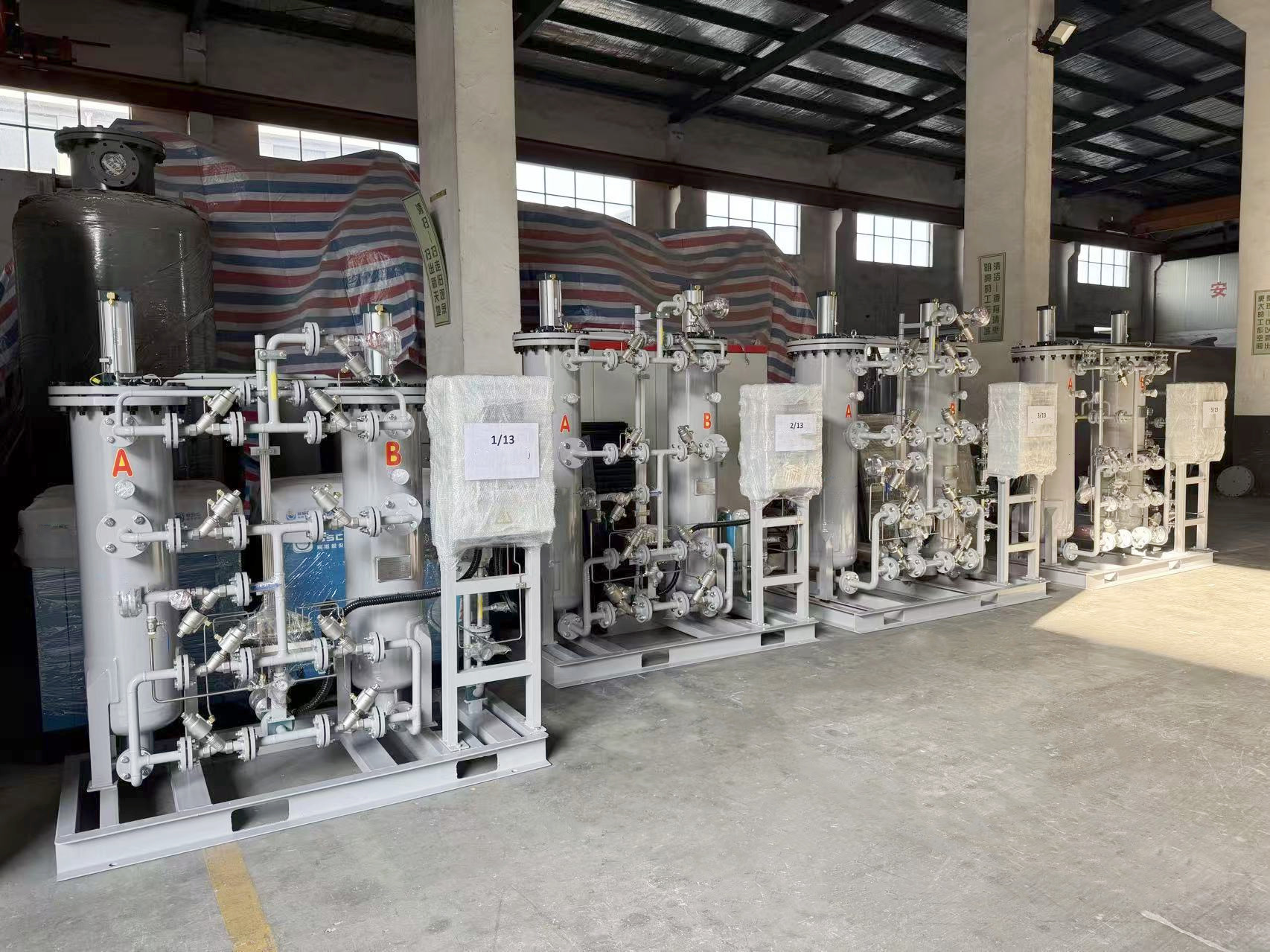
OEM / ODM production capability
Quality management is documented through ISO 9001, ISO 14001, and ISO 45001 system certificates covering relevant management activities in the production of BXN PSA nitrogen equipment and BXO PSA oxygen equipment. For pressure-vessel-oriented projects, buyers can request ASME standard execution and customized stainless steel versions. In the European market, pressure equipment must comply with PED 2014/68/EU and bear CE marking where applicable, so the manufacturer should be asked to state the applicable code on the technical datasheet.
The Value of a Complete Pretreatment System
PSA and membrane generators share one important condition: the compressed air entering the generator must be clean and dry enough for the downstream separation material. If feed air contains water or oil, molecular sieve performance and membrane performance both degrade.
BODA GAS supplies refrigeration dryers, heatless desiccant dryers, heated desiccant dryers, combination low-dew-point dryers, high-efficiency oil-water separators, oil removers, precision filters, activated carbon filters, and sterilizing filters. For a PSA nitrogen station, the standard full system is usually: air compressor, air buffer tank, filters, dryer, activated carbon filter, PSA nitrogen generator, nitrogen buffer tank, and oxygen analyzer. Membrane systems follow the same logic because membrane modules also need dry, oil-free feed air for a stable service life.
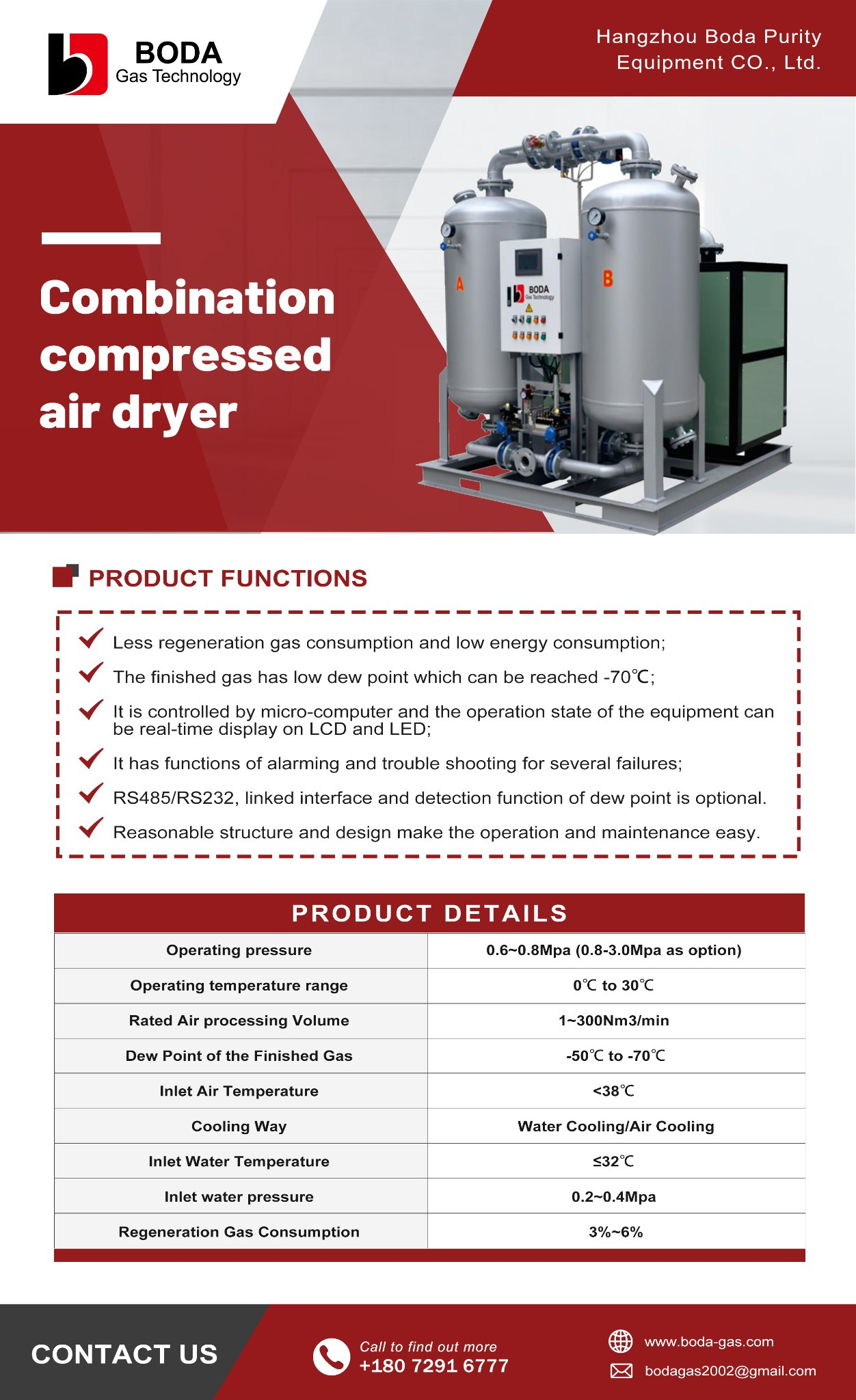
Combination desiccant dryer for low-dew-point compressed-air pretreatment
Frequently Asked Questions
What are the key differences between PSA and membrane nitrogen generators?
PSA generators use carbon molecular sieves to adsorb oxygen under pressure, which allows very high purity levels up to 99.999%, as in the BODA BXN Series. Membrane generators use hollow-fiber bundles that separate gases by permeation speed, giving a compact and quiet design; the BODA BMN Series membrane generator is rated for 95%-99.9% purity. The main practical difference is the purity ceiling: above 99.9%, PSA is the technology that normally satisfies the requirement.
What is the benefit of an on-site nitrogen generator compared with delivered nitrogen?
An on-site generator such as the BODA BXN PSA nitrogen generator can produce nitrogen up to 99.999% with adjustable purity, and the flow rate can be matched to demand. On-site supply avoids cylinder handling and delivery scheduling, and it cuts long-term operating and logistics costs compared with purchasing bulk gas. Independent US energy data cited by the U.S. Department of Energy estimates savings of up to 40% versus traditional cylinder deliveries.
What maintenance and cost should be expected for an industrial PSA nitrogen generator system?
Maintenance follows a predictable routine. Precision filter elements are commonly replaced around every 8000 hours. The air compressor needs standard service, including oil, oil filter, and air/oil separator changes, roughly every 3000-4000 runtime hours. Air dryer desiccant is typically replaced after 16,000-24,000 hours, while PSA carbon molecular sieve is expected to last 6-10 years. The exact interval depends on air quality and site conditions.
How do I choose the required nitrogen purity for my process?
Use the application tier as a guide. For 95%-98% purity, look at fire protection, marine tank blanketing, oil-field pipeline purging, and tyre inflation. For 99%-99.9%, look at food and beverage modified atmosphere packaging, winemaking, and conventional plastic molding. For 99.95%-99.99%, look at laser cutting of mild steel, electronics, cable production, and pharmaceutical tank blanketing. For 99.999% and above, plan for ultra-high-purity applications such as special-metal laser cutting, high-end electronics, and specialized laboratories.
Can a Chinese manufacturer provide OEM or ODM service for industrial PSA nitrogen generators?
Yes. BODA GAS supports OEM and ODM production, with a minimum order of 1 unit, monthly production capacity of approximately 40 units, and lead times of 25-45 days. Customers can customize flow rate, purity, pressure, dew point, material, production standard, voltage, logo, nameplate, and painting color. The technical team can also prepare a tailored scheme that calculates outlet flow, purity, and power consumption for the actual site conditions, and equipment is factory-tested before dispatch.
Conclusion
PSA and membrane nitrogen generators overlap in the medium-purity zone, but they serve different operating envelopes. A PSA nitrogen generator is the stronger choice when high purity, very low dew point, flexible output, or future expansion above 99.9% matters. A membrane nitrogen generator is suitable when the target purity can be met inside its range and the site benefits from compact, quiet, structurally simple generation.
BODA GAS can support either decision with verified equipment specifications, OEM/ODM production, full pretreatment integration, and after-sales installation guidance. To compare the complete BODA BXN and BMN system options, download the product manual below or contact the BODA GAS team with your purity, flow, pressure, dew point, and site voltage data.
Need a technical proposal for PSA or membrane nitrogen generation?
BODA GAS provides system selection, OEM customization, and pre-shipment testing. MOQ is 1 unit; lead time is 25-45 days.