
Ranked: PSA Nitrogen Generator Purification Options for 99.9995% Purity
Reaching 99.9995% nitrogen purity on site is a purification decision as much as a generation decision. A PSA nitrogen generator removes most of the oxygen from compressed air, but a 5 ppm total-impurity target means the residual oxygen, carbon dioxide and moisture left after the adsorption towers still have to be handled by a dedicated purification stage.
Among the purification configurations offered by BODA GAS — Hangzhou Boda Purity Equipment Co., Ltd., a PSA nitrogen and oxygen generator manufacturer established in Hangzhou, Zhejiang Province in 2002 — the BCP Series carbon loaded purification nitrogen generator ranks first for this target. It is specified for at least 99.9995% purity with O2 at a maximum of 5 ppm, CO2 at a maximum of 1 ppm and a dew point of −60 °C, across a 1–500 Nm³/h flow range. That specific combination of limits is what makes it the default specification for bright annealing, brazing, powder-metallurgy sintering, semiconductor, photovoltaic and lithium-battery duties.
The ranking below orders the available purification setups by target purity, achievable flow and end-use fit, and explains why each position is where it is. It is an evaluation of purification routes for a defined purity class, not a comparison of competing brands, and every figure quoted comes from BODA GAS product and process documentation.
Ranking summary: 1) BCP Series carbon loaded purification nitrogen generator — 99.9995% and above, O2 ≤ 5 ppm, CO2 ≤ 1 ppm, −60 °C dew point, 1–500 Nm³/h. 2) BHP Series hydrogenation purification nitrogen generator equipment — the alternative purification route for projects that specify hydrogenation. 3) BMN Series membrane separation nitrogen generator — 95–99.9% purity at 5–3000 Nm³/h for lower-purity, higher-flow duties.
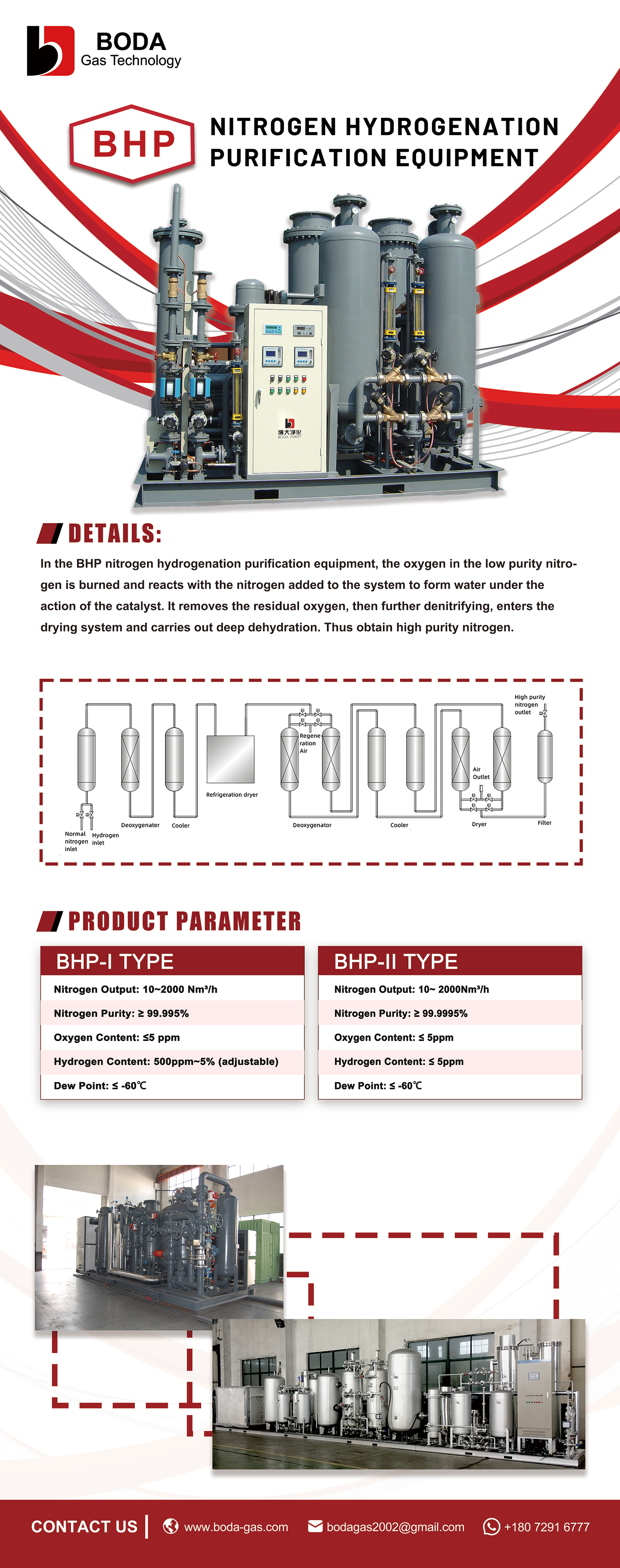
A dedicated purification stage sits downstream of the PSA towers and defines the achievable impurity ceiling.
Why 99.9995% Purity Is a Different Specification
At 99.9995% purity, the permitted total impurity is only 5 ppm. That single number immediately broadens the specification from “how much oxygen is left” to four separate limits that must all be met at the same time:
- Nitrogen purity: at least 99.9995%, measured at the outlet of the purification stage, not at the outlet of the adsorption towers.
- Residual oxygen: maximum 5 ppm O2.
- Residual carbon dioxide: maximum 1 ppm CO2.
- Moisture: a pressure dew point of −60 °C.
Carbon dioxide and water are the two variables buyers most often leave out of an inquiry, and they are the two that most often cause a system to fail acceptance. A generator that meets the O2 figure but delivers a −40 °C dew point does not satisfy a 99.9995% specification, because the water content alone consumes the entire impurity budget. A purification route therefore has to be selected against all four limits together.
Industry Background: Where Ultra-High-Purity Nitrogen Is Actually Required
Nitrogen purity requirements cluster by application rather than by industry label. BODA GAS documents four commonly referenced bands:
- 95–98%: fire protection, marine tank blanketing, oil-field pipeline purging and general tire inflation.
- 99–99.9%: food and beverage modified atmosphere packaging, winemaking and conventional plastic molding.
- 99.95–99.99%: mild-steel laser cutting, electronics manufacturing, cable production and pharmaceutical tank blanketing.
- 99.999% and above: cutting special metals such as titanium alloy, high-end electronics production and specialized laboratory applications.
The applications named in the 99.9995% bracket for the BCP Series sit at the top of that pyramid: bright annealing and brazing, where surface oxidation ruins the finish; powder-metallurgy sintering, where residual oxygen attacks the metal powder; semiconductor and photovoltaic processing; and lithium-battery manufacturing, where moisture and CO2 affect cell chemistry. In each case the purification stage is not an accessory — it is the part of the system that determines whether the process works.
That is also why the question is rarely “which nitrogen generator” and more often “which purification configuration, at what flow, for which end use.” An on-site PSA nitrogen generator sized for 99.9% packaging duty and one specified for 99.9995% sintering duty may share the same adsorption principle but not the same downstream equipment list.
Comparison Table: Three Purification Routes Side by Side
| Rank | Purification setup | Purity target | Flow range | Best-fit end uses |
|---|---|---|---|---|
| 1 | BCP Series carbon loaded purification nitrogen generator | ≥ 99.9995%; O2 ≤ 5 ppm; CO2 ≤ 1 ppm; −60 °C dew point | 1–500 Nm³/h | Bright annealing, brazing, powder-metallurgy sintering, semiconductor, photovoltaic, lithium battery |
| 2 | BHP Series hydrogenation purification nitrogen generator equipment | Ultra-high-purity route, specified per project | Confirmed per project | Projects whose specification or site policy requires a hydrogenation-based purification step |
| 3 | BMN Series membrane separation nitrogen generator | 95–99.9% | 5–3000 Nm³/h | Tank blanketing, pipeline purging, food and beverage packaging, higher-flow lower-purity duties |
Flow and purity values reflect the published configuration of each series. Exact figures for a specific project are confirmed at the technical-scheme stage, because altitude, inlet air conditions, voltage and duty cycle all affect the final selection.
1. BCP Series Carbon Loaded Purification Nitrogen Generator
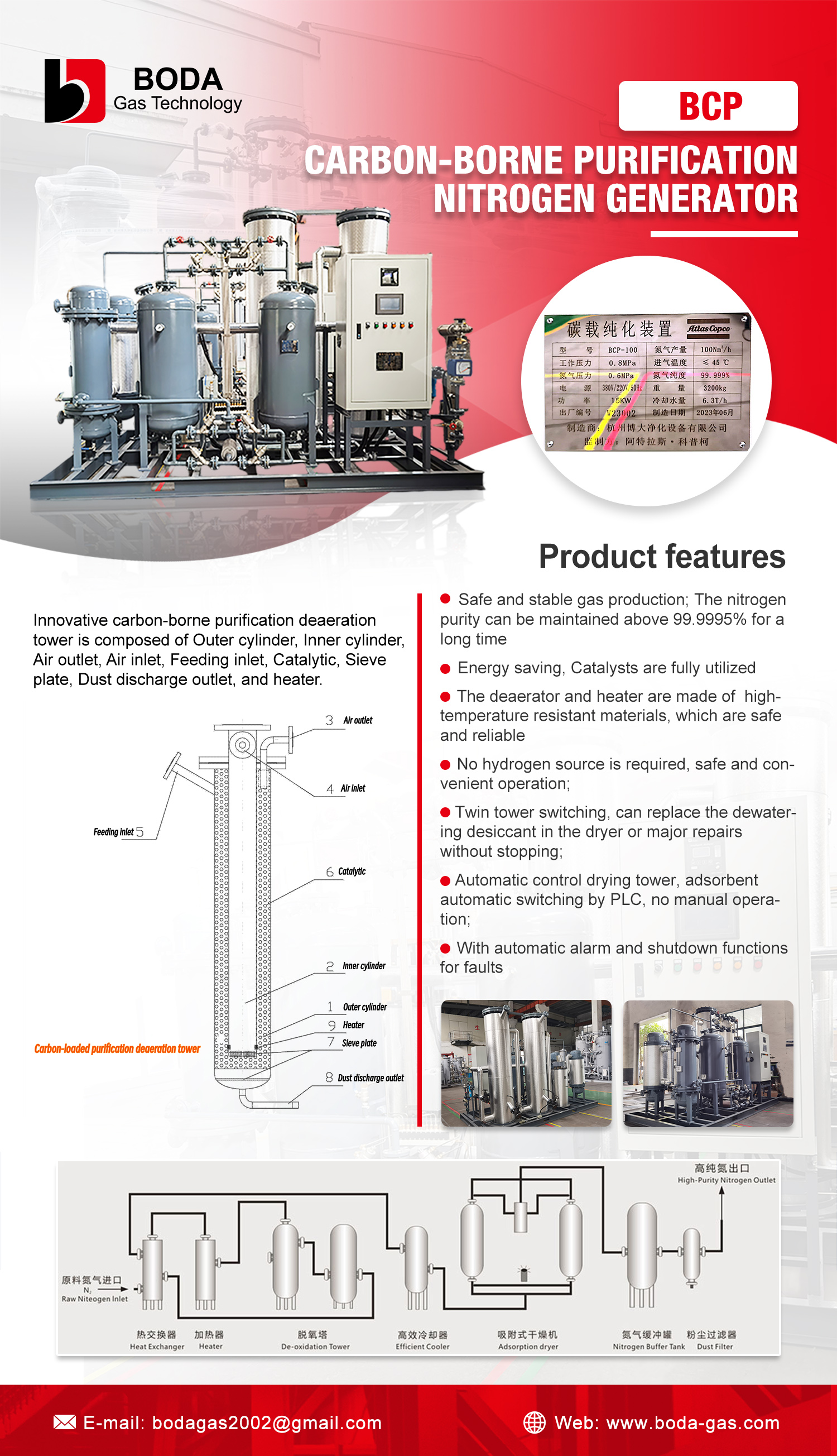
BCP Series: carbon loaded purification downstream of PSA adsorption.
The BCP Series is the only configuration in this evaluation that carries all four ultra-high-purity limits as published specifications rather than as project targets. It is an industrial PSA nitrogen generator with an integrated carbon loaded purification stage, and the published operating window is:
- Purity: at least 99.9995%
- Oxygen: maximum 5 ppm
- Carbon dioxide: maximum 1 ppm
- Dew point: −60 °C
- Flow: 1–500 Nm³/h
Why it ranks first. The selection logic for a 5 ppm impurity budget has nothing to do with how much nitrogen the adsorption towers can produce. It depends on whether the downstream purification stage can remove the last traces of O2, CO2 and water simultaneously and repeatably. The BCP Series is specified around exactly that combination, so a buyer is not assembling a purity claim from three separate component datasheets. The 1–500 Nm³/h range is also wide enough to cover pilot, mid-size and full production duties without changing purification technology.
Where it fits. Bright annealing and brazing are the clearest cases: any residual oxygen in the furnace atmosphere shows up directly as discoloration or oxidation on the work surface, and a −60 °C dew point keeps hydrogen and moisture reactions out of the picture. Powder-metallurgy sintering is similarly sensitive, since residual oxygen reacts with the powder surface before densification. Semiconductor and photovoltaic processing, and lithium-battery electrode drying and cell sealing, extend the same logic to contamination control at trace level.
Practical boundary. Above 500 Nm³/h, the BCP Series is no longer the natural fit and the conversation moves either to multiple purification trains or to a lower-purity technology. Buyers who need a very large flow at 99.9995% should expect a multi-unit arrangement rather than a single package.
2. BHP Series Hydrogenation Purification Nitrogen Generator Equipment
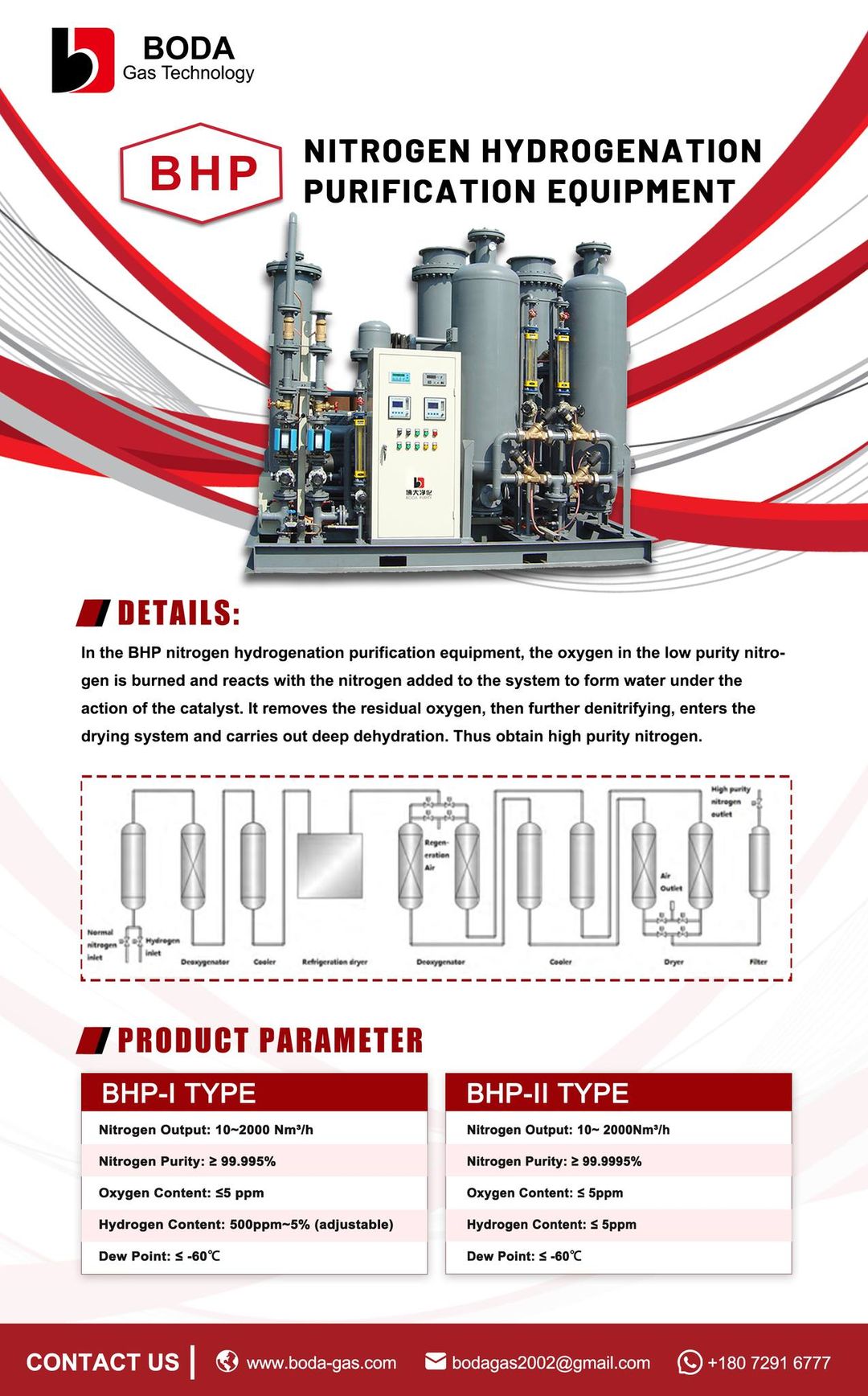
BHP Series: an alternative ultra-high-purity purification route based on hydrogenation.
The BHP Series is the second purification route available for ultra-high-purity duty, and it exists for a specific reason: it gives buyers an alternative when the project specification, the site’s gas-safety policy or an existing plant standard calls for a hydrogenation-based purification step rather than a carbon loaded one.
Why it ranks second rather than first. Ranking here follows clarity of fit, not capability. The BCP Series carries published figures that map directly onto the four limits of a 99.9995% specification, so a buyer can compare an inquiry against a written target. The BHP Series is a route selected at project level, which means the purity, flow and dew-point limits are established during technical scheme development rather than read from a fixed published window. For a buyer who simply needs to hit 99.9995% with O2 ≤ 5 ppm, CO2 ≤ 1 ppm and −60 °C at 1–500 Nm³/h, the BCP Series is the shorter path.
Where it fits. The BHP Series belongs in projects where hydrogenation purification is already the expected route — for example, when a plant’s engineering standard, an EPC specification or a regional safety review has already determined the purification principle before the supplier is selected. In those cases the practical question is not which route is better but which supplier can engineer the specified route and integrate it with pre-treatment, buffering and analysis. BODA GAS offers both routes from the same manufacturing base, so the choice can be made on project grounds rather than on supplier availability.
3. BMN Series Membrane Separation Nitrogen Generator
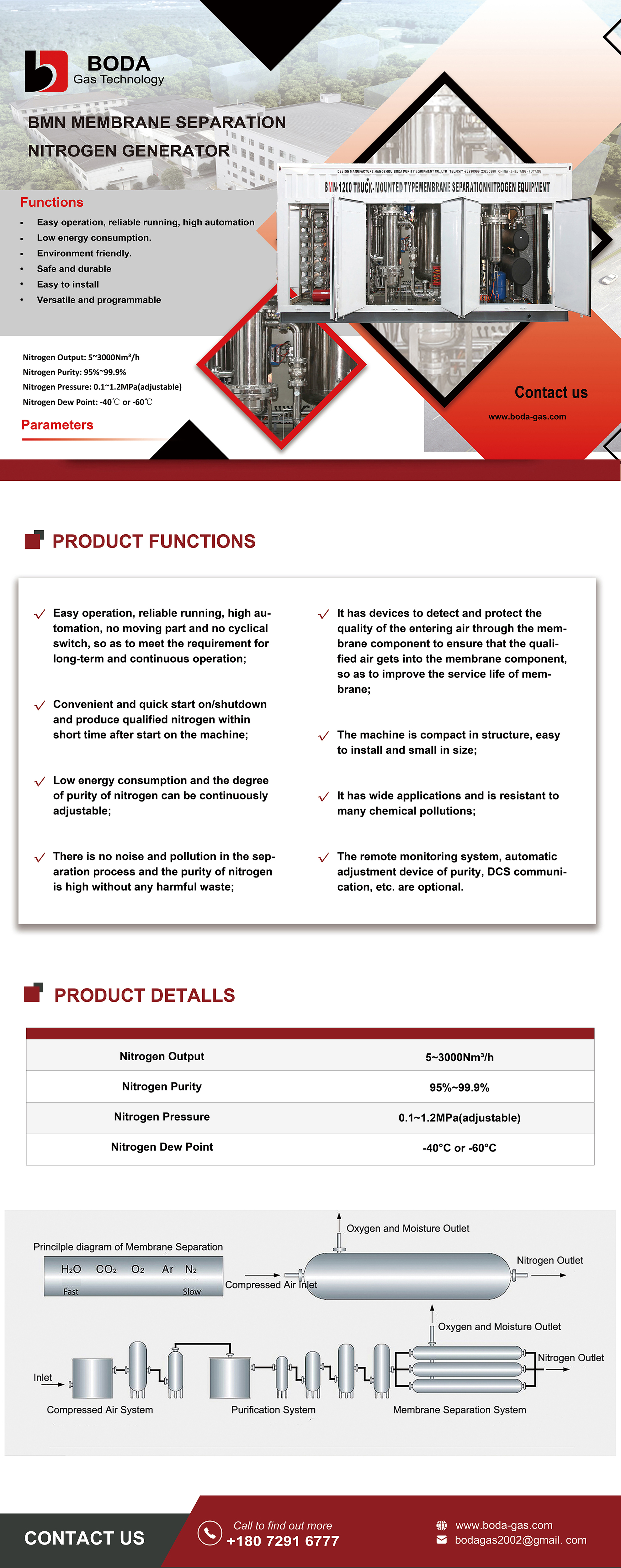
BMN Series: membrane separation for lower-purity, higher-flow duties.
The BMN Series sits third for the 99.9995% question, but that position should not be read as a weakness. Membrane separation is included in this ranking because a large share of inquiries that start at ultra-high purity turn out, once the application is examined, to need something else entirely: more flow at a lower purity band.
The published operating window for the BMN Series is 95–99.9% purity at 5–3000 Nm³/h. That is a far wider flow span than the BCP Series offers, and it is the reason membrane systems appear so often in tank blanketing, pipeline purging, marine inerting and food and beverage modified atmosphere packaging.
Why it ranks third. Membrane separation does not reach the 99.9995% band. If the process genuinely needs O2 ≤ 5 ppm, CO2 ≤ 1 ppm and a −60 °C dew point, the BMN Series is the wrong tool and no amount of pre-treatment will change that. The ranking reflects the target purity of this article, not the general usefulness of the technology.
Where it fits. Food and beverage packaging normally sits in the 99–99.9% band, which the BMN Series covers at high flow. Chemical plant blanketing and purging frequently accept the same range. Oil and gas applications vary widely by duty, and some upstream or pipeline duties need far less purity than the specification template implies. In all of these cases, specifying a membrane unit instead of a carbon loaded purification unit reduces both equipment complexity and the number of components that need maintenance.
The Layer That Protects Every Option: Air Pre-Treatment
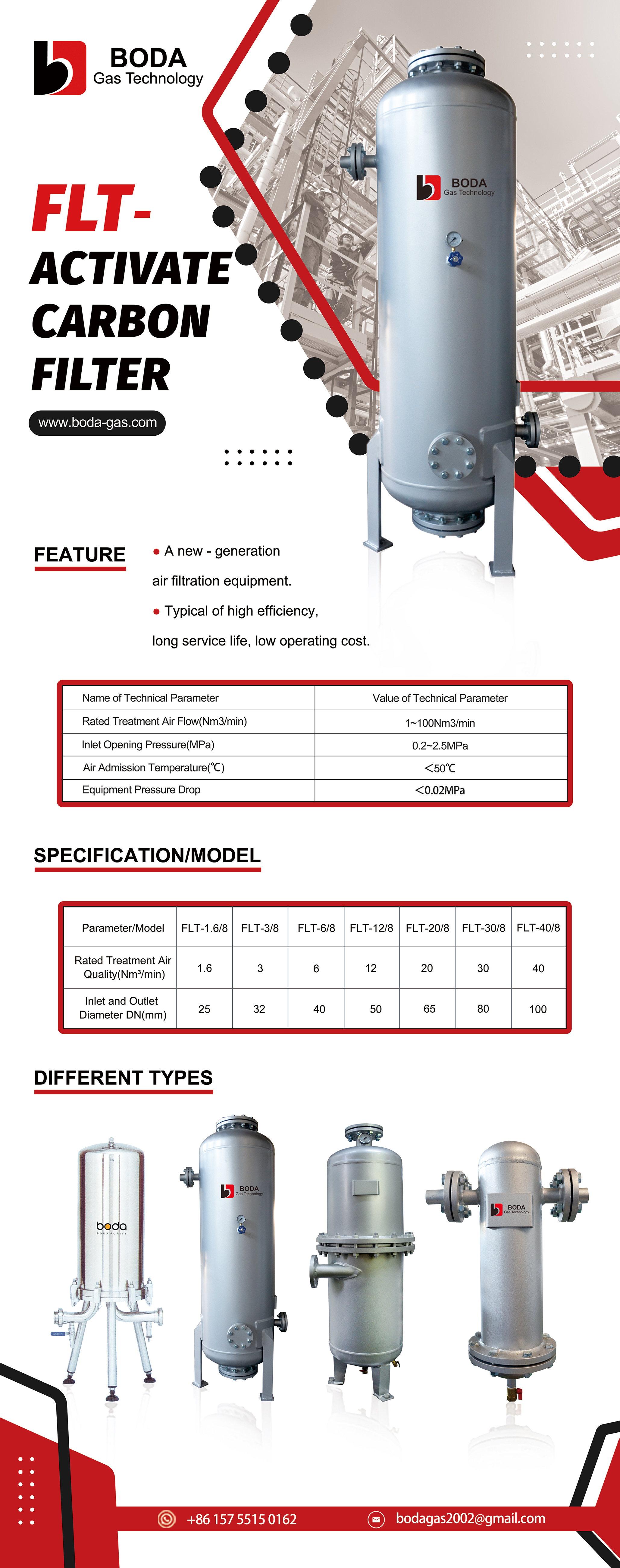
Pre-treatment protects the carbon molecular sieve and, by extension, the purity the purification stage can hold.
No purification stage can compensate for contaminated inlet air. Oil vapour, water carry-over and particulate matter degrade the carbon molecular sieve, and a degraded sieve produces a purity that drifts downward long before it fails outright. For that reason the pre-treatment train should be specified together with the purification route, not after it.
The BODA GAS pre-treatment components that support a 99.9995% configuration are:
- High efficiency oil-remover (FLY Series) — removes oil carry-over from the compressor before it reaches the desiccant or the sieve.
- High efficiency oil-water separator (FYS Series) — bulk condensate and oil removal at the front of the train.
- Activated carbon filter (FLT Series) — captures residual oil vapour and hydrocarbon impurities.
- Precision filter (FAL Series) — removes dust and solid particles downstream of the dryer.
- Sterilizing filter (FLC Series) — where microbiological control is required, as in pharmaceutical and food-contact duties.
- Heatless compressed air desiccant dryer (ADL Series) and heated compressed air desiccant dryer (ADH Series) — bring the compressed air dew point down before adsorption.
A dryer is not optional on a high-purity system. BODA GAS specifies dryers for high-purity nitrogen where the end-use points require a defined dew point, and for sites with high ambient temperature where moisture load in the inlet air is elevated. For sites where a standard dryer is not enough, a combined low dew point compressed air dryer (FAG Series) can be used to push the compressed-air dew point lower before the towers.
Maintenance of this layer is predictable, which matters for a low-maintenance PSA nitrogen generator specification. BODA GAS publishes the following service intervals: precision filter elements replaced every 8,000 hours; air compressor service including oil, oil filter and air/oil separator every 3,000–4,000 running hours; air dryer desiccant generally at 16,000–24,000 hours; and carbon molecular sieve replacement typically at 6–10 years.
Step-by-Step: Specifying a 99.9995% Purification Setup
The sequence below reflects how a BODA GAS technical scheme is normally built. Each step removes a decision that would otherwise resurface later as a purity deviation.
- Fix the end-use limits, not just the headline purity. Record purity, O2, CO2 and dew point as four separate requirements. A specification that states only “99.9995%” leaves the two hardest variables undefined.
- Confirm the real flow. Peak demand, not average demand, sets the size. For the BCP Series the ceiling is 500 Nm³/h per purification train; above that, plan for multiple trains or a different technology.
- Specify the pre-treatment train against the inlet air. Oil-remover, oil-water separator, activated carbon filter, dryer and precision filter are selected for the local ambient conditions and compressor type, not copied from a template.
- Select the purification route. BCP Series carbon loaded purification for the 99.9995% class; BHP Series hydrogenation purification where the project specifies that route; BMN Series membrane separation where the real requirement is 95–99.9% at higher flow.
- Define the buffer and analysis arrangement. A nitrogen buffer tank smooths pressure and flow fluctuation from tower switching and covers peak consumption; an oxygen analyser with automatic venting protects the downstream process from off-spec gas during start-up and upset.
- Fix the commercial and mechanical envelope. Voltage, outlet pressure, material, production standard, footprint, painting colour and nameplate details are all part of the configuration and should be settled before the order is placed.
- Agree the acceptance basis. Test conditions, sampling point and instrument must be written into the order so that both parties measure the same thing at the same place.
Use Cases: Which Configuration Fits Which Duty
The three routes map onto distinct operating realities. The examples below are drawn from BODA GAS project records and published application notes.
Cable and electronics manufacturing. A cable manufacturer in Uzbekistan operates three BXN-375H units producing 99.999% high-purity nitrogen with adjustable purity, running fully automatic unattended PLC operation for three years. An electronics producer in India runs two BXN-50A+ units at 99.995% for five years with remote start-stop and dew-point readout; a comparable electronics installation in Jordan has run two units for five years. These are the duties where the difference between 99.99% and 99.9995% is measured in scrap rate rather than in a specification sheet.
Chemical and fine chemical plants. PSA nitrogen generators for the chemical industry are frequently supplied as ASME-standard skid-mounted packages. BODA GAS has supplied two units to a fine chemical plant in Tanzania (ten years of stable operation), two units to a chemical plant in Malaysia (eight years, ASME standard, low dew point) and two units to a chemical plant in Indonesia (seven years, ASME standard, stainless steel pipeline). Where the chemistry demands ultra-high purity, the BCP Series route applies; where the duty is blanketing or purging, the BMN Series often covers it.
Oil and gas. PSA nitrogen generators in oil and gas applications are usually supplied as a movable containerized PSA nitrogen generator or a skid-mounted PSA nitrogen generation package, because the unit has to travel to the well site or pipeline spread. BODA GAS has supplied four ASME-standard units to an onshore and offshore oil and gas operation in Saudi Arabia, plus three pipeline-type compressed-air dryers to an EPC contractor in Uganda for a petroleum pipeline project.
Food and beverage, and pharmaceutical. PSA nitrogen generators for food and beverage packaging typically sit in the 99–99.9% band and require a sterilizing filter in the train; a food-processing end user in Mexico has run two units producing food-grade nitrogen for four years. PSA nitrogen generators for the pharmaceutical industry follow the same logic with tighter documentation, and BODA GAS holds ISO 13485 medical device quality management certification alongside its ISO 9001, ISO 14001 and ISO 45001 systems.
Very large flow. A coal-chemical and electromechanical end user in Nigeria operates two units with a nitrogen output capacity of 3000 Nm³/h. At that scale the conversation is about system architecture — multiple trains, buffer volume and pre-treatment redundancy — rather than about a single purification stage.
What This Means for a Buyer Specifying Ultra-High Purity
A good quality PSA nitrogen generator for the 99.9995% class is not identified by the generator alone. It is identified by whether the supplier can show, in writing, the four impurity limits, the flow at which those limits hold, the pre-treatment train protecting them, and the acceptance method that will be used to prove it. The BCP Series carries the four limits as published figures; the BHP Series provides the alternative purification route where the project requires it; the BMN Series covers the large-flow, lower-purity duties where membrane separation is the simpler engineering answer.
Because the pre-treatment layer determines whether the purification stage can hold its numbers over years rather than weeks, it should be specified at the same time and by the same supplier. A split scope — generator from one vendor, dryers and filters from another — is where most purity-drift problems begin.
Frequently Asked Questions
What certifications does a Chinese OEM industrial PSA nitrogen generator manufacturer hold for regulated projects?
BODA GAS holds an ISO 9001:2015 quality management system certificate (244-25-QL-11075-R0-S, issued 2025-08-11, valid to 2028-08-10), an ISO 14001:2015 environmental management system certificate (244-24-EJ-09517-R2-S, issued 2024-07-15, valid to 2027-11-04) and an ISO 45001:2018 occupational health and safety management system certificate (244-24-SY-09318-R2-S, issued 2024-07-15, valid to 2027-11-04), all issued by YAB CERTIFICATION CO.,LTD. The certified scope covers the relevant management activities involved in the production of BXN PSA nitrogen equipment, BXO PSA oxygen equipment, general refrigeration compressed air dryers and general adsorption compressed air dryers. The company also holds ISO 13485 medical device quality management system certification, and all equipment must pass qualification testing prior to factory release.
Can a Chinese PSA nitrogen generator manufacturer build an OEM unit to 99.9995% purity with a custom voltage and layout?
Yes. BODA GAS operates on an OEM and ODM basis and lists flow rate, purity, pressure, dew point, material, production standard, voltage, logo, nameplate and painting colour as customizable parameters. The technical team calculates air-to-nitrogen ratio, outlet flow, purity and power consumption against the site’s altitude, voltage and application, then produces a layout and technical scheme before the order. Monthly capacity is 40 units, which matters when an OEM buyer needs repeat batches rather than a single machine.
What are the minimum order quantity, payment terms and delivery terms?
The minimum order quantity is 1 unit. Delivery terms are EXW, FOB, CIF or CFR. Payment terms are 30% deposit by T/T in advance with the remaining 70% by T/T before dispatch. Acceptance is based on a pre-shipment test, so the purity and flow figures are verified before the equipment leaves the factory rather than after arrival on site.
How is a 99.9995% purification unit tested before shipment, and can a sample be validated first?
Every unit undergoes 100% testing covering visual inspection and function inspection, and the pre-shipment test forms the contractual acceptance basis. For buyers validating a new process or a new supplier, the practical route is to define the test conditions — sampling point, instrument, stabilization time and load — in the technical scheme and then confirm the outlet figures against those conditions at the factory. This is the point at which questions about O2 at 5 ppm, CO2 at 1 ppm and a −60 °C dew point should be answered, not after the skid has been installed.
What is the lead time, and what support comes after delivery?
Standard lead time is 25–45 days. BODA GAS provides a 12-month equipment guarantee, on-site and remote installation guidance, operation-staff training, remote technical support and 24-hour online after-sales service. Installation itself is deliberately simple: the skid is set down and the power cable connected, after which the unit is essentially plug-and-play, with operation manuals and video guidance supplied. To confirm which purification route fits a specific purity, flow and end-use combination, send the four impurity limits and the peak flow to BODA GAS for a technical scheme and quotation.
Conclusion
Ranked against the 99.9995% target, the order is clear. The BCP Series carbon loaded purification nitrogen generator comes first because it is the configuration that carries all four limits — at least 99.9995% purity, O2 ≤ 5 ppm, CO2 ≤ 1 ppm and a −60 °C dew point — across a 1–500 Nm³/h range, and because that range covers the annealing, brazing, sintering, semiconductor, photovoltaic and lithium-battery duties where the specification is written. The BHP Series hydrogenation purification nitrogen generator equipment follows as the alternative purification route for projects where hydrogenation is already the specified principle. The BMN Series membrane separation nitrogen generator takes third place for this purity class while remaining the right answer for 95–99.9% duties at 5–3000 Nm³/h.
Whichever route is selected, the pre-treatment train — high efficiency oil-remover, high efficiency oil-water separator, activated carbon filter, desiccant dryer and precision filter — is what keeps the purification stage performing year after year. Specify it in the same scope as the generator, and the purity number on the datasheet becomes a number the plant can actually hold.
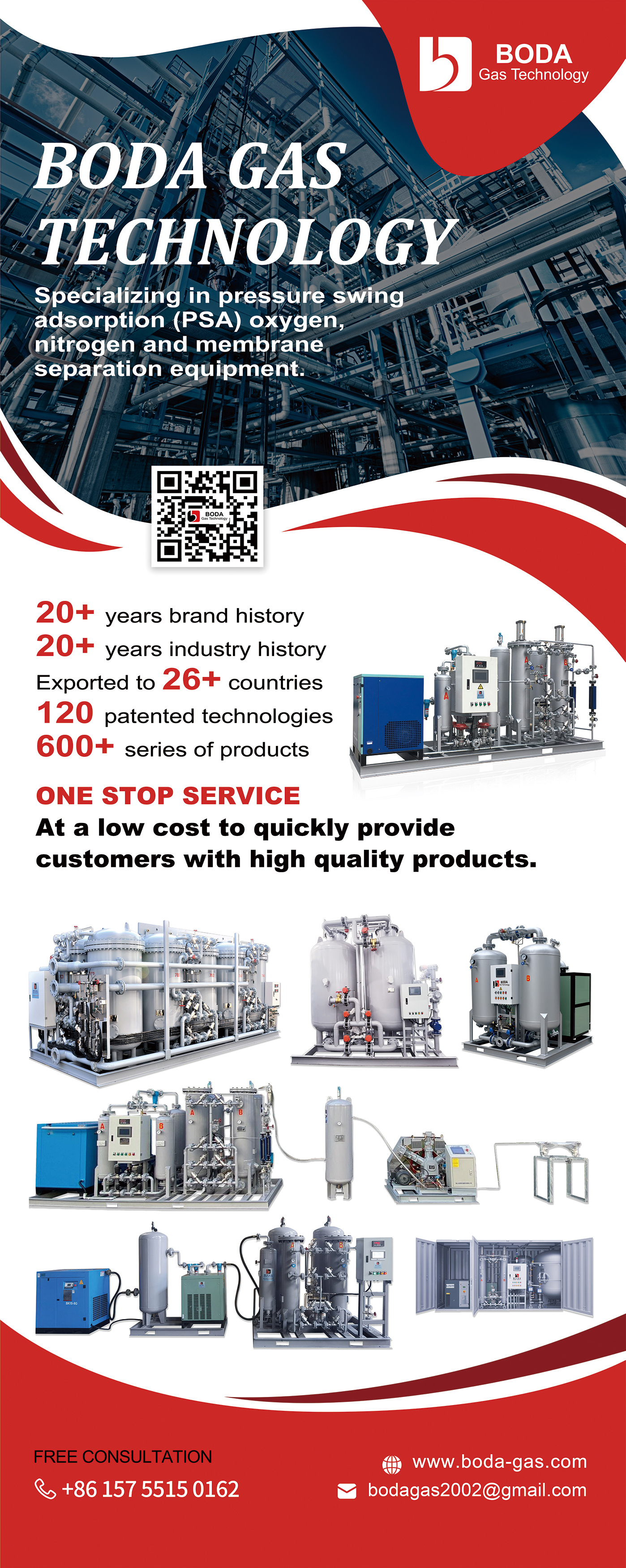
Specifying 99.9995% nitrogen? Start with the four limits.
Send BODA GAS your required purity, O2, CO2, dew point, peak flow and site voltage. The technical team returns a configuration with the purification route, pre-treatment train and layout matched to your duty.
Email: bodagas2002@gmail.com | Tel / WhatsApp: +86 157-5515-0162
Download the full product manual: BODA GAS Product Manual (PDF)
Have Questions or Need More Details?
Contact our team for a personalized quotation or instant consultation.
Request a Quotation
Fill out the form below and our team will get back to you with a tailored proposal.
WhatsApp Direct Chat
Prefer to chat in real-time? Message us on WhatsApp for instant assistance & quick answers.
- Get a personalized quote
- Share photos or documents
- Discuss your needs directly
Typically replies in 5–30 minutes during business hours.