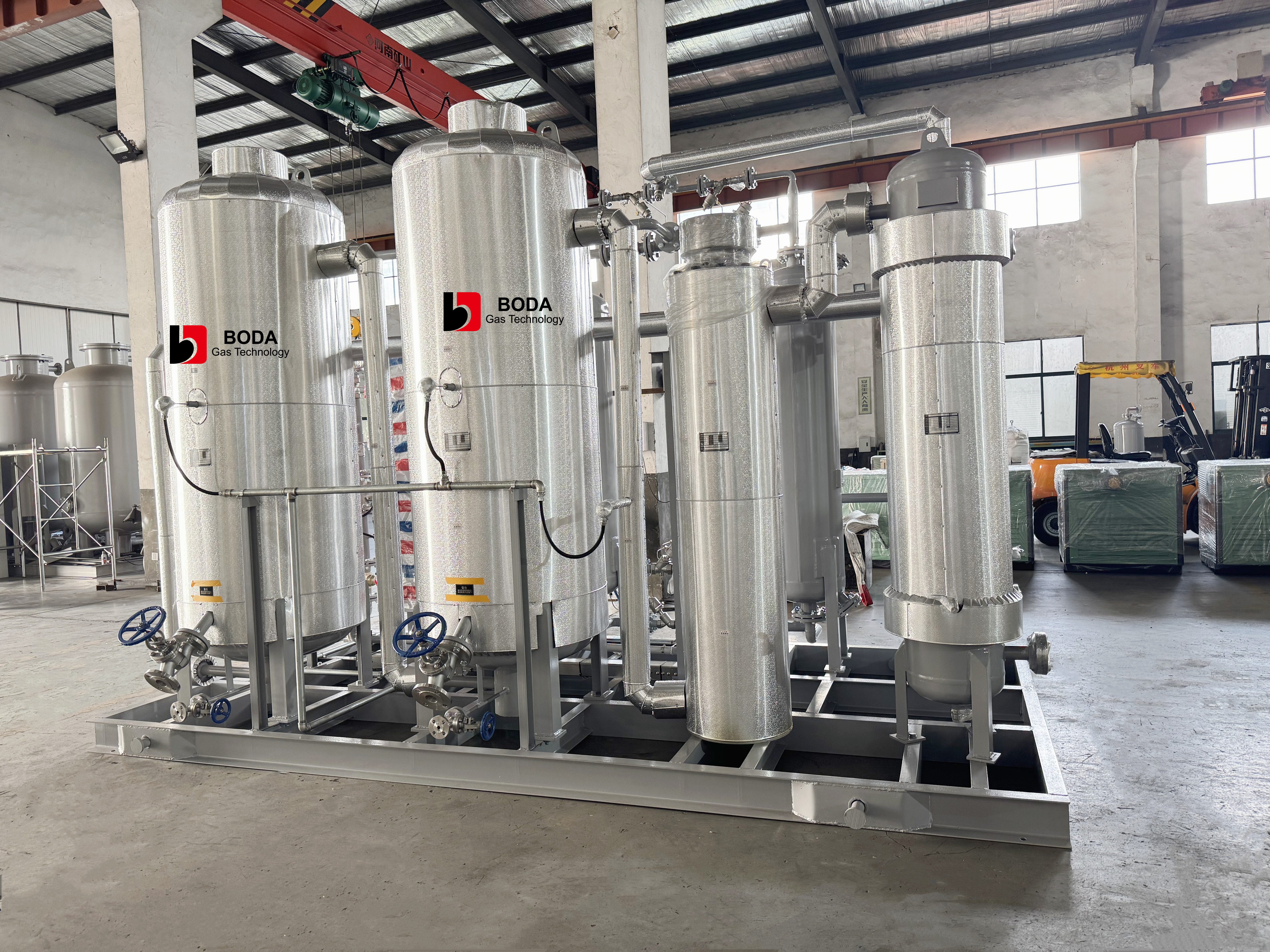
Using Carbon Loaded Purification for Annealing and Brazing Applications
Annealing and brazing furnaces rarely fail because nitrogen is unavailable. They fail because the nitrogen is not clean enough. A bright anneal that comes out discoloured, a brazed joint where the filler metal refuses to wet the base metal, a sintered part with oxides locked into the structure — these are gas-quality problems, not furnace problems. Carbon loaded purification addresses exactly that class of problem: it takes nitrogen that a PSA generator has already separated from air and strips out the last few parts per million of oxygen and carbon dioxide before the gas reaches the hot zone. The BCP Series from Hangzhou Boda Purity Equipment Co., Ltd. (BODA GAS) is documented with an output range of 1–500 Nm³/h, nitrogen purity of at least 99.9995%, oxygen content at or below 5 ppm, carbon dioxide content at or below 1 ppm and a nitrogen dew point of ≤-60°C. This guide explains what those figures mean inside a bright annealing, brazing or powder-metallurgy sintering furnace, and how to specify a system around them.
Problem Definition: Why a Purity Percentage Is Not a Furnace Specification
PSA nitrogen generation separates nitrogen from air by pressure swing adsorption. Under pressure, carbon molecular sieve (CMS) adsorbs oxygen preferentially while nitrogen concentrates in the gas phase. The BXN Series PSA nitrogen generator from BODA GAS covers a nitrogen flow rate of 1–3,000 Nm³/h, purity of 95%–99.999%, outlet pressure adjustable from 0.1 to 1.15 MPa, and a nitrogen dew point between -40°C and -70°C, with a noise level of 65–85 dB(A).
For tyre inflation, marine tank blanketing, fire protection or general pipeline purging, that range is generous. A standard PSA unit running at 95%–99.9% purity already delivers more than those processes need.
Furnace atmospheres are different, and the difference is not about the headline purity number. It is about which residuals remain and how much of each is left. Three residual species drive oxidation in an annealing or brazing furnace.
Oxygen. Oxygen that reaches the hot zone reacts with the workpiece surface. In bright annealing the objective is a metallic, oxide-free finish straight out of the furnace, so any oxygen arriving at the part works directly against the process goal. In brazing, an oxide film on the base metal or on the filler metal is what stops capillary flow into the joint.
Carbon dioxide. CO₂ is also an oxidising species at furnace temperature, and it is carried through the separation process as a trace constituent of the product gas. Its acceptable limit in demanding furnace work is tighter than the oxygen limit — which is why the BCP Series is specified with carbon dioxide content at or below 1 ppm rather than at the same level as oxygen.
Moisture. Water vapour is the third oxidiser and it is controlled separately through dew point. The BCP Series is documented at a nitrogen dew point of ≤-60°C, with dedicated drying stages upstream to reach it.
The practical consequence is simple. A specification that states “99.999% nitrogen” without naming the oxygen limit, the carbon dioxide limit and the dew point limit does not tell an annealing or brazing engineer whether the gas will actually protect the part.
Industry Background: Why Heat Treatment Moved to On-Site Nitrogen
On-site nitrogen generation has shifted from a niche utility decision to a mainstream industrial one, and metal heat treatment sits inside that shift.
Market research describes the global industrial nitrogen generator market at USD 4.29 billion in 2023, projected to reach USD 6.47 billion by 2031 (Verified Market Research). Within that market, pressure swing adsorption is the dominant technology, accounting for approximately 48% of global nitrogen generator market share (Fortune Business Insights). Asia-Pacific is the fastest-growing region and is projected to hold a 35% market share by 2032 (Verified Market Research).
Installed capacity is concentrated in the small and mid-size bands. PSA nitrogen generator installations are divided by capacity into sub-100 Nm³/h at 42%, 100–500 Nm³/h at 36%, and above 500 Nm³/h at 22% (Precedence Research / Dataintelo). The 1–500 Nm³/h output range of the BCP Series therefore spans the two largest installation bands — the scale at which most annealing shops, brazing cells and sintering lines actually operate.
Two economic factors keep pushing buyers toward on-site generation. On-site nitrogen generation can reduce nitrogen supply costs by up to 40% compared with traditional cylinder deliveries, once logistics fees are eliminated (U.S. Department of Energy source data). And where purity requirements exceed 99.9%, PSA systems are favoured over membrane systems, because membrane purity is typically capped at lower levels (Atlas Copco).
Heat treatment fits this trend for a specific reason: a bright annealing line or a brazing furnace runs continuously, and a continuous ultra-high-purity nitrogen demand is precisely the consumption profile that penalises cylinder and liquid delivery most heavily.
Detailed Solution: What Carbon Loaded Purification Actually Removes
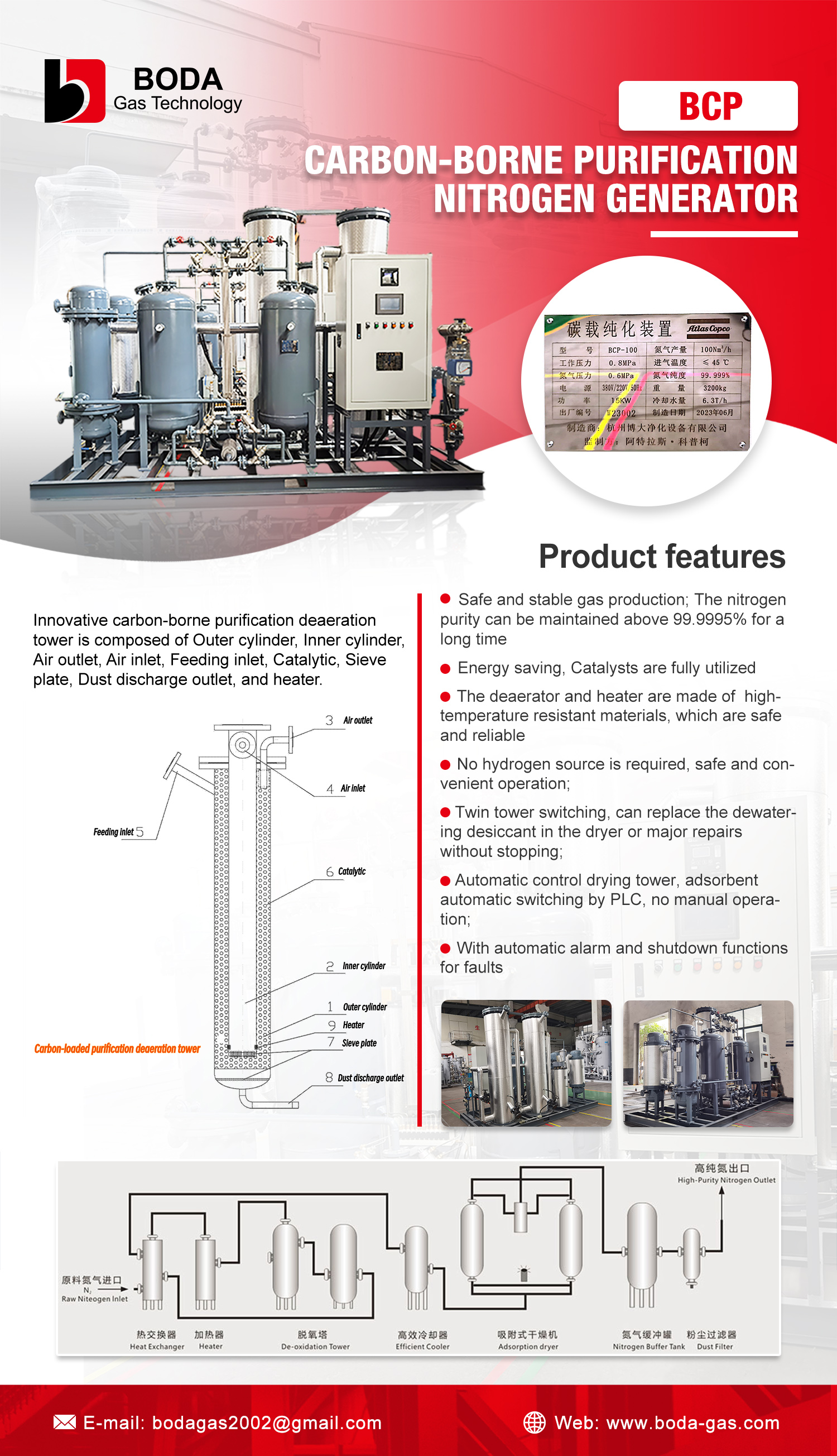
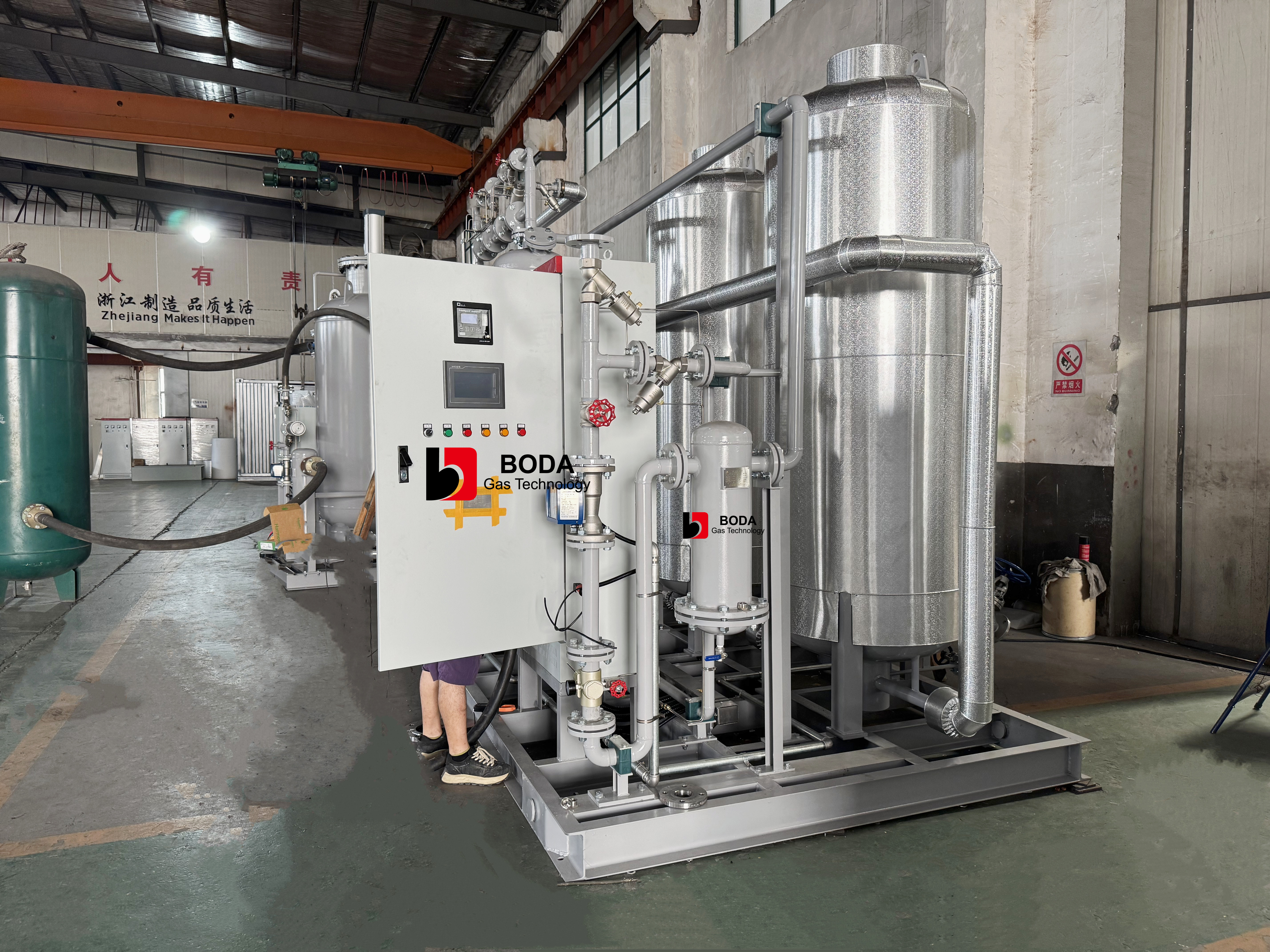
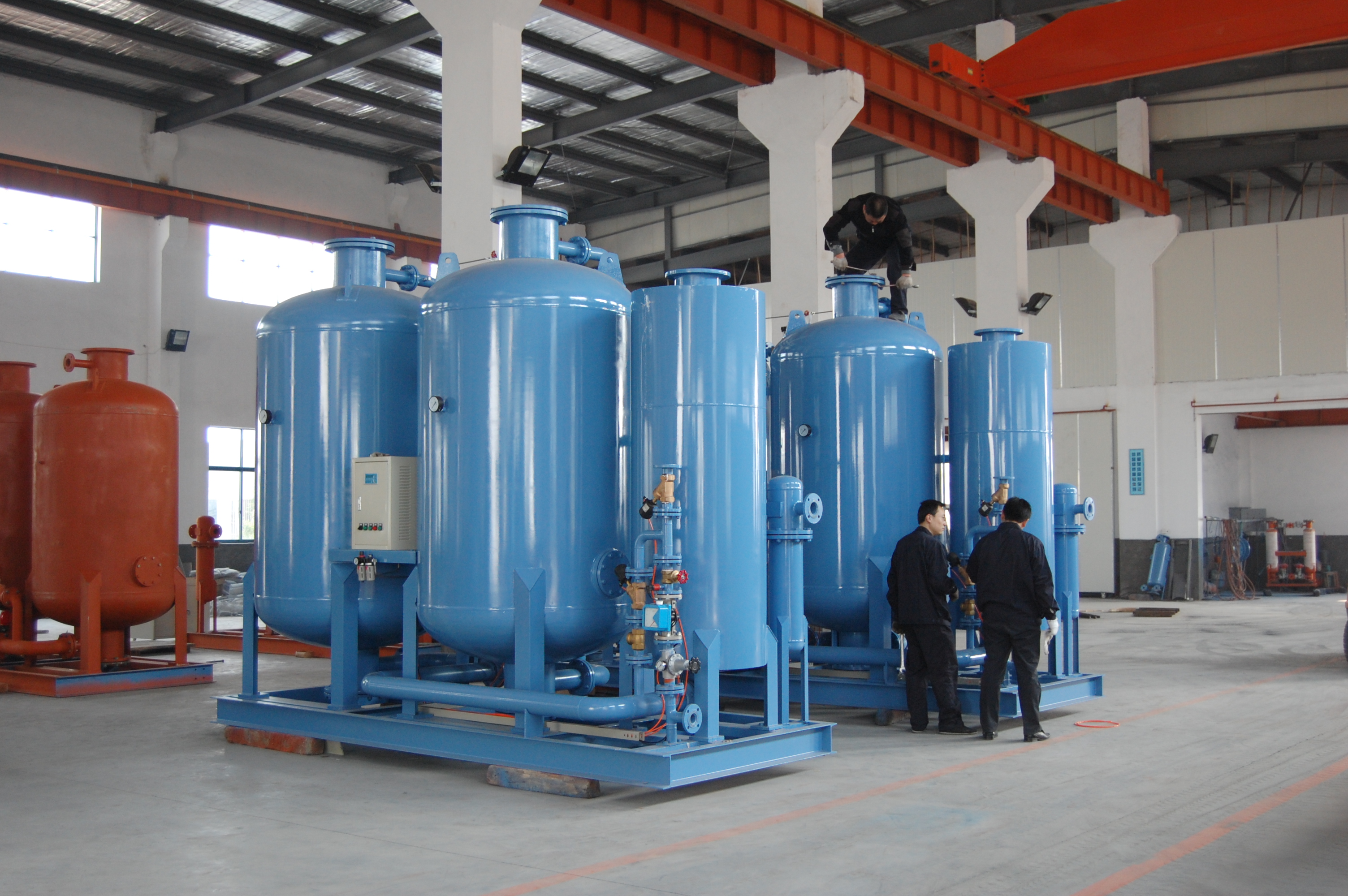
Carbon loaded purification is a post-PSA purification stage. Nitrogen leaves the carbon molecular sieve beds at whatever purity the PSA stage delivers, then passes through a purification vessel packed with carbon-loaded catalyst that removes the remaining oxygen, supported by drying and automatic venting hardware that manages moisture and rejects off-specification gas.
The BCP Series is BODA GAS's implementation of that route. Its documented specification is as follows.
| Product | Carbon loaded purification nitrogen generator (BCP Series) |
| Nitrogen output | 1–500 Nm³/h |
| Nitrogen purity | ≥99.9995% |
| Oxygen content | ≤5 ppm |
| Carbon dioxide content | ≤1 ppm |
| Nitrogen dew point | ≤-60°C |
| Material | Carbon steel / SS304 |
| Customization | Stainless steel, ATEX, ASME, CE |
| Control & diagnostics | Fault diagnosis, alarm and automatic processing functions; optional DCS communication interface |
Beyond the headline numbers, four design features matter to a furnace engineer.
No hydrogen. The BCP Series is documented as containing no H₂, which makes it suitable for applications with strict requirements for hydrogen and oxygen. This is a real constraint inside a furnace room: hydrogen brings zoning, ventilation and gas-detection obligations that many sites would rather avoid, and some materials and downstream processes cannot tolerate residual hydrogen at all.
Double-tower deaerator. The deaerator uses a double tower structure, which allows carbon-loaded catalyst to be added or replaced without stopping the machine. For a furnace that runs continuously, servicing the purification stage online removes what would otherwise become a planned production stop.
Automatic venting. The automatic venting device, covered by a national patent, is what keeps finished-gas quality stable: off-specification gas is diverted rather than delivered to the furnace.
Component selection and diagnostics. Key components are sourced from established brands, and the system includes fault diagnosis, alarm and automatic processing functions, with an optional DCS communication interface for plants that want furnace and gas-plant data on one screen.
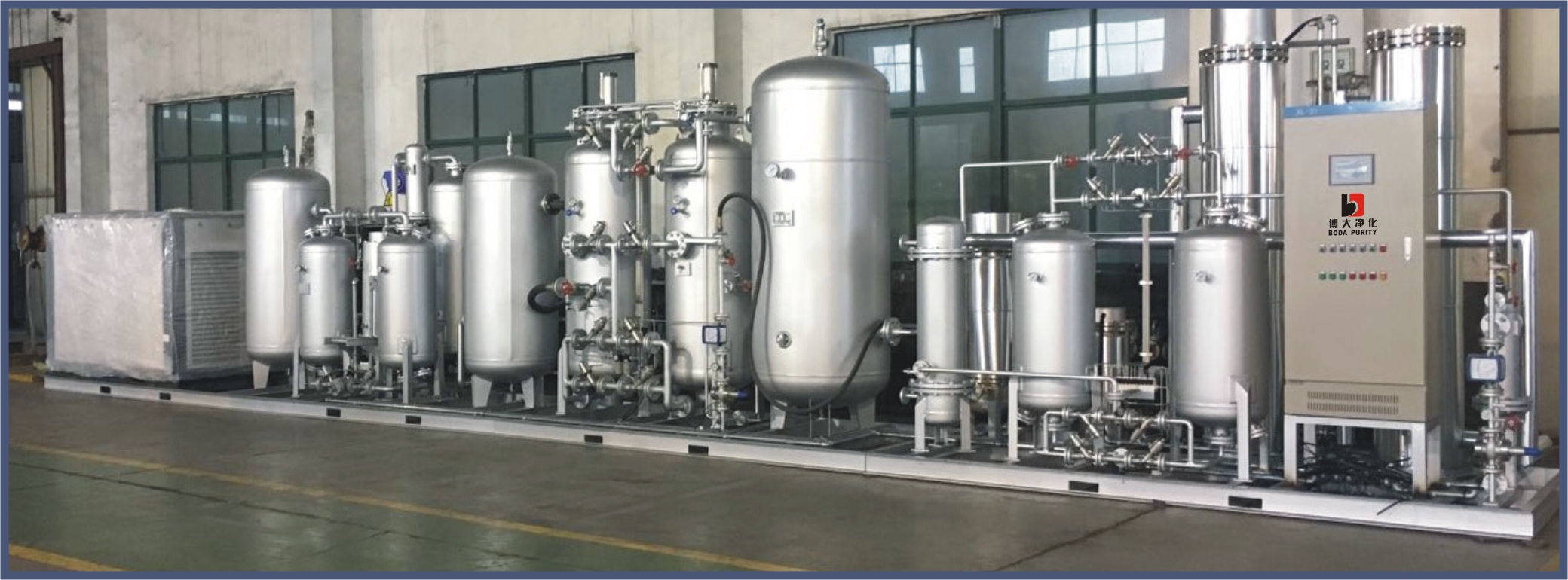
Carbon loaded purification only performs if the gas reaching it is clean
Oil vapour is the main threat to both the carbon molecular sieve and the purification catalyst, because oil contamination degrades adsorbent performance. BODA GAS builds the upstream chain from its own filtration and drying products, so the purification stage is protected by equipment specified to the same duty:
- The FYS Series high efficiency oil-water separator handles the first stage with three-stage centrifugal, impact and gravity-settling separation at gas-liquid separation efficiency above 98%, protecting every filter element downstream with no consumable filter element required.
- The FAL Series precision filter intercepts particulate contaminants ahead of the molecular sieve, with low pressure loss of ≤0.02 MPa and a quick-open housing for element replacement.
- The FLY Series high efficiency oil-remover combines cyclone separation, coarse filtration and fine filtration to reach 0.1 µm filtration precision with residual oil below 0.01 mg/m³.
- The FLT Series activated carbon filter removes oil vapour and VOC impurities, holding outlet oil content below 0.003 mg/m³, with multi-layer graded filling to avoid airflow short-circuit and an anti-powder-leakage baffle plate that prevents carbon dust migrating into downstream equipment.
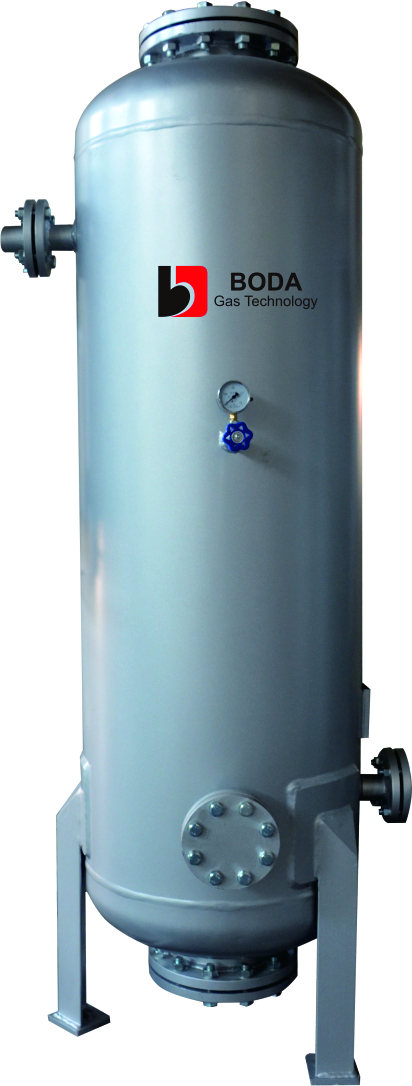
Drying follows filtration. For annealing and brazing targets at ≤-60°C dew point, the drying stage is normally desiccant-based. BODA GAS supplies the ADL Series heatless desiccant dryer (dew point ≤-40°C or ≤-52°C, regeneration air loss ≤12%), the ADH Series heated desiccant dryer (same dew point range, regeneration air loss ≤6%), and the FAG Series combined low dew point compressed air dryer, which integrates a refrigerated dryer and an adsorption dryer into a single unit and reaches a qualified air dew point of ≤-60°C to -70°C with regeneration air loss of only 3%–6%.
Two Purification Routes: Carbon Loaded (BCP) or Hydrogenation (BHP)
BODA GAS builds two purification routes for the same furnace family, and choosing between them is a site decision as much as a technical one.
The BHP Series hydrogenation purification nitrogen generator uses catalytic hydrogenation to strip residual oxygen. The BHP-Ⅰ model delivers 10–2,000 Nm³/h at a purity of at least 99.9995%, oxygen content ≤5 ppm and dew point ≤-60°C, with hydrogen content adjustable from 500 ppm to 5%. The BHP-Ⅱ model delivers the same output, purity, oxygen and dew point figures with hydrogen content held at ≤5 ppm. Both models are documented for bright annealing, brazing and powder-metallurgy sintering of stainless steel, titanium alloy and copper materials, and additionally for optical-fibre preform sintering and special-glass melting shielding gas, rare-earth material sintering, tungsten-alloy smelting and magnetic-material production, and high-temperature inorganic-powder sintering and polymer-material blanketing.
The BCP Series reaches a comparable purity level through a hydrogen-free route. The decision rule is straightforward:
- Choose carbon loaded purification (BCP) when the site restricts hydrogen, when hydrogen zoning, ventilation or gas detection would add cost and complexity, when residual hydrogen is unacceptable to the material or to the downstream process, or when the furnace atmosphere must be hydrogen-free by specification.
- Choose hydrogenation purification (BHP) when hydrogen is already available and permitted on site, and when a controlled hydrogen residual is acceptable or beneficial to the process.
- Check flow before either choice. The BCP Series covers 1–500 Nm³/h; above that, the BHP Series extends to 2,000 Nm³/h. Membrane separation (BMN Series, 5–3,000 Nm³/h, 95%–99.9% purity, pressure 0.1–1.2 MPa adjustable) is documented for metal-annealing, brazing and powder-metallurgy shielding gas where the tighter residual limits are not required.
Step-by-Step Breakdown: Specifying the System
Specifying a carbon loaded purification nitrogen system for annealing or brazing follows a fixed sequence. Each step produces a number the next step depends on.
Step 1 — Define the furnace atmosphere, not the gas product
Start from the hot zone: which material, which process, which surface result is acceptable. From that, fix five numbers — nitrogen flow at the furnace inlet (Nm³/h), purity target, maximum oxygen content, maximum carbon dioxide content, and maximum dew point. Inlet pressure and acceptable pressure fluctuation come next.
Step 2 — Size the PSA stage around the site, not around a catalogue
BODA GAS calculates air-to-nitrogen ratio, outlet flow, purity and power consumption against the customer's site altitude, voltage, usage industry and working condition, then produces an exclusive layout and technical scheme for review.
Step 3 — Remove bulk water and oil before fine filtration
The FYS Series high efficiency oil-water separator removes bulk liquid at above 98% gas-liquid separation efficiency. This is the stage that determines how hard the downstream filters have to work.
Step 4 — Filter to protect the sieve and the catalyst
FAL Series precision filter first, then FLY Series oil-remover at 0.1 µm and less than 0.01 mg/m³ residual oil, then FLT Series activated carbon filter at less than 0.003 mg/m³. Oil that survives this chain reaches the molecular sieve and the purification catalyst, and neither tolerates it well.
Step 5 — Dry to the target dew point
Select the dryer type against the required dew point and the acceptable regeneration air loss. For a ≤-60°C target, the FAG Series combined low dew point compressed air dryer reaches ≤-60°C to -70°C at 3%–6% regeneration air loss.
Step 6 — Separate nitrogen with carbon molecular sieve
The BXN Series PSA nitrogen generator performs the separation across 1–3,000 Nm³/h and 95%–99.999% purity, with a modular, low-maintenance structure designed for continuous operation and an automatic venting device covered by national patented technology.
Step 7 — Purify with carbon-loaded catalyst
The BCP Series deaerator removes residual oxygen and carbon dioxide down to the ≤5 ppm and ≤1 ppm limits, with automatic venting protecting finished-gas quality and a double-tower structure that allows catalyst service without stopping the machine.
Step 8 — Store, monitor and deliver
A nitrogen buffer tank smooths the pressure and flow fluctuation caused by tower switching and covers peak furnace demand. An oxygen analyser or purity sensor continuously monitors gas quality and vents out-of-specification gas. Where the plant runs a DCS, the optional DCS communication interface links the gas plant into plant control.
Step 9 — Commission and run
BODA GAS equipment is skid-mounted and designed for minimal installation: position the unit, connect the power cable, start it. The company provides 24-hour online technical support, operation manuals and video guidance, and overseas resident engineers are available for on-site installation, commissioning and maintenance service.
Use Cases: Bright Annealing, Brazing and Powder-Metallurgy Sintering
Bright annealing of stainless steel, titanium alloy and copper. The objective is a metallic, oxide-free surface leaving the furnace without a subsequent pickling step. Both BODA GAS purification routes are documented for this material group: the BHP Series hydrogenation purification route, and the BCP Series carbon loaded route where the site requires a hydrogen-free atmosphere.
Brazing. Filler-metal wetting depends on a clean base-metal surface. Oxide is the mechanism that stops capillary flow, and carbon dioxide at ≤1 ppm and oxygen at ≤5 ppm are the residual limits the BCP Series is specified to hold. The same material group — stainless steel, titanium alloy and copper — is documented for this application.
Powder-metallurgy sintering. Surface oxides on powder particles become defects in the finished part, so the shielding gas has to be clean before the compact reaches sintering temperature. Carbon loaded purification is documented for the powder-metallurgy family alongside hydrogenation purification and, at looser residual limits, membrane separation shielding gas.
Adjacent processes served by the same purification platform. The BCP Series is also documented for lithium-ion battery electrode drying, electrolyte blanketing and cell-sealing shielding gas; for PV-cell sintering, silicon-wafer processing and thin-film deposition process gas; and for semiconductor wafer purging, SMT soldering and electronic-component anti-oxidation gas. On the hydrogenation side, the BHP Series additionally covers optical-fibre preform sintering and special-glass melting shielding gas, rare-earth material sintering, tungsten-alloy smelting and magnetic-material production, and high-temperature inorganic-powder sintering and polymer-material blanketing.
Comparison Table: Carbon Loaded vs. Hydrogenation vs. Membrane
The table below compares the three nitrogen supply routes documented for annealing, brazing and sintering duties. Only verified product data is used; blank cells indicate that the specification is not published for that model.
| Parameter | BCP Series — carbon loaded purification | BHP Series — hydrogenation purification | BMN Series — membrane separation |
|---|---|---|---|
| Separation basis | PSA with carbon loaded purification | PSA with catalytic hydrogenation purification | Membrane hollow-fibre permeation |
| Nitrogen output | 1–500 Nm³/h | 10–2,000 Nm³/h | 5–3,000 Nm³/h |
| Nitrogen purity | ≥99.9995% | ≥99.9995% | 95%–99.9% |
| Oxygen content | ≤5 ppm | ≤5 ppm | — |
| Carbon dioxide content | ≤1 ppm | — | — |
| Nitrogen dew point | ≤-60°C | ≤-60°C | -40°C or -60°C |
| Hydrogen content | None (H₂-free) | BHP-Ⅰ: 500 ppm–5% adjustable; BHP-Ⅱ: ≤5 ppm | — |
| Nitrogen pressure | — | — | 0.1–1.2 MPa adjustable |
| Documented link to annealing, brazing and sintering | Hydrogen-free route for processes with strict hydrogen and oxygen requirements | Documented for bright annealing, brazing and powder-metallurgy sintering of stainless steel, titanium alloy and copper | Documented for metal-annealing, brazing and powder-metallurgy shielding gas |
| Material and customization | Carbon steel / SS304; stainless steel, ATEX, ASME, CE | Carbon steel / SS304 | Carbon steel / SS304; stainless steel, ATEX, ASME, CE |
Reading the table: purity alone does not decide the route. The BCP and BHP Series both reach ≥99.9995%, so the deciding factors are hydrogen availability and acceptability on site, the required flow, and whether the process needs carbon dioxide held at or below 1 ppm. Membrane separation occupies a different band entirely and is selected when the residual limits of an annealing or brazing atmosphere are not required.
FAQ: Carbon Loaded Purification for Annealing and Brazing
1. What nitrogen purity, flow, oxygen, carbon dioxide and dew point can carbon loaded purification deliver?
The BCP Series from BODA GAS is documented with a nitrogen output of 1–500 Nm³/h, nitrogen purity of at least 99.9995%, oxygen content at or below 5 ppm, carbon dioxide content at or below 1 ppm and a nitrogen dew point of ≤-60°C. The unit is constructed from carbon steel or SS304 and can be customized with stainless steel, ATEX, ASME and CE configurations. It includes fault diagnosis, alarm and automatic processing functions, an automatic venting device, and an optional DCS communication interface.
2. What certification and compliance points should be checked for a nitrogen generator used in furnace atmospheres?
BODA GAS holds ISO 9001 quality management, ISO 13485 medical device quality management, ISO 14001 environmental management and ISO 45001 occupational health and safety system certifications, and all equipment must pass qualification testing before factory release. Pressure-vessel compliance depends on the destination market: in the EU, for example, pressure vessels in PSA nitrogen generators must comply with the Pressure Equipment Directive (PED 2014/68/EU) and bear the CE mark. Because the BCP Series can be supplied with ATEX, ASME and CE customization, buyers should confirm the exact standard and certification scope against their own market at the quotation stage rather than assuming it.
3. If a PSA generator already reaches 99.999%, why is a carbon loaded purifier needed at all?
Because the furnace responds to specific residuals, not to the purity percentage. Residual oxygen oxidises the workpiece surface and prevents brazing filler metal from wetting the joint, while residual carbon dioxide is also oxidising at furnace temperature and its acceptable limit is tighter than the oxygen limit in demanding furnace work. Carbon loaded purification is the stage that brings those two residuals down to documented limits — oxygen at or below 5 ppm and carbon dioxide at or below 1 ppm — after PSA separation. A purity figure on its own does not state those limits, so it cannot be used as a furnace specification.
4. What does a carbon loaded purification system cost to run, and what maintenance does it need?
On-site nitrogen generation can reduce nitrogen supply costs by up to 40% compared with traditional cylinder deliveries by eliminating logistics fees, and the BCP Series uses an energy-efficient purification technology that reduces system operating energy consumption. Routine maintenance follows the same pattern as a standard PSA nitrogen system: precision filter elements are typically replaced around every 8,000 running hours; air compressor service including oil, oil filter and air/oil separator falls in the 3,000–4,000 running-hour range; air dryer desiccant generally lasts 16,000–24,000 hours; and carbon molecular sieve typically lasts 6–10 years. The BCP Series deaerator uses a double tower structure, so carbon-loaded catalyst can be added or replaced without stopping the machine — a maintenance feature that matters most on a continuously running furnace.
5. How should a buyer evaluate a Chinese PSA nitrogen generator supplier for an annealing or brazing project?
Start with documentation rather than price. Ask the supplier to state flow, purity, oxygen content, carbon dioxide content and dew point as separate, verifiable figures for the exact configuration being purchased, because a single purity number is not sufficient for furnace work. Then check the scope of quality-system certification, confirm which third-party pressure-vessel standard applies in your market, and ask how the purification stage is serviced without a production stop. BODA GAS, headquartered in Hangzhou, Zhejiang Province, China, has manufactured PSA nitrogen generators, PSA oxygen generators and compressed air purification equipment since 2002, exports to markets across the Middle East, Africa, Central Asia, Eastern Europe, Southeast Asia and Latin America, and supports OEM and ODM customization with adjustment for different working voltages and outlet pressure. Compare suppliers on the same basis: request a quotation and a free technical scheme and layout for your working condition, and where the process allows, validate the specification on a sample or pilot configuration before committing to full capacity. Contact BODA GAS at bodagas2002@gmail.com or +86 157-5515-0162 to start that comparison.
Conclusion: Define the Residual, Then Choose the Route
Annealing and brazing atmospheres are not specified by a purity percentage. They are specified by residual oxygen, residual carbon dioxide and dew point, held continuously at the flow the furnace actually consumes. Carbon loaded purification is the stage that closes that gap: it takes PSA-separated nitrogen and brings oxygen to ≤5 ppm and carbon dioxide to ≤1 ppm, at a dew point of ≤-60°C, across 1–500 Nm³/h — without introducing hydrogen into the furnace room.
Where hydrogen is permitted and available, the BHP Series hydrogenation purification route covers the same bright annealing, brazing and powder-metallurgy sintering duties and extends to 2,000 Nm³/h. Where the residual limits are looser, membrane separation covers 5–3,000 Nm³/h at 95%–99.9%. The engineering decision is therefore not “which generator is best”, but “which residual limits does my furnace require, and which purification route reaches them under my site's constraints”.
The upstream chain matters as much as the purification stage itself. Oil vapour that survives filtration will degrade carbon molecular sieve and purification catalyst, which is why BODA GAS supplies the oil-water separator, precision filter, oil-remover, activated carbon filter and dryer as one specified chain leading into the PSA and purification stages.
Next Step: Size a Carbon Loaded Purification System for Your Furnace
If you are specifying nitrogen for bright annealing, brazing or powder-metallurgy sintering, BODA GAS can size a carbon loaded purification system against your actual flow, purity, oxygen, carbon dioxide and dew point limits and produce a layout and technical scheme for review. Send your working condition — nitrogen flow, purity, outlet pressure, voltage and application — and request a quotation.
Email: bodagas2002@gmail.com
Tel / WhatsApp: +86 157-5515-0162
Website: www.boda-gas.com
Download the full specification set: BODA GAS Product Manual (PDF)