Eyewash Station Long-Term Partnership: Maintenance, Spare Parts & After-Sales FAQ
Eyewash Station Long-Term Partnership: Maintenance, Spare Parts & After-Sales FAQ
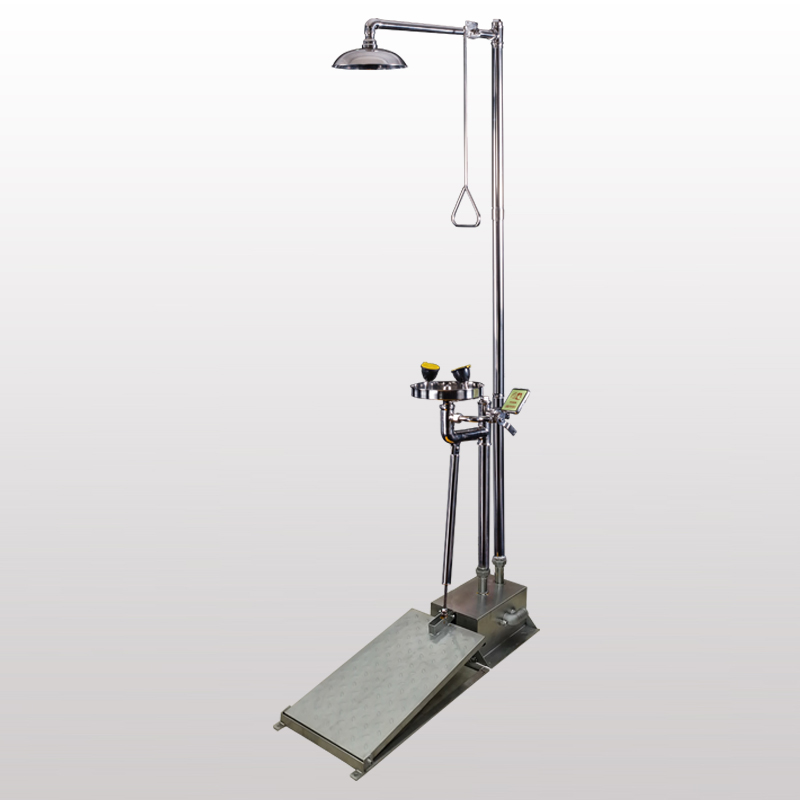
Anti-freeze shower and eyewash with large pedal, shown for long-term service planning. Image source: BOHUA product image.
Long-term eyewash station ownership is decided less by the installation day than by what happens afterwards: whether the unit still activates within one second, whether tepid water reaches the eyes, whether the correct replacement parts are available, and whether the facility can prove that maintenance and training took place.
Shanghai Bohua Safety Device Co., Ltd. (BOHUA) is a Shanghai-based manufacturer of emergency shower and eyewash equipment, founded in 2006. Its product range covers 11 series and more than 100 types of eyewash, and its stated service model includes OEM/ODM customization, 100% testing, a one-year warranty on listed models, and remote after-sales support. This FAQ-style guide explains how distributors and facility buyers can manage maintenance, spare parts and after-sales support across the product lifecycle without treating the original purchase as the end of the project.
Problem Definition: Why Eyewash Stations Fail After Acceptance
An eyewash station is a passive safety device for most of its life. It stands unused until an emergency, so deterioration is easy to miss: a dust cover stays closed, a ball valve becomes stiff, a spray head partially blocks, a heat-tracing circuit is switched off, or a portable tank is left without enough water for the required flushing duration. The procurement file may still look complete because it contains a model number, a certificate and an invoice.
The lifecycle risk is therefore different from the purchase risk. At the evaluation stage, buyers compare flow rates, materials, activation methods and certifications. At the ownership stage, the same buyers need a maintenance routine, a spare-parts path and a documented after-sales process. A unit can pass acceptance testing and still fail a site audit if access is obstructed, flushing fluid is not tepid, activation is slow, or maintenance records cannot be produced.
This is why a long-term partnership should be evaluated with the same discipline as the original product specification. The questions are practical: which components are inspected, which records are kept, which parts are configuration-specific, and who provides technical support when a unit is in service for years.
Industry Background: What Maintenance and After-Sales Must Support
ANSI/ISEA Z358.1-2014 establishes minimum performance and use requirements for emergency eyewash and shower equipment, and it provides minimum guidance for performance, use, installation, testing, maintenance and training. It covers emergency showers, eyewashes, eye/face washes and combination units. The standard is a reference framework, not a substitute for product-level certification, so buyers should request both the applicable standard reference and the product certificate.
In the United States, OSHA 29 CFR 1910.151(c) requires suitable facilities for quick drenching or flushing of the eyes and body where workers may be exposed to injurious corrosive materials. The Joint Commission summary adds operational criteria that matter during service: equipment should be accessible within 10 seconds, on the same level as the hazard, and on an unobstructed path; flushing fluid should be tepid, approximately 16 to 38 degrees Celsius. European guidance referenced in EN 15154-2 and 5 describes a water temperature range of 15 to 37 degrees Celsius.
Flow and duration criteria also shape maintenance. ANSI Z358.1-2014 specifies a minimum eyewash flow rate of 0.4 GPM for a duration of 15 minutes. OSHA's cited interpretation describes at least 30 gallons per minute for a permanently installed emergency shower, and at least 20 gallons per minute continuously for at least 15 minutes for a self-contained or portable emergency shower. These figures are not interchangeable across equipment classes, which is why maintenance checks must match the actual configuration on site.
Service implication: a maintenance programme that checks only the eyewash outlet is incomplete. Access, activation, flow, water temperature, freeze protection, electrical components and records all belong to the same compliance picture.
Detailed Solution: How BOHUA Supports the Installed Base
BOHUA's manufacturing base is located at No 661, Chenjing Road, Sijin Town, Songjiang District, Shanghai, China. The company reports a 4,000 m² facility, 50 employees and a 5-person R&D team. Its product portfolio covers portable, wall-mounted, vertical, compound, anti-freeze, electric heating and electric heat tracing configurations, which means a long-term service programme has to be organised by product family rather than by a single generic checklist.
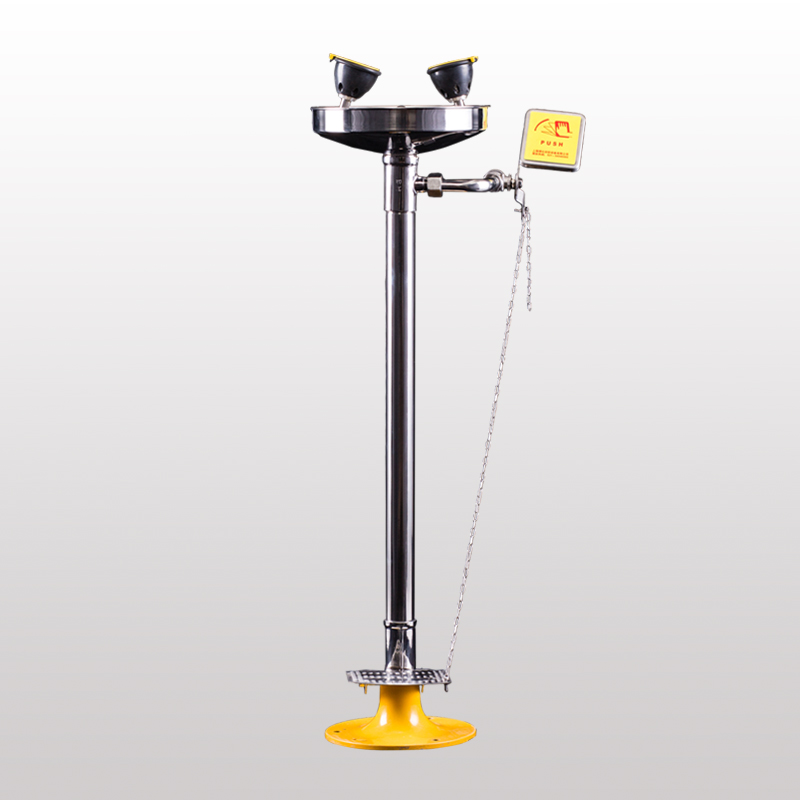
Vertical eyewash configuration, used to illustrate component-level inspection. Image source: BOHUA product image.
For buyers evaluating a long-term partner, the certification record is part of the after-sales case because it defines what the installed unit was qualified against. BOHUA's provided certification data includes the following:
| Certification | Certificate number | Issuer | Validity stated |
|---|---|---|---|
| ANSI Z358.1-2014 | CHSH25071073147 | GLOBAL TESTING SERVICES CO., LTD. | 2025-07-30 to 2030-07-29 |
| CE | CLSH25071073148 | GLOBAL TESTING SERVICES CO., LTD. | 2025-07-30 to 2030-07-29 |
| ISO Quality Management Systems | 288SCC24Q-SHBH002798S | Shanghai Center Certification Co., Ltd. | 2024-01-15 to 2027-01-14 |
| ISO 45001 Occupational Health & Safety Management Systems | 288SCC19S-SHB000647R2S | Shanghai Center Certification Co., Ltd. | 2019-08-12 to 2028-08-11 |
The ANSI and CE certificates are listed with a scope covering all types of emergency eyewash stations. For a service file, the practical value is traceability: the model, certificate number and installation date can be linked, so a later spare-parts request or audit does not depend on memory or a missing datasheet.
BOHUA's stated capability profile also matters for lifecycle support. The company offers OEM/ODM production and customizable features such as acoustic and optical alarms, lighting, DCS signal upload, electrical heating, cooling and skid-mounted systems. Its stated monthly capacity is 1,000 units, lead time is 30 days, minimum order quantity is 5, quality control is 100% test, export markets include the EU, Middle East, Australia and Africa, and after-sales support is remote support. These facts do not replace a service agreement, but they define the operating context in which spare parts and technical answers are requested.
One ODM case illustrates the long-term logic. A client in China used 15 BH30-1062 electric heat tracing shower and eyewash units for five years in a cold-climate application, with the stated purpose of keeping the facility legally compliant year-round and the stated result of reliable, compliant and safe emergency response. The lesson is not that every site needs heat tracing; it is that the original configuration, the climate and the service routine have to remain aligned over time.
Step-by-Step Breakdown: A Maintenance and Spare-Parts Routine
Step 1: Build an asset register before the first inspection
Record the model, configuration, serial or asset number, installation date, warranty start date and certificate reference for every unit. Include the options that affect service, such as electric heating, heat tracing, alarm, lighting, DCS signal upload or skid mounting. BOHUA's product range spans 11 series and more than 100 types, so a register that says only “eyewash station” is not specific enough for parts planning.
Step 2: Check access and activation
Confirm that the unit remains on the same level as the hazard, within a travel time of no more than 10 seconds, and on an unobstructed path. Then activate the unit and verify that start speed is within one second, as stated in BOHUA's specifications for the relevant models. Access problems are often created after installation by stored materials, new equipment or changed traffic routes, so this check belongs in every inspection.
Step 3: Verify flow and flushing duration
Match the test method to the equipment class. The ANSI reference for eyewash flow is 0.4 GPM for 15 minutes; OSHA's cited interpretation describes 30 gallons per minute for a permanently installed shower and 20 gallons per minute continuously for at least 15 minutes for a self-contained or portable shower. BOHUA's listed shower flow rate is 120–180 L/min and its listed eyewash flow rate is at least 1.5 L/min for the models where these values are specified. Record the actual result, not only a pass/fail mark.
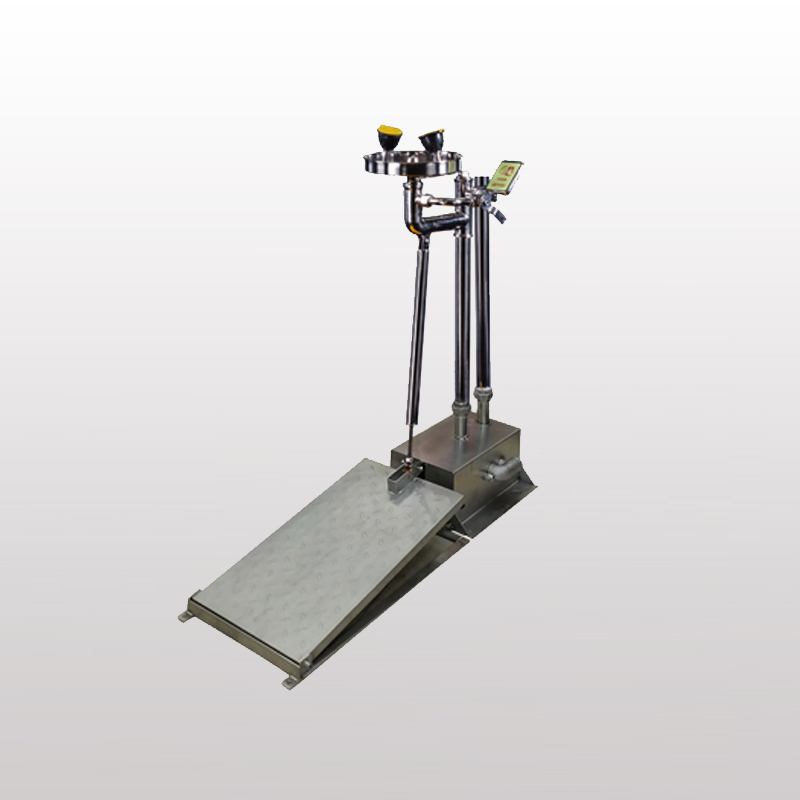
Anti-freeze vertical eyewash for cold-climate service planning. Image source: BOHUA product image.
Step 4: Confirm water temperature and freeze protection
Flushing fluid should be tepid. The Joint Commission summary gives approximately 16 to 38 degrees Celsius, while the European reference in EN 15154-2 and 5 gives 15 to 37 degrees Celsius. In unheated or outdoor locations, this becomes a freeze-protection question. BOHUA's anti-freeze and anti-scald models, such as the BH30-1008 shower and eyewash and the BH32-1008 vertical eyewash, are identified as anti-freeze and anti-scald configurations. Electric heat tracing and electric heating models add another service dimension because the electrical circuit, explosion-proof grade and protection level must remain intact.
Step 5: Inspect components, not only the overall unit
Check the spray head and filter, the two-piece ball valve, the cow-horn bend with adjustable flow, the fixed soft rubber anti-dust cover and the luminous aluminium alloy indicator where these are listed. A blocked PP+304 filter or a stiff valve can change the user experience before it changes the flow reading. For stainless steel units, inspect surfaces and joints for conditions that could affect function. The material specification for many BOHUA models is 304 stainless steel, with selected models using 316 stainless steel or 304 stainless steel combined with ABS.
Step 6: Fix the spare-parts list at the time of order
Customized units can differ in electrical and control configuration. BOHUA's OEM/ODM options include acoustic and optical alarms, lighting, DCS signal upload, electrical heating, cooling and skid-mounted systems. A spare-parts list should therefore identify the exact configuration rather than the product family alone. The one-year warranty stated on listed models covers the initial period, but long-term availability depends on a documented parts list and a clear route to remote technical support.
Step 7: Keep records and refresh training
ANSI/ISEA Z358.1-2014 includes testing, maintenance and training within its guidance. Keep inspection results, corrective actions, parts replacements, training dates and certificate references together. When a unit is relocated or a production area changes, update the asset register and re-check access, temperature and flow. Records are the difference between a maintained station and a station that merely exists.
Use Cases: Matching the Service Model to the Site
Chemical, pharmaceutical and laboratory facilities. Compound units such as the BH30-2010 provide a shower and eyewash in one floor-mounted 304 stainless steel unit, with a listed shower flow rate of 120–180 L/min, eyewash flow rate of at least 1.5 L/min, start speed within one second and net weight of 16 kg. The maintenance focus is dual-outlet testing, spray pattern and record keeping for both functions.
Cold-climate and unheated buildings. Anti-freeze and anti-scald models such as the BH30-1008 and BH32-1008 are intended for conditions where temperature control is part of compliance. Electric heat tracing models such as the BH30-1062 add a 220V circuit with 48W/M heat-tracing power, explosion-proof grades EXD II BT4, BT6, CT4 and CT6, and protection levels IP54, IP56 and IP65. Service checks must include the electrical enclosure and thermostat or control function, not only the water outlet.
Portable and field deployment. The BH34-0628 portable shower and eyewash uses a 28L tank with tank pressure of 1.0MPa, while the BH34-0665F uses a 65L tank. Portability changes the maintenance question: tank condition, fill level, placement and the ability to deliver the required flushing duration become part of the routine. The ANSI and CE certification for BH34-0628 should be kept with the unit's service file.
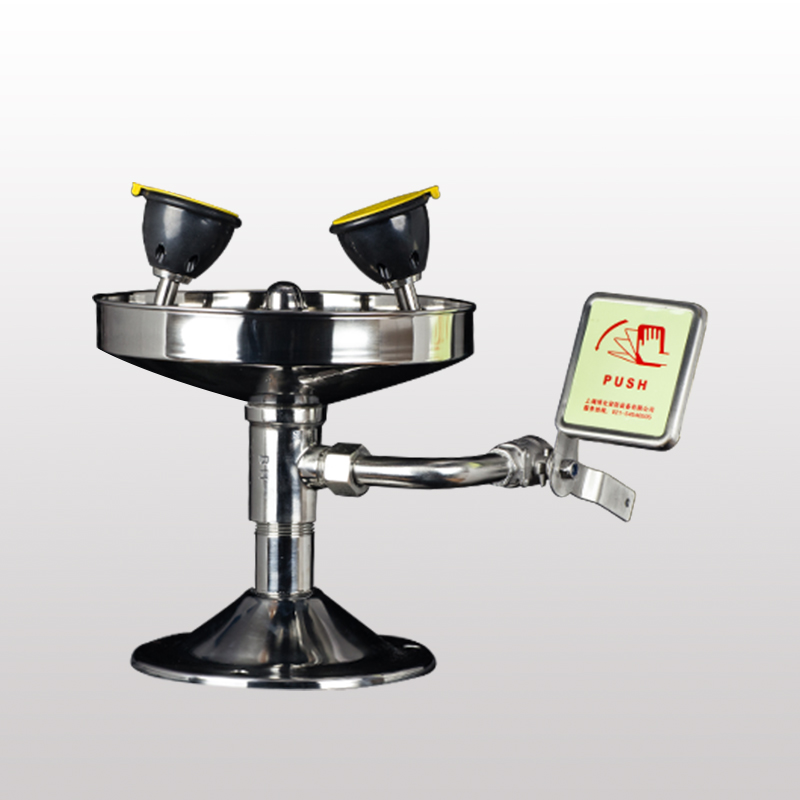
Desk-top eyewash for laboratory environments. Image source: BOHUA product image.
Electrical and hazardous areas. The BH32-1066 electric heating vertical eyewash is listed with 380V voltage, 15KW power, explosion-proof grades EXD II BT4 and CT4, and protection levels IP54, IP56 and IP65. These attributes make electrical inspection and documentation more important than on a passive unit. The BH30-1066 electric heating shower and eyewash carries the same 380V, 15KW and EXD II BT4/CT4 and IP54/IP56/IP65 specification.
Laboratory benches and compact spaces. Desk-top models such as the BH35-1009 keep the eyewash close to the point of use. Their maintenance routine should still cover activation, spray pattern, valve condition and record keeping, even though the unit is small.
Comparison Table: Service-Relevant Differences Across BOHUA Models
The table below uses only the product facts provided in the BOHUA specification set. It is intended to show why a single maintenance checklist cannot cover every configuration.
| Model | Configuration | Material | Activation | Warranty | Maintenance focus |
|---|---|---|---|---|---|
| BH30-1008 | Anti-freeze and anti-scald shower and eyewash | 304 SS | Push handle | One-year | Temperature protection; shower 120–180 L/min; eyewash ≥1.5 L/min |
| BH30-1062 | Electric heat tracing shower and eyewash | 304 SS + ABS | Push handle | One-year | 220V circuit; 48W/M heat tracing; EXD II BT4/BT6/CT4/CT6; IP54/IP56/IP65 |
| BH32-1066 | Electric heating vertical eyewash | 304 SS | Not stated in the available specification | One-year | 380V; 15KW; EXD II BT4/CT4; IP54/IP56/IP65 |
| BH34-0628 | Portable shower and eyewash | 304 SS | Push handle | One-year | 28L tank; 1.0MPa tank pressure; portable placement and fill control |
| BH34-0665F | Portable shower and eyewash | 304 SS | Push handle | One-year | 65L tank; portable placement and fill control |
| BH30-2010 | Compound emergency shower and eyewash | 304 SS | Push handle | One-year | Dual outlet; 508mm discharge at 1524mm; 16kg; dimensions 72.2 x 29.5 x 27.5 cm |
Note: “Not stated in the available specification” means the supplied product data did not list an activation method for that model. It is not an inference that the model lacks an activation method.
FAQ: Long-Term Ownership, Spare Parts and After-Sales
What documentation should a facility keep to show an eyewash station remains compliant over its service life?
ANSI/ISEA Z358.1-2014 provides minimum guidance for performance, use, installation, testing, maintenance and training, while OSHA 29 CFR 1910.151(c) requires suitable facilities for quick drenching or flushing where workers may be exposed to injurious corrosive materials. A practical service file should link each station to its model, certificate numbers, installation date, test and maintenance records, and operator training records.
Can BOHUA supply replacement parts and service support for customized eyewash stations?
BOHUA offers OEM/ODM customization for features such as acoustic and optical alarms, lighting, DCS signal upload, electrical heating, cooling and skid-mounted systems. After-sales support is provided as remote support, and the listed product warranty is one year on the models where it is specified. Because customized units can differ in electrical and control configuration, the spare-parts list should be fixed at the time of order.
What factors drive the long-term cost of owning an eyewash station?
Long-term cost is driven mainly by configuration complexity, site conditions and service planning rather than by the initial unit alone. Electric heating and heat tracing add electrical components, anti-freeze and anti-scald designs address cold or hot-water conditions, and portable units add tank and placement considerations. A service agreement that defines inspection, parts and documentation reduces unplanned compliance risk.
Can we validate a BOHUA unit before committing to a multi-site rollout?
BOHUA's stated minimum order quantity is 5 units and the stated lead time is 30 days. Every unit is described as 100% tested, and OEM/ODM options are available. A sample or pilot inquiry should specify the model, configuration, certification requirement and destination market so that the quotation matches the intended deployment.
What lead time should distributors plan for repeat orders and spare parts?
BOHUA's stated lead time is 30 days, with a monthly capacity of 1,000 units. Distributors should add buffer time for customized electric heating, anti-freeze or alarm configurations and should confirm the spare-parts schedule in the service agreement. To request a sample, quotation, spare-parts list or service agreement discussion, contact BOHUA at sales@shanghai-bohua.com or WhatsApp +86 18917119171.
Conclusion: A Long-Term Partnership Is a Service Model
Eyewash station ownership is a lifecycle commitment. The installed unit must remain accessible, activate quickly, deliver the required flow for the required duration, provide tepid flushing fluid where applicable, and retain a documented service history. A supplier that can support those requirements across portable, wall-mounted, vertical, compound, anti-freeze and electric heating configurations is more useful than a supplier that competes only on the initial specification sheet.
BOHUA's provided facts support that service conversation: 11 series and more than 100 types of eyewash, a 4,000 m² facility, 50 employees, a 5-person R&D team, OEM/ODM customization, 100% testing, a 30-day stated lead time, a stated monthly capacity of 1,000 units, a one-year warranty on listed models and remote after-sales support. The ANSI, CE, ISO Quality Management and ISO 45001 certificates add traceability to the installed base.
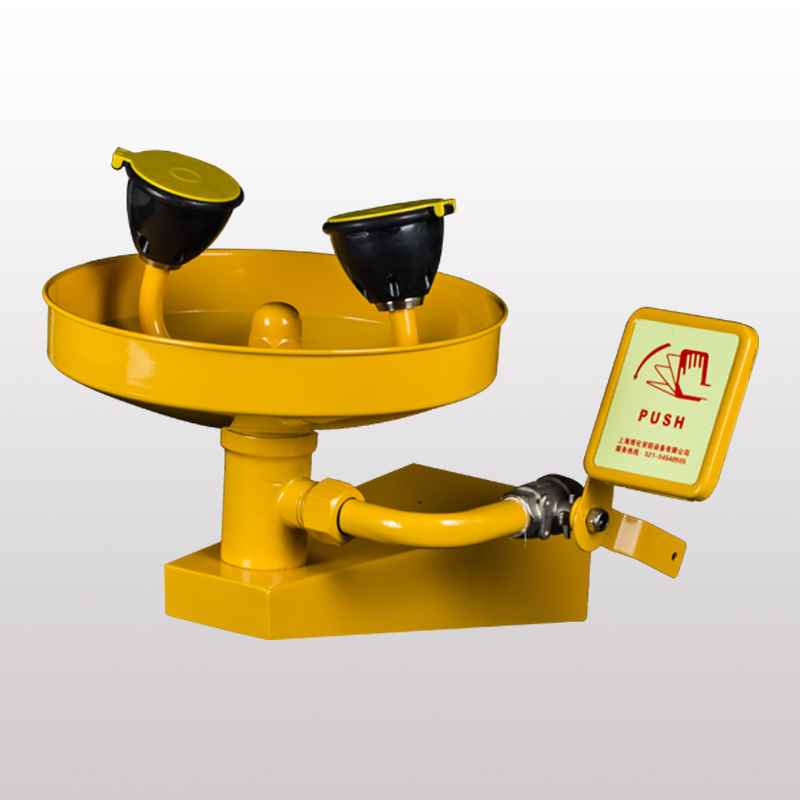
Wall-mounted eyewash configuration. Image source: BOHUA product image.
Next step: request a sample, quotation, spare-parts list or service agreement discussion.
Shanghai Bohua Safety Device Co., Ltd.
No 661, Chenjing Road, Sijin Town, Songjiang District, Shanghai, China
Email: sales@shanghai-bohua.com
Tel / WhatsApp: +86 18917119171
Website: https://www.eyewashcn.com/
Product brochure: download the BOHUA brochure.
Have Questions or Need More Details?
Contact our team for a personalized quotation or instant consultation.
Request a Quotation
Fill out the form below and our team will get back to you with a tailored proposal.
WhatsApp Direct Chat
Prefer to chat in real-time? Message us on WhatsApp for instant assistance & quick answers.
- Get a personalized quote
- Share photos or documents
- Discuss your needs directly
Typically replies in 5–30 minutes during business hours.