
How to Deploy Portable Eyewash Stations on Remote Sites: A Step-by-Step Application Guide
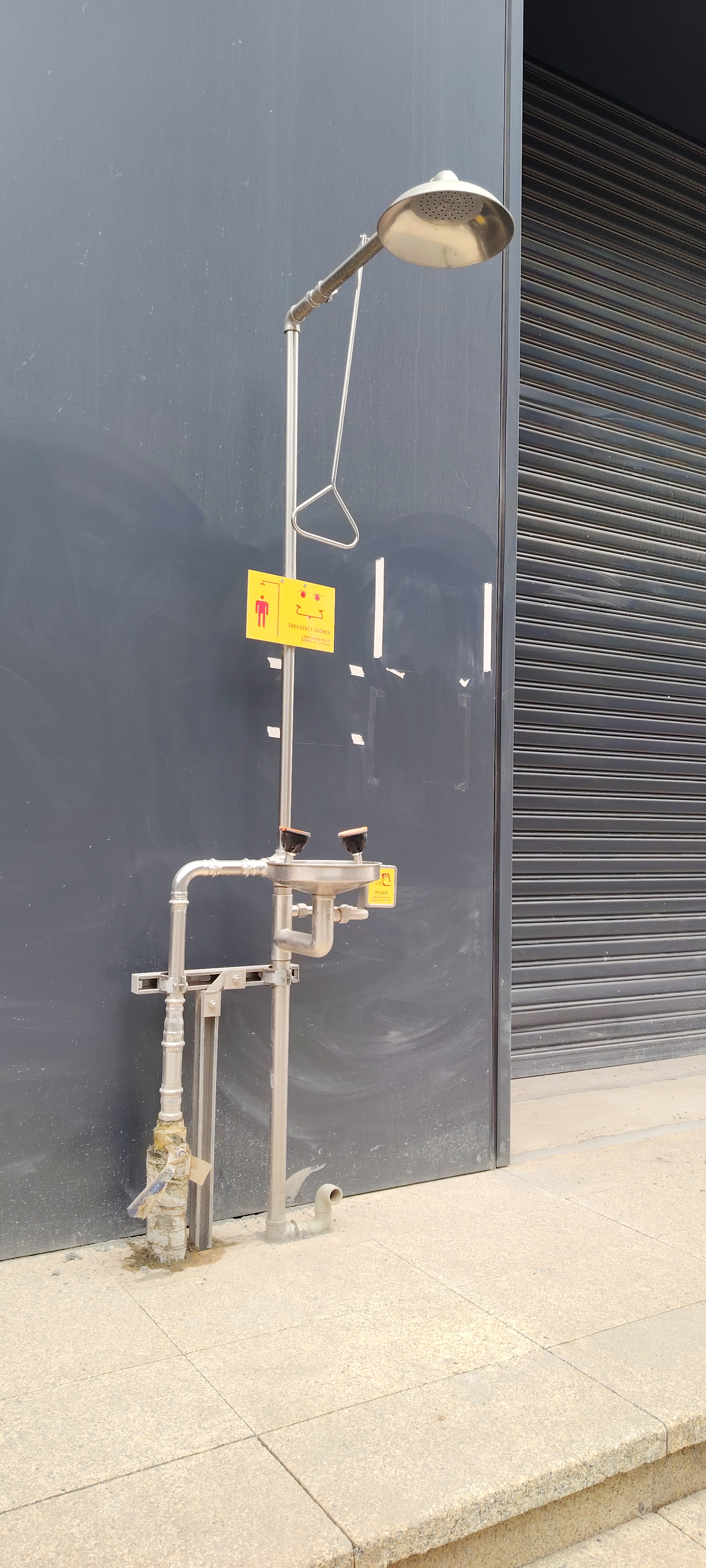
Emergency shower and eyewash equipment from BOHUA, the manufacturer of the BH34-0628 (28 L) and BH34-0665F (65 L) portable units discussed in this guide.
A portable eyewash station is the practical way to place emergency eye and body flushing next to a hazard when a worksite has no plumbed water line. The deployment decision is rarely just about the unit itself. It is a sequence of six decisions that starts with hazard mapping and ends with a maintenance routine that still works after the site has moved twice.
This guide is written for safety managers, site supervisors and procurement teams running construction, mining and field-operations sites where fixed plumbing is unavailable or impractical. It uses two BOHUA portable units, the BH34-0628 with a 28 L tank and the BH34-0665F with a 65 L tank, as working examples of how the selection logic plays out in practice.
The Flushing Problem on a Site With No Water Line
A remote site usually has the hazard before it has the infrastructure. Solvents, cement dust, battery acid, hydraulic fluid, fuel and abrasive particulates all create eye-exposure risk, and the first minutes after exposure determine the outcome. Without a dedicated flushing point, the practical fallback becomes a walk to a site office, a vehicle water bottle, or nothing at all.Three measurable constraints define the problem.
- Access. Emergency eyewash and shower equipment should be reachable within 10 seconds, on the same level as the hazard and along an unobstructed path of travel, according to The Joint Commission's summary of the ANSI Z358.1 reference and OSHA 29 CFR 1910.151(c) context.
- Flow and duration. ANSI/ISEA Z358.1-2014 sets a minimum eyewash flow rate of 0.4 GPM (about 1.5 L per minute), and the cited OSHA interpretation describes portable eyewash units delivering water continuously for at least 15 minutes.
- Temperature. Flushing fluid should be tepid, described by The Joint Commission as approximately 16 to 38 degrees Celsius.
Fixed plumbing satisfies all three on a permanent plant. On a temporary site it satisfies none of them, because the water line, the drain and the heated supply room either do not exist or arrive after the hazard does. A self-contained unit closes that gap by carrying its own flushing fluid and its own stored pressure, which is why portable equipment is treated as a distinct product class rather than a temporary substitute for a shower.
How Standards Treat Portable Equipment
OSHA 29 CFR 1910.151(c) requires suitable facilities for quick drenching or flushing of the eyes and body where workers may be exposed to injurious corrosive materials, and the requirement applies to the work area rather than to a building. ANSI/ISEA Z358.1-2014 sets the minimum performance and use requirements for eyewash and shower equipment, and it covers emergency showers, eyewashes, eye and face washes and combination units together with installation, testing, maintenance and training guidance. In practice, that means a portable station is judged on the same evidence base as a fixed one, but with installation and maintenance adapted to a mobile site.
Flow criteria are configuration-specific, and mixing them up is a common specification error. The same OSHA interpretation describes a permanently installed emergency shower connected to plumbing delivering at least 30 gallons of clean water per minute, while a self-contained or portable emergency shower is described as delivering at least 20 gallons per minute continuously for at least 15 minutes. A portable unit therefore has to be assessed against the portable criterion, not the fixed-supply figure.
For deployments outside the United States, EN 15154-2 and EN 15154-5 define European requirements, including a flushing-water temperature range of 15 to 37 degrees Celsius. On the demand side, Global Market Insights estimates the North America emergency shower and eyewash station market at USD 360 million in 2025, which reflects how much of this equipment is bought as a compliance item rather than an optional accessory.
What BOHUA Portable Stations Bring to a Remote Site
Shanghai Bohua Safety Device Co., Ltd. is a Shanghai-based manufacturer of emergency shower and eyewash equipment, founded in 2006 and located at No. 661 Chenjing Road, Sijin Town, Songjiang District, Shanghai, China. The company has developed 11 series and more than 100 types of eyewash equipment and states a monthly capacity of 1,000 units with 100 percent testing.
Certification is the first filter for evaluation-stage buyers, because a portable unit is usually deployed to satisfy an audit trail rather than to fill a shelf. BOHUA holds:
- ANSI/ISEA Z358.1-2014 certificate CHSH25071073147, issued 30 July 2025 by GLOBAL TESTING SERVICES CO., LTD and valid to 29 July 2030, covering all types of emergency eyewash stations.
- CE certificate CLSH25071073148, issued 30 July 2025 by GLOBAL TESTING SERVICES CO., LTD and valid to 29 July 2030.
- ISO 9001 quality management system certificate 288SCC24Q-SHBH002798S, issued 15 January 2024 by Shanghai Center Certification Co., Ltd and valid to 14 January 2027.
- ISO occupational health and safety management system certificate 288SCC19S-SHB000647R2S, issued 12 August 2019 by Shanghai Center Certification Co., Ltd and valid to 11 August 2028.
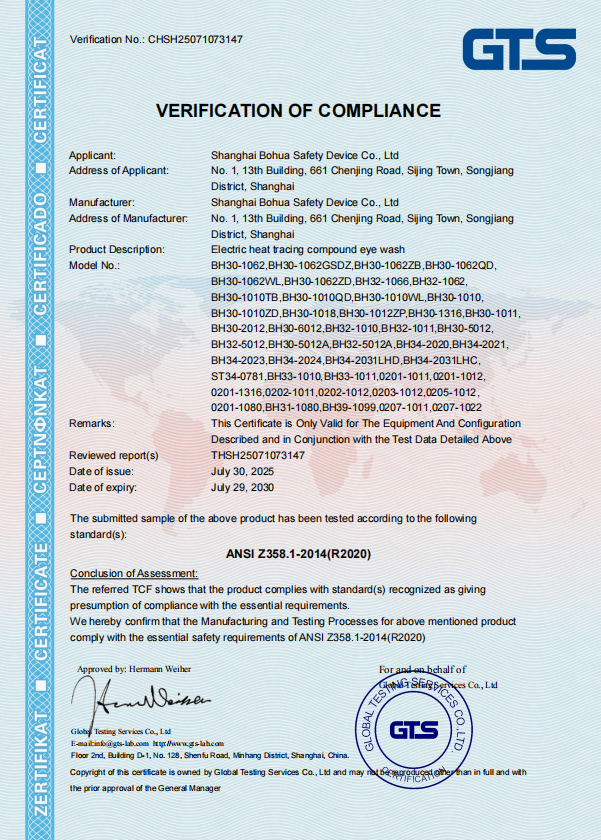
ANSI/ISEA Z358.1-2014 certificate CHSH25071073147, valid to 29 July 2030, held for all types of emergency eyewash stations.
The two units this guide uses as examples are the BH34-0628 and the BH34-0665F, both listed as portable shower and eyewash stations. Both are built in 304 stainless steel, both are specified for activation within one second, and both are charged to a tank pressure of 1.0 MPa. Stainless steel matters more on a remote site than it does in a plant: units are moved, loaded onto vehicles, stored in containers and exposed to weather, and a 304 stainless steel body is the difference between a station that survives a site transfer and one that does not.
Mobility is the second operational advantage. A portable station is only useful if it can follow the work front across a site as excavation, drilling or commissioning moves. Customization options available from BOHUA include acoustic and optical alarms, lighting, DCS signal upload, electric heating, cooling and skid-mounted configurations, with OEM/ODM production, a minimum order quantity of 5 units, a 30-day lead time and remote after-sales support.
One check is worth running before specifying a tank size. At the ANSI/ISEA Z358.1-2014 eyewash minimum of 0.4 GPM, fifteen minutes of flushing requires roughly 22.7 litres of fluid. A 28 L nominal tank covers that eyewash requirement with a modest margin, while a 65 L tank provides substantially more reserve for body drenching or repeat use. Nominal volume is not the same as usable delivered volume, so confirm the usable capacity and delivered flow against the unit documentation before signing off.
Step-by-Step Deployment
Step 1: Map the hazard and the water gap
Walk the site and mark every point where a worker could receive a splash, spray or particulate exposure. Record what the substance is, how the task is performed and how long the exposure risk persists. Then mark the nearest plumbed water source. The distance between those two sets of marks is the deployment zone, and any hazard with no flushing point within a 10-second unobstructed walk belongs on the list.
Step 2: Choose between 28 L and 65 L
Capacity selection follows the exposure profile, not the budget line. The BH34-0628 at 28 L suits eye-exposure tasks in tight areas and small crews, where the unit must be light enough to reposition frequently. The BH34-0665F at 65 L suits locations where body drenching is credible, where several workers share one point, or where refilling is infrequent because the site is remote. Both are combination shower and eyewash units, but the larger tank carries the reserve that a body-exposure scenario demands.
Step 3: Place the unit for 10-second access
Position the station on the same level as the hazard, on the path a worker would actually run, and with nothing between the hazard and the unit. Keep it clear of vehicle routes, spoil piles and material stacks that move weekly. Signage should be visible from the hazard point, not only from the site office. If the layout will change, mark a secondary position on the site plan now rather than discovering the gap during an audit.
Step 4: Set up without plumbing
Because a portable unit needs no water line and no drain, setup is a matter of a stable base and a clear approach. Place the unit on firm, level ground or on a skid-mounted frame where the surface is soft, verify that the spray pattern is not blocked by a wall or structure, and confirm that the bowl or spray area drains away from walkways. Plan the relocation route at the same time: the value of a portable station is that it moves with the work front, and that only happens if the move is scheduled rather than improvised.
Step 5: Charge to 1.0 MPa and verify one-second activation
Fill the tank with clean flushing fluid, then charge the tank to 1.0 MPa using the unit's air connection and read the gauge after the charge settles. A station charged below specification will deliver a weak or short flush, and the failure only becomes visible at the moment of use. Once charged, operate the activation mechanism and confirm that flow starts within one second. Time it with a stopwatch during commissioning, record the result, and repeat the check at every inspection.
Step 6: Build a maintenance routine that survives a moving site
Maintenance on a remote site fails for organisational reasons more often than technical ones. Assign a named owner, tie the check to an existing weekly site walk, and keep a physical tag on the unit. The routine itself is short: confirm the unit is accessible and undamaged, check the pressure gauge, operate the unit briefly to confirm one-second activation, replace flushing fluid on the schedule set by the fluid supplier and the site risk assessment, and re-charge after any use. ANSI/ISEA Z358.1-2014 treats testing, maintenance and training as part of the equipment requirement, so the record belongs in the site safety file alongside the certificate.
Freeze protection deserves a separate decision. Portable units are not heated by default, and a tank that freezes is not a flushing station. For sub-zero deployment, electric heating, electric heat tracing and cooling options are available in the BOHUA range and should be specified at the quotation stage rather than retrofitted in winter.
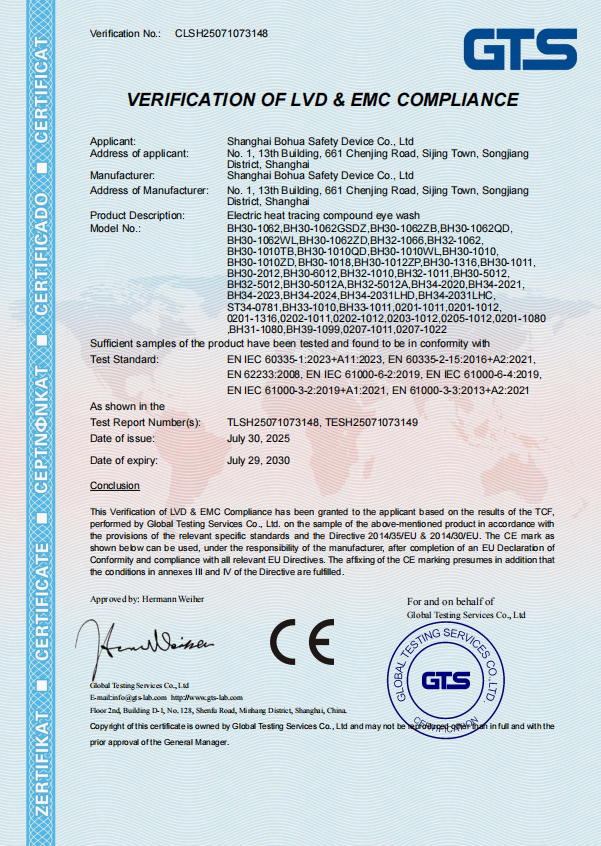
CE certificate CLSH25071073148, valid to 29 July 2030, covering all types of emergency eyewash stations.
Where Portable Deployment Pays Off
Construction. The hazard moves with the trade. A station that can be relocated from the excavation to the steel-erection area to the commissioning zone covers three work fronts with one asset, and it can be on site before the temporary water connection is commissioned.
Mining and quarrying. Remote benches and processing areas are often far from a plumbed supply. A 65 L unit placed at the accessible entry point to a work area gives a defined, signed flushing location that is not dependent on a pump or a line.
Field operations and maintenance. Temporary crews working on pipelines, turbines or remote assets need a flushing point that travels in the service vehicle. A 28 L unit with a stable base fits that use case without requiring a dedicated water supply.
Cold-climate compliance. BOHUA has supplied an ODM project in China with 15 electric heat tracing shower and eyewash units, in service for five years, to keep the facility legally compliant year-round and demonstrate due diligence for worker safety in cold climates. The reported result was reliable, compliant and safe emergency response. The lesson for portable deployment is the same one that project addressed: the equipment specification has to match the climate, not just the hazard.
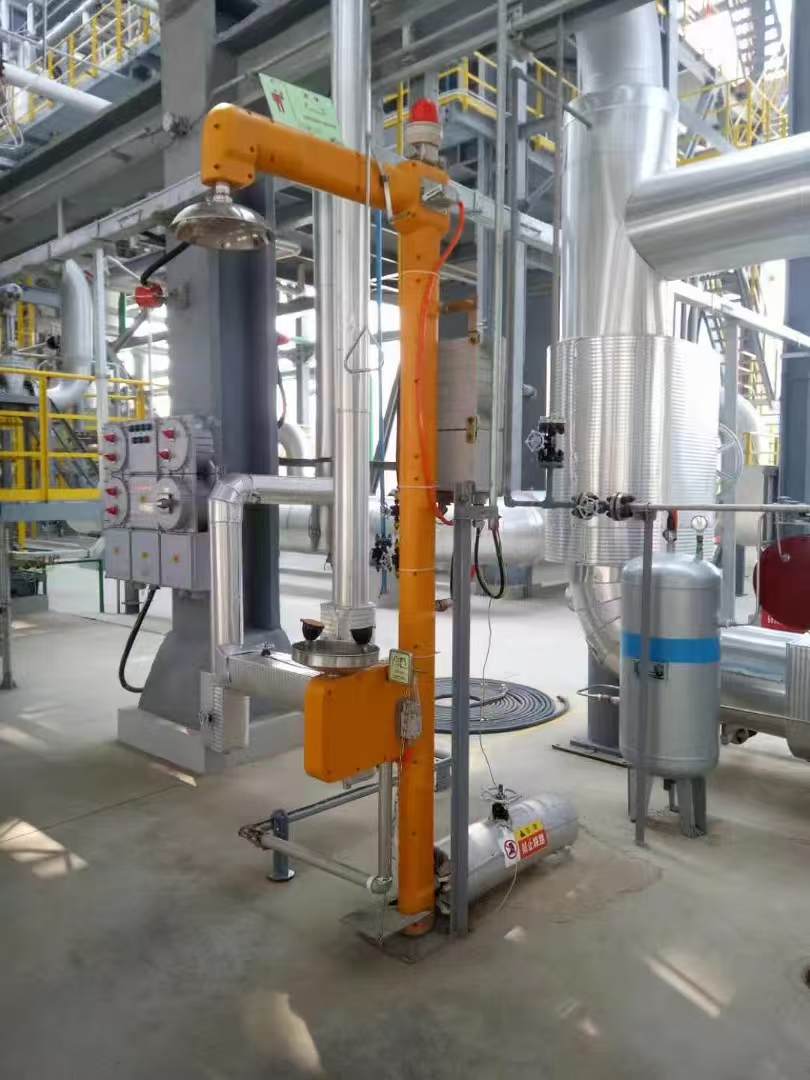
Electric heat tracing shower and eyewash supplied for a cold-climate ODM project in China, in service for five years.
Model Comparison
| Attribute | BOHUA BH34-0628 | BOHUA BH34-0665F |
|---|---|---|
| Product type | Portable shower and eyewash | Portable shower and eyewash |
| Nominal tank capacity | 28 L | 65 L |
| Body material | 304 stainless steel | 304 stainless steel |
| Tank pressure | 1.0 MPa | 1.0 MPa |
| Activation | Within one second | Within one second |
| Eyewash duration reference (15 min at 0.4 GPM requires about 22.7 L) | Covers the eyewash requirement with modest margin | Covers the eyewash requirement with substantially more reserve |
| Best fit | Eye-exposure tasks, tight areas, frequent relocation | Body-drenching risk, shared points, infrequent refilling |
| Plumbing required | None | None |
Comparison uses BOHUA product and certificate data only. Capacities are nominal; confirm usable delivered volume and flow against unit documentation.
| Requirement reference | Value | Source |
|---|---|---|
| Eyewash minimum flow rate | 0.4 GPM for 15 minutes | ANSI/ISEA Z358.1-2014; OSHA interpretation |
| Portable or self-contained shower | 20 GPM continuously for at least 15 minutes | OSHA 29 CFR 1910.151(c) interpretation |
| Permanently installed shower supply | At least 30 GPM | OSHA 29 CFR 1910.151(c) interpretation |
| Access to equipment | 10 seconds maximum, same level, unobstructed | The Joint Commission summary |
| Flushing fluid temperature | 16 to 38 degrees Celsius | The Joint Commission summary |
| European flushing temperature | 15 to 37 degrees Celsius | EN 15154-2 and EN 15154-5 |
Frequently Asked Questions
Does a portable eyewash station meet ANSI and OSHA expectations on a remote site?
A portable, self-contained station is addressed as a distinct equipment class by both frameworks. ANSI/ISEA Z358.1-2014 sets minimum performance and use requirements for eyewash and shower equipment and covers installation, testing, maintenance and training, while OSHA 29 CFR 1910.151(c) requires suitable facilities for quick drenching or flushing within the work area. Practical compliance depends on the unit meeting the eyewash flow criterion of 0.4 GPM, being reachable within 10 seconds on an unobstructed path, and being inspected and maintained on a documented schedule. BOHUA holds ANSI/ISEA Z358.1-2014 certificate CHSH25071073147 and CE certificate CLSH25071073148, both valid to 29 July 2030. Confirm the applicable jurisdiction and standard edition before final specification.
How much flushing fluid does a portable unit need for eye exposure versus body exposure?
At the 0.4 GPM eyewash minimum, fifteen minutes of flushing requires roughly 22.7 litres, so a 28 L nominal tank covers the eyewash requirement with a modest margin. Body drenching draws far more fluid, which is why the 65 L BH34-0665F is the appropriate choice where skin exposure is credible. Where a site must demonstrate sustained shower flow, request the delivered flow rate and duration from the unit test documentation and plan supplementary water capacity if needed. Both models use 304 stainless steel bodies and activate within one second at a tank pressure of 1.0 MPa.
What drives the cost of a portable eyewash deployment?
Capacity and configuration drive most of the difference. A 28 L unit and a 65 L unit sit at different points on material and fluid volume, 304 stainless steel construction sets the material baseline, and options such as acoustic and optical alarms, lighting, DCS signal upload, electric heating, cooling or a skid-mounted frame add scope. Order quantity, freight to a remote location and the maintenance consumables plan complete the picture. BOHUA states a minimum order quantity of 5 units and a 30-day lead time; project-specific pricing is quoted per configuration rather than published as a list.
Can we validate a unit before committing the whole site?
Yes, and it is the sensible sequence for an evaluation-stage buyer. BOHUA operates OEM/ODM production with 100 percent testing, so a trial unit can be assessed on the points that matter on site: whether the activation mechanism works with gloves on, whether the spray pattern suits the crew, whether the unit can be moved by the people who will actually move it, and whether the documentation package satisfies the site audit. Sample and quotation requests are handled through the BOHUA sales team at sales@shanghai-bohua.com or +86 18917119171.
How long does supply take, and what comes after delivery?
BOHUA states a monthly capacity of 1,000 units and a 30-day lead time, with a minimum order quantity of 5 units, and supports remote after-sales assistance. For multi-site rollouts, order the first tranche against the commissioning date rather than the site mobilisation date, so units arrive in time to be charged, tested and signed off before the hazard appears. The full product range, specifications and certification details are in the BOHUA catalogue, available here: download the BOHUA product catalogue. For a deployment plan built around your site layout, send the hazard map and crew numbers to the sales team for a configuration recommendation.
Conclusion
Deploying a portable eyewash station on a remote site is a six-step discipline: map the hazard and the water gap, size the tank against the exposure profile, place the unit within a 10-second unobstructed walk, set it up without plumbing, charge to 1.0 MPa and confirm one-second activation, then run a maintenance routine that is owned by a named person and recorded. The equipment choice follows from those steps, not the other way round. A 28 L BOHUA BH34-0628 covers eye-exposure tasks in tight, frequently relocated positions; a 65 L BH34-0665F carries the reserve that body-exposure risk demands. Both are 304 stainless steel, both activate within one second, and both are backed by ANSI/ISEA Z358.1-2014, CE and ISO certification that a site auditor can verify. Start with the hazard map, and the specification writes itself.
Planning a portable eyewash deployment?
BOHUA supplies portable shower and eyewash stations for construction, mining and field operations, with OEM/ODM configuration, 100 percent testing and a 30-day lead time. Send your site layout and crew numbers for a configuration recommendation, or request a sample and quotation.
Email: sales@shanghai-bohua.com | Tel / WhatsApp: +86 18917119171 | Chat on WhatsApp | www.eyewashcn.com
Have Questions or Need More Details?
Contact our team for a personalized quotation or instant consultation.
Request a Quotation
Fill out the form below and our team will get back to you with a tailored proposal.
WhatsApp Direct Chat
Prefer to chat in real-time? Message us on WhatsApp for instant assistance & quick answers.
- Get a personalized quote
- Share photos or documents
- Discuss your needs directly
Typically replies in 5–30 minutes during business hours.