
Inside an Eyewash Station: Activation, Flow, and Cold-Weather Protection Explained
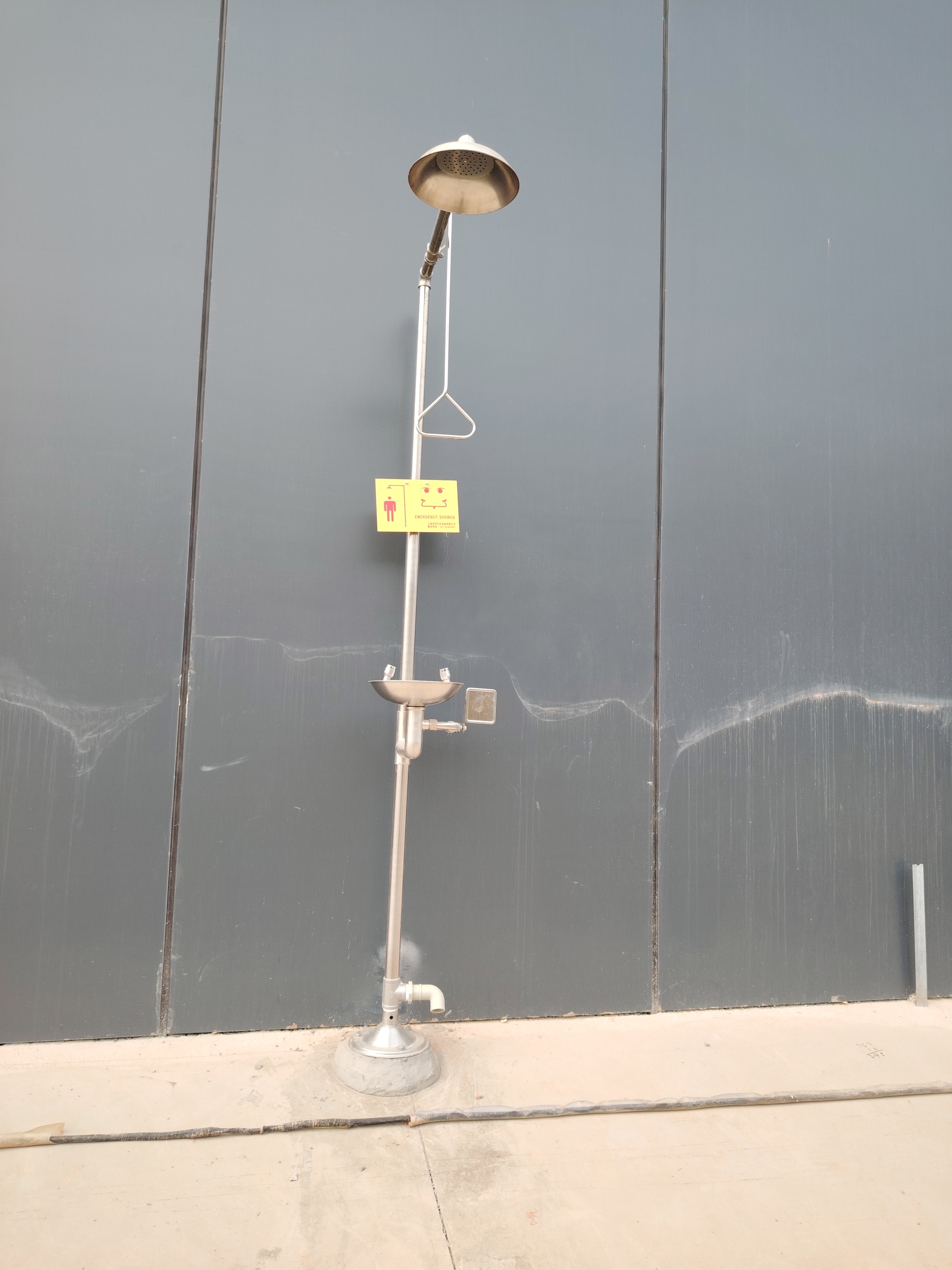
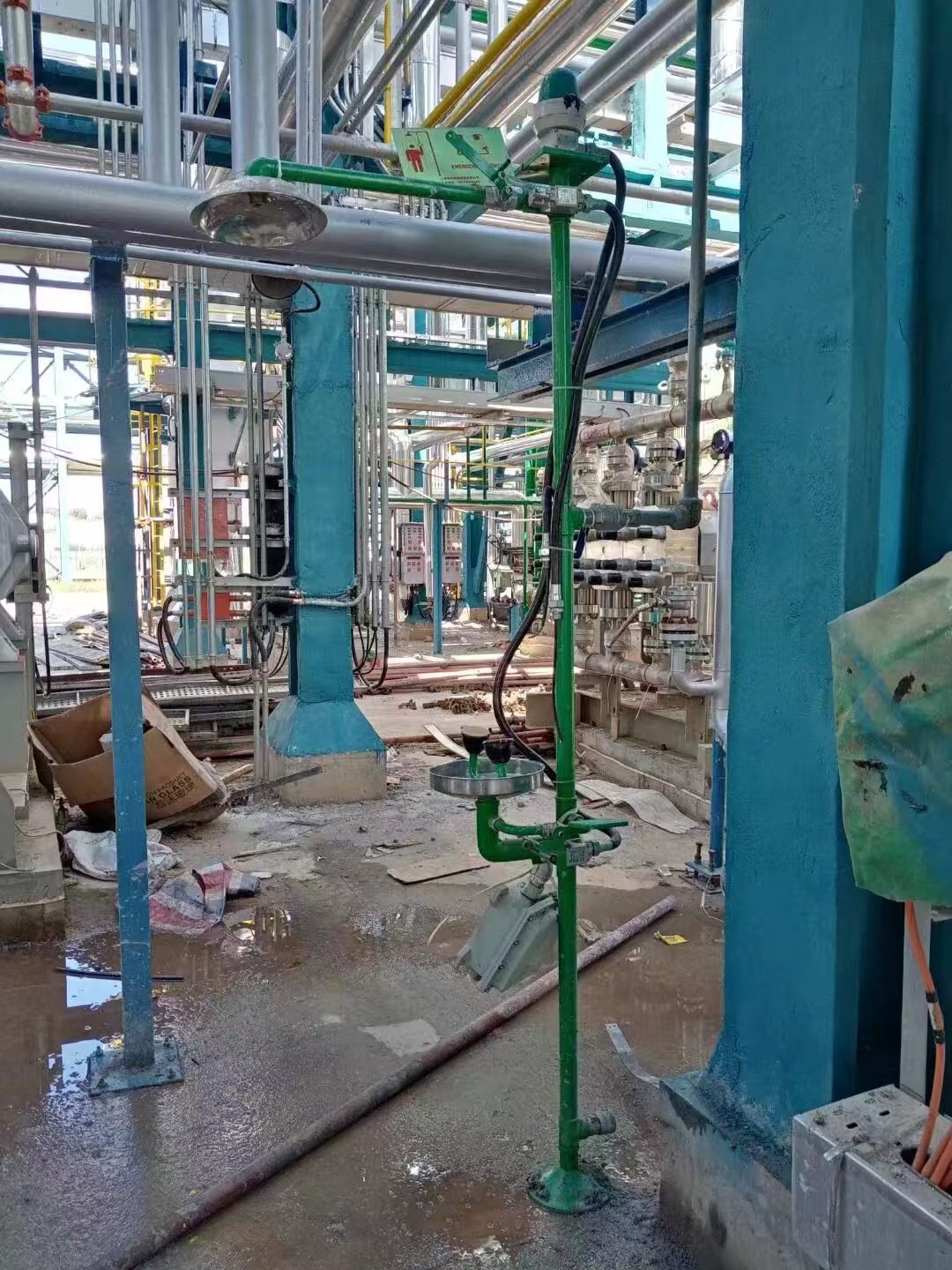
An emergency eyewash station delivers a controlled flow of flushing fluid to the eyes and face — and, on combination units, to the body — within seconds of being actuated. Whether it works when someone needs it comes down to three mechanical realities: the activation input releases the valve cleanly, the outlet delivers its rated flow, and water can still move through the unit when the site is cold.
This explainer follows that chain in order. It starts at the handle and ends at the nozzle, then looks at what a 12–18 L/min eyewash figure actually means next to the standards that govern flushing equipment, and finishes with the freeze and scald problem that decides whether a station is usable outdoors in winter. Model references come from Shanghai Bohua Safety Device Co., Ltd. (BOHUA), a Shanghai-based manufacturer of emergency shower and eyewash equipment established in 2006, with 11 series and more than 100 product types and an annual production capacity of 20,000 units.
Why the first second matters more than any other specification
Regulatory and standards frameworks converge on speed, volume and access. In the United States, OSHA 29 CFR 1910.151(c) requires suitable facilities for quick drenching or flushing of the eyes and body where employees may be exposed to injurious corrosive materials. ANSI/ISEA Z358.1-2014 establishes minimum performance and use requirements for emergency showers, eyewashes, eye/face washes and combination units, and extends to installation, testing, maintenance and training. A widely cited operational summary from The Joint Commission adds the layout rule: equipment should be reachable within 10 seconds, on the same level as the hazard, along an unobstructed path of travel.
None of that matters if the valve hesitates. BOHUA rates the start speed of the models discussed here — including the BH30-1008 anti-freeze and anti-scald shower and eyewash and the BH34-0628 portable unit — as within 1 second. That figure describes actuation-to-delivery, not the time needed to reach the station. Both numbers belong in a site plan: a unit that starts in one second but sits 30 seconds away fails the access criterion just as surely as a unit that stalls at the handle.
The activation sequence, step by step
On a plumbed combination unit, the mechanical chain runs from actuator to outlet in six stages. Not every model uses every stage: wall-mounted and desk-top eyewash units end at the bowl, while portable units draw from a tank instead of a supply line.
Step 1: Locate and reach the station
Access is the first mechanical prerequisite, because nothing downstream can compensate for it. Placement within 10 seconds of the hazard, on the same level, with a clear path, is the criterion most often cited from the ANSI-referenced summary. BOHUA combination units carry a luminous aluminium alloy indicator so the station remains identifiable when lighting is poor — a detail that matters in plant rooms, tank farms and night-shift operation.
Step 2: Apply the actuation input
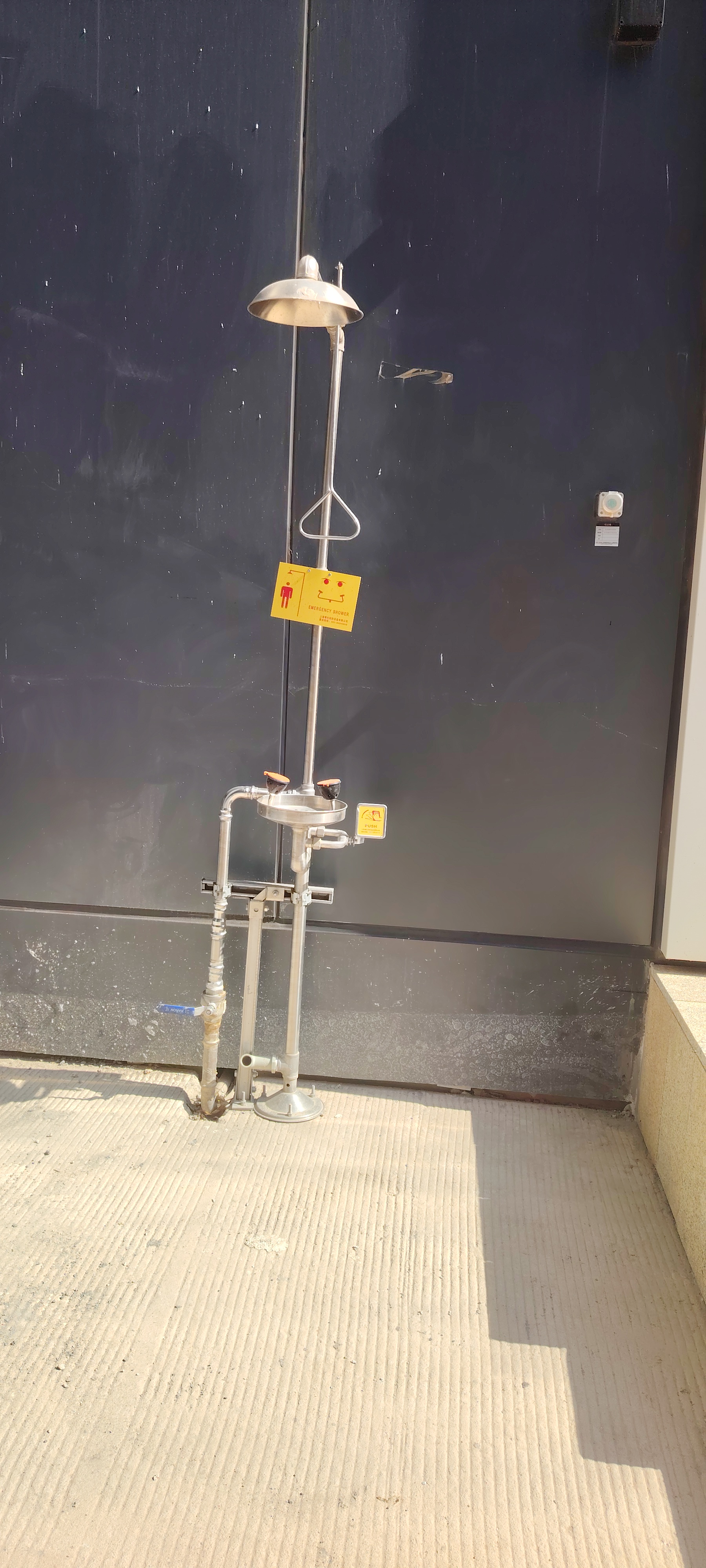
Actuation is where configurations diverge most. The common inputs across the category are a push handle for the shower, a push plate operated by hand or foot, a push flag or handle for the eyewash bowl, and a pull chain for the shower. BOHUA builds all four patterns plus two further variants:
- Push handle, floor-mounted: the BH30-1008 anti-freeze and anti-scald shower and eyewash, the BH30-1316 compound unit and the BH34-0628 portable unit all use push-handle activation.
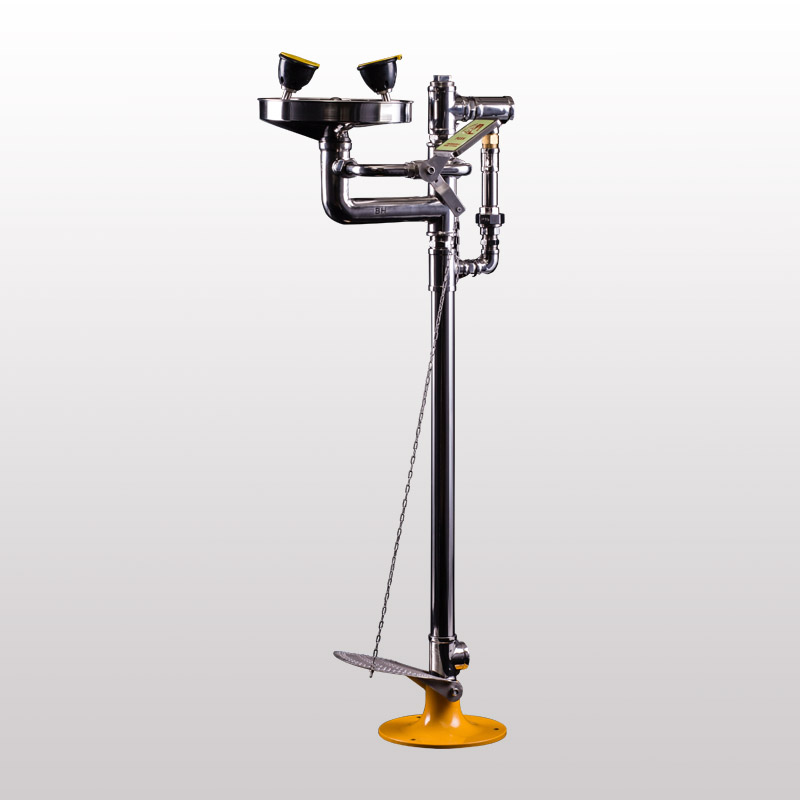
- Pedal actuation: the BH32-5012A anti-freeze vertical eyewash uses a small pedal, and the BH30-5012T anti-freeze shower and eyewash uses a large pedal — useful where the operator's hands must stay free of the control.
- Fully automatic: the BH38-1010 wall-mounted eyewash and the BH32-1061 vertical eyewash are fully automatic units, and the BH38-1009 desk-top eyewash is equipped with a sensor.
The trade-off is straightforward. Manual actuation has no electrical dependency and gives the operator a positive, visible confirmation that the valve has been moved. Automatic and sensor-based activation removes the reach-and-grab step but introduces a power and sensing dependency that must be maintained and tested.
Step 3: The valve opens and stays open
BOHUA units use a two-piece ball valve as the flow-control element. The behaviour that matters at this stage is the stay-open function: eyewash operation is hands-free, so the flush continues after the operator releases the handle. This is not a convenience feature. A fifteen-minute flush that has to be held in place is a flush that gets cut short, and both hands are usually needed to hold the eyelids open during eye irrigation.
Step 4: Water enters through the DN32 inlet
Water reaches the unit through a DN32 inlet on the models described here — wall-mounted, vertical, desk-top, combination and portable alike. On floor-mounted combination units the geometry is fixed and worth planning around: overall height 2480 mm, shower head at 2100 mm, water inlet at 1600 mm, eyewash bowl at 1050 mm, and drainage at 133 mm. Those heights determine whether the unit lands on an existing domestic-water branch or requires a new one.
Step 5: Flow is shaped at the bend and the sprinkler
Raw line pressure is not a flushing pattern. The cow-horn bend on BOHUA units provides adjustable flow, letting the installer balance the streams so the eyewash delivers a soft, aerated coverage rather than a hard jet. Downstream of the bend, the sprinkler is built from PP with a 304 stainless filter, and sprinkler spacing is 101.6 mm on the wall-mounted, desk-top and combination models. On combination units the water discharge range is specified as 508 mm at a distance of 1524 mm from the mounting surface — the figure that tells a planner how far the shower plume reaches.
Step 6: Flushing continues until it is deliberately stopped
Because the eyewash valve stays open, the flush ends when the operator closes it, not when grip fails. The outlet then returns to standby under a fixed soft rubber anti-dust cover that shields the sprinkler between uses, and residual water leaves through the drainage path at 133 mm. Everything between activations is protection: cover on, valve closed, bowl clear, path unobstructed.
Flow rate: what 12–18 L/min means, and what it does not
Eyewash flow figures are routinely compared across models that were never specified on the same basis. Two numbers dominate BOHUA documentation, and they belong to different product families:
- Vertical eyewash units — including the BH32-1008 anti-freeze and anti-scald model, the BH32-1011, the BH32-1061 and the BH32-1062B electric heating version — are listed at an eyewash flow of 12–18 L/min.
- Combination shower and eyewash units — including the BH30-1008, the BH30-1316, the BH30-1062 and the BH34-0628 — are listed with an eyewash flow of ≥1.5 L/min alongside a shower flow of 120–180 L/min.
The difference is not a contradiction; it is a specification convention. One figure is a delivery band (12–18), the other is a floor prefixed with a greater-than-or-equal sign (≥1.5). Comparing them directly, or assuming the higher band applies to every unit in a catalogue, is where specification errors begin.
For calibration, the flow criterion most often cited from the ANSI/ISEA Z358.1-2014 reference is 0.4 gallons per minute for eyewash equipment, which converts to approximately 1.5 L/min. The OSHA-cited interpretation adds configuration-specific figures for showers: at least 30 gallons per minute for a permanently installed unit, and at least 20 gallons per minute continuously for 15 minutes for a self-contained or portable shower. These are reference points, not a certificate for any individual model, and the adopted standard edition plus local jurisdiction still govern.
What a flow figure cannot tell you is equally important. It does not establish spray pattern, flushing-fluid temperature, duration, access distance, installation quality or maintenance condition — the other half of what the standard reference covers. A datasheet flow number is a design input. It becomes a compliance statement only when the delivered flow, pattern and temperature are verified on the installed unit.
One caveat worth checking on the datasheet: BOHUA product documents list standard water pressure as 0.25–0.4, with the unit written as Pa in some documents and MPa in others. Delivered flow depends on supply pressure, so confirm the intended unit and the actual line pressure at the tap before ordering, rather than assuming the number matches your plant's domestic-water system.
Tank capacity sets a second, harder limit on portable units. The BH34-0628 carries 28 L and the BH34-0665F carries 65 L, with tank pressure of 1.0 MPa on the 28 L model. A tank is a finite reservoir: capacity, not plumbing, determines how long the unit can deliver, so the tank size has to be matched to the flushing window the site plan requires.
Cold-weather protection: freeze, scald and the heating options
Flushing fluid is supposed to be tepid. The Joint Commission summary of the ANSI-referenced criteria puts it at approximately 16 to 38 °C, and EN 15154-2 and EN 15154-5 place the European requirement at 15 to 37 °C. Two opposite failure modes push a site outside those ranges, and they need different engineering responses.
Failure mode one: the water will not flow or arrives too cold
Freezing is a flow problem before it is a comfort problem. Water held in an exposed unit or its supply branch can freeze and stop delivery entirely, which is why the anti-freeze series exists. BOHUA's anti-freeze and anti-scald models combine both protections in one unit:
- BH30-1008 anti-freeze and anti-scald shower and eyewash — 304 stainless steel, floor-mounted, push-handle activation, start speed within 1 second, shower flow 120–180 L/min, eyewash flow ≥1.5 L/min, overall height 2480 mm, shower head 2100 mm, eyewash 1050 mm, drainage 133 mm, DN32 inlet and outlet, luminous aluminium alloy indicator.
- BH32-1008 anti-freeze and anti-scald vertical eyewash — 304 stainless steel, overall height 1050 mm, DN32 inlet, eyewash flow 12–18 L/min, drainage height 133 mm, start speed within 1 second.
- BH30-5012T anti-freeze shower and eyewash, large pedal — 304 stainless steel, pedal activation, shower flow 120–180 L/min, eyewash flow ≥1.5 L/min, overall height 2480 mm, DN32 inlet and outlet.
The anti-freeze designation protects the unit. It does not automatically protect the branch line feeding it, so freeze protection for the supply pipework remains a separate design decision for the site engineer.
Failure mode two: the water arrives too hot
An overheated supply is the mirror problem: flushing fluid above the tepid range works against the purpose of a 15-minute flush. Anti-scald protection is the reason BOHUA pairs both functions in the same series rather than offering freeze protection alone — a site with an unheated exterior run and a sun-exposed roofline can present both risks in the same year.
Active heating: electric heating and electric heat tracing
Where passive protection is not enough, BOHUA offers two electrically based families with different characteristics:
- Electric heat tracing, BH30-1062 — 304 stainless steel and ABS, floor-mounted, push-handle activation, electric heat trace power 48 W/m at a rated voltage of 220 V, shower flow 120–180 L/min, eyewash flow ≥1.5 L/min, protection levels IP54, IP56 or IP65, explosion-proof grade EXD II BT4, BT6, CT4 or CT6.
- Electric heating, BH30-1066 and BH32-1062B — 15 kW power rating at a rated voltage of 380 V, protection levels IP54, IP56 or IP65, explosion-proof grade EXD II BT4 and CT4. The BH30-1066 is a floor-mounted shower and eyewash; the BH32-1062B is a vertical eyewash with 12–18 L/min eyewash flow, 1050 mm overall height, 133 mm drainage height and DN32 inlet.
The electrical data is not a footnote — it drives the installation. A 15 kW heating load at 380 V needs a supply and protection scheme sized for it, and a heat-tracing circuit at 220 V needs its own circuit. Where the area carries a hazardous classification, the explosion-proof grade must match the site's zone documentation; IP54, IP56 and IP65 describe ingress protection against dust and water, which is a different question from ignition protection.
These configurations are commonly deployed in Russia, Kazakhstan and Middle Eastern markets, where winter outdoor installation and wide diurnal temperature swings occur in the same facility portfolio.
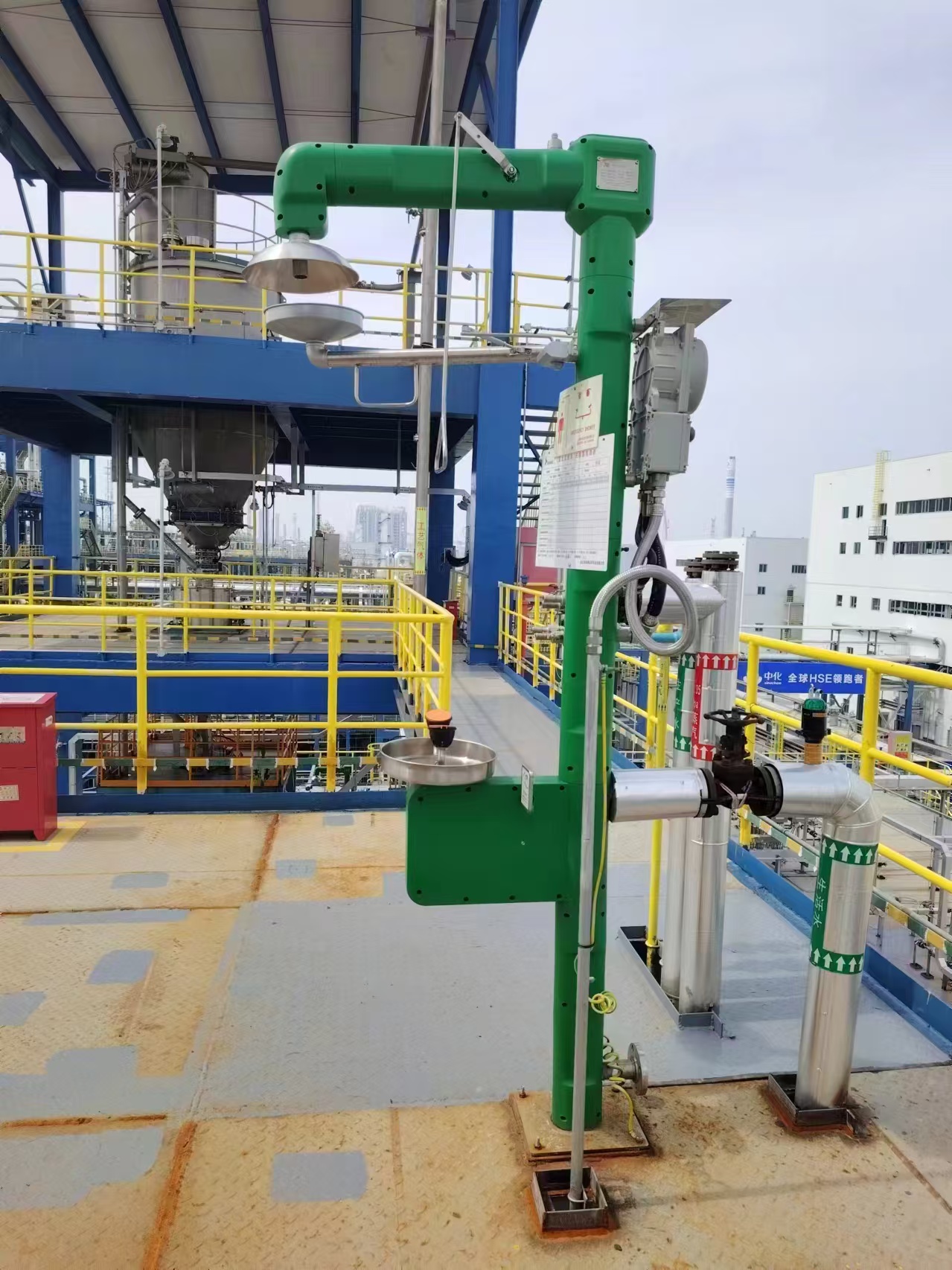
What heating does not do is substitute for commissioning. A heated unit still needs its delivered temperature and flow verified on site, because heating capacity, supply temperature and flow rate interact — and only the installed system shows the result.
Materials and connections: 304 stainless steel and the DN32 inlet
Most of the range discussed here is built in 304 stainless steel, with several models using 304 stainless steel combined with ABS. The BH30-1316 compound emergency shower and eyewash is the exception in this group, specified in 316 stainless steel. Two details repeat across the catalogue and deserve attention because they drive installation cost: the DN32 inlet and outlet size, and the 133 mm drainage height.
Material choice is a corrosion question, not a marketing one. Grades containing molybdenum are generally selected where chloride exposure is a concern, which is a common reason 316 appears alongside 304 in industrial specifications. The defensible approach is to match the grade to the actual chemical list at the point of use and confirm the selection with a materials or process engineer. Neither grade is a blanket guarantee, and neither substitutes for the standard-based performance criteria.
Model comparison: activation, flow and cold-weather role
| Model | Configuration | Material | Eyewash flow | Shower flow | Cold-weather design |
|---|---|---|---|---|---|
| BH30-1008 | Floor-mounted combination shower and eyewash | 304 SS | ≥1.5 L/min | 120–180 L/min | Anti-freeze and anti-scald |
| BH32-1008 | Vertical eyewash | 304 SS | 12–18 L/min | — | Anti-freeze and anti-scald |
| BH30-1062 | Floor-mounted combination, electric heat tracing | 304 SS + ABS | ≥1.5 L/min | 120–180 L/min | Heat tracing, 48 W/m at 220 V |
| BH32-1062B | Vertical eyewash, electric heating | 304 SS + ABS | 12–18 L/min | — | Electric heating, 15 kW at 380 V |
| BH34-0628 | Portable shower and eyewash, 28 L tank | 304 SS | ≥1.5 L/min | 120–180 L/min | — |
| BH30-1316 | Floor-mounted combination shower and eyewash | 316 SS | ≥1.5 L/min | 120–180 L/min | — |
| BH33-1011 | Wall-mounted eyewash | 304 SS + ABS | ≥1.5 L/min | — | — |
| BH38-1010 | Fully automatic wall-mounted eyewash | 304 SS | ≥1.5 L/min | — | — |
An em dash means the supplied specification for that model does not state the item. It does not mean the feature is unavailable — confirm configuration-specific details with the supplier before specifying.
Matching the configuration to the site
Configuration follows the hazard and the building, not the reverse. Some practical mappings:
- Indoor laboratory or pharmaceutical bench area: wall-mounted and desk-top eyewash units such as the BH33-1011 wall-mounted model (304 stainless steel and ABS, ≥1.5 L/min, 101.6 mm sprinkler spacing, DN32) or the fully automatic BH38-1010 and sensor-equipped BH38-1009 where minimal contact is preferred.
- Chemical plant process area: a floor-mounted combination unit — the BH30-1008 for general service, or the BH30-1316 where 316 stainless steel is specified.
- Unheated warehouse, tank farm or outdoor winter installation: anti-freeze and anti-scald models, or electric heat tracing and electric heating units where active thermal control is required.
- Remote construction site or field maintenance without plumbing: the BH34-0628 (28 L) or BH34-0665F (65 L) portable units, with tank capacity matched to the required flushing window.
- Classified electrical area: a heated unit with an explosion-proof grade matched to the site's zone documentation.
The industries these configurations serve span chemical manufacturing, pharmaceuticals and biotechnology, laboratories, oil, gas and petrochemical, metalworking and manufacturing, agriculture and pesticide handling, food processing, and mining — a spread that explains why the catalogue runs to 11 series rather than one universal unit.
Pre-purchase checklist
Before an RFQ goes out, confirm each of the following against the datasheet rather than the brochure headline:
- Activation method — push handle, push plate, pedal, pull chain or automatic, and how it is tested after installation.
- Start speed — the rated figure (within 1 second across the models cited here) and the test that demonstrates it.
- Eyewash flow and its basis — whether the figure is a band (12–18 L/min) or a floor (≥1.5 L/min), and for which outlet.
- Shower flow on combination units (120–180 L/min on the models above) and the supply capacity behind it.
- Supply pressure and unit — 0.25–0.4 as listed, with the Pa/MPa question resolved in writing.
- Inlet, drainage and mounting heights — DN32 inlet and outlet, 133 mm drainage, 1600 mm water inlet, 1050 mm eyewash, 2100 mm shower head, 2480 mm overall on floor-mounted combination units.
- Material grade — 304 or 316 stainless steel, matched to the chemical exposure at the point of use.
- Thermal design and electrical data — anti-freeze and anti-scald, heat tracing at 48 W/m and 220 V, or electric heating at 15 kW and 380 V, with IP and explosion-proof grades stated.
- Documentation set — datasheet, installation drawing, test and flushing records, and certification documents relevant to the target market.
Frequently asked questions
How quickly should an eyewash station start delivering water?
BOHUA rates the start speed of the models discussed here — including the BH30-1008 anti-freeze and anti-scald shower and eyewash and the BH34-0628 portable unit — as within 1 second, measured from actuation to water delivery. That is separate from the access criterion: the ANSI-referenced operational summary cites a maximum travel time of 10 seconds from the hazard, on the same level and along an unobstructed path. Both figures belong in the site plan, because a fast unit placed too far away does not satisfy the access requirement.
Do all eyewash stations deliver 12–18 L/min?
No. On BOHUA units, the 12–18 L/min band appears on vertical eyewash models such as the BH32-1008, BH32-1011, BH32-1061 and BH32-1062B. Combination shower and eyewash units are instead listed with an eyewash flow of ≥1.5 L/min alongside a shower flow of 120–180 L/min. The two conventions — a delivery band and a minimum floor — are not directly interchangeable, and the ANSI/ISEA Z358.1-2014 reference point of 0.4 gallons per minute (approximately 1.5 L/min) is a minimum criterion rather than a description of every product. Always read the figure that applies to the specific model and outlet.
How do you keep an eyewash station usable in freezing weather?
Two approaches are documented for BOHUA units. Passive protection comes from the anti-freeze and anti-scald series, such as the BH30-1008 combination unit and the BH32-1008 vertical eyewash, both in 304 stainless steel with DN32 inlets. Active protection comes from the electric heat tracing series, such as the BH30-1062 with 48 W/m heat trace power at 220 V, and the electric heating series, such as the BH30-1066 and BH32-1062B at 15 kW and 380 V, with IP54, IP56 or IP65 protection and explosion-proof grades from EXD II BT4 through CT6 depending on model. Whichever route is chosen, the supply branch feeding the unit needs its own freeze protection, and the installed unit should be verified for delivered temperature and flow.
What water temperature should the eyewash deliver?
Flushing fluid is meant to be tepid. The Joint Commission summary of the ANSI-referenced criteria gives approximately 16 to 38 °C, and EN 15154-2 and EN 15154-5 specify 15 to 37 °C for the European market. A cold supply can fall below that band and an overheated supply can exceed it, which is why the anti-freeze and anti-scald combination exists as a single series rather than two separate options. The applicable market standard and the site's own risk assessment determine which criterion governs a given project.
What should I request from a supplier before placing an order?
Ask for the model datasheet with flow figures identified by outlet, the stated supply pressure and its unit, inlet and outlet size, drainage height, material grade, activation method and start speed, and — for heated units — power rating, voltage, IP rating and explosion-proof grade. Add the installation drawing, test and flushing records, and any certification documents required for the destination market. BOHUA publishes a downloadable product brochure that covers the range and can serve as a starting reference; for a specific configuration, request the matching datasheet and a quotation for the exact model rather than relying on the general catalogue.
Conclusion
An eyewash station is a short mechanical chain with three weak points. The activation input has to move freely and, once moved, keep the valve open so the flush is not interrupted by tired hands. The outlet has to deliver its rated flow — and that rating has to be read correctly, because 12–18 L/min on a vertical eyewash and ≥1.5 L/min on a combination unit describe different things and neither is self-certifying. And the water has to be able to arrive at all, at a temperature inside the tepid range, which is where anti-freeze and anti-scald design and electric heating or heat tracing earn their place on the specification.Get those three right, and the rest is detail: DN32 inlets, 133 mm drainage, 304 or 316 stainless steel, 101.6 mm sprinkler spacing, and mounting heights that fit the building rather than the catalogue page.
For the full model range, specifications and installation details, the BOHUA emergency shower and eyewash product brochure is available to view and download.
Need the datasheet for a specific configuration?
BOHUA supplies emergency shower and eyewash equipment from a 4,000 m² facility in Songjiang District, Shanghai, with an annual production capacity of 20,000 units and export business accounting for 20% of total sales. To match a unit to your site conditions, request a sample or a quotation for the exact model: sales@shanghai-bohua.com or +86 18917119171. Full company and product information is available at eyewashcn.com.
Have Questions or Need More Details?
Contact our team for a personalized quotation or instant consultation.
Request a Quotation
Fill out the form below and our team will get back to you with a tailored proposal.
WhatsApp Direct Chat
Prefer to chat in real-time? Message us on WhatsApp for instant assistance & quick answers.
- Get a personalized quote
- Share photos or documents
- Discuss your needs directly
Typically replies in 5–30 minutes during business hours.