
Understanding Eyewash Flow Rates and Materials: A Technical Guide to Selecting 304 vs. 316 Stainless Steel Stations
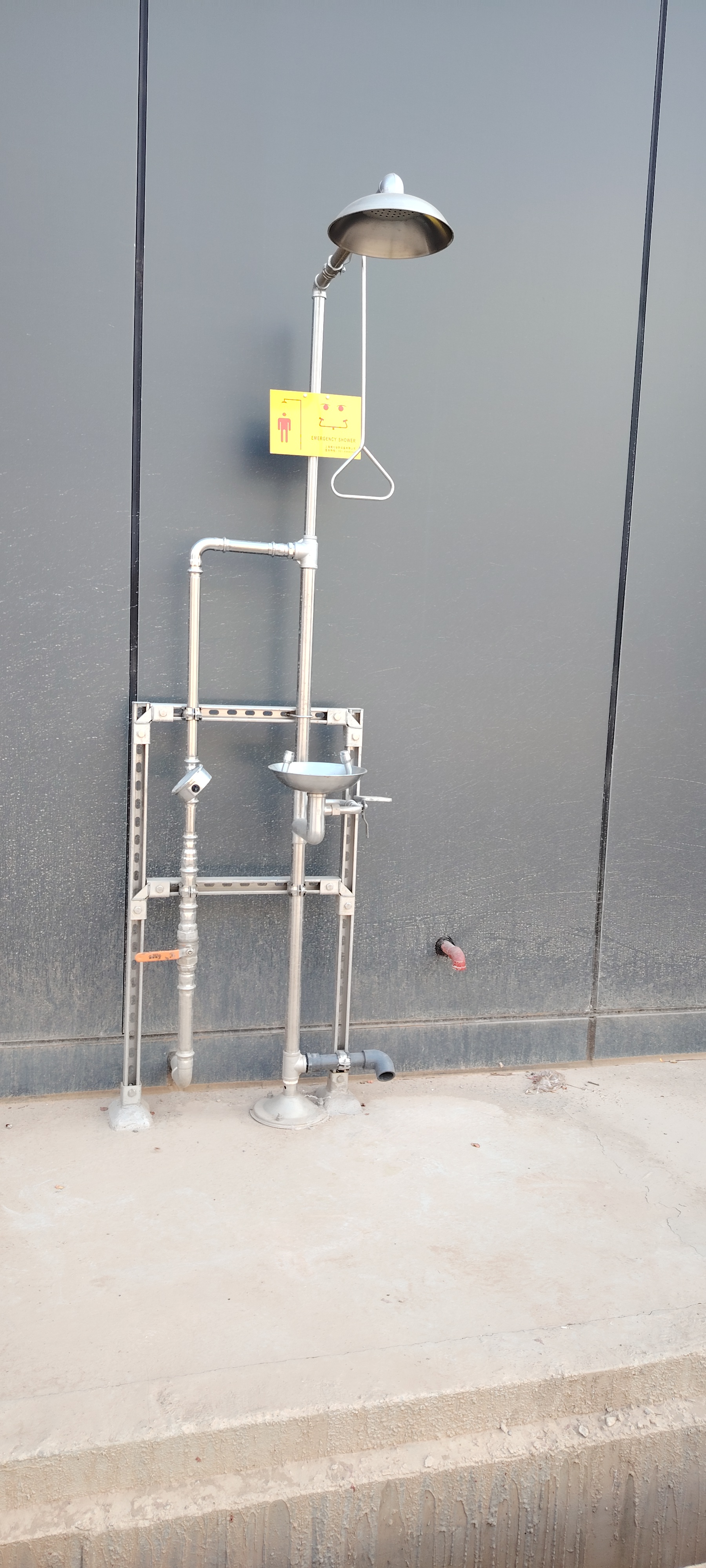
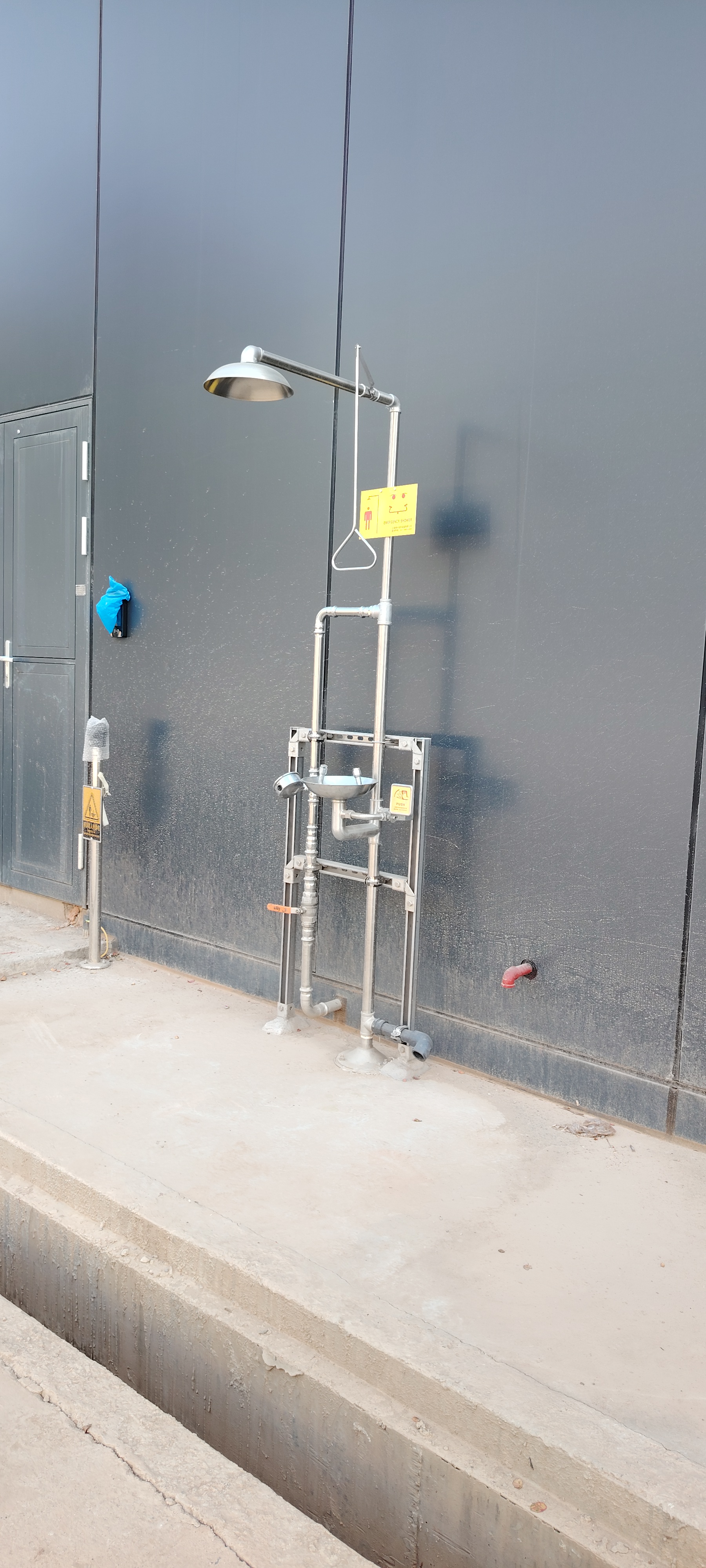
A compound emergency shower and eyewash station in 316 stainless steel — the configuration typically specified where chemical exposure drives the material decision.
Two specification lines decide whether an emergency eyewash or shower station still performs on the day it is needed: the stainless steel grade of its wetted and structural parts, and the flow rate it is rated to deliver. For most general industrial plants, 304 stainless steel is the appropriate grade. For chemical manufacturing, petrochemical, pharmaceutical and heavy wash-down environments, 316 stainless steel is the preferred grade because its molybdenum content improves resistance to chloride and chemical attack. Flow rate is an equally concrete decision: the BOHUA BH30-1316 compound emergency shower and eyewash is rated at an eyewash flow rate of ≥1.5 L/min and a shower flow rate of 120–180 L/min, while ANSI/ISEA Z358.1-2014 (R2020) sets the underlying minimum at 0.4 gallons per minute of flushing fluid for at least 15 minutes.
This guide is written for procurement engineers, EHS specifiers and importers who have to defend a material and a flow-rate figure inside a purchase specification. It explains what actually changes between 304 and 316 stainless steel, how eyewash and shower flow ratings should be read, and how the BOHUA BH32-6012 grounded vertical eyewash (304 SS) and the BH30-1316 compound station (316 SS) differ in the values that matter at the connection point and at the eyewash head.
Problem Definition: The Two Specification Gaps That Create Rework
Emergency eyewash stations rarely fail because a buyer chose the wrong product category. They fail because two specification lines were left vague: the material grade was never written into the purchase order, and flow rate was treated as a single number rather than a set of ratings for separate functions.
- Material grade left unstated. A station quoted only as "stainless steel" does not tell an engineer whether the body, pipework and fittings will tolerate the chlorides, acids or wash-down chemicals present in the plant. The difference between 304 and 316 is a corrosion-resistance decision, not a cosmetic one.
- Shower flow and eyewash flow conflated. A compound station delivers two separate streams with two separate ratings. Approving a unit because the shower meets 120–180 L/min says nothing about the eyewash heads, which are rated at ≥1.5 L/min on the same station.
- Certification assumed rather than verified. A standard reference in a brochure is not the same as a certificate number, an issuing body and a validity period that can be checked.
- Site interface ignored. Inlet size, overall height and drainage height determine whether the approved station can actually be installed at the chosen location without rework.
The practical consequence is that a technically adequate station can still become a compliance and maintenance problem once it is installed in the wrong environment or connected to a supply that cannot deliver the rated flow.
Industry Background: A Mature Market Where Specification Detail Wins
The emergency shower and eyewash station market is a stable, specification-driven category rather than a fast-moving consumer market. According to Spherical Insights, the global market was valued at approximately USD 417.3 million in 2024, with North America holding the largest regional revenue share at approximately USD 145.1 million in the same year. Transparency Market Research projects the market to reach USD 713.4 million by 2035, growing at a CAGR of 4.7% from 2025.
Published estimates for this category diverge noticeably between research firms, largely because some studies include supplementary personal wash units while others count only plumbed and portable stations. For buyers, the useful conclusion is not the exact market figure but the structure of the category: it is crowded, it is standards-bound, and named global competitors identified by Cognitive Market Research include Haws Corporation, Bradley Corporation, Guardian Equipment and Speakman. In a market with this many established participants, the differentiator available to a procurement engineer is not brand familiarity but verifiable specification data — grade, flow, geometry, certification scope and test regime.
The Material Decision: What Actually Changes Between 304 and 316
1. The metallurgical difference
Both 304 and 316 are austenitic stainless steels. The decisive difference is that 316 contains molybdenum, which improves resistance to pitting and crevice corrosion in chloride-bearing and chemically aggressive environments. In an emergency station, that resistance matters across the wetted path — the bowl, the spray heads and the pipework — not only on the visible outer surface.
2. Why 316 is preferred in chemical-heavy environments
Where a station sits inside a chemical manufacturing, petrochemical or pharmaceutical process area, it is exposed both to splash and to cleaning agents. Chloride exposure is the classic failure route for stainless steel in these areas, which is why 316 is the preferred grade for the BH30-1316 compound emergency shower and eyewash. That station is supplied with a 316 stainless steel body and pipework, floor mounting, push-handle activation, a DN32 inlet and outlet, and separate eyewash and shower circuits on a single 2480 mm column.
3. Where 304 remains the correct specification
304 is not a downgrade — it is the correct default for environments without aggressive chemical or chloride load. General metalworking, assembly plants, food processing areas and many laboratory installations are served well by 304 stations. The BOHUA BH32-6012 grounded vertical eyewash is built in 304 stainless steel, with a DN32 water inlet, a 2480 mm overall height, a 133 mm drainage height and an eyewash flow listed at 12–18 L/min.
The Flow Rate Decision: Reading Eyewash and Shower Ratings Correctly
Flow rate is where specification documents most often become ambiguous, because a compound station carries several ratings at once. Four values should be separated on any data sheet.
Eyewash flow
On the BH30-1316 compound station, the eyewash flow rate is listed as ≥1.5 L/min, alongside a shower flow rate of 120–180 L/min. That 1.5 L/min figure corresponds closely to the ANSI/ISEA Z358.1-2014 (R2020) minimum of 0.4 gallons per minute of flushing fluid for at least 15 minutes. Standalone vertical eyewash models such as the BH32-6012 publish a different figure — an eyewash flow of 12–18 L/min. Because these two numbers come from different model families, they should be read against the data sheet of the specific model being purchased, not compared directly against each other.
Shower flow
Shower-equipped compound stations are rated at 120–180 L/min. This is the value that determines whether a body-contamination event can be flushed effectively, and it is the rating that most directly depends on the site's delivered water pressure and pipe size.
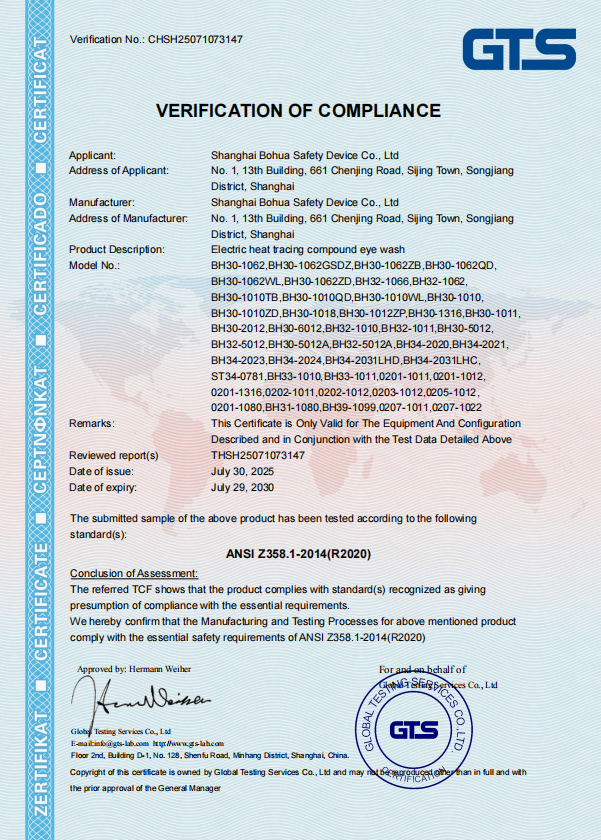
ANSI Z358.1-2014 certificate CHSH25071073147, issued by GLOBAL TESTING SERVICES CO., LTD. for all types of emergency eyewash stations.
Activation speed and spray geometry
Rated flow only matters if it is reached immediately. BOHUA stations list a start speed of within 1 second under a standard water pressure of 0.25–0.4 pa as recorded in the manufacturer's specification data. Spray geometry is specified through a sprinkler spacing of 101.6 mm on compound models, with a water discharge range of 508 mm at a distance of 1524 mm from the surface.
The pressure assumption behind every rating
Every published flow figure assumes adequate supply pressure. Where site pressure falls below the stated standard water pressure, delivered flow falls with it, and a station that was compliant on paper will underperform in an incident. Verifying supply pressure before placement is therefore part of the flow-rate specification, not a separate commissioning task.
Inlet, Geometry and Drainage: Values That Determine Installability
Material and flow are the safety decisions; geometry is the installability decision. In the BOHUA specification data, both the BH32-6012 vertical eyewash and the BH30-1316 compound station use a DN32 water inlet, and both stand at an overall height of 2480 mm with a drainage height of 133 mm.
On the compound station, the remaining height values are what engineers use to check ergonomics and pipe routing: shower head at 2100 mm, water inlet at 1600 mm, and eyewash at 1050 mm. A unit can be fully certified, correctly graded and correctly rated, and still be rejected on site if these clearances do not match the corridor, the ceiling height or the drainage route available at the chosen location.
Step-by-Step: Specifying a 304 or 316 Station
- Classify the exposure first. List the chemicals handled at the location, the cleaning agents used, and whether the area experiences chloride splash. This single step decides whether 304 will hold up or whether 316 is required.
- Confirm the governing standard. US-based sites typically reference ANSI/ISEA Z358.1-2014 (R2020); European sites reference the EN 15154 series, in which Part 2 specifically covers plumbed-in eyewash units. Confirm which applies before comparing hardware.
- Fix the flow requirements separately. Write the eyewash flow requirement and the shower flow requirement as two distinct lines in the specification — for example ≥1.5 L/min eyewash and 120–180 L/min shower on a compound station.
- Verify the supply can deliver it. Check available pressure against the stated standard water pressure and confirm the supply line size against the DN32 inlet.
- Map the geometry. Confirm 2480 mm overall height, shower head at 2100 mm, eyewash at 1050 mm, inlet at 1600 mm and drainage at 133 mm against the actual installation point.
- Specify activation and maintenance details. Push-handle activation, start speed within 1 second, two-piece ball valve, cow-horn bend with adjustable flow and a fixed soft-rubber anti-dust cover are the serviceable points that determine how the unit behaves between inspections.
- Close the loop with documentation. Record the certificate numbers, issuing authority and validity dates in the purchase file, together with the 100% test regime applied before shipment.
Use Cases: Matching Grade and Flow to the Environment
Chemical and petrochemical process areas
This is the clearest 316 case. The BH30-1316 compound emergency shower and eyewash pairs a 316 stainless steel body with the full 120–180 L/min shower rating and ≥1.5 L/min eyewash rating on a floor-mounted 2480 mm column, covering both eye contact and full-body splash in one footprint.
General manufacturing and metalworking
Where exposure is dust, particulates and routine industrial contamination rather than aggressive chemistry, a 304 station such as the BH32-6012 grounded vertical eyewash delivers the required flushing function with the same DN32 connection and 2480 mm height as the 316 platform, which simplifies spares and layout planning across a site.
Cold-climate facilities
Freezing risk is a material-and-configuration problem as much as a heating problem. A documented BOHUA case involves an ODM client in China that installed 15 anti-freeze units — the BH30-1062 electric heat tracing shower and eyewash — to keep the facility legally compliant year-round and to demonstrate due diligence for worker safety in cold climates. The project has been in operation for five years, with emergency response capability recorded as the key highlight and reliable, compliant and safe emergency response as the outcome.
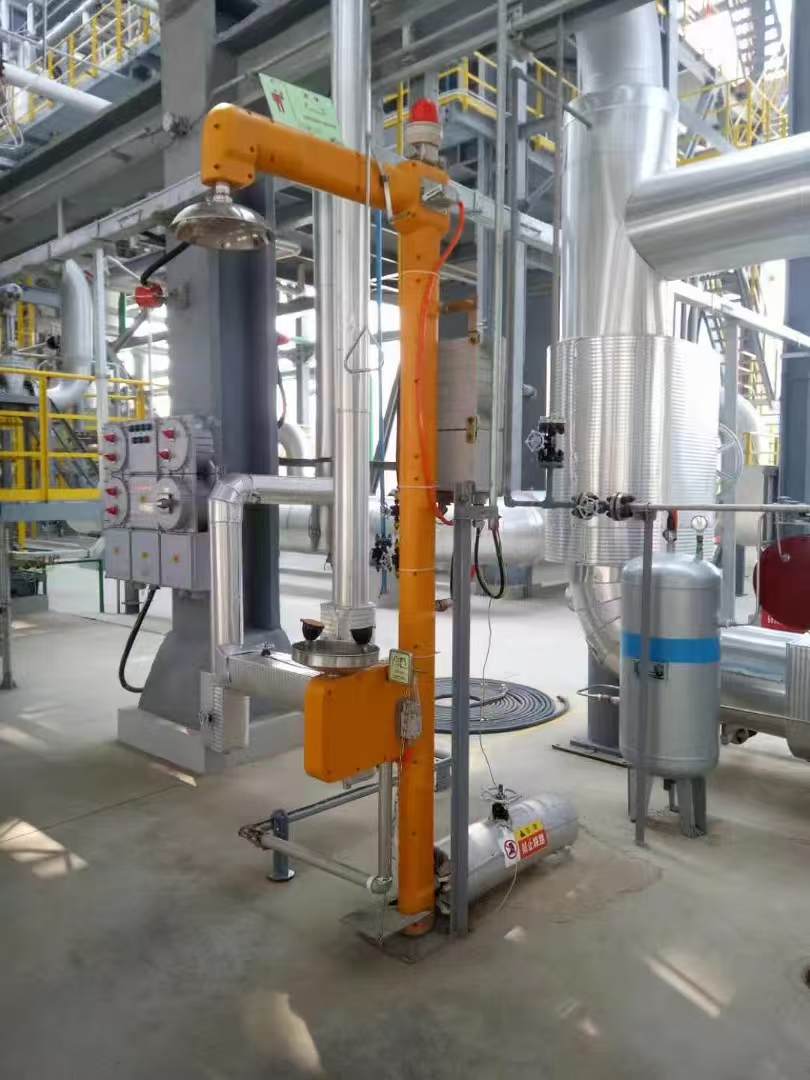
Electric heat tracing shower and eyewash configuration (BH30-1062) — the model specified in a five-year cold-climate ODM installation.
Laboratories and light-duty rooms
For bench-level risk, wall-mounted and desk-top 304 configurations use the same DN32 connection, ≥1.5 L/min eyewash flow rate and 101.6 mm sprinkler spacing as their larger counterparts, which keeps the flushing specification consistent from lab bench to plant floor even though the physical format changes.
Comparison Table: 304 vs. 316 Stations in BOHUA Configurations
| Decision factor | 304 stainless steel | 316 stainless steel |
|---|---|---|
| Example BOHUA model | BH32-6012 grounded vertical eyewash | BH30-1316 compound emergency shower and eyewash |
| Molybdenum content | No added molybdenum | Contains molybdenum for improved chloride and chemical resistance |
| Typical environment fit | General manufacturing, metalworking, laboratories, food processing | Chemical manufacturing, petrochemical, pharmaceutical, heavy wash-down |
| Water inlet / outlet | DN32 | DN32 |
| Eyewash flow | 12–18 L/min | ≥1.5 L/min |
| Shower flow | Not applicable — eyewash-only unit | 120–180 L/min |
| Overall height | 2480 mm | 2480 mm |
| Start speed | Within 1 second | Within 1 second |
| Standard water pressure | 0.25–0.4 pa | 0.25–0.4 pa |
BH30-1316 compound station: geometry and hydraulic values
| Parameter | Value |
|---|---|
| Shower head height | 2100 mm |
| Water inlet height | 1600 mm |
| Eyewash height | 1050 mm |
| Drainage height | 133 mm |
| Sprinkler spacing | 101.6 mm |
| Water discharge range | 508 mm, at a distance of 1524 mm from the surface |
| Sprinkler and fittings | PP+304 filter sprinkler, two-piece ball valve, cow-horn bend with adjustable flow, fixed soft-rubber anti-dust cover, luminous aluminium alloy indicator |
Verification: Certificates, Scope and Quality Control
Material and flow specifications should be backed by documents a buyer can check. Shanghai Bohua Safety Device Co., Ltd. (BOHUA), founded in 2006 and based in Songjiang District, Shanghai, has developed and produced 11 series and more than 100 types of eyewash, and holds ISO 9001 quality management system certification (certificate 288SCC24Q-SHBH002798S, issued 15 January 2024, valid to 14 January 2027 by Shanghai Center Certification Co., Ltd.) and ISO occupational health and safety management system certification (certificate 288SCC19S-SHB000647R2S, issued 12 August 2019, valid to 11 August 2028).
Product-level conformity is documented separately. The company's stations are covered by ANSI Z358.1-2014 certificate CHSH25071073147 and CE certificate CLSH25071073148, both issued by GLOBAL TESTING SERVICES CO., LTD. on 30 July 2025 and valid until 29 July 2030 for all types of emergency eyewash stations. Production runs under a 100% test regime before shipment, with a stated monthly capacity of 1,000 units and a lead time of 30 days.
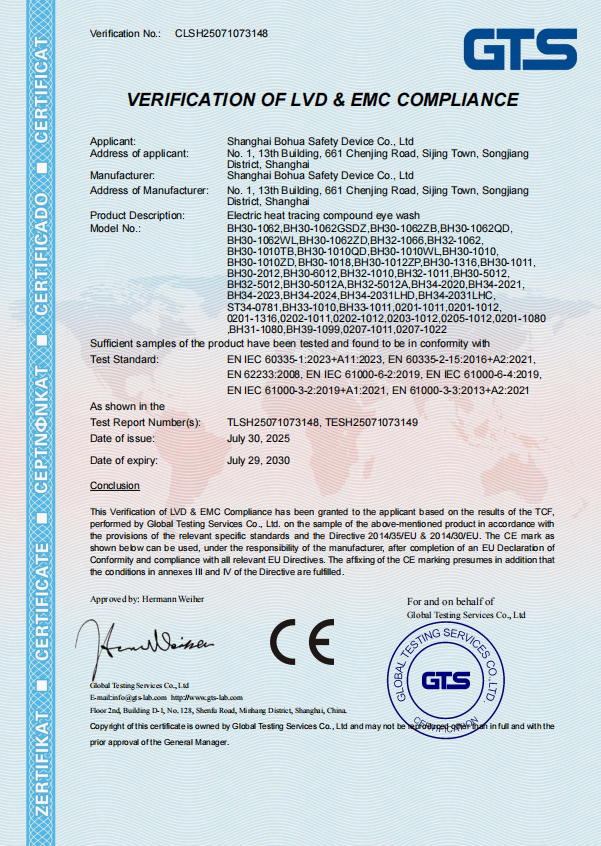
CE certificate CLSH25071073148, valid until 29 July 2030, covering all types of emergency eyewash stations.
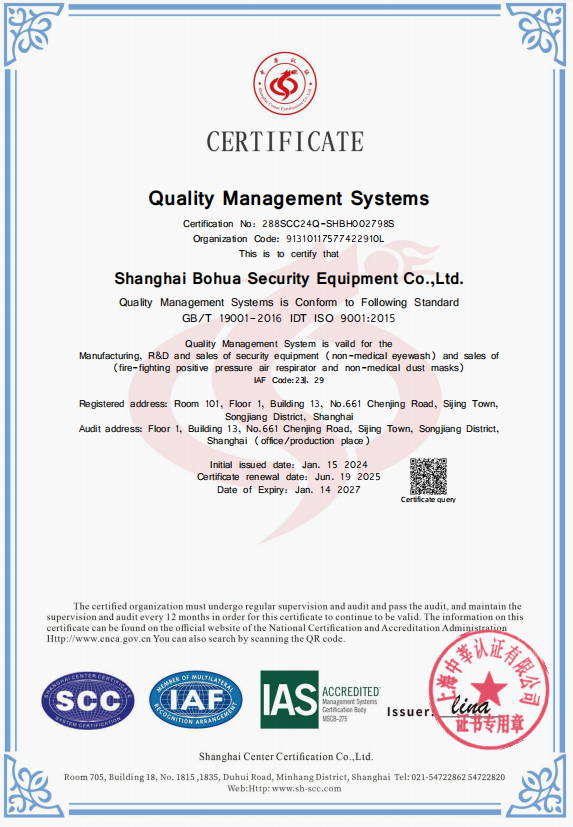
ISO quality management system certificate 288SCC24Q-SHBH002798S, covering manufacturing, R&D and sales of security equipment.
For buyers evaluating a material decision rather than a brand decision, three verification steps are worth building into the purchase file: confirm that the certificate scope covers the specific station type being ordered, confirm the validity dates have not lapsed at the time of ordering, and confirm the issuing body is named rather than implied.
Frequently Asked Questions
Which standard governs a 304 or 316 stainless steel eyewash station — and does the material change the requirement?
The material grade does not change the governing standard; it changes how long the station survives its environment. In the United States, ANSI/ISEA Z358.1-2014 (R2020) requires eyewash stations to deliver 0.4 gallons per minute of flushing fluid for at least 15 minutes. In Europe, the EN 15154 series regulates emergency safety showers, with EN 15154-2 covering plumbed-in eyewash units. BOHUA's stations are covered by ANSI Z358.1-2014 certificate CHSH25071073147 and CE certificate CLSH25071073148, both issued by GLOBAL TESTING SERVICES CO., LTD. on 30 July 2025 and valid until 29 July 2030 for all types of emergency eyewash stations.
Can BOHUA supply both 304 and 316 stainless steel stations?
Yes. The BOHUA BH32-6012 grounded vertical eyewash is produced in 304 stainless steel with a DN32 water inlet, a 2480 mm overall height and an eyewash flow of 12–18 L/min. The BOHUA BH30-1316 compound emergency shower and eyewash is produced in 316 stainless steel with a DN32 inlet and outlet, an eyewash flow rate of ≥1.5 L/min and a shower flow rate of 120–180 L/min. Both are supported by an OEM/ODM program that can add acoustic and optical alarms, lighting, DCS signal uploading, electrical heating, cooling and skid-mounted systems, with a stated monthly capacity of 1,000 units.
What drives the cost difference between a 304 and a 316 station?
Two factors dominate: material grade and configuration scope. Because 316 stainless steel contains molybdenum, its material cost is generally higher than 304, and the grade should be reserved for environments where that resistance is actually needed. Beyond the grade, cost follows the configuration — electrical heating or heat tracing, alarms, sensing, skid-mounting — and the order quantity, with BOHUA's minimum order quantity set at 5 units. A configuration-based quotation is therefore more reliable than a per-unit comparison between grades.
Can a station be validated on site before a wider rollout?
The minimum order quantity of 5 units allows a station to be installed and operated at a real site before a wider rollout, which is the practical way to confirm that material grade, delivered flow and geometry match the actual exposure and pipework. Every unit is 100% tested before shipment, and after-sales support is provided remotely. Validation should include supply pressure against the 0.25–0.4 pa standard referenced in the specification data, start speed within 1 second, and confirmation of the 133 mm drainage route.
What is the lead time, and how should installation be planned around it?
Standard lead time is 30 days against a stated monthly production capacity of 1,000 units. Installation planning should confirm a DN32 supply line, an overall height of 2480 mm with the shower head at 2100 mm and the eyewash at 1050 mm, a water inlet height of 1600 mm, and drainage at 133 mm. For a configuration review or a quotation, contact sales@shanghai-bohua.com or request the BOHUA product catalogue through the link at the end of this guide.
Conclusion: Write the Grade and the Flow Into the Specification
The 304 versus 316 decision is settled by the environment, not by preference: 316 where chlorides and aggressive chemicals are present, 304 where they are not. The flow-rate decision is settled by the standard and the site: ≥1.5 L/min eyewash and 120–180 L/min shower on a compound station, with a supply that can actually deliver those rates at a start speed within 1 second. Once both lines are written, the remaining risk sits in geometry — DN32 inlet, 2480 mm height, 133 mm drainage — and in documentation that can be verified rather than assumed.
Next step
If you are specifying a 304 or 316 stainless steel station for a chemical, industrial or cold-climate site, BOHUA can review your exposure, supply pressure and geometry requirements against the BH32-6012, BH30-1316 and other models in the range.
- Email: sales@shanghai-bohua.com
- WhatsApp / Tel: +86 18917119171
- Website: www.eyewashcn.com
- Address: No 661, Chenjing Road, Sijin Town, Songjiang District, Shanghai, China
- Download the product catalogue: BOHUA product catalogue (PDF)
Have Questions or Need More Details?
Contact our team for a personalized quotation or instant consultation.
Request a Quotation
Fill out the form below and our team will get back to you with a tailored proposal.
WhatsApp Direct Chat
Prefer to chat in real-time? Message us on WhatsApp for instant assistance & quick answers.
- Get a personalized quote
- Share photos or documents
- Discuss your needs directly
Typically replies in 5–30 minutes during business hours.