Capsule House Manufacturers Compared: A Resort Buyer’s Guide
Capsule House Manufacturers Compared: A Resort Buyer’s Guide
When a resort project calls for capsule houses, the question is not only which capsule house design fits the landscape. It is also which manufacturer can deliver a steel modular capsule house that meets local building codes, arrives on schedule, and performs for years in outdoor conditions. This guide is written for buyers in the evaluation stage. It explains how to compare capsule house manufacturers, what documentation to request, and what factory-level evidence separates a reliable supplier from a risky one.
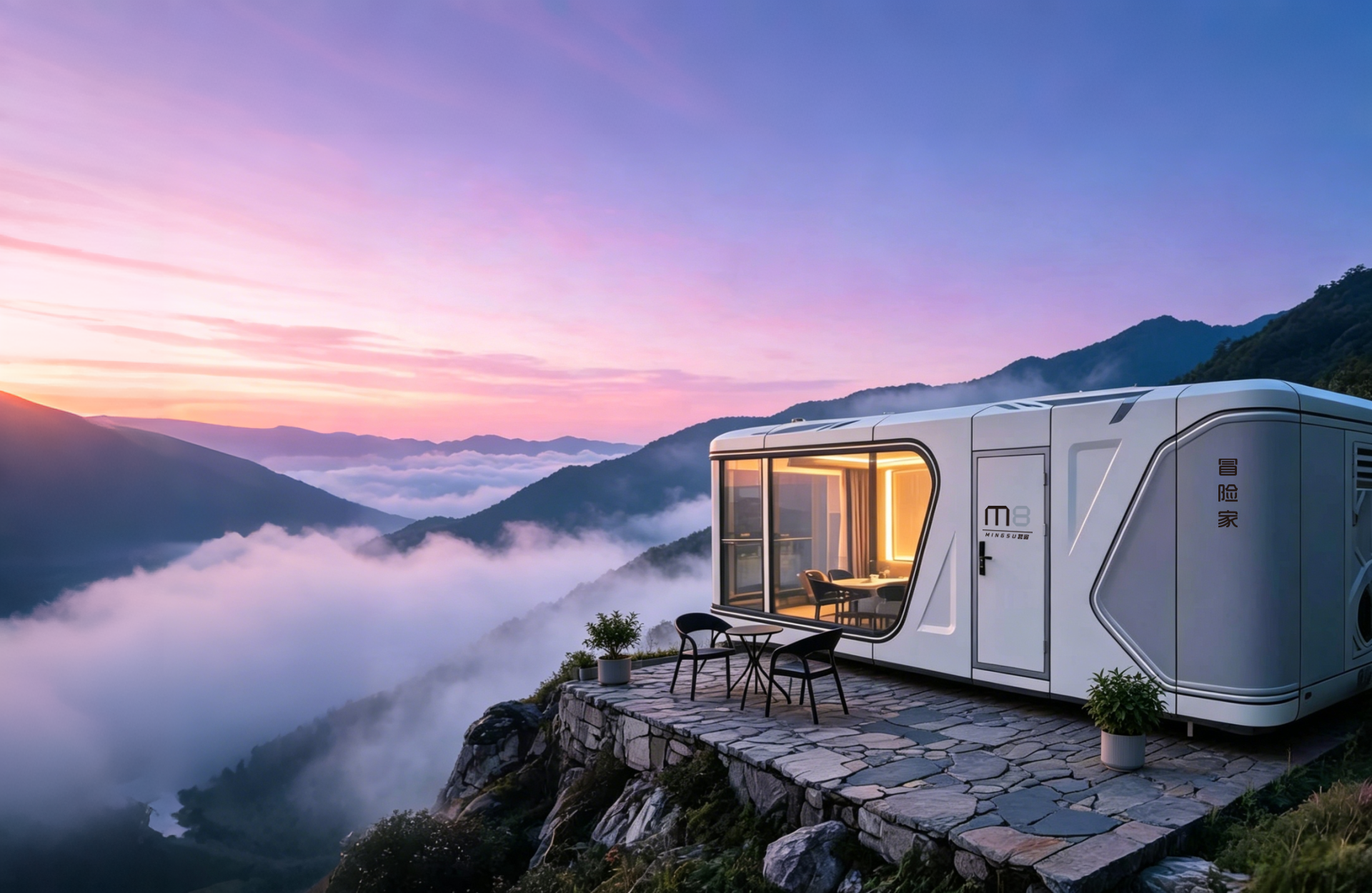
Steel modular capsule house suitable for outdoor glamping and resort accommodation.
The Evaluation Problem: Picking a Capsule House Manufacturer Is Not Like Choosing a Product SKU
Capsule houses are factory-prefabricated units that combine structure, insulation, glazing, interiors, and sometimes bathroom systems in one deliverable. Because they are used outdoors, in environments ranging from humid coastlines to cold mountain sites, the manufacturer's material choices and quality control matter as much as the design. Buyers evaluating manufacturers face several common challenges:
- Similar-looking units may have very different steel frames, insulation cores, windows, and door systems.
- Regulatory classification varies by country: a unit may be treated as an RV, an ADU, a modular building, or a construction product subject to CE marking.
- Customization requests such as voltage, logo placement, bathroom layout, or material upgrades require a manufacturer with real engineering capacity.
- Long lead times or low monthly capacity can delay an entire resort opening.
This section outlines a repeatable comparison framework. The rest of the article applies it to a specific example: BOITO-MINGSU, the capsule house product line of Guangdong Mingsu Sojourn Technology Co., Ltd.
Industry Background: Why Resort Developers Are Investing in Capsule Accommodation
The broader market justifies the growing interest in portable prefab capsule houses. According to Mordor Intelligence, the global prefabricated housing market is projected to reach approximately USD 152.74 billion by 2026, with modular homes growing at an estimated CAGR of 7.05% through 2031. Grand View Research expects the glamping market to reach USD 7.9 billion by 2033, and it reports that cabins and pods are the largest glamping accommodation segment, holding a 43.0% share in 2025. For resort developers, these numbers support the shift toward prefabricated capsule accommodation that can be installed quickly and relocated if necessary.
Construction efficiency is a key driver. Modular housing projects can reduce construction timelines by 30%–50% compared with traditional on-site methods, according to Fortune Business Insights. Modular construction also minimizes on-site waste—by about 30% on average, as reported by The Freedonia Group. In Asia-Pacific, the fastest-growing region for glamping and luxury modular pods is projected to expand at a 12.6% CAGR through 2034, which increases demand for reliable suppliers. On the supply side, China exported USD 3.24 billion of prefabricated buildings in 2024, with Malaysia and the United States among key growth markets.
Operational Advantages of Modular Capsule Units
Beyond market data, capsule houses offer operational advantages that are especially relevant to resort owners. The manufacturing process is fully prefabricated; no complex foundation is required on-site. The ground only needs to be leveled, and a single capsule can be lifted into place. Installation of one capsule can be completed in about two hours, significantly shortening the project cycle. Because the structure is formed in the factory, there is no on-site construction waste. According to BOITO-MINGSU's product knowledge base, this approach can save up to 80% of civil construction costs. The units can also be moved and reused as a whole after a project ends, which reduces the risk of losing fixed assets. For seasonal or experimental resort sites, this flexibility is a practical advantage.
Detailed Solution: A Manufacturer Evaluation Framework for Capsule Houses
To compare capsule house manufacturers fairly, use six criteria: company credentials, product specifications, customization ability, quality control, certifications, and proof from real projects. The following framework is based on the BOITO-MINGSU product line and can be applied to any supplier.
1. Company Credentials and Factory Capacity
Guangdong Mingsu Sojourn Technology Co., Ltd., operating as BOITO-MINGSU, is a member of the BOITO Group. The company specializes in the research, development, manufacturing, and export of modular hospitality buildings and capsule houses. Its factory in Yangjiang, Guangdong, covers 10,000 m² and employs 30 people, with 25 engineers on the R&D team. Annual output is about 1,000 units, and roughly 40% of production is exported to Southeast Asia, the EU, and the USA.
Why this matters: a manufacturer with in-house engineering and a stated monthly capacity can support customization, answer technical questions, and plan production around your lead time.
2. Product Line and Material Specifications
A credible capsule house manufacturer should offer models that fit different site needs. In the BOITO-MINGSU lineup, the M8 Capsule House and M10 Capsule House each accommodate 1 to 4 guests. The M3 Breeze Single Capsule is a compact 6.9 m² unit. The Apple Capsule MINI adds a curved Apple-style silhouette, and the MS-XO8 F commercial cabin expands the concept into catering service use.
| Model | Dimensions (LxWxH) | Area | Guests | Power | Weight |
|---|---|---|---|---|---|
| M8 Capsule House | 8.3m x 3.3m x 3.2m | 27.39 m² | 1–4 | 8KW | ≈7T |
| M10 Capsule House | 10m x 3.6m x 3.2m | 27.36 m² | 1–4 | 10KW | ≈9.5T |
| M3 Breeze Single Capsule | 3m x 2.3m x 2.5m | 6.9 m² | 1 | 6KW | ≈2T |
| Apple Capsule MINI | 8.3m x 3.3m x 3.2m | 27.39 m² | 1–4 | 7KW | ≈6.5T |
| MS-XO8 F Commercial Cabin | 16m x 3.6m x 3.2m | 57.6 m² | 1–4 | 10KW | ≈13T |
Material details are equally important. The commercial cabin, for example, uses a hot-dip galvanized steel frame structure with an anti-seismic steel system, fluorocarbon-painted aluminum exterior panels, polyurethane foam insulation, double-layer tempered Low-E hollow glass, and Arrow sanitaryware. These are the kinds of specifications a manufacturer should be able to document.
3. Customization and Regulatory Alignment
BOITO-MINGSU works in ODM production mode. Customization can include voltage and logo, and the company states that products can be customized to meet the building codes and electrical standards of different countries. For resort brands that need a consistent visual identity, logo application may seem minor, but it affects exterior finish and durability. Electrical standards become critical when units are shipped to another country.
4. Quality Control and Testing
Quality control within BOITO-MINGSU includes 100% testing of units. For overseas buyers, this is a simple but significant checkbox: does the manufacturer test every unit or only perform spot checks? The answer affects the risk of receiving defective units on a remote project site.
5. Certifications that Matter
For global projects, documentation is non-negotiable. In the European Union, capsule houses fall under the Construction Products Regulation and must bear CE marking for legal installation. In the United States, regulatory treatment differs depending on whether a unit is classified as an RV, an ADU, or a state-certified modular building.
BOITO-MINGSU holds an ISO14001 Environmental Management System Certificate (certificate number ISC-E-2025-5371-R), issued by Beijing International Standard United Certification Co., Ltd. and valid until 2028-11-23. The certification scope covers environmental management activities for the manufacturing of metal structures (mobilehomes). It is not a substitute for country-specific product certification, but it shows that the factory has an environmental management system in place.
6. Proof from Resort Projects
A manufacturer’s track record in similar applications is one of the strongest evaluation signals. According to BOITO-MINGSU’s project case, 10 units of product model 7228 were installed in Malaysia for camping resort accommodation. The case notes low noise operation and stable operation over a 20-year period, and the units were supplied to tourism resort OEM clients. This type of evidence helps a buyer understand how the product performs outside the factory.
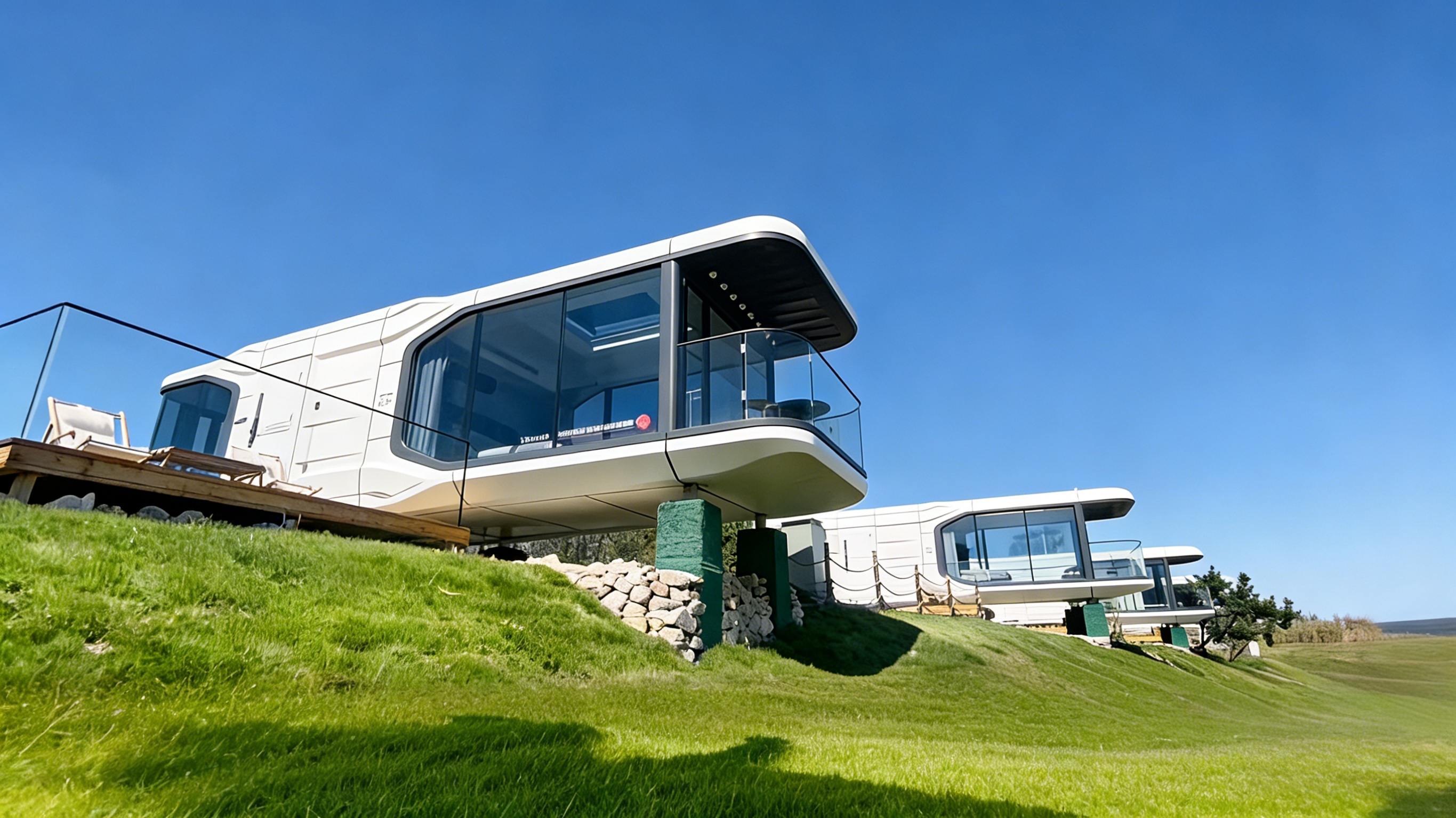
Capsule house units installed in an outdoor resort setting.
Step-by-Step Breakdown: How to Evaluate a Capsule House Supplier
The following seven-step process condenses the framework into an actionable procurement workflow.
- Define your project parameters. Decide unit type, quantity, site conditions, guest capacity per unit, and power requirements. For example, an M8 Capsule House occupies 27.39 m² and consumes approximately 8 kW, while an M10 consumes approximately 10 kW.
- Shortlist manufacturers with relevant product lines. Look for a manufacturer that offers modular tourism capsule cabins, not just a single prototype design.
- Request product data sheets. The data sheet should include dimensions, weight, material specifications, guest capacity, and power consumption. Compare these against your site plan.
- Ask for certification documents. Confirm that the manufacturer can share certificates and specify their scope. Check the expiration date and certifying body.
- Check customization capability. Ask about voltage, logo, bathroom fit-out, insulation upgrades, and whether the manufacturer can adapt to your country’s electrical standards.
- Review quality control and shipping. Confirm how many units are tested, how units are protected for ocean freight, and what documentation is provided after shipment.
- Request reference projects or case studies. The most relevant proof is another camping or resort project in a climate or terrain similar to yours.
Use Cases: Where Capsule Houses Fit in Hospitality and Tourism
BOITO-MINGSU’s product profile lists several typical applications: glamping sites, eco-resorts, holiday parks, beach resorts, mountain resorts, staff accommodation, and other hospitality developments. The company also describes use cases for quick-setup shops and scenic-area guestrooms that do not disrupt the ecosystem.
The Malaysia case illustrates the core use case: a camping resort operator commissioned 10 units as accommodation. From a buyer’s perspective, a project like this demonstrates that the manufacturer can handle a small series order, deliver units with a consistent finish, and support an operator in a resort environment.
Project records also include camping resorts in Thailand using 10 units of the M8 model, tourism villages in Malaysia using 4 units of the M8 model, camping resorts in China using a combination of M8 and M12 units, holiday homes in Canada using customized models, and business cabins in Hong Kong using customized models. These examples show that capsule houses are not limited to one geography or business model. They are used for beachfront rental rooms, mountain-view cabins, staff housing, and even small commercial structures such as cafés or shops.
Comparison Table: Capsule House Manufacturers in the Export Market
The table below compares BOITO-MINGSU with two manufacturers cited in third-party industry sources. Because public data on Chinese capsule house exporters is limited, specifications should be verified directly with each company.
| Manufacturer | Base | Product Focus | Evidence / Notes |
|---|---|---|---|
| BOITO-MINGSU (Guangdong Mingsu Sojourn Technology Co., Ltd.) | Yangjiang, Guangdong, China | Steel modular capsule houses, glamping cabins, mobile sleep pods, modular villas | ISO14001 certified; ODM customization; 100% unit testing; documented Malaysia camping resort project with 10 units; exports to Southeast Asia, EU, USA |
| Liansheng (Qingdao) | Qingdao, China | Apple cabins and modular pods | Cited as a top-tier manufacturer of apple cabins and modular pods in the Chinese export sector (third-party industry blog) |
| Glamni | China (brand) | Apple cabins and modular pods | Cited as a top-tier manufacturer of apple cabins and modular pods in the Chinese export sector (third-party industry blog) |
Competitor claims are sourced from publicly available industry citations and require direct verification.
Frequently Asked Questions
Q1: What should I look for when comparing capsule house manufacturers for a resort project?
Compare manufacturers on six criteria: company credentials, product specifications, customization capability, quality control, certifications, and reference projects. For resort projects, a manufacturer with experience supplying tourism resort OEM clients and camping resorts is more relevant than one with only residential project examples.
Q2: What certifications should a capsule house manufacturer have?
Certification requirements depend on the destination country. In the EU, capsule houses must meet the Construction Products Regulation and carry CE marking for legal installation. In the US, units may be classified as RVs, ADUs, or state-certified modular construction. A manufacturer can also hold voluntary system certifications, such as ISO14001, which BOITO-MINGSU holds under certificate number ISC-E-2025-5371-R.
Q3: What customization capabilities does BOITO-MINGSU offer?
BOITO-MINGSU operates in ODM mode. Customization includes voltage and logo, and the company states that its products can be customized to meet building codes and electrical standards of different countries. Production capacity is 30 to 50 units per month, and the MOQ is 10 units.
Q4: Is there a real camping resort reference project for BOITO-MINGSU capsule houses?
Yes. In a project located in Malaysia, 10 units of product model 7228 were installed for camping resort accommodation. The capsule houses feature a hot-dip galvanized steel frame structure, and the case records low noise operation and stable operation over a 20-year period.
Q5: What are the typical lead time and MOQ for capsule house orders?
For BOITO-MINGSU, the lead time is 30–45 days with a minimum order quantity of 10 units. The factory's monthly capacity is 30 to 50 units, and all units undergo 100% testing. For project-specific delivery planning, you can contact BOITO-MINGSU at info@gdmingsu.com or via WhatsApp at +86-190 7530 9888.
Download the BOITO-MINGSU 2026 Brochure
Review the full capsule house product range, specifications, and company background.
Conclusion
Evaluating capsule house manufacturers is a decision about risk, not just aesthetics. The manufacturer that can document its steel frame structure, insulation system, testing procedure, certifications, and relevant resort projects is the manufacturer that deserves a place on your shortlist. BOITO-MINGSU, a brand of Guangdong Mingsu Sojourn Technology Co., Ltd., offers one reproducible example of how these criteria can be met: a 10,000 m² factory, 25 R&D engineers, ODM customization, 100% unit testing, ISO14001 certification, and a 10-unit camping resort project in Malaysia. Use the framework in this guide to run your own comparison, and ask every shortlisted supplier for the same level of documentation.