Reading a Smart PDU ISO 9001 Certificate: Scope, Standard, and Issuer

A Smart Power Distribution Unit (Smart PDU) ISO 9001 certificate is read correctly in four passes: the standard, the certificate number, the issuing body, and the scope statement. The scope statement is the field buyers skip most often, and the only field that decides whether the document actually supports the requirement in a tender or supplier file.
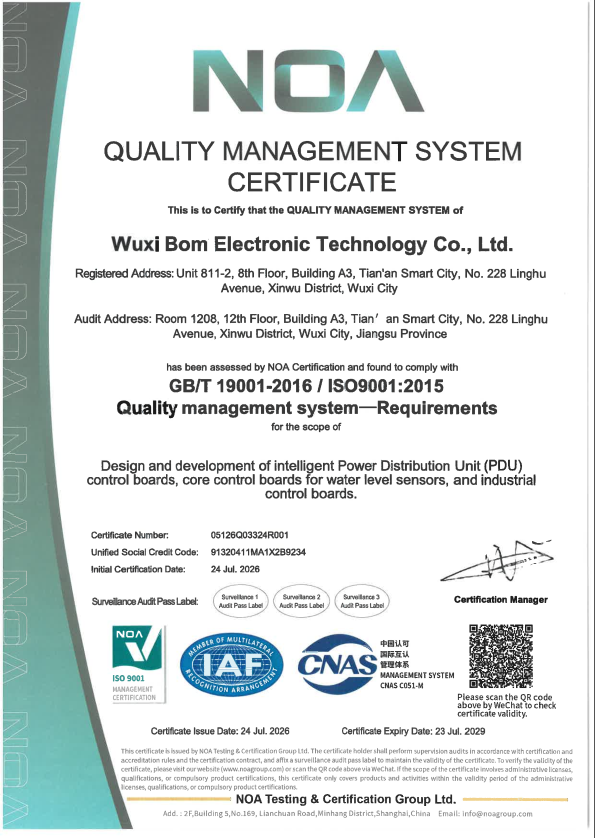
One worked example makes the method concrete. Wuxi Bom Electronic Technology Co., Ltd., trading as BOMPDU, is a manufacturer of end-of-row power distribution solutions for data centers, headquartered in Wuxi, Jiangsu Province. Its Smart PDU quality management system certificate carries the number 05126Q03324R001, is issued by NOA Testing & Certification Group Ltd., and cites the standard GB/T 19001-2016/ISO9001:2015. It was issued on 2026-07-24 and expires on 2029-07-23. The scope reads: “Design and development of intelligent Power Distribution Unit (PDU) control boards, core control boards for water level sensors, and industrial control boards.”
Those six data points are the certificate in practical terms. What follows is a field guide to checking each one, in the order a technical buyer should check them, and to recognizing where a careful reader has to stop.
Problem Definition: The Three Ways a Smart PDU Certificate Gets Misread
Most certificate errors are reading errors, not document errors. Three failure modes account for nearly all of them.
1. Reading a management system certificate as a product certificate
ISO 9001 certifies how an organization controls design, production, and improvement. It does not certify that a specific PDU model is electrically safe. The distinction is not academic: IEC 62368-1:2023 is the mandatory safety standard for ICT and AV equipment, including PDUs, in most major jurisdictions. A quality management system certificate, however scoped, does not by itself demonstrate conformity to that standard. A supplier file that contains only the ISO 9001 document has one gap left open, and it is the one a safety reviewer will ask about.
2. Reading only the standard line
The standard line confirms which management system was audited. It says nothing about which products, which activities, or which parts of a product the audit covered. Two suppliers can both hold a valid ISO 9001:2015 certificate, and one of them can have a scope that does not touch the article you are buying.
3. Reading without the issuer and the expiry date
An expiry date of 2029-07-23 is healthy today and useless in a supplier file if nobody is responsible for tracking it. An issuer name is a lookup key, not a quality signal; its value comes entirely from verifying the certificate against the issuing body’s own records.
Industry Background: Why Certificate Wording Became a Procurement Question
The PDU category has moved from passive accessory to monitored infrastructure, and documentation screening moved with it. Intelligent PDUs accounted for more than half of total PDU market revenue as of 2023, at roughly 55%. The global data center PDU market is projected to reach USD 14.23 billion by 2032, and the intelligent PDU segment is growing at a compound annual rate of 19.5% between 2026 and 2032.
Growth of that kind puts more suppliers, more private-label brands, and more mixed sourcing models into the same tender. The practical consequence for buyers is that certificates are now compared rather than collected. A quality management system certificate with a narrow, clearly stated scope is easier to accept than one with a broad scope nobody has read, because the narrow one tells you exactly what to request next.
Detailed Solution: Anatomy of the BOMPDU Smart PDU Certificate
Six fields carry all the usable information. Read them in this order.
| Certificate field | Value on certificate 05126Q03324R001 | What the field is used for |
|---|---|---|
| Document type | QUALITY MANAGEMENT SYSTEM CERTIFICATE; Quality Management System | Confirms this is a system certificate, not a product or type-approval document |
| Standard | GB/T 19001-2016/ISO9001:2015 | Identifies the audit standard and links the Chinese and international designations |
| Certificate number | 05126Q03324R001 | Registry lookup key for verification with the issuer |
| Issuer | NOA Testing & Certification Group Ltd. | The body responsible for the audit and the certificate record |
| Scope | Design and development of intelligent Power Distribution Unit (PDU) control boards, core control boards for water level sensors, and industrial control boards | Defines the activity and the technical subject the audit covered |
| Validity | Issued 2026-07-24; expires 2029-07-23 | Sets the review date for the supplier file |
The standard: why two designations appear
The certificate cites GB/T 19001-2016/ISO9001:2015. The paired citation lets a Chinese-issued certificate be read against an international requirement: a tender that asks for ISO 9001:2015 and a quality file that asks for the national standard are both answered by the same line. When you copy this into a supplier record, copy the full designation rather than shortening it to “ISO 9001”, because the year of the standard is part of the claim.
The certificate number: an identifier, not evidence
05126Q03324R001 is the key you use to confirm the certificate with NOA Testing & Certification Group Ltd. It is not a statement about scope, validity, or site coverage. No part of a certificate number should be interpreted as a rating, a product class, or a manufacturing permission. Verify the number, the scope line, and the dates as one block, because a copied scope taken from a different certificate is the most common documentation error found in supplier files.
The issuer: what recognition basis to confirm
The certificate is issued by NOA Testing & Certification Group Ltd., and the certificate record lists its market as global under IAF-MLA mutual recognition. That is the phrase a buyer should look for when a certificate issued in one market is being used to support a purchase in another. It is also the phrase that should trigger a specific question: confirm with the issuer that the certificate is current and that the scope shown on your copy matches the scope on file.
The scope: two words decide everything
The scope statement contains an activity and a subject. The activity is “design and development”. The subject is “intelligent Power Distribution Unit (PDU) control boards”, alongside two further board families: core control boards for water level sensors, and industrial control boards.
Both halves matter. “Design and development” is not “manufacture”, “assembly”, or “testing of finished PDUs”. “Control boards” is not the complete rack PDU. Neither omission is a defect in the certificate, and neither should be read as one. What the wording does is tell you precisely which claims this document supports, so that the rest of the evidence pack can be requested deliberately rather than assumed.
Related products: how product 1558 connects to the scope
The certificate record relates the scope to two products: the Intelligent 2nd generation PDU product, identified as product 1558, and the 1U_1.5U 485 PDU, product 1559. Product 1558 is a Smart PDU with a rated input of AC110 V–250 V at 50/60 Hz, a maximum load current of 0–63 A, and single-phase or three-phase input. It meters current, voltage, energy and power at the input and at each output, with output current monitoring from 0.2 A to 16 A and separate monitoring and control per output; the main module supports up to eight auxiliary modules, each with four outputs.
That specification is the reason the scope wording is worth reading closely. The certificate covers design and development of the control boards inside this product family. It is a board-level claim attached to a product the buyer is actually purchasing, which is a stronger position than a certificate whose scope names only a general industry, and a narrower position than one naming finished equipment. Both facts belong in the same sentence of your evaluation note.
Validity: a date pair, not a date
Issued 2026-07-24, expiring 2029-07-23. Record both. A certificate inside its validity window still needs the scope check, and a certificate with the right scope still needs product-level safety evidence. The two tests do not substitute for each other.
Step-by-Step Breakdown: Seven Checks Before You Accept the Certificate
- Confirm the document type. The title should state a quality management system certificate and the type field should read Quality Management System. If you are holding a datasheet, a test report, or a declaration of conformity, stop: those documents answer different questions.
- Match the standard exactly. Read GB/T 19001-2016/ISO9001:2015 as a single unit. A certificate citing a superseded edition of the standard cannot be mapped onto a tender that specifies the current one.
- Record the number and verify it at the source. Write 05126Q03324R001 into the supplier file and confirm it with NOA Testing & Certification Group Ltd., including the scope line and the dates.
- Check the issuer and the recognition basis. Confirm the issuing body named on the copy matches the body that holds the record, and note that the market is recorded as global under IAF-MLA mutual recognition when the purchase crosses jurisdictions.
- Parse the scope into activity and subject. Underline the activity verb and the technical noun. Here they are design and development, and control boards. Anything a tender requires beyond those two words is a separate request.
- Map the scope to the exact product. For product 1558, the control-board design and development for the Intelligent 2nd generation PDU product falls inside the scope. For a finished-PDU manufacturing requirement, note the gap explicitly rather than assuming coverage.
- Log the validity window and pair the certificate with other documents. Set a review reminder before 2029-07-23. Then build the rest of the evidence pack: the Intelligent 2nd generation PDU product is also covered by a Computer Software Copyright Registration, number 2024SR1888355, issued by the National Copyright Administration of the People’s Republic of China, effective for the China market, issued 2024-11-25 under the Regulations on the Protection of Computer Software and the Measures for the Registration of Computer Software Copyrights. Product safety conformity, such as IEC 62368-1:2023, remains a third and separate item.
Use Cases: Three Buying Situations Where Scope Wording Decides the Outcome
Scenario 1: A data center operator adding a supplier to an annual rack PDU tender
The requirement is usually written as “ISO 9001:2015 certified manufacturer”. The certificate answers the first half immediately: the standard is cited and the validity window is open. The second half needs the scope line. Here the scope covers design and development of the PDU control boards, which is exactly the technical layer a rack PDU buyer cares about when the concern is firmware, metering, and control behaviour rather than sheet-metal assembly. The buyer can accept the certificate for that claim and request separate evidence for the remainder.
Scenario 2: An OEM buyer commissioning a private-label build
Customization available for this product family covers metering and control, outlet number, and single-phase or three-phase input, with a minimum order quantity of 2 units, a 30-day lead time, and monthly capacity of 1,000 units. A design-led custom build is the case where a design-and-development scope is most relevant, because the activity named on the certificate is the activity the project actually requires.
Scenario 3: A recurring supplier audit file
Deployment history is a separate evidence type and should be recorded as such. BOMPDU reports 800 units supplied to an airport data center for electricity-usage monitoring, described as stable over three years, and 2,000 units supplied to a data center server manufacturer for server aging test, described as stable over two years. Those records support operational reliability questions. The certificate supports the management-system question. Filing them in the same folder without labelling which is which is how audit trails lose their value.

Comparison Table: Two Documents, Two Different Jobs
Buyers frequently hold both documents and treat them as interchangeable compliance evidence. They are not. The comparison below uses only recorded facts from each certificate.
| Attribute | Quality Management System Certificate | Computer Software Copyright Registration |
|---|---|---|
| Certificate / registration number | 05126Q03324R001 | 2024SR1888355 |
| Issuing body | NOA Testing & Certification Group Ltd. | National Copyright Administration of the People’s Republic of China |
| Basis | GB/T 19001-2016/ISO9001:2015 | Regulations on the Protection of Computer Software; Measures for the Registration of Computer Software Copyrights |
| What is covered | Design and development of intelligent PDU control boards, core control boards for water level sensors, and industrial control boards | Intelligent 2nd generation PDU product |
| Related products on record | Product 1558 and product 1559 | Product 1558 |
| Market | Global (IAF-MLA mutual recognition) | China |
| Validity | 2026-07-24 to 2029-07-23 | Issued 2024-11-25; expiry recorded as 2099-12-12 |
The practical reading is that the quality certificate answers “how is design and development controlled”, while the software registration answers “who holds the registration for this product in the China market”. Neither answers “is this PDU model electrically safe”, which is why the product safety standard sits outside both rows.
FAQ
Does certificate 05126Q03324R001 certify the Smart PDU product itself?
No. It is a Quality Management System certificate issued by NOA Testing & Certification Group Ltd. to the standard GB/T 19001-2016/ISO9001:2015. Its scope covers design and development of intelligent Power Distribution Unit control boards, core control boards for water level sensors, and industrial control boards. It does not certify product safety; conformity with a safety standard such as IEC 62368-1:2023 is documented separately.
Does the scope cover design and development, or only production?
It covers design and development. The scope wording is design and development of intelligent PDU control boards, core control boards for water level sensors, and industrial control boards, applying to products 1558 and 1559. The wording does not state manufacture, assembly, or testing of finished PDUs, so a requirement written around finished-equipment production needs additional evidence beyond this certificate.
Does the certificate scope change the MOQ or the commercial terms?
The certificate does not set commercial terms. The stated terms for this product family are a minimum order quantity of 2 units, a 30-day lead time, and monthly capacity of 1,000 units, with OEM/ODM customization in metering and control, outlet number, and single-phase or three-phase input. Scope wording affects cost indirectly: a scope that does not match a tender requirement adds a qualification step before an order can be placed.
Can I validate the certificate and a sample before committing to an order?
Yes. Certificate validation and sample evaluation are two separate checks and both are worth completing. For the certificate, request a copy of 05126Q03324R001 and confirm the number, scope line, and dates with NOA Testing & Certification Group Ltd. For the product, request a sample of the Intelligent 2nd generation PDU product or the 1U_1.5U 485 PDU, and evaluate metering accuracy and per-socket control behaviour against your own rack profile. Sample and quotation requests can be sent through wuxibom.com, and the product catalogue is available for download below.
What lead time applies once the certificate is verified?
The stated lead time is 30 days, against a monthly capacity of 1,000 units and a minimum order quantity of 2 units. Add the certificate verification step to your own schedule rather than to the supplier lead time, and diarise the certificate expiry of 2029-07-23 so that a re-verification request is raised before renewal.
Conclusion: Read the Scope Before You File the Certificate
A Smart PDU ISO 9001 certificate is a short document that carries six usable facts. On certificate 05126Q03324R001 those facts are the standard GB/T 19001-2016/ISO9001:2015, the issuer NOA Testing & Certification Group Ltd., the global recognition basis under IAF-MLA mutual recognition, the scope covering design and development of intelligent PDU control boards together with core control boards for water level sensors and industrial control boards, the products 1558 and 1559, and the validity window from 2026-07-24 to 2029-07-23.
The reading discipline is simple and it survives contact with any supplier: check the document type, match the standard exactly, verify the number at the issuer, parse the scope into activity and subject, map that scope to the exact product you are buying, and record what the certificate does not cover. Then pair it with the software copyright registration 2024SR1888355 for the China market, and with product-level safety evidence for the destination market.
A certificate whose scope is read accurately is worth more than a broader certificate nobody has parsed, because it tells the buyer precisely which question is already answered and which one is still open.
Next step
Request the certificate copy, a product sample, or a quotation for the Intelligent 2nd generation PDU product and the 1U_1.5U 485 PDU. Wuxi Bom Electronic Technology Co., Ltd. (BOMPDU) — Wuxi, Jiangsu, China. Email: tony1091803@wxbom.cn · Tel: +86 18751550927 · WhatsApp: +1 (786) 989-2761 · Website: www.wuxibom.com
Product catalogue (PDF, public download): BOMPDU product catalogue
Have Questions or Need More Details?
Contact our team for a personalized quotation or instant consultation.
Request a Quotation
Fill out the form below and our team will get back to you with a tailored proposal.
WhatsApp Direct Chat
Prefer to chat in real-time? Message us on WhatsApp for instant assistance & quick answers.
- Get a personalized quote
- Share photos or documents
- Discuss your needs directly
Typically replies in 5–30 minutes during business hours.