Smart PDU Purchasing Terms & Acceptance Criteria: Buyer FAQ
Smart PDU Procurement · Buyer FAQ
Smart PDU Purchasing Terms & Acceptance Criteria: Buyer FAQ
Few Smart PDU orders stall on technology. They stall on unanswered commercial questions: which minimum order quantity applies to the exact part number, what the FOB term actually covers, when the balance payment is released, and which document proves the supplier's quality system. This buyer FAQ collects the questions that decide whether a Smart Power Distribution Unit purchase order is approved, and answers each one against the terms stated by the supplier.
BOMPDU is the brand of Wuxi Bom Electronic Technology Co., Ltd., a manufacturer established in 2018 in Wuxi, Jiangsu Province, China, producing intelligent PDUs and 1U/1.5U RS485 PDUs for data center end-of-row power distribution. Its stated commercial position is narrow and specific, which makes it useful as a worked example: every term below can be matched line by line against a purchase order before signature.
The answer in brief
- Minimum order quantity: configuration-dependent — 2 units stated for general supply, and 10, 70 or 100 units stated at module level.
- Delivery term: FOB.
- Payment terms: 30/70.
- Acceptance criteria: pre-shipment test.
- Production: 1,000 units per month, with a typical lead time of 30 days.
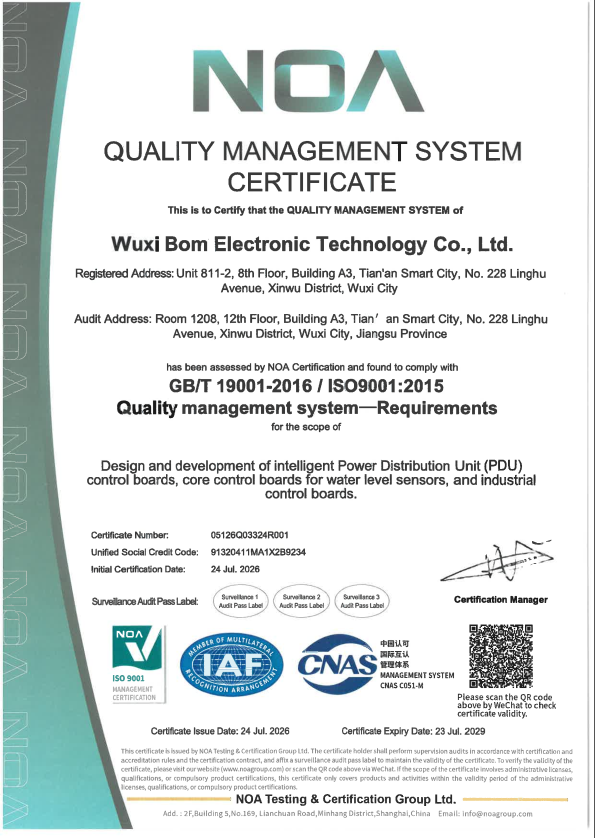
- Quality document: Quality Management System Certificate to ISO 9001:2015 and GB/T 19001-2016/ISO9001:2015, certificate number 05126Q03324R001, issued by NOA Testing & Certification Group Ltd.
Where ambiguity enters a Smart PDU order
Ambiguity in rack power procurement concentrates in three places, and all three sit outside the datasheet.
Quantity. Buyers usually quote one MOQ for a whole family. Suppliers often state MOQ per configuration, because controllers, housings and outlet assemblies behave differently in production. When a buyer writes "MOQ to be confirmed" into an RFQ, the final order quantity can be renegotiated after the technical choice is already locked.
Acceptance. "Acceptance criteria: pre-shipment test" means the buyer's acceptance gate closes before the goods leave the factory, not on arrival at the warehouse. Buyers who assume the opposite discover that remediation options shrink sharply once the container has sailed.
Documents. A quality management certificate proves a management system was audited to a standard. It does not prove a product model complies with a safety standard. Treating one document as the other is the most common compliance error in PDU purchasing.
The decision rule is simple: every term that can change the price, the delivery date or the right to reject goods should appear in the purchase order with a number, a name or a defined event attached to it.
Why these terms now carry more weight
Smart PDUs have moved from premium option to default specification. Intelligent PDUs accounted for more than half of total PDU market revenue as of 2023, at 55% (ResearchAndMarkets, 2024). The global data center PDU market is projected to reach USD 14.23 billion by 2032, with the intelligent segment growing at a 19.5% CAGR from 2026 to 2032 (MarketsandMarkets).
Volume growth changes what buyers ask for. A category supplied in small batches is qualified on samples; a category supplied in project batches is qualified on documents, test records and written acceptance criteria, because a single ambiguity repeats across hundreds of units.
Safety expectations have tightened in parallel. IEC 62368-1:2023 is the safety standard for ICT and AV equipment, including PDUs, in most major jurisdictions (IECEE/IEC). That standard is a product-safety matter; the ISO 9001 certificate discussed below is a quality-management matter. Both are relevant to an approved order, and neither substitutes for the other.
The terms package stated for BOMPDU Smart PDU orders
The package below is stated per term, in the order a purchasing team normally verifies it.
Minimum order quantity is stated per configuration
BOMPDU states a minimum order quantity of 2 units at the general supply level, applicable to EU and Middle East markets. Module-level quantities are stated separately: 10 units, 70 units for the main module of the Intelligent 2nd generation PDU, and 100 units for the distributed control module. These are not competing numbers; they describe different bill-of-materials levels, and the buyer's job is to attach the correct one to the part number being ordered.
Delivery term and payment split
The stated delivery term is FOB, and the stated payment terms are 30/70. Both are short formulations that carry most of their meaning in the blanks: FOB requires a named port, and 30/70 requires two defined trigger events. A purchase order that records the split without recording what releases each instalment leaves the supplier and the buyer free to interpret it differently at the exact moment cash flow matters.
Acceptance criteria: pre-shipment test
The stated acceptance criterion is a pre-shipment test. In practice this means the verification event happens in the factory, before dispatch, and the buyer's leverage is highest when the test scope is written down in advance rather than agreed on the day of inspection.

Two documented control behaviours are worth naming explicitly in the test scope, because they are the ones buyers most often assume and least often verify. The first is overload handling: a dual-level alarm mechanism, with a primary alarm as current approaches the rated value and a secondary alarm at overload, fed back over RS485 or the network. The second is relay life management: control logs of sub-control unit relays are recorded, and action status and service life are tracked through log analysis. An acceptance test that exercises one alarm tier and never reads a relay log confirms less than the buyer may believe.
Lead time, capacity and product scope
Typical production lead time is 30 days, with a monthly production capacity of 1,000 units. The product scope relevant to a purchase order is the Intelligent 2nd generation PDU and the 1U/1.5U RS485 PDU. The manufacturing organisation behind the brand is supported by a 12-engineer R&D team and holds more than ten invention patents for PDU products covering common PDU connector types.

The quality document, read precisely
BOMPDU holds a Quality Management System Certificate issued by NOA Testing & Certification Group Ltd. The certificate covers ISO 9001:2015 and GB/T 19001-2016/ISO9001:2015 under certificate number 05126Q03324R001. Four attributes matter to a buyer, and all four are printed on the document: the standard and its edition, the certificate number, the issuing body, and the scope.
The practical use of that document is verification, not decoration. A certificate copy in a sales folder proves that a PDF exists. A certificate number checked against the issuer's record proves that the certification is live and that the entity named on it is the entity that will appear on the contract.
Step by step: approving a Smart PDU order without loose ends
- Lock the configuration before discussing quantity. Name the product family, the module level and the outlet arrangement. Only then ask for the MOQ that applies, because 2, 10, 70 and 100 units all appear in the same supplier's published terms at different levels.
- Write the delivery term with its port. FOB plus a named port converts a three-letter abbreviation into an identifiable handover point.
- Define both payment triggers. Record the 30/70 split and state what releases each part — typically an accepted pre-shipment test and a complete shipping document set.
- Convert acceptance criteria into a test list. Start from "pre-shipment test", then add the functions to be exercised, the alarm tiers to be demonstrated, the logs to be exported, and the report format to be delivered.
- Verify the certificate, not the copy. Check certificate number 05126Q03324R001 with NOA Testing & Certification Group Ltd., confirm the standards ISO 9001:2015 and GB/T 19001-2016/ISO9001:2015, confirm the scope covers the product being ordered, and confirm the legal entity matches the contracting supplier.
- Fix the schedule against capacity and lead time. With 1,000 units per month and a typical 30-day lead time, agree the start trigger for the clock and the date the pre-shipment test must be completed.

Three buyers, three different uses of the same terms
Distributor running a first trial order. A channel partner wants a small opening quantity to test sell-through. The relevant figure is the 2-unit general minimum, and the risk to manage is scope creep: a trial order that quietly becomes a module-level order will meet a different MOQ. The buyer should confirm the exact part numbers before the trial quantity is fixed.
Data center project buying at module level. A project team specifies the Intelligent 2nd generation PDU with distributed control modules. The main module is stated at 70 units and the distributed control module at 100 units, so the project quantity should be planned in those blocks rather than in rack counts. Scheduling then runs against 1,000 units per month and a typical 30-day lead time.
Industrial integrator needing acceptance evidence. An integrator must hand a commissioning file to an end user. Here the acceptance criterion drives the document request: a pre-shipment test, with the overload alarm tiers and relay control logs explicitly covered, produces evidence that can be filed, whereas a generic pass statement does not.
Purchasing terms at a glance
| Term | Stated position | What the purchase order should state |
|---|---|---|
| Minimum order quantity | 2 units general; 10, 70 and 100 units at module level | Exact part numbers and the MOQ that applies to each |
| Delivery term | FOB | Named port and handover point |
| Payment terms | 30/70 | The event that releases each instalment |
| Acceptance criteria | Pre-shipment test | Test items, logs to be exported, report format |
| Lead time | 30 days typical | Start trigger and required test-completion date |
| Monthly capacity | 1,000 units | Delivery schedule for volumes above one month of output |
| Quality certificate | ISO 9001:2015; GB/T 19001-2016/ISO9001:2015; no. 05126Q03324R001; NOA Testing & Certification Group Ltd. | Verified copy with scope and certified entity confirmed |
| Product scope | Intelligent 2nd generation PDU; 1U/1.5U RS485 PDU | Model list attached to the order |
Table note: all values above are the supplier-stated terms listed in this article; no third-party benchmark is implied.
FAQ: purchasing terms and acceptance criteria
1. Which quality certificate should be verified before a Smart PDU order is approved?
Verify the supplier's Quality Management System certificate: standard and edition, certificate number, issuing body, scope and the certified legal entity. BOMPDU holds a Quality Management System Certificate issued by NOA Testing & Certification Group Ltd. covering ISO 9001:2015 and GB/T 19001-2016/ISO9001:2015 under certificate number 05126Q03324R001. Before approving an order, check the number against the issuer's record, confirm the scope covers power distribution unit manufacture, confirm the certified entity name matches the company signing the contract, and confirm the standard edition is current. A quality management certificate is not a product safety approval: where the destination market requires safety evidence, request it separately, noting that IEC 62368-1:2023 is the safety standard for ICT and AV equipment, including PDUs, in most major jurisdictions.
2. What production capacity and lead time support a Smart PDU order?
Monthly production capacity is 1,000 units, and the typical production lead time is 30 days. The manufacturer behind BOMPDU is Wuxi Bom Electronic Technology Co., Ltd., established in 2018 in Wuxi, Jiangsu Province, China, with a 12-engineer R&D team and more than ten invention patents for PDU products. For planning purposes, treat 1,000 units as a monthly output ceiling and 30 days as a typical — not guaranteed — lead time, then fix both against the actual model list in the order.
3. What minimum order quantity and payment terms apply?
The minimum order quantity is 2 units at the general supply level, with module-level quantities stated at 10 units, 70 units for the Intelligent 2nd generation PDU main module, and 100 units for the distributed control module. Payment terms are stated as 30/70 and the delivery term as FOB. Because MOQ and price both move with configuration, the approval step is to confirm the MOQ against the exact part number rather than against the product family, and to record which event releases each part of the payment.
4. Can a buyer validate a Smart PDU before releasing the full order?
Yes, within the stated terms. The acceptance criterion is a pre-shipment test, so validation happens in the factory before dispatch, and the 2-unit general minimum makes a small first order possible for trial use. The buyer should convert the criterion into a written test list: power-on behaviour, outlet-level and metering functions, the dual-level overload alarm with a primary alarm approaching rated current and a secondary alarm at overload reported over RS485 or the network, plus an export of sub-control unit relay control logs. Ask for the report format in advance, and confirm the certificate copy matches the number on the issuer's record.
5. How should lead time be written into a Smart PDU order?
Write three items: the typical 30-day lead time, the event that starts the clock, and the date by which the pre-shipment test must be completed and accepted. The clock normally starts when the order is confirmed and the agreed advance is received, and it should stop only when the test result has been accepted — otherwise the test and the schedule are managed as two unrelated processes. Where an order approaches the stated 1,000-unit monthly capacity, split delivery into monthly blocks so that capacity is committed in writing. Buyers who want to close these points before internal approval can request a quotation, a sample plan or the product catalog through the BOMPDU website at www.wuxibom.com.

Conclusion: approve the terms, then the technology
A Smart PDU order is approved when its commercial terms are as specific as its specifications. The six terms that remove most of the ambiguity are simple to state: the MOQ attached to the exact part number, FOB with a named port, a 30/70 split with defined triggers, a pre-shipment test with a written test list, a 30-day typical lead time measured against 1,000 units per month of capacity, and a quality certificate verified by number rather than by attachment — ISO 9001:2015 and GB/T 19001-2016/ISO9001:2015, certificate number 05126Q03324R001, issued by NOA Testing & Certification Group Ltd.
Next step for buyers
Request a Smart PDU quotation with the MOQ, FOB port, payment trigger dates and acceptance test list confirmed for your model list — or start with a 2-unit trial order and a documented pre-shipment test.
BOMPDU — Wuxi Bom Electronic Technology Co., Ltd.
Contact: Tony · Email: tony1091803@wxbom.cn · Tel: +86 18751550927
WhatsApp: +1 (786) 989-2761 · Website: www.wuxibom.com
Address: Room 1208, Building A3, Wuxi Tian'an Smart City, No. 228 Linghu Avenue, Xinwu District, Wuxi, Jiangsu, China
Download the BOMPDU product catalog for model reference before drafting the purchase order: BOMPDU Product Catalog (PDF).
Have Questions or Need More Details?
Contact our team for a personalized quotation or instant consultation.
Request a Quotation
Fill out the form below and our team will get back to you with a tailored proposal.
WhatsApp Direct Chat
Prefer to chat in real-time? Message us on WhatsApp for instant assistance & quick answers.
- Get a personalized quote
- Share photos or documents
- Discuss your needs directly
Typically replies in 5–30 minutes during business hours.