 5000 m²
 70
70

Smart PDU vs. Standard PDU: A Practical Buyer's Comparison with Sensor Integration Options
Smart PDU vs. Standard PDU: A Practical Buyer's Comparison with Sensor Integration Options
Two racks can draw the same electricity and still be worlds apart in operations. One closes its door on an unmonitored power strip; the other closes it on a networked, metered unit that reports per-outlet current, trips an alarm when a threshold is crossed, and accepts an environmental sensor on the same monitored path. This comparison explains what actually changes when you move from a standard PDU to a smart PDU, which specifications decide the outcome, and where optional sensors such as the BM-CGQ04 Temperature & Humidity Sensor and the BM-CGQ05 Smoke Detector fit into the decision.
What a standard PDU and a smart PDU actually do
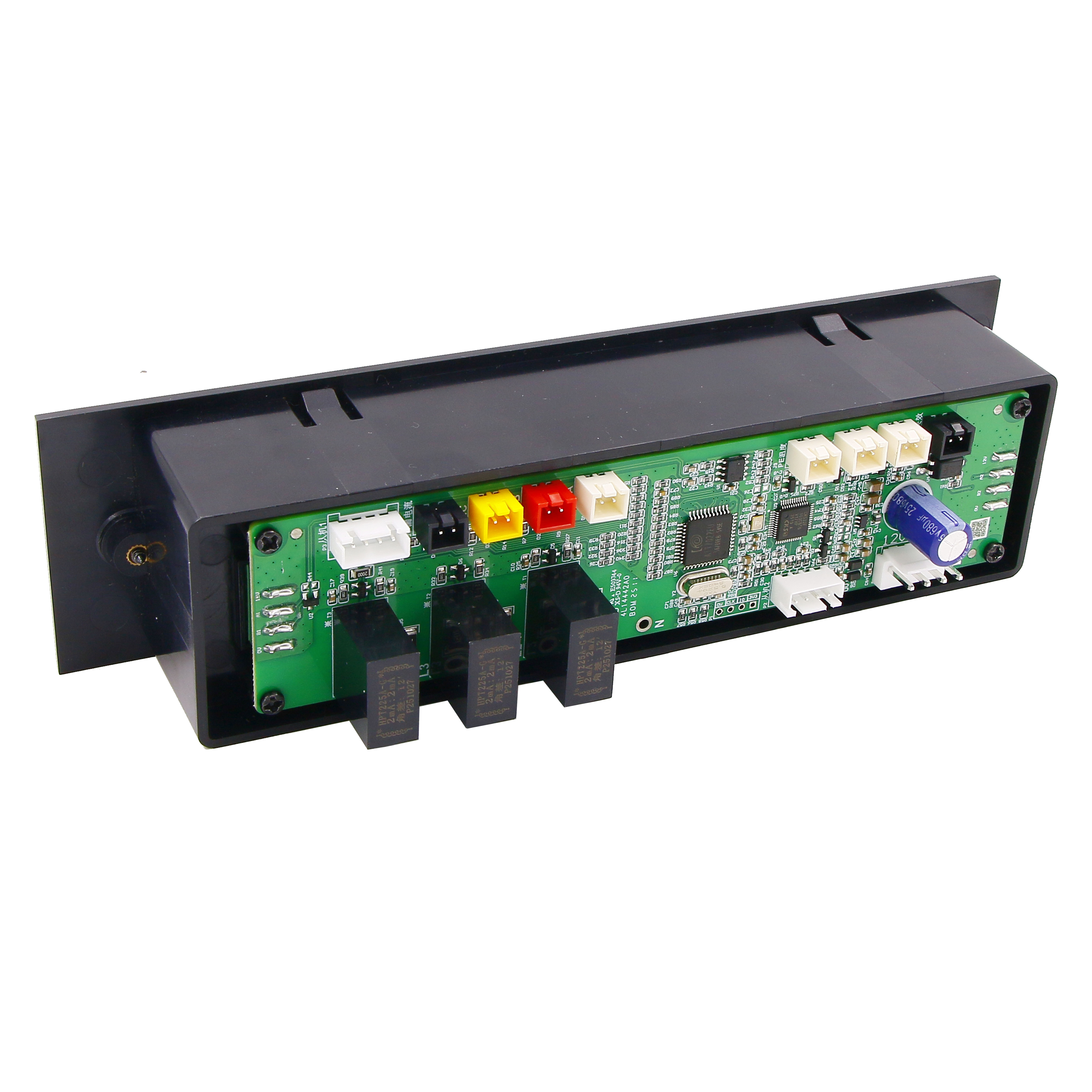
A standard PDU — often called a basic PDU or power strip — performs one function: it takes a single input feed and distributes it to a fixed number of outlets inside the rack. It has no metering, no network interface and no alarm logic. Everything an operator knows about that rack's power state comes from a physical inspection, a clamp meter, or an upstream facility meter that covers dozens of racks at once.
A smart PDU (also written intelligent PDU) keeps the same distribution function and adds four independent layers on top of it:
- Measurement. Voltage, current, energy and power are measured and reported, either at the input of the unit only or at each individual outlet.
- Communication. The measurements are exposed over a fieldbus or network interface so that a DCIM platform, BMS or PLC can read them.
- Control. Outlets can be switched remotely, so a hung server or a failed edge device can be power-cycled without dispatching a technician.
- Expansion. Extra I/O — dry contacts, RS-485 channels, auxiliary modules — allows environmental sensors to share the same monitored power infrastructure.
Because those four layers are independent of each other, the honest answer to "smart or standard?" is not binary. Between a passive strip and a fully instrumented rack PDU sits a middle tier: the metered PDU, which measures at the input and communicates over RS-485 but does not control individual outlets. BOMPDU manufactures in both tiers — the Intelligent 2nd generation PDU product, and the 1U_1.5U 485 PDU.
The practical framing. Buyers are really answering three separate questions: (1) How granular must the metering be — input only, or per outlet? (2) How much control does the operations team need — none, remote reboot of the whole strip, or per-outlet switching? (3) Should environmental monitoring ride on the PDU's own communication path, or be purchased as a separate system with its own gateway, wiring and software licence?
Industry background: why this comparison matters more than it did five years ago
The financial weight of the category has grown with rack density. According to Data Bridge Market Research, the global Intelligent Power Distribution Unit (PDU) market was valued at approximately USD 4.81 billion in 2024 and is projected to reach USD 9.46 billion by 2032. Fortune Business Insights reports that Asia Pacific dominated the PDU market with a 37.45% share in 2025, driven by data center expansion and industrialisation — which is also where most of the manufacturing capacity for metered and intelligent PDUs now sits.
Note on market figures: published estimates vary widely depending on scope, because some analysts count rack PDUs only while others include the broader smart power distribution system. The two figures above are cited for directional context, not for budget modelling.
Three technical developments shape the comparison itself:
- Safety standard convergence. Power distribution units must conform to the IEC 62368-1 safety standard, which replaced IEC 60950-1 and IEC 60065-1 as the mandatory hazard-based standard for ICT and AV equipment. This applies to the base power distribution function of both standard and smart PDUs.
- Network security requirements. Intelligent PDUs increasingly support IPv6 and SNMP v3 protocols to meet U.S. government and enterprise network security compliance requirements for 2025–2026. A smart PDU that cannot be placed on a modern, IPv6-addressed management VLAN becomes a liability rather than an asset.
- Rack density pressure. Market leaders in the rack PDU segment include Schneider Electric (APC), Eaton, Vertiv and Legrand (Raritan), with high-density AI racks — up to 132kW — driving demand for intelligent three-phase units. At that density, input-level metering alone is usually insufficient, because a single overloaded outlet can be the difference between a degraded node and a dropped rack.
Put together, the industry direction is clear: the question is no longer whether power should be measured, but how deep the measurement goes and how much of the environmental picture can be attached to the same monitored bus.
Detailed solution: what the BOMPDU Intelligent 2nd generation PDU adds
BOMPDU is the brand of Wuxi Bom Electronic Technology Co., Ltd., a manufacturer headquartered in Wuxi, Jiangsu Province, China, specialising in the R&D, production and sales of end-of-row power distribution solutions for data centers. The company was established in 2018, operates a 5,000 m² facility with 70 employees and a 12-engineer R&D team, and states an annual output of 10,000 units. Its two main product lines map directly onto the comparison in this article: the Intelligent 2nd generation PDU product, and the 1U_1.5U 485 PDU.
Input-side measurement on the intelligent unit
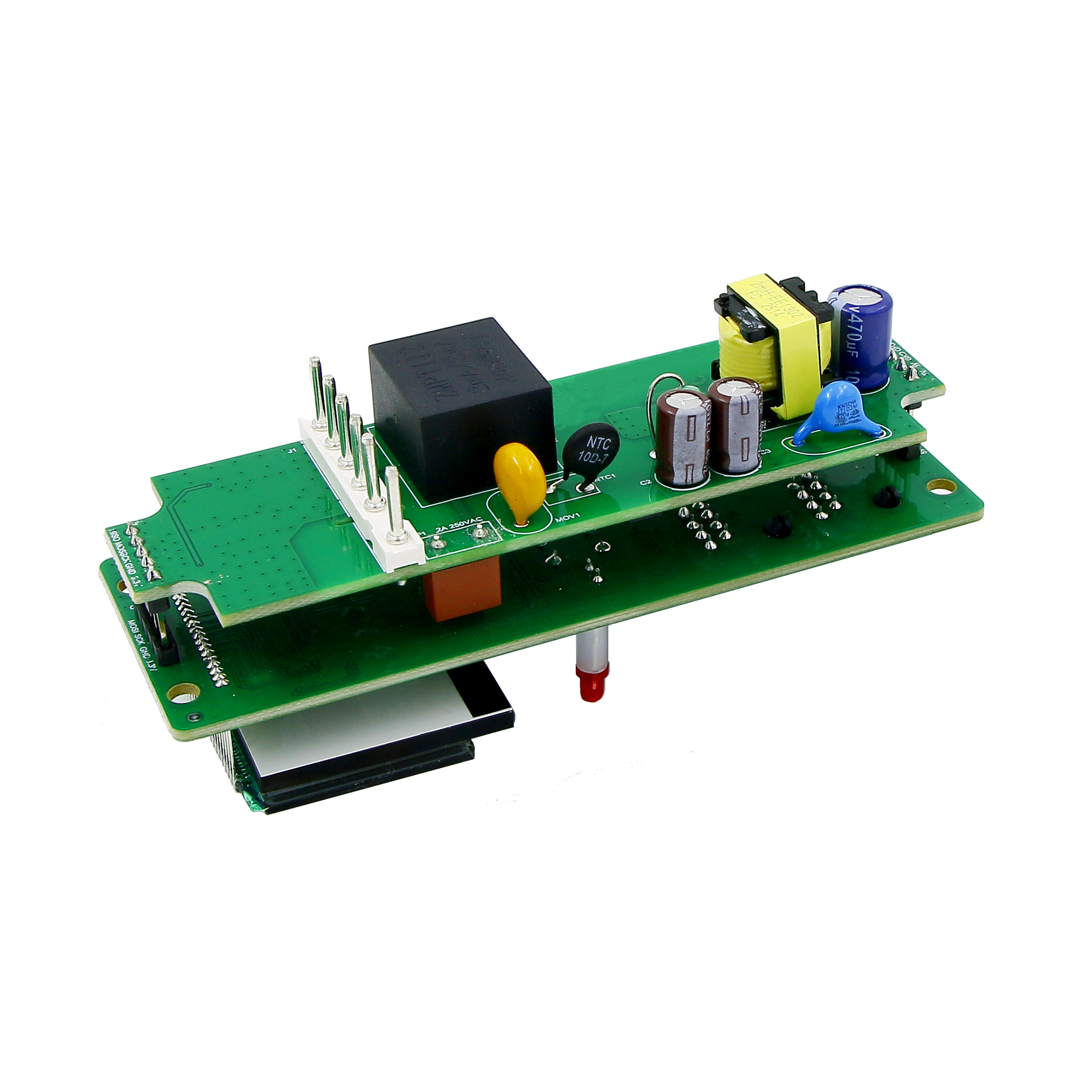
The Intelligent 2nd generation PDU accepts AC 110V–250V, 50/60Hz input, with a maximum load current of 0–63A, and is available in single-phase or three-phase input configurations. At the input it collects current, voltage, electrical energy and power — active power, reactive power, apparent power and power factor. The published accuracies are:
- Voltage accuracy: 0.5% across 85–250V
- Current accuracy: level 1 from 0.65–3.1A; level 0.5 from 3.1–63A
Output-side measurement and per-outlet control
Where the intelligent unit separates itself from an input-metered PDU is at the outlet. Each output is monitored and controlled separately, collecting current, voltage, electrical energy and power. Rated output voltage is AC 220V, 50/60Hz. The rated output current is a maximum of 16A per single channel and 32A per board. Output measurement accuracies are:
- Voltage accuracy: 1% across 85–250V
- Current monitoring range: 0.2–16A
- Current accuracy: 2% from 0.2–0.8A; 1% from 0.8–16A
Modular expansion: how sensor integration is physically possible
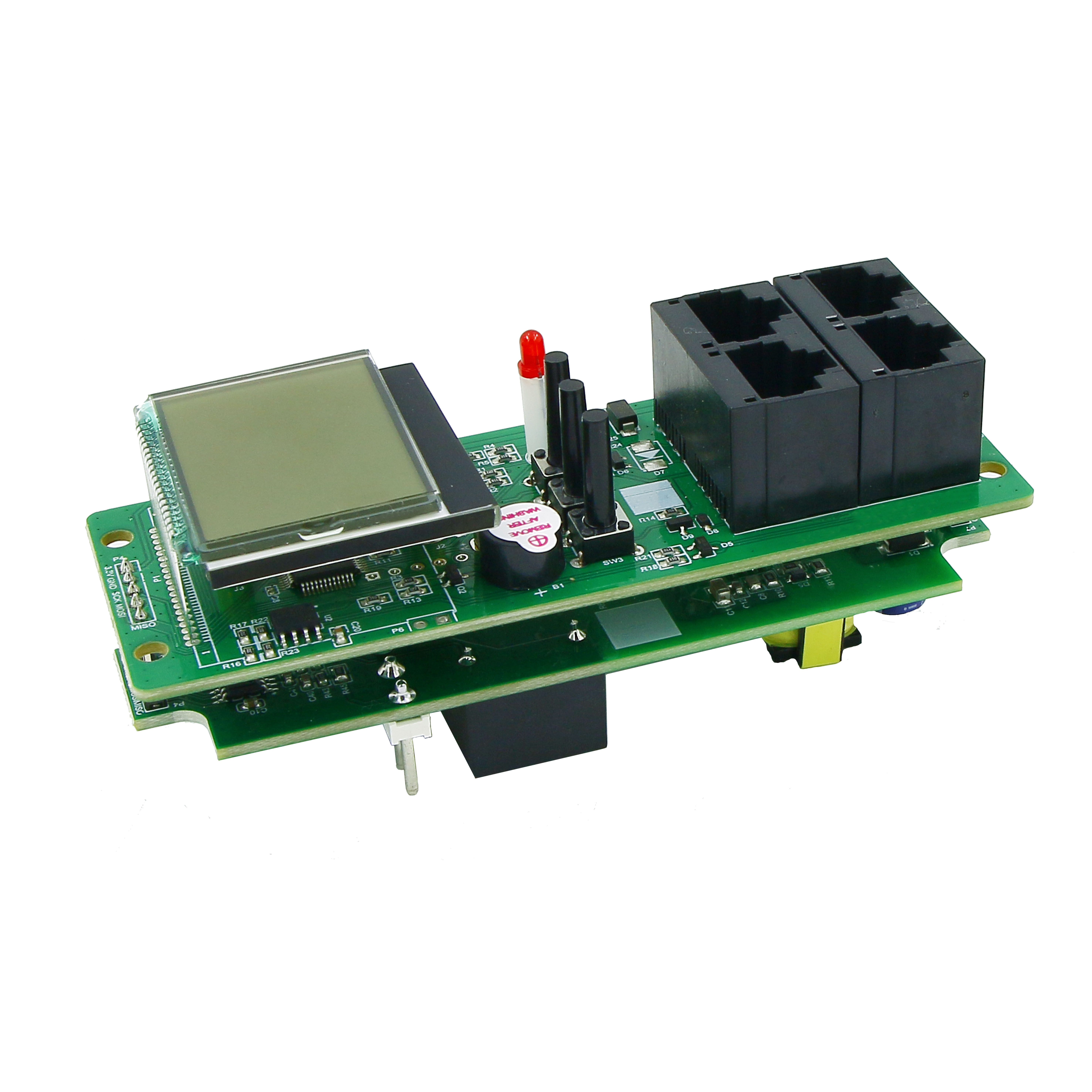
Sensor integration is not a software feature bolted onto a finished product — it depends on the mechanical and electrical capacity built into the unit. The Intelligent 2nd generation PDU uses a modular architecture in which an auxiliary module provides 4 outputs, and the main module can support up to 8 auxiliary modules. That expansion headroom is what allows environmental sensing to be added at the rack level instead of being purchased as a completely separate system with its own gateway and cabling.
Optional environmental sensors
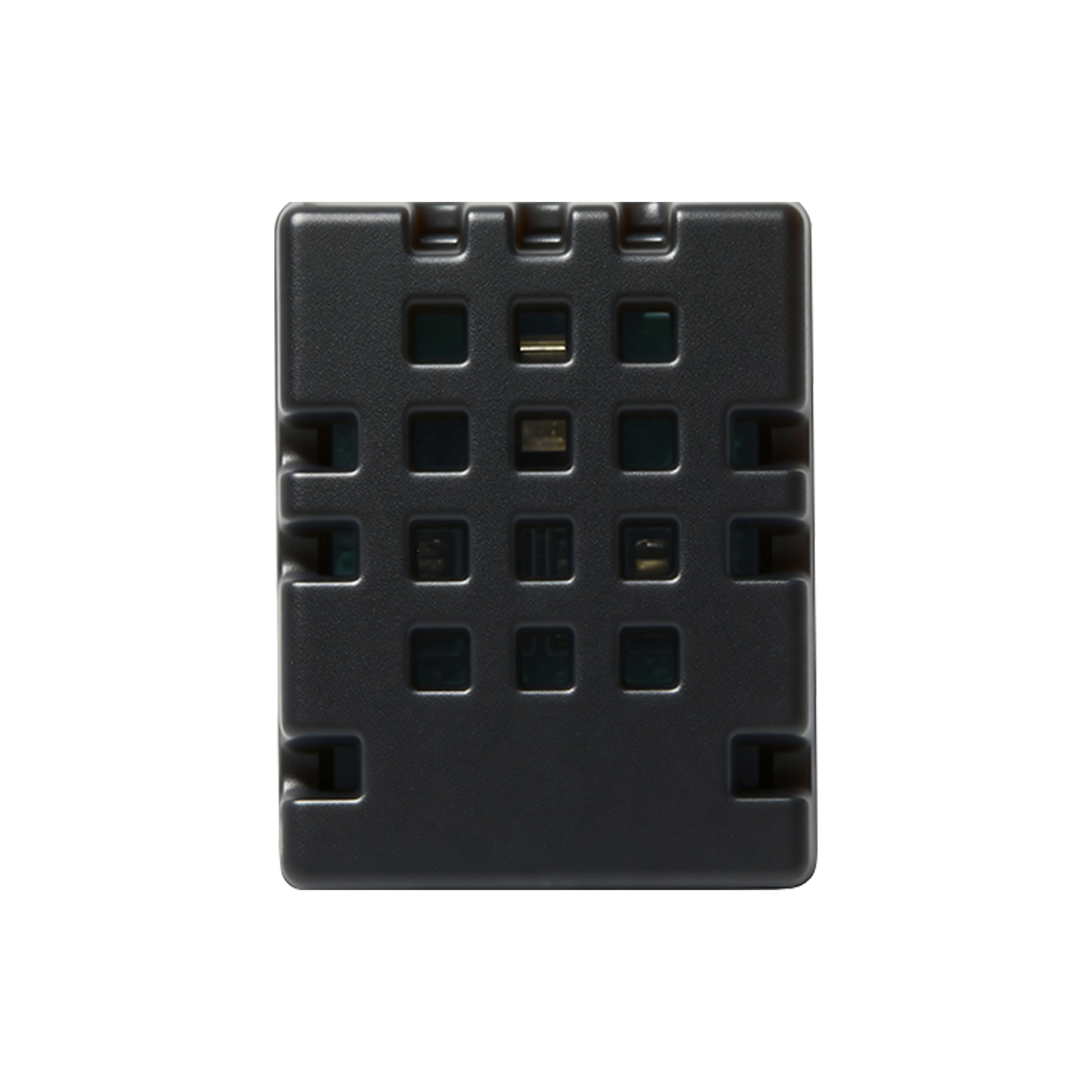
BOMPDU's sensor range extends the monitored rack beyond electrical parameters. Two units are particularly relevant when evaluating a smart PDU against a standard one, because a standard strip has no path to accept them at all:
- BM-CGQ04 Temperature & Humidity Sensor. A digital sensor with an I²C interface, 2.2–5.5V DC supply, a humidity range of 0–100% RH at ±3% RH typical accuracy, and a temperature range of −40°C to 80°C at ±0.5°C typical accuracy. It is rated with ESD protection to JEDEC JESD22-A114 (HBM ±4 kV) and supplied factory calibrated.
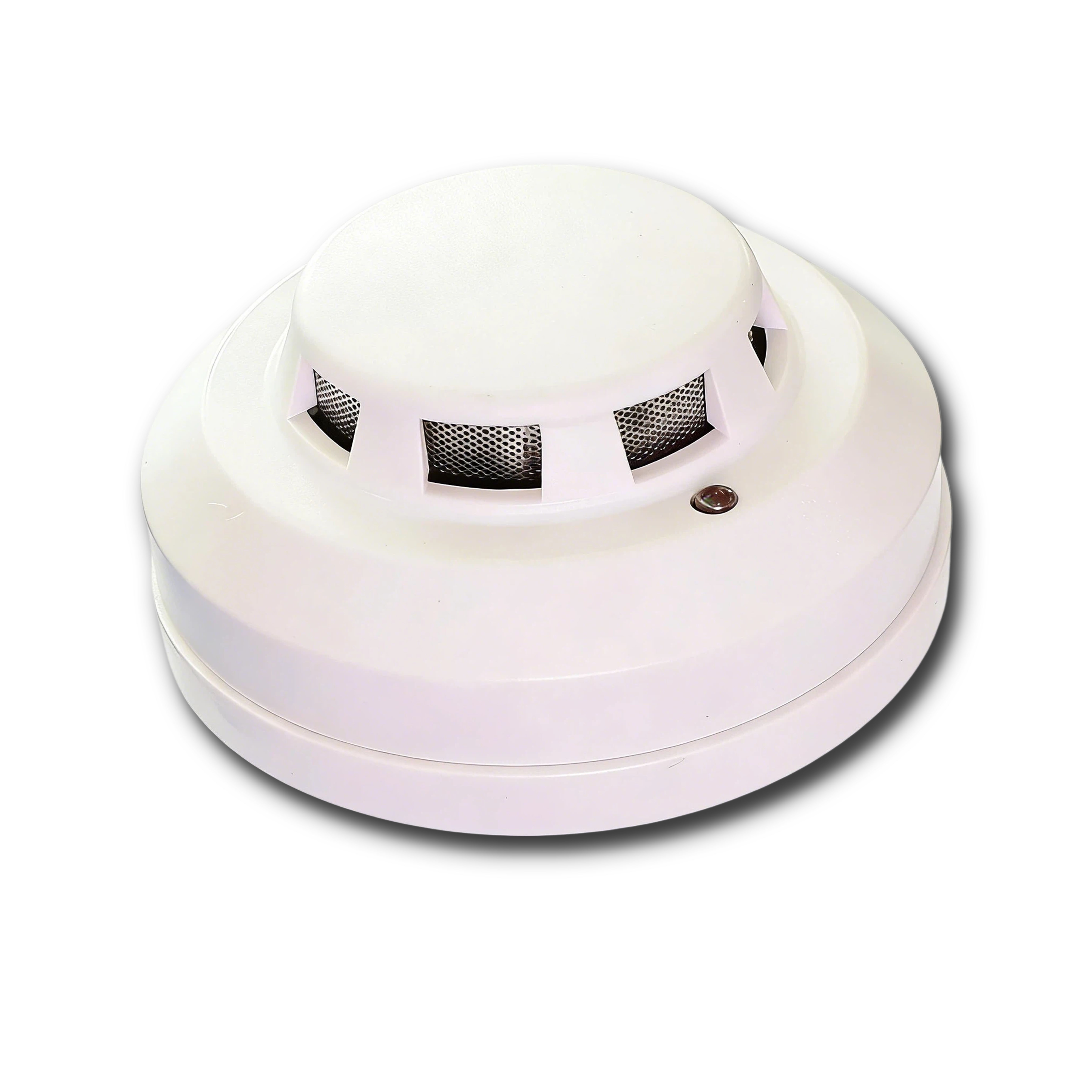
- BM-CGQ05 Smoke Detector. A wired smoke sensor using photoelectric/optical detection, powered at 10–35V DC, with an LED alarm indicator and alarm signal output, wired in a 2-wire or 4-wire configuration and mounted on a standard wall or ceiling base. It is specified to an industrial-grade application standard.
The wider sensor family follows the same logic. The BM-CGQ02 Temperature & Humidity Sensor offers a tighter ±2% RH and ±0.3°C typical accuracy for applications where the environmental envelope must be characterised more precisely. The BM-CGQ06 Water Leak Detector uses a 12V DC supply, SPDT relay output and RS-485 communication with MODBUS™ protocol, supports sensor cable runs up to 500m with an RS-485 range up to 1,200m without a repeater, and mounts on a 35mm DIN rail — its RS-485/Modbus interface is what makes it a natural companion to an RS-485 monitored power path. The BM-CGQ07 Door Sensor is a dry-contact device (normally open / normally closed, configurable), operating at 5–30V DC with a magnetic actuation gap of ≤15mm, suited to cabinet door status monitoring.
Certification and design control
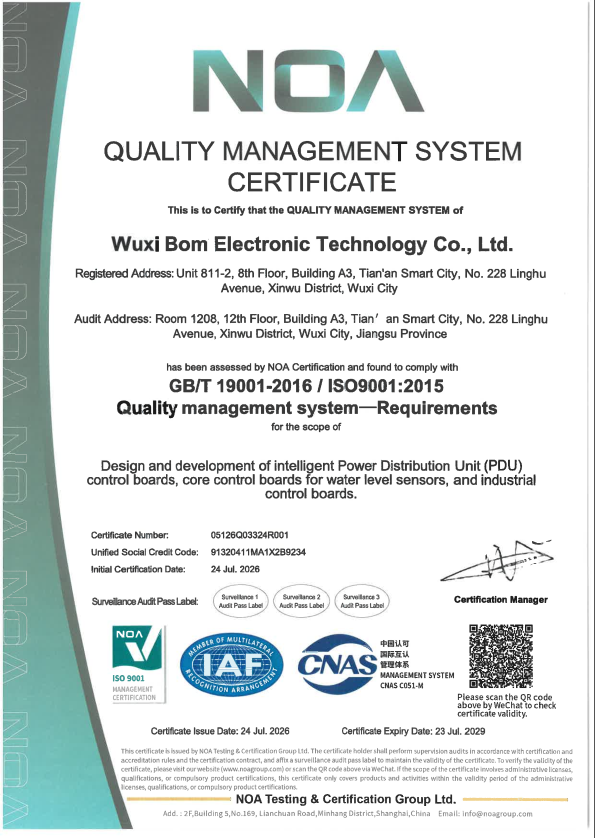
For a buyer comparing suppliers, the certification question on a smart PDU is not only about the finished assembly. The applicable standard cited for BOMPDU's quality management system is GB/T 19001-2016/ISO9001:2015, and the certificate — number 05126Q03324R001, issued by NOA Testing & Certification Group Ltd. — is valid from 24 July 2026 to 23 July 2029 and recognised under IAF-MLA mutual recognition. Its scope explicitly covers the design and development of intelligent Power Distribution Unit (PDU) control boards, core control boards for water level sensors, and industrial control boards. In other words, the certification covers the intelligent control layer itself, not just final assembly.
For the China market, the Intelligent 2nd generation PDU product also holds a Computer Software Copyright Registration (certification number 2024SR1888355) issued by the National Copyright Administration of the People's Republic of China, registered under the Regulations on the Protection of Computer Software and the Measures for the Registration of Computer Software Copyrights.
Step-by-step: how to specify and compare, in the order that matters
The sequence below works for a single-rack pilot as well as a multi-hall rollout. Each step closes off a class of specification error before it reaches the RFQ stage.
- Establish the electrical envelope first. Confirm input voltage range, phase configuration and maximum load current. If the rack will run on single-phase today but three-phase later, choose a platform that supports both rather than buying twice. The Intelligent 2nd generation PDU covers AC 110V–250V at 0–63A with single-phase or three-phase input.
- Decide metering granularity. Input-only metering answers "how much is this rack pulling?" Per-outlet monitoring answers "which device is pulling it?" The intelligent unit measures per outlet across a 0.2–16A range, with 1% current accuracy above 0.8A.
- Decide control granularity. If the requirement is remote reboot of an entire strip, an input-metered unit may suffice. If individual devices must be cycled without affecting neighbours — the common case in colocation and edge sites — per-outlet separate monitoring and control is the requirement to specify.
- Plan the sensor inputs before the rack is wired. Decide which environmental risks need coverage: heat and humidity at the intake, smoke at the top of the cabinet, water near the floor, door status for access integrity. Then confirm the PDU can accept them — the Intelligent 2nd generation PDU's modular architecture supports up to 8 auxiliary modules per main module, each auxiliary module providing 4 outputs.
- Verify the protocol against your management stack. Confirm that the PDU's interface matches what your DCIM, BMS or PLC actually reads. BOMPDU's PDU line communicates over an RS-485 interface using the Modbus communication protocol, which is also the protocol used by the BM-CGQ06 Water Leak Detector. Where the site requires IPv6 or SNMP v3 on the management VLAN, verify that capability explicitly rather than assuming it from the term "smart".
- Match alarm behaviour to your escalation policy. Alarms are only useful if the thresholds match how the site is operated. Look for configurable set-points — the 1U_1.5U 485 PDU, for example, provides overvoltage, undervoltage and overcurrent alarms with parameters that can be set — and decide whether alarms should be read from the device or polled by the management platform.
- Close the certification and documentation loop. Request the certificate number, issuing authority, validity window and, critically, the scope statement. A certificate that covers control board design and development tells you more than one that only covers assembly. Then run a sample pilot before committing to a fleet order.
Use cases: where the extra intelligence pays back
Two verified deployment patterns illustrate the difference between specifying on price and specifying on outcome.
Airport data center — 800 units, three years of stable operation. The requirement was electricity usage monitoring, with real-time monitoring of current, voltage, energy and power for each socket. That is exactly the specification where a standard PDU cannot compete: an unmonitored strip would have required separate branch-circuit metering hardware, additional cabling and a second software integration. Three years of stable operation on 800 units speaks to the durability question that buyers rightly ask about intelligent hardware.
Server manufacturer — 2,000 units, two years of stable operation. This deployment supports server aging tests, and the requirement was remote control of on/off with real-time monitoring, removing the need for on-site operators during long test cycles. Here the value is not the data itself but the labour model it enables: unattended burn-in, with power cycling executed over the network instead of by hand.
Beyond these, the same feature set maps onto other environments documented in BOMPDU's application scenarios:
- Telecom base stations. Remote reboot with voltage and current monitoring, in a 24/7 continuous operation profile, matched to BBU, RRU and battery equipment, where wide temperature range and lightning protection are the environment's defining constraints.
- Industrial automation. Power control via RS-485 and status collection on automated production lines, matched to PLC, touch screen and sensor equipment, where Modbus-RTU and strong anti-interference performance matter more than dashboard aesthetics.
- Government and command centers. Hierarchical power management and fault alarm in emergency command environments running 24/7, matched to servers, KVM and large display systems, with dual power input and alarm notification as stated requirements.
- Intelligent transportation. Centralised power control and status feedback for road traffic monitoring systems, matched to cameras, optical transceivers and industrial PCs, with surge protection and rail-mount installation.
The pattern across all of them is the same: the intelligent PDU is justified not by the dashboard, but by the field visits it removes and the faults it surfaces before they escalate.
Comparison table: standard PDU, metered RS-485 PDU, and smart PDU
The table below separates the three realistic options using only verified specifications. It is the fastest way to see which tier the requirement actually falls into.
| Decision dimension | Standard PDU (basic) | 1U_1.5U 485 PDU | Intelligent 2nd generation PDU |
|---|---|---|---|
| Power distribution | Yes | Yes | Yes |
| Rated input voltage | Not metered | 100V–240V (operating range 90V–264V) | AC 110V–250V, 50/60Hz |
| Maximum load current | Not specified by device | Level 1 metering via external transformer | 0–63A |
| Phase configuration | Fixed at purchase | Fixed at purchase | Single-phase or three-phase input |
| Input parameters measured | None | Voltage, current, power, electricity | Current, voltage, energy, power (active, reactive, apparent, power factor) |
| Input accuracy | None | Level 1 (1% ± 0.1) | Voltage 0.5% (85–250V); current level 1 at 0.65–3.1A, level 0.5 at 3.1–63A |
| Outlet-level monitoring | No | No | Yes — separate monitoring and control per output; 0.2–16A range, 1% accuracy above 0.8A |
| Remote outlet control | No | No | Yes — separate monitoring and control |
| Rated output | Passive outlets | Passive outlets | AC 220V, 50/60Hz; 16A max per channel, 32A max per board |
| Communication interface | None | RS-485, Modbus protocol | RS-485 support for Modbus-based monitoring and control |
| Local display | None | Segment-code LCD, white background with black text; 0.01V / 0.01A / 0.01kW / 0.01kWh resolution | Not part of the published specification |
| Alarm capability | None | Overvoltage, undervoltage, overcurrent alarms with settable parameters | Control and monitoring per outlet |
| Sensor / I/O expansion | None | None documented | Yes — auxiliary module with 4 outputs; main module supports up to 8 auxiliary modules |
| Typical justification | Lowest unit cost, no monitoring requirement | Basic consumption visibility without outlet control | Per-outlet accountability, remote recovery, integrated environmental monitoring |
Sensor selection can be treated as a separate but related table, because only the intelligent tier has a documented expansion path to accept these devices:
| Model | Sensing function | Interface / output | Monitoring role in the rack |
|---|---|---|---|
| BM-CGQ04 | Temperature & humidity | I²C; 2.2–5.5V DC; 0–100% RH at ±3% RH; −40°C to 80°C at ±0.5°C | Intake air conditions; supports thermal trending across the row |
| BM-CGQ02 | Temperature & humidity (higher accuracy) | I²C; 2.2–5.5V DC; 0–100% RH at ±2% RH; −40°C to 80°C at ±0.3°C | Where the environmental envelope must be characterised more tightly |
| BM-CGQ05 | Smoke detection | Wired photoelectric; 10–35V DC; LED indicator; alarm signal output; 2-wire or 4-wire | Early smoke detection at cabinet level, above the equipment line |
| BM-CGQ06 | Water leak detection | RS-485 with MODBUS™; SPDT relay; 12V DC, 3W; 35mm DIN rail; sensor cable up to 500m | Floor and under-floor leak detection on the same RS-485 path |
| BM-CGQ07 | Door / cabinet status | Dry contact (NO/NC configurable); 5–30V DC; actuation gap ≤15mm; IP40 | Access integrity and cabinet-open event logging |
Read together, the two tables define the buying decision: the sensor table only becomes relevant once you have chosen the intelligent tier, because a standard PDU offers no documented path to accept any of these devices.
FAQ: compliance, capability, budget, sampling and lead time
Does a smart PDU require different certification than a standard PDU?
Both must satisfy the applicable product safety standard, since the base power distribution function is common to both. For ICT and AV equipment, the mandatory hazard-based standard is IEC 62368-1, which replaced IEC 60950-1 and IEC 60065-1, according to UL Solutions. The difference appears on the manufacturing and firmware side. BOMPDU's quality management system is certified to ISO 9001:2015, with the applicable standard cited as GB/T 19001-2016/ISO9001:2015, under certificate number 05126Q03324R001 issued by NOA Testing & Certification Group Ltd. and valid from 24 July 2026 to 23 July 2029. Its scope covers the design and development of intelligent PDU control boards, core control boards for water level sensors, and industrial control boards — which is the part of the scope a smart PDU buyer should be checking. For the China market, the Intelligent 2nd generation PDU product also holds a Computer Software Copyright Registration, number 2024SR1888355, issued by the National Copyright Administration of the People's Republic of China.
Can a smart PDU also monitor temperature, humidity, smoke, water leaks and door status?
Yes — provided the unit has the I/O and expansion capacity to accept the sensors. The Intelligent 2nd generation PDU uses a modular architecture in which each auxiliary module provides 4 outputs and the main module supports up to 8 auxiliary modules. On that basis, environment monitoring can be attached to the same monitored infrastructure rather than bought as a standalone system. BOMPDU's sensor range includes the BM-CGQ04 Temperature & Humidity Sensor (I²C, 0–100% RH at ±3% RH, −40°C to 80°C at ±0.5°C), the BM-CGQ05 Smoke Detector (wired photoelectric, 10–35V DC, alarm signal output), the BM-CGQ06 Water Leak Detector (RS-485 with MODBUS™, 12V DC, DIN rail mount, sensor cable up to 500m) and the BM-CGQ07 Door Sensor (dry contact, 5–30V DC, actuation gap ≤15mm). Note that the BM-CGQ04 and BM-CGQ02 sensors use an I²C interface at 2.2–5.5V DC rather than RS-485, so the integration path — board-level or via the auxiliary module — should be confirmed against the rack wiring plan during specification, not after delivery.
Why does a smart PDU cost more than a standard PDU, and what drives the difference?
The cost gap is structural rather than commercial. A standard PDU contains distribution hardware and outlets. A smart PDU adds current transformers or metering front-ends at the input and at each outlet, a control board with per-outlet switching, a communication interface, and firmware that has to be maintained and certified. On top of that, the intelligent unit in this comparison carries a design-and-development scope under ISO 9001:2015 covering intelligent PDU control boards. Sensor integration adds further cost only when it is actually specified — auxiliary module count, and whether environmental sensors such as the BM-CGQ04 or BM-CGQ05 are included. BOMPDU quotes configurations individually rather than publishing list pricing, so the meaningful comparison is cost per monitored outlet plus the cost of the alternative you would otherwise buy. MOQ for OEM/ODM configurations starts at 2 units, which keeps a single-rack evaluation inexpensive.
Can I validate a smart PDU with a sample before committing to a fleet order?
Yes, and for a specification this feature-dependent it is the sensible route. BOMPDU's stated OEM/ODM terms include a MOQ of 2 units, a 30-day lead time, and 100% testing before shipment. A sample order can be configured for the parameters that matter to your site — metering and control behaviour, outlet count, and single-phase or three-phase input — so that alarm thresholds and sensor wiring can be verified against your DCIM or BMS before the fleet decision. Since the quality control approach is 100% test rather than batch sampling, the unit you evaluate reflects the manufacturing process that will produce the order.
What is the typical lead time and after-sales support, and how do I request a sample or quote?
Standard lead time is 30 days, supported by a monthly production capacity of 1,000 units, with OEM/ODM production modes covering meter and control configuration, outlet number, and single-phase or three-phase input. BOMPDU's stated export markets are the EU and the Middle East, alongside the USA and Southeast Asia, and after-sales support is provided remotely. The most efficient next step is to send your rack parameters — input voltage, phase, maximum load current, required outlet count, whether per-outlet monitoring and control is required, and which environmental sensors should be integrated — and request a configuration and sample quotation.
Next step: request a sample, a quote, or the product catalog
Send your rack specification to BOMPDU (Wuxi Bom Electronic Technology Co., Ltd.) and receive a configured quotation for the Intelligent 2nd generation PDU or the 1U_1.5U 485 PDU, including the sensor options discussed above. Sample orders start at a MOQ of 2 units with a 30-day lead time.
Email: tony1091803@wxbom.cn | Tel: +86 18751550927 | WhatsApp: +1 (786) 989-2761
Website: www.wuxibom.com | Address: Room 1208, Building A3, Wuxi Tian'an Smart City, No. 228 Linghu Avenue, Xinwu District, Wuxi, Jiangsu, China
Download the full product brochure: BOMPDU product catalog (PDF)
Conclusion
The smart PDU versus standard PDU decision resolves into three questions with unusually clear answers. If the site needs to know which specific device is responsible for a load spike, input metering is not enough — per-outlet monitoring with 1% current accuracy above 0.8A is. If the site needs to recover a hung device without a site visit, per-outlet control is the requirement, not a remote reboot of the whole strip. And if environmental risk — heat, humidity, smoke, water, open doors — must be visible in the same place as electrical risk, the PDU needs documented expansion capacity, which on the Intelligent 2nd generation PDU means an auxiliary module with 4 outputs and support for up to 8 auxiliary modules per main module.
A standard PDU remains the correct answer where there is genuinely no monitoring requirement and the rack is covered by upstream metering. A metered RS-485 unit such as the 1U_1.5U 485 PDU covers the middle ground with level 1 (1% ± 0.1) measurement accuracy and settable overvoltage, undervoltage and overcurrent alarms. The intelligent tier earns its premium when per-outlet accountability, remote recovery and integrated environmental sensing are on the requirement list — supported, in BOMPDU's case, by a quality management system certified to ISO 9001:2015 whose scope covers intelligent PDU control board design and development.