Supplier Audit Guide: Is PDU Control Board Design Really Covered?

Production site of Wuxi Bom Electronic Technology Co., Ltd. (BOMPDU), Wuxi, Jiangsu, China — the entity whose certificate scope is examined in this guide.
Almost every smart PDU supplier audit begins with the same request: send your ISO certificate. What arrives is usually a single page carrying a logo, a number, and one sentence describing the scope of the audit. That sentence is the only part of the document that actually answers the buyer's question, because it defines what the certification covers — and, by omission, what it does not.
The question this guide addresses is narrow and practical: when a supplier says its quality certificate covers PDU control board design and development, is that statement supported by the wording on the certificate, or does it only describe manufacturing activity? For buyers evaluating a smart power distribution unit under time pressure, the difference between those two answers changes what evidence must be requested before the purchase order is signed.
Short answer. Certificate number 05126Q03324R001, issued by NOA Testing & Certification Group Ltd. against GB/T 19001-2016/ISO9001:2015, states a scope of “Design and development of intelligent Power Distribution Unit (PDU) control boards, core control boards for water level sensors, and industrial control boards.” Design and development coverage for PDU control boards is therefore explicitly stated, not implied. What the certificate does not state is equally important: it does not name finished-unit assembly, does not name RS485 as a design discipline, and does not substitute for product safety conformity.
Wuxi Bom Electronic Technology Co., Ltd. (BOMPDU) is a Wuxi, Jiangsu-based manufacturer of end-of-row power distribution solutions for data centers, established in 2018 and operating with 70 employees including a 12-engineer R&D team. Its product scope includes the Intelligent 2nd generation PDU product and the 1U/1.5U 485 PDU, and it supplies OEM and ODM production with customization of outlet number, metering and control features, and IP/3P input. More information is available at www.wuxibom.com.
Problem Definition: The Three Questions Buyers Accidentally Merge
Supplier questionnaires compress three distinct questions into one checkbox, and that compression is where audit risk enters the file:
- System question: Does the supplier hold a certified quality management system?
- Activity question: Does that certification cover the activity being purchased — in this case, design and development rather than only production?
- Product question: Does the certification documentation actually reach the specific model and control board being quoted?
A supplier can answer “yes” to the first question and still leave the second and third unresolved. That is not a compliance failure by the supplier; it is a reading failure by the buyer. ISO 9001 certification audits management-system processes against a defined scope. It does not certify every product a company makes, and it does not certify product safety. When a buyer accepts the certificate logo as proof of design capability for a specific board, the audit trail has effectively stopped at the letterhead.
For procurement teams, the practical consequence is that the certificate must be read as a structured document with named fields, and each field must be checked against the item being purchased. The next sections do that field by field.
Industry Background: Why Scope Language Became a Purchasing Issue
Smart PDUs are no longer a premium niche. A 2024 industry research report distributed via BusinessWire reported that intelligent PDUs accounted for 55% of total PDU market revenue as of 2023, and MarketsandMarkets projects the global data center PDU market reaching USD 14.23 billion by 2032, with the intelligent segment growing at a 19.5% CAGR from 2026 to 2032. As intelligent PDU volume rises, more of the value in a rack PDU sits in the control board — metering, switching logic, communication interfaces — rather than in sheet metal and connectors.
That shift moves the audit focus. When the differentiating component is a control board, a buyer's due diligence has to confirm that the supplier's certified scope reaches design and development of that board, not merely the assembly of the finished enclosure. Two further industry facts shape how that check should be run:
- Management-system certification and product safety certification are different instruments. IEC 62368-1:2023 is the mandatory safety standard for ICT and AV equipment including PDUs in most major jurisdictions. Compliance with it is demonstrated through product testing and conformity documentation, not through a quality-management audit. A QMS certificate never replaces it.
- Scope statements travel internationally under accreditation agreements. The BOMPDU certificate states its market applicability as “Global (IAF-MLA mutual recognition)”, which matters when a buyer in the EU or Middle East is accepting a certificate issued in China as part of a tender file.
Because certification is an assertion about a defined scope rather than a statement of overall quality, the buyer's job is to test the boundary. Scope statements are written by the certification body after audit, and they tend to be precise: the verbs (“design and development”, “production”, “sales”) and the nouns (“control boards”, “water level sensors”, “industrial control boards”) both carry weight.
Detailed Solution: Reading Certificate 05126Q03324R001 as Evidence
The six fields that decide whether design is covered
The certificate that BOMPDU presents for PDU control board design carries the following attributes. Each one has a specific audit function, and leaving any of them out of the purchasing file creates a gap that is hard to close after shipment.
- Certificate number: 05126Q03324R001. This is the identifier that allows the buyer — or the buyer's own auditor — to verify the document against the issuing body's register. A certificate copy without a number in the PO file cannot be verified later.
- Issuer: NOA Testing & Certification Group Ltd. The issuer determines who performed the audit and who can answer a scope clarification request. When a buyer needs written confirmation that a specific board falls inside the scope, this is the organisation that can provide it.
- Standard: GB/T 19001-2016/ISO9001:2015. The dual numbering indicates the Chinese national adoption of ISO 9001:2015. Reading the standard matters because the standard defines what a certified system must control — design inputs, design outputs, review, verification and validation among them.
- Scope of certification: design and development of intelligent Power Distribution Unit (PDU) control boards, core control boards for water level sensors, and industrial control boards. This is the decisive field. The verb is “design and development”, not “production” or “assembly”, which is the strongest form of coverage a buyer can expect on a design question.
- Market applicability: Global, under IAF-MLA mutual recognition. This addresses the question of whether the certificate is meaningful outside China.
- Validity: issued 24 July 2026, expiring 23 July 2029. Certificate expiry is a live procurement date, not a formality. Buyers running multi-year framework agreements should record the expiry in the contract and require notification of any change in scope or status.
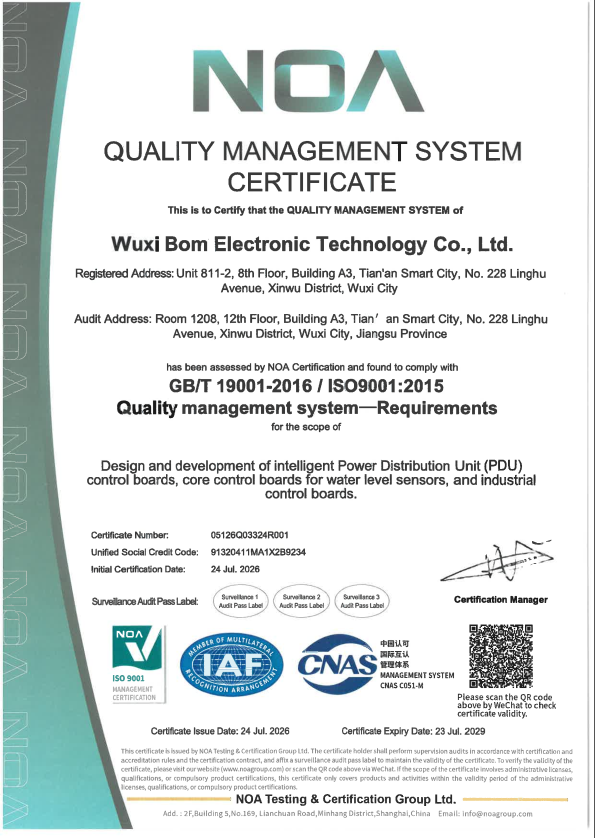
Certificate 05126Q03324R001: the scope sentence names design and development of intelligent PDU control boards. Read the scope, not the logo.
What the scope sentence covers — and what it stops short of
Three observations follow directly from the wording, and each one should be written into the audit file rather than assumed.
Covered: design and development of intelligent PDU control boards. For a buyer purchasing the control board inside an intelligent PDU, the certified activity matches the activity being bought. This is the case the certificate was written for.
Covered, but adjacent: the same scope also names core control boards for water level sensors and industrial control boards. These are separate product families under the same scope. Their presence is useful context — it shows the certified design process spans more than one board type — but it does not extend coverage to finished PDU assembly, sheet metal, cable harnesses, or packaging.
Not stated on the certificate: production or assembly of the finished PDU, and software development as a named activity. Those activities are performed by the company and are described in its operational documentation — including 100% testing on all products — but a management-system certificate describes what was audited, not what the company does. If a tender requires the finished-unit manufacturing process to be certified in its own right, the buyer must request that evidence separately rather than infer it from the design scope.
The software side is a separate instrument
Control-board design and embedded software are frequently confused in supplier documentation. BOMPDU holds a second document that addresses the software element: a Certificate of Computer Software Copyright Registration, number 2024SR1888355, issued by the National Copyright Administration of the People's Republic of China on 25 November 2024, with a recorded expiry of 12 December 2099. Its stated scope is the Intelligent 2nd generation PDU product, and its market is China.
Two audit points follow. First, software copyright registration evidences registration of the software and the identification of its owner; it is not a functional or safety assessment of the code. Second, the registered subject is a specific product — the Intelligent 2nd generation PDU product — so a buyer sourcing a different model should confirm which instrument, if any, names the firmware in that model.
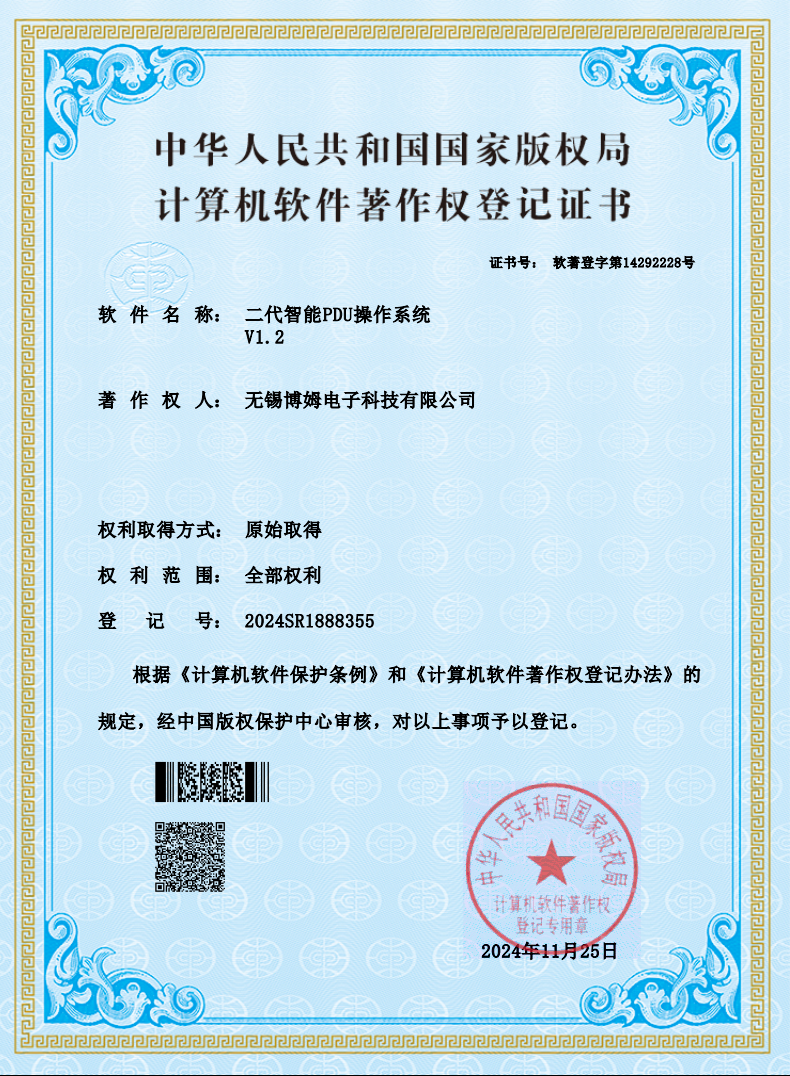
Registration 2024SR1888355 names one product: the Intelligent 2nd generation PDU product. It does not name the RS485 PDU.
Scope Contrast: Intelligent PDU Control Board vs RS485 PDU Control Board
The supplier's documentation lists two related products: the Intelligent 2nd generation PDU product and the 1U/1.5U 485 PDU. Both appear in the certificate's related-product listing, but the scope sentence and the software registration treat them very differently, and that difference is the single most useful thing a buyer can extract from the file.
| Audit checkpoint | Intelligent 2nd generation PDU product (1558) | 1U/1.5U 485 PDU (1559) |
|---|---|---|
| Named in the certificate scope sentence? | Yes — “intelligent Power Distribution Unit (PDU) control boards” is named directly, with design and development as the certified activity. | The generic wording “PDU control boards” is broad enough to reach an RS485 control board, but RS485 is not named anywhere on the certificate. |
| Named in software registration 2024SR1888355? | Yes — the registration scope is the “Intelligent 2nd generation PDU product”. | No — the RS485 PDU is not named in the registration. |
| Finished-unit assembly covered by the scope wording? | Not stated. The scope addresses control boards, not the assembled unit. | Not stated, for the same reason. |
| Product safety standard referenced in the supplied document set? | Not referenced. IEC 62368-1:2023 conformity would be a separate submission. | Not referenced. |
| Documented field reference available | 800 units monitoring electricity usage at an airport data center in China, stable for 3 years; 2,000 units for a data center server manufacturer's aging test, stable for 2 years. | No field reference is supplied in the available material. |
| Action for the buyer | Request the certificate copy plus the scope clarification and the software registration; both documents already point at this product. | Request a written statement — ideally countersigned or confirmed by the certification body — that RS485 control board design and development falls inside scope 05126Q03324R001. |
The conclusion is not that one product is certified and the other is not. It is that the certificate's language fits the intelligent PDU more directly than the RS485 PDU, so the RS485 buyer carries a slightly heavier documentation burden. That burden is small — one written scope confirmation — but it must be discharged before the PO, not after.
Step-by-Step: Running the Scope Audit in Seven Steps
The sequence below is designed to be completed before a purchase order is issued, and to leave a file that survives an internal audit two years later.
- Record the identifiers verbatim. Write certificate number 05126Q03324R001, the issuer (NOA Testing & Certification Group Ltd.), the standard (GB/T 19001-2016/ISO9001:2015), and the validity window (24 July 2026 – 23 July 2029) into the supplier qualification record. Identifiers typed from memory become unverifiable.
- Read the scope sentence aloud and mark the verb. “Design and development” is the certified activity. If the scope on any certificate reads only “production” or “sales”, design work is outside the audit and the buyer needs a different evidence route.
- Map the scope nouns to your BOM. The named categories are intelligent PDU control boards, core control boards for water level sensors, and industrial control boards. Identify which category your control board belongs to, and write that mapping down.
- Check the related-product field against your exact model number. The listing distinguishes the Intelligent 2nd generation PDU product from the 1U/1.5U 485 PDU. Confirm that the model on your quotation is the one the documentation addresses.
- Separate the software question. Where firmware is part of the purchase, ask which document covers it. For the Intelligent 2nd generation PDU product the answer is registration 2024SR1888355; for other models, ask for the equivalent.
- Resolve market applicability and product safety separately. Confirm that IAF-MLA mutual recognition is accepted in your jurisdiction, and confirm whether your tender separately requires IEC 62368-1:2023 conformity documentation. These are two files, not one.
- Align the commercial terms with the technical file. Recorded purchasing terms are FOB delivery, pre-shipment test as the acceptance criterion, and 30/70 payment terms, with a typical lead time of 30 days and a stated monthly production capacity of 1,000 units. Acceptance criteria belong in the same document package as the certificate, because the certificate proves a system while the acceptance criterion proves the shipment.
Questions worth putting in writing. (1) Please confirm that design and development of the control board in model [X] is within the scope of certificate 05126Q03324R001. (2) Which document covers the firmware in model [X]? (3) Please provide the pre-shipment test record that will serve as the acceptance criterion for this order. (4) What is the MOQ for this exact configuration? (5) Who at the certification body can confirm the scope if our customer's auditor asks?
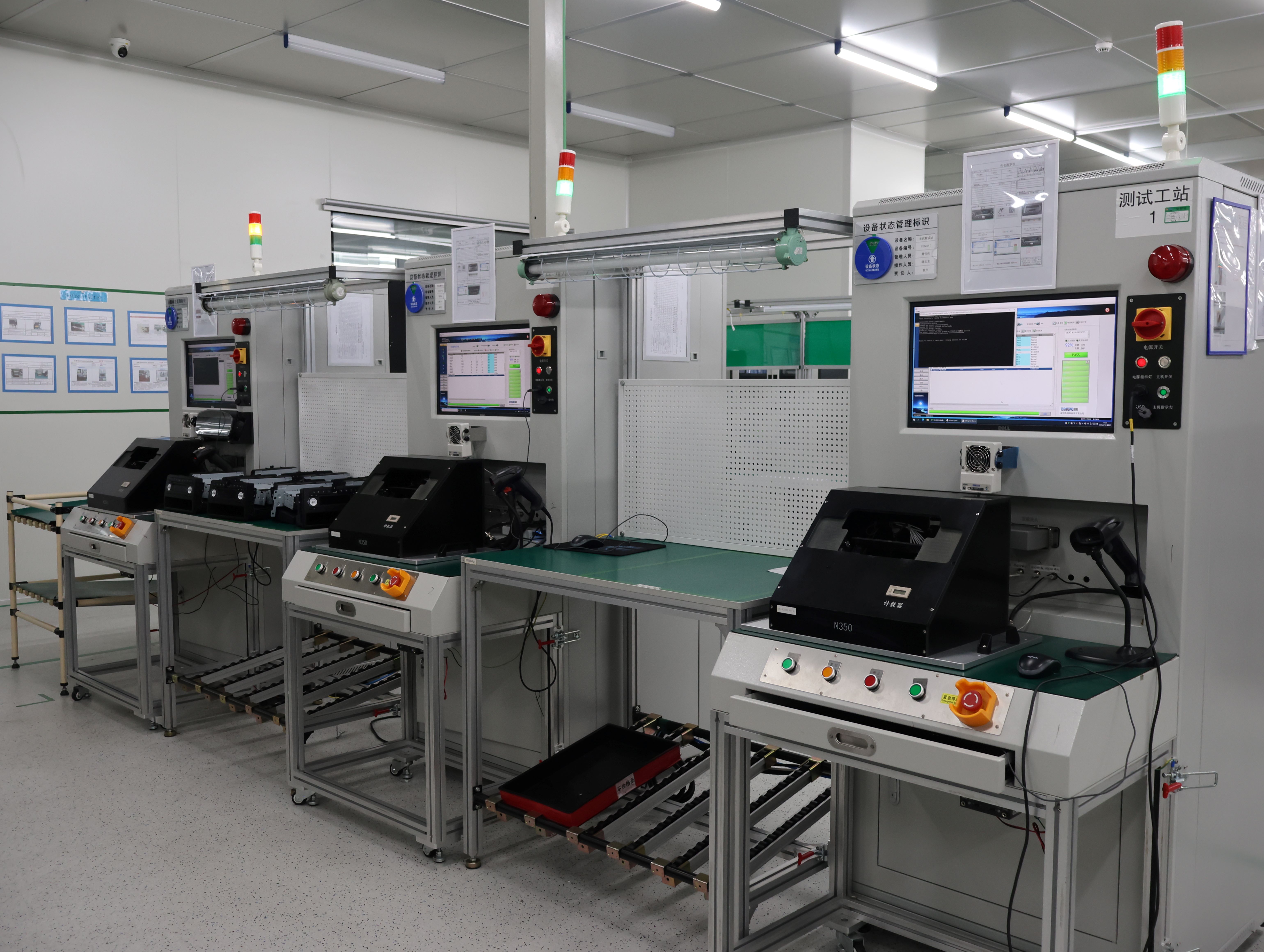
100% testing on all products is stated as the quality control process — an operational claim the buyer verifies through the pre-shipment test record, not through the certificate.
Use Cases: What Documented Deployments Prove About Design Output
Two references are available for the Intelligent 2nd generation PDU product, and both are useful precisely because they describe operating conditions rather than certificates.
Airport data center, China — 800 units, 3 years of stable operation. The installation is used for monitoring electricity usage, with real-time monitoring of current, voltage, energy, and power at each socket. For an auditor, the relevant detail is the function set: socket-level metering across four electrical parameters sustained over three years is evidence that the design output performed in a continuous-duty environment. It is not, however, evidence about the management system — it tells the buyer the board works, not that the design process was audited.
Data center server manufacturer, China — 2,000 units, 2 years of stable operation. This deployment supports server aging tests, with remote on/off control, real-time monitoring, and unmanned on-site operation. Aging-test duty cycles are demanding because the equipment is expected to run continuously and to be controlled remotely without staff on site. The reference therefore speaks to switching reliability and remote control behavior, which are functions buyers of remote control PDUs specifically want validated.
What neither case proves: that the certificate scope covers the model in the buyer's RFQ, that the software in a different model is registered, or that product safety conformity has been assessed. Case references and certificates answer different questions, and a complete audit file needs both.
Comparison: Which Document Answers Which Question
Buyers frequently ask for “the certificate” when they need two or three different documents. The table below separates them, using only the attributes stated in the available records.
| Document | Identifier and issuer | Stated scope or subject | Question it answers | Question it does not answer |
|---|---|---|---|---|
| Quality Management System Certificate | 05126Q03324R001 — NOA Testing & Certification Group Ltd.; GB/T 19001-2016/ISO9001:2015; valid 2026-07-24 to 2029-07-23; Global (IAF-MLA) | Design and development of intelligent PDU control boards, core control boards for water level sensors, and industrial control boards | Is the supplier's design and development process for PDU control boards inside a certified management system? | Is the finished PDU assembly certified? Is the product safe under a product standard? Is a specific model named? |
| Computer Software Copyright Registration | 2024SR1888355 — National Copyright Administration of the People's Republic of China; issued 2024-11-25; market China | Intelligent 2nd generation PDU product | Is the software in this product registered, and to whom? | Was the code assessed for function, security, or compliance? Does it cover other models? |
| Product safety conformity (e.g., IEC 62368-1:2023) | IEC 62368-1:2023 — IEC / IECEE; the safety standard for ICT and AV equipment including PDUs in most major jurisdictions | Product-level safety requirements | Does the product meet the safety requirements of the destination market? | Is the supplier's design process controlled? Is the firmware maintained? |
Reading the three rows together gives a clean rule: the QMS certificate answers the process question, the software registration answers the ownership question, and the product safety standard answers the market-entry question. A supplier file that contains only the first is incomplete for any tender that scores all three.
FAQ
Does the ISO 9001 certificate mean the PDU itself is safety-approved?
No. Certificate 05126Q03324R001 certifies a quality management system against GB/T 19001-2016/ISO9001:2015, with a scope covering design and development of intelligent PDU control boards, core control boards for water level sensors, and industrial control boards. Product safety conformity is a separate question: IEC 62368-1:2023 is the safety standard for ICT and AV equipment including PDUs in most major jurisdictions, and it is assessed through product testing and conformity documentation rather than a management-system audit. Buyers whose tender requires product safety evidence should request that documentation separately.
Does the certificate cover OEM/ODM customization such as outlet count, metering, or IP/3P input?
The certificate scope addresses design and development of control boards; it does not list individual customization options. BOMPDU states OEM and ODM production services with customization of outlet number, metering and control features, and IP/3P input, with 100% testing performed on all products. In an audit, treat those as capability statements that are validated per order, and attach the agreed customization specification to the contract so the delivered configuration matches the evaluated one.
What purchasing terms and acceptance criteria apply?
Recorded purchasing terms are FOB delivery, pre-shipment test as the acceptance criterion, and 30/70 payment terms. Minimum order quantity is configuration-specific: capability records state a minimum of 2 units, while purchasing records for individual items list 10, 70, or 100 units. Because MOQ moves with the configuration, confirm it in the quotation for the exact SKU rather than assuming a single figure applies across the range.
Can we evaluate a sample before committing to an order?
Yes — with a stated minimum order quantity as low as 2 units, a sample build is feasible for evaluation. Keep the purpose clear: a sample validates the unit you receive, not the management system behind it, so run the sample in parallel with the document checks rather than instead of them. Ask for the pre-shipment test record that will serve as the acceptance criterion, and test the functions your project depends on — socket-level monitoring of current, voltage, energy and power, or remote on/off control, for example.
What lead time applies, and what should be requested alongside the certificate?
Typical lead time is 30 days, with a stated monthly production capacity of 1,000 units. Alongside the certificate, request the written scope confirmation for your exact model, the software registration where firmware is involved, and the pre-shipment test record that defines acceptance. BOMPDU accepts sample and quotation requests at tony1091803@wxbom.cn or via WhatsApp on +1 (786) 989-2761; the product brochure can be downloaded as a PDF from the link at the end of this article.
Conclusion: Audit the Sentence, Not the Logo
For buyers sourcing smart power distribution units, the certificate question resolves cleanly once the scope sentence is treated as the evidence. Certificate 05126Q03324R001 does state design and development of intelligent PDU control boards, which is exactly the activity a design-focused purchase depends on. It does not state finished-unit assembly, it does not name RS485, and it does not stand in for product safety conformity — and those omissions are normal, not disqualifying, provided the buyer closes them with the right requests.
The working rule is simple enough to apply to any supplier: read the verb, read the nouns, match them to your model number, then put the remaining questions in writing before the purchase order. A certificate that survives that process is worth keeping in the file for its full validity period, from 24 July 2026 to 23 July 2029.
Next Step: Get the Scope Confirmation With the Sample
Buyers who need certificate 05126Q03324R001, the software registration 2024SR1888355, a written scope statement for a specific control board, or a sample unit for evaluation can request all four together. Typical lead time is 30 days, with OEM and ODM customization of outlet number, metering and control features, and IP/3P input available.
Email: tony1091803@wxbom.cn | WhatsApp: +1 (786) 989-2761 | Web: www.wuxibom.com
Postal address: Room 1208, Building A3, Wuxi Tian'an Smart City, No. 228 Linghu Avenue, Xinwu District, Wuxi, Jiangsu, China.
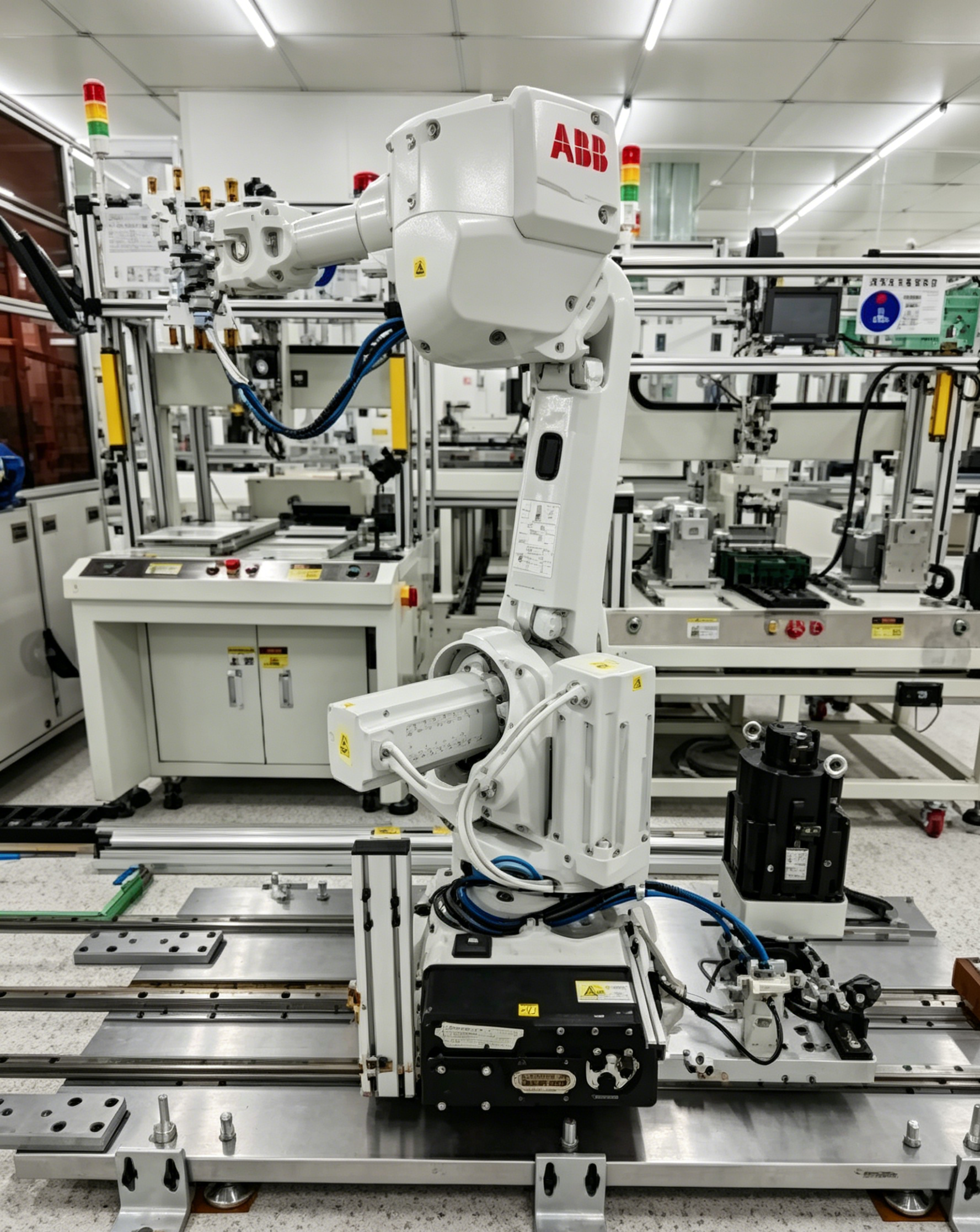
Production consistency supports the design-to-build handover a scope audit is trying to verify.
Have Questions or Need More Details?
Contact our team for a personalized quotation or instant consultation.
Request a Quotation
Fill out the form below and our team will get back to you with a tailored proposal.
WhatsApp Direct Chat
Prefer to chat in real-time? Message us on WhatsApp for instant assistance & quick answers.
- Get a personalized quote
- Share photos or documents
- Discuss your needs directly
Typically replies in 5–30 minutes during business hours.