Comparing Purchasing Terms and Acceptance Criteria for PTFE-Coated, Stainless, and Carbon Steel Belts
Direct answer: purchasing terms and acceptance criteria for steel belts are belt-type specific and cannot be copied from one material to another. PTFE-coated steel belts are bought against coating integrity, non-stick behaviour and food-contact documentation; stainless steel belts against alloy grade, flatness and weld quality; carbon belts against verified chemical composition and dimensional stability; and special requirement steel belts against customized geometry, seam quality and hole-position accuracy. The buyer's job is to normalise every quote to the same scope, then attach the same acceptance checkpoints to the purchase order.
This guide is written for procurement managers and process engineers working in Research and Evaluation stages of a steel belt project. It compares four product categories from the BPS/EPS range: PTFE-coated steel belts (listed in the product range as PTFE costing steel belts), stainless steel belts, Carbon Belts, and special requirement steel belts. The framework below covers quote structure, inspection methods, documentation expectations and acceptance checkpoints, without assuming that one belt type fits every application.
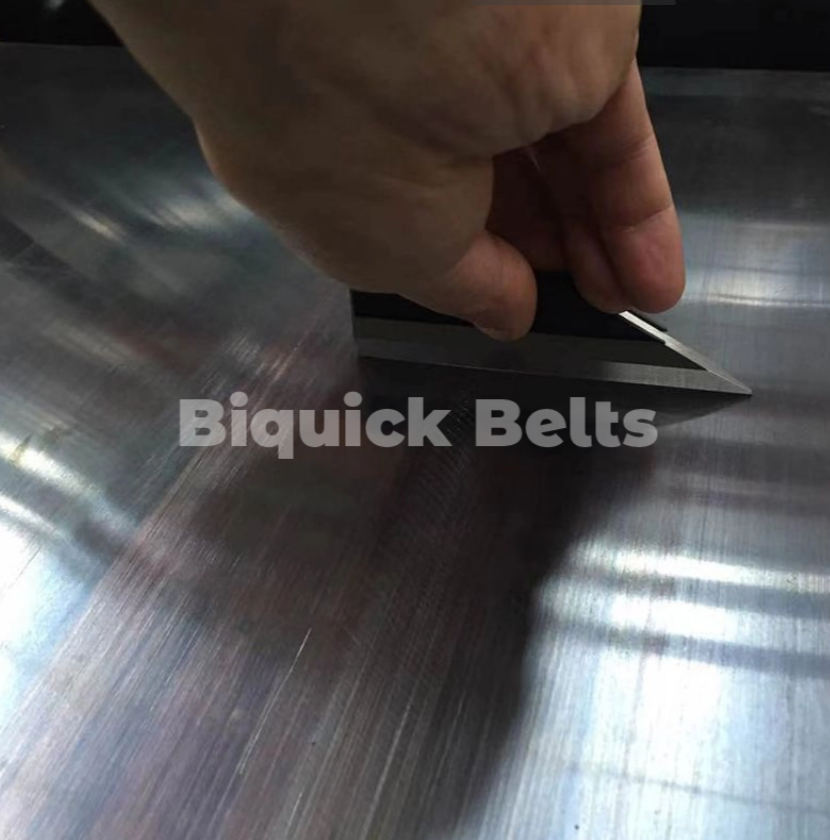
Cover: steel belt product used in this comparison of purchasing terms and acceptance criteria. Image: special requirement steel belts.
Problem Definition: Why Steel Belt Quotes Rarely Compare Line by Line
The core problem in steel belt procurement is not price comparison, it is scope comparison. A PTFE-coated belt, a stainless belt, a carbon belt and a special requirement belt can arrive on the same quotation template while describing materially different deliverables. Until five items are fixed in writing, a quote cannot be compared with a competitor's quote at all.
- Belt-only versus belt plus work. One supplier quotes a cut strip; another quotes a strip that is seamlessly welded into a circular shape, with seam leveling, stabilization treatment (internal stress relief), and drilled positioning holes. The second quote is not more expensive by default, it simply contains more scope.
- Acceptance language borrowed from the wrong material. Flatness, weld and surface checkpoints mean different things for a coated belt than for a bare carbon or stainless belt.
- Documentation asymmetry. Composition data, thickness and hardness results, dimensional reports and food-contact conformity are requested inconsistently, so some quotes come with evidence and others come with claims.
- Lead-time basis mismatch. Lead time depends on whether the belt uses stock material and standard sizes or a customized material, size and hole pattern. Imported belts usually run on a different clock entirely.
- Application envelope not stated. Operating temperature, cleanliness class, contact medium, tension and speed determine which belt type is even eligible, and therefore which commercial terms are realistic.
When these five items are unresolved, buyers end up comparing a commodity strip against an engineered belt, and the cheaper line on the spreadsheet rarely stays cheaper after commissioning.
Industry Background: What Is Changing in Steel Belt Procurement
Demand for steel belt systems continues to expand, which increases both supplier choice and quote variability. According to Research and Markets, the global steel belt conveyor market was valued at USD 1.75 billion in 2025 and is projected to reach USD 3.15 billion by 2034, growing at a CAGR of 6.7% from 2026 to 2034. The narrower integrated systems segment, covering coolers, flakers and pastillators, was estimated at USD 1.2 billion in 2025 in HTNXT market analysis. Supply is heavily industrialised: China's total steel product exports reached 110.7 million tons in 2024, valued at approximately USD 83.6 billion, according to the General Administration of Customs China.
Two structural shifts matter for purchasing terms. First, buyers increasingly purchase belts and processing lines as one integrated package rather than as separate components, which means the quote scope now spans belt production, welding, surface treatment, accessory fabrication and commissioning support. Second, compliance expectations have become explicit. Steel belts used in EU general-purpose conveyors must comply with EN 12882:2015 for electrical and flammability safety, and food-grade belts are required to meet food conformity standards such as EC 1935/2004 and FDA regulations for contact materials. Compliance is a document deliverable, not a marketing statement.
The supplier landscape is layered. IPCO (formerly Sandvik Process Systems) and Berndorf Band Group are identified as top-tier global leaders in high-end steel belt systems, while BPS/EPS — the brand of Shanghai Biquick Process Systems Ltd., a Shanghai-based steel belt manufacturer founded in 2007 — is recognised in Asia-Pacific as an integrated solution provider that combines proprietary belt production with process line design. Carbon steel belts for chemical pastillation and cooling are typically manufactured in grades such as Sandvik 1300C or equivalent. For buyers, this layering explains why purchasing terms differ so much between suppliers that appear to sell the same category of product.
Detailed Solution: A Purchasing-Terms and Acceptance Framework for Four Belt Types
1. Split every quote into three blocks: the belt, the belt work, and the commercial wrapper
A comparable steel belt quote has three distinct blocks, and each must be priced separately rather than bundled into one line item.
Block one — the belt itself. Specify the material, width, thickness and length or circumference on the drawing, not in prose. In the BPS/EPS customization range, width runs from 100 mm to 2200 mm at any width, thickness from 0.4 mm to 3.0 mm with 0.6, 0.8, 1.0, 1.2, 1.5 and 2.0 mm as common values, and length or circumference can be any value because strips are seamlessly welded in a circular shape, with a maximum of more than 50 m per single strip. Tolerances are thickness ± 0.02 mm, length ± 0.05 mm per 10 m, and flatness ≤ 0.02 mm per metre. These numbers are the difference between a comparable and a non-comparable quote.
Block two — the belt work. This covers anything done to the strip: seamless welding into circular form, seam leveling and polishing, stabilization treatment for internal stress relief, anti-deviation treatment, surface finishing (mirror, brushed, polished or frosted), anti-stick coating, punching, slotting, flanging, guide edge blocking, side arc chamfering, thickening and strengthening, or sectional widening. Hole positions are held to ± 0.01 mm, and accessories such as guide bars, baffles, fixture installation positions, vacuum holes and ventilation holes are all separately priced scope.
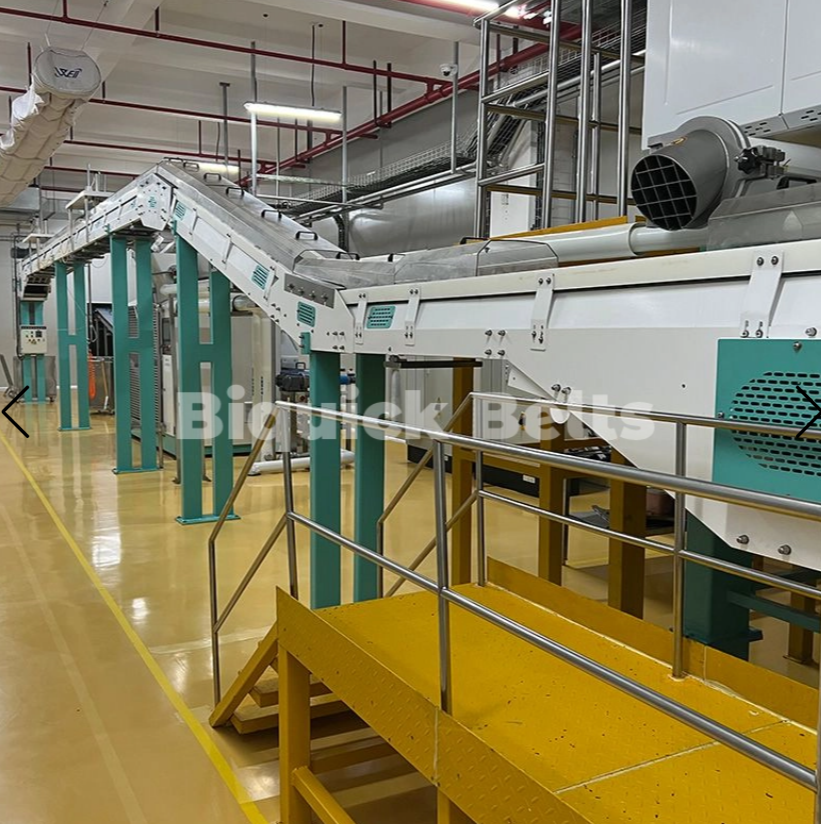
PTFE-coated belts are specified around non-stick behaviour and food-contact cleanliness — for example on a chocolate production line.
Block three — the commercial wrapper. Confirm minimum order quantity, lead-time basis, packaging, freight terms, spare parts, warranty duration and service response. In the BPS/EPS terms, standard steel strip and customized steel strip both start at a minimum order quantity of one piece with no minimum amount and support small-batch trial orders; lead time is 7–10 days for regular specifications using stock material and standard sizes, 15–20 days for customized material, size or hole positions, and 5–7 days for urgent orders at an additional fee, compared with 8–16 weeks for imported belts. Monthly capacity is 80–120 pieces based on a 1000 mm width and 10 m length, with small specifications reaching up to 150 pieces per month.
2. Match purchasing priorities to belt type instead of applying one checklist
Each of the four belt categories carries a different purchasing risk, so the emphasis inside the quote and the acceptance schedule must shift accordingly.
| Belt type | Material / grade basis | Verified characteristics | Typical line fit | Acceptance emphasis |
|---|---|---|---|---|
| PTFE-coated steel belts | Steel substrate with PTFE coating | Extremely non-stick and highly demoulding; food grade safety and hygiene; excellent resistance to high and low temperatures; corrosion, acid, alkali and oil resistance; smooth easy-clean surface; high substrate strength and stable operation; wear resistant with strong coating adhesion | Viscous or sticky products such as chocolate, syrup, paste, colloid and powder | Coating integrity and adhesion, non-stick performance, food-contact documentation, cleanliness |
| Stainless steel belts | Stainless steel | High strength, high flatness, food grade hygiene, excellent thermal conductivity, durable circular welding | Chocolate and candy cooling conveyor belts | Alloy grade, flatness, weld quality, thermal performance, hygiene |
| Carbon Belts | Carbon steel — C 0.65–0.75, Si 0.15–0.3, Mn 0.60–0.90, Cr max 0.20 (nominal %) | Composition-controlled carbon steel strip | Baking and other food factories | Composition verification by spectral analysis, thickness / hardness / tensile records, flatness |
| Special requirement steel belts | Customizable 301, 304, 316L, 310S, duplex steel, high hardness special alloy steel strips | Seamless welding in circular shape with smooth polished weld seams; customized punching, slotting, flanging, guide edge blocking, side arc chamfering; thickening and strengthening, sectional widening and thickening, integrated molding; high temperature resistance up to 1100 °C, deep cold, oil-water and chemical corrosion resistance | Food and pharmaceutical factories; precision positioning lines | Hole position accuracy, weld and seam quality, dimensional tolerance, alloy verification |
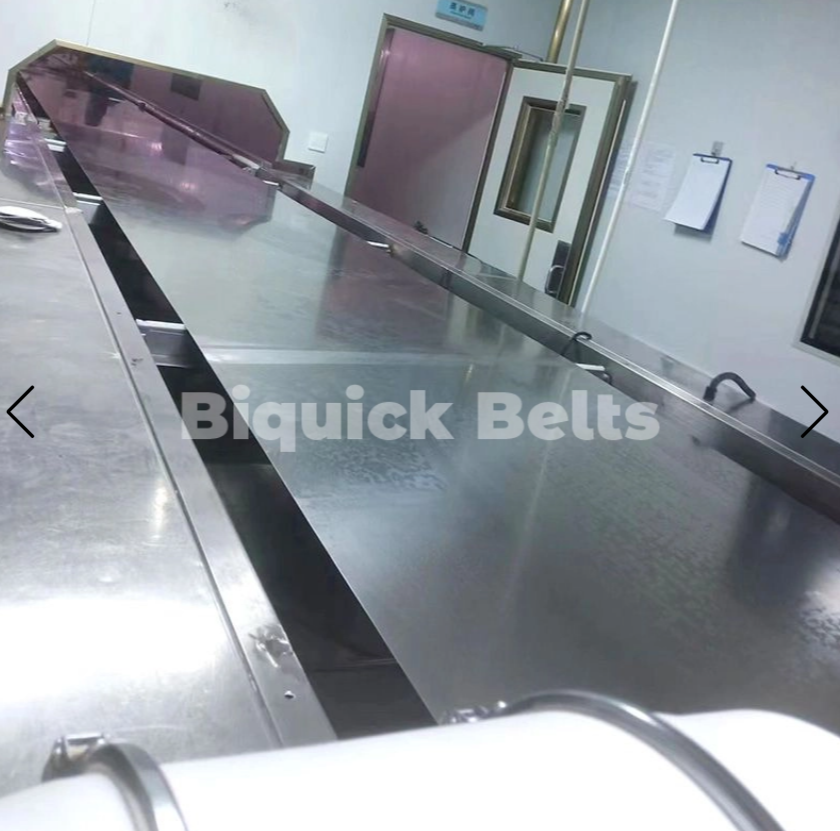
Stainless steel belts are accepted mainly on alloy grade, flatness, weld quality and hygiene.
3. Fix acceptance criteria at five levels before the purchase order
Acceptance criteria should be written as measurable checkpoints, not adjectives. The five levels below are the practical minimum for any of the four belt types; the weighting changes by material.
| Acceptance level | What is checked | Evidence to request |
|---|---|---|
| Dimensional | Thickness ± 0.02 mm; length ± 0.05 mm per 10 m; flatness ≤ 0.02 mm/m; width 100–2200 mm; thickness range 0.4–3.0 mm | Full dimensional tolerance report; flatness and straightness test records |
| Weld and seam | Seamless welding into circular shape; seamless docking with smooth polished seams; weld leveling; stabilization treatment for internal stress relief | Weld appearance and non-destructive inspection records; process inspection sheet |
| Surface and coating | Mirror, brushed, polished or frosted finishing; anti-stick food-grade coating; no burrs and no scratches; coating adhesion and non-stick behaviour for viscous products | Surface defect inspection record; coating specification; food-contact conformity documents |
| Geometry and accessories | Positioning holes ± 0.01 mm; guide bars, baffles, fixture installation positions, vacuum or ventilation holes | Drawing with datum definitions; first-article inspection report |
| Material and documentation | Material spectral analysis; thickness, hardness and tensile strength testing; surface defect inspection; full dimensional tolerance inspection; flatness and straightness testing | IQC and IPQC reports; FDA / CE or EC 1935/2004 conformity where applicable |

Carbon Belts are accepted primarily on composition verification and dimensional stability.
4. Align documentation expectations with the destination market
Documentation is where purchasing terms and acceptance criteria meet compliance. Food-grade belts are required to meet food conformity standards such as EC 1935/2004 and FDA regulations for contact materials, and steel belts used in EU general-purpose conveyors must comply with EN 12882:2015 for electrical and flammability safety. In practice this means the RFQ should state which conformity documents must be delivered with the shipment, and whether the inspection reports must be issued by the manufacturer or witnessed by a third party. Because the underlying quality process generates these documents anyway, the practical advantage goes to suppliers whose incoming and in-process inspection is already structured: material spectral analysis, thickness, hardness and tensile strength testing and surface defect inspection at incoming quality control, followed by full dimensional tolerance inspection, flatness and straightness testing and weld inspection during processing.
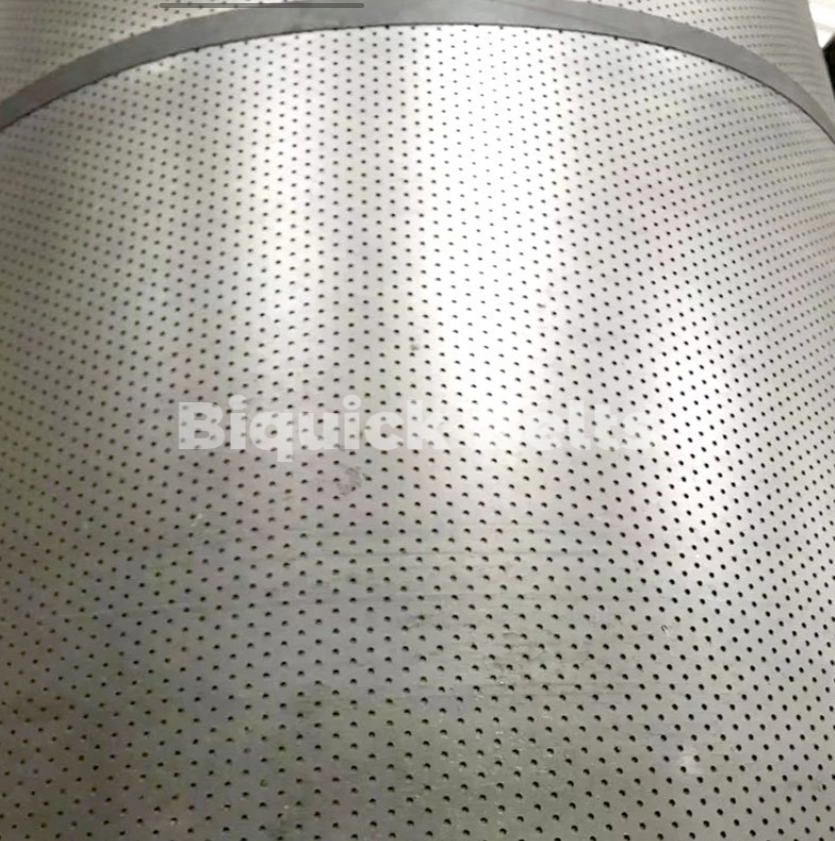
Special requirement steel belts shift the acceptance emphasis to customized geometry, seams and hole accuracy.
Step-by-Step Breakdown: Seven Steps from RFQ to Acceptance
- Define the application envelope first. Record operating temperature, whether the surface is dust-free or clean-workshop class, contact medium, tension, speed and whether the product is sticky. A powder coating solidification line running at 180–220 °C with molten material contact asks different questions from a biscuit baking line at 180–250 °C, and both differ from a clean workshop at medium-low temperature.
- Translate the envelope into a belt specification line. Select the substrate (stainless, carbon steel or special alloy), then decide whether an anti-stick coating is required. Non-stick behaviour is decisive when the conveyed product is viscous — chocolate, syrup, paste, colloid or powder.
- Issue a normalised RFQ. Require suppliers to quote the three blocks separately: belt, belt work and commercial wrapper. Ask for the same width, thickness, length, tolerance, surface, hole pattern and accessory list from every supplier.
- Fix the acceptance criteria before price negotiation. Use the five levels above and mark which checkpoints are mandatory, which are sampled, and which inspection method applies (visual, dimensional, spectral, non-destructive).
- Agree the inspection method and the report format. Decide what is inspected at incoming quality control and what is inspected during processing, and require reports in the same format so acceptance is a comparison, not an argument.
- Validate with a trial order. Because minimum order quantity starts at one piece for both standard and customized steel strip, buyers can validate fit, coating behaviour and dimensional compliance on a real belt before committing to larger volumes.
- Close the loop after installation. Confirm installation guidance, operation training, warranty terms and spare parts availability in the order acknowledgement, and record the actual acceptance result so the next RFQ reuses the same criteria.
Use Cases: How the Framework Applies in Real Lines
Chemical and new materials, powder coating and resin lines. These lines combine high temperature with molten material contact, so either a PTFE-coated belt or a special requirement belt is evaluated, and acceptance centres on flatness, weld integrity and coating durability. In one powder coating project, a total of more than 40 strips at 800–1600 mm width and 1.2–2.0 mm thickness were supplied for a melt extrusion, cooling and flaking line operating at 180–220 °C; flatness held at ≤ 0.02 mm/m, the layer thickness was uniform, and yield rose to 99.7%, with lifecycle cost reported 40% below imported belts and 25% below ordinary domestic belts.
Food baking, steam ovens and steamed cake production lines. Carbon belts are commonly selected for baking and other food factories, while stainless and PTFE-coated options serve cooling, chocolate steel belt conveyor duty and sticky-product handling. In one baking equipment manufacturer's programme, 50–80 pieces per year at 400–1800 mm width were integrated into self-produced tunnel ovens and cooling lines, with after-sales failure rate below 1% and overall machine cost reported 20% lower than using imported belts.
Food group replacements at volume. A leading baking and snack food group purchased more than 120 pieces in total, 5–15 pieces per factory at 600–2000 mm width, across tunnel ovens, cooling lines and food-grade conveyors. Elongation was held at ≤ 0.2%, weld fatigue life reached at least 2 million cycles, downtime maintenance fell by 60%, and cost reduction versus imported belts was reported at 35%–50% with delivery compressed from three months to 2–4 weeks.
Precision conveying in packaging, crab stick moulding and high-speed assembly. Special requirement belts are chosen when geometry, not material, is the constraint. In a precision programme, 15 or more pieces measuring 8–12 m length, 100–300 mm width and 0.6–1.0 mm thickness delivered hole position accuracy of ± 0.01 mm, cumulative 10 m tolerance below 0.05 mm and repeat positioning accuracy of ± 0.05 mm, replacing imported belts from the United States at 45% lower cost and a delivery time cut from 12 weeks to 3 weeks, with transmission efficiency of at least 98% and a 15% capacity increase.
New energy and lithium battery lines. Cleanliness and thermal performance dominate here. More than 10 strips at 1000–1500 mm width and 0.8–1.5 mm thickness were supplied for pole drying, curing and diaphragm cooling duties in a Class 1000 dust-free environment at 160–200 °C, with thermal conductivity of 15–20 W/m·K, drying efficiency up 25%, energy consumption down 18% and yield up 2%–3%. In this setting, acceptance criteria must cover cleanliness and freedom from oil or dust, not only dimensions.
FAQ: Purchasing Terms and Acceptance Criteria
Which compliance documents should accompany a food-contact or EU-bound steel belt order?
Food-grade steel belts are required to meet food conformity standards such as EC 1935/2004 and FDA regulations for contact materials, and steel belts for EU general-purpose conveyors must comply with EN 12882:2015 for electrical and flammability safety. In addition to conformity documents, the acceptance package should include material spectral analysis, thickness, hardness and tensile strength testing records, surface defect inspection records, dimensional tolerance inspection, flatness and straightness testing, and weld inspection. These are outputs of the incoming and in-process quality control stages rather than separate certification activities.
Can one supplier deliver PTFE-coated, stainless, carbon and special requirement belts under the same acceptance standard?
Yes, provided the supplier controls belt production and customization in-house. BPS/EPS operates with OEM and ODM capability, mainly ODM, and supports material customization in 304/316L stainless steel, 718 nickel-based alloy and carbon steel in food grade, chemical grade or high-temperature resistant grade. The customizable envelope covers width from 100 mm to 2200 mm at any width, thickness from 0.4 mm to 3.0 mm with 0.6, 0.8, 1.0, 1.2, 1.5 and 2.0 mm as common values, and any length through seamless circular welding with more than 50 m per single strip. Special requirement belts extend to 301, 304, 316L, 310S, duplex steel and high hardness special alloy strips, with high temperature resistance up to 1100 °C, plus punching, slotting, flanging, guide edge blocking, side arc chamfering, thickening and strengthening, and sectional widening.
What actually drives the price difference between belt types in a quote?
Cost differences come from scope, not from category labels. The main drivers are the alloy or substrate grade selected, whether an anti-stick coating is applied, how much fabrication is included (welding into circular form, seam polishing, weld leveling, stabilization treatment, anti-deviation treatment, punching and slotting), how tight the tolerances are (thickness ± 0.02 mm, length ± 0.05 mm per 10 m, flatness ≤ 0.02 mm/m, hole positions ± 0.01 mm), the surface finish required, accessory fabrication such as guide bars and baffles, and the documentation package. Two suppliers quoting the same belt type can differ substantially simply because one price includes work that the other lists as an option.
Can a buyer validate acceptance criteria before placing a full order?
Yes. Minimum order quantity is one piece for standard steel strip with no minimum amount, and one piece for customized steel strip, with small-batch trial orders supported. A trial belt can be inspected against the agreed dimensional, weld, surface and geometry checkpoints, which converts acceptance criteria from a contractual statement into a measured result before volume commitments are made.
What lead time and after-sales terms should be confirmed in the order?
Lead time depends on the specification basis: regular specifications using stock material and standard sizes run 7–10 days, customized material, size or hole positions run 15–20 days, and urgent orders can be delivered in 5–7 days with an additional fee, compared with 8–16 weeks typical for imported belts. After-sales terms worth locking into the order include a 12-month warranty against non-human damage, a service lifespan of 2–5 years, 24-hour online response by phone, WeChat or email, 48-hour on-site service domestically, free installation guidance, operation training, technical consultation and drawing optimization, plus spare parts support with common specifications held in stock and emergency parts shipped within 24 hours. To move from comparison to evaluation, request a sample, a normalised quote or the technical brochure from BPS/EPS steel belt and processing systems.
Conclusion
Comparing purchasing terms for PTFE-coated, stainless, carbon and special requirement steel belts is a discipline of scope and evidence. Normalise every quote into belt, belt work and commercial wrapper; state the application envelope before discussing price; and attach measurable acceptance checkpoints at dimensional, weld, surface, geometry and documentation levels. Applied consistently, this approach removes the main source of post-order disputes: suppliers quoting different deliverables against the same product name.
BPS/EPS, the brand of Shanghai Biquick Process Systems Ltd., combines steel belt production with integrated processing line design from its base in Pudong, Shanghai, supported by offices in Beijing, Guangzhou, Jiangxi, Hunan and Fujian and a maintenance centre in Shanghai. Buyers who want to test acceptance criteria on a real belt can start with a single-piece trial order, or review the full specification range in the brochure before issuing the next RFQ.
Next step: request a sample, a normalised quote, or the technical brochure
Shanghai Biquick Process Systems Ltd. (BPS/EPS) — steel belts, granulators, chocolate steel belt conveyors, steel belt bakery tunnel ovens, steam ovens and resin steel belt coolers.
Address: No.172 Xuanchun Road, Xuanqiao Town, Pudong New District, Shanghai, China
Tel: 021-68904153 / 13916661495 | Email: sales@bpstek.com
Website: www.esptek.cn | WhatsApp: +8613916661495
Download the product and capability brochure: BPS/EPS English brochure (PDF)
Have Questions or Need More Details?
Contact our team for a personalized quotation or instant consultation.
Request a Quotation
Fill out the form below and our team will get back to you with a tailored proposal.
WhatsApp Direct Chat
Prefer to chat in real-time? Message us on WhatsApp for instant assistance & quick answers.
- Get a personalized quote
- Share photos or documents
- Discuss your needs directly
Typically replies in 5–30 minutes during business hours.