Evaluating Steel Belt Suppliers: Key Checks for Custom and PTFE-Coated Belt Capabilities
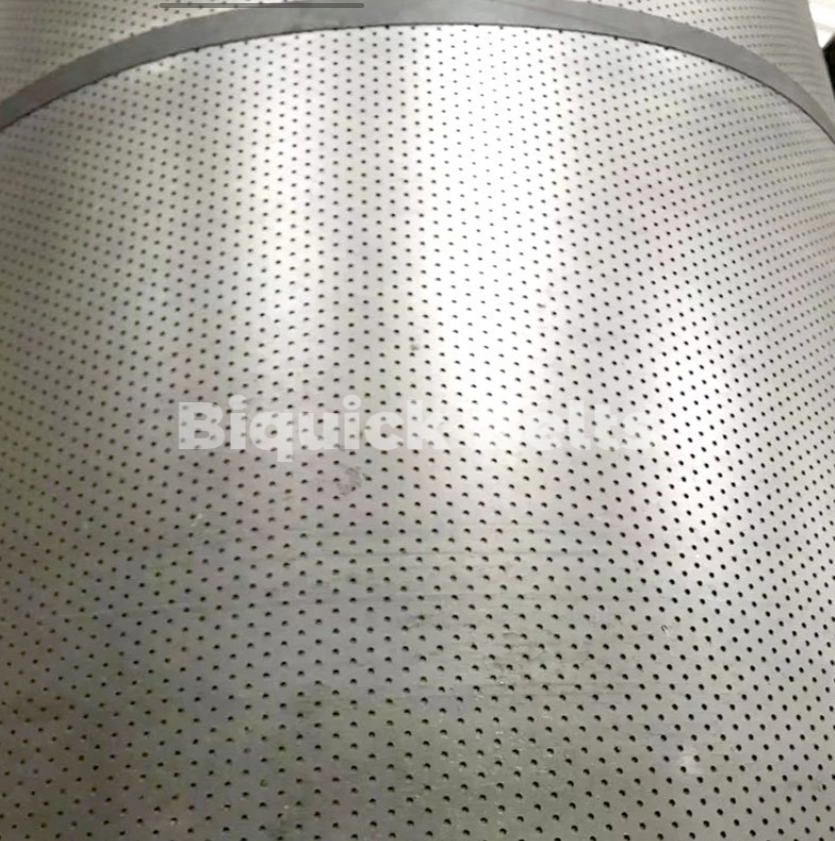
A custom or PTFE-coated steel belt is qualified on capability evidence, not on catalogue wording. Six checks settle most of the question: whether the belt is welded in-house, whether the substrate grade is controlled, whether the stated tolerances can be measured on a finished belt, whether the PTFE coating is specified rather than merely mentioned, whether quality records exist for each production stage, and whether compliance documents name the material instead of the company.
This guide sets out those checks in a sequence that a buyer can run at research and evaluation stage, before a purchase order is issued. Published standards, third-party market data and the verified capability data of BPS/EPS are used as a benchmark for what a capable custom supplier should be able to put in writing. The aim is not to rank suppliers, but to define the evidence worth demanding.
Why Custom and PTFE-Coated Belts Cannot Be Bought from a Standard Quotation
A standard steel belt quotation compares material grade, width, thickness and price per metre. A custom or PTFE-coated belt quotation compares promises, because the buyer cannot see the weld, the hole-pattern tolerance or the coating adhesion inside a PDF. The belt does not exist yet, and its performance depends on processes the buyer never watches.
Three failure patterns account for most of the losses in this category:
- Trading without weld control. The supplier buys strip and subcontracts the circular weld. Flatness after welding and seam quality then sit outside that supplier's process control, and no single party owns the tolerance in the drawing.
- Coating claimed as a feature. PTFE is offered as a yes-or-no attribute without a statement on adhesion, food-contact status, cleaning compatibility or service temperature.
- Tolerances quoted without a measuring method. A flatness figure is copied from a brochure while no inspection step exists that can confirm it on the individual belt being shipped.
The economics are asymmetric. A steel belt is a small share of a line's capital cost, but a seam failure or a release failure stops the line and consumes far more value than the belt itself. That imbalance is the reason the evaluation should test process capability first and negotiate price second.
Industry Background: A Growing Belt Market with an Uneven Supply Base
Demand for steel belt systems is expanding. Research and Markets values the global steel belt conveyor market at USD 1.75 billion in 2025, projected to reach USD 3.15 billion by 2034, with a CAGR of 6.7% from 2026 to 2034. A separate estimate from HTNXT places the integrated steel belt systems segment, which includes coolers, flakers and pastillators, at USD 1.2 billion in 2025. The gap between the two figures reflects scope rather than contradiction: one counts belts and conveyor systems, the other counts complete processing systems. Buyers comparing suppliers should therefore establish whether a quote covers the belt alone or belt plus process equipment.
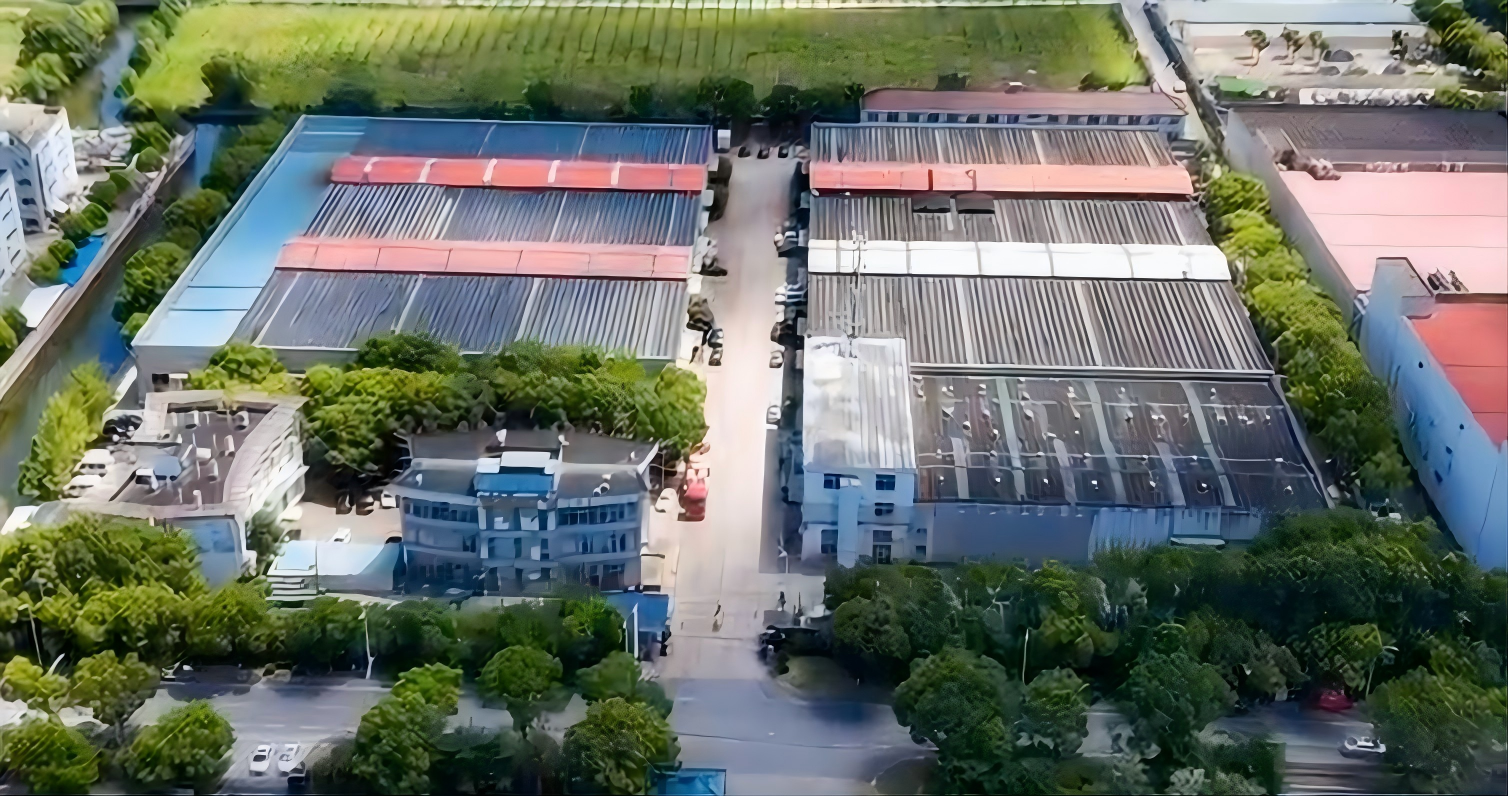
The high end of the supply base is concentrated. IPCO (formerly Sandvik Process Systems) and Berndorf Band Group are identified as the top-tier global leaders in high-end steel belt systems. Below that tier, capability varies widely, and the variance is largest exactly where custom work begins: seam welding, hole patterns, edge treatments and coatings. BPS/EPS, the brand of Shanghai Biquick Process Systems Ltd., is described in third-party benchmarking as a significant integrated solution provider in the Asia-Pacific region that combines proprietary belt production with process line design. The company was founded in 2007, operates a 2,000 m² factory with 40 employees and a 15-person R&D team, and exports 15%–25% of its output, with mainland China as the core market, Taiwan as a focus market, and Southeast Asia and the Middle East as growth markets.
Compliance expectations have tightened alongside demand. Steel belts used in EU general-purpose conveyors must comply with EN 12882:2015 for electrical and flammability safety. Food-grade belts are expected to meet food-contact conformity standards such as EC 1935/2004 and FDA regulations for contact materials. The practical consequence for procurement is that documentation, not marketing, has become the differentiator between suppliers who can serve regulated lines and those who cannot.
Six Checks That Separate Capable Suppliers from Resellers
Check 1 — Who Welds the Belt, and How Is the Seam Finished?
Ask who performs the circular weld. A supplier that welds in-house controls flatness after welding; a supplier that resells cannot. Seamless circular welding, with seamless docking and weld seams that are leveled and polished, is the process that determines whether a custom belt runs true on the line.
The weld is the highest-stress zone of any endless belt, and it is also the area most sensitive to heat. Process customization such as weld leveling, stabilization treatment for internal stress relief and anti-deviation treatment directly affects how a belt behaves at operating temperature. BPS/EPS produces steel strip at roughly 50–80 tons per year and builds seamless circular belts with a maximum single-belt length of 50 m and above, with weld seams leveled and polished. A buyer evaluating any supplier should ask for the maximum single-belt circumference, the weld finishing method, and whether stabilization is applied after welding.
Check 2 — Is the Substrate Grade Controlled or Merely Named?
A PTFE coating is a surface; the substrate underneath determines strength, flatness and thermal conduction. Grade control therefore has to be verified before the coating is discussed.
Custom steel belts can be produced in 301, 304, 316L, 310S, duplex steel and high-hardness special alloy strips, with 718 nickel-based alloy and carbon steel in food-grade, chemical-grade and high-temperature-resistant variants available for custom work. Carbon belts carry a nominal chemistry of C 0.65–0.75, Si 0.15–0.3, Mn 0.60–0.90 and Cr max 0.20, which is the reference point buyers should compare against a mill certificate. At incoming inspection, BPS/EPS performs material spectral analysis together with thickness, hardness and tensile strength testing and surface defect inspection. A supplier unable to describe incoming material verification is unlikely to control it in production.
Check 3 — Can the Supplier Hold the Tolerance It Writes Down?
Tolerance is the check most often answered with a catalogue number rather than a measurement. A custom belt should be quoted with an envelope and with measurable limits.
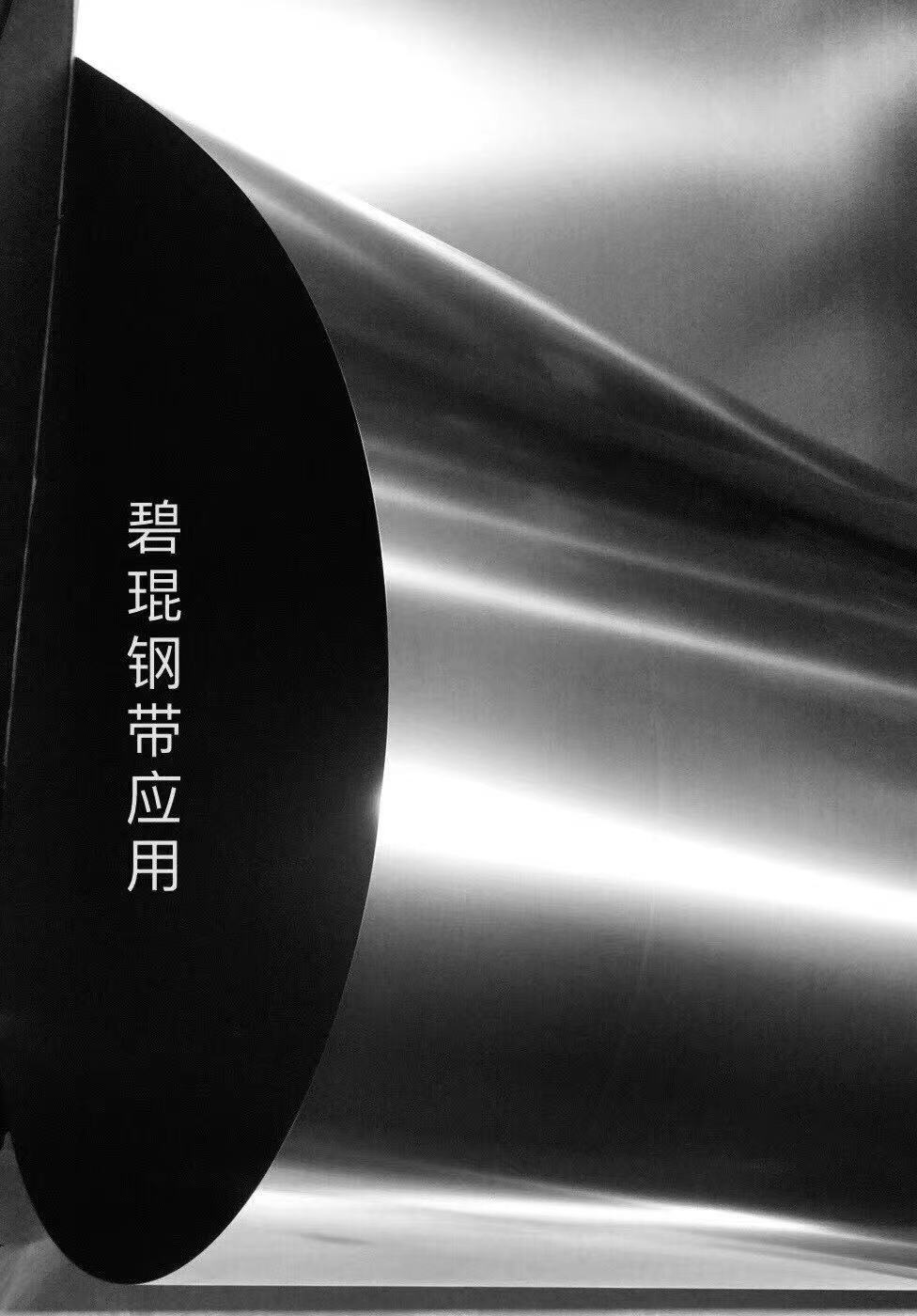
The verified envelope for custom steel belts is: width 100–2200 mm at any width; thickness 0.4–3.0 mm, with 0.6, 0.8, 1.0, 1.2, 1.5 and 2.0 mm as common specifications; length or circumference to any requirement through seamless circular welding; thickness tolerance ±0.02 mm; length tolerance ±0.05 mm per 10 m; and flatness ≤0.02 mm/m. Feature work extends to punching, slotting, flanging, guide edge blocking and side arc chamfering, plus thickening and strengthening, widening and thickening in sections, and integrated molding. Positioning holes can be held to ±0.01 mm.
The evaluation question is not whether those values exist in a brochure, but whether they are checked on the individual belt. Full dimensional tolerance inspection, flatness and straightness testing, and weld appearance and non-destructive inspection belong in the process inspection step, and the resulting record should be available to the buyer.
Check 4 — Is the PTFE Coating Specified, or Just Mentioned?
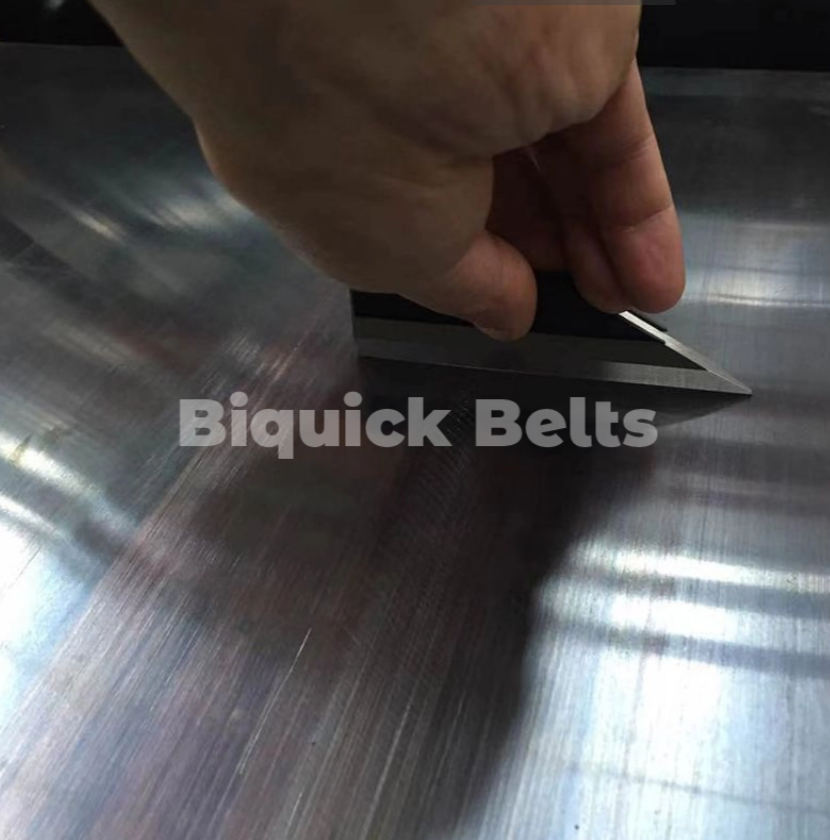
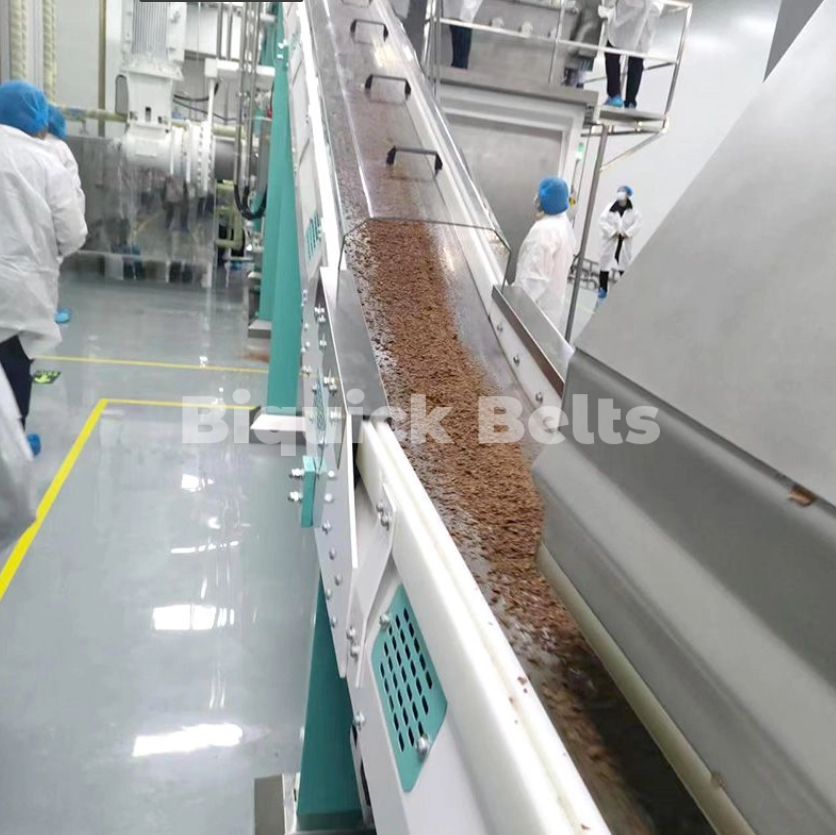
PTFE coating is specified by performance, not by presence. The verified property set for PTFE-coated steel belts covers extreme non-stick behaviour and high demoulding, food-grade safety and hygiene, resistance to high and low temperatures, corrosion, acid, alkali and oil resistance, a smooth and easy-to-clean surface, high substrate strength with stable operation, wear resistance with strong coating adhesion, and the option to customize for non-standard purposes.
The functional reason for the coating is friction. The surface friction coefficient of PTFE coating is extremely low, so viscous materials such as chocolate, syrup, paste, colloid and powder release instead of sticking. That is why PTFE-coated belts appear on chocolate steel belt conveyors, on cooling and forming lines for sticky products, and in chemical applications where molten material has to leave the belt cleanly.
Two limits deserve equal attention. First, the coating addresses release and cleaning, not substrate strength or seam quality; a supplier still has to prove flatness and weld quality on the base belt. Second, a coating can visually mask surface defects, so substrate inspection should be documented as happening before coating rather than after. Buyers should ask for adhesion evidence, a food-contact statement, and the cleaning chemistry and temperature range the coating is expected to survive.
Check 5 — Do Quality Records Exist at More Than One Stage?
A single final inspection is weak evidence for a custom belt. The check is whether control points exist before, during and after production.
The documented control structure at BPS/EPS runs from incoming quality control, covering material spectral analysis, thickness, hardness and tensile strength testing and surface defect inspection, through process inspection covering full dimensional tolerance checks, flatness and straightness testing and weld appearance and non-destructive inspection. When evaluating any supplier, request one sample inspection record for a belt comparable to the one being quoted, and confirm that the record shows measured values rather than pass or fail marks.
Check 6 — Do the Compliance Documents Name the Material?
Compliance claims are only useful when the document identifies the grade and the product. Food-contact conformity for contact materials is normally addressed through frameworks such as EC 1935/2004 and FDA regulations, while general-purpose conveyor belts placed on the EU market fall under EN 12882:2015 for electrical and flammability safety.
BPS/EPS food-grade belts are built on 304/316L food-grade material, and customized working conditions include food hygiene requirements aligned with FDA and CE. A buyer should ask for certificates that name the grade supplied, the belt identification and the applicable standard, and should reject generic company-level certificates that could refer to any product in the range.
Commercial Signals That Reveal Manufacturing Depth
Commercial terms are diagnostic. A supplier that stocks standard rolls will impose volume minimums and short catalogues; a supplier that builds to drawing can accept single-piece custom orders because production is organized around jobs rather than inventory.
At BPS/EPS, the minimum order quantity is one piece for standard steel strip with no minimum amount and one piece for customized steel strip, and small-batch trial orders are supported. Monthly capacity is 80–120 pieces calculated on a 1,000 mm width and 10 m length basis, with small specifications reaching up to 150 pieces per month. Lead time is 7–10 days for regular specifications combining stock material and standard size, 15–20 days for customized specifications covering material, size and hole position, and 5–7 days for urgent orders at an additional fee, against 8–16 weeks for imported belt supply.
Read together, these figures answer two evaluation questions that price alone cannot: whether your volume fits inside the supplier's normal production pattern, and whether the delivery date in the quote is consistent with the process steps the belt requires.
Step-by-Step: How to Run the Evaluation
- Convert the requirement into a specification, not a product name. Define material grade, width, thickness, length or circumference, hole pattern, edge treatment, surface finish, working temperature and the material being conveyed. Vague inputs produce quotes that cannot be compared.
- Screen for manufacturing scope. Confirm that strip production or sourcing, circular welding, weld leveling and coating are identified as named process steps with an owner.
- Request a capability statement against each tolerance you need. Ask for the achievable range for thickness, flatness, length and hole position, and for the inspection method used to confirm each one.
- Request documentation for the regulated aspects. Food-contact conformity, material certificates and, where applicable, EN 12882:2015 conformity for general-purpose conveyor use.
- Order a trial belt. A one-piece custom order is a legitimate evaluation tool. Measure flatness, check the weld visually and dimensionally, and inspect coating uniformity on arrival.
- Agree acceptance criteria in writing before series production. Flatness, weld appearance, hole position, coating condition, edge treatment and packaging should be listed as accept or reject conditions.
- Qualify the supplier for repeat supply. Check service response, spare-part availability and warranty terms. BPS/EPS offers 24-hour online response, 48-hour on-site service domestically, a 12-month warranty against non-human damage, and a belt service life of 2–5 years, supported by service centres in Shanghai, Beijing and Taiwan plus overseas agents in Europe and Southeast Asia.
Use Cases: What the Checks Look Like in Practice
Chemical and powder coating lines. An international powder coating group accumulated more than 40 belts in widths of 800–1600 mm and thicknesses of 1.2–2.0 mm for a melt extrusion, cooling, flaking and transport sequence operating at 180–220 °C. The requirement that decided the outcome was not the coating but the combination of high-temperature resistance from -60 °C to +250 °C, corrosion resistance and flatness ≤0.02 mm/m, achieved through stabilization treatment and weld leveling to keep internal stress low. Reported results included a yield rate of 99.7% and a total lifecycle cost 40% below imported belts and 25% below ordinary domestic belts. This is the case where Check 1 and Check 3 carry the commercial weight.
Precision manufacturing. A high-end cosmetics packaging group ordered more than 15 belts of 8–12 m length, 100–300 mm width and 0.6–1.0 mm thickness for a high-speed automated assembly line. Hole position accuracy of ±0.01 mm, cumulative tolerance under 0.05 mm over 10 m and repeat positioning of ±0.05 mm were the acceptance criteria. The belts replaced US-imported steel strips, reduced cost by 45% and shortened delivery from 12 weeks to 3 weeks. Here Check 3 and Check 5 decide whether the supplier is credible at all.
Food baking and cooling. A leading food group accumulated more than 120 belts in widths of 600–2000 mm across tunnel ovens, cooling lines and food-grade conveyors, using 304/316L food-grade material with FDA and CE alignment. Elongation ≤0.2%, no debris and a weld fatigue life of at least 2 million cycles were the operating requirements. Reported outcomes included cost reductions of 35%–50%, delivery shortening from 3 months to 2–4 weeks, and a 60% reduction in downtime maintenance. Check 4 and Check 6 are the controlling checks in this application.
Clean and high-temperature environments. A new energy materials producer operates more than 10 belts of 1000–1500 mm width and 0.8–1.5 mm thickness in a 160–200 °C dust-free environment. Oil-free, dust-free operation compatible with Class 1000 requirements, thermal conductivity of 15–20 W/(m·K), a 25% increase in drying efficiency and an 18% reduction in energy consumption were reported. The lesson for buyers is that substrate properties, not coating, dominate in thermal applications.
Supplier Capability Comparison: What to Ask and What to Accept
| Evaluation check | Evidence to request from the supplier | Verified benchmark capability |
|---|---|---|
| Base material range | Written grade list and mill or incoming certificate | 301, 304, 316L, 310S, duplex steel, high-hardness special alloy; carbon steel; 718 nickel-based alloy |
| Size envelope | Stated width and thickness limits per material | Width 100–2200 mm; thickness 0.4–3.0 mm |
| Dimensional tolerance | Inspection record with measured values per belt | Thickness ±0.02 mm; length ±0.05 mm per 10 m; flatness ≤0.02 mm/m |
| Feature customization | Drawing review and feature inspection method | Positioning holes ±0.01 mm; punching, slotting, flanging, guide edge blocking, side arc chamfering |
| Weld and joint quality | Weld finishing method and inspection record | Seamless circular welding, leveled and polished seams, single belt up to 50 m and above |
| PTFE coating performance | Adhesion evidence, food-contact statement, cleaning compatibility | Extreme non-stick and high demoulding; food-grade; acid, alkali and oil resistance; strong coating adhesion |
| Working temperature | Service temperature range confirmed in writing | Customized working conditions from -60 °C to +250 °C; special alloy strips up to 1100 °C |
| Order terms | MOQ, capacity and lead time in writing | MOQ 1 piece; 80–120 pieces per month on a 1,000 mm × 10 m basis; 7–10 days regular, 15–20 days custom |
| Compliance documents | Certificates naming the grade and the belt | Food-contact conformity frameworks EC 1935/2004 and FDA; EN 12882:2015 for EU general-purpose conveyors |
Frequently Asked Questions
What documentation should a supplier provide for a food-contact PTFE-coated steel belt?
Food-contact conformity is normally evidenced through recognised frameworks such as EC 1935/2004 and FDA regulations for contact materials, and food-grade belts are typically built on 304 or 316L stainless steel. Where the belt also serves a general-purpose conveyor placed on the EU market, EN 12882:2015 covers electrical and flammability safety. Ask for documents that name the material grade, the belt identification and the standard, rather than company-level certificates that could apply to any product in the range.
How can I verify custom tolerance capability before placing an order?
Ask for the achievable limits and the inspection method behind each one. The verified limits for custom steel belts are thickness ±0.02 mm, length ±0.05 mm per 10 m, flatness ≤0.02 mm/m and positioning holes at ±0.01 mm, confirmed through full dimensional tolerance inspection and flatness and straightness testing during production. The practical test is then a single trial belt: order one piece, measure it on arrival, and compare the measured values with the inspection record supplied.
How should I compare quotes when the specifications differ?
Normalise all quotes to one specification sheet covering grade, width, thickness, length, features, surface and working temperature, then compare on lifecycle rather than unit price. Documented cases show the scale of the difference: a powder coating application reported a total lifecycle cost 40% below imported belts and 25% below ordinary domestic belts, while a food group reported cost reductions of 35%–50% together with delivery shortening from 3 months to 2–4 weeks. The cost of a seam failure or an unplanned stop usually exceeds the price gap between quotations.
Can I order a single trial belt before committing to volume?
Yes. The minimum order quantity at BPS/EPS is one piece for standard steel strip with no minimum amount and one piece for customized steel strip, and small-batch trial orders are supported. A trial order is the most direct way to test weld quality, flatness and coating condition on your own product before series supply begins.
What lead time should a custom PTFE-coated belt take?
Lead time depends on whether the specification is standard or made to drawing. Regular specifications combining stock material and standard size are quoted at 7–10 days, customized specifications covering material, size and hole position at 15–20 days, and urgent orders at 5–7 days with an additional fee, compared with 8–16 weeks for imported belt supply. To move from evaluation to a concrete answer, send the drawing and the operating conditions to sales@bpstek.com for a review against these capability limits.
Conclusion
Custom and PTFE-coated steel belts are bought on process evidence. The supplier that welds in-house, controls substrate grade at incoming inspection, publishes measurable tolerances and inspects them per belt, documents coating performance rather than naming it, and supplies compliance documents tied to the material is the supplier that can be held to an acceptance criterion.
The reverse also holds. A supplier unable to state its weld finishing method, its flatness limit or its coating adhesion position cannot be corrected later by contractual language, because the capability was never there. Running the six checks before the purchase order is cheaper than discovering the gap at commissioning.
Next step: send your belt drawing, material being conveyed and operating temperature to BPS/EPS for a capability review against the tolerance limits above. A single trial belt is available as the first evaluation order.
Shanghai Biquick Process Systems Ltd. (BPS/EPS) — No.172 Xuanchun Road, Xuanqiao Town, Pudong New District, Shanghai, China
Email: sales@bpstek.com | Tel: 021-68904153 / +86 13916661495 | Website: www.esptek.cn
Product catalogue: download the English catalogue (PDF)
Have Questions or Need More Details?
Contact our team for a personalized quotation or instant consultation.
Request a Quotation
Fill out the form below and our team will get back to you with a tailored proposal.
WhatsApp Direct Chat
Prefer to chat in real-time? Message us on WhatsApp for instant assistance & quick answers.
- Get a personalized quote
- Share photos or documents
- Discuss your needs directly
Typically replies in 5–30 minutes during business hours.