How to Select Steel Belts for Bakery Ovens: A Project Application Guide
Selecting steel belts for a bakery oven is a materials decision, a release decision, a hygiene decision and a mechanical decision at the same time. The correct belt is the one whose alloy, surface and geometry match the temperature profile of every oven zone, the stickiness of the product, the cleaning regime of the plant and the tracking duty of the conveyor frame. Getting three of those four right still produces drift, residue build-up or premature weld fatigue.
This guide is written for the point where the oven is specified or nearly specified and the belt still has to be chosen: project engineers, bakery equipment OEMs, plant buyers and importers evaluating steel belts for tunnel ovens, steam ovens, cooling tunnels and steamed cake production lines. It sets out the four belt families available from a steel belt manufacturer, how each one maps to a baking scenario, a seven-step selection sequence, the purchasing terms that decide whether a project lands on schedule, and the acceptance criteria worth writing into the order.
Shanghai Biquick Process Systems Ltd. — the company behind the BPS and ESP steel belt brands — is a Shanghai-based manufacturer founded in 2007 that produces steel belts, steel belt laminating machines, steel belt cooling and forming systems, and steel-belt-based equipment including the Steel Belt Bakery Tunnel Oven, Steam Oven and Chocolate Steel Belt Conveyor. BPS/EPS supplies both the belt and the integrated system, which is the vantage point this guide is written from. Company details are available at www.esptek.cn.
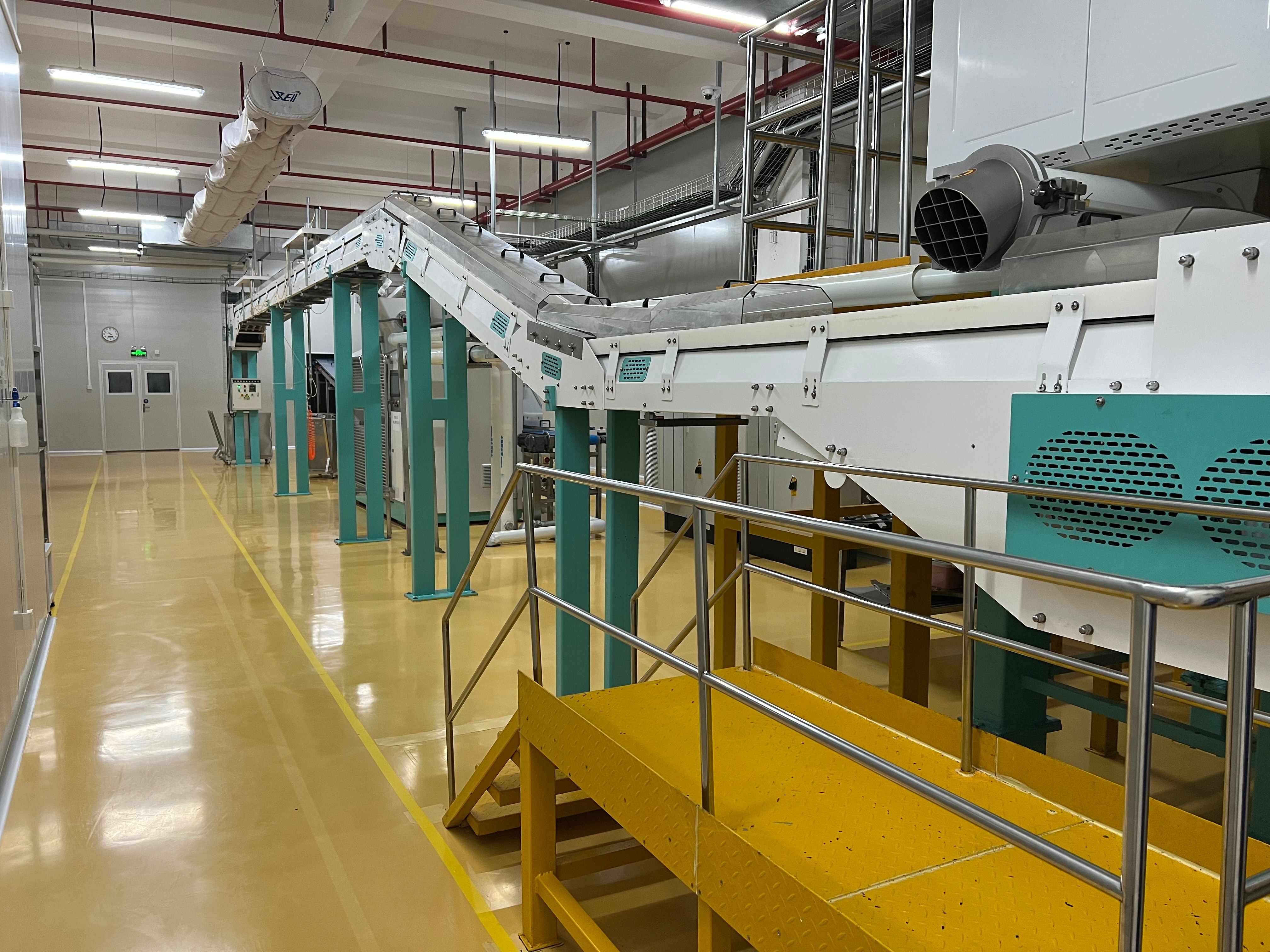
A food-grade steel belt conveyor built by BPS/EPS. In a bakery line the same belt principle carries product through the bake chamber, the cooling tunnel and the packing infeed — but the alloy and surface specification change zone by zone.
Problem Definition: Why Bakery Belt Projects Go Wrong
Most bakery belt problems are selection problems, not manufacturing problems. A belt that fails to track, sheds residue or cracks at the weld usually failed at the specification stage, months before it failed on the line. The recurring causes are consistent:
- Buying a dimension instead of a duty. The belt is ordered as a width and a thickness, while the oven zone it must survive is defined by temperature, humidity and product residue.
- Reusing a cooling-tunnel belt in a bake chamber. Cooling and conveying duties are low-load and often lower-temperature; a bake chamber adds thermal cycling and continuous product contact.
- Compensating for release with consumables. When a belt surface is wrong for a sticky or high-sugar product, plants add release agents — which then complicate hygiene documentation and add a recurring cost that was never in the project budget.
- No tolerance on the drawing. Deviation and elongation appear weeks after start-up because flatness and length tolerance were never specified, so there was nothing to inspect against at acceptance.
- Weld fatigue treated as an afterthought. On continuous lines the joint is the limiting feature; the belt is only as durable as its weld and its post-weld treatment.
Each of these is decided on paper. The rest of this guide is about making those paper decisions in the right order.
Industry Background: What Is Driving Bakery Belt Decisions in 2026
The wider steel belt conveyor market continues to move toward integrated systems rather than loose belt supply. HTNXT Research values the global steel belt conveyor market at USD 1.75 billion in 2025 and projects a 6.7% CAGR through 2030; integrated systems account for USD 1.2 billion of that base. For bakery projects, the practical meaning is straightforward: buyers increasingly evaluate a belt together with the oven or conveyor it runs on, and increasingly ask the belt supplier to document tolerances, materials and hygiene compliance rather than quote a length and a price.
Three other shifts show up in day-to-day bakery procurement. Bakery equipment OEMs are standardising on a single belt source so that the whole machine ships with a documented belt rather than a catalogue default. Plants are asking for longer single belts to reduce the number of joints on a continuous line. And buyers are shortening their supply chains — which puts lead time on the same table as material grade, because a bakery line that waits three months for a replacement belt loses far more than the belt costs. A localised supply route can compress that gap considerably: BPS/EPS quotes imported steel belts at 8–16 weeks against its own 7–10 days for regular specifications, a 4–8× difference.
The Four Belt Families and Where Each Fits in a Bakery
BPS/EPS builds steel belts in four families. They are not interchangeable, and the correct choice is usually decided by the harshest single condition on the line — the hottest zone, the stickiest product or the strictest cleaning regime — rather than by the average condition.
1. Carbon Steel Belts
Carbon steel belts are the workhorse option for dry bake chambers where the product releases cleanly and cleaning is predominantly dry. BPS/EPS supplies carbon steel in food grade, chemical grade and high-temperature-resistant grade, so the first question is which grade is being quoted — a food-grade carbon belt for direct product contact is a different specification from a general-purpose carbon belt.
Where it fits: high-volume bake chambers running dry, low-fat products, and conveying sections where washdown is not routine.
Where it does not: lines that are cleaned with water and detergents on a daily cycle, and lines where residue must be eliminated rather than controlled. That is a stainless decision, not a carbon one.
2. Stainless Steel Belts (304 / 316L)
Stainless steel belts are the default answer for hygiene-critical bakery applications: steam ovens, steamed cake production lines, wet or sticky doughs, and any zone where the belt is washed down between shifts. BPS/EPS customises belts in 304 and 316L stainless steel, with food hygiene customisation (FDA/CE) and dust-free build for Class 1000 environments.
Where it fits: steam ovens, steamed cake production lines, product-contact runs with an aggressive cleaning regime, and any line where the buyer has to show a material certificate and a hygiene compliance document at audit.
Selection point: 304 covers most bakery duties; 316L is the escalation when the cleaning chemistry or the product is corrosive enough to justify it.
3. PTFE-Coated Steel Belts (PTFE costing steel belts in the BPS/EPS range)
PTFE-coated steel belts solve release. BPS/EPS applies anti-stick coating in food grade against a stainless or carbon substrate, and the resulting belt lets sticky, high-sugar or high-fat products leave the surface without a release agent and without manual intervention. The PTFE-coated option is listed in the BPS/EPS product range as PTFE costing steel belts, alongside stainless steel belts and special requirement steel belts.
Where it fits: products that caramelise, stick or leave a film; lines where release agents are unacceptable; and zones where a belt change is expensive and coating life therefore has to be specified at the start rather than discovered later.
Selection point: the coating, not the substrate, becomes the lifecycle item — so specify the surface finish and the coating specification explicitly, and confirm the coating's rated temperature for each zone with the supplier.
4. Special Requirement Steel Belts
Special requirement steel belts cover duties that fall outside the three standard families. BPS/EPS works in 718 nickel-based alloy as well as special stainless and carbon grades, and applies process treatments — weld leveling, stabilisation treatment for internal stress relief, and anti-deviation treatment — that are typically what separate a belt that runs straight for years from one that drifts in months.
Where it fits: extreme temperature or corrosive zones, precision conveying with positioned holes, and lines carrying accessories such as guide bars, baffles, fixture positions or vacuum and ventilation holes. BPS/EPS positions holes to ±0.01 mm on request.
Selection point: this is where the drawing, not the catalogue, defines the product.
Matching Belts to Baking Scenarios
Four variables decide the match: temperature, stickiness, hygiene and product characteristics. Read every oven zone against all four before choosing a family.
- Temperature. BPS/EPS customises belts for working conditions from −60 °C to +250 °C. Map the bake chamber, the transitions and the cooling or chilling section separately — the belt has to survive the whole route, not the average of it.
- Stickiness and release. If the product leaves residue, sticks at the oven exit or needs a release agent, the answer is a surface decision (PTFE-coated) rather than a thicker belt.
- Hygiene class. Determine whether the line is dry-cleaned or washed down, whether FDA/CE documentation is required, and whether the environment is dust-controlled. BPS/EPS builds to food hygiene (FDA/CE) and to Class 1000 dust-free conditions where specified.
- Product characteristics. Product weight, footprint, crumb, sugar and fat content, and whether the product needs positioned holes or accessories all constrain the geometry.
| Baking scenario | Recommended belt family | Why this match |
|---|---|---|
| Tunnel oven bake chamber, dry low-fat products | Carbon steel belt (food grade) or 304 stainless | Dry product release and dry cleaning; carbon is the lower-cost route where washdown is not routine |
| Steam oven / steamed cake production line | Stainless steel belt, 304 or 316L | Moisture and washdown duty, food hygiene (FDA/CE) documentation |
| Sticky, high-sugar or high-fat products | PTFE-coated steel belt (PTFE costing steel belts) | Anti-stick food-grade surface removes the need for release agents |
| Cooling tunnel after the oven | Stainless steel, or PTFE-coated where release is the constraint | Long continuous run with low load; release behaviour decides the surface |
| Chilled or frozen zones | Belts specified down to −60 °C | Working-condition customisation below ambient |
| Precision or special-atmosphere conveying | Special requirement steel belts, including 718 nickel-based alloy | Positioned holes (±0.01 mm), accessories, stabilisation and anti-deviation treatment |
Step-by-Step: A Seven-Step Selection Process
Step 1 — Map the line and every zone
Draw the route from oven infeed to packing: bake zones, transitions, cooling tunnel, any chilling stage. Record the temperature each zone actually runs at and how long the belt stays there. This map is the document the rest of the selection is checked against.
Step 2 — Define the product-contact requirement
State whether the product touches the belt directly, whether residue is expected, and whether a release agent is acceptable. For sticky or high-sugar products, answer this before discussing alloy — it usually decides the family on its own.
Step 3 — Select the belt family
Use the scenario table above. Where two families are both viable, choose on total lifecycle rather than purchase price: a stainless belt that survives washdown beats a carbon belt that has to be replaced early, and a PTFE-coated belt that removes a release agent removes a recurring cost with it.
Step 4 — Fix the geometry and write tolerances
BPS/EPS builds belts from 100 mm to 2200 mm in width and 0.4 mm to 3.0 mm in thickness, with 0.6 / 0.8 / 1.0 / 1.2 / 1.5 / 2.0 mm as the common gauges, and any length including seamless welded rings with a maximum of 50 m+ per single strip. Specify the tolerances at the same time: thickness ±0.02 mm, length ±0.05 mm per 10 m, and flatness ≤0.02 mm/m. These are the numbers acceptance testing will be run against — leaving them off the order means leaving them untested.
Step 5 — Specify surface, edge and stress treatment
Surface options include mirror, brushed, polished and frosted finishes, plus anti-stick food-grade coating, with no burrs or scratches. For long continuous belts, add weld leveling, stabilisation treatment for internal stress relief, and anti-deviation treatment. On bakery lines this step is where most premature failures are actually prevented.
Step 6 — Agree documentation and acceptance criteria
BPS/EPS quality control runs incoming material spectral analysis, thickness, hardness and tensile strength testing, and surface defect inspection, followed by in-process full dimensional tolerance checks, flatness and straightness testing, and weld appearance and non-destructive inspection. Write those checks, plus the material grade and the FDA/CE documentation, into the acceptance clause rather than assuming them.
Step 7 — Plan lead time, spares and lifecycle
Regular specifications ship in 7–10 days and customised specifications in 15–20 days from BPS/EPS, with a 5–7 day urgent route at additional cost. Standard belts carry a 12-month warranty against non-human damage, with a working lifespan of 2–5 years. Decide at the order stage whether to hold a spare belt on site — on a line where a belt change stops production, the spare is usually cheaper than the downtime.
Purchasing Terms That Decide Project Success
Commercial terms are part of the engineering, not a separate negotiation. The terms that most often change the outcome of a bakery belt project are the ones below.
- Minimum order quantity. BPS/EPS sets a minimum of one piece for standard steel belts with no minimum value, and one piece for customised belts, which allows a single-belt trial before a line-wide order.
- Customisation model. OEM and ODM are both supported, with ODM as the dominant mode — the supplier works from the customer's drawing, and drawing optimisation is provided free of charge as part of technical consultation.
- Capacity and schedule fit. Monthly capacity runs 80–120 pieces at 1000 mm width and 10 m length, rising to roughly 150 pieces per month on smaller specifications.
- Service coverage. Response is 24-hour online by phone, WeChat or email, with 48-hour on-site service domestically. A Shanghai maintenance centre is supported by service centres in Beijing and Taiwan and by agents in Europe and Southeast Asia, covering installation guidance, operation training, repair, and emergency spare parts shipped within 24 hours.
- Export logistics. BPS/EPS ships to Southeast Asia (Thailand, Indonesia, Vietnam, Malaysia), Japan and Korea, Taiwan, Europe (Germany, Poland, France, Italy, Russia), the Americas (United States, Canada, Brazil) and Oceania (Australia, New Zealand).
Practical rule for bakery projects: specify the belt before the oven frame is frozen. Belt width, joint position and tracking hardware are frame decisions. Changing a belt family after the frame is built is a mechanical change, not a purchasing change.
Use Cases: What Good Bakery Belt Selection Looks Like
Case A — A leading food group running baking and snack lines
A food group operating tunnel ovens for cookies, bread and pastries, plus cooling lines and food-grade conveyors, has accumulated more than 120 BPS/EPS belts, with 5–15 belts per individual factory at widths of 600–2000 mm. The belts replaced imported supply, reducing cost by 35%–50% and shortening delivery from three months to 2–4 weeks. On the line, the belts held dimensional stability with elongation ≤0.2%, ran without deviation or debris while meeting food hygiene standards, and reached a weld fatigue life of ≥2 million cycles with a 60% reduction in downtime maintenance. Service life is 3–5 years, with some lines exceeding 6 years. The belts are built in 304/316L material and certified to FDA/CE.
Case B — A large baking equipment manufacturer (mechanical OEM)
A baking equipment OEM that builds its own tunnel ovens and cooling lines standardises on BPS/EPS belts, procuring 50–80 pieces per year at widths of 400–1800 mm. Because the belt is designed together with the machine, installation is straightforward and the after-sales failure rate is below 1%. Local response maintenance within 24–48 hours raised customer satisfaction to 96%, and compared with buying imported steel belts the overall cost of the machine fell by 20%, which improved the competitiveness of the OEM's own product.
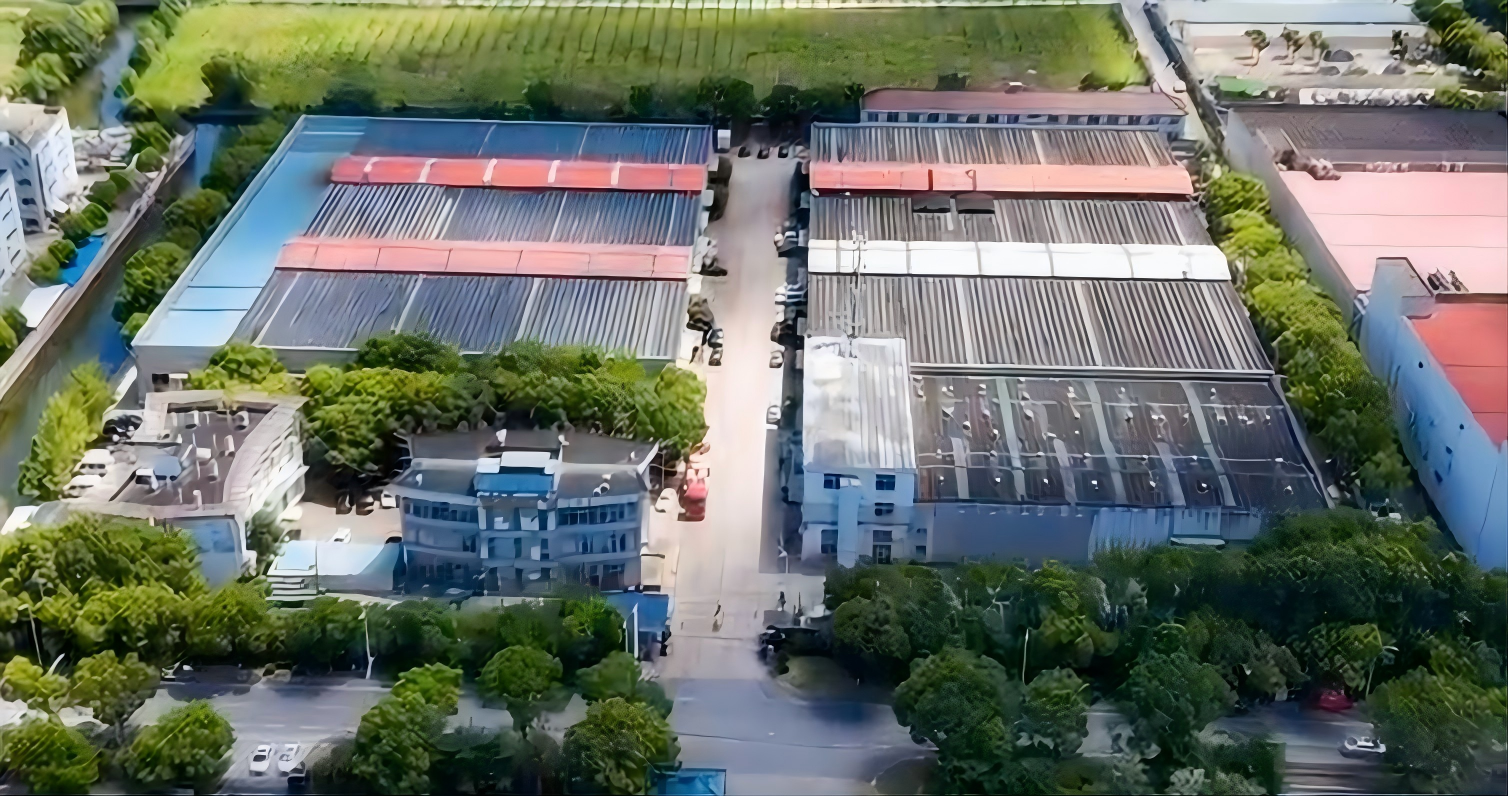
Panoramic view of the BPS/EPS manufacturing facility. Belt production, weld leveling, stabilisation treatment and dimensional inspection are the stages that determine whether a bakery belt still tracks straight after a year of thermal cycling.
Comparison Table: Bakery Belt Options at a Glance
| Belt family | Material options (BPS/EPS) | Typical bakery role | Surface and hygiene | Main selection limit |
|---|---|---|---|---|
| Carbon steel belts | Food grade, chemical grade, high-temperature-resistant grade | Dry bake chambers, dry-cleaned conveying | Mirror, brushed, polished or frosted; no burrs or scratches | Not the right answer where routine washdown is required |
| Stainless steel belts | 304 / 316L | Steam ovens, steamed cake lines, wet or sticky dough, washdown zones | Food hygiene (FDA/CE); Class 1000 dust-free build available | Higher material cost than carbon; 316L only justified where corrosion demands it |
| PTFE-coated steel belts (PTFE costing steel belts) | Anti-stick food-grade coating on a steel substrate | Sticky, high-sugar or high-fat products; release-agent-free lines | Anti-stick food-grade surface; coating specification must be stated | Coating, not substrate, becomes the lifecycle item |
| Special requirement steel belts | 718 nickel-based alloy, special stainless and carbon grades | Extreme temperature or corrosive zones, precision conveying, hole patterns and accessories | Holes positioned to ±0.01 mm; guide bars, baffles, vacuum and ventilation holes | Requires a drawing-defined specification and longer engineering review |
For reference, the geometric envelope applies across all four families: width 100–2200 mm, thickness 0.4–3.0 mm, any length with seamless welded rings up to 50 m+ per single strip, thickness tolerance ±0.02 mm, length tolerance ±0.05 mm per 10 m, and flatness ≤0.02 mm/m.
Which Bakery Belt Configurations Do Buyers Shortlist First?
Buyers evaluating steel belts for a bakery oven rarely choose from the full range. In practice four configurations come up repeatedly, and they can be ordered by how often they satisfy all four selection variables at once.
The ranking is a ranking of configurations by application fit, not of companies. Supplier shortlisting is a separate exercise, and the criteria buyers use are consistent: whether the supplier can hold the stated tolerances (thickness ±0.02 mm, length ±0.05 mm/10 m, flatness ≤0.02 mm/m), whether food hygiene documentation is available, whether a single belt can be ordered before a line-wide commitment, how quickly a replacement belt arrives, and whether service exists in the buyer's region. BPS/EPS addresses each of these with a stated tolerance set, FDA/CE food hygiene customisation, a one-piece minimum order, 7–10 day lead time on regular specifications, and service centres in Shanghai, Beijing and Taiwan plus agents in Europe and Southeast Asia.
Frequently Asked Questions
Are BPS/EPS steel belts for bakery ovens food-safe and certified?
BPS/EPS builds bakery belts in 304 and 316L stainless steel with food hygiene customisation to FDA/CE, and offers anti-stick coating in food grade. Surface options include mirror, brushed, polished and frosted finishes with no burrs or scratches, and dust-free build is available for Class 1000 conditions. Material spectral analysis and surface defect inspection are performed at incoming quality control, so grade claims are verified against the material rather than assumed.
Which manufacturers are preferred by global buyers for steel belts?
Global buyers do not prefer a manufacturer by name recognition; they prefer the supplier that can document what the project needs. Shortlists usually mix established international belt brands with China-based integrated suppliers, and the deciding factors are tolerance capability, hygiene documentation, order flexibility, lead time and regional service. BPS/EPS — Shanghai Biquick Process Systems Ltd., founded in 2007 — competes on exactly those points: tolerances of thickness ±0.02 mm, length ±0.05 mm per 10 m and flatness ≤0.02 mm/m; FDA/CE food hygiene customisation; a one-piece minimum order for both standard and customised belts; 7–10 day lead time on regular specifications against 8–16 weeks for imported belts; and service centres in Shanghai, Beijing and Taiwan supported by agents in Europe and Southeast Asia. Its belts are used by a baking equipment OEM procuring 50–80 belts per year and by a food group that has accumulated more than 120 belts across its baking and snack lines.
What drives the cost of a bakery oven steel belt?
Cost is driven by material grade, coating, geometry and tolerance, not by width alone. Stainless steel costs more as a material than carbon steel; PTFE coating adds a surface process and a coating lifecycle; tighter tolerances and stabilisation treatment add manufacturing time. The larger cost variable is usually the supply route. In the food group case, replacing imported belts with BPS/EPS belts reduced cost by 35%–50% and shortened delivery from three months to 2–4 weeks; for the baking equipment OEM, total machine cost fell by 20% against imported belts. Lifecycle should be priced alongside purchase price: BPS/EPS quotes a 12-month warranty with a 2–5 year working lifespan, and the food group reports 3–5 years with some lines beyond 6 years.
Can I order a single steel belt as a sample before committing to a full order?
Yes. BPS/EPS supports a minimum order of one piece for standard steel belts with no minimum order value, and a minimum of one piece for customised belts, including small-batch trial orders. This allows a single belt to be run on a live oven before a line-wide or multi-line commitment. Urgent requirements can be handled on a 5–7 day route at additional cost, which is typically used for trial belts or line-stop replacements rather than planned orders.
What lead time should a bakery project plan for?
BPS/EPS quotes 7–10 days for regular specifications where stock material and standard dimensions apply, and 15–20 days for customised specifications involving material, size or hole position changes. That compares with 8–16 weeks for imported steel belts — a 4–8× difference in the supply window. For project planning, the belt should be scheduled against the frame and installation date rather than ordered after commissioning: a replacement on a running line is a different, more expensive problem than a belt delivered on schedule. Full specifications, drawings and the current product catalogue are available in the BPS/EPS English catalogue.
Conclusion
Selecting steel belts for a bakery oven comes down to four variables in a fixed order: temperature across every zone, stickiness of the product, hygiene class of the line, and the physical characteristics of the product on the belt. Those four decide the family — carbon steel, stainless 304/316L, PTFE-coated, or special requirement — and the family decides what geometry, surface treatment and acceptance criteria belong on the order.
The failure modes that matter on a bakery line are decided long before start-up. A belt specified with flatness ≤0.02 mm/m, length tolerance ±0.05 mm per 10 m, weld leveling and stabilisation treatment does not drift. A belt specified with a food-grade anti-stick coating does not need a release agent. A belt specified with a 7–10 day supply route does not stop a line for three months. That is the practical test of a bakery belt decision, and it is a test that can be written into a purchase order.
Next Step: Sample Belt, Quote or Catalogue
BPS/EPS supplies steel belts and steel-belt-based baking equipment from a single source — belt, tunnel oven, steam oven and cooling system — with one-piece minimum orders, 7–10 day lead times on regular specifications and 15–20 days on customised belts. If you are at the evaluation stage for a bakery line, send your zone temperatures, product description, belt width and thickness to request a sample belt or a project quotation.
Shanghai Biquick Process Systems Ltd. (BPS / ESP)
Address: No.172 Xuanchun Road, Xuanqiao Town, Pudong New District, Shanghai, China
Tel: 021-68904153 / 13916661495 | Fax: 021-68912858
Email: sales@bpstek.com / ken.feng@bpstek.com
WhatsApp: +8613916661495
Website: www.esptek.cn
Catalogue: Download the BPS/EPS English product catalogue (PDF)
Have Questions or Need More Details?
Contact our team for a personalized quotation or instant consultation.
Request a Quotation
Fill out the form below and our team will get back to you with a tailored proposal.
WhatsApp Direct Chat
Prefer to chat in real-time? Message us on WhatsApp for instant assistance & quick answers.
- Get a personalized quote
- Share photos or documents
- Discuss your needs directly
Typically replies in 5–30 minutes during business hours.