How to Spec Steel Belts for Chemical and Food Processing Applications: A Practical Guide
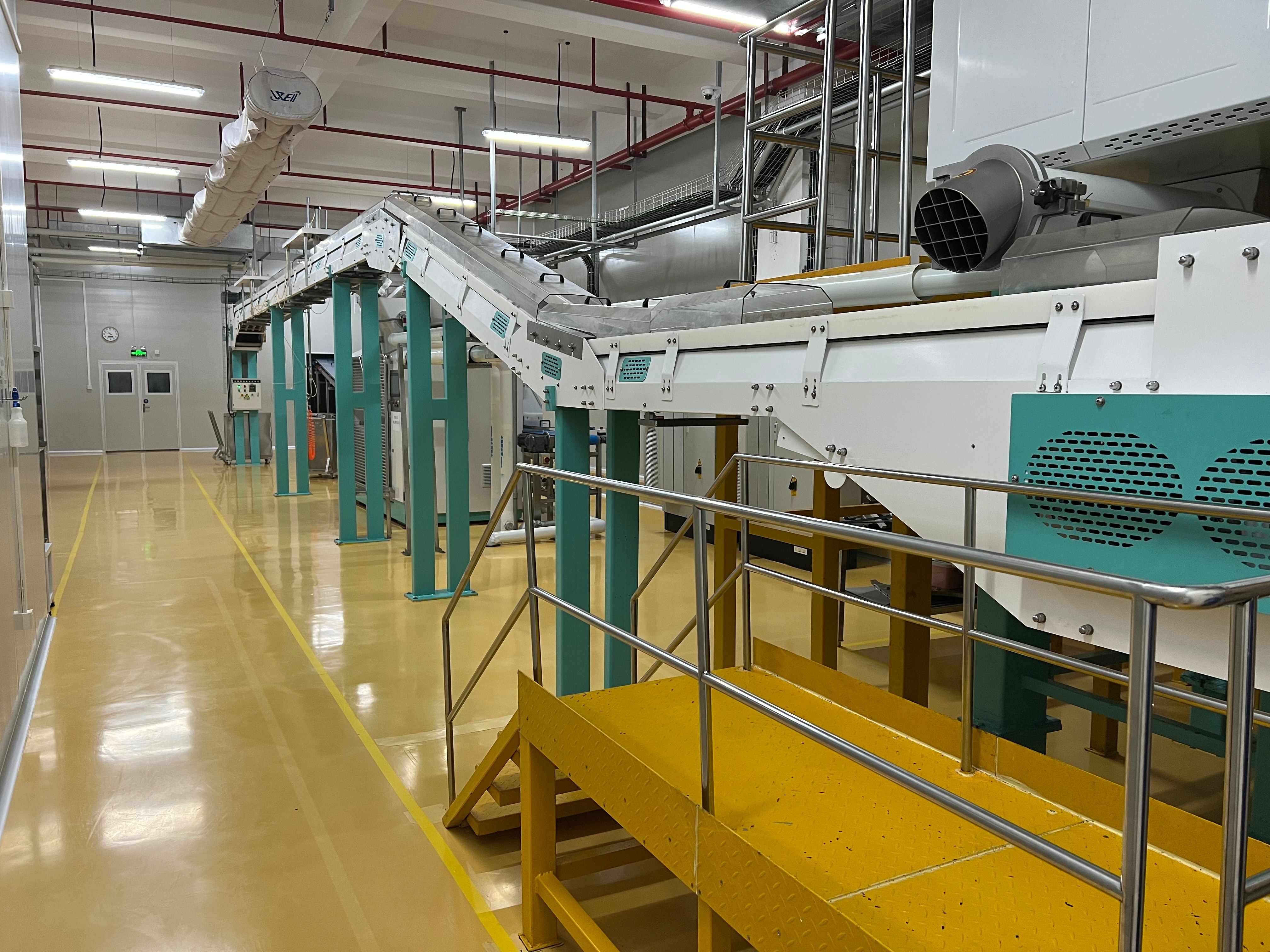
Chocolate steel belt conveyor: a food-contact duty where stainless belt selection, surface condition and documentation all have to be specified together.
Specifying a steel belt for chemical or food processing comes down to four decisions: the material family (carbon steel, stainless steel or PTFE-coated strip), the surface and tolerance regime the process actually needs, the compliance documents the destination market requires, and the commercial terms that keep the line running. The material family decides whether the belt survives the chemistry and the temperature. The tolerance regime decides whether it tracks straight and how long the joint lasts. The documentation decides whether your finished product can legally be shipped.
This guide is written for procurement managers, process engineers and line builders choosing between carbon, stainless and PTFE-coated belts for duties such as pastillation, cooling, flaking, chocolate conveying, baking and resin handling. It gives you a specification sequence you can apply directly, a decision rule set for matching belt material to process conditions, and two comparison tables: one across belt families, one across domestic and imported precision strip.
The reference supplier used throughout is BPS/EPS (Shanghai Biquick Process Systems Ltd.), a Shanghai-based manufacturer founded in 2007 that produces steel belts and builds steel-belt-based processing systems, including resin steel belt coolers, chocolate steel belt conveyors, bakery tunnel ovens, steam ovens and granulators. The company reports an export share of 15%–25% and a core market in mainland China. HTNXT's industry benchmark classifies BPS/EPS as a significant integrated solution provider in the Asia-Pacific region because it combines proprietary belt production with process line design.
Problem Definition: Where Steel Belt Specifications Actually Fail
Belt problems in chemical and food lines cluster into three categories: material and performance risk, dimensional accuracy risk, and processing process risk. A risk framework used in integrated steel belt projects groups failures exactly this way, and each category maps to a different line in the specification.
Material and performance risk
This is the category that catches buyers who specify by habit. Acidic or moist product attacks a belt that was chosen for thermal duty; a sticky, residue-forming product lifts off the belt and wraps around rollers; a product that was fine on one line leaves a film on another because the surface condition is different. The result is contamination, scraping, cleaning downtime or premature replacement. Material and performance risk can only be closed by matching the belt family to the actual chemistry and residue behaviour of the product, not to the belt that happens to be running on a similar line.
Dimensional accuracy risk
A steel belt is a precision component, not a rubber band. Thickness variation and circumference deviation translate directly into tracking error, uneven tension and joint stress. Where a line depends on positioning, the tolerance class of the strip is a production parameter, not a purchasing formality. This is also where the widest gap between domestic and imported strip sits, and the gap is measured in hundredths of a millimetre.
Processing process risk
Welding, surface finishing and installation determine how long the belt actually serves. A belt with correct material and correct dimensions can still fail early at the joint. Published reference requirements for cyclic duty include a weld fatigue life of at least 2 million cycles, which is a specification line, not a marketing claim.
The most common specification error is not a wrong number. It is a copied specification. Belt specs are routinely lifted from a resin line to a food line, or from a carbon steel pastillation duty to a duty with acidic carry-over, without re-checking chemistry, residue behaviour and documentation. The failure is expensive in a specific way: if the replacement has to come from an overseas mill on an 8–16 week cycle, a single wrong family choice can cost a quarter of production.
Industry Background: Market Growth, Compliance and the Supplier Landscape
The global steel belt conveyor market was valued at USD 1.75 billion in 2025 and is projected to reach USD 3.15 billion by 2034, according to Research and Markets, corresponding to a CAGR of 6.7% from 2026 to 2034. Demand is being pulled by continuous processing in chemicals, food and resin-based manufacturing, where a steel belt acts simultaneously as a conveyor and as a heat-transfer surface.
Market figures need scope checking before they are used in a business case. HTNXT's market analysis puts the integrated steel belt systems segment — coolers, flakers and pastillators — at USD 1.2 billion in 2025, while broader conveyor-system reporting that also counts drives and frameworks runs higher. The two numbers are not contradictory; they measure different things. For procurement purposes, the integrated systems figure is usually the more relevant one, because that is the segment in which belts are specified together with the process line.
Compliance pressure is the second structural driver. Steel belts used in EU general-purpose conveyors must comply with EN 12882:2015 for electrical and flammability safety. Food-grade steel belts are required to meet food conformity standards such as EC 1935/2004 and FDA regulations for materials in contact with food. Neither requirement is optional, and neither can be resolved after the belt has been ordered. They belong in the specification document alongside thickness and grade.
On the supply side, the high-end of the market is led by IPCO (formerly Sandvik Process Systems) and Berndorf Band Group. Below that tier, integrated regional suppliers combine belt production with line engineering. BPS/EPS falls into this group: it manufactures steel strip and builds the cooling, flaking, pastillation and oven systems that use it, which matters when belt and line have to be tuned together. The wider context is that China's total steel product exports reached 110.7 million tons in 2024, valued at approximately USD 83.6 billion according to the General Administration of Customs China — material availability from Asia is not the constraint. Documentation and tolerance discipline are.
The Three Belt Families and the Process Conditions They Match
Carbon steel belts fit chemical pastillation and cooling duties where the belt works as a thermal surface and food contact is not involved. Stainless steel belts, referenced in grades such as 304, 316L and 718, fit food-contact and precision conveying duties. PTFE-coated steel belts fit release-critical duties where sticky or residue-forming product must not adhere to the belt surface. Those three rules resolve the majority of specification questions before any commercial discussion starts.
Carbon steel belts: thermal duty in chemical processing
Published specification data describes carbon steel belts for chemical pastillation and cooling as being manufactured in grades such as Sandvik 1300C or equivalent carbon steel. The reference application is exactly what the name suggests: a molten or semi-molten product is deposited onto a cooled belt, solidifies, and is discharged as pastilles or flakes. Within the BPS/EPS range this duty corresponds to the sulphur pastillator shown below, and to comparable cooling and flaking roles where the belt functions as the heat-exchange surface.
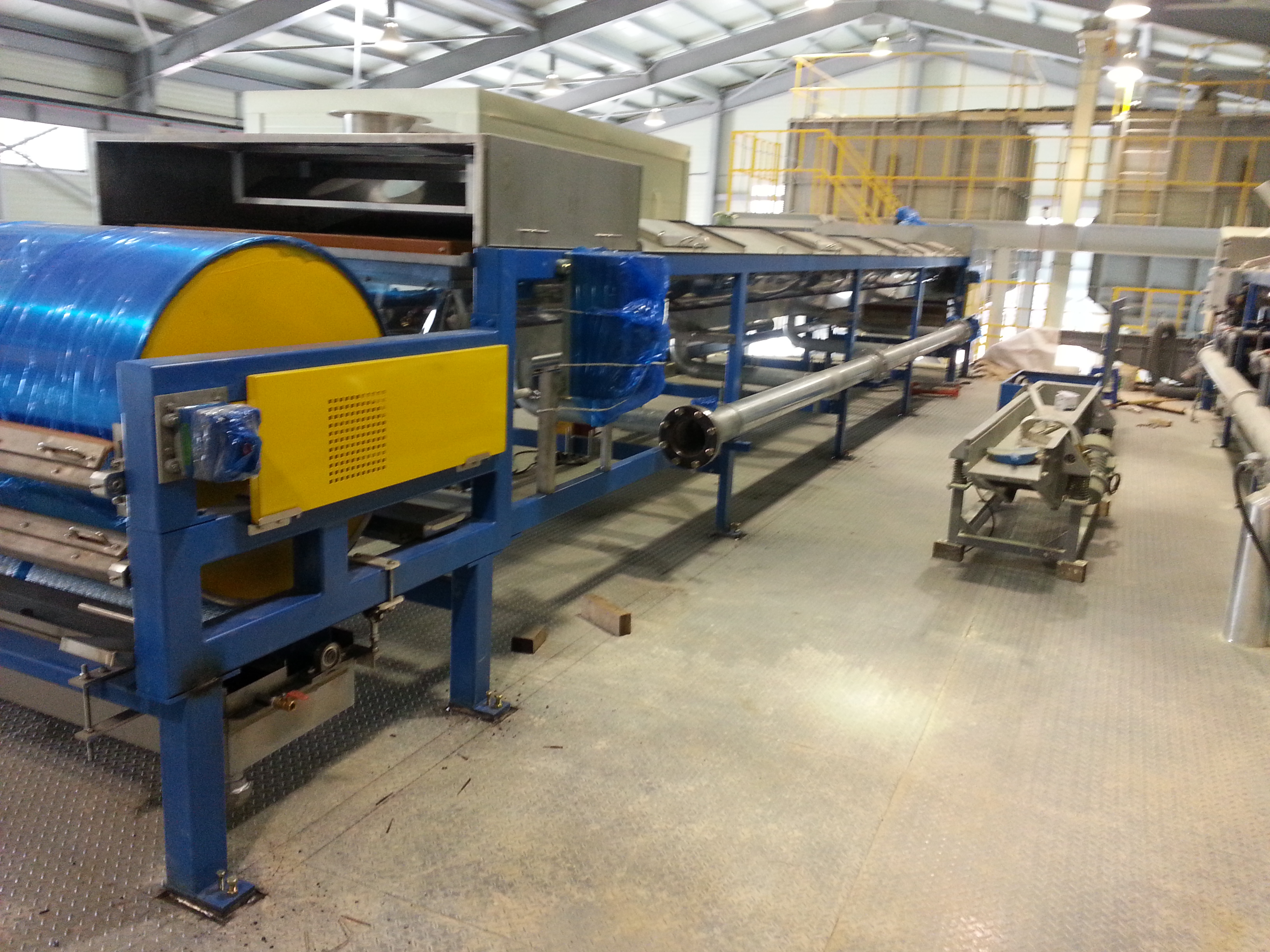
Sulphur pastillator: a chemical pastillation duty where carbon steel is the reference belt family.
What to write into the specification for a carbon belt: grade equivalence to a named reference grade, thickness tolerance, flatness and surface condition, joint configuration, and the thermal performance the cooling or heating section must deliver. What to leave out: any assumption that carbon steel is interchangeable with a food-contact grade. The published specification data for carbon chemical belts does not present them as food-contact materials, and carbon steel is generally the lower-corrosion-resistance option of the three families. Where carry-over moisture or acidic product is present, the material decision has to move.
Stainless steel belts: food contact and precision duty
Stainless steel is the default family for food processing. The material group referenced in high-precision strip comparisons includes 304, 316L and 718, and the documented best-fit applications are food tunnel furnaces, chocolate cooling lines, precision drying and curing, and high-precision conveying where positioning is held to about ±0.1 mm. Food-grade belts in this family are required to meet food conformity standards such as EC 1935/2004 and FDA regulations for contact materials.
Grade selection inside the family follows common industry practice: 304 covers general food-contact duty; 316L is normally selected where corrosion resistance requirements are higher than 304 can serve, which is usual in lines with acidic product, brine or aggressive washdown; 718 is the nickel-based option in the group and is chosen for higher-strength duty. Stainless steel also carries the tightest tolerance expectations, and a buyer who needs food compliance and positioning accuracy in the same belt is specifying in the most demanding corner of the catalogue.
The limitation is worth stating plainly: stainless steel solves corrosion and compliance, not stickiness. A sticky product on a stainless belt still needs release management, whether through surface condition, cooling profile or a coated belt.
PTFE-coated steel belts: release and residue control
PTFE-coated steel belts exist for the duties where product adhesion is the problem rather than temperature or corrosion. Chocolate, sticky bakery products, resin and coating-related materials release cleanly from a coated surface, which reduces scraping, cleaning frequency and product loss. The coating also gives the belt a chemically inert working surface, which is why coating appears in specifications alongside stainless rather than instead of it.
Four points belong in a PTFE-coated specification. First, coating coverage and surface inspection criteria, agreed in writing with the supplier. Second, cleaning method compatibility — the coated surface has to survive the actual washdown or cleaning regime on the line. Third, temperature compatibility: confirm that the process window sits inside what the coating system can accept. Fourth, recoating or replacement planning, because a coating is a wear layer rather than a permanent surface, and mechanical contact from scrapers or product guides shortens its life.
Decision rules for matching belt to process condition
Use these rules in order; each one narrows the family before the next is applied.
- Acidic or corrosive product, or aggressive cleaning chemicals: move from carbon steel to stainless, and evaluate 316L rather than 304.
- Moisture, washdown or high humidity: treat corrosion as a primary risk, then check drainage and cleaning at the belt support and return sections.
- Sticky or residue-forming product: specify a PTFE-coated belt, or specify release management explicitly if the family must stay stainless.
- Direct food contact: stainless steel plus the compliance package — EC 1935/2004 and FDA statements included at quotation stage.
- Positioning-critical conveying: specify the precision strip class, not just the material, because tolerance class is what holds positioning.
When the belt and the line must be specified together
For integrated duties the belt is not a component you buy against a drawing. In a flaker, cooler or pastillator, belt speed, cooling profile, feed distribution and discharge interact, so belt selection and line design have to be solved together. BPS/EPS manufactures both sides of that equation. Its product range covers steel belts, granulators, chocolate steel belt conveyors, steel belt bakery tunnel ovens, steam ovens and resin steel belt coolers.
Capacity data from the same source is useful for judging fit. Reported annual output includes steel strip at approximately 50–80 tons per year; steel strip laminating machines in single and double belt configuration at 10–15 units per year as customized non-standard equipment, with a single unit capacity of 500–1400 kg/h; and steel strip cooling and forming systems at 5–8 sets per year. For a buyer, those numbers describe a supplier that builds to order rather than one that ships standard units from stock.
Step-by-Step: Building a Steel Belt Specification
Step 1 — Write the process envelope before contacting anyone
List the product chemistry and its behaviour when acidic, the moisture and washdown regime, whether the product is clean-releasing or sticky, the operating temperature window, whether the belt makes direct product contact, the cleaning method and frequency, product changeover frequency, and the positioning accuracy the line needs. A supplier cannot price or design against an envelope that has not been written down, and buyers who skip this step end up specifying the belt they already had.
Step 2 — Select the material family and name the grade
Apply the decision rules above, then write the grade into the specification: 304, 316L or 718 for stainless, or equivalence to a named carbon grade such as Sandvik 1300C or equivalent for chemical pastillation and cooling duty. Naming the reference grade is what allows a supplier to quote against something verifiable rather than against a description.
Step 3 — Fix the tolerance regime
Reference figures for domestically produced high-precision steel strip are a thickness tolerance of ±0.02–0.03 mm and a length or circumference tolerance of ±0.05 mm per 10 m. The imported benchmark for the same class of strip is ±0.015–0.02 mm on thickness and ±0.03 mm per 10 m on circumference. State where the line genuinely requires high-precision positioning of about ±0.1 mm, and where it does not. Paying for a tolerance class the line cannot use is one of the more common forms of over-specification.
Step 4 — Specify the belt format and the joint
Decide between open-length and endless belt format based on how the belt will be installed and tensioned on your line. The joint is the highest-risk element of the belt, so the specification should state the joint type, the inspection requirement, and the fatigue expectation for cyclic duty — a reference value in this class of belt is a weld fatigue life of at least 2 million cycles. Specify joint inspection, not just joint presence.
Step 5 — Attach the compliance and traceability package
Name the standards that apply to the destination market: EN 12882:2015 for EU general-purpose conveyors, and EC 1935/2004 plus FDA regulations where the belt contacts food. Behind those declarations, specify the quality controls that produce them: raw material access control, performance indicator control, surface quality control, dimensional verification before processing, process dimension monitoring, factory final inspection control, standardized process documentation, key process control, finished product simulation verification, and quality traceability control.
Step 6 — Set the commercial baseline
Domestically produced high-precision steel strip is positioned 30%–50% below imported strip on cost, with a delivery time of 2–4 weeks against 8–16 weeks for imports, and local repair or replacement response within 24–48 hours against an overseas transfer cycle for imported material. Thermal conductivity in this class is around 15–20 W/m·K, heating and cooling efficiency is reported 20%–40% higher than rubber belts for equivalent duty, and transmission efficiency is at least 98% with no slippage. These are the figures to put in the comparison sheet, not in a general claim.
Step 7 — Write the deviation and remedy path into the agreement
A specification is only as strong as the path that follows a deviation. For material and performance issues, the expected sequence is quick response, re-examination and judgment, and responsibility disposal. Where the cause is selection deviation, the remedy is technical solution optimization: assisting with adjusted belt specifications or process parameters, and re-customizing if necessary. For dimensional accuracy issues, the sequence is on-site review, real-time processing, delivery guarantee and process optimization. For processing technology issues, it is problem identification, on-site service support where necessary, return, exchange or remake, and process upgrade. Buyers who put this ladder in the purchase agreement get a defined outcome instead of a negotiation.
Application Scenarios
Chemical processing: pastillation, cooling and flaking
Chemical duties are thermal duties. Molten product is deposited onto a cooled belt, solidifies into pastilles or flakes, and is discharged. Sulphur pastillation is the reference case in published carbon steel belt specifications, and the same logic covers wax pastillation and comparable cooling and flaking roles. Belt family follows corrosion exposure: carbon steel where the duty is thermal and dry, stainless where carry-over or washdown introduces aggressive chemistry.
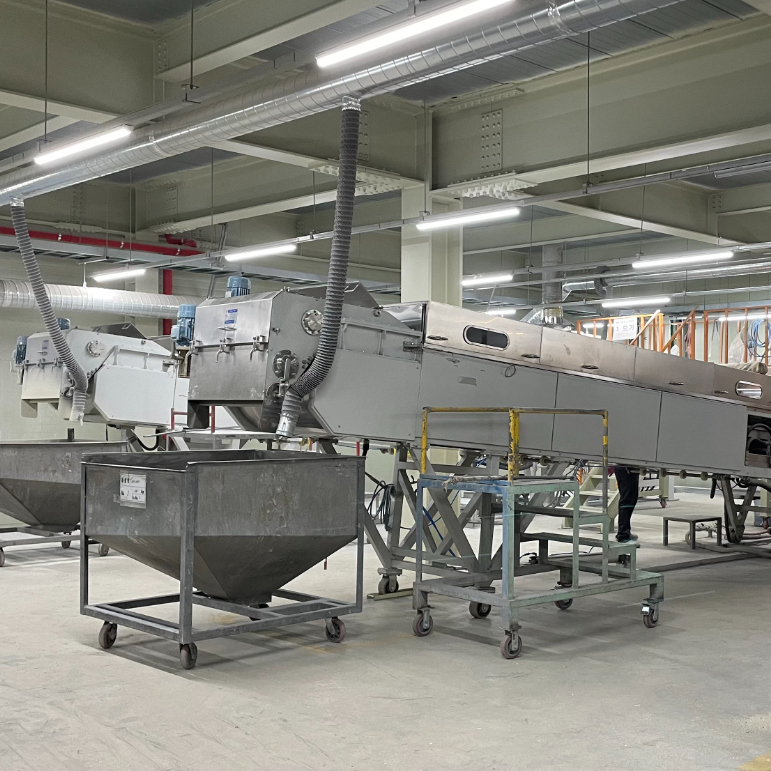
Powder steel belt flaker: a flaking duty where belt surface condition determines release and discharge quality.
Food processing and baking: chocolate, tunnel ovens and steam ovens
Food duties combine food-contact compliance with precise temperature control. Chocolate steel belt conveyors cool and convey in one pass, bakery tunnel ovens and steam ovens run the belt through a controlled temperature profile, and precision drying and curing duties depend on consistent belt flatness. Stainless steel is the family here, with grades chosen against the product and cleaning regime, and with EC 1935/2004 and FDA documentation attached at quotation.
Resin and coating-adjacent duties
Resin cooling and flaking sits between the two worlds: thermal duty like chemical processing, but often with product adhesion that pushes the specification towards surface treatment or a coated belt. Single-belt resin flakers and double-belt resin cooling flakers, epoxy and polyester steel belt coolers, and powder-related flaking duties in the BPS/EPS range are specified on the same sequence: envelope, family, tolerance, joint, documentation, terms.
Comparison: Belt Families and Domestic vs Imported Precision Strip
Table 1 compares the three belt families on the attributes that can be verified from published specification and compliance sources. It is a selection table, not a ranking: the correct family is the one that matches your process envelope.
| Attribute | Carbon steel belt | Stainless steel belt | PTFE-coated steel belt |
|---|---|---|---|
| Documented reference application | Chemical pastillation and cooling | Food tunnel furnace, chocolate cooling line, precision drying and curing, high-precision conveying | Release-critical duties with sticky or residue-forming product |
| Material references | Grades such as Sandvik 1300C or equivalent carbon steel | 304, 316L, 718 | Steel strip with PTFE coating system |
| Positioning capability | Not referenced for positioning-critical duty | Referenced for high-precision conveying at about ±0.1 mm | Coating coverage and surface criteria agreed with supplier |
| Food-contact compliance path | Not presented as a food-contact grade in the cited specification data | EC 1935/2004 and FDA compliance for contact materials | Depends on end market; confirm documentation for the specific duty |
| Primary verification focus | Grade equivalence, thickness tolerance, flatness, joint configuration | Dimensional verification, surface quality, compliance, traceability | Coating coverage, cleaning compatibility, temperature compatibility, recoating plan |
Table 2 compares domestically produced high-precision steel strip with imported precision strip from Europe, Japan and South Korea, using published comparison data. It is the table to bring into a decision meeting, because the specification gap and the cost gap are visible side by side.
| Metric | Domestic high-precision steel strip | Imported precision steel strip (Europe / Japan / South Korea) |
|---|---|---|
| Material and process benchmark | 304 / 316L / 718; welding process and precision control benchmarked against imports | Reference benchmark |
| Tensile strength | ≥ 600–800 MPa | Equivalent |
| Thickness tolerance | ±0.02–0.03 mm | ±0.015–0.02 mm (difference within 0.01 mm) |
| Length / circumference tolerance | ±0.05 mm per 10 m | ±0.03 mm per 10 m (difference within 0.02 mm) |
| Weld fatigue life | ≥ 2 million cycles | Equivalent |
| Temperature range | −60 °C to +250 °C | −60 °C to +300 °C (difference of about 50 °C) |
| Cost position | 30%–50% lower than imports | Reference |
| Delivery time | 2–4 weeks | 8–16 weeks |
| Maintenance response | Local repair or replacement response within 24–48 hours | Overseas transfer, with associated downtime |
Belt-system efficiency characteristics reported in the same comparison data: thermal conductivity of approximately 15–20 W/m·K, heating and cooling efficiency 20%–40% higher than rubber belts, and transmission efficiency of at least 98% with no slippage.
Best-fit summary from the same data: food tunnel furnace, chocolate cooling line, precision drying and curing, and high-precision conveying with positioning around ±0.1 mm.
FAQ: Steel Belt Specification for Chemical and Food Processing
What compliance documents should be specified for a food-grade steel belt?
Food-grade steel belts are required to meet food conformity standards such as EC 1935/2004 in the European Union and FDA regulations for materials in contact with food. For EU installations, steel belts used in general-purpose conveyors must also comply with EN 12882:2015 for electrical and flammability safety. In practice the specification should name the standard, the market it applies to, and the document that proves it, so the declaration arrives with the belt rather than being requested afterwards.
Can one belt material serve both chemical and food processing lines?
Not as a default. Carbon steel belts are specified for chemical pastillation and cooling duties such as sulphur pastillation, and published specification data does not present them as food-contact grades. Stainless steel belts in grades such as 304, 316L and 718 are the food-contact and precision family, and are required to meet EC 1935/2004 and FDA contact-material regulations. PTFE-coated belts address release-critical duties where sticky residues are the constraint. A site that runs both chemical and food duties needs two specifications, or a stainless specification with the compliance package, rather than one belt stretched across both.
How much does material and supplier choice change the cost of a steel belt?
Cost tracks material grade, tolerance class, joint and documentation. In published comparison data, domestically produced high-precision steel strip is positioned 30%–50% below imported precision strip from Europe, Japan and South Korea, with delivery of 2–4 weeks against 8–16 weeks for imports. The tolerance difference is measurable but small: thickness tolerance of ±0.02–0.03 mm against ±0.015–0.02 mm, and circumference tolerance of ±0.05 mm per 10 m against ±0.03 mm per 10 m. Temperature capability differs by about 50 °C: −60 °C to +250 °C against −60 °C to +300 °C for imported strip. The commercial decision is therefore whether the line genuinely needs the extra tolerance and the extra temperature headroom.
How can we validate a belt specification before committing the whole line?
Validation in this category is a documented quality sequence rather than an informal trial. It includes dimensional verification before processing, process dimension monitoring, key process control, standardized process documentation, finished product simulation verification, and quality traceability control, with factory final inspection ahead of shipment. If a selection deviation is identified, the defined remedy path is technical solution optimization: adjusting belt specifications or process parameters, and re-customizing if necessary. Buyers should ask for the simulation verification record and the traceability documentation as part of the order package. The BPS/EPS product catalogue, including belt and system configurations, can be downloaded from the English product brochure.
What lead time and after-sales response should the specification assume?
Assume the delivery and service figures that apply to the sourcing route. Domestically produced high-precision steel strip is quoted at 2–4 weeks, against 8–16 weeks for imported material, and local repair or replacement response runs within 24–48 hours, while imported belts require an overseas transfer with the downtime that implies. BPS/EPS operates a maintenance center in Shanghai providing spare parts, maintenance, emergency maintenance, installation guidance and operation training, with offices in Beijing, Guangzhou, Jiangxi, Hunan and Fujian. For a line where a belt failure stops production, that response window belongs in the commercial terms, not in the general description.
Conclusion
Steel belt specification for chemical and food processing is a sequence, not a preference. Write the process envelope, choose the family against chemistry, moisture and residue behaviour, fix the tolerance regime the line actually needs, specify the joint and its fatigue expectation, attach the compliance package for the destination market, and set the commercial terms including the deviation and remedy path. Carbon steel stays in thermal chemical duty. Stainless steel carries food contact and precision. PTFE coating solves release. Where belt and line interact — flakers, coolers, pastillators and ovens — specify them together, because the components cannot be optimized separately.
Next step: review your belt specification with BPS/EPS
BPS/EPS (Shanghai Biquick Process Systems Ltd.) manufactures steel belts and builds the integrated cooling, flaking, pastillation and oven systems that use them. Send your process envelope — chemistry, temperature window, residue behaviour, positioning requirement and destination market — and request a specification review and quotation.
Website: www.esptek.cn | Blog: blog.esptek.cn
Email: sales@bpstek.com | Tel: 021-68904153 / +86 13916661495 | Fax: 021-68912858
Address: No.172 Xuanchun Road, Xuanqiao Town, Pudong New District, Shanghai, China
Download the product brochureAsk a specification question on WhatsApp
Have Questions or Need More Details?
Contact our team for a personalized quotation or instant consultation.
Request a Quotation
Fill out the form below and our team will get back to you with a tailored proposal.
WhatsApp Direct Chat
Prefer to chat in real-time? Message us on WhatsApp for instant assistance & quick answers.
- Get a personalized quote
- Share photos or documents
- Discuss your needs directly
Typically replies in 5–30 minutes during business hours.