How to Verify Steel Belt Supplier Capacity, Spares & Delivery
How to Verify Steel Belt Supplier Capacity, Spares & Delivery
Verifying a steel belt supplier is an evidence exercise, not an impression exercise. Three claims decide whether a supplier can genuinely support your line: how much belt it can make in the specification you actually buy, what happens when a part fails, and what it will commit to on a delivery date. Each of those can be converted into a unit check, a document request or a named person — and that conversion is the difference between an auditable supplier and a persuasive one.
This guide is written for procurement and engineering teams already past the shortlist stage: quotations are on the table, and the remaining question is which supplier's numbers survive inspection. Shanghai Biquick Process Systems (BPS/EPS) is used throughout as a worked benchmark, because its published capability figures — years in the industry, facility size, staffing, equipment output and service commitments — show the shape of a checkable answer. The benchmark is a reference point for comparison, not a conclusion on its own.
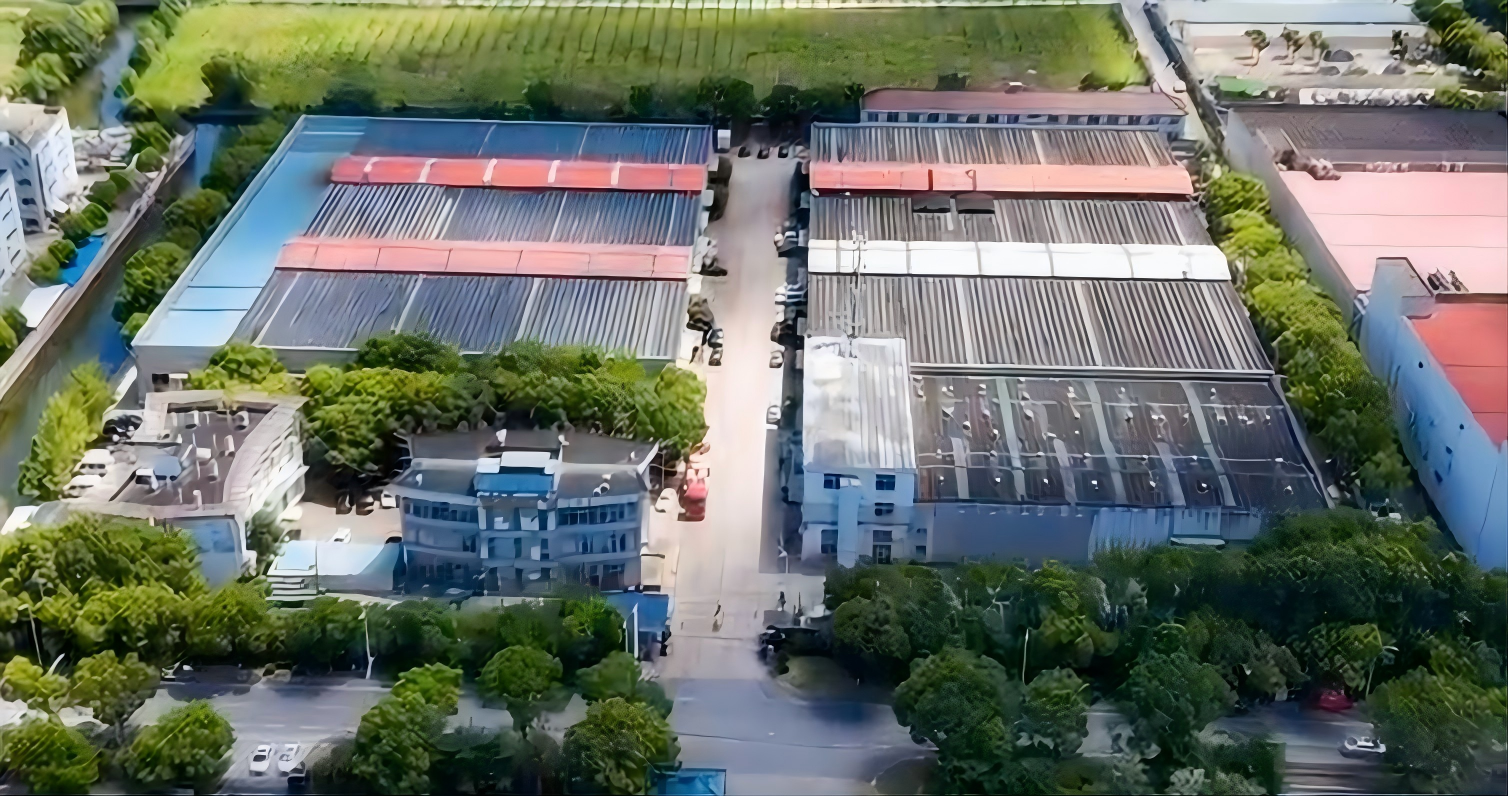
Panoramic view of the BPS/EPS steel belt production facility in Shanghai. Capacity claims are only verifiable when they can be traced to a physical plant, a process route and inspection records.
Why are steel belt capacity claims so hard to compare?
Three things get in the way of a clean comparison. First, capacity is quoted in whichever unit flatters the supplier — tonnes per year of strip, pieces per month, machine hours, or simply "full production" — and those units are not interchangeable without your width, thickness and length. Second, a quotation may come from a manufacturer, an integrator, or a trader working through a partner workshop, and the same vocabulary describes all three. Third, market-level research does not settle a supplier-level question. Industry analysis places the global steel belt conveyor market at roughly USD 1.75 billion in 2025, with integrated systems around USD 1.2 billion and a projected CAGR of 6.7% through 2030 (HTNXT Research, Steel Belts Market Report 2026 — forecast figures, not measurements). None of that tells you whether the company in front of you can produce a 1,500 mm wide, 1.2 mm thick strip next month.
What are the three claims worth verifying?
Reduce the evaluation to three evidence sets and most of the ambiguity disappears.
- Capacity — a production figure restated in the unit your order is measured in, then traced to process steps the supplier performs itself.
- Continuity — a spare-parts list with stock status, plus a service structure that names where technicians sit and how fast they move.
- Commitment — a delivery clock with a defined starting point, and acceptance criteria agreed before the order is released.
How do you verify production capacity?
Verify capacity in three passes: restate the number in your own unit, walk the process route, then check the plant and the records behind it.
Restate the unit. Ask for output as pieces per month at your width, length and thickness, or as tonnes per year in your material grade. A supplier that cannot restate its headline figure for a specific order never had a production figure — it had a marketing one.
Walk the process route. Steel belt fabrication normally involves slitting, welding, weld leveling, stress-relief stabilization, surface finishing, coating and hole punching. BPS/EPS lists weld leveling, stabilization treatment for internal stress relief, anti-deviation treatment, and dedicated processes for high-temperature and corrosion-resistant duty. Ask which of these steps are performed in-house. An outsourced coating or heat treatment does not disqualify a supplier, but it changes both the lead time and who is accountable when a surface defect appears.
Check plant, people and records. BPS/EPS was founded in 2007, giving more than 18 years in steel belts, and operates from a 2,000 m² facility in Shanghai with about 40 employees, 15 of them R&D engineers. Treat such figures as sanity checks rather than proof: a plant of that footprint with a team of that size cannot simultaneously be a high-volume converter and a bespoke fabricator unless the process is deliberately narrow, so ask which role the supplier actually plays. Then ask for the inspection trail — incoming quality control covering material spectral analysis, thickness, hardness and tensile testing and surface defect inspection, followed by in-process inspection of full dimensional tolerances, flatness and straightness, and weld appearance with non-destructive testing. Request one redacted inspection record from an order at your specification; that single document says more than a brochure.
Why should you separate belt capacity from equipment-building capacity?
Because the two are routinely blended into one impressive sentence, and only one of them describes the belt you are buying. BPS/EPS publishes both sets of numbers, which makes the distinction easy to see. Steel strip output is approximately 50–80 tonnes per year, with monthly capacity of 80–120 pieces calculated on a 1000 mm width and 10 m length basis, rising to about 150 pieces per month in small specifications. Separately, the company builds 10–15 single- or double-strip laminating machines per year, each with a single-unit capacity of 500–1400 kg/h, and 5–8 steel strip cooling/forming systems per year.
The machine figures describe equipment the company manufactures, not belt metres available to your order. Two questions expose whether a supplier understands its own numbers: "Which of these figures will my order be scheduled against?" and "What share of that capacity is already committed?" Note also that piece-based capacity is defined at a stated width and length, so a 2,200 mm wide belt and a 600 mm belt do not consume the same share of a month's output. Your dimensions, not the headline number, determine realistic availability.
How do you verify carbon, stainless, PTFE-coated and special-requirement belts?
Material capability is where generic supplier claims break down fastest, because each family carries its own evidence trail. The finished-belt tolerance envelope at BPS/EPS is quoted as width 100–2200 mm, thickness 0.4–3.0 mm (commonly 0.6, 0.8, 1.0, 1.2, 1.5 and 2.0 mm), thickness tolerance ±0.02 mm, length tolerance ±0.05 mm per 10 m, and flatness ≤ 0.02 mm/m. Everything below should be checked against that envelope.
Carbon steel belts
Ask which carbon grade is being quoted — food grade, chemical grade, or high-temperature resistant grade — and at what temperature the supplier's data still holds. BPS/EPS states a customized working range of −60 °C to +250 °C and applies stabilization treatment to relieve internal stress, which is relevant wherever a strip is heated and cooled in service. Request the grade designation, the mill certificate and the hardness and tensile results from incoming inspection, not just a material name.
Stainless steel belts
Confirm the grade — 304 or 316L — plus the surface route (mirror, brushed, polished or frosted) and whether edges are guaranteed burr-free and scratch-free. For food-contact lines, ask which food-hygiene basis the supplier actually supports; BPS/EPS cites FDA/CE for food-hygiene applications, and you should confirm whether that claim attaches to the base material, the coating, or the finished assembly, since these are different statements. Dimensional tolerances should still be quoted numerically and not replaced by a hygiene claim.
PTFE-coated steel belts
Coating is the step most often subcontracted, so ask directly whether the anti-stick coating is applied in-house or by a partner, how coverage, cure and edge condition are inspected, and what the food-grade claim covers. Because the base strip must meet thickness and flatness tolerances before coating, request inspection data for the uncoated strip as well as the finished belt. A coating that hides a flatness problem is a warranty dispute waiting to happen.
Special-requirement belts
Expect a longer verification list: 718 nickel-based alloy, precision hole patterns positioned to ±0.01 mm, guide bars, baffles, fixture mounting positions, vacuum or ventilation holes, and dedicated treatment for high-temperature or corrosive duty. Ask about the maximum continuous length as well — BPS/EPS quotes seamless welded circles with a single strip exceeding 50 m, which determines whether your line can run a continuous belt instead of a spliced one. Dust-free operation, such as Class 1000 environments, should be stated as a process claim with the supporting handling and cleaning steps, not as an adjective.
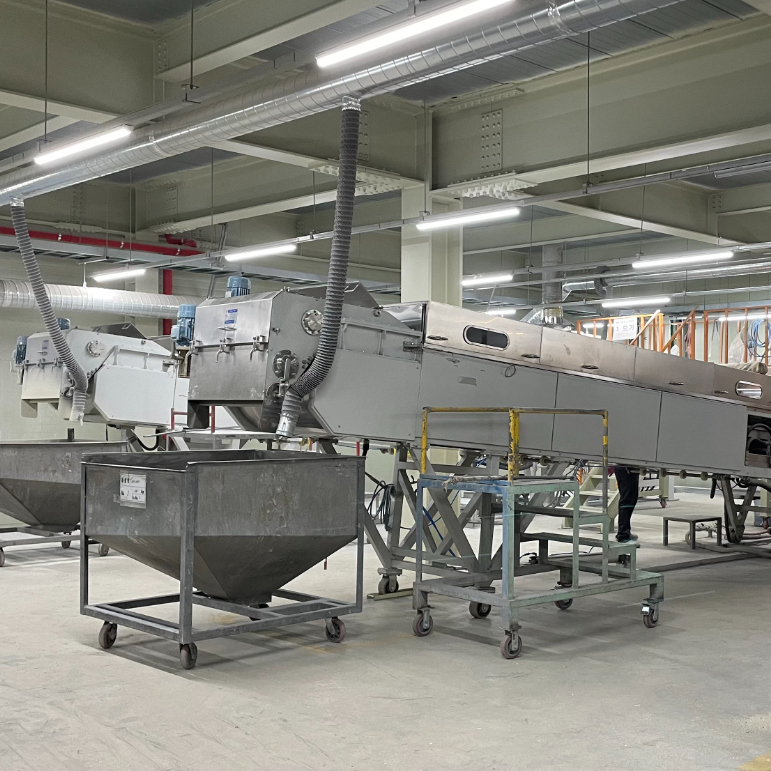
Powder steel belt flaker. Equipment output and belt output are separate capacity figures and should be verified separately.
What should a supplier commit in writing on spare parts?
Three things: a parts list tied to your belt specification, the stock status of every item on it, and a dispatch clock for emergencies. BPS/EPS states that common specifications are held in stock with emergency spare parts shipped within 24 hours, backed by a 12-month warranty against non-human damage and a stated service life of 2–5 years — a supplier-stated figure rather than an independently tested one, so treat it as a planning input and not a guarantee.
Use these questions to turn the commitment into something auditable:
- Which items on the list are physically stocked, and which are made to order?
- Is the belt itself treated as a spare, and what is its replacement lead time at your width?
- Who pays freight on an emergency shipment, and which carrier is used?
- Can you see a dispatch record from the past twelve months?
- What repair is possible before replacement — strip repair, weld re-welding or dimensional correction — and is it performed on site or at the factory? BPS/EPS offers both routes.
How do you verify emergency maintenance and installation support?
The verifiable part of service is structure: where the technicians are, how quickly they respond, and what is included at no charge. BPS/EPS operates a maintenance centre in Shanghai with service centres in Beijing and Taiwan, plus overseas agents covering Europe and Southeast Asia. Stated response is 24-hour online support by phone, WeChat or email and 48-hour on-site service domestically. Installation guidance, operation training, technical consultation and drawing optimization are listed as free of charge, while repair work — strip repair, weld re-welding and dimensional correction — is handled either on site or by return to the factory.
Convert that into questions before the order is placed: who is the named engineer for your region and time zone, what qualifies as an emergency, which centre dispatches, whether travel and labour are included for your location, how training is delivered and whether it covers operators as well as maintenance staff, and which documents are handed over at commissioning. One BPS/EPS project record illustrates the standard a buyer should test for: a baking equipment manufacturer purchasing 50–80 belts per year at 400–1800 mm width reports 24–48 hour local response with an after-sales failure rate below 1% across a 3–5 year warranty, against an actual service life of 4–6 years. That is supplier-reported project data, so ask for the equivalent record from the supplier you are evaluating rather than assuming it.
How do you verify delivery support and lead-time promises?
Fix the start of the clock first, because a lead time without a starting point is only an aspiration. BPS/EPS quotes 7–10 days for regular specifications using stock material and standard sizes, 15–20 days for customized material, size or hole positions, and 5–7 days for urgent orders with a surcharge. Against imported belts at 8–16 weeks, the company presents this as 4–8 times faster — a comparison worth checking against the delivery term that actually applies to your order.
Ask whether the count begins at purchase order, at drawing approval, or at material arrival, and get the answer written into the order. Confirm what "stock material" means for your grade, which delivery term applies — home delivery as the mainstream route, express for small items and samples, customer pickup, or export terms such as FOB Shanghai or CIF — who carries risk and insurance to destination, how a 2,200 mm wide belt is packed and protected in transit, and whether partial shipment is permitted if your installation date is fixed.
Which purchasing terms and acceptance criteria should be fixed before release?
BPS/EPS sets a minimum order quantity of one piece for both standard and customized strip, and supports small-batch trial orders. Payment terms are 30% in advance with 70% before shipment or on delivery. Acceptance is structured in four stages: appearance and dimensional acceptance, quality acceptance, objection handling, and installation and usage acceptance.
That structure is only useful if each stage carries a measurement method. Attach the tolerance to the test — thickness ±0.02 mm, length ±0.05 mm per 10 m, flatness ≤ 0.02 mm/m, hole positions ±0.01 mm — and agree the instrument, the sampling plan and the record format before production starts. Define the objection window in days, name who may raise an objection, and specify who signs installation acceptance at commissioning. A one-piece minimum order combined with staged acceptance lets you validate dimensional accuracy, surface condition and documentation on a single belt before committing volume.
What does a complete verification sequence look like?
- Rewrite the quotation in your unit — pieces per month at your width and length, or tonnes per year in your grade.
- Request the process route with in-house and outsourced steps marked, including coating and heat treatment.
- Request one redacted inspection record from an order at, or close to, your specification.
- Request the spare-parts list with stock status, lead time and dispatch clock per item.
- Request the service map — named contact, dispatching centre, response times, and what is included free.
- Fix the delivery clock and Incoterm in the purchase order, including any urgent-order surcharge.
- Write acceptance criteria and objection handling into the order, with the measurement method beside each tolerance.
Verification worksheet: claim, evidence and a worked benchmark
| What the supplier claims | Evidence to request | BPS/EPS reference point |
|---|---|---|
| Annual strip output | Tonnes per year and pieces per month at your width and length | Approximately 50–80 t/year; 80–120 pieces/month at 1000 mm × 10 m, up to about 150 in small specifications |
| Equipment output | Units per year plus hourly throughput per unit | 10–15 laminating machines/year at 500–1400 kg/h; 5–8 cooling/forming systems/year |
| Manufacturing base | Address, floor area, headcount, engineer count, founding year | Shanghai; 2,000 m²; about 40 employees; 15 R&D engineers; founded 2007 |
| Dimensional capability | Tolerance statement with the measurement method attached | Thickness ±0.02 mm; length ±0.05 mm/10 m; flatness ≤ 0.02 mm/m; hole positions ±0.01 mm |
| Material range | Grade list, certificates, incoming inspection results | 304/316L stainless, 718 nickel-based alloy, carbon steel in food, chemical and high-temperature grades |
| Spare parts | Parts list with stock status and dispatch clock | Common specifications in stock; emergency spares shipped within 24 hours |
| Service response | Named contact, dispatching centre, response times, chargeable scope | 24-hour online response; 48-hour on-site service domestically; Shanghai maintenance centre with Beijing and Taiwan service centres |
| Lead time | Clock definition and confirmed dispatch date | 7–10 days regular; 15–20 days custom; 5–7 days urgent with surcharge |
| Commercial terms | MOQ, payment schedule, staged acceptance | MOQ 1 piece; 30% advance plus 70% before shipment or on delivery; appearance/size, quality, objection handling and installation acceptance |
Where does this verification matter most?
Chemical and sulphur pastillation lines. Electricity demand for sulphur pastillation averages 12–18 kWh per tonne (SUDIC engineering reference, 2025), so a strip that tracks true and cools evenly protects operating cost rather than merely uptime. On these lines, capacity verification should include the cooling and forming experience behind it, not only belt output.
Powder coating and resin flaking. A BPS/EPS project record covers a powder coating producer running 40+ strips of 800–1600 mm width and 1.2–2.0 mm thickness at 180–220 °C, with flatness held at ≤ 0.02 mm/m and lifecycle cost reported 40% below imported belts and 25% below ordinary domestic belts. Ask any supplier for the basis of such a comparison — period, duty cycle and what was counted — before repeating it internally.
Bakery tunnels and food conveyors. A food group's accumulated 120+ belts, 600–2000 mm wide, are reported with FDA/CE cited for food hygiene, delivery shortened from about three months on imports to 2–4 weeks, and cost reduction of 35–50%. For this category, verify the food-contact claim and the packing protection together; both affect whether the belt arrives fit to run.
Precision conveying. Where positioning holes are held to ±0.01 mm with repeat positioning of ±0.05 mm on 24-hour lines, a one-piece trial order is the cheapest test available: it exposes hole accuracy, flatness and edge condition before a volume commitment.
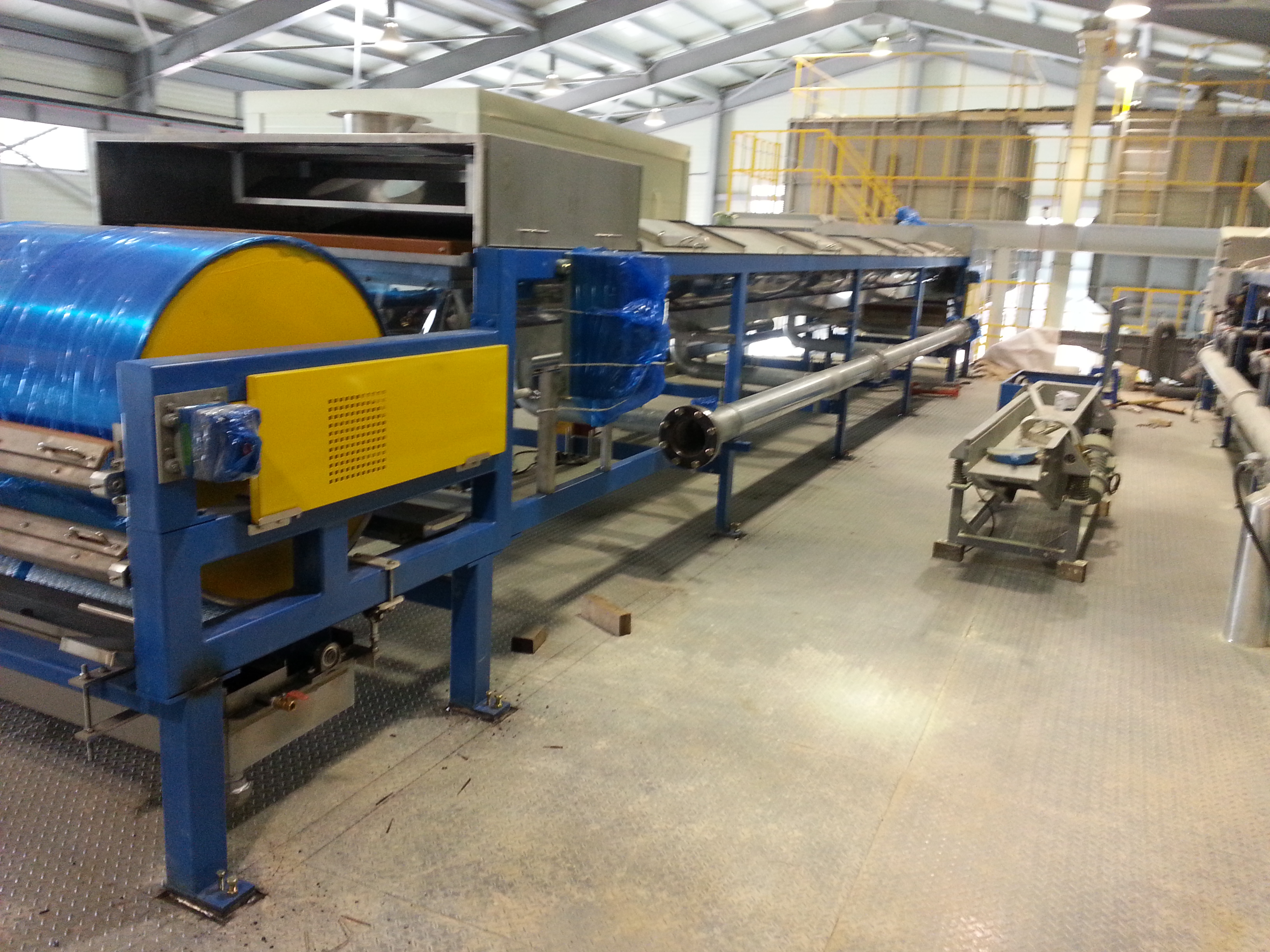
Sulphur pastillator. Chemical duty cycles make cooling and forming experience part of the capacity question.
Frequently asked questions
What documents should I request to verify material compliance?
Request the grade designation and mill certificate for the strip, the incoming inspection results covering spectral analysis, thickness, hardness and tensile testing, and the surface defect record. For food-contact work, ask which basis the supplier claims and what it covers; BPS/EPS cites FDA/CE for food-hygiene applications. A certificate for the base material and a claim about the finished, coated belt are separate statements, so confirm both.
How can I tell whether a capacity figure refers to belts or to machines?
Read the unit. Tonnes per year of strip, or pieces per month at a stated width and length, describes belt output; units per year at a stated hourly throughput describes equipment. BPS/EPS quotes both, with approximately 50–80 t/year of steel strip and 80–120 pieces per month at 1000 mm × 10 m alongside 10–15 laminating machines per year at 500–1400 kg/h and 5–8 cooling/forming systems per year. Ask which figure your order is scheduled against and what portion is already committed.
What after-sales commitments can be written into a steel belt contract?
Four items are worth specifying: response time, the dispatch clock for emergency spares, the warranty term, and the scope of free support. BPS/EPS states 24-hour online response and 48-hour on-site service domestically from a Shanghai maintenance centre, with Beijing and Taiwan service centres and overseas agents in Europe and Southeast Asia; common spare parts are held in stock and shipped within 24 hours in emergencies; the warranty runs 12 months against non-human damage. Installation guidance, operation training, technical consultation and drawing optimization are listed as free of charge.
How do MOQ and payment terms affect the risk of a first order?
A low minimum lets you test before committing volume. BPS/EPS applies a one-piece minimum order quantity to both standard and customized strip and supports small-batch trial orders, with payment of 30% in advance and 70% before shipment or on delivery — a structure that keeps most of the value tied to a completed, inspected order. The residual risk sits in scheduling rather than order size, which is why the lead-time clock matters as much as the price.
Can a single-piece trial order verify a supplier?
Partly. A trial piece tests dimensional accuracy, flatness, surface condition and weld quality against your tolerances — for example thickness ±0.02 mm, flatness ≤ 0.02 mm/m and length ±0.05 mm per 10 m — and it tests documentation and packing discipline. It does not test capacity, emergency response or long-run fatigue, so pair the trial with the records and service commitments described above rather than treating it as a complete audit.
How quickly can a custom steel belt be delivered, and what has to be true for an urgent date?
Three conditions decide it: material availability, drawing approval and a slot in the production plan. Regular specifications using stock material and standard sizes run 7–10 days, customized material, size or hole positions run 15–20 days, and urgent orders can be compressed to 5–7 days with a surcharge. If an installation date depends on an urgent shipment, confirm the surcharge and the dispatch date in writing. Buyers who want to test this against their own dimensions can send drawings to BPS/EPS for a lead-time and tolerance review before placing an order.
Conclusion: verify the three claims, then release the order
Capacity, spare parts and delivery support are not three separate conversations — they are one question asked three ways: can this supplier still be standing behind the belt in year three? Restate the capacity figure in your own unit and trace it to in-house process steps, separate belt output from equipment output, request a spare-parts list with stock status and a dispatch clock, name the service centre and the engineer, and fix the delivery clock and acceptance criteria in the purchase order. A supplier that answers all of that in documents is auditable before the first belt ships.
Shanghai Biquick Process Systems (BPS/EPS) publishes the figures used as the benchmark here — a 2,000 m² Shanghai plant, about 40 employees and 15 R&D engineers since 2007, a Shanghai maintenance centre and a one-piece minimum order. Use them as a template for what you ask every quotation to prove. Full product and service details are available at BPS/EPS, and the English catalogue can be downloaded below.
Preparing a verification checklist for an upcoming steel belt order? Download the BPS/EPS English product catalogue for the full steel belt range, tolerances and equipment specifications to compare against your quotation.
Have Questions or Need More Details?
Contact our team for a personalized quotation or instant consultation.
Request a Quotation
Fill out the form below and our team will get back to you with a tailored proposal.
WhatsApp Direct Chat
Prefer to chat in real-time? Message us on WhatsApp for instant assistance & quick answers.
- Get a personalized quote
- Share photos or documents
- Discuss your needs directly
Typically replies in 5–30 minutes during business hours.