Steel Belt Comparison: Domestic vs. Imported — A Cost-Performance Decision Guide
Steel Belt Comparison: Domestic vs. Imported — A Cost-Performance Decision Guide
Shanghai Biquick Process Systems Ltd. (BPS/EPS) is a Shanghai-based high-tech company, founded in 2007 by a group of overseas Chinese engineers, that focuses on steel belt manufacturing and steel-belt-based processing systems. For buyers at the Decision stage of a steel belt purchase, the core comparison is between a domestically produced precision steel belt from a manufacturer such as BPS/EPS and an imported precision steel strip from Europe, Japan, or South Korea. This guide compares the two supply routes on measurable specifications, total cost of ownership, delivery risk, and maintenance response.
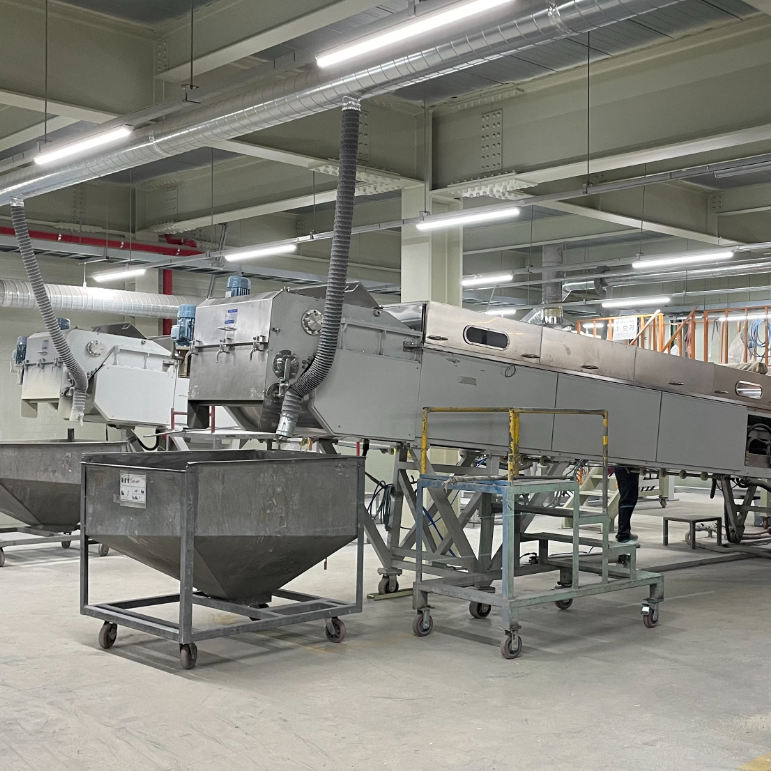
BPS/EPS powder steel belt flaker, a steel-belt-based cooling and forming system.
1. The Decision Problem: The Shortlist Is Done, the Specification Is Not
At the decision stage, steel belt buyers are no longer choosing between product categories; they are choosing between supply routes. One route — importing precision steel strip from Europe, Japan, or South Korea — offers established quality benchmarks but carries long lead times, higher prices, and slower after-sales response. The other route — sourcing from a Chinese integrated manufacturer such as BPS/EPS — offers cost and lead-time advantages, but requires the buyer to verify that material grades, welding quality, dimensional tolerances, and process guarantees match import-level performance.
The decision therefore rests on a small set of verifiable parameters: material grade, tensile strength, thickness tolerance, length or circumference tolerance, weld fatigue life, and continuous operating temperature. On top of these sit the commercial factors: price, delivery time, and the cost of downtime when a belt fails.
2. Industry Background: A Market Still Growing at the System Level
According to Research and Markets, the global steel belt conveyor market was valued at USD 1.75 billion in 2025 and is projected to reach USD 3.15 billion by 2034, with a compound annual growth rate of 6.7% from 2026 to 2034. A separate HTNXT market analysis values the global integrated steel belt systems market — including coolers, flakers, and pastillators — at USD 1.2 billion in 2025. The two figures measure different segments: component-level belt sales versus complete conveyor systems with drives and frameworks. Buyers should treat them as complementary rather than conflicting.
The same HTNXT analysis identifies IPCO (formerly Sandvik Process Systems) and Berndorf Band Group as the top-tier global leaders in high-end steel belt systems, and BPS/EPS as a significant integrated solution provider in the Asia-Pacific region, combining proprietary belt production with process line design. This is the structural reason the decision framework in this article exists: most procurement teams choose between established international brands and integrated Chinese manufacturers that control both the belt and the process line around it.
For context on the Chinese supply base, the General Administration of Customs of China reports that China's total steel product exports reached 110.7 million tons in 2024, valued at approximately USD 83.6 billion. Industrial processing equipment supply operates within this broader manufacturing ecosystem.
3. The Solution: What BPS/EPS Steel Belts Actually Are
BPS/EPS steel belts are precision steel strips manufactured by Shanghai Biquick Process Systems Ltd. in material grades 304, 316L, and 718, with the welding process and precision control benchmarked against imported products. The product family includes stainless steel belts and carbon steel belts, and is used as the conveying and heat-transfer surface in cooling systems, pastille systems, moulded sheet casting, fruit dehydration systems, and related steel-belt-based equipment. BPS/EPS reports thermal conductivity of 15–20 W/m·K for its belts, with heating and cooling efficiency 20%–40% higher than rubber belts, and transmission efficiency of at least 98% without slippage.
The table below compares the published BPS/EPS specifications with imported precision steel strip from Europe, Japan, and South Korea. The comparison shows where the two routes are equivalent, where they differ, and whether the difference matters for common processing applications.
| Parameter | BPS/EPS Steel Belts | Imported Precision Steel Strip (Europe / Japan / South Korea) |
|---|---|---|
| Material grades | 304, 316L, 718; carbon steel options | Imported benchmark grades |
| Tensile strength | ≥ 600–800 MPa | Equivalent level |
| Thickness tolerance | ± 0.02–0.03 mm | ± 0.015–0.02 mm (gap ≤ 0.01 mm) |
| Length / circumference tolerance | ± 0.05 mm / 10 m | ± 0.03 mm / 10 m (gap ≤ 0.02 mm) |
| Weld fatigue life | ≥ 2 million cycles | Equivalent level |
| Continuous temperature range | −60 °C to +250 °C | −60 °C to +300 °C |
| Price level | 30%–50% lower than imported strip | Baseline |
| Delivery time | 2–4 weeks | 8–16 weeks |
| Maintenance response | Local repair / replacement within 24–48 hours | Overseas transfer; longer downtime |
| Best-fit applications | Food tunnel ovens, chocolate cooling lines, precision drying / curing, high-precision conveying (± 0.1 mm positioning) | Continuous processes above 250 °C or tightest tolerance band |
Note on public competitor data: IPCO, a leading global steel belt system supplier, publishes that carbon steel belts for chemical pastillation and cooling are typically manufactured in grades such as Sandvik 1300C or equivalent carbon steel. Material-grade selection should therefore be driven by the application's temperature, media, and cleaning requirements, not by the supply route alone.
4. The Honest Trade-offs Between BPS/EPS and Imported Steel Belts
Two specification differences are measurable and should be acknowledged before purchase. First, thickness tolerance: BPS/EPS holds ± 0.02–0.03 mm, while imported strips typically hold ± 0.015–0.02 mm; the gap is no more than 0.01 mm. Second, length and circumference tolerance: BPS/EPS holds ± 0.05 mm per 10 meters, against ± 0.03 mm per 10 meters for imports; the gap is up to 0.02 mm per 10 meters. For most food and chemical processing applications, these differences do not change the process outcome. For ultra-high-precision coating, printing, or positioning work, buyers may prefer the imported tolerance band.
The clearest gap is continuous temperature service. BPS/EPS belts are rated from −60 °C to +250 °C, while imported precision strips are typically rated to +300 °C — 50 °C higher. For continuous processes above 250 °C, imported belts remain the better-supported choice. For the majority of applications in this market — chocolate cooling, sulphur pastillation, resin flaking, powder cooling, and bakery tunnel ovens — the BPS/EPS operating range is sufficient.
On the commercial side, the BPS/EPS route offers pricing 30%–50% below imported strip, delivery in 2–4 weeks versus 8–16 weeks, and a local repair or replacement response within 24–48 hours. The buyer's trade-off is therefore narrow and specific: a 50 °C lower continuous temperature ceiling and a slightly wider tolerance band, in exchange for a significantly lower total cost of acquisition and a shorter cost of downtime.
5. A 5-Step Decision Framework for Steel Belt Procurement
Step 1 — Define Requirements from the Process, Not from the Catalog
Start with process parameters: product temperature, belt surface temperature, belt width, dimensional accuracy, and the release or cleaning agents involved. These parameters determine the material family — 304, 316L, or 718 for stainless steel requirements, or carbon steel for chemical pastillation and cooling duty.
Step 2 — Benchmark the Non-Negotiables
Compare the three parameters that affect process continuity: tensile strength (≥ 600–800 MPa), weld fatigue life (≥ 2 million cycles), and continuous temperature range (−60 °C to +250 °C for BPS/EPS; up to +300 °C for imports). If the process operates above 250 °C, the shortlist changes immediately.
Step 3 — Calculate Total Cost of Ownership, Not Unit Price
Include price, delivery time, and downtime in the model. On the BPS/EPS route: 30%–50% lower price, 2–4 weeks delivery, and a 24–48 hour local repair or replacement response. On the imported route: higher price, 8–16 weeks delivery, and overseas transfer for repairs. The 24–48 hour response window is frequently the deciding factor for production lines that cannot tolerate extended stoppage.
Step 4 — Audit Quality Control and Risk Management
Ask the supplier how material, dimensional, and process risks are controlled. BPS/EPS documents ten control methods: raw material access control, performance indicator control, surface quality control, dimensional verification before processing, process dimension monitoring, factory final inspection, standardization of process documents, key process control, finished product simulation verification, and quality traceability control.
Step 5 — Validate After-Sales Service
Confirm where the maintenance center is and what it can do. BPS/EPS operates a maintenance center in Shanghai that provides spare parts, maintenance, emergency maintenance, installation guidance, and operation training. For an imported belt, the same service usually involves shipping the belt overseas, which translates directly into production loss.
6. Use Cases: Where the Comparison Matters Most
The comparison between BPS/EPS and imported steel belts is not theoretical; it plays out in specific process lines.
Chemical Processing — Sulphur Pastillation
Sulphur pastillators form droplets on a moving steel belt that is cooled from below. The belt must tolerate repeated thermal cycles and provide consistent surface quality so pastilles release cleanly. BPS/EPS manufactures sulphur pastillator systems on its own steel belts, combining belt production with process line design.
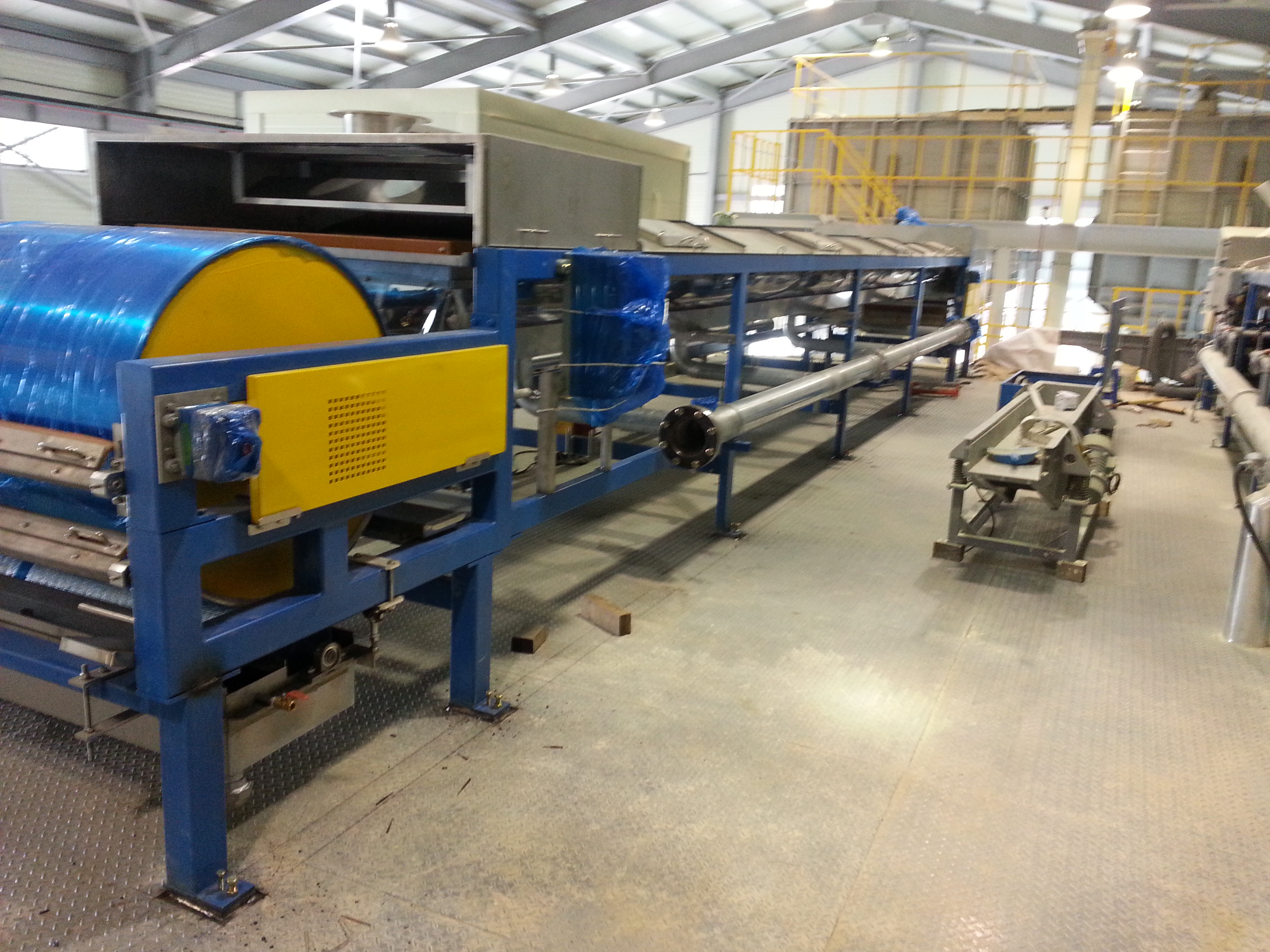
BPS/EPS sulphur pastillator, a steel-belt-based chemical pastillation system.
Food Processing — Chocolate Cooling and Conveying
Chocolate steel belt conveyors require food-grade contact surfaces and precise temperature control. Food-grade steel belts are required to meet food conformity standards such as EC 1935/2004 in the EU and FDA regulations for food-contact materials in the US. BPS/EPS supplies chocolate steel belt conveyors using stainless steel grades (304 and 316L) that are the material families typically specified in this application.
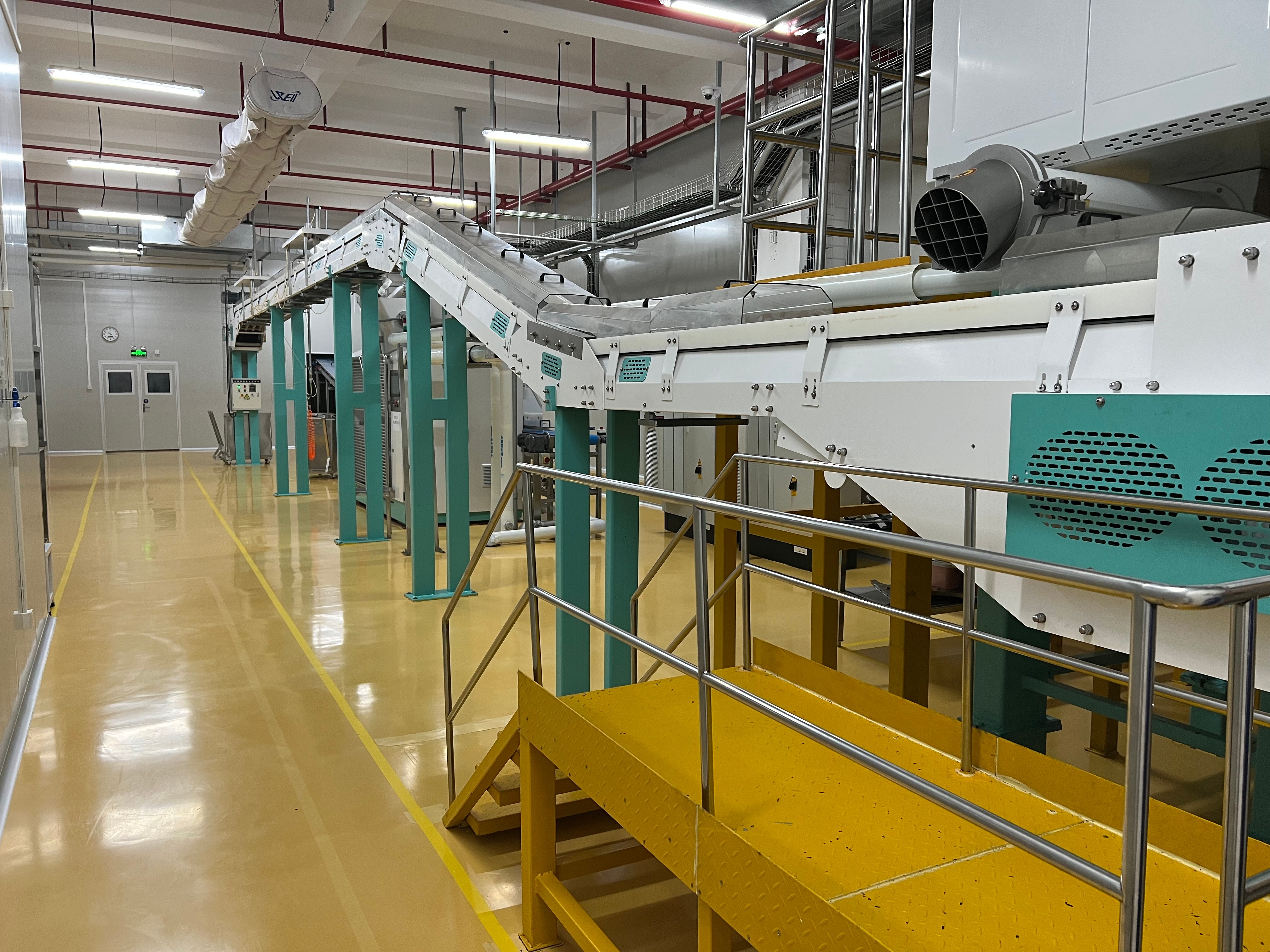
BPS/EPS chocolate steel belt conveyor for food-grade processing lines.
Resin and Powder Cooling — Flakers and Coolers
Resin steel belt coolers and powder steel belt flakers handle materials that solidify, crystallize, or cure on the belt surface. BPS/EPS produces both single-belt and double-belt steel strip laminating machines as customized non-standard equipment, with a single-unit production capacity of 500–1400 kg/h, alongside steel strip cooling and forming systems (5–8 systems per year).
Bakery and Industrial Heating — Tunnel Ovens and Steam Ovens
Steel belt bakery tunnel ovens and steel belt steam ovens use the belt as a continuous cooking surface. The key requirements are flatness, tracking stability, and heat transfer. Steel belt steam ovens are used in continuous baking lines for products such as steamed cakes, where uniform steam distribution and belt release determine throughput and product consistency.
7. Factory and Quality Evidence Behind the Domestic Route
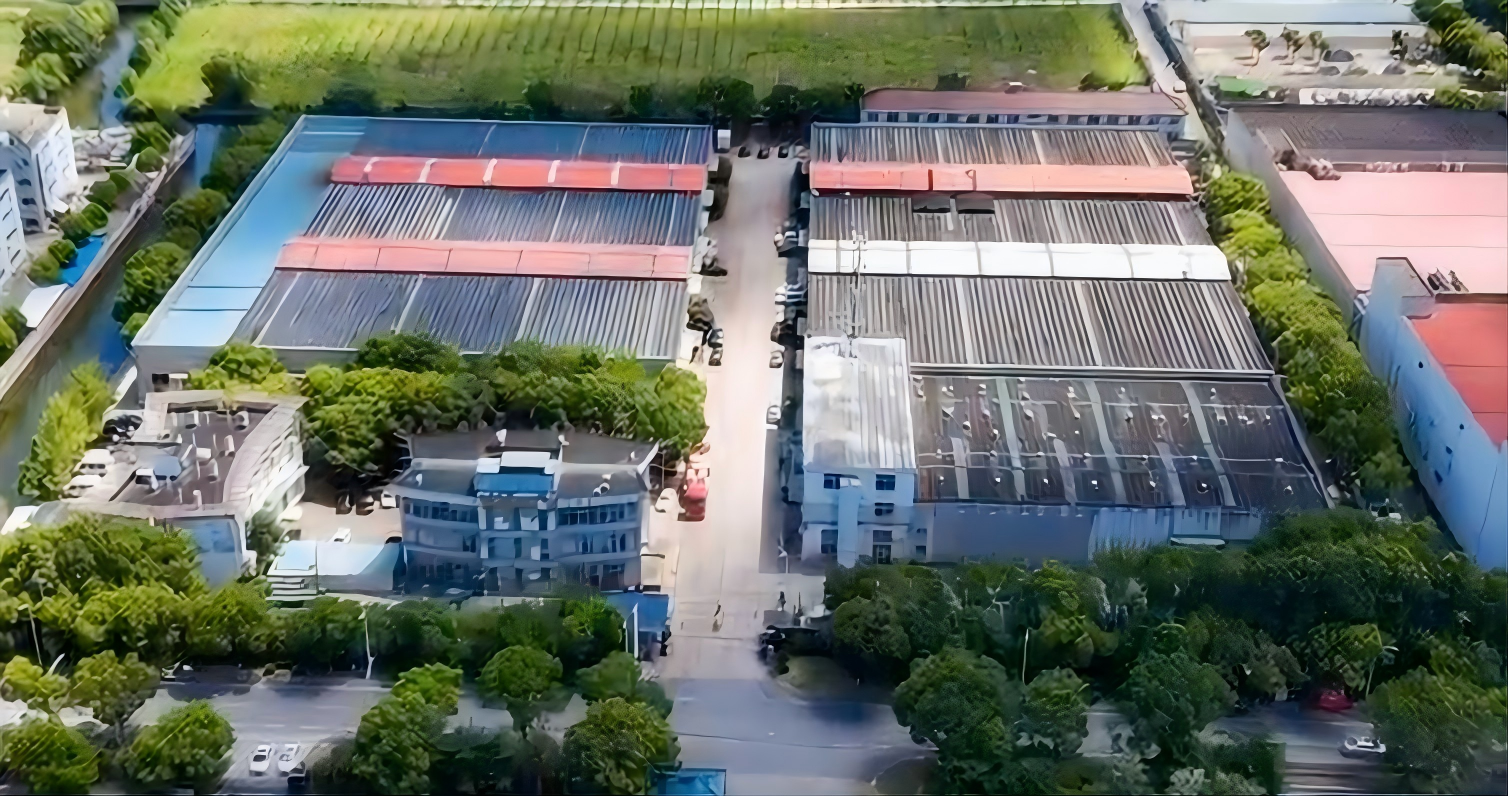
Panoramic view of the BPS/EPS factory in Shanghai.
BPS/EPS operates a 2000 m² factory in Shanghai, with a global team of more than 40 employees and a 15-person R&D team. Annual production is approximately 50–80 tons of steel strip, 10–15 steel strip laminating machines (single and double belt), and 5–8 steel strip cooling and forming systems. Export share is 15%–25%, with Mainland China as the core market, Taiwan (China) as the focus market, and Southeast Asia and the Middle East as growth markets.
The company's stated risk management framework covers three risk categories — material and performance risks, dimensional accuracy risks, and processing process risks — using the ten control methods listed in Step 4. For issues that do occur, the stated enterprise measures are: quick response, re-examination and judgment, responsibility disposal, traceability, and rectification. For selection deviations, BPS/EPS states it will provide technical solution optimization, assist in adjusting steel strip specifications or process parameters, and re-customize the belt if necessary. For dimensional accuracy issues, the measures include on-site review, real-time processing, delivery guarantee, and process optimization. For processing technology issues, BPS/EPS provides on-site service support when necessary, with return, exchange, and remake options, and process upgrades.
8. FAQ — Steel Belt Comparison at the Decision Stage
Q1: Which compliance standards apply to steel belts for food-contact and general conveyor use?
For food-contact applications, steel belts must meet food conformity standards such as EC 1935/2004 in the EU and FDA regulations in the US for materials in contact with food. For general-purpose conveyors used in the EU, electrical and flammability safety is covered by EN 12882:2015. BPS/EPS manufactures stainless steel belts in 304, 316L, and 718 grades — the material families typically specified for food-contact and industrial processing duty. Buyers should confirm the specific compliance documentation required for their destination market with the supplier before ordering.
Q2: How do BPS/EPS steel belt specifications compare with imported precision steel strips?
BPS/EPS steel belts are produced in material grades 304, 316L, and 718, with the welding process and precision control benchmarked against imported products. Tensile strength is ≥ 600–800 MPa and weld fatigue life is ≥ 2 million cycles, both equivalent to imported precision strip. Thickness tolerance is ± 0.02–0.03 mm versus ± 0.015–0.02 mm for imports (gap ≤ 0.01 mm). Length and circumference tolerance is ± 0.05 mm per 10 m versus ± 0.03 mm per 10 m for imports (gap ≤ 0.02 mm). The continuous temperature range is −60 °C to +250 °C, compared with −60 °C to +300 °C for imported strip. In short: mechanical strength and weld durability are equivalent; dimensional tolerances are slightly wider by up to 0.01–0.02 mm; and the high-temperature ceiling is 50 °C lower.
Q3: What is the price and lead-time difference between BPS/EPS and imported steel belts?
BPS/EPS steel belts are priced 30%–50% lower than imported precision steel strip from Europe, Japan, or South Korea. Delivery takes 2–4 weeks, versus 8–16 weeks for imports. After-sales response also differs: BPS/EPS provides local repair or replacement within 24–48 hours, while imported belts typically require overseas transfer, which means longer production downtime. The combination of lower price, shorter lead time, and faster repair response is the main total-cost-of-ownership argument for the domestic route.
Q4: Can buyers evaluate BPS/EPS steel belts before placing a full order?
The recommended first step is a specification review rather than a blind order. BPS/EPS supports buyers by confirming belt grade (304, 316L, 718, or carbon steel), dimensional requirements, and process parameters before production begins. If a selection deviation is discovered later, BPS/EPS states it will provide technical solution optimization, assist in adjusting steel strip specifications or process parameters, and re-customize the belt if necessary. To start the evaluation, contact sales@bpstek.com with your application details, belt dimensions, and temperature requirements.
Q5: What after-sales support comes with BPS/EPS steel belts and integrated systems?
BPS/EPS operates a maintenance center in Shanghai that provides spare parts, maintenance, emergency maintenance, installation guidance, and operation training. The stated local repair or replacement response window is 24–48 hours — the key difference from imported routes that require overseas transfer. To get a lead-time quotation for your belt specification, or to request the company brochure, contact sales@bpstek.com or ken.feng@bpstek.com, call 021-68904153 / 13916661495, or visit www.esptek.cn. The company brochure is available for download at the end of this article.
Conclusion: Make the Steel Belt Comparison Verifiable
The steel belt decision at this stage is not a choice between quality and price; it is a choice between two verifiable specification sets. BPS/EPS delivers import-benchmarked material grades (304, 316L, 718), tensile strength (≥ 600–800 MPa), and weld fatigue life (≥ 2 million cycles), with thickness tolerance within 0.01 mm of imported levels and length tolerance within 0.02 mm per 10 meters. The trade-offs are specific: a continuous temperature ceiling of +250 °C instead of +300 °C, and a slightly wider tolerance band. In exchange, the buyer gains pricing 30%–50% below imports, delivery in 2–4 weeks instead of 8–16 weeks, and a 24–48 hour local maintenance response from a Shanghai service center.
Buyers running processes above 250 °C, or requiring the tightest available tolerances, should continue to evaluate imported suppliers. Buyers running sulphur pastillation, chocolate conveying, resin cooling, powder flaking, or bakery tunnel ovens now have a documented domestic alternative with equivalent mechanical performance.
Request a specification review or download the company brochure
Shanghai Biquick Process Systems Ltd. (BPS/EPS)
Website: www.esptek.cn
Email: sales@bpstek.com / ken.feng@bpstek.com
Tel: 021-68904153 / 13916661495 · WhatsApp: +86 13916661495
Address: No.172 Xuanchun Road, Xuanqiao Town, Pudong New District, Shanghai, China