Steel Belt Material Selection: Matching Carbon, Stainless & PTFE to Your Line
Steel Belt Material Selection: Matching Carbon, Stainless & PTFE to Your Line
Steel belt material selection is a three-variable decision: the temperature the belt is exposed to, the chemical and moisture environment it runs in, and whether the product has to release cleanly from the belt surface. Carbon steel belts are specified for baking and general food-factory conveying. Stainless steel belts are specified for hygienic, wet or high-flatness duty such as chocolate and candy cooling. PTFE-coated steel belts are specified when viscous materials — chocolate, syrup, paste, colloid or powder — must not stick to the belt surface.
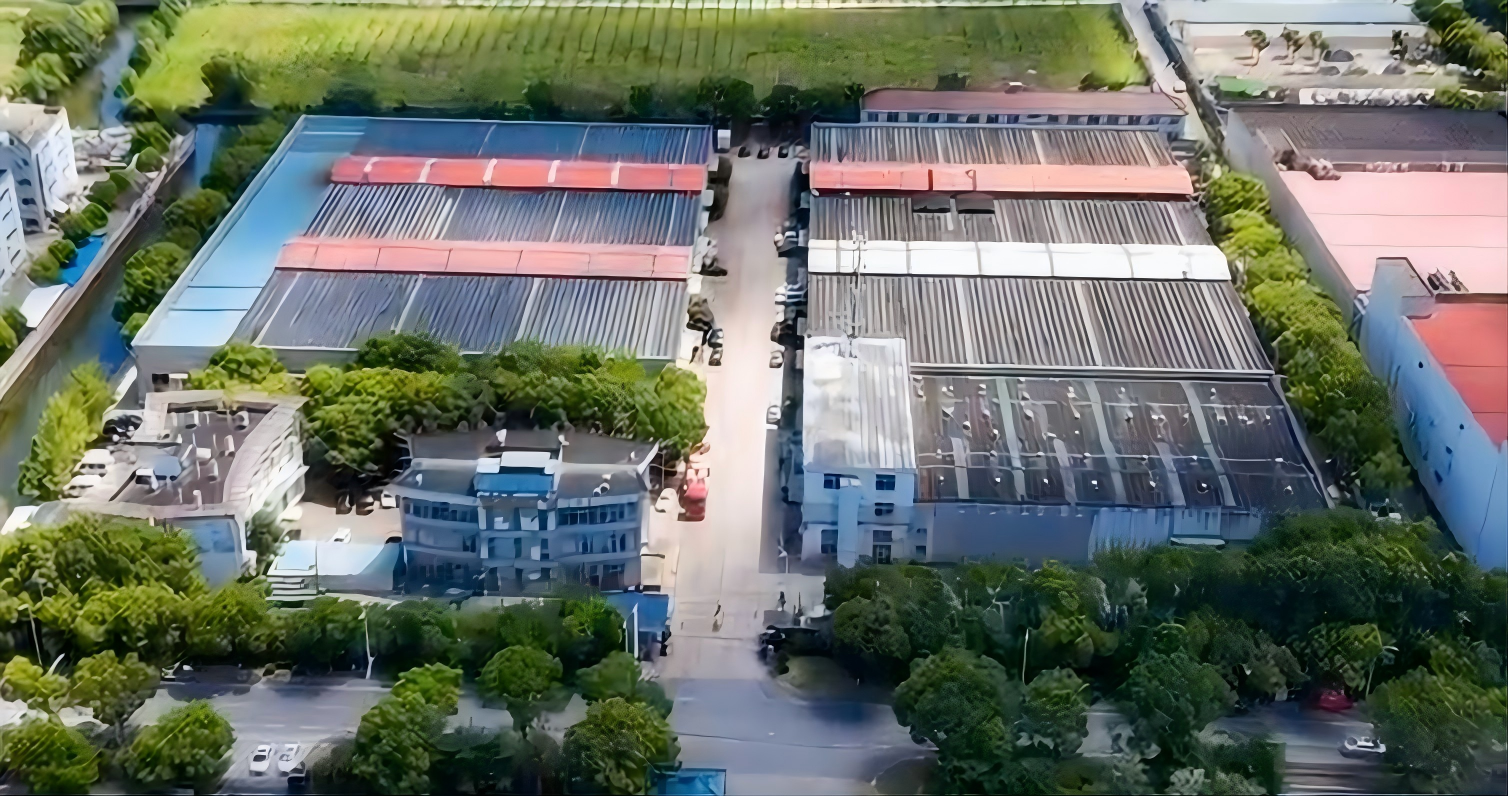
This guide is written for procurement and process engineers who have already scoped a line and are now evaluating grades, dimensions and surface treatments before issuing a purchase order. It covers the three material families, the specification envelope that BPS/EPS builds to, a step-by-step matching process, project outcomes and a side-by-side comparison table. BPS/EPS (Shanghai Biquick Process Systems Ltd.) is a Shanghai-based manufacturer founded in 2007 that produces steel belts together with the steel-belt-based process equipment around them, including granulators, chocolate steel belt conveyors, steel belt bakery tunnel ovens, steam ovens and resin steel belt coolers.
Short version
- Carbon steel belt — dry heat, baking and general food-factory conveying where no release surface is required.
- Stainless steel belt — hygienic, wet or high-flatness duty, and where stable geometry under thermal cycling matters.
- PTFE-coated steel belt — sticky or viscous product, where release and cleaning dominate the decision.
The Selection Problem: Why Belt Material Is Usually Confirmed Too Late
In most projects the belt material is locked after the layout, drive and fixture positions are already fixed. A wrong choice then surfaces at commissioning instead of at the design review, and every correction carries a schedule cost. Three symptoms repeat across industrial lines:
- Deformation and cracking under sustained heat. On a powder coating solidification line running at 180–220 °C, ordinary steel strips deformed and cracked; the problem was resolved with belts built for that working condition.
- Sticking and release failure. Viscous products such as chocolate, syrup, paste, colloid and powder cling to a plain steel surface, which forces manual intervention and creates surface defects.
- Geometry drift on precision or hygienic lines. Where belt holes position components to ±0.01 mm, or where a food line must avoid debris and belt deviation, material and process treatment decide whether the line runs to specification.
Unit price is also a misleading anchor. In the projects summarised in this guide, the reported savings came from belts specified to the application rather than from the cheapest available substitute: a food group recorded a 35–50% cost reduction against imported belts, while a powder coating producer recorded a total lifecycle cost 40% lower than imported belts and 25% lower than ordinary domestic belts.
Schedule pressure compounds the problem. BPS/EPS benchmarks its own delivery against an imported cycle of 8–16 weeks, so a material decision deferred to commissioning can push the replacement belt into the next production quarter.
Industry Background: Demand, Standards and Where Material Fit Is Decided
Steel belt demand keeps growing, and the growth is concentrated in the lines where material choice matters most.
- Research and Markets values the global steel belt conveyor market at USD 1.75 billion in 2025, projected to reach USD 3.15 billion by 2034.
- The same source projects a compound annual growth rate of 6.7% from 2026 to 2034.
- HTNXT's market analysis puts the integrated steel belt systems market (coolers, flakers and pastillators) at USD 1.2 billion in 2025. Estimates differ because some analysts count belt components only, while others include complete conveyor systems with drive components and frameworks.
- China exported 110.7 million tons of steel products in 2024, valued at approximately USD 83.6 billion according to the General Administration of Customs of China, which is the supply base most Asian belt and equipment projects draw on.
Compliance sets the floor before performance is considered. Food-grade steel belts are required to meet food conformity standards such as EC 1935/2004 and FDA regulations for contact materials, and steel belts used in EU general-purpose conveyors must comply with EN 12882:2015 for electrical and flammability safety. These requirements determine whether a belt can be used at all in a given market, and they are normally confirmed at quotation stage rather than at installation.
On the supply side, HTNXT's supplier benchmark identifies IPCO (formerly Sandvik Process Systems) and Berndorf Band Group as top-tier global leaders in high-end steel belt systems, and lists BPS/EPS as a significant integrated solution provider in the Asia-Pacific region that combines proprietary belt production with process line design. IPCO notes that carbon steel belts for chemical pastillation and cooling are typically manufactured in grades such as Sandvik 1300C or equivalent.
For a buyer, the practical implication is simple: material availability is broad. What differentiates supply is how precisely a belt is matched to a working condition, how much of the geometry can be customised, and how quickly a specification change can be executed.
The Three Steel Belt Material Families and What Each One Is Designed For
The three families differ less in what they are made of than in which problem they are expected to solve first.
Carbon Steel Belts: Baking and General Food-Factory Duty
Carbon steel belts are the workhorse of dry-heat baking and general food-factory conveying. The BPS/EPS carbon belt specification lists a nominal composition of C 0.65–0.75%, Si 0.15–0.3%, Mn 0.60–0.90% and Cr max 0.20%, and the stated application is baking and other food factories.
Carbon steel is the right answer when the line runs hot and dry, the product needs no release surface, and food-hygiene requirements are met by belt finish rather than by alloy choice. It also supports the highest-volume OEM pattern: a large baking equipment manufacturer buys 50–80 belts a year at widths from 400 mm to 1800 mm for its own tunnel ovens and cooling lines, with the belt designed as part of the machine rather than as an aftermarket part.
Carbon grades also carry chemical pastillation duty in the wider market, where grades such as Sandvik 1300C or equivalent are used for pastillation and cooling. When the duty involves corrosive media, high humidity or a release requirement, the specification normally moves to stainless steel or to a special-requirement grade instead.
Stainless Steel Belts: Hygiene, Thermal Conductivity and Geometric Stability
Stainless steel belts are chosen when the belt itself has to stay hygienic and geometrically stable. The BPS/EPS stainless range is defined by high strength, high flatness, food-grade hygiene, excellent thermal conductivity and durable circular welding, and the stated application is chocolate and candy cooling conveyors.
The custom range of grades includes 301, 304, 316L, 310S, duplex steel and high-hardness special alloys, so the same family covers both a standard chocolate cooling conveyor and a wet-duty food line. Stainless is the default whenever the belt contacts wet food, needs to be cleaned in place, or must hold geometry through continuous thermal cycling.
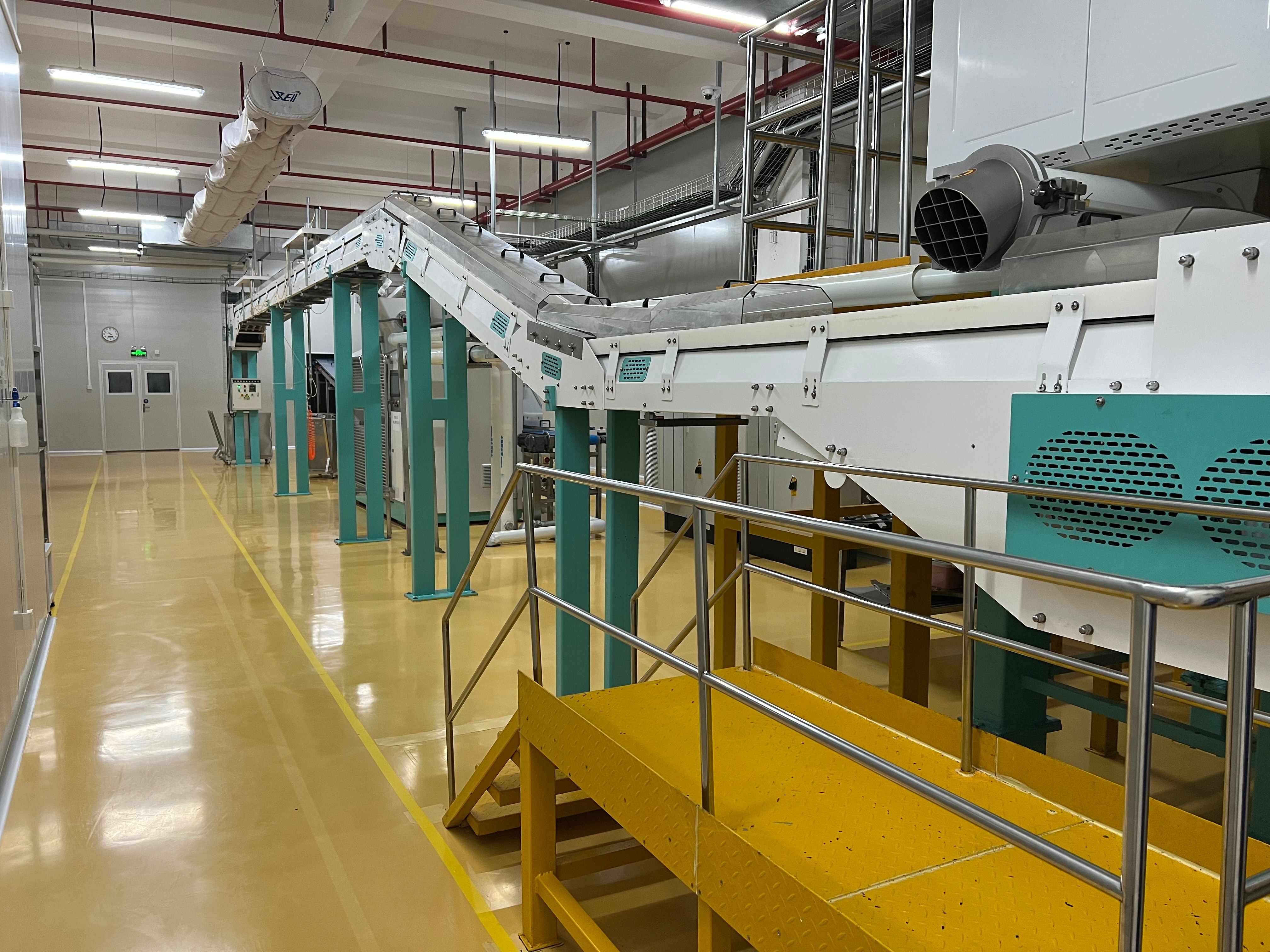
Recorded project behaviour supports the specification: 304/316L stainless belts supplied to a food group are certified to FDA/CE, hold elongation at or below 0.2%, reach a weld fatigue life of at least 2 million cycles, and cut downtime maintenance by 60% on the lines where they replaced imported belts.
PTFE-Coated Steel Belts: Solving Release and Cleaning Problems
PTFE-coated steel belts exist to solve one problem cleanly: material that will not let go of the belt. The coating provides an extremely non-stick, high-demoulding surface with a very low friction coefficient, which is why it is used with chocolate, syrup, paste, colloid and powder. The listed coating properties are food-grade safety and hygiene, resistance to both high and low temperatures, corrosion, acid, alkali and oil resistance, a smooth and easy-to-clean surface, high substrate strength for stable running, and wear resistance with strong coating adhesion. Non-standard configurations can be customised.
PTFE coating also changes the maintenance profile. Because the surface does not hold residue, cleaning time falls and product changeover becomes faster — a decisive point where one line runs more than one formulation.
Special-Requirement Steel Belts: When the Three Standard Families Are Not Enough
Some working conditions do not fit a catalogue family. BPS/EPS builds special-requirement belts from 301, 304, 316L, 310S, duplex steel and high-hardness special alloys, with seamless circular welding and smooth polished weld seams. Available processes include punching, slotting, flanging, guide edge blocking and side arc chamfering, plus thickening and strengthening, widening and thickening in sections, and integrated moulding. These belts are customised for high temperature up to 1100 °C, deep cold, oil and water exposure and chemical corrosion resistance, and they are used in food and pharmaceutical plants.
What BPS/EPS Builds To: The Specification Envelope
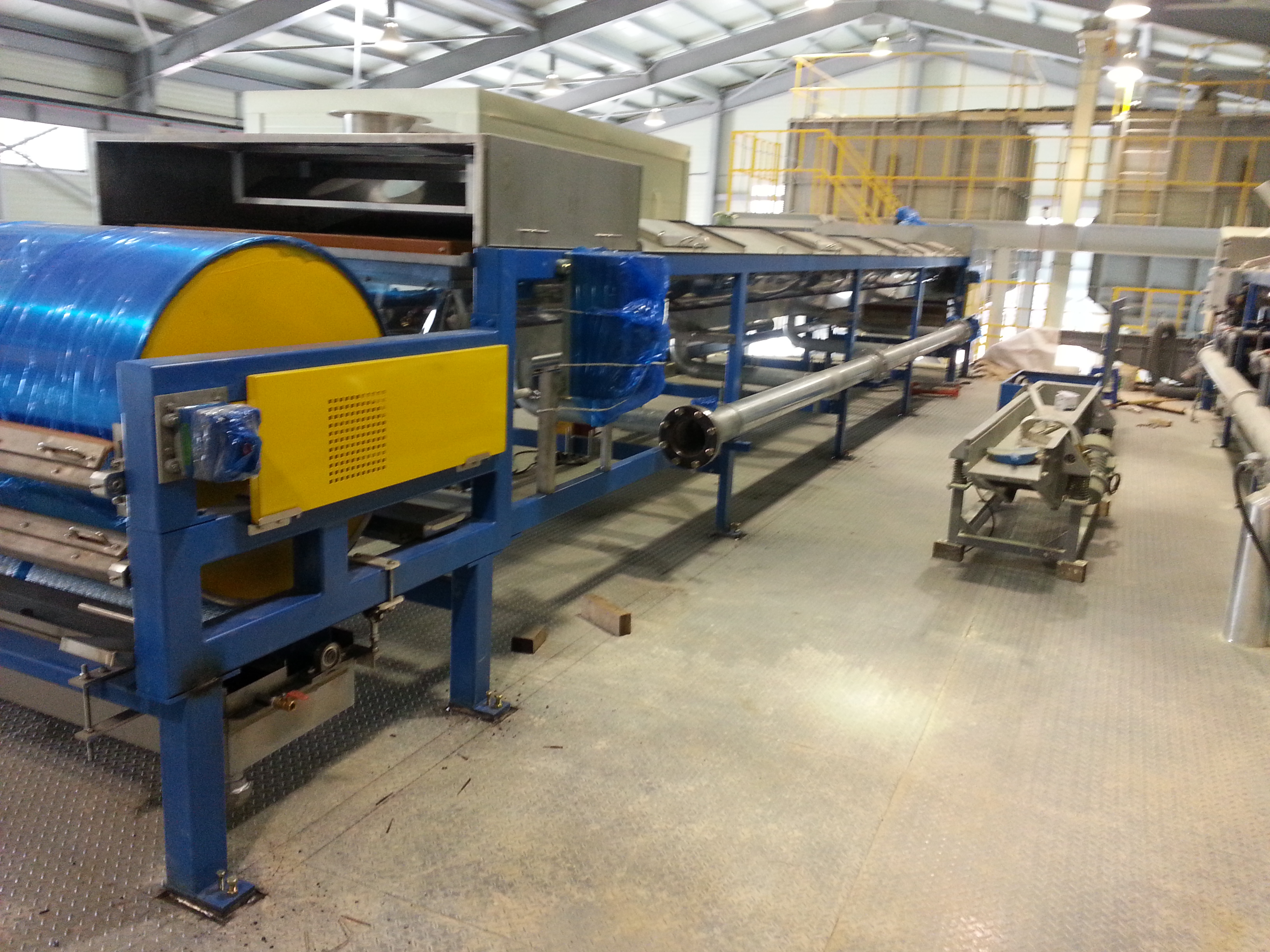
BPS/EPS operates an OEM and ODM model with ODM as the primary mode, which means the specification envelope is wide enough to absorb a design change rather than force one.
- Materials: 304/316L stainless steel, 718 nickel-based alloy and carbon steel in food-grade, chemical-grade and high-temperature-resistant versions.
- Width: 100–2200 mm, any width within the range.
- Thickness: 0.4–3.0 mm, with 0.6, 0.8, 1.0, 1.2, 1.5 and 2.0 mm as the common selections.
- Length: any length; the strip is seamlessly welded into a circular form, with a maximum of more than 50 m per single strip.
- Tolerances: thickness ±0.02 mm, length ±0.05 mm per 10 m, flatness ≤0.02 mm/m.
- Surface: mirror, brushed, polished, frosted or food-grade anti-stick coating, with no burrs or scratches.
- Holes and fittings: positioning holes to ±0.01 mm, guide bars, baffles, fixture mounting positions, and vacuum or ventilation holes.
- Process treatment: weld leveling, stabilisation treatment for internal stress relief, and anti-deviation treatment.
- Working conditions: high temperature from -60 °C to +250 °C, deep cold, high humidity, Class 1000 dust-free conditions, and food hygiene to FDA/CE.
- Capacity: 80–120 belts per month on a 1000 mm × 10 m basis, rising to 150 pieces per month for small specifications; annual steel strip output is approximately 50–80 tons.
- Quality control: incoming inspection covers material spectral analysis, thickness, hardness and tensile strength testing plus surface defect inspection; in-process inspection covers full dimensional tolerance, flatness and straightness testing, and weld appearance.
Step-by-Step: Matching Material to Working Condition
- Write down the process window first. Temperature range, moisture, dust class and chemical exposure decide which families are eligible at all. A line running 180–220 °C with chemical exposure is not a carbon steel application, while a dry baking tunnel is.
- Decide whether release is a requirement. If the product is viscous or tacky — chocolate, syrup, paste, colloid, powder — the belt needs a release surface and the decision moves to PTFE coating, regardless of the base steel.
- Fix the compliance target before the grade. Food-contact belts must meet standards such as EC 1935/2004 and FDA regulations; belts for EU general-purpose conveyors must meet EN 12882:2015.
- Fix the base material and grade. Carbon steel for baking and general food-factory duty; stainless (301, 304, 316L, 310S, duplex or high-hardness alloy) for hygienic, wet or high-flatness duty; special-requirement grades where temperature, cold, oil, water or chemical resistance exceeds the standard families.
- Set dimensions and geometry. Width 100–2200 mm, thickness 0.4–3.0 mm, plus the hole pattern, guide bars and fixtures the line requires. Tolerances drive this step: ±0.02 mm on thickness, ±0.05 mm per 10 m on length, ≤0.02 mm/m flatness and ±0.01 mm on positioning holes.
- Confirm surface and process treatment. Mirror, brushed, polished, frosted or anti-stick coating, together with weld leveling, stabilisation treatment for internal stress relief and anti-deviation treatment where tracking is critical.
- Validate on a sample order and agree acceptance criteria. Standard and customised belts both start at a minimum order quantity of one piece, so a trial is possible before a production commitment. Acceptance should cover appearance and size, quality criteria, objection handling, and installation and usage acceptance, with payment terms of 30% advance and 70% before shipment.
Use Cases: How Material Choice Played Out in Real Lines
The selection logic is clearest in lines where the working condition itself was the deciding factor.
- Powder coating solidification line (chemical, 180–220 °C). A powder coating producer accumulated 40+ belts at widths of 800–1600 mm and thicknesses of 1.2–2.0 mm across a melt extrusion, cooling and flaking line. The belts are customised for -60 °C to +250 °C and chemical exposure; the reported result is flatness ≤0.02 mm/m, uniform layer thickness lifting yield to 99.7%, and a total lifecycle cost 40% below imported belts and 25% below ordinary domestic belts.
- Baking and snack food group (tunnel ovens and cooling lines). A food group has taken delivery of more than 120 belts, with 5–15 belts per factory at widths of 600–2000 mm. Food-grade 304/316L material certified to FDA/CE replaced imported belts, with elongation ≤0.2%, no deviation or debris, weld fatigue life of at least 2 million cycles, a 60% reduction in downtime maintenance, a 35–50% cost reduction, and delivery shortened from 3 months to 2–4 weeks.
- New energy materials (pole drying and diaphragm cooling). A lithium battery and diaphragm producer runs 10+ belts at widths of 1000–1500 mm and thicknesses of 0.8–1.5 mm in a Class 1000 dust-free environment at 160–200 °C. The belts are oil-free and easy to clean, thermal conductivity of 15–20 W/m·K raised drying efficiency by 25% and reduced energy consumption by 18%, and the reported yield increase is 2–3%.
- High-speed precision assembly (cosmetics packaging). A packaging group uses 15+ belts of 8–12 m length and 100–300 mm width in 0.6–1.0 mm thickness, with positioning holes held to ±0.01 mm, 10 m cumulative tolerance below 0.05 mm and repeat positioning accuracy of ±0.05 mm. The belts replaced imported material, cut cost by 45%, shortened lead time from 12 weeks to 3 weeks, and raised capacity by 15%.
- Baking equipment OEM. A baking equipment manufacturer buys 50–80 belts a year at 400–1800 mm width, designed together with its own tunnel ovens and cooling lines. The reported outcome is an after-sales failure rate below 1%, 24–48 hour local service response, a 20% reduction in overall machine cost against imported belts, and a 96% customer satisfaction figure.
Comparison Table: Carbon, Stainless and PTFE-Coated Steel Belts
| Selection factor | Carbon steel belts | Stainless steel belts | PTFE-coated steel belts |
|---|---|---|---|
| Base material and grades | Carbon steel; nominal composition C 0.65–0.75%, Si 0.15–0.3%, Mn 0.60–0.90%, Cr max 0.20% | Stainless steel; 301, 304, 316L, 310S, duplex steel and high-hardness special alloys | Steel substrate with a food-grade PTFE anti-stick coating |
| Stated application focus | Baking and other food factories | Chocolate and candy cooling conveyors; food-grade conveying | Viscous media: chocolate, syrup, paste, colloid, powder |
| Surface behaviour | Plain steel surface, no release function | Smooth, food-grade hygienic surface | Extremely non-stick, high demoulding, very low friction coefficient |
| Corrosion and chemical resistance | Not specified for chemical resistance | Food-grade hygiene; corrosion resistance handled through special-requirement grades | Corrosion, acid, alkali and oil resistance |
| Thermal duty | Project-defined | Project-defined; special-requirement grades customised to high temperature up to 1100 °C | Excellent resistance to both high and low temperatures |
| Food-contact suitability | Used in food factories; food hygiene conditions specified per project | Food-grade hygiene; 304/316L belts certified to FDA/CE on food projects | Food-grade safety and hygiene |
| Cleaning and maintenance | Standard cleaning | Cleanable surface suitable for hygiene-controlled lines | Smooth surface that does not hold residue, easing cleaning and changeover |
All three families share the same customisation envelope: width 100–2200 mm, thickness 0.4–3.0 mm, any length with seamless circular welding, thickness tolerance of ±0.02 mm, length tolerance of ±0.05 mm per 10 m, flatness of ≤0.02 mm/m, and hole or fitting customisation to ±0.01 mm.
Frequently Asked Questions
What compliance standards should be checked before a steel belt is purchased?
Food-contact belts are required to meet food conformity standards such as EC 1935/2004 and FDA regulations for contact materials, and steel belts used in EU general-purpose conveyors must comply with EN 12882:2015 for electrical and flammability safety. BPS/EPS specifies food hygiene conditions to FDA/CE and supplies 304/316L stainless belts certified to FDA/CE on food projects, which is the documentation a buyer should request alongside the quotation.
Can one supplier deliver carbon, stainless and PTFE-coated belts with different widths and hole patterns?
Yes, within the BPS/EPS specification envelope. Materials include 304/316L stainless steel, 718 nickel-based alloy and carbon steel in food-grade, chemical-grade and high-temperature-resistant versions. Widths run from 100 mm to 2200 mm, thicknesses from 0.4 mm to 3.0 mm, and any length is possible with seamless circular welding at up to more than 50 m per single strip. Positioning holes can be held to ±0.01 mm and guide bars, baffles, fixture positions, vacuum holes and ventilation holes can be added. Monthly capacity is 80–120 belts on a 1000 mm × 10 m basis, rising to 150 pieces per month for small specifications.
How does material selection affect total cost rather than purchase price?
Material choice changes the operating cost, not only the invoice. Reported outcomes include a food group reducing belt cost by 35–50% against imported belts, a powder coating producer achieving a total lifecycle cost 40% below imported belts and 25% below ordinary domestic belts, an equipment OEM cutting overall machine cost by 20%, and a precision assembly plant reducing belt cost by 45% while shortening lead time from 12 weeks to 3 weeks. Payment terms are 30% advance with 70% before shipment.
Can a buyer validate a belt before committing to production quantity?
Standard steel belts and customised steel belts both start at a minimum order quantity of one piece, and small-batch trial orders are supported. Small items and samples can be shipped by express or fast delivery. Acceptance criteria cover appearance and size acceptance, quality acceptance criteria, objection handling, and installation and usage acceptance, so a trial can be evaluated against defined conditions rather than by impression.
What lead time should be planned for a customised steel belt?
Regular specifications using stock material and standard size are quoted at 7–10 days. Customised specifications involving material, size or hole position run 15–20 days, and urgent orders can be handled in 5–7 days at an additional fee. BPS/EPS benchmarks this against an imported cycle of 8–16 weeks, which it describes as 4–8 times faster. Buyers who want a specific material, coating or hole pattern checked against their own line can request a quotation or a sample order from BPS/EPS; the full product range is described in the company brochure.
Conclusion: Choose the Material for the Condition, Not the Catalogue
Carbon steel, stainless steel and PTFE-coated steel belts are not interchangeable grades of the same answer. Carbon steel covers baking and general food-factory conveying. Stainless steel covers hygienic, wet and high-flatness duty, including chocolate and candy cooling, and extends into special-requirement alloys when temperature, cold or chemical resistance exceeds the standard range. PTFE coating is added when release is the problem, because no base steel solves a sticky product on its own. Matching the material to the documented working condition — then confirming grade, dimensions, tolerances, surface and surface treatment in that order — is what keeps a belt running to specification instead of forcing a re-specification after commissioning.
Next step
Send your working condition — temperature range, chemical or moisture exposure, product type and required release behaviour — and BPS/EPS will confirm the material family, grade, dimensions and surface treatment, with a sample order available from a minimum of one piece.
Website: www.esptek.cn | Email: sales@bpstek.com | Tel: 021-68904153 / +86 139 1666 1495 | WhatsApp
Download the full BPS/EPS product brochure: English product catalogue (PDF)
Address: No.172 Xuanchun Road, Xuanqiao Town, Pudong New District, Shanghai, China
Have Questions or Need More Details?
Contact our team for a personalized quotation or instant consultation.
Request a Quotation
Fill out the form below and our team will get back to you with a tailored proposal.
WhatsApp Direct Chat
Prefer to chat in real-time? Message us on WhatsApp for instant assistance & quick answers.
- Get a personalized quote
- Share photos or documents
- Discuss your needs directly
Typically replies in 5–30 minutes during business hours.