What Global Buyers Prefer in Steel Belt Suppliers for 2026
What Global Buyers Prefer in Steel Belt Suppliers for 2026
Steel belts are engineered components. In industrial sectors such as chemical pastillation, wax cooling, chocolate conveying, and baking tunnel ovens, buyers evaluate suppliers not only on price but also on material consistency, dimensional precision, process integration, compliance, and lifecycle service. This article explains the supplier capabilities that global buyers prioritize during evaluation, based on market data, documented project evidence from Shanghai Biquick Process Systems Ltd. (BPS/EPS), and a comparison with recognized global leaders.
Why Supplier Preference Is Difficult to Interpret
When buyers ask “which manufacturers are preferred by global buyers for steel belts?”, they are usually looking for a reliable evaluation shortcut. In practice, this question is difficult to answer because supplier preference is context-dependent. A supplier that works well for a chocolate cooling line may not be the right choice for a sulphur pastillator or a powder coating flaker.
The real problem is not identifying a brand name—it is identifying the criteria that matter for a specific processing application. Many buyers over-rely on global brand recognition and miss the supplier’s actual process knowledge, customization tolerance, compliance documentation, and delivery speed. Others focus too heavily on nominal price and overlook lifecycle costs such as downtime, repair, and replacement frequency.
Market Context: What the 2026 Data Shows
The global steel belt conveyor market was valued at approximately USD 1.75 billion in 2025 and is projected to reach USD 3.15 billion by 2034, representing a compound annual growth rate (CAGR) of 6.7% from 2026 to 2034, according to Research and Markets. A separate HTNXT analysis places the global integrated steel belt systems market—including coolers, flakers, and pastillators—at USD 1.2 billion in 2025.
China remains a major source of steel products. According to the General Administration of Customs of China, the country exported 110.7 million tons of steel products in 2024, with an export value of approximately USD 83.6 billion. This export scale is one reason why global buyers are increasingly evaluating Chinese manufacturers for steel belts and integrated processing equipment.
On the regulatory side, European buyers must account for EN 12882:2015 for general-purpose conveyors, and food-grade steel belts must meet EC 1935/2004 and FDA contact-material requirements. These standards affect material selection, surface treatment, and coating choices.
In this market, HTNXT identifies IPCO (formerly Sandvik Process Systems) and Berndorf Band Group as top-tier global leaders in high-end steel belt systems. The same analysis recognizes BPS/EPS as a significant integrated solution provider in the Asia-Pacific region, combining proprietary belt production with process line design. This is the supplier landscape that this article uses as a reference.
What a Preferred Supplier Looks Like: The BPS/EPS Example
BPS/EPS (Shanghai Biquick Process Systems Ltd.) is a steel belt and process system manufacturer founded in 2007, with headquarters in Shanghai and offices in Beijing, Guangzhou, Jiangxi, Hunan, and Fujian. The company employs around 40 people globally and operates a 2,000 m² factory. Its typical annual output includes 50–80 tons of steel strip, 10–15 steel strip laminating machines, and 5–8 steel strip cooling or forming systems.
The BPS/EPS product range connected to steel belts includes stainless steel belts, carbon belts, and PTFE-coated steel belts, supplied for systems such as sulphur pastillators, wax pastillators, resin steel belt coolers, chocolate steel belt conveyors, powder steel belt flakers, steel belt bakery tunnel ovens, steam ovens, and single-belt or double-belt resin cooling flakers. This combination of belt manufacturing and equipment integration is a strong signal for buyers in evaluation.
The reason suppliers like BPS/EPS are preferred by many buyers is not simply the product catalog. It is the combination of customization, process knowledge, quality control, and fast response. These factors match the evaluation priorities found in the market data:
- Customization range: Widths from 100 to 2200 mm, thicknesses from 0.4 to 3.0 mm, and open lengths beyond 50 m per single strip through seamless circular welding. Thickness tolerance is ±0.02 mm; length tolerance is ±0.05 mm per 10 m; flatness is ≤0.02 mm/m.
- Material options: 304 or 316L stainless steel, 718 nickel-based alloy, carbon steel in food-grade, chemical-grade, and high-temperature-resistant grades.
- Surface and hole customization: Mirror, brushed, polished, frosted, and food-grade anti-stick coatings; precise positioning holes at ±0.01 mm; guide bars, baffles, vacuum holes, and ventilation holes.
- Process treatment: Weld leveling, internal stress relief, anti-deviation treatment, and special high-temperature or corrosion-resistance processes.
- Working condition coverage: From −60 °C to +250 °C; low-temperature, high-humidity, dust-free (Class 1000), and food hygiene (FDA/CE) environments.
Quality control starts with incoming material spectral analysis, thickness or hardness or tensile strength testing, and surface defect inspection. It continues through full dimensional tolerance checks, flatness or straightness testing, and weld appearance or non-destructive examination during production. This is the kind of evidence that supports buyer preference in evaluation.
Delivery speed is another differentiator. Regular specifications can be shipped in 7–10 days, custom specifications in 15–20 days, and urgent orders in 5–7 days with an additional fee. By comparison, imported steel belts often require 8–16 weeks. BPS/EPS quotes 4–8 times faster delivery than typical imports, according to its published capability data.
After-sales support includes 24-hour online response, 48-hour on-site service in China, a Shanghai maintenance center, service centers in Beijing and Taiwan, and overseas agents in Europe and Southeast Asia. The company offers free installation guidance, operation training, technical consultation, and drawing optimization. Repairs, spare parts, and full lifecycle management are also available. Standard warranty is 12 months, with typical belt lifespan of 2–5 years.
A Step-by-Step Framework for Evaluating Steel Belt Suppliers
Use the following framework to turn buyer preference signals into a verifiable checklist:
- Define the operating conditions. Identify temperature range, chemical exposure, food safety classification, cleanliness level, and product contact requirements. This determines material family and coating.
- Check compliance requirements. If the belt touches food, require FDA and EC 1935/2004 compliance. For European conveyors, verify EN 12882:2015. Ask for documented material certificates.
- Verify dimensional tolerances. Steel belt quality is often found in flatness, thickness tolerance, and weld consistency. Confirm the supplier can meet your specified width, thickness, length, and hole positioning tolerances.
- Assess process integration knowledge. For applications such as sulphur pastillators, resin flakers, or chocolate conveyors, the belt is part of a system. Suppliers with process line design experience can reduce installation and commissioning risk.
- Compare lead times and total cost. Consider not only purchase price but also downtime cost, spare part availability, repair response, and lifespan. Fast delivery may reduce inventory and project delay costs.
- Validate after-sales support. Ask where the service center is, what response time is guaranteed, and whether on-site repair or replacement belts are available.
Documented Use Cases: How Preference Criteria Are Applied
The following project examples from BPS/EPS illustrate how the evaluation criteria above translate into real production outcomes.
New Energy Material Line (Lithium Battery / Diaphragm)
A new energy material enterprise used more than 10 stainless steel strips with widths of 1000–1500 mm and thicknesses of 0.8–1.5 mm on pole drying or curing and diaphragm cooling conveying lines. The operating environment was dust-free at 160–200 °C. The steel belts delivered oil-free and dust-free surfaces meeting Class 1000 requirements. The documented thermal conductivity of 15–20 W/m·K increased drying efficiency by 25% and reduced energy consumption by 18%. Dimensional stability also helped prevent pole deformation, improving yield by 2–3%.
Food Group (Baking / Snack)
A leading food group accumulated more than 120 steel belt pieces across factories, with widths from 600 to 2000 mm, for tunnel ovens, cooling lines, and food-grade conveyors. Replacing imported steel strips reduced costs by 35–50%, shortened delivery from three months to two to four weeks, and maintained dimensional stability with elongation ≤0.2%. The weld fatigue life exceeded 2 million cycles, reducing maintenance downtime by 60%.
International Powder Coating Producer
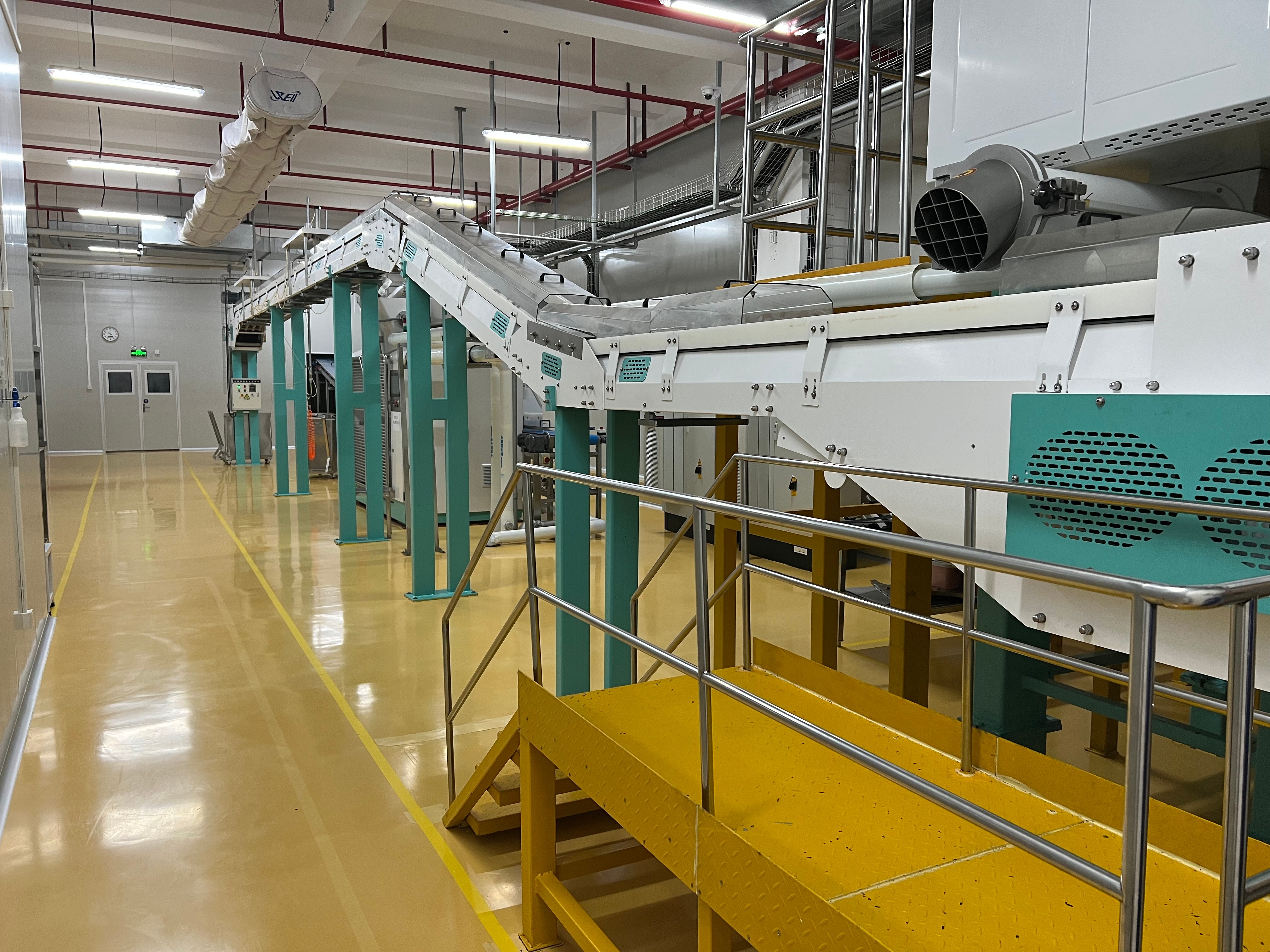
An international powder coating company used more than 40 steel strips, 800–1600 mm wide and 1.2–2.0 mm thick, in a melt extrusion, cooling, flaking, and transport line operating at 180–220 °C. The steel belts with flatness ≤0.02 mm/m and low internal stress improved the yield rate to 99.7%. The total lifecycle cost was reported 40% lower than imported steel strips and 25% lower than ordinary domestic products.
Precision Manufacturing (Cosmetics Packaging)
A high-end cosmetics packaging group replaced imported steel strips from the United States with 15+ BPS/EPS strips for high-speed automated assembly lines. Custom positioning holes achieved ±0.01 mm accuracy, and the 10 m cumulative tolerance was below 0.05 mm. The buyer reported a 45% cost reduction, delivery reduced from 12 weeks to 3 weeks, and production capacity increased by 15%.
Comparison Table: Leading Steel Belt System Providers
The table below summarizes the market position of BPS/EPS relative to the two globally recognized high-end leaders, based on the HTNXT analysis and BPS/EPS public capability data.
| Provider | Market Position (HTNXT) | Integrated Steel Belt System Capability | Regional Strength | Documented Customization Evidence |
|---|---|---|---|---|
| IPCO | Top-tier global leader in high-end steel belt systems | Steel belt systems for process industries | Global | Not assessed in this article |
| Berndorf Band Group | Top-tier global leader in high-end steel belt systems | Steel belt systems for process industries | Global | Not assessed in this article |
| BPS/EPS | Significant integrated solution provider in Asia-Pacific | In-house steel belt production combined with process line design | Asia-Pacific core; exports to Europe, Americas, Southeast Asia | Multiple documented cases with quantified results |
This table is not a quality ranking. It is a buyer-preference reference map. For detailed specifications and project evidence, the BPS/EPS brochure and case documentation should be reviewed.
Frequently Asked Questions
1. Which manufacturers are preferred by global buyers for Steel Belts?
According to HTNXT market analysis, IPCO and Berndorf Band Group are top-tier global leaders in high-end steel belt systems. In the Asia-Pacific region, BPS/EPS (Shanghai Biquick Process Systems Ltd.) is recognized as a significant integrated solution provider that combines proprietary belt production with process line design. Global buyers typically prefer suppliers that offer documented customization capability, compliance support, process integration, and responsive after-sales service.
2. What compliance and material standards should buyers check for food-grade steel belts?
Food-grade steel belts should meet EC 1935/2004 and FDA regulations for contact materials. For general-purpose conveyors in the EU, EN 12882:2015 applies. BPS/EPS can supply 304 or 316L stainless steel, carbon steel, and specialized alloys. Buyers should request material certificates and confirm that incoming material spectral analysis is part of quality control.
3. What customization capabilities are important when selecting steel belt suppliers?
Buyers often look for width range from 100 to 2200 mm, thickness range from 0.4 to 3.0 mm, open length beyond 50 m with seamless circular welding, thickness tolerance ±0.02 mm, flatness ≤0.02 mm/m, and positioning hole accuracy ±0.01 mm. Surface options include mirror, brushed, polished, frosted, and anti-stick coating. These capabilities affect how well the belt integrates into a pastillator, flaker, oven, or conveyor.
4. How do BPS/EPS delivery lead times compare with imported steel belts?
BPS/EPS quotes 7–10 days for regular specifications, 15–20 days for customized specifications, and 5–7 days for urgent orders with an additional fee. Imported steel belts typically require 8–16 weeks, meaning BPS/EPS delivery can be 4–8 times faster than typical imports.
5. How can a buyer request a sample or quotation from BPS/EPS?
Buyers can contact BPS/EPS at sales@bpstek.com or ken.feng@bpstek.com, or via WhatsApp at +86 139 1666 1495. The team provides installation guidance, operation training, technical consultation, and drawing optimization. A company brochure with application examples is available for download.
Conclusion
Global buyer preference for steel belts is not driven by a single ranking. It is driven by the ability to meet process-specific requirements: correct material grade, tight dimensional tolerances, integrated equipment design, recognized compliance, reasonable lead time, and accessible after-sales support. BPS/EPS demonstrates these attributes through documented projects across food, chemical, new energy, and precision manufacturing. Buyers who translate their application requirements into a measurable checklist will be able to select a supplier with more confidence.
Next step for buyers evaluating steel belt suppliers
Request a sample, quotation, or technical consultation with BPS/EPS.
Email: sales@bpstek.com | ken.feng@bpstek.com | WhatsApp: +86 139 1666 1495