Convection Oven vs Champions League MAX Series: A Head-to-Head Bakery Oven Decision
Short answer: A commercial bakery with a mixed, pastry-led menu and a constrained floor plan is normally served by the BRESSO Convection Oven HCV series — the HCV-6S and HCV-10S need only 900 mm of width at 380V/10.5kW and 380V/21kW, and the HCV-5 AIR runs on the lightest load in the range at 380V/9kW. A bakery built around sustained peak-hour volume and continental bread programmes is served by the Champions League MAX Series Oven (HBVO-400ЗMAX-ZS3): 12 trays across three decks, 380V/27kW, and an installed footprint of 1930 × 3100 mm. The useful question is not which oven is stronger, but which of the two production philosophies matches your bake-off calendar, your verified electrical supply and your available square metres.
Both ovens come from the same manufacturer. BRESSO has built bakery equipment since 1991, beginning in South Korea and now operating through a Shanghai branch in the Jiading High-tech Industrial Park, with ISO9001, CE, FCC and ETL certifications behind its range. Because the certification and manufacturing baseline is shared, this comparison deliberately sets brand credibility aside and works only with the physical decision: footprint, power draw, capacity and peak-demand behaviour.
Why This Decision Is Usually Framed Wrong
Most bakery buyers compare the two things that are easiest to see: tray count and price. Both are downstream of the constraints that actually determine whether an oven works in a shop.
- Footprint — installed length × depth, plus door swing, tray-loading space and service clearance. A 1930 × 3100 mm oven is not simply a bigger oven; it is a different room layout.
- Power draw — connected load decides whether the existing supply can run the unit alongside proofers, mixers and refrigeration. 9 kW and 27 kW are not two points on one scale; they are two different electrical projects.
- Capacity — total trays do not describe throughput. Deck count and trays per deck determine how many products at different temperatures can bake at the same time without flavour transfer.
- Peak demand — the 40 minutes when the counter queue is longest. Some bakeries never have that window; others have it twice a day, every day.
Two failure patterns follow. Adding decks to gain capacity without checking the electrical supply and floor plan creates rework at installation. Buying maximum power for a menu that never fills twelve trays locks capital into capacity that is never used. Both are avoidable with a short, structured evaluation — the framework set out below.
What the Market Context Says About These Two Oven Types
The global commercial oven market for bakery applications was valued at approximately USD 4.6 billion in 2024, with a projected CAGR of 4.1% through 2035 (Market Research Future). Within that market, convection ovens are estimated to hold around 35.2% share, a position attributed to their efficiency in even heat distribution (Future Market Insights). Even heat distribution is exactly the property that makes deck convection designs the default for pastry and small-bread programmes.
Demand for higher-capacity, heat-retaining ovens is driven by a different segment. The global artisanal bakery market was valued at nearly USD 95 billion in 2022, which drives demand for specialised steam-assisted and stone-deck ovens (Middleby / Market Data). Regionally, Asia-Pacific commanded 40% of the global bakery processing equipment market in 2024, with China holding 39% of the regional total (Fortune Business Insights) — relevant context for buyers shortlisting manufacturers in that region.
Read the scope before comparing market numbers. Reports that count bakery ovens alone sit lower than reports covering the wider bakery processing equipment category, which also includes mixers and proofers. Two figures that look contradictory are often measuring different things.
The Two Contenders in Plain Numbers
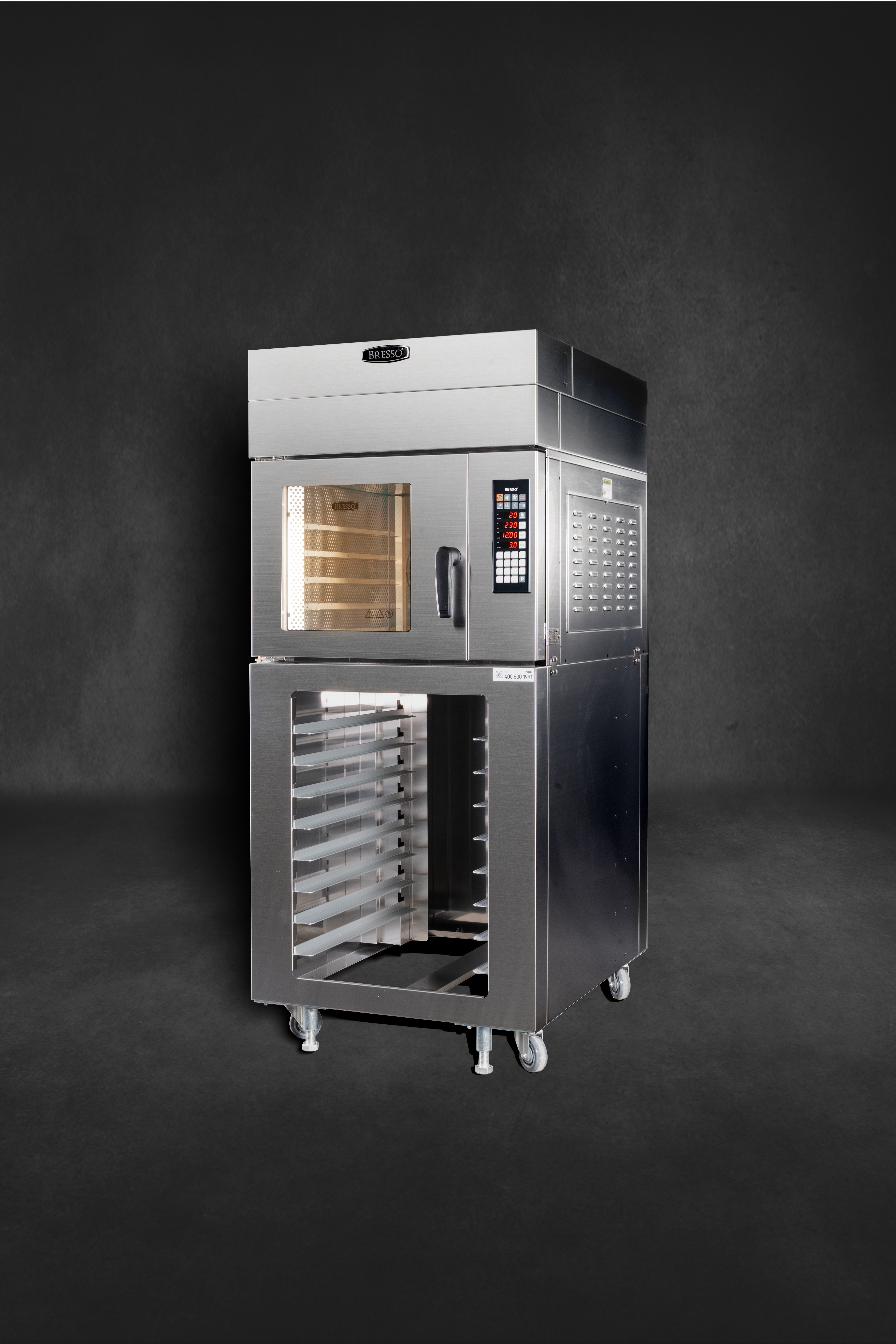
Convection Oven HCV series (stainless steel, 380V):
- HCV-5 AIR — 5 decks / 5 trays; L1900 × D1220 × H2065 mm; 380V / 9kW
- HCV-5+5 AIR — 2 decks / 10 trays; L1900 × D1340 × H2065 mm; 380V / 18kW
- HCV-6S — 6 decks / 6 trays; L900 × D1340 × H2065 mm; 380V / 10.5kW
- HCV-10S — 10 decks / 10 trays; L900 × D1220 × H2065 mm; 380V / 21kW
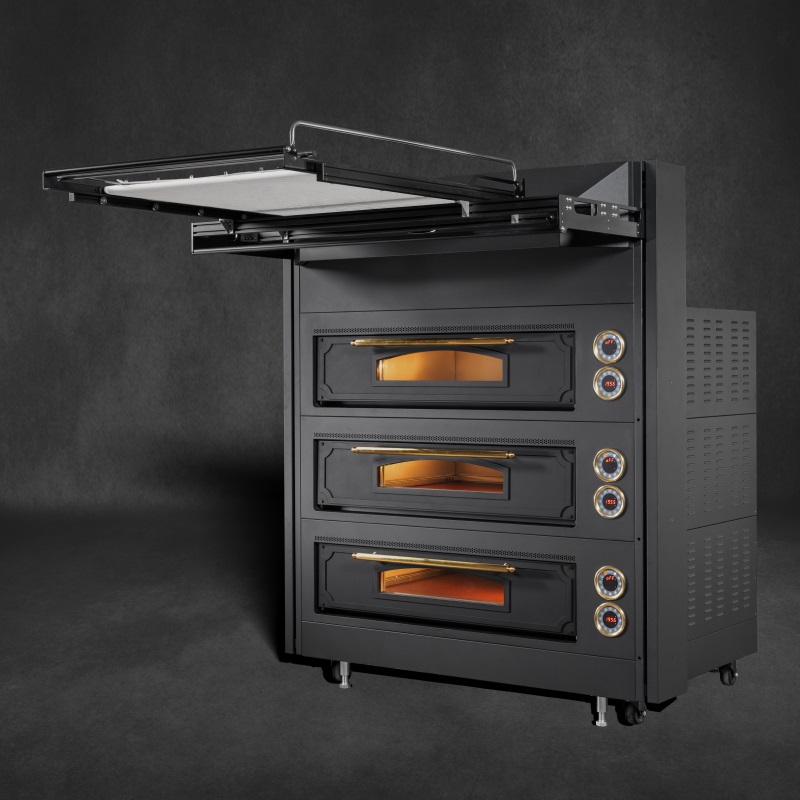
Champions League MAX Series Oven — HBVO-400ЗMAX-ZS3 (stainless steel, 380V):
- Capacity — 4 trays × 3 decks = 12 trays
- Overall dimensions — L 1930 × D 3100 × H 2250 mm
- Voltage / power — 380V / 27kW
Every model in both families uses a 380V supply and a stainless steel body. Neither is a light-duty appliance; both are cabinet-style deck ovens intended for continuous commercial duty.
The Decision Framework: Four Axes
1. Footprint — what you actually give up
Calculated from published dimensions, the MAX Series occupies about 5.98 m² of installed floor area (1930 × 3100 mm). The convection models occupy considerably less: roughly 1.10 m² for the HCV-10S, 1.21 m² for the HCV-6S and 2.32 m² for the HCV-5 AIR. The HCV-6S and HCV-10S achieve this by trading deck depth for a 900 mm-wide tower configuration — which is precisely the argument in rent-per-square-metre locations such as mall units and street-front shops.
Height also differs and is easy to miss: every HCV model stands 2065 mm tall, while the MAX Series stands 2250 mm. Ceiling clearance and extraction routing should be confirmed against those figures before an order, not after delivery.
2. Power draw — 9 to 21 kW versus 27 kW
The convection range steps through 9kW (HCV-5 AIR), 10.5kW (HCV-6S), 18kW (HCV-5+5 AIR) and 21kW (HCV-10S); the MAX Series runs at 27kW. Calculated from published figures, connected load per tray is 1.8 kW/tray for the HCV-5 AIR, 1.75 kW/tray for the HCV-6S, 2.1 kW/tray for the HCV-10S and 2.25 kW/tray for the MAX Series. The MAX sits at the top of that band, which is consistent with its role: holding temperature and recovering quickly under continuous loading rather than finishing short batches.
The practical consequence is a verification step, not a claim about running cost. A 27 kW oven and a 9 kW oven imply different distribution-board requirements, while load diversity, tariff structure and installation method are site-specific. The electrical calculation belongs to your contractor; the specification sheet only tells you which number to give them.
3. Capacity and tray geometry
Total capacity favours the MAX Series: 12 trays against 10 (HCV-10S), 6 (HCV-6S) and 5 (HCV-5 AIR). But how trays are grouped matters more than the total when a shop bakes several products simultaneously. The MAX distributes 4 trays per deck across 3 decks; the HCV-5+5 AIR distributes 5 trays per deck across 2 decks.
That is why per-deck independence deserves a place in the comparison. In a US bakery installation, independent temperature control and an exhaust valve on each deck allowed high-temperature milk bread on the top deck and low-temperature chiffon cake on the bottom deck in the same session, with no flavour transfer between products. For a bakery with a broad product range and limited space, this deck-level control is often more valuable than a higher tray total.
4. Peak-demand behaviour
Peak demand is where the two philosophies separate most clearly, and the relevant evidence is the field record rather than the specification sheet. In Singapore, 50 units were installed across boutique bakeries and chain cafés in the CBD and Orchard Road district, producing French croissants, sourdough and delicate soft buns tailored to local tastes. The installation has now been running for six years; the equipment's high efficiency and extremely low failure rate handled intense, continuous bake-off demand during peak brunch hours, and this reduced the distributor's local after-sales labour costs. A Canadian shop-owner installation recorded zero-failure stable operation during peak hours as well.
The pattern is consistent: where the peak window is short and the menu is pastry-led, the convection range absorbs it. Where the peak window is long, or where crusty continental bread is produced at volume, insulation and heat retention become the deciding properties — the situation described in the Mongolia case below.
Side-by-Side Comparison
| Attribute | Convection Oven HCV-5 AIR | Convection Oven HCV-6S | Convection Oven HCV-10S | Champions League MAX Series HBVO-400ЗMAX-ZS3 |
|---|---|---|---|---|
| Capacity | 5 decks / 5 trays | 6 decks / 6 trays | 10 decks / 10 trays | 4 trays × 3 decks = 12 trays |
| Overall dimensions (mm) | L1900 × D1220 × H2065 | L900 × D1340 × H2065 | L900 × D1220 × H2065 | L1930 × D3100 × H2250 |
| Installed footprint (calculated) | ≈2.32 m² | ≈1.21 m² | ≈1.10 m² | ≈5.98 m² |
| Voltage / power | 380V / 9kW | 380V / 10.5kW | 380V / 21kW | 380V / 27kW |
| Connected load per tray (calculated) | 1.8 kW/tray | 1.75 kW/tray | 2.1 kW/tray | 2.25 kW/tray |
| Material | Stainless steel | Stainless steel | Stainless steel | Stainless steel |
| Certification coverage | Listed among the related products of BRESSO's cETLus / ETL Sanitation authorization (certificate 5029105, Intertek Testing Services) | Listed among the related products of the same ETL authorization (certificate 5029105) | ||
| Typical fit | Pastry and small-bread menus with a limited electrical supply | Space-constrained shops needing more decks than a 5-tray unit | Busy shops with a wide product range but no extra floor width | High-output bakeries with sustained peak windows and around 6 m² of usable floor |
Step-by-Step: Choosing Between the Convection Oven and the MAX Series
- Write down the busiest day's bake-off calendar. List every product, batch size, bake time and temperature, and mark which products must be in the oven in the same window. This single page removes most of the ambiguity from the decision.
- Measure the floor, not the oven. Add door swing, tray-loading space and service clearance to the installed footprint, then compare the result against ≈1.10 m² (HCV-10S), ≈1.21 m² (HCV-6S), ≈2.32 m² (HCV-5 AIR) and ≈5.98 m² (MAX Series).
- Confirm the supply with your electrical contractor. Give them the actual figure — 9, 10.5, 18, 21 or 27 kW at 380V — rather than a vague description of a commercial oven. Whether the site can carry it, and what installation work is required, is their calculation.
- Match deck geometry to the product mix. Count how many products must bake at different temperatures at the same time. If the answer is two or more, prioritise independent per-deck control and exhaust valves over raw tray count.
- Validate with a sample batch before a full rollout. BRESSO's minimum order is 2 units with a standard lead time of 30–45 days, which makes a pilot installation practical before a multi-site commitment.
Real Installations: What Buyers Can Learn From Them
Singapore — 50 units, six years, tropical humidity. A distributor placed 50 units across boutique bakeries and chain cafés in Singapore's CBD and Orchard Road. The shops produce French croissants, sourdough and delicate soft buns adapted to local tastes. Two problems shaped the specification: year-round heat and humidity, and premium mall rents measured per square metre. The exhaust valve design and hot air circulation rapidly extract excess moisture from the chamber, keeping baguettes and croissants crisp rather than soggy in a tropical climate, and the resulting revenue-per-square-foot ratio helped mall-based stores use premium kitchen space efficiently. The same installation has absorbed intense continuous bake-off demand during peak brunch hours for six years without the distributor absorbing heavy after-sales labour costs.
Canada — 8 units, zero failures at peak, lower energy use. An eight-unit installation for a shop-owner client covers batch production of delicate Asian pastries — soft buns, Japanese milk bread, egg tarts and sponge cakes — where precise temperature control matters. The reported outcomes after 15 years of operation are zero-failure stable operation during peak hours and a 20% reduction in energy consumption compared with the older equipment it replaced. Independent top/bottom heat adjustment and a compact footprint were the deciding features for a space-constrained mall or street bakery.
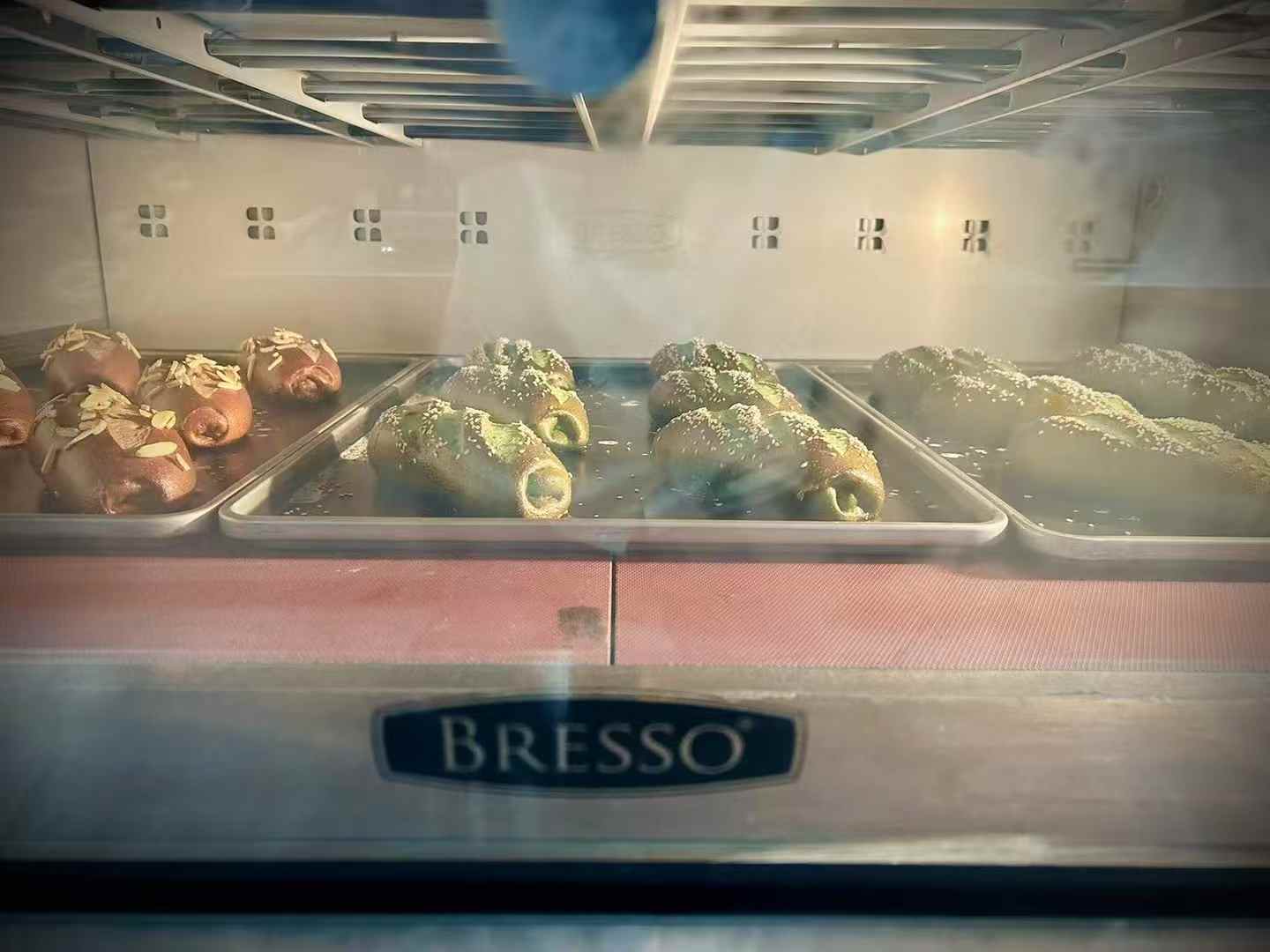
Mongolia — 100 units, heat retention in freezing conditions. In Ulaanbaatar, 100 units were installed across boutique bakeries and Western restaurants producing baguettes, traditional Russian Lieba and crusty European breads. The operating environment is the opposite of Singapore's: extremely cold and dry. The reported result is rapid heating even at lower indoor temperatures without a significant increase in energy consumption, supported by an extra-thick, high-density insulation layer that locks chamber heat in. A paired proofer supplied humidity compensation, solving the dough-skinning problem caused by the dry local climate, and the extremely low failure rate saved the distributor substantial cross-border after-sales maintenance costs. The installation has run for five years.
Malaysia — 6 units, consistency in pastry production. A bakery chain running six units for croissants, palmiers, Danishes and cookies reported uniform golden colour on every tray, distinct flaky layers and no need to rotate trays mid-bake. The convection airflow was described as abundant but gentle — enough to move heat evenly without disturbing delicate laminated pastry — while the double-glazed insulated door kept temperature fluctuation within ±1°C.
Across all four installations the same conclusion holds: footprint and the length of the peak window, not tray count, decide the model.
When the Convection Oven Is Enough
- The floor area you can allocate to the oven is under roughly 3 m², including loading space.
- The menu is led by pastries, small breads, cakes, soft buns and cookies rather than crusty continental loaves at volume.
- Peak windows are short and the daily load fits within the tray capacity of a 5–10 tray cycle.
- The verified electrical supply cannot reasonably support a 27 kW connection.
- The location is a mall or street-front unit where revenue per square metre matters more than maximum batch size — the pattern recorded in the Canada and Singapore installations.
When the MAX Series Is Justified
- Production is built around long, sustained peak windows that repeat daily, so heat retention and fast recovery matter more than installed load.
- Batch cycles genuinely fill a 12-tray platform (4 trays × 3 decks) in normal operation, not only on exceptional days.
- Roughly 6 m² of usable floor is available, with 2250 mm of height clearance and extraction routing confirmed in advance.
- The environment is demanding — very cold, very dry, or otherwise hard on chamber temperature stability, as in the Mongolia installation.
- You are a distributor or multi-site operator standardising on one platform; the 50-unit Singapore and 100-unit Mongolia deployments show multi-unit programmes already supported at this scale.
Verification Checklist Before You Sign
Whichever model you choose, the same documents should be verified first. BRESSO's cETLus / ETL Sanitation authorization (certificate 5029105, issued by Intertek Testing Services) covers the US and Canadian markets to UL 197:2010, CSA C22.2#109:2017 and NSF/ANSI STD.4, with a scope of commercial electric bakery retarder proofer equipment; the issue date is 2024-08-27 and the expiry date is 2099-12-31. Both the Convection Oven HCV and the Champions League MAX Series Oven are listed among the related products on that authorization.
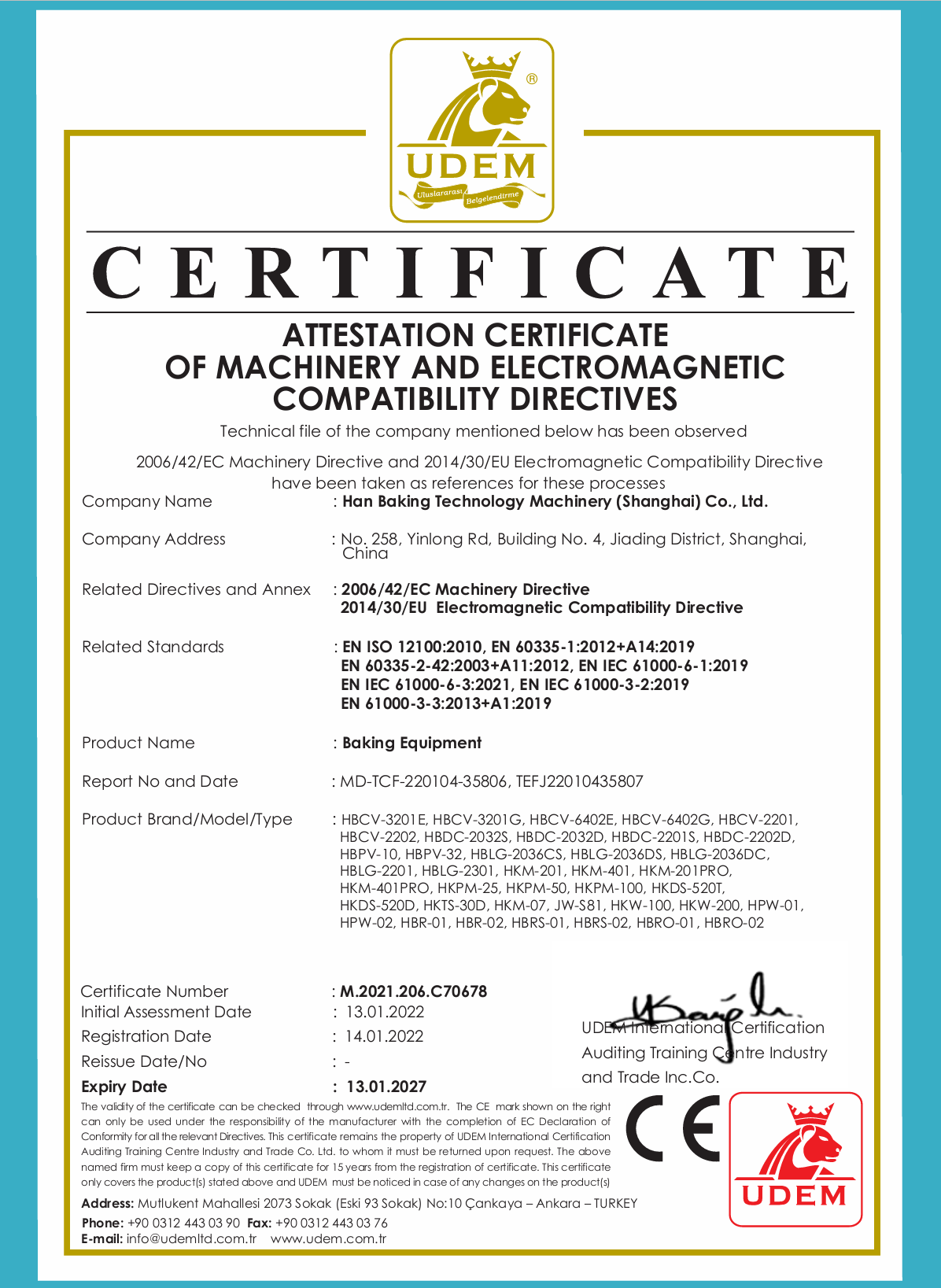
For the European market, BRESSO holds attestation certificate M.2021.206.C70678, issued by UDEM, covering the Machinery Directive (2006/42/EC) and the Electromagnetic Compatibility Directive (2014/30/EU), issued 2022-01-14 and valid until 2027-01-13. On the manufacturing side, OEM/ODM production is available with customisation of voltage, colour and size; stated monthly capacity is 1000 units, with a minimum order of 2 units and a standard lead time of 30–45 days. Incoming Quality Control covers purchased components on arrival, with 100% inspection applied to critical components.
Frequently Asked Questions
Are the Convection Oven and the Champions League MAX Series Oven certified for North America and the EU?
For the US and Canada, BRESSO holds an AUTHORIZATION TO MARK for cETLus / ETL Sanitation Listed status, certificate 5029105, issued by Intertek Testing Services, covering commercial electric bakery retarder proofer equipment to UL 197:2010, CSA C22.2#109:2017 and NSF/ANSI STD.4. Both the Convection Oven HCV and the Champions League MAX Series Oven (HBVO-400ЗMAX-ZS3) appear among the related products on that authorization, which is valid from 2024-08-27 to 2099-12-31. For the EU, the CE attestation M.2021.206.C70678 issued by UDEM covers the Machinery Directive (2006/42/EC) and the EMC Directive (2014/30/EU) and runs to 2027-01-13.
What should buyers check when shortlisting top bakery oven manufacturers in China?
Verify four things: certification documents with certificate numbers and issuing bodies that can be checked independently; stated production capacity and lead time; the quality-control process, including whether critical components receive 100% inspection; and the manufacturer's record of multi-unit deployments rather than single-unit sales. BRESSO, founded in 1991 in South Korea with a branch in Shanghai's Jiading High-tech Industrial Park, states a monthly capacity of 1000 units, a 30–45 day lead time, and OEM/ODM capability with customisable voltage, colour and size.
How should I compare the cost side of the two ovens?
Start with the drivers you can measure. The convection models draw 9kW to 21kW, the MAX Series 27kW, and the installed footprints range from about 1.10 m² to about 5.98 m² — in rented premises, floor area is a recurring cost rather than a one-off. Then look at the operating record: a Canadian eight-unit installation reported a 20% reduction in energy consumption compared with the older equipment it replaced, and the Singapore deployment of 50 units reported a high revenue-per-square-foot ratio together with reduced after-sales labour costs. BRESSO does not publish list prices; a project quote should be requested against your actual menu, supply and site layout.
Can we test a sample before committing to a full installation?
Yes. BRESSO's minimum order quantity is 2 units, which makes a pilot installation or a small trial batch practical before a full rollout. After-sales support is delivered remotely, and the full product brochure — covering the Convection Oven HCV series, the Champions League MAX Series Oven, European and Asian deck ovens, and retarder-proofers — is available for download from the link at the end of this article.
What is the lead time for a mixed order?
The standard lead time is 30–45 days against a stated monthly production capacity of 1000 units. Lead time should be confirmed at the point of order, because configuration choices — voltage, colour and size customisation — are handled per project. To start, send your menu, your verified supply details and your floor measurements to the BRESSO team and request a model recommendation and quote.
Conclusion: The Decision Rule in One Paragraph
Choose the Convection Oven HCV range when floor space and connected load are the binding constraints and the daily bake-off fits within a 5–10 tray cycle — the HCV-10S at 900 mm wide and 380V/21kW covers most busy shop bakeries, and the HCV-5 AIR at 380V/9kW is the option when the supply is the limitation. Choose the Champions League MAX Series Oven (HBVO-400ЗMAX-ZS3) when production genuinely fills 12 trays across three decks, when peak windows are long and repeated, and when roughly 6 m² of floor and a verified 380V/27kW supply are available. Both are stainless steel, both run on 380V, and both sit inside the same ETL, CE and ISO9001 manufacturing system — so the decision rests on footprint, power, capacity and peak demand.
Request a sample, a quote, or the 2026 brochure
Send your bake-off calendar, verified electrical supply and floor measurements, and BRESSO will recommend the model that fits — or confirm that your current convection oven is already sufficient.
Email: re@bresso-oven.com | WhatsApp: +8615901736616 | Web: bresso-oven.com
Add: Building 16, No.258, Yinlong Rd, Jiading District, Shanghai, China

Have Questions or Need More Details?
Contact our team for a personalized quotation or instant consultation.
Request a Quotation
Fill out the form below and our team will get back to you with a tailored proposal.
WhatsApp Direct Chat
Prefer to chat in real-time? Message us on WhatsApp for instant assistance & quick answers.
- Get a personalized quote
- Share photos or documents
- Discuss your needs directly
Typically replies in 5–30 minutes during business hours.