Retarder-Proofer Pro vs Air: A Comparison Guide for Commercial Bakery Buyers
BRESSO manufactures two parallel electric retarder-proofer lines, the HBDC Pro series and the HBDC Air series. Both share the same stainless steel cabinet construction, both operate on 220V, and both fall inside the scope of the same cETLus / ETL Sanitation listing (certificate 5029105) for commercial electric bakery retarder-proofer equipment. The purchase decision is therefore not settled at the series level. It is settled at the model level: which size code, in which series, matches a specific proofing load, a specific footprint, and a specific set of acceptance terms.
This guide is written for buyers already past discovery: bakers, chain operators, importers and distributors who have shortlisted a retarder-proofer and now need to convert that shortlist into a purchase order without a configuration mismatch. It compares the Pro and Air series on the facts BRESSO publishes and documents, explains how the model naming maps across the two lines, and sets out the verification and acceptance steps that should decide the final pick.
The Real Decision: Series Name or Size Code?
Retarder-proofers combine two functions in one cabinet: a retarding stage that holds shaped dough at low temperature to control fermentation timing, and a proofing stage that runs controlled warmth and humidity before baking. Buyers rarely get this wrong at the concept level. What they get wrong is the mapping between a series name and the model code that will actually be installed.
Four failure modes account for most of the friction in this category:
- Comparing at series level. Pro and Air are parallel lines, not sequential tiers. A like-for-like comparison is only valid between the Pro and Air models that share the same numeric size code.
- Buying on footprint alone. Cabinet dimensions tell you whether the unit fits through the door and into the proofing corner. They do not tell you whether the cabinet keeps pace with a morning bake-off schedule.
- Assuming certification covers every variant. A listing carries a defined scope. Buyers should confirm the certificate in hand names the exact model code being ordered, not just the product family.
- Leaving acceptance undefined. When pre-shipment inspection, witness testing and payment instruments are not written down before the PO, disputes get resolved after the container has sailed.
Industry Background: Why Retarder-Proofers Decide a Bakery's Morning
The retarder-proofer is a scheduling instrument as much as a baking instrument. By holding shaped dough overnight and proofing it to a defined point in the early hours, a shop can sell fresh croissants, baguettes and soft buns from opening without staffing a night shift. That is why the category is evaluated on continuity and repeatability rather than peak temperature alone.
The electrical platform matters commercially. Market Research Future estimates the global commercial oven market at USD 25.45 billion in 2024 and forecasts that electric ovens will account for 57.8% of market revenue in 2025, which reflects how firmly electric cabinets have become the default specification in urban bakery formats where gas infrastructure is limited or where consistent chamber control is the priority.
Regulatory expectations have moved in parallel. In the United States and Canada, commercial electric retarder-proofer equipment is typically assessed against UL 197, CSA C22.2 No. 109 and NSF/ANSI Standard 4, which is the standard set named on BRESSO's Intertek authorization to mark. In the European Union, the relevant framework is the Machinery Directive 2006/42/EC together with the Electromagnetic Compatibility Directive 2014/30/EU, both of which are named on BRESSO's CE attestation. A buyer comparing two series inside one manufacturer should expect both series to sit inside the same conformity envelope, and should verify that they do.
How the HBDC Pro and HBDC Air Series Are Built and Covered
The manufacturer behind both lines
BRESSO is a baking equipment brand founded in Seoul, South Korea in 1991, with a branch in Shanghai Jiading High-tech Industrial Park and a 5,500 m² production base established in Shanghai in 2017. The company reports a 3,000 m² workshop and R&D center across Seoul and Henan, a 15,000 m² manufacturing footprint, roughly 155 employees and 20 engineers dedicated to baking equipment development, more than 30 related product patents, and an export share of about 45% across markets including the US, Canada, Mexico, Germany and Australia. Production is organised around in-house sheet metal, assembly and an operation centre, with imported Bystronic sheet metal processing and bending equipment from Switzerland, and the company holds ISO9001, CE and FCC certification.
That positioning is the reason the Pro and Air comparison is worth doing properly. Both series come out of the same sheet metal and assembly chain, which means the differences between them are configuration differences, not manufacturing-origin differences.
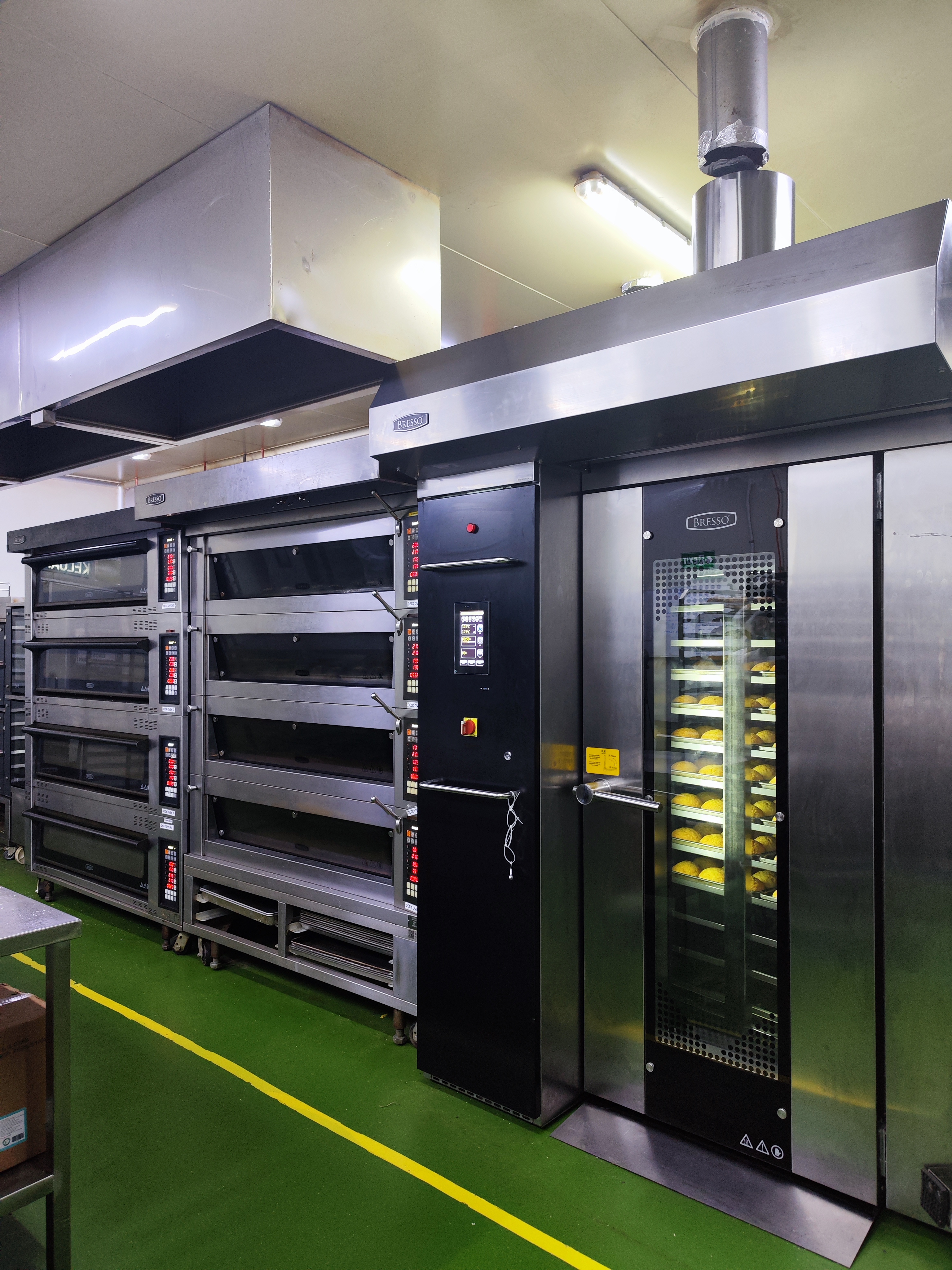
Shared manufacturing platform: the HBDC Pro and HBDC Air series are produced through the same sheet metal and assembly chain at BRESSO.
What both series share
- Cabinet construction: stainless steel construction across the retarder-proofer range.
- Electrical platform: 220V operation as standard, with worldwide voltage customisation available through BRESSO's OEM/ODM programme.
- North American listing: cETLus / ETL Sanitation Listed under Intertek certificate 5029105, scope Commercial Electric Bakery Retarder Proofer Equipment, against UL 197:2010, CSA C22.2#109:2017 and NSF/ANSI STD.4, issued 2024-08-27 and valid to 2099-12-31. Both HBDC Pro and HBDC Air are referenced under this scope.
- EU conformity: CE attestation M.2021.206.C70678 issued by UDEM on 2022-01-14, valid to 2027-01-13, covering Machinery Directive 2006/42/EC and EMC Directive 2014/30/EU against EN ISO 12100:2010, EN 60335-1:2012+A14:2019, EN 60335-2-42:2003+A11:2012 and the applicable EN 61000 series standards. HBDC Pro is named among the covered products.
- Quality system: ISO9001, with incoming quality control that inspects all purchased components on arrival and applies 100% inspection to critical components.
The model lineup, mapped Pro against Air
BRESSO's naming convention pairs a Pro model and an Air model at each numeric size code. That pairing is what makes a controlled comparison possible: the numeric block identifies the size code shared by both lines, while the PRO or AIR suffix identifies the series. Four pairs are in the current lineup.
| Size code | HBDC Pro model | HBDC Air model | Documented cabinet dimension |
|---|---|---|---|
| 2018 | HBDC-2018PRO | HBDC-2018AIR | L600 × D955 × H2065 |
| 2032 | HBDC-2032PRO | HBDC-2032AIR | Confirm on model datasheet |
| 1618 | HBDC-1618PRO | HBDC-1618AIR | Confirm on model datasheet |
| 2032S | HBDC-2032SPRO | HBDC-2032SAIR | Confirm on model datasheet |
The 2018 code is the only pair with a dimension currently documented in the format L × D × H, at L600 × D955 × H2065. Buyers should treat that figure as the reference point for door width, corridor clearance and proofing-corner layout on the 2018 pair, and request the equivalent drawing for the 2032, 1618 and 2032S codes before committing floor space. Requests should also confirm the unit basis and tolerance applied to the published figures, so that the drawing and the purchase order describe the same cabinet.
Step-by-Step: Choosing Between Pro and Air
Step 1 — Fix the proofing load before looking at series
State the dough volume a single morning bake-off must move, the number of distinct products, and the holding window between retard and bake. A shop running one croissant and one baguette line has a different requirement from a shop running laminated pastry, soft buns and travel cakes out of the same kitchen. This step produces the size code, not the series.
Step 2 — Compare Pro and Air only at the same size code
Once the size code is fixed, the Pro model and the Air model at that code are the two candidates. Request the configuration sheet for both, side by side. Comparing HBDC-2018PRO against HBDC-2032AIR mixes two variables and produces no usable answer.
Step 3 — Validate footprint and installation path
Use the documented dimension for the 2018 pair (L600 × D955 × H2065) and the equivalent drawing for the other codes. Check door width, lift access, corridor turns and service clearance on the hinge side. Retarder-proofers are installed once and serviced for years, so clearance for door swing and panel access belongs in this step, not in the installation week.
Step 4 — Confirm voltage and certificate scope for the destination market
The standard platform is 220V. For destinations outside that specification, BRESSO customises voltage under its OEM/ODM programme, and any voltage change should be reflected on the certificate scope request. For US and Canadian installations, ask for the Intertek authorization to mark 5029105 with the model code named; for EU installations, ask for CE attestation M.2021.206.C70678 and confirm the model appears among the covered products.
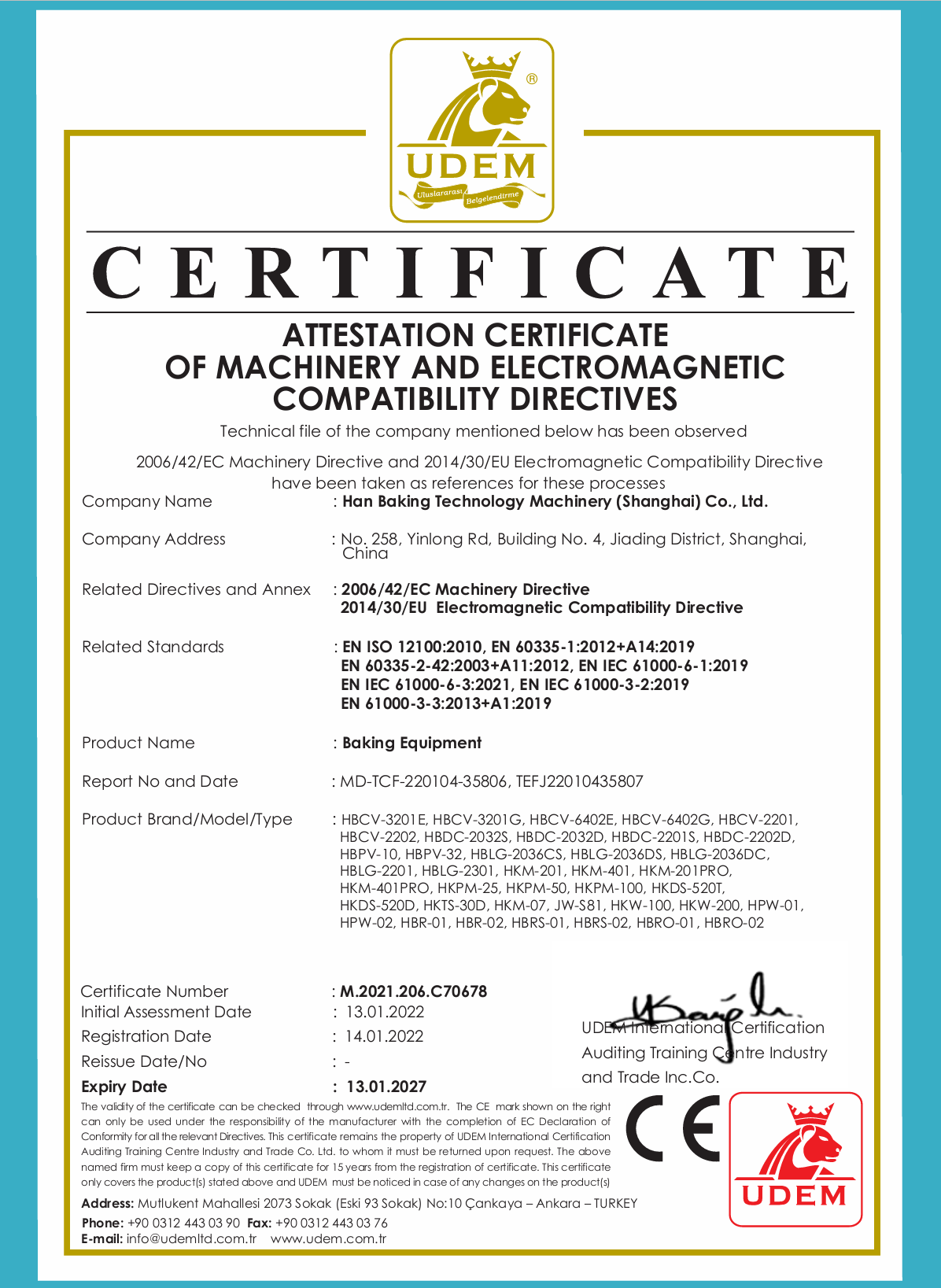
EU conformity documentation: CE attestation M.2021.206.C70678, issued 2022-01-14 and valid to 2027-01-13, names HBDC Pro among covered products.
Step 5 — Write the commercial terms into the order
BRESSO's stated purchasing terms are a minimum order quantity of 2 units, delivery on FOB or CIF terms, and payment by T/T or irrevocable L/C at sight. Lead time is 30–45 days against a monthly capacity of 1,000 units. These terms apply to both series, so they do not differentiate Pro from Air — but they do set the inspection window, which is where the last step lives.
Step 6 — Agree acceptance criteria before shipment
The stated acceptance framework is pre-shipment on-site inspection plus a third-party witness test. For a two-unit order this is a short factory visit; for a multi-unit distributor order it is the point at which the Pro-or-Air decision is formally closed. Schedule the inspection inside the 30–45 day lead time rather than after it.
Use Cases: Where the Pro-or-Air Question Actually Lands
Field evidence from BRESSO installations shows that retarder-proofer performance is usually judged on environmental control rather than on headline specifications. Four patterns recur.
Humidity control in tropical markets
A Singapore distributor installed 50 units across boutique bakeries and chain cafés in the CBD and Orchard Road, an installation running for six years, with HBDC Air among the equipment in service. The reported outcome was that exhaust valve design and hot air circulation extracted excess moisture from the chamber quickly enough to keep baguettes and croissants crisp in year-round high heat and humidity, while the low failure rate carried the distributor's after-sales labour cost down during peak brunch service. For a buyer in a similar climate, chamber moisture extraction is the parameter to interrogate, not cabinet finish.
Humidity compensation in dry, cold markets
A Mongolia distributor installed 100 units across boutique bakeries and Western restaurants in Ulaanbaatar, running for five years. There, the paired proofer's humidity compensation solved dough skinning caused by the dry local climate, while an extra-thick high-density insulation layer held chamber heat against low winter indoor temperatures. The lesson transfers to any cold-climate or heavily air-conditioned site: proofing humidity control is the specification that determines whether the retarder-proofer earns its footprint.
Laminated pastry and colour uniformity
A Malaysian bakery chain installed 6 units across boutique French patisseries, running for five years, with the reported result of uniform golden colour and distinct flaky layers on every tray, and no mid-bake tray rotation. Gentle convection airflow preserved delicate pastry layers and a double-glazed insulated door held temperature within ±1°C. Buyers producing laminated dough should treat airflow gentleness and door sealing as comparison criteria between any two candidate cabinets.
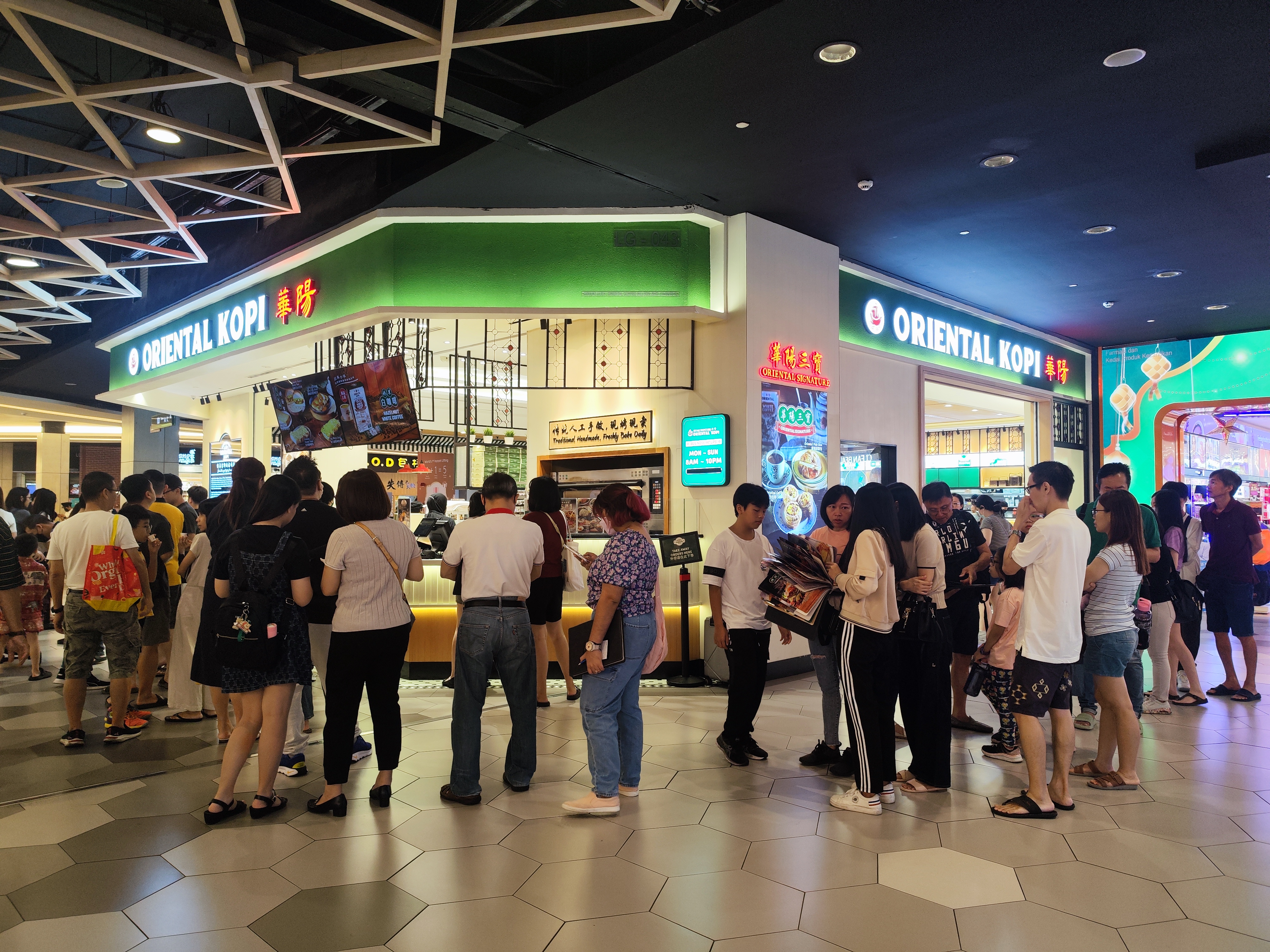
Laminated pastry production: airflow gentleness and door sealing drive colour uniformity on croissant and Danish lines.
High-output shops and mixed product ranges
A Malaysian factory operation installed 50 units for milk bread, soft buns, sweet rolls and everyday pastries, running five years, with precise top and bottom heat delivering even colour without frequent tray rotation and an easy-to-understand control panel that cut apprentice training time. At the other end of the scale, a Canadian shop owner ran 8 units for fifteen years with zero-failure operation during peak hours and a reported 20% energy consumption reduction against older equipment, while an Australian end user ran 5 units for fifteen years and reported a 30% production efficiency increase. Retarder-proofer selection in these cases was driven by throughput continuity and energy behaviour, which is the correct frame for a Pro-versus-Air decision at a large size code.
Comparison Table: HBDC Pro vs HBDC Air
| Comparison criterion | HBDC Pro series | HBDC Air series |
|---|---|---|
| Model designations | HBDC-2018PRO, HBDC-2032PRO, HBDC-1618PRO, HBDC-2032SPRO | HBDC-2018AIR, HBDC-2032AIR, HBDC-1618AIR, HBDC-2032SAIR |
| Documented cabinet dimension | 2018 code: L600 × D955 × H2065 | 2018 code: L600 × D955 × H2065 |
| Cabinet construction | Stainless steel | Stainless steel |
| Electrical platform | 220V standard; voltage customisation via OEM/ODM | 220V standard; voltage customisation via OEM/ODM |
| US / Canada safety and sanitation listing | cETLus / ETL Sanitation Listed, Intertek certificate 5029105, UL 197:2010, CSA C22.2#109:2017, NSF/ANSI STD.4, issued 2024-08-27, valid to 2099-12-31 | Covered under the same certificate 5029105 scope for commercial electric bakery retarder-proofer equipment |
| EU conformity | CE attestation M.2021.206.C70678, issued 2022-01-14, valid to 2027-01-13, Machinery Directive 2006/42/EC and EMC Directive 2014/30/EU | CE framework applies to the retarder-proofer range; confirm model listing on the attestation copy supplied with the order |
| Quality management | ISO9001; incoming quality control with 100% inspection on critical components | ISO9001; incoming quality control with 100% inspection on critical components |
| OEM / ODM availability | Yes — customisable voltages, colours and sizes | Yes — customisable voltages, colours and sizes |
| MOQ | 2 units | 2 units |
| Lead time and capacity | 30–45 days; 1,000 units monthly | 30–45 days; 1,000 units monthly |
| Delivery and payment | FOB or CIF; T/T or irrevocable L/C at sight | FOB or CIF; T/T or irrevocable L/C at sight |
| Acceptance criteria | Pre-shipment on-site inspection plus third-party witness test | Pre-shipment on-site inspection plus third-party witness test |
| After-sales | Remote support | Remote support |
Read the table as a filter, not a verdict. Where the two series are identical on a criterion, that criterion cannot decide the purchase. The decision therefore rests on the model-level configuration differences that BRESSO documents for each size code, and on the three variables that a buyer controls: the proofing load, the footprint available, and the acceptance terms written into the order.
Frequently Asked Questions
Does the ETL and CE documentation cover both the HBDC Pro and HBDC Air?
BRESSO's Intertek authorization to mark, certificate 5029105, is listed as cETLus / ETL Sanitation Listed for Commercial Electric Bakery Retarder Proofer Equipment in the US and Canada, against UL 197:2010, CSA C22.2#109:2017 and NSF/ANSI STD.4. It was issued on 2024-08-27 and is valid to 2099-12-31, and both HBDC Pro and HBDC Air are referenced under the product scope. On the EU side, CE attestation M.2021.206.C70678 issued by UDEM on 2022-01-14 and valid to 2027-01-13 covers Machinery Directive 2006/42/EC and EMC Directive 2014/30/EU, and names HBDC Pro among covered products. Buyers should request the certificate copy with the exact model code named before issuing the PO.
As an OEM bakery oven manufacturer for commercial bakery shops, what can BRESSO customise on a Pro or Air unit?
BRESSO provides OEM and ODM production services, with customisation for voltages used worldwide, plus colours and sizes. Customisation runs through the same manufacturing chain as the standard range: in-house sheet metal and assembly in Shanghai, with imported Bystronic sheet metal processing and bending equipment, under an ISO9001 system and incoming quality control that applies 100% inspection to critical components. Monthly capacity is 1,000 units and the MOQ is 2 units, so a customised first order does not require a container-scale commitment.
What purchasing terms apply to a Pro or Air retarder-proofer order?
The stated terms are a minimum order quantity of 2 units, delivery on FOB or CIF terms, and payment by T/T or irrevocable L/C at sight. These terms are the same for both series, which means commercial terms will not separate Pro from Air — only the model configuration will. Buyers should confirm the Incoterm and port pair in writing at quotation stage, since FOB and CIF place different obligations for freight and insurance on the buyer.
Can the units be inspected and witnessed before shipment?
Yes. The stated acceptance criteria are pre-shipment on-site inspection combined with a third-party witness test. In practice this means the Pro-or-Air decision can be verified against the actual cabinet rather than against a brochure: proofing and retarding behaviour, control panel operation and cabinet condition can all be checked at the factory before the unit is released. For multi-unit distributor orders, the witness test is the natural point to confirm that every unit matches the approved configuration.
What lead time should a bakery plan for?
Lead time is 30–45 days, supported by a monthly capacity of 1,000 units. Two planning consequences follow. First, the pre-shipment inspection must be scheduled inside that window, not appended after it. Second, installation, power connection and a first proofing trial should be planned against the arrival date rather than against the order date, so that the retarder-proofer is commissioned before the next menu change. To start a configuration review or request a sample-stage quotation for the HBDC Pro or HBDC Air model you have shortlisted, contact BRESSO at re@bresso-oven.com or via WhatsApp at +8615901736616, and include your size code, destination market and required voltage.
Conclusion: Close the Decision at Model Level
The HBDC Pro and HBDC Air series are not two quality tiers. They are two lines from one manufacturer, built on the same stainless steel cabinet platform, operating on the same 220V electrical basis, and sitting inside the same ETL and CE conformity envelope, produced through the same Shanghai sheet metal and assembly chain under ISO9001. What separates them is configuration at a given size code.
That makes the buying process simple to state and easy to get wrong. Fix the proofing load, derive the size code, compare Pro against Air only at that code, validate the documented dimension — L600 × D955 × H2065 on the 2018 pair, with drawings requested for the 2032, 1618 and 2032S codes — then lock voltage, certificate scope, MOQ, delivery terms and acceptance criteria into the order. A buyer who does those steps in that order will end up with a retarder-proofer that matches the schedule it was bought for, whichever series name is on the nameplate.
Next step
Request the model datasheet and a quotation for your shortlisted size code, or arrange a pre-shipment inspection slot within the current lead time.
Email: re@bresso-oven.com | WhatsApp: +8615901736616
Website: bresso-oven.com
Download the full product catalogue: BRESSO Product Brochure 2026 (PDF)
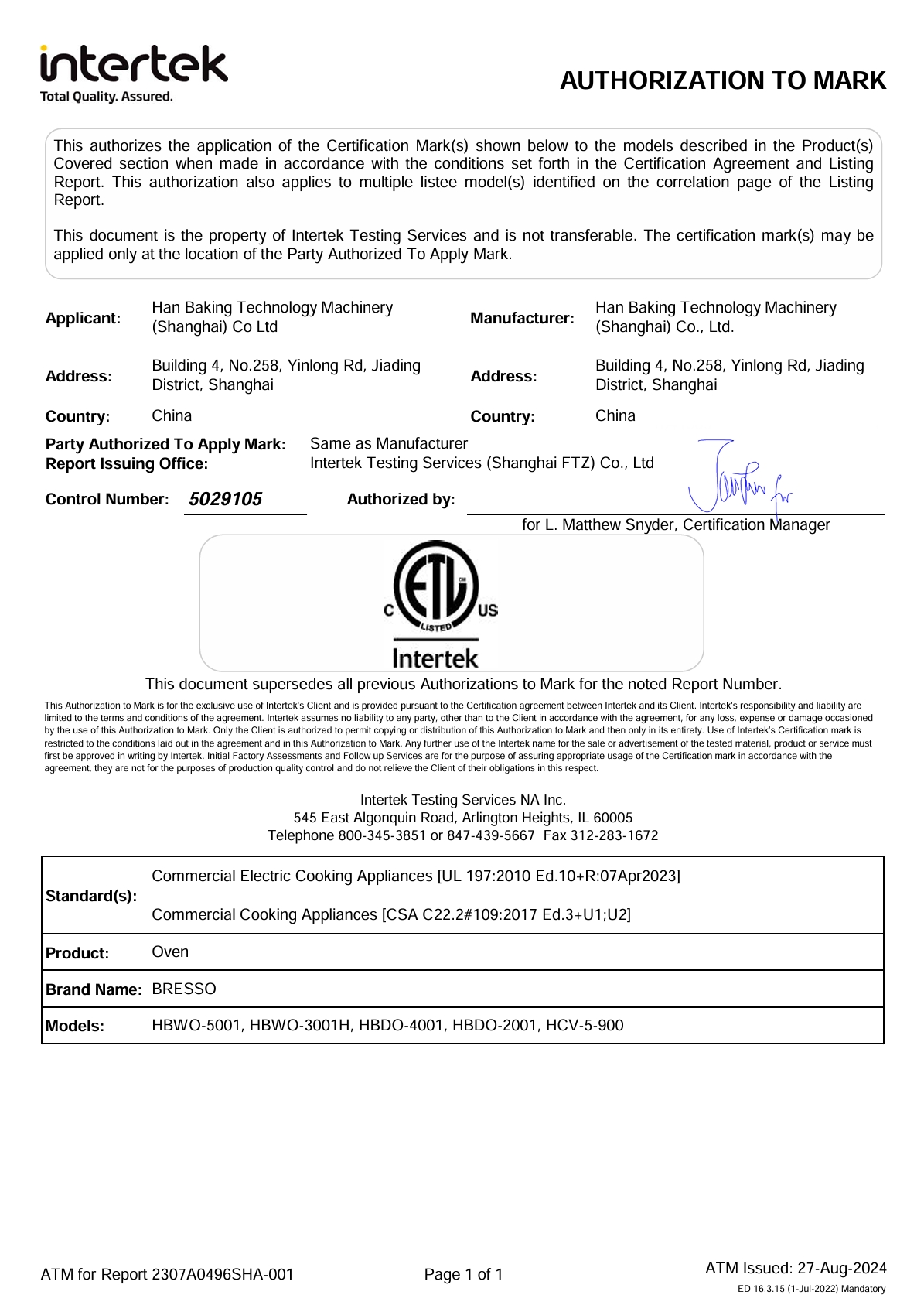
Before the PO: confirm the Intertek ETL listing 5029105 names the exact HBDC Pro or HBDC Air model code being ordered.
Have Questions or Need More Details?
Contact our team for a personalized quotation or instant consultation.
Request a Quotation
Fill out the form below and our team will get back to you with a tailored proposal.
WhatsApp Direct Chat
Prefer to chat in real-time? Message us on WhatsApp for instant assistance & quick answers.
- Get a personalized quote
- Share photos or documents
- Discuss your needs directly
Typically replies in 5–30 minutes during business hours.