Top Bakery Ovens for High-Output Manufacturing: Ranked by Real-World Performance
Top Bakery Ovens for High-Output Manufacturing: Ranked by Real-World Performance
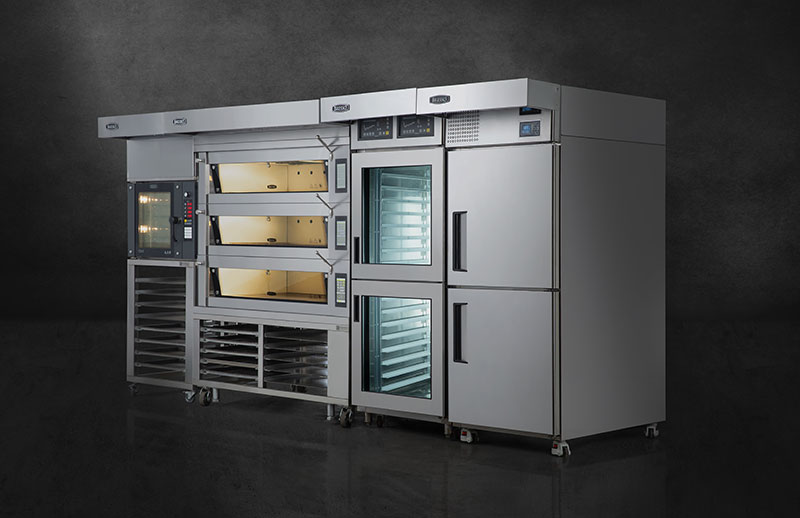
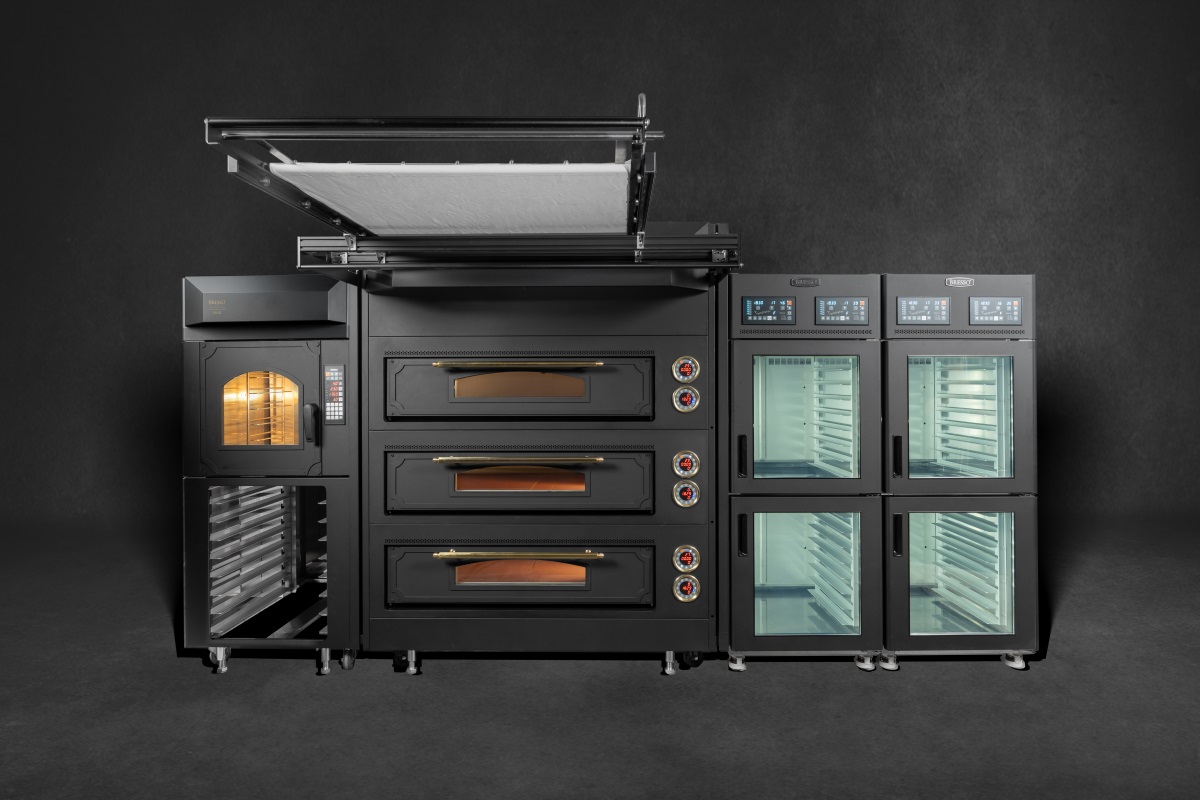
Three BRESSO deck-oven platforms cover high-output bakery manufacturing: the European Oven (HBWO) series, the Asian Oven (HBVO) series and the Champions League MAX Series Oven. Ranked on the numbers that decide output per shift — deck count, tray capacity, nameplate power per tray and installed footprint — the order for general line use is: European Oven (HBWO) first, Asian Oven (HBVO) second, Champions League MAX third. The MAX moves to the top of the list when the requirement is the largest single oven structure in the range and the plant has the floor depth, ceiling height and 380V capacity to support it.
All three platforms are electric, stainless-steel deck ovens rated at 380V, and all three are offered in a 12-tray configuration. The difference between them is therefore not “more trays” versus “fewer trays”. It is how much electrical load and floor space each platform consumes to deliver those 12 trays, and which tray and product formats each one was designed around.
This ranking uses BRESSO’s published specifications and the documented operating scenario for these ovens. It deliberately leaves out installation-specific claims that are not part of the published record, and it flags every point where a buying decision has to be confirmed against a specific project.
The Real Problem: Four Numbers Decide the Oven, and They Pull in Different Directions
A bakery planning a high-output line is usually not short of oven options. It is short of a way to compare them on equal terms. Deck ovens are specified with four numbers, and those numbers rarely point in the same direction:
- Deck and tray capacity — how much product one bake cycle holds.
- Nameplate power — the electrical load one oven adds to the plant, and the biggest single driver of energy cost per tray.
- Overall dimensions — the floor area, depth and ceiling height the oven locks up for years.
- Tray and pan standard — whether the racks, pans, loaders and proofers the bakery already owns will keep working.
An oven that wins on capacity can lose on utility load. A platform that wins on footprint can lose on standardisation if it does not accept a common tray size such as EN 600×400 mm. A third complication sits on top: most “best oven” lists rank manufacturers by reputation rather than by numbers a plant can plan against, so the research stage turns into a comparison of marketing instead of a comparison of specifications.
The workable answer is to rank the platforms against the criteria that actually constrain the plant — capacity, power per tray, footprint, format — and then re-check that ranking against the site.
Industry Background: A Growing Market That Buys on Specifications
The commercial bakery oven category is large and still expanding. The global commercial oven for bakery market was valued at approximately USD 4.6 billion in 2024, with a projected compound annual growth rate of 4.1% through 2035, according to Market Research Future. Measured more broadly, the bakery processing equipment market — ovens, proofers and related equipment — reached USD 14.81 billion in 2024 according to a BRESSO industry analysis.
Definitions matter when reading those figures. Depending on whether a report counts bakery ovens alone or all bakery processing equipment, published 2024 estimates for the same period range from USD 4.6 billion to roughly USD 16.47 billion. Buyers comparing market data should always check what a figure includes before it goes into a business case.
Three further data points shape demand in this category:
- Asia-Pacific held 40% of the global bakery processing equipment market in 2024, and China accounted for 39% of that regional total, per Fortune Business Insights data cited in BRESSO’s industry analysis.
- The global artisanal bakery market was valued at nearly USD 95 billion in 2022, which drives demand for specialised steam-assisted and stone-deck ovens, according to Middleby / Market Data.
- Convection ovens are estimated to hold a 35.2% share of the global commercial oven market, according to Future Market Insights, because of their efficiency in even heat distribution.
BRESSO also builds convection ovens (the HCV series, in stainless steel, from HCV-5 AIR to HCV-10S) and retarder-proofers, but this ranking covers the deck-oven platforms used for high-output manufacturing: the HBWO, HBVO and Champions League MAX Series.
How This Ranking Was Built
The four ranking criteria
- Output ceiling per unit — the highest published tray capacity in each series.
- Nameplate power per tray — published power divided by published tray capacity, compared at the 12-tray level.
- Footprint and tray density — overall dimensions multiplied to give installed floor area, and trays per square metre derived from that area.
- Documented format and duty — whether a tray standard is published, and whether the platform sits inside BRESSO’s documented commercial operating scenario.
What this ranking does not claim
- No metered energy data. Power per tray uses nameplate ratings only. Real consumption depends on load, baking profile, oven insulation, door openings and ambient conditions.
- No site-specific outcomes. Deployment counts and measured results for individual installations are not part of this article. If a project needs them, request references from the manufacturer.
- No external comparison. This is an internal ranking of three BRESSO platforms measured against the same criteria, not a claim about brands outside the range.
Everything below is drawn from BRESSO’s published model data and its documented application scenario for bakery ovens. Dimensions are given as published, in millimetres.
Rank 1 — European Oven (HBWO) Series
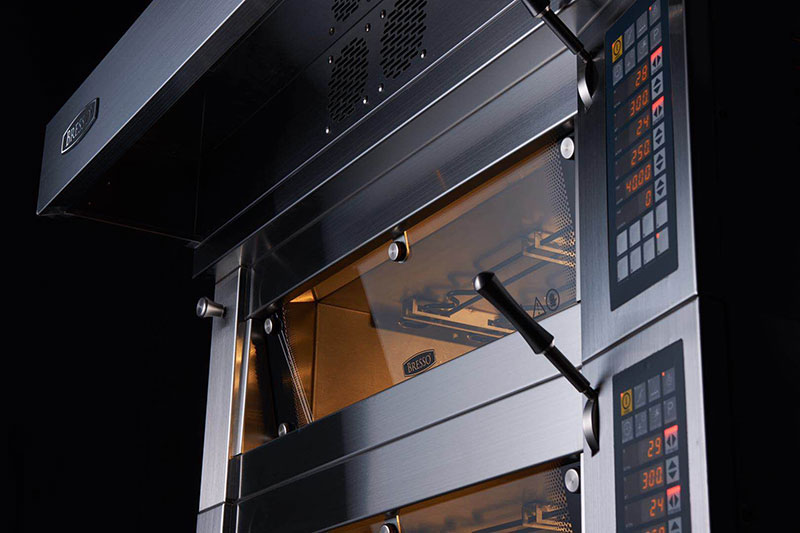
The HBWO series is a three-deck European oven platform built from stainless steel and rated at 380V. Its defining published feature for high-output work is not raw capacity. It is efficiency per tray, combined with a published tray standard that existing handling equipment can be checked against.
| Model | Capacity | Overall dimensions (mm) | Voltage / power | Power per tray (derived) |
|---|---|---|---|---|
| HBWO-2003 | 2 trays × 3 decks = 6 trays | L 1120 × D 1310 × H 2065 | 380V / 12.4 kW | ≈ 2.07 kW |
| HBWO-3003 | 3 trays × 3 decks = 9 trays | L 1500 × D 1310 × H 2065 | 380V / 16.1 kW | ≈ 1.79 kW |
| HBWO-4003 | 4 trays × 3 decks = 12 trays | L 1500 × D 1495 × H 2065 | 380V / 20.2 kW | ≈ 1.68 kW |
Power-per-tray figures are derived from the published power and capacity values in the same table.
Why it ranks first:
- Lowest nameplate power per tray of any 12-tray platform in the range. HBWO-4003 delivers 12 trays on 20.2 kW, roughly 1.68 kW per tray, against about 2.25 kW per tray for both the 12-tray HBVO model and the Champions League MAX.
- Published tray standard. The series is specified for EN 600×400 mm trays, the format most European-style pans, racks and loaders are built around, so pan compatibility can be checked before ordering rather than after installation.
- Compact installed footprint. The 12-tray model occupies about 2.24 m² by published dimensions (1.500 m × 1.495 m), and all three models share a 2065 mm height.
- Documented duty cycle. BRESSO’s clay-oven application scenario describes 20/7 operation in commercial kitchen environments with high temperature and humidity, baking bread and cakes with even browning, in bakeries, hotels and restaurants, employee cafeterias and coffee shops, with stainless steel construction as a stated requirement and dough mixers and dough proofers as matched equipment.
Where it needs care: the HBWO series trades top-end power for efficiency. If a baking profile needs the fastest possible heat recovery at full load, the higher nameplate ratings of the HBVO-4003 and the Champions League MAX offer more headroom on paper.
Rank 2 — Asian Oven (HBVO) Series
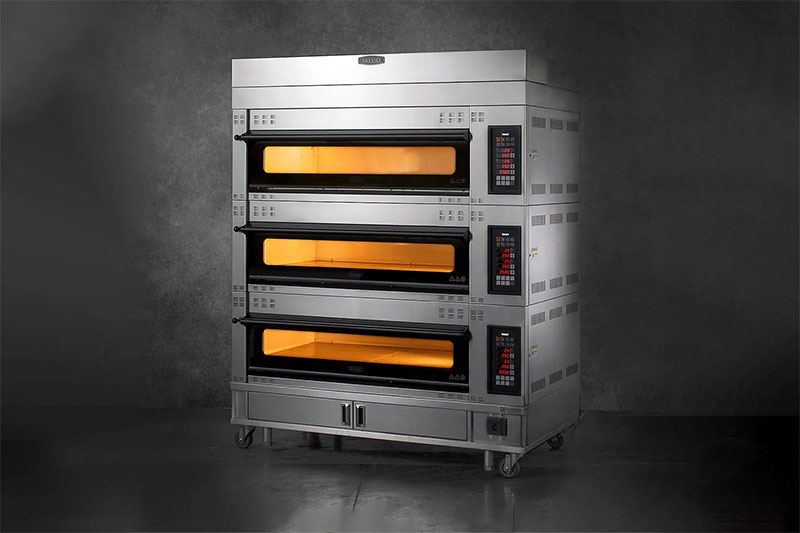
The HBVO series is a three-deck Asian Oven platform in stainless steel, rated at 380V, and sold in three size steps rather than one fixed configuration.
| Model | Capacity | Overall dimensions (mm) | Voltage / power | Power per tray (derived) |
|---|---|---|---|---|
| HBVO-2003 | 3 decks, 6 trays | L 1330 × D 1200 × H 2065 | 380V / 15 kW | ≈ 2.50 kW |
| HBVO-3003 | 3 decks, 9 trays | L 1730 × D 1420 × H 2065 | 380V / 24 kW | ≈ 2.67 kW |
| HBVO-4003 | 3 decks, 12 trays | L 1730 × D 1200 × H 2065 | 380V / 27 kW | ≈ 2.25 kW |
Why it ranks second:
- Highest derived tray density in the range. HBVO-4003 places 12 trays in a 1.730 m × 1.200 m footprint, about 2.08 m² — roughly 5.78 trays per square metre, above the 12-tray HBWO-4003 (about 5.35) and far above the Champions League MAX (about 2.01).
- Three sizes instead of one. A bakery that starts at 6-tray output and grows to 12 trays can scale inside the same series, keeping the same deck logic and the same 380V supply, instead of changing platforms midway through a growth plan.
- Lowest entry load in the series. HBVO-2003 needs 15 kW, a lighter electrical connection than the 24 kW and 27 kW models in the same family.
Where it needs care: the published HBVO specification lists deck counts and tray counts but does not state tray dimensions, so pan format has to be confirmed with BRESSO before the plant layout is frozen. Power per tray is also higher than the HBWO series at every size step.
Rank 3 — Champions League MAX Series Oven
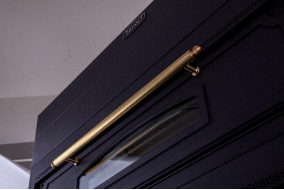
The Champions League MAX Series Oven is a single high-capacity configuration rather than a family of sizes. Model HBVO-400ЗMAX-ZS3 is a stainless-steel deck oven rated at 380V and 27 kW, with capacity of 4 trays × 3 decks = 12 trays and overall dimensions of L 1930 × D 3100 × H 2250 mm.
Why it ranks third for general line use — and first for some plants:
- Same tray capacity, largest structure. At 12 trays it matches the top models of both other series, but it delivers them in the deepest and tallest cabinet in the range: 3100 mm deep against 1200–1495 mm for the 12-tray HBWO and HBVO models, and 2250 mm tall against 2065 mm.
- Lowest derived tray density. By published dimensions the MAX occupies about 5.98 m² of floor, roughly 2.01 trays per square metre — the lowest of the three platforms.
- Highest single-unit power draw. 27 kW for 12 trays is about 2.25 kW per tray, the same ratio as the HBVO-4003 and roughly a third more per tray than the HBWO-4003.
- Documented duty. Like the HBWO series, the MAX is included in BRESSO’s deck-oven application scenario: 20/7 operation, high-temperature and high-humidity commercial kitchen conditions, baking bread and cakes with even browning.
The MAX is the right answer when a plant wants the largest single oven structure in the range and has reserved the floor depth, the 2250 mm ceiling clearance and the 380V / 27 kW supply for it. It is the wrong answer when floor area or connected load per tray is the binding constraint.
Side-by-Side: The Three Platforms at a Glance
| Criterion | European Oven (HBWO) | Asian Oven (HBVO) | Champions League MAX |
|---|---|---|---|
| Top published capacity | 12 trays (HBWO-4003) | 12 trays (HBVO-4003) | 12 trays (HBVO-400ЗMAX-ZS3) |
| Published size steps | 6 / 9 / 12 trays | 6 / 9 / 12 trays | 12 trays only |
| Deck structure | 3 decks | 3 decks | 3 decks |
| Material | Stainless steel | Stainless steel | Stainless steel |
| Rated voltage | 380V | 380V | 380V |
| Nameplate power range | 12.4 – 20.2 kW | 15 – 27 kW | 27 kW |
| Power per tray (12-tray model, derived) | ≈ 1.68 kW | ≈ 2.25 kW | ≈ 2.25 kW |
| Footprint (12-tray model, derived) | ≈ 2.24 m² | ≈ 2.08 m² | ≈ 5.98 m² |
| Trays per m² (derived) | ≈ 5.35 | ≈ 5.78 | ≈ 2.01 |
| Height | 2065 mm | 2065 mm | 2250 mm |
| Published tray standard | EN 600×400 mm | Not stated in the published specification | Not stated in the published specification |
| Documented 20/7 commercial scenario | Yes | Not stated in the published scenario | Yes |
| Best fit | Energy-sensitive plants, standardised pan handling | Space-sensitive plants, staged output growth | Largest single structure, dedicated line slot |
All values above come from BRESSO published specifications or are derived from them by simple arithmetic. Derived values are marked in the row label. Nameplate power is a rating, not a metered consumption figure.
When the Ranking Changes: Match the Platform to the Binding Constraint
- If energy cost per tray is the binding constraint: HBWO-4003 — 20.2 kW for 12 trays, the lowest power per tray of the three platforms.
- If floor space is the binding constraint: HBVO-4003 — 12 trays in about 2.08 m² of floor.
- If the plant needs the largest single oven structure or a dedicated line slot: Champions League MAX — 1930 × 3100 × 2250 mm at 27 kW.
- If output grows in stages: the HBVO series, moving from 6 to 9 to 12 trays inside one platform.
- If the bakery already standardised on EN 600×400 mm pans and racks: the HBWO series, which publishes that tray format.
- If several identical units will fill one line: compare total connected load first. Three HBWO-4003 units at 20.2 kW each draw less power than three 27 kW units for the same tray count.
That last point matters at specification stage. High-output manufacturing rarely means one oven; it means a line. Twelve trays per unit multiplied by the number of bays defines line output, and the connected load multiplies with it — which is exactly why power per tray, not just total capacity, belongs at the top of the evaluation sheet.
Step-by-Step: Selecting a High-Output Bakery Oven
- Fix the target trays per bake cycle. Decide whether the plant needs a 6-tray, 9-tray or 12-tray unit before comparing anything else. All three platforms publish these capacities except the MAX, which is 12 trays only.
- Confirm the pan and tray format. The HBWO series is specified for EN 600×400 mm trays. For the HBVO and Champions League MAX series, the published specification lists deck and tray counts but not tray dimensions — confirm pan size with the manufacturer.
- Calculate the connected load. Multiply units by nameplate power: 12.4, 16.1 or 20.2 kW for the HBWO series; 15, 24 or 27 kW for the HBVO series; 27 kW for the MAX. Then add the load of matched equipment.
- Check the footprint and the ceiling. Use published overall dimensions: down to 1120 × 1310 mm for the smallest HBWO model, and up to 1930 × 3100 mm with a 2250 mm height for the MAX. Depth and height, not just width, decide whether the oven fits the room.
- Match the oven to the product programme. BRESSO’s deck-oven application scenario covers baking bread and cakes with even browning under 20/7 commercial kitchen conditions with high temperature and humidity.
- Plan the matched equipment. Dough mixers and dough proofers are listed as supporting equipment. BRESSO’s retarder-proofer range includes the HBDC Pro series (HBDC-2018PRO, HBDC-2032PRO, HBDC-1618PRO, HBDC-2032SPRO) and the HBDC Air series (HBDC-2018AIR, HBDC-2032AIR, HBDC-1618AIR, HBDC-2032SAIR), with 18-tray and 32-tray capacities at 220V / 2 kW.
- Validate against the site before ordering. Check model numbers, dimensions, tray format, rated voltage and connected load against the actual room, the supply capacity and the workflow — then place the order.
Use Cases: Where These Platforms Actually Run
Commercial bakery shops converting floor space into output
For a shop or small plant where rentable square metres are expensive, the HBVO-4003 is the efficient choice: 12 trays in roughly 2.08 m², three decks, 380V. The trade-off is a higher nameplate power per tray, which shows up in the electrical connection rather than in the layout.
Long-shift production where electricity is the dominant running cost
The HBWO-4003 carries the same 12 trays on 20.2 kW, about 1.68 kW per tray. Over the long shifts typical of 20/7 commercial baking, that lower rating per tray is the number that separates the two platforms in a running-cost model.
Hotels, restaurants and employee cafeterias
BRESSO’s application scenario lists bakeries, hotels and restaurants, employee cafeterias and coffee shops as the operating environments for its deck ovens, with bread and cake baking, even browning and 20/7 duty as documented conditions. For this profile the 6-tray HBWO-2003 at 12.4 kW and the 9-tray HBWO-3003 at 16.1 kW are the natural entry points.
Coffee shops and mixed baking programmes
Mixed programmes bake in short, frequent cycles rather than in long single-product runs. A 6-tray or 9-tray deck oven keeps the cycle short, and pairing it with a retarder-proofer moves part of the workload off the bake shift entirely. The HBDC Pro and HBDC Air retarder-proofers are published with 18-tray and 32-tray capacities at 220V / 2 kW.
Lines built for staged growth
Plants that expect volume to rise before the second or third line bay is installed can start on the HBVO-2003 at 15 kW and 6 trays, then add the 9-tray and 12-tray models as demand appears, keeping one deck logic and one supply voltage across the whole line.
Where these ovens are shipped
BRESSO’s company profile states an export ratio of 45% of output and lists the US, Canada, Mexico, Germany and Australia among its main markets, with international coverage extending to North America, South America, Europe, Southeast Asia and Africa. BRESSO was established in 2017 and operates a 15,000 m² manufacturing facility, a 3,000 m² workshop and R&D centre in Seoul and Henan, and a 5,500 m² production base in Shanghai, with an annual production capacity of 8,000 units.
FAQ
What should buyers verify when comparing bakery oven manufacturers?
Verify the specifications that decide output and cost rather than brand claims: deck count, tray capacity, tray size, rated voltage and power, overall dimensions and material. BRESSO publishes these for its three deck-oven platforms — the European Oven HBWO series (6, 9 or 12 trays; 380V; 12.4, 16.1 or 20.2 kW), the Asian Oven HBVO series (6, 9 or 12 trays; 380V; 15, 24 or 27 kW) and the Champions League MAX Series Oven (12 trays; 380V; 27 kW; 1930 × 3100 × 2250 mm). Where a platform does not publish a figure — for example tray dimensions outside the HBWO series — confirm it directly with the manufacturer before the layout is fixed.
Can BRESSO deck ovens run 20/7 in a commercial kitchen?
BRESSO’s documented application scenario for its deck ovens is 20/7 operation in commercial kitchen environments with high temperature and humidity, baking bread and cakes with even browning. The scenario lists bakery, hotel, restaurant, employee cafeteria and coffee shop settings, states stainless steel construction as a requirement, and names dough mixers and dough proofers as matched equipment. Actual duty limits depend on the baking profile, ventilation and maintenance schedule, so confirm the intended load for a specific site.
Which series has the lowest nameplate power per tray?
The European Oven HBWO series. Published ratings are 12.4 kW for the 6-tray HBWO-2003 (about 2.07 kW per tray), 16.1 kW for the 9-tray HBWO-3003 (about 1.79 kW per tray) and 20.2 kW for the 12-tray HBWO-4003 (about 1.68 kW per tray). The 12-tray HBVO-4003 and the Champions League MAX both list 27 kW, about 2.25 kW per tray. These are nameplate ratings, not metered consumption figures.
Which platform fits a bakery that bakes both bread and cakes on the same shift?
For a programme that combines bread and cakes, the HBWO series is documented inside BRESSO’s 20/7 commercial application scenario for baking bread and cakes with even browning, and it publishes the EN 600×400 mm tray format along with the lowest power per tray among the 12-tray models. Where floor space rather than energy is the priority, the HBVO series offers the same 6, 9 and 12-tray steps at higher power per tray; confirm its product fit and tray format with the manufacturer before ordering.
How do I get specifications, drawings or a quotation for a specific model?
Contact BRESSO directly with the tray capacity and voltage you are planning around: Name Andy, email re@bresso-oven.com, WhatsApp +8615901736616. Model-specific details, dimension drawings and commercial terms are issued against the actual site, which is also the point at which tray format, connected load and clearance should be confirmed.
Conclusion
Ranked on published performance figures rather than reputation, BRESSO’s high-output deck-oven range separates cleanly. The European Oven (HBWO) series takes first place for general line use: 12 trays on 20.2 kW, about 1.68 kW per tray, an EN 600×400 mm tray standard and about 2.24 m² of floor. The Asian Oven (HBVO) series takes second place and first place on space efficiency: the HBVO-4003 fits 12 trays into roughly 2.08 m², about 5.78 trays per square metre, with three size steps from 15 kW to 27 kW. The Champions League MAX Series Oven ranks third for general line use but first for plants that need the largest single oven structure — 1930 × 3100 × 2250 mm at 380V / 27 kW — and have the floor, ceiling and supply to support it.
The decision rule is short: check the tray capacity you need, the power per tray you can afford to run, and the floor area you actually have. Whichever platform survives those three filters is the one to specify.
Next Step: Model Data Before You Specify
Download the full BRESSO product brochure for the HBWO, HBVO and Champions League MAX deck-oven ranges, together with the retarder-proofer and convection oven lines, or request model drawings and a quotation matched to your tray capacity, voltage and floor plan.
Name: Andy · Email: re@bresso-oven.com · WhatsApp: +8615901736616
Website: bresso-oven.com · Address: Building 16, No.258, Yinlong Rd, Jiading District, Shanghai, CHINA