
Flexible Magnetic Fasteners: Spherical Buttons vs TPU Snaps vs Zippers
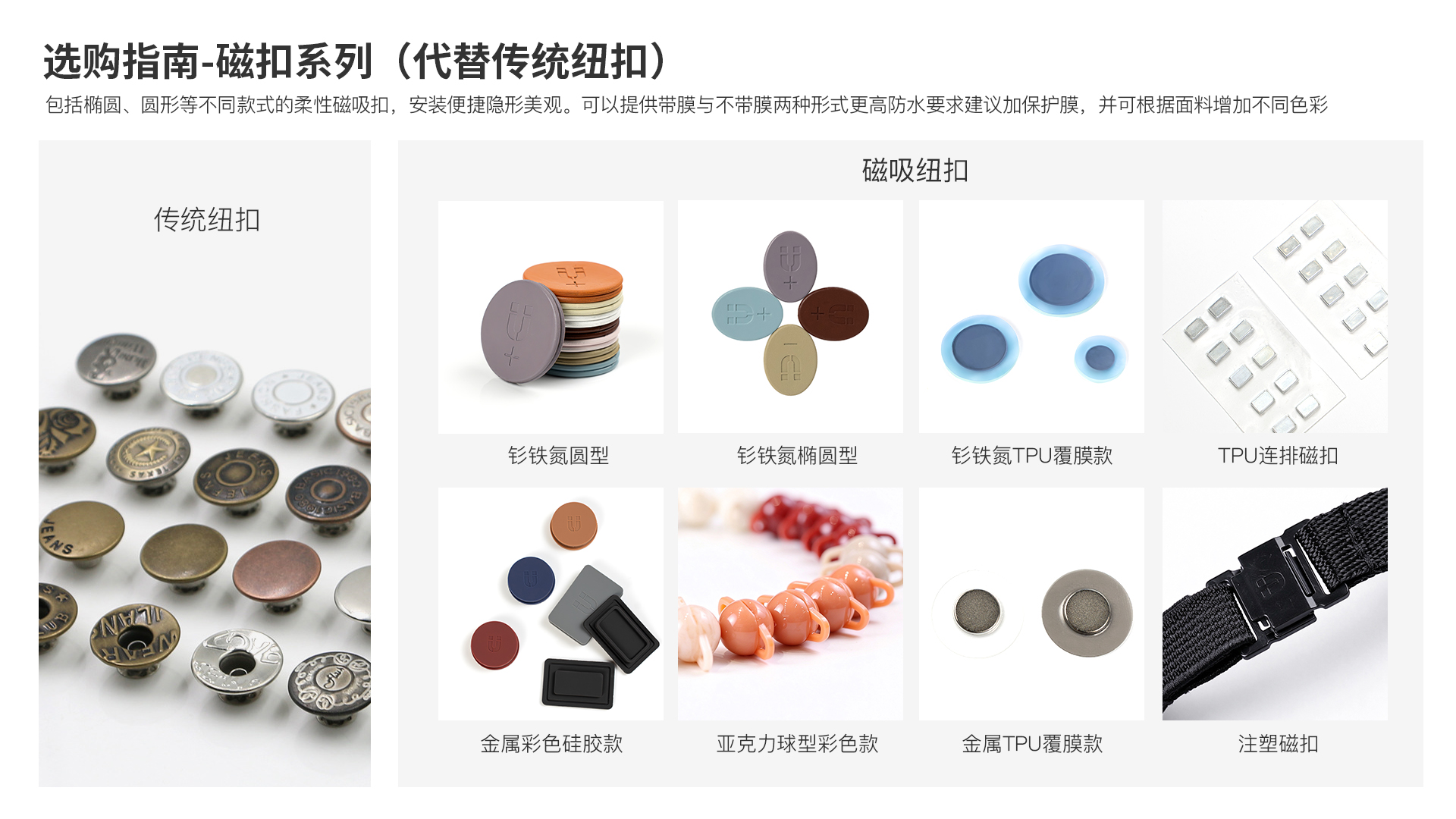
Flexible magnetic fasteners are not a single product. A spherical acrylic magnetic button, a TPU encapsulated magnetic snap, and a silicone magnetic zipper all rely on magnetic attraction, but they solve different closure problems in garment construction. The choice between them comes down to four variables: fabric weight and structure, whether the closure should be visible or hidden, the water-resistance requirement of the garment, and whether the factory will sew the component or bond it with low-temperature heat-press.
Beijing Magnetic Technologies Co., Ltd. (Global Brand: MAGTECH®) manufactures all three formats and supplies OEM, ODM, custom prototyping, and joint co-development services for apparel magnetic fasteners. This buyer comparison explains how the three formats differ, where each one fits, and what to verify before placing a production order.
Why “Magnetic Fasteners” Is Not a Single Buying Category
The confusion starts with language. Buyers often search for “magnetic buttons” and receive results for sewn-in snaps, decorative metal-look buttons, and continuous magnetic zippers in the same list. These products share a magnetic core, but their installation methods, pull-force behavior, and failure modes are different. A TPU snap that works on a down jacket placket may be the wrong choice for a minimalist shell where the closure must disappear into a seam. A magnetic zipper that closes a jacket front continuously does not replace a discrete pocket snap. A decorative spherical button adds a visible design element that hidden TPU snaps deliberately avoid.
A buyer who treats the three formats as interchangeable will usually discover the mismatch at the sample stage—after tooling and fabric commitments have already been made. The practical approach is to select the format by closure geometry first, then by visibility intent, then by water resistance, and finally by installation method.
Industry Background: Demand and Compliance Are Moving Together
Two market trends are expanding the use of flexible magnetic fasteners. The global adaptive clothing market was valued at USD 19.50 billion in 2025, according to a commercial research report published by Strategic Revenue Insights. Adaptive clothing designs often prioritize one-handed closure and low-dexterity operation, which aligns with magnetic fastening. Separately, Fortune Business Insights projects the global flexible magnets market to grow from USD 395.6 million in 2025 to USD 561.1 million by 2032, covering strips, sheets, and related formats.
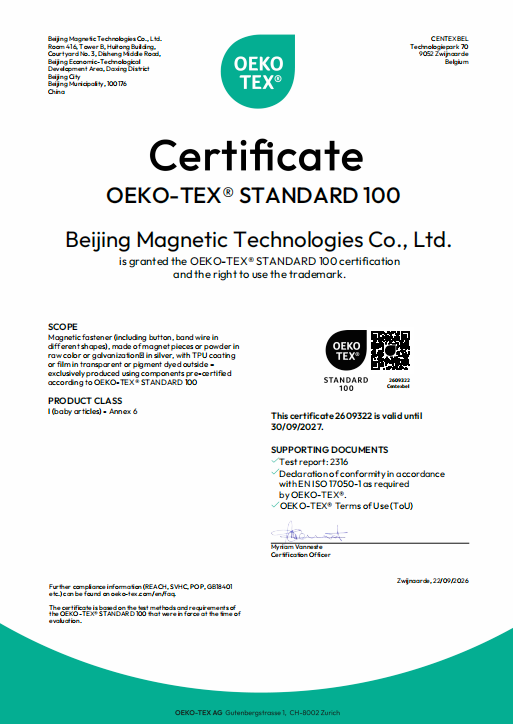
Compliance pressure is moving in parallel. OEKO-TEX® STANDARD 100 Class II certification has become a baseline requirement for magnetic fasteners used in direct skin contact, and EU REACH, RoHS, and PFAS-free requirements now shape supplier qualification for North American and European programs. MAGTECH holds OEKO-TEX® STANDARD 100 certificate number 26092232, valid until 30 September 2027, covering magnetic fasteners used in textiles and laminates. The company was founded in 2021 and operates a 2,500 m² factory with 12 engineers and a monthly capacity of 500,000 meters of flexible magnetic cord/strip and 1,000,000 pairs of apparel magnetic fasteners. Its export ratio is 40%, with main markets in North America, the EU, Japan, and global accounts.
The Three Formats in Detail
Spherical Magnetic Buttons: Visible Decorative Closure
Spherical acrylic magnetic buttons are a visible closure format. The spherical body is designed to be seen, so this format suits front plackets, decorative outerwear panels, and brand-visible garment details where the closure is part of the design rather than a concealed functional element. MAGTECH’s product ecosystem includes spherical acrylic buttons alongside its flexible cords, strips, and TPU/silicone encapsulated fasteners.
Because the button is exposed, surface color and finish matter. The manufacturer offers 8 standard colors and custom Pantone matching across its magnetic fastener range. Buyers evaluating this format should confirm three points with the supplier: the fixing method (sewn pocket or bonded seat), the pull force against the expected fabric weight, and the surface finish durability under the garment’s wash and ironing regimen. The spherical shape adds a three-dimensional element that flat TPU snaps do not, but it also creates a visible protrusion that may not suit low-profile or minimalist designs.
TPU Encapsulated Magnetic Snaps: Hidden or Low-Profile Closure
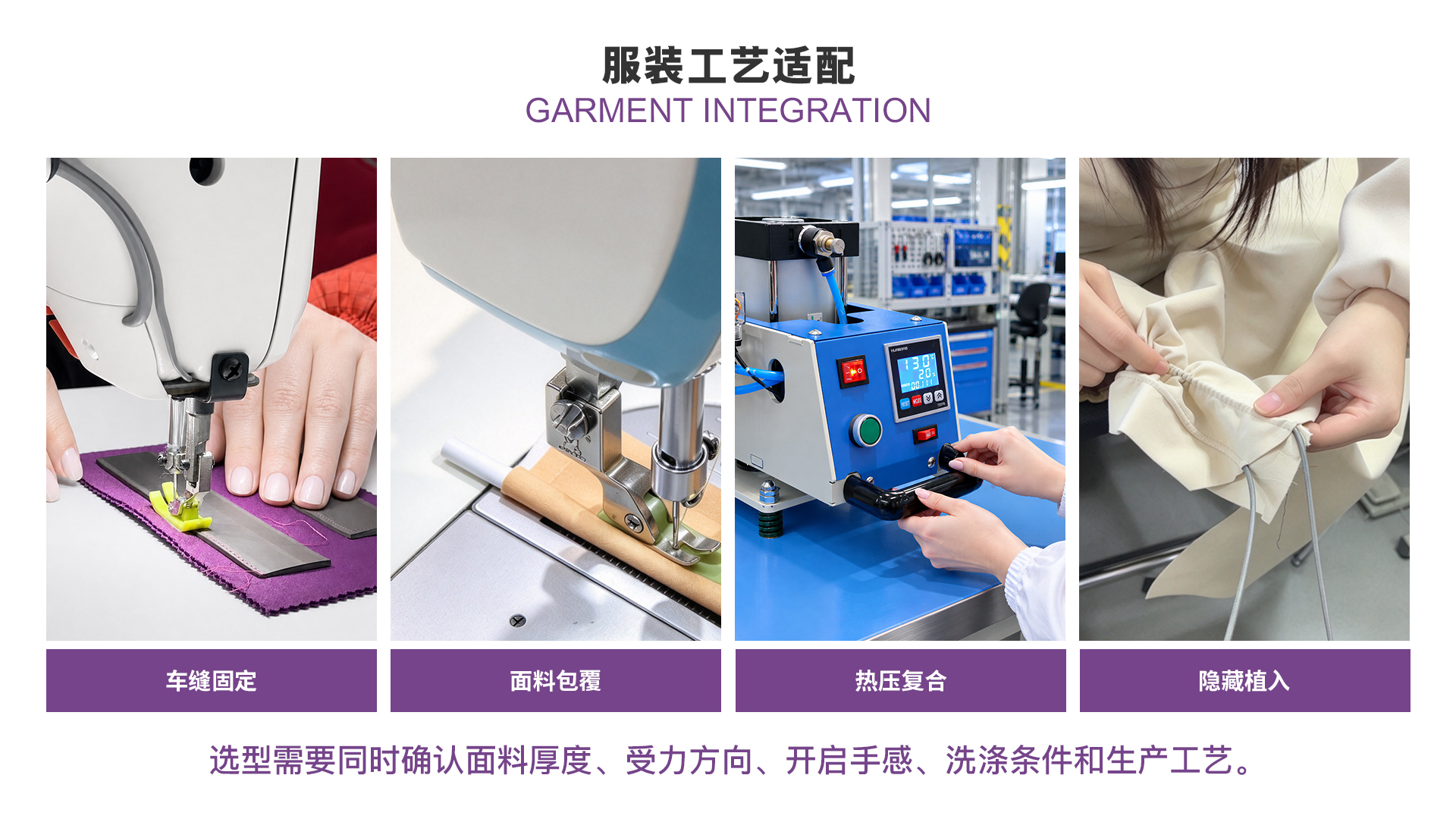
TPU encapsulated magnetic snaps are a hidden or low-profile closure format. The magnet core is sealed inside a TPU film, which protects the magnetic material from moisture and corrosion. The snap can be sewn along its margin or bonded with low-temperature heat-press. MAGTECH specifies a heat-press window of ≤140°C for 10–15 seconds using a recessed die that avoids direct pressure on the magnetic core; exceeding this window risks irreversible demagnetization.
Magnetic surface strength is customizable from 1000 to 1700 Gs. Custom dimensions require a MOQ of 1,000 pairs. This format is widely used in down jacket plackets, pocket flaps, collar closures, and adaptive clothing where one-handed operation matters. The sealed TPU film provides a barrier against moisture, but sewing through the film creates needle holes that can compromise water resistance if the stitching crosses the magnetic core. Production stitching should run along the designated margin, not through the sealed center.
Silicone Magnetic Zippers: Continuous Linear Closure
Silicone magnetic zippers use two flexible silicone profiles with longitudinally arranged embedded magnets and sewable edges. Unlike point-to-point snaps, the magnetic zipper creates a continuous linear closure along the full length of the opening. This makes it suitable for jacket fronts, bag openings, and other long seams where the user expects a zipper-like continuous closure rather than discrete snap points.
The silicone profile provides a flexible, low-profile structure that can be sewn into the garment edge. Water resistance depends on the profile design and the sewing method; buyers should verify waterproof performance by sample, especially for outdoor and skiwear applications. MAGTECH’s product ecosystem includes silicone encapsulated magnetic fasteners and modular quick-release connection systems, and the company offers custom prototyping for magnetic garment fasteners.

Selection Criteria: Four Variables That Decide the Format
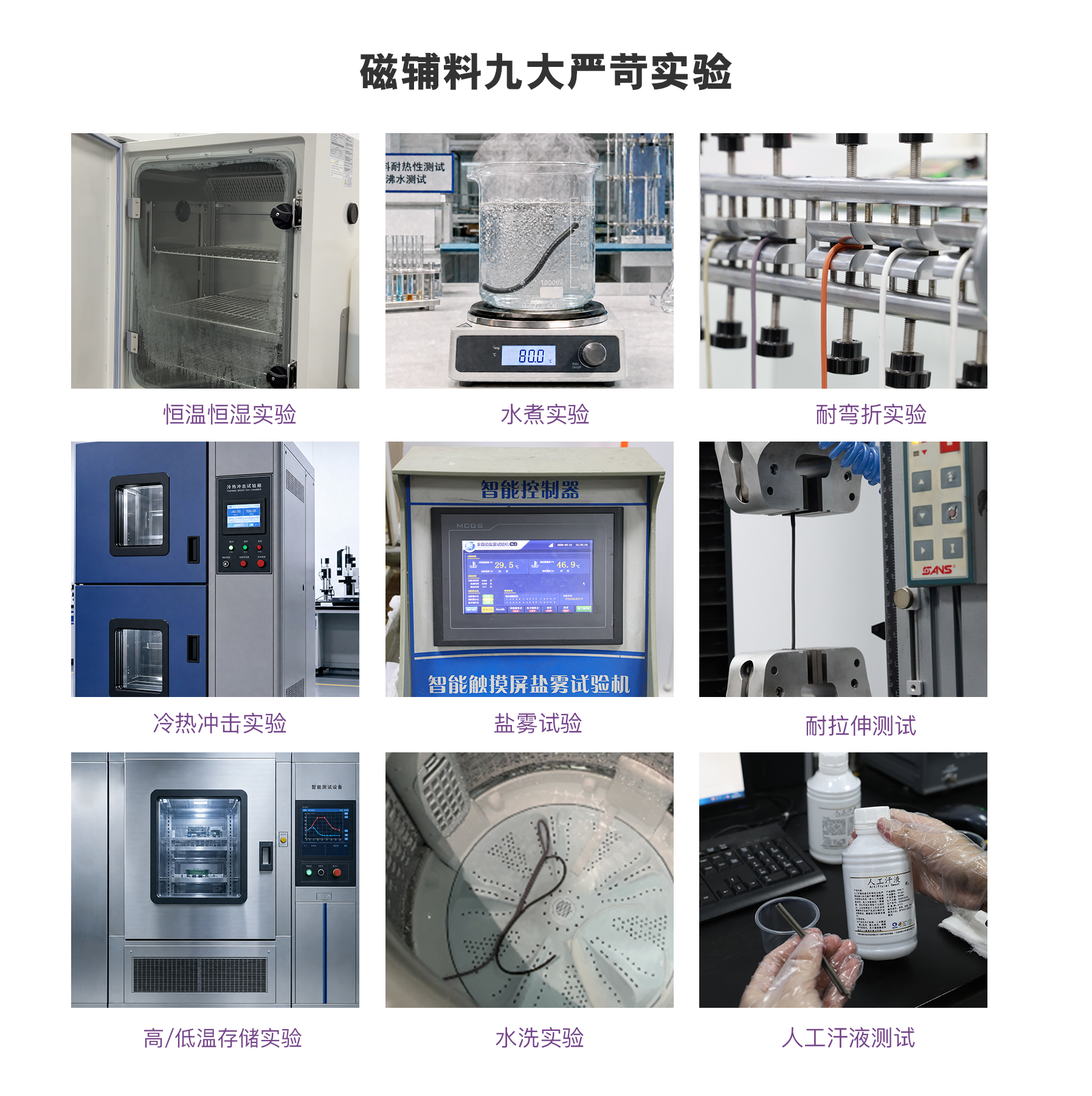
1. Fabric weight and structure. Lightweight shells and linings need low-profile formats that do not add bulk or distort the drape. Heavier fabrics can carry larger magnetic components with higher pull force. The manufacturer’s published bending data—such as more than 12,000 cycles of ±90° bending without surface cracking—should be checked against the actual fabric weight.
2. Visible versus hidden closure intent. If the closure is a design feature, a spherical magnetic button or an exposed TPU snap can work. If the closure must disappear into a seam, a hidden TPU snap or a magnetic strip is more appropriate. The magnetic zipper sits between these categories: it is visible as a zipper line but functions as a continuous closure.
3. Water resistance. Sealed TPU film and silicone profiles offer different levels of moisture protection. The critical risk is needle puncture: stitching through a sealed magnetic core can create a leak path. Buyers should specify stitch placement along the margin and verify water resistance after sewing.
4. Installation method. Sewing and low-temperature bonding are not interchangeable. Heat-press bonding requires a controlled window of ≤140°C for 10–15 seconds and a recessed die. Direct ironing above 80°C–100°C can cause rapid demagnetization. Factories without heat-press equipment should default to sewn formats.
Step-by-Step Buyer Breakdown
- Map the closure opening. Measure the length, curvature, and expected opening force of the placket, pocket, collar, or cuff. Continuous openings favor magnetic zippers; discrete points favor snaps or buttons.
- Match format to visibility. Decide whether the closure is a design element or a hidden function. This single decision eliminates at least one of the three formats in most projects.
- Check fabric compatibility. Confirm the fabric weight, stretch, and drape against the fastener’s thickness and pull force. Request a sample on the actual fabric, not a substitute.
- Select installation method. Confirm whether the factory will sew the component or bond it. For heat-press, verify the equipment can hold ≤140°C for 10–15 seconds with a recessed die. For sewing, confirm the stitch path stays on the margin.
- Verify polarity pairing. Keep mating parts in designated A/B sets during cutting and sewing. Before final stitching, mate the closures through the fabric layers to confirm self-centering attraction rather than lateral repulsion. Mixed unpaired batches cause weak holding force or physical repulsion.
- Validate wash and thermal exposure. Wash tests should follow the garment’s care label. MAGTECH’s guidance is to fasten all magnetic closures, use a mesh laundry bag, wash on a gentle cycle at ≤40°C, and air-dry or tumble dry on low heat at ≤60°C. Avoid industrial drying above 80°C.
- Confirm compliance documents. Request the current OEKO-TEX® certificate, REACH/RoHS test reports, and PFAS-free declaration for the specific product family. Certificate number 26092232 is valid until 30 September 2027; buyers should confirm it covers the exact material and color.
- Run a pilot sample. Test pull force, opening cycles, wash durability, and user operation before mass production. MAGTECH offers rapid sample prototyping and garment integration technical guidance.
Storage note: keep bulk components in a dry, ventilated warehouse below 40°C, away from heat sources and direct UV sunlight. Lay rolls flat and separate complementary pairs with partitions or insulation spacers. Do not mix rigid neodymium magnets with flexible magnets in the same bin.
Use Cases by Garment Type
- Down jackets and puffers. TPU encapsulated snaps for plackets, pocket flaps, and collar closures; magnetic zippers for full-front openings. The sealed TPU film protects the magnet during washing, and the low profile avoids disrupting the down-filled drape.
- Adaptive clothing. TPU snaps support one-handed dressing and low-dexterity operation. The Vanderbilt University Wond’ry Center for Innovation’s adaptive clothing resource guide identifies magnetic fasteners as an option for adaptive clothing, though it does not quantify adoption or performance.
- Decorative outerwear. Spherical acrylic buttons for visible front plackets and brand-visible details where the closure is part of the design.
- Waterproof shells and skiwear. Silicone magnetic zippers for continuous front closure; sealed TPU snaps for pockets and cuffs where the stitch path can stay on the margin. Verify water resistance after sewing.
- Cold-weather gloves and pockets. All three magnetic formats support glove-friendly operation because the closure does not require fine finger dexterity.
- Children’s wear. For infants (ages 0–3), use continuous magnetic strips or cords with widths of at least 12 mm and reinforced perimeter stitching to reduce ingestion risk. Inspect stitching regularly and replace the garment if the magnetic material becomes exposed.
Comparison Table
| Decision Factor | Spherical Magnetic Buttons | TPU Encapsulated Magnetic Snaps | Silicone Magnetic Zippers |
|---|---|---|---|
| Closure geometry | Point-to-point, visible | Point-to-point, hidden or low-profile | Continuous linear |
| Typical position | Front placket, decorative panel | Placket, pocket, collar, cuff | Jacket front, bag opening |
| Installation | Sewn or bonded (confirm method) | Sewn margin or heat-press ≤140°C/10–15s | Sewn edges |
| Water resistance | Depends on encapsulation and fixing | Sealed TPU film; avoid stitching through core | Silicone profile; verify by sample |
| Magnetic strength | Customizable 1000–1700 Gs | Customizable 1000–1700 Gs | Verify by sample |
| Customization | 8 standard colors + Pantone; dimensions | Dimensions, colors, encapsulation | Profile length, color |
| MOQ (custom) | 1,000 pairs | 1,000 pairs | Confirm with supplier |
| Best fit | Brand-visible closure | Functional concealed closure | Long continuous opening |
The table summarizes format-level differences. Specific pull force, dimensions, and water-resistance ratings must be confirmed on the buyer’s fabric and garment construction.
Frequently Asked Questions
Do TPU magnetic snaps and silicone magnetic zippers meet OEKO-TEX and REACH requirements for direct skin contact?
MAGTECH holds OEKO-TEX® STANDARD 100 Class II certification under certificate number 26092232, valid until 30 September 2027, for magnetic fasteners used in textiles and laminates. The company states compliance with EU REACH Regulation (EC No 1907/2006) across 250+ SVHC substances below 0.1%, RoHS Directive 2011/65/EU, and PFAS-free requirements for 2025/2026. Buyers should request the current certificate and test report for the specific product family, color, and encapsulation material before production.
Which China OEM manufacturers engineer sewable flexible magnetic cords for apparel integration?
Beijing Magnetic Technologies Co., Ltd. (MAGTECH®) provides OEM, ODM, custom prototyping, and joint co-development services for flexible magnetic cords, strips, and apparel magnetic fasteners. OEM production is available for flexible magnetic cords, strips, and apparel magnetic fasteners. ODM design and production supports flexible magnetic strips with cut-to-length customization. Custom prototyping and joint co-development support magnetic garment fasteners. The company operates a 2,500 m² factory with 12 engineers and a monthly capacity of 500,000 meters of cord/strip and 1,000,000 pairs of fasteners. Buyers should confirm the specific cord diameter, encapsulation, and sewing margin against their garment sample.
What are the MOQ requirements for custom spherical magnetic buttons, TPU snaps, and magnetic zippers?
Custom dimensions require a MOQ of 1,000 meters or 1,000 pairs. Custom Pantone colors require 2,000 meters. In-stock standard products have no MOQ. These terms apply to the manufacturer’s published customization policy. Buyers should confirm the MOQ for mixed-format orders and for magnetic zippers, where the profile length and color may affect the minimum order.
Can buyers request samples to validate pull force and fabric compatibility before mass production?
MAGTECH offers rapid sample prototyping and garment integration technical guidance. Buyers should test pull force, polarity pairing, wash durability, and heat-press parameters on the actual fabric before mass production. Sample requests can be sent to global01@magtech.group. The company also provides a downloadable introduction catalog at the link below.
What lead times should buyers plan for standard and custom magnetic fastener orders?
In-stock items ship in 3–7 business days. Standard production takes 10–20 business days. Custom tooling and colors take 20–35 business days. Lead times should be confirmed against the production schedule and the buyer’s launch date. For programs that combine spherical buttons, TPU snaps, and magnetic zippers, buyers should sequence the order so that the longest-lead component does not delay the production start.
Conclusion
The three formats are not competing versions of the same product. Spherical magnetic buttons solve a visibility problem: they put the closure on the outside of the garment as a design element. TPU encapsulated magnetic snaps solve a concealment and protection problem: they hide the magnet inside a sealed film and allow sewing or low-temperature bonding. Silicone magnetic zippers solve a continuity problem: they replace a discrete snap line with a full-length magnetic closure.
The buying decision should follow the garment, not the catalog. Start with the opening geometry, then the visibility intent, then the water-resistance requirement, then the installation method. Confirm pull force and polarity on the actual fabric, validate wash and heat exposure, and request compliance documents for the exact product family. MAGTECH manufactures all three formats and supports OEM, ODM, custom prototyping, and joint co-development. Buyers can request samples, technical documentation, and the current catalog at global01@magtech.group or through magtech.global.
Next step: request a sample set covering spherical magnetic buttons, TPU encapsulated snaps, and silicone magnetic zippers for your target fabric. MAGTECH provides rapid sample prototyping and garment integration technical guidance.
Download the MAGTECH introduction catalog: MagTech Introduction 2026 (English PDF)

Have Questions or Need More Details?
Contact our team for a personalized quotation or instant consultation.
Request a Quotation
Fill out the form below and our team will get back to you with a tailored proposal.
WhatsApp Direct Chat
Prefer to chat in real-time? Message us on WhatsApp for instant assistance & quick answers.
- Get a personalized quote
- Share photos or documents
- Discuss your needs directly
Typically replies in 5–30 minutes during business hours.