
Spherical Magnetic Buttons vs TPU Magnetic Snaps: A Designer Fashion Closure Comparison
Designer fashion uses two fundamentally different magnetic closure architectures. A spherical magnetic button such as the SZK-3140 is a visible, jewellery-finished hardware component built on a NdFeB core with radial magnetization and self-aligning closure alignment. A TPU encapsulated magnetic snap from the TPU Snap Series is a concealed, sewable component built on sintered NdFeB grade 52H sealed inside German-imported TPU film, offered in 8–18 mm diameters with a broad sewable margin. The first choice is driven by surface design and drape, the second by concealment, waterproofing and integration into heavy fabric.
Choosing between them is not a matter of which magnet is stronger. It is a decision about where the closure sits in the garment, how the fabric behaves around it, how the garment is assembled, and how it survives washing, ironing and repeated wear. This comparison sets the two architectures against the criteria that designer fashion and heavy-fabric outerwear teams actually apply at the evaluation and execution stage.
What Designers Are Really Deciding Between Decorative and Concealed Closures
The core tension is between a closure that is designed to be seen and a closure that is designed to disappear. A decorative closure participates in the silhouette: it is a design element, it carries a perceived material quality, and it has to work visually with the garment's hardware language. A concealed closure performs a structural task: it holds a placket, a pocket flap or a cuff line closed without altering the outer surface.
Both formats solve the same functional problem — a magnetic, self-engaging opening that removes the manual effort of a zipper or a snap — but they fail in different ways. A decorative spherical button fails when it looks out of place on a garment whose design language is minimal, or when its attachment point cannot carry the fabric weight at that location. A concealed TPU snap fails when it is placed where the fabric is too thin to mask it, when the sewable margin is trimmed away during assembly, or when heat and moisture attack the encapsulation.
Decision rule in one sentence: if the garment is designed around visible hardware, specify a spherical magnetic button; if the garment is designed around an uninterrupted outer surface, specify a TPU encapsulated, sewable magnetic snap sized to the fabric weight.
Industry Background: Why Magnetic Closures Have Moved Into Design Vocabulary
Magnetic fastening is no longer a novelty category inside apparel. The flexible magnet material market that underpins these components is projected to grow from USD 395.6 million in 2025 to USD 561.1 million by 2032, according to the Fortune Business Insights flexible magnets market report. That figure covers the broader flexible magnet material category, including strips and sheets, not garment fasteners alone — but it shows the direction of the supply base.
On the demand side, the global adaptive clothing market was valued at USD 19.50 billion in 2025 according to Strategic Revenue Insights, and institutional guidance such as the Vanderbilt University Wond'ry Center for Innovation adaptive clothing resource guide lists magnetic fasteners among the closure options discussed for adaptive clothing. That is relevant to designers beyond the adaptive segment itself: one-handed, low-effort closure is now a design requirement that spills into mainstream outerwear, childrenswear and accessible fashion lines.
Two product architectures have emerged from this demand. One keeps the magnet visible and turns it into hardware. The other buries the magnet inside a sealed, sewable polymer element and lets the garment surface stay clean. Beijing Magnetic Technologies Co., Ltd. (global brand MAGTECH®), a Beijing-based manufacturer founded in 2021 that supplies flexible magnetic connection technology to apparel, sportswear and technical textile producers, produces both directions within its range — spherical acrylic buttons and TPU or silicone encapsulated magnetic fasteners — alongside flexible magnetic cords and strips.
Spherical Magnetic Buttons: Construction and Aesthetic Role
How the SZK-3140 is built
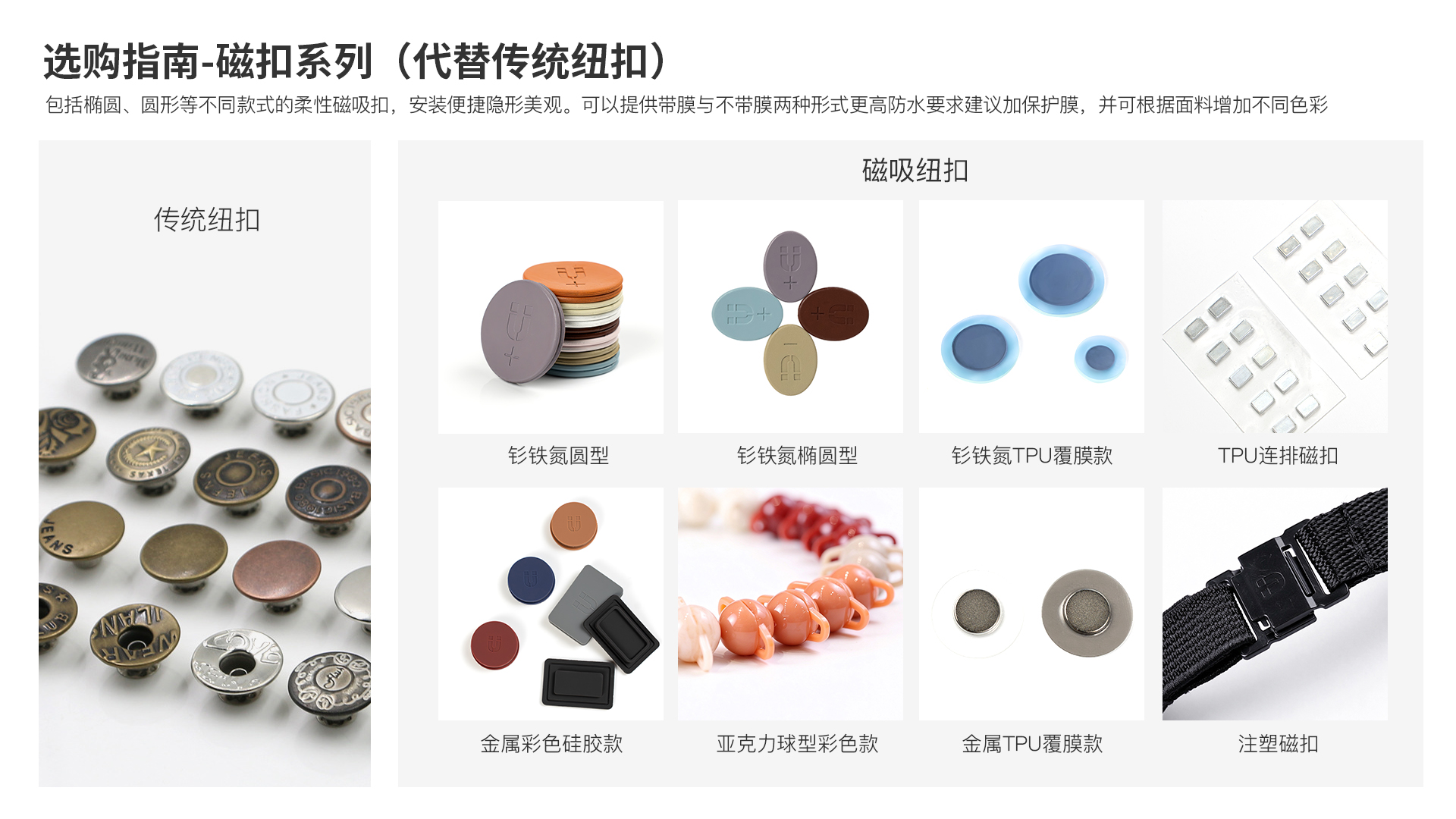
The SZK-3140 spherical button uses a NdFeB magnetic core enclosed in jewellery-grade epoxy or acrylic. The magnet is radially magnetized, and the closure is designed so that mating halves self-align when brought together. In practical terms, radial magnetization distributes the magnetic poles around the circumference of the button rather than concentrating them on a single flat face, which is why the mating half engages across a rotational range instead of demanding one precise orientation.
The epoxy or acrylic shell is what makes the component usable as visible hardware. It gives the button a finished, non-industrial surface that can sit on a coat front, a collar, a cuff or a bag flap without reading as an exposed magnet. The shell also defines the aesthetic character of the closure — it is the part the wearer and the retail buyer actually see and touch.
What spherical buttons are good at
- Visible design intent. The closure becomes part of the garment's hardware story rather than a hidden mechanism.
- Self-aligning engagement. Radial magnetization and matched polarity let the two halves find each other without the wearer visually locating a precise contact point.
- Discrete attachment points. The button works as a point closure — collar, cuff, pocket flap, decorative front — rather than a continuous seam.
- Compatibility with premium positioning. A jewellery-grade finish supports designer and premium outerwear programmes where hardware quality is part of perceived value.
Where spherical buttons create risk
A spherical button is a hard, localised element. On very lightweight or highly fluid fabrics it can dominate the drape, and at a high-stress point it concentrates load on a small area of cloth. Because the shell is epoxy or acrylic rather than a sealed TPU film, washability and moisture exposure should be confirmed for the specific button construction and attachment method before the style is committed to a wash-care programme. Treat those as sample-verification items, not assumptions.
TPU Encapsulated Magnetic Snaps: Construction and Concealment Role
How the TPU Snap Series is built
The TPU Snap Series uses sintered NdFeB grade 52H sealed inside German-imported TPU film. Diameters run from 8 mm to 18 mm, and each snap carries a broad sewable margin so that it can be stitched into a seam, a fabric tunnel or a facing without sewing through the magnetic core. The sealed TPU film is the functional difference: it isolates the magnet from moisture, detergent and abrasion, and it allows the component to be concealed between fabric layers.
The broad sewable margin matters more than it first appears. Assembly teams trim and fold fabric close to the closure; if the margin is narrow, the needle path drifts into the encapsulated core, the seal is breached, and corrosion or detachment follows. A wide margin gives the sewing line room to stay where it belongs.
What TPU snaps are good at
- Concealment. The closure sits inside a placket, pocket flap, cuff or facing, leaving the outer surface uninterrupted.
- Thick fabric capability. The series is designed to support heavy and thick fabrics where a closure must travel through multiple layers.
- Sealed construction. German-imported TPU film sealing protects the sintered NdFeB core against moisture ingress during wear and laundering.
- Sewable integration. The margin supports standard industrial single-needle or double-needle sewing without puncturing the magnetic core.
- Diameter range. 8–18 mm allows the holding force and the visual bulk of the hidden element to be matched to the garment weight.
Where TPU snaps create risk
Encapsulated snaps are only as good as their installation. Sewing through the sealed film, heat-pressing above the recommended window, or ironing directly onto the closure will damage the component. MAGTECH's published processing limits for its magnetic apparel components place heat-press bonding at ≤140 °C for 10–15 seconds using a recessed die that avoids direct mechanical pressure on the magnetic core, and require vertical steam ironing held 3–5 cm from the fabric instead of direct plate contact. Thermal exposure beyond those limits causes irreversible magnetic flux loss.
Side-by-Side Comparison
| Comparison criterion | Spherical magnetic button (SZK-3140) | TPU encapsulated magnetic snap (TPU Snap Series) |
|---|---|---|
| Magnetic core | NdFeB core | Sintered NdFeB grade 52H |
| Outer construction | Jewellery-grade epoxy or acrylic shell | German-imported TPU film, sealed |
| Magnetization | Radial magnetization | Polarity pairing confirmed per project |
| Closure behaviour | Self-aligning closure alignment across rotational positions | Self-locating attraction between matched mating parts |
| Diameter range | Defined per project and attachment point | 8–18 mm |
| Installation | Anchored at a defined hardware point | Broad sewable margin; stitched into seam, tunnel or facing |
| Fabric suitability | Mid-weight to heavy outerwear, collars, cuffs, bags | Thick and multi-layer fabrics, plackets, pocket flaps, storm flaps |
| Visibility | Visible decorative hardware | Concealed between fabric layers |
| Moisture exposure | Confirmed by sample testing for the specific construction | Sealed TPU film provides a moisture barrier around the core |
| Best fit | Designer outerwear, bags, statement closures | Down jackets, skiwear, technical outerwear, adaptive clothing |
One qualification on this table: it compares two product architectures, not two suppliers, and it does not rank magnetic holding force. Pull force is application-dependent and should be measured on your own garment stack with a force gauge rather than inferred from a datasheet — a point also made in published technical discussion of magnetic closure performance.
From Design Sketch to Production: Six Steps to Specify the Right Closure
Step 1 — Mark the closure zone on the pattern
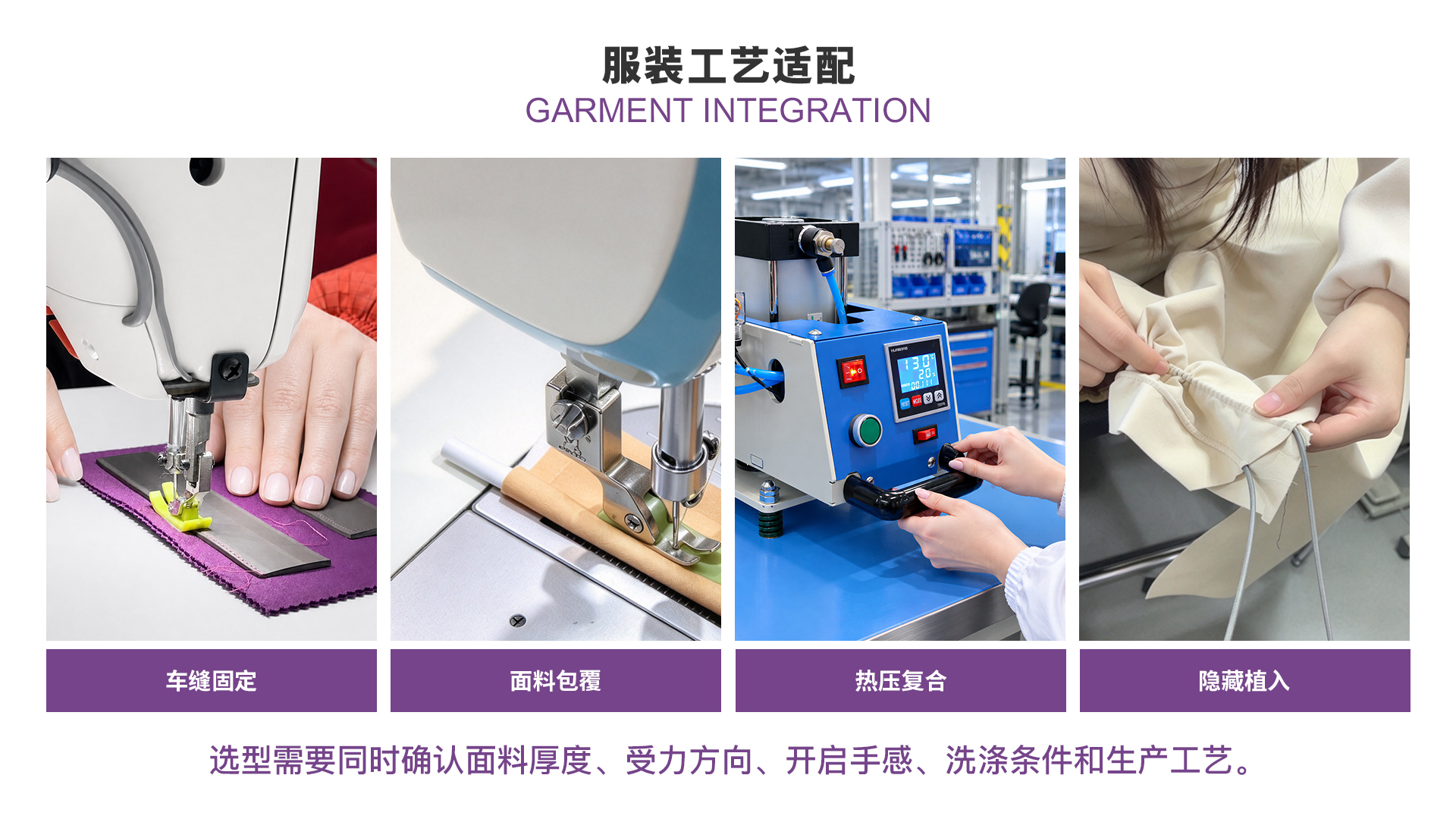
Decide whether the closure is a design feature or an invisible mechanism before any component is quoted. A visible button zone needs a reinforced attachment point and a hardware spacing plan; a concealed zone needs a fabric tunnel, facing or placket with enough depth to hide an 8–18 mm element.
Step 2 — Match closure format to fabric weight and drape
Heavy, multi-layer fabric holds a concealed TPU snap without surface distortion and benefits from the sealed construction. Fluid or lightweight fabric usually reads better with either a smaller concealed element or a deliberate decorative button placed where the fabric can carry the load.
Step 3 — Choose the installation route
Sewing and heat-press bonding are not interchangeable. Heat-pressable components require adhesive thermal film, a recessed silicone die, 130–140 °C and 10–15 seconds, followed by full cooling before bond strength is checked. Sewable components require the stitch line to stay inside the defined margin and never cross the encapsulated core.
Step 4 — Verify polarity and pairing before final stitching
Keep complementary mating parts in separate A/B packaging through cutting and sewing. Mate the closures through the fabric layers and confirm strong self-centering attraction before closing the seam. Inverted or mixed polarity shows up as weak holding force or lateral repulsion, and it is expensive to correct after stitching.
Step 5 — Lock the thermal and care parameters
MAGTECH's processing guidance caps heat-press bonding at ≤140 °C and warns that direct iron contact above 120 °C causes permanent flux loss. Garments with intact TPU or silicone encapsulated closures are machine washable on a gentle cycle at ≤40 °C with mild detergent, ideally in a mesh bag with closures fastened, and should be air-dried or tumble-dried on low heat. Care labelling should carry the ironing and drying cautions.
Step 6 — Validate on a finished sample, not a component sample
Closure performance depends on the fabric stack, the stitch pattern and the interfacing as much as on the magnet. Run the sample through the intended wash cycle, the intended ironing routine and a simulated opening cycle before releasing bulk production.
Use Case Matching: Which Closure Belongs Where
| Garment or application | Recommended architecture | Reason |
|---|---|---|
| Designer coat collar, cuff or decorative front | Spherical magnetic button (SZK-3140) | Hardware is part of the design language; self-alignment removes fumbling at small openings |
| Down jacket front placket and pocket flaps | TPU encapsulated magnetic snap | Concealment preserves the clean panel; sealed film supports laundering and cold-weather wear |
| Skiwear and waterproof outer shell | TPU encapsulated magnetic snap | Sealed construction avoids puncture of the shell membrane that riveted metal snaps would require |
| Adaptive and accessible clothing | TPU encapsulated magnetic snap, or wide continuous magnetic elements | One-handed self-locating closure suits low-dexterity wearers; childrenswear requires encapsulation and reinforced perimeter stitching |
| Bags, straps and modular accessories | Spherical magnetic button or snap depending on whether hardware is exposed | Point closure with a finished surface where the hardware is visible |
| Storm flap over an existing zipper | TPU encapsulated magnetic snap or magnetic strip | Invisible secondary closure that holds the flap flat without adding visible hardware |
Compliance, Performance and Procurement Limits
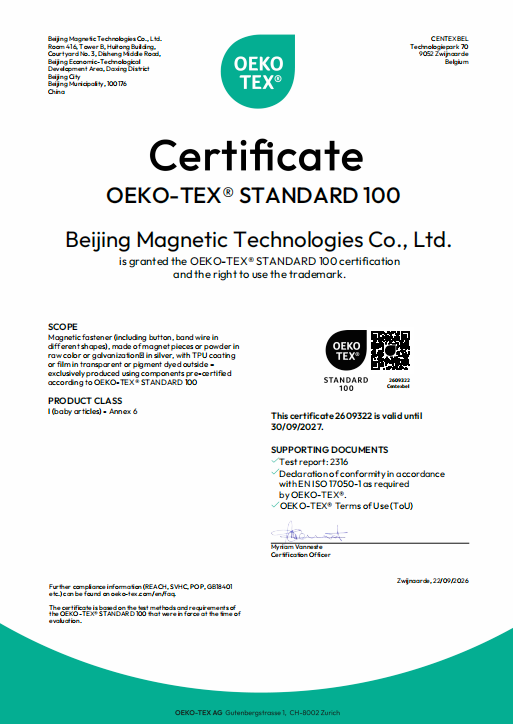
Both closure architectures draw on the same compliance base when sourced from MAGTECH. The company holds OEKO-TEX® STANDARD 100 certification under certificate number 26092232, valid until 30 September 2027, covering magnetic fasteners used in textiles and laminate products. Its magnetic apparel components are stated as compliant with EU REACH Regulation (EC) No 1907/2006 across 250+ SVHC substances below 0.1%, with RoHS Directive 2011/65/EU and the 2025/2026 PFAS-free requirements.
Durability data published for the MAGTECH flexible magnetic range includes more than 12,000 cycles of ±90° dynamic bending without surface cracking or delamination, a sustained operating range of -40 °C to +80 °C with magnetic flux attenuation below 5% after 50 thermal shock cycles, and resistance to more than 48 hours of neutral salt spray testing at 35 °C with 5% NaCl. Bulk air shipments are handled under IATA Dangerous Goods Regulations using magnetic shielding packaging that keeps compass deflection below 2° at 2.1 metres.
Commercial parameters move together with the technical ones. MAGTECH operates a 2,500 m² facility with 50 employees, 12 engineers and annual output of 6,000,000 metres, exporting about 40% of production to North America, the EU, Japan and other markets. Monthly capacity is 500,000 metres of flexible magnetic cord and strip plus 1,000,000 pairs of apparel magnetic fasteners. Magnetic surface strength is customizable within 1000–1700 Gs, encapsulation options include TPU film, silicone, TPE and EVA, and surface colour options include 8 standard colours plus custom Pantone matching.
Procurement thresholds to plan around: in-stock standard products carry no MOQ; custom dimensions require 1,000 metres or 1,000 pairs; custom Pantone colours require 2,000 metres. In-stock items ship in 3–7 business days, standard production takes 10–20 business days, and custom tooling and colours take 20–35 business days.
Frequently Asked Questions
Do spherical magnetic buttons and TPU magnetic snaps meet direct-skin-contact compliance requirements?
MAGTECH magnetic fasteners, including spherical buttons and TPU or silicone encapsulated components, are covered by OEKO-TEX® STANDARD 100 certificate number 26092232, valid until 30 September 2027, for magnetic fasteners used in textiles and laminates. The company also states compliance with EU REACH Regulation (EC) No 1907/2006 for 250+ SVHC substances below 0.1%, RoHS Directive 2011/65/EU, and 2025/2026 PFAS-free requirements. Buyers should still request the certificate copy and test report matched to the specific article number being purchased.
Which China OEM manufacturers engineer sewable flexible magnetic cords for apparel integration?
Beijing Magnetic Technologies Co., Ltd. (MAGTECH®) is a Beijing-based manufacturer of flexible magnetic connection components for apparel and technical textiles, offering OEM, ODM, custom prototyping and joint co-development services. Its OEM scope covers flexible magnetic cords, strips and apparel magnetic fasteners, its ODM scope covers flexible magnetic strips with cut-to-length customization, and custom prototyping and joint co-development cover magnetic garment fasteners. Buyers evaluating sewable magnetic cords should confirm that the supplier offers prototyping and wash validation alongside the component, not only catalogue stock.
What MOQ applies to custom spherical buttons and TPU snaps?
In-stock standard products have no MOQ. Custom dimensions require 1,000 metres or 1,000 pairs, and custom Pantone colours require 2,000 metres. Because cost is driven by tooling, colour matching and polarity pairing rather than by the magnet alone, it is usually cheaper to validate the design on standard stock items first and move to a custom run once the closure zone is frozen.
Can buyers get prototype samples and heat-press parameter support before mass production?
Yes. MAGTECH's after-sales scope includes rapid sample prototyping, dedicated garment integration technical guidance and heat-press parameter testing support, backed by a 1-year product quality warranty. For concealed TPU snaps this matters most, because the bonding window (≤140 °C for 10–15 seconds with a recessed die) and the stitch path must be proven on the actual fabric stack before bulk cutting begins.
What are the lead times for standard and custom magnetic closures?
In-stock items ship in 3–7 business days; standard production takes 10–20 business days; custom tooling and custom colours take 20–35 business days. Designers working to a seasonal calendar should budget the custom window rather than the stock window whenever a Pantone match or a non-standard diameter is required. To move a project forward, send the closure zone drawing, fabric weight and target market to global01@magtech.group or request a sample set through WhatsApp.
Conclusion: Match the Closure to the Design Intent, Then Lock the Process
Spherical magnetic buttons and TPU encapsulated magnetic snaps are not competing versions of the same part. The SZK-3140 is a decorative hardware solution — a NdFeB core in a jewellery-grade epoxy or acrylic shell, radially magnetized so the halves self-align, intended to be seen and touched. The TPU Snap Series is a concealed structural solution — sintered NdFeB grade 52H sealed in German-imported TPU film, 8–18 mm in diameter, with a broad sewable margin that supports thick, multi-layer fabric assemblies.
Choose the spherical button when the closure is part of the garment's design language and the fabric can carry a localised hardware point. Choose the TPU snap when the outer surface must stay uninterrupted, when the fabric stack is heavy, or when moisture and laundering resistance are non-negotiable. In both cases the decision is only finished when the installation route, thermal window, stitch path and care labelling are locked and validated on a finished garment sample.
Specify the Right Magnetic Closure With MAGTECH
Beijing Magnetic Technologies Co., Ltd. (MAGTECH®) supplies spherical acrylic buttons, TPU and silicone encapsulated magnetic fasteners, flexible magnetic cords and strips, and modular magnetic connection components, with OEM, ODM, custom prototyping and joint co-development support backed by OEKO-TEX® STANDARD 100 certification.
Request a sample set, a technical quotation, or the full product catalogue: Download the MAGTECH Introduction 2026 (English PDF).
Contact: Alex · Email global01@magtech.group · Tel +86 13436441698 · WhatsApp +86 13051156601 · magtech.global · Room 416, Building B, Huitong Building, No. 3, Disheng Middle Road, Daxing District, Beijing, CN.
Have Questions or Need More Details?
Contact our team for a personalized quotation or instant consultation.
Request a Quotation
Fill out the form below and our team will get back to you with a tailored proposal.
WhatsApp Direct Chat
Prefer to chat in real-time? Message us on WhatsApp for instant assistance & quick answers.
- Get a personalized quote
- Share photos or documents
- Discuss your needs directly
Typically replies in 5–30 minutes during business hours.