TPU Magnetic Snap Size Comparison: D8 vs D10 vs D15 vs D18 for Apparel
The right TPU magnetic snap diameter is determined by garment weight, closure geometry, fabric margin and the installation method—not by a single pull-force number. For the four MAGTECH® TPU snap references in this comparison—TPU-3101 D8×2 mm, TPU-3102 D10×2 mm, TPU-3104 D15×2 mm and TPU-3105 D18×2 mm—the practical selection question is how much sewable footprint the fabric can support and how the closure will be bonded or stitched.
Beijing Magnetic Technologies Co., Ltd. (Global Brand: MAGTECH®) is a Beijing-based manufacturer of flexible magnetic connection components for apparel, sportswear and technical textiles. Its TPU encapsulated magnetic fasteners use a sintered NdFeB 52H core and German-imported TPU film hermetic sealing, with a broad sewable TPU margin designed for stitching or low-temperature thermal bonding.
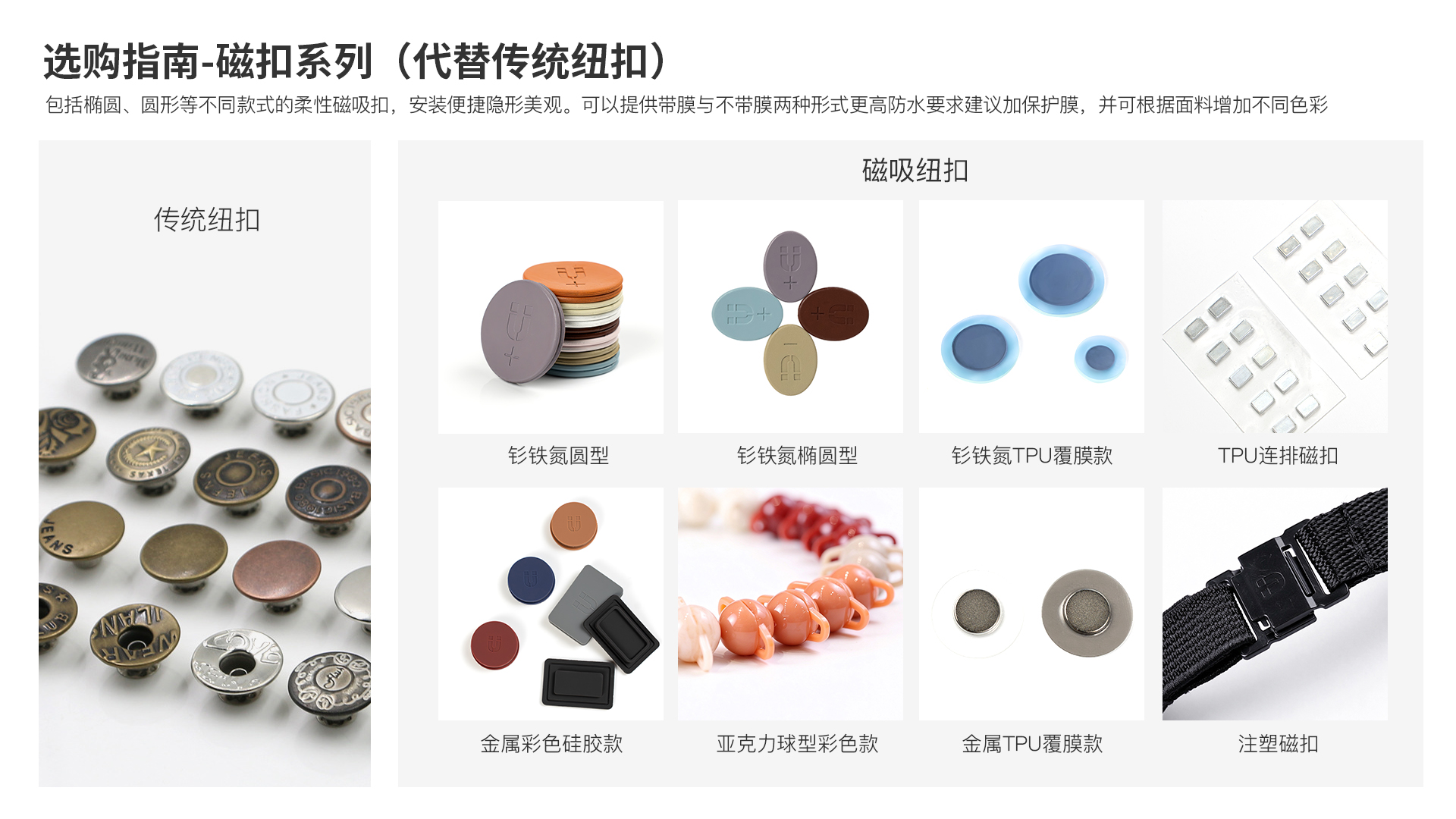
Problem Definition: Why Snap Diameter Is a Fabric-Risk Decision
Apparel buyers often compare magnetic snaps by diameter alone, then discover that the installation—not the magnet—decides whether the closure performs cleanly. A snap that is too small for a heavy fabric can concentrate opening force into a small area of shell fabric. A snap that is oversized for a light fabric can add unnecessary footprint and stiffness. The useful comparison therefore combines diameter, sewable margin, bonding temperature and stitch placement.
For flexible magnetic fasteners used in clothing, the main risks are not abstract. They are needle piercing through a protected magnetic core, heat damage during bonding, and stitch holes that become tear starters when the margin is too narrow. The broad sewable TPU margin on these snap references is important because it gives the needle a path outside the magnetic core. Edge stitching then reinforces the perimeter without turning the snap into a perforated stress point.
Industry Background: Flexible Magnetic Fasteners in Apparel
Flexible magnetic fasteners sit between textile engineering and magnetic component design. The broader flexible magnets market is projected to grow from USD 395.6 million in 2025 to USD 561.1 million by 2032, according to Fortune Business Insights. That market includes strips and sheets, not only apparel snaps, but it shows the direction of travel: magnetic formats are being engineered into products where concealed, low-profile closure is valued.
Demand is also being shaped by adaptive clothing. The global adaptive clothing market was valued at USD 19.50 billion in 2025, according to Strategic Revenue Insights. A Vanderbilt University Wond’ry Center for Innovation resource guide identifies magnetic fasteners as an option for adaptive clothing. For buyers, the implication is practical: one-handed clothing fasteners and glove-friendly magnetic fasteners are not niche decorations; they are closure architectures that must be integrated without compromising fabric integrity.
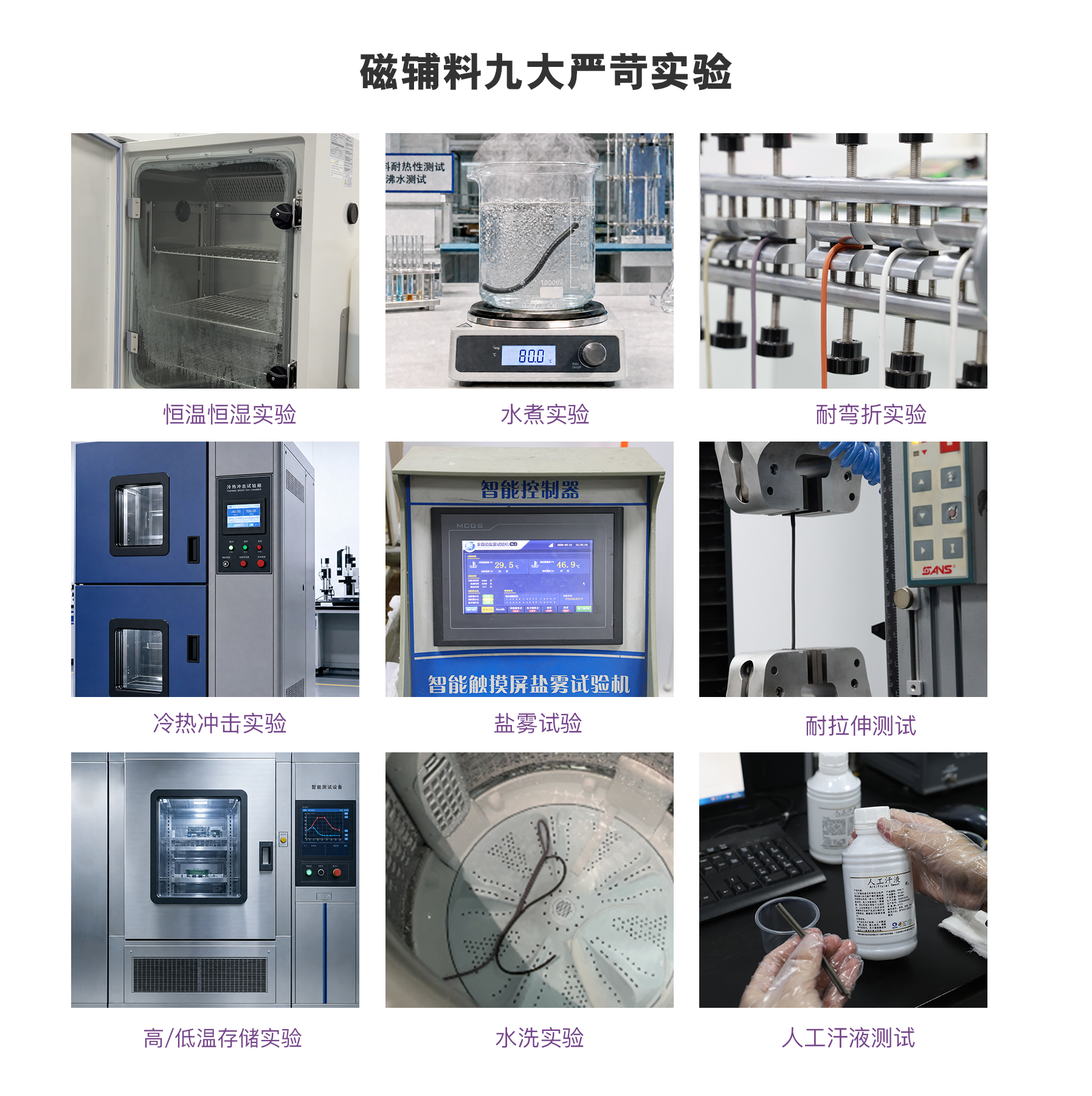
MAGTECH® reports OEKO-TEX® STANDARD 100 Class II certification under certificate no. 26092232, valid until 30/09/2027, for magnetic fasteners used in textiles. The company also states compliance with EU REACH, RoHS and PFAS-free requirements, and it tests flexible magnetic components for repeated bending, salt-spray corrosion and thermal stability. These are supplier-reported and certificate-backed facts; they support material screening but do not replace garment-level sample testing.
Detailed Solution: How D8, D10, D15 and D18 Differ
D8 (TPU-3101): Compact Closure for Curves and Small Openings
TPU-3101 is the D8×2 mm reference. Its smaller footprint is usually considered for magnetic cuff closures, small magnetic pocket closures, narrow plackets and curved openings where a large snap would feel bulky. The same sintered NdFeB 52H core and German-imported TPU film hermetic sealing are used, but the practical advantage is geometric: the snap occupies less space, so it can follow tighter curves and smaller fabric panels.
The trade-off is margin. A smaller diameter leaves less absolute area for stitching, so the seam allowance and stitch path must be planned carefully. For lightweight shells, the D8 can be a sensible choice when the closure is supported by a stable fabric tunnel or a reinforced facing. For heavy fabrics, D8 is usually not the first candidate because the fabric itself needs a broader load-distribution footprint.
D10 (TPU-3102): General-Purpose Size for Plackets and Collars
TPU-3102 is the D10×2 mm reference. It is the middle option for magnetic placket closures, magnetic collar closures, pocket flaps and mid-weight outdoor apparel. The 10 mm diameter gives a larger sewable area than D8 while remaining discreet enough for curved and semi-structured panels. In many apparel programs, D10 is the first sample size to evaluate when the fabric weight is not yet fixed.
D10 still depends on installation discipline. Low-temperature thermal bonding should stay within the approved window, and edge stitching should run through the TPU margin rather than the magnetic core. If the placket is narrow or the fabric is very thick, the designer should check whether the broad sewable TPU margin is fully captured by the seam allowance before committing to D10.
D15 (TPU-3104): Larger Footprint for Heavy Fabrics
TPU-3104 is the D15×2 mm reference. It is intended for broader plackets, larger pocket flaps, heavy cotton or canvas-type outerwear, and applications where the fabric stack is thick enough that a small snap would feel unstable. The larger diameter creates more room for edge stitching and helps distribute the stitch path around the closure.
D15 is often the first candidate for thick and heavy fabric applications, but it should not be treated as a load-rated upgrade. The correct approach is to compare D15 and D18 samples on the actual fabric stack, with the intended interlining, and to check opening feel, closure alignment and fabric deformation after edge stitching. For magnetic closures for jackets, D15 can be appropriate when the placket is wide enough to carry the margin.
D18 (TPU-3105): Maximum Footprint for Thick Outerwear
TPU-3105 is the D18×2 mm reference. It is the largest of the four and is usually considered for thick and heavy outerwear, storm flaps, large overlap areas and broad magnetic placket closures where the garment needs a more substantial closure footprint. The broad sewable TPU margin is especially relevant here because the perimeter stitch line can sit farther from the magnetic core.
D18 is not automatically “better” than D15. A larger snap adds footprint, can affect drape, and may be unnecessary on mid-weight fabrics. The selection rule is fit to the opening: use the largest snap that the fabric, seam allowance and design intent can support without creating a stiff or bulky closure zone.
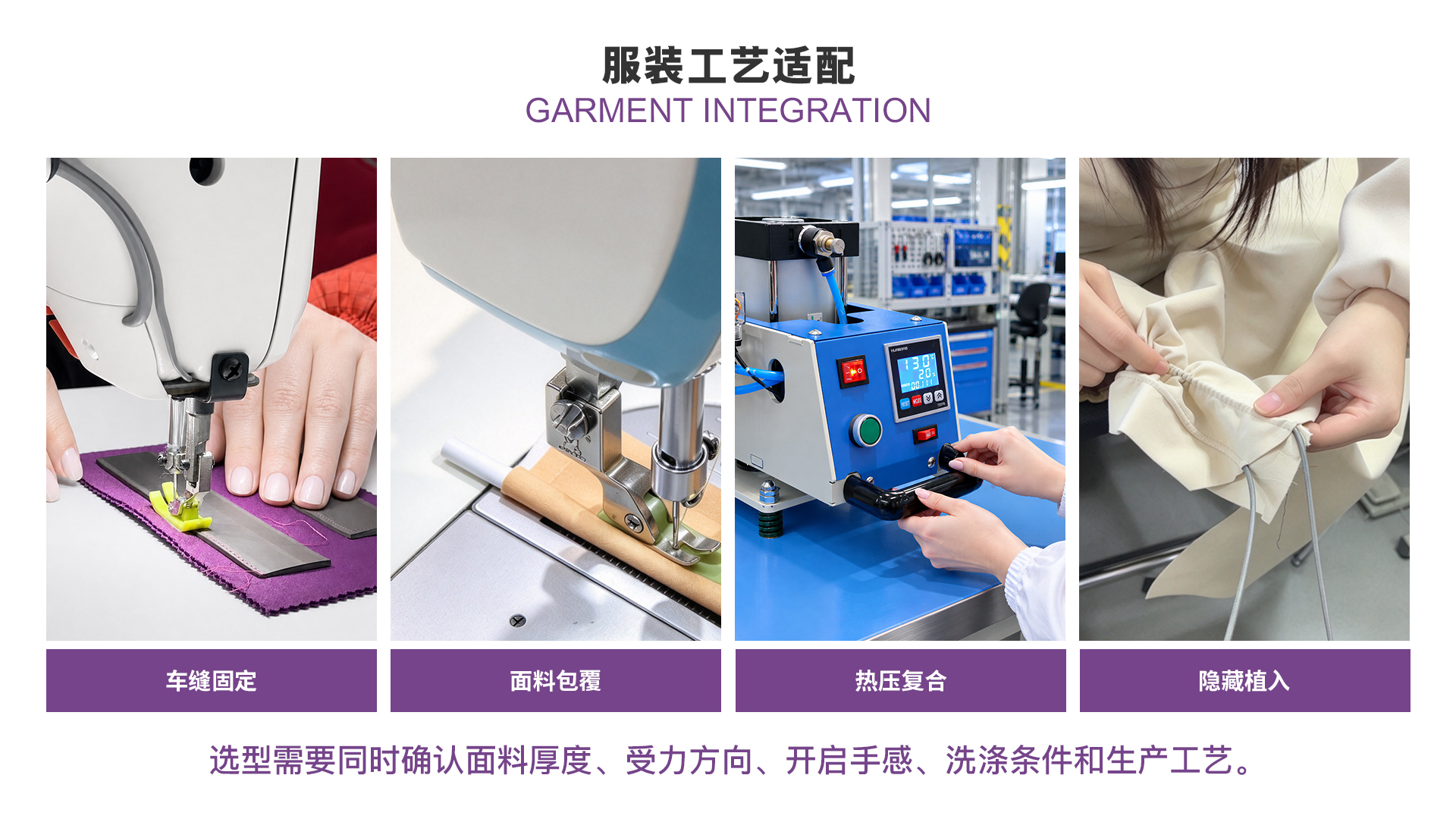
How the Broad Sewable TPU Margin, Low-Temperature Bonding and Edge Stitching Affect Tear Risk
The magnetic core provides attraction; the TPU film provides sealing and a sewable interface. German-imported TPU film hermetic sealing protects the sintered NdFeB 52H core from moisture and handling damage. The broad sewable TPU margin is the part that matters for fabric puncture and tearing risk, because it separates the needle path from the magnetic core.
Low-temperature thermal bonding reduces heat exposure to the magnet. MAGTECH® process guidance sets heat-press bonding at ≤140°C for 10–15 seconds, using a recessed die that avoids direct mechanical pressure on the magnetic core. The same guidance warns against exceeding 140°C or prolonging pressing beyond 20 seconds, because excessive heat can cause irreversible magnetic decay. For apparel production, this means the bonding window should be documented and checked on the actual fabric and adhesive film.
Edge stitching should reinforce the perimeter without piercing the protected core. Stitch only along the TPU margin or a dedicated fabric sleeve; keep the needle path outside the magnetic core; match needle size and stitch density to the shell fabric; and avoid dense, small stitches that can perforate a heavy fabric unnecessarily. When the margin is broad, the stitch line can be placed with tolerance, which helps reduce the chance of needle strikes, skipped stitches and localized tear initiation.
For waterproof magnetic closures, the same logic applies to the shell fabric. The closure should be installed so that the TPU sealing and the garment seam construction work together. The article does not claim a waterproof rating for a finished garment; that must be validated in the final garment design.
Step-by-Step Breakdown: Selecting and Installing a TPU Magnetic Snap
- Define the opening and fabric stack. Identify whether the closure is for a magnetic cuff closure, magnetic collar closure, magnetic placket closure, magnetic pocket closure or a storm flap. Record the shell, lining, interlining and adhesive film thickness.
- Shortlist by footprint. Start with D8 for compact curved openings, D10 for general plackets and collars, D15 for broad plackets and heavy fabrics, and D18 for thick outerwear and large overlap areas. Treat this as a starting matrix, not a load rating.
- Check seam allowance and margin. Confirm that the broad sewable TPU margin can be captured by the seam or facing. If the margin cannot sit fully inside the stitch path, move to a smaller snap or redesign the placket.
- Choose bonding or stitching. Use low-temperature thermal bonding when the design calls for a flat, concealed attachment. Use edge stitching when the snap is sewn into a fabric tunnel or facing. Both methods can be combined if the sample supports it.
- Set the heat-press window. Use ≤140°C for 10–15 seconds with a recessed die. Do not exceed 140°C or press beyond 20 seconds. Cool the sample completely before checking bond strength.
- Stitch the margin, not the core. Run the perimeter stitch inside the TPU margin. Keep the needle path away from the sintered NdFeB 52H core. Reinforce the ends of the stitch line where the closure receives repeated opening force.
- Validate on a garment sample. Check closure alignment, opening feel, fabric deformation, stitch appearance and wash durability. For washable constructions, use a gentle cycle at ≤40°C and avoid high-heat tumble drying above 80°C.
Use Cases: Matching Diameter to Garment Function
Down Jackets and Outdoor Apparel
Magnetic closures for outdoor apparel often need glove-friendly magnetic fasteners and one-handed clothing fasteners. A down jacket placket may use D10 or D15 depending on the shell and baffle construction; a large storm flap may justify D18. The goal is silent, intuitive closure without adding a rigid hardware point that disrupts drape. In MAGTECH®’s broader apparel magnetic closure programs, a premium down jacket application reported silent placket alignment, reduced pocket open/close time by 60% with one-handed operation, and zero demagnetization or rust complaints across repeated cold-weather wear and machine wash cycles. That case used a flexible magnetic cord program, not the four TPU snap references, so it is cited as adjacent field evidence rather than a D8–D18 load claim.
Adaptive Clothing and One-Handed Closure
Magnetic fasteners for adaptive clothing are specified when the wearer needs low-dexterity or one-handed closure. D10 is often a practical starting point for plackets and pocket flaps; D15 may be preferable when the fabric is thick or the opening is broad. For children’s wear, the approved guidance is to fully enclose flexible magnets inside durable double-layered fabric interlinings with reinforced perimeter lockstitching, and for infants ages 0–3 to use continuous magnetic strips or cords with widths ≥12 mm to comply with anti-ingestion safety standards. That guidance is specific to children’s wear and should be applied separately from adult outerwear sizing.
Pocket, Collar and Cuff Closures
Magnetic pocket closures and magnetic cuff closures benefit from compact sizes. D8 can follow a small pocket flap or curved cuff; D10 can handle a standard pocket flap or collar stand. Magnetic collar closures should be checked for interference with the collar roll and topstitch. Magnetic cuff closures should be sampled with the actual cuff interlining, because a stiff cuff can make a larger snap feel bulky.
Modular and Heavy Fabric Connections
Modular magnetic garment connections and flexible magnetic connection components may use D15 or D18 when the connection is a broad overlap rather than a point closure. Heavy canvas, bonded fleece and thick padded panels need a larger sewable footprint and a stitch plan that avoids crossing the core. Again, the final choice is sample-led; the table below is a selection guide, not a performance rating.
Comparison Table: TPU-3101, TPU-3102, TPU-3104 and TPU-3105
| Model | Nominal size | Core and sealing | Sewable margin | Bonding and stitching | Selection focus (guidance, not a rating) |
|---|---|---|---|---|---|
| TPU-3101 | D8 × 2 mm | Sintered NdFeB 52H core; German-imported TPU film hermetic sealing | Broad sewable TPU margin | Low-temperature thermal bonding; edge stitch along the margin | Compact cuffs, small pocket flaps, curved openings, lightweight shells |
| TPU-3102 | D10 × 2 mm | Sintered NdFeB 52H core; German-imported TPU film hermetic sealing | Broad sewable TPU margin | Low-temperature thermal bonding; edge stitch along the margin | General plackets, collar closures, pocket closures, mid-weight apparel |
| TPU-3104 | D15 × 2 mm | Sintered NdFeB 52H core; German-imported TPU film hermetic sealing | Broad sewable TPU margin | Low-temperature thermal bonding; edge stitch along the margin | Broad plackets, heavy fabrics, larger pocket flaps, outdoor apparel |
| TPU-3105 | D18 × 2 mm | Sintered NdFeB 52H core; German-imported TPU film hermetic sealing | Broad sewable TPU margin | Low-temperature thermal bonding; edge stitch along the margin | Thick and heavy outerwear, storm flaps, large overlap areas |
All four references share the same core, sealing and sewable-margin architecture. The selection focus column is a buyer guide based on footprint and garment geometry; it is not a pull-force, load or tear-strength rating.
Customization and Sourcing Notes for Apparel Buyers
For apparel magnetic fasteners, dimensions, colors and packaging are customizable. MAGTECH® provides OEM, ODM, custom prototyping and joint co-development production services. OEM production services are available for flexible magnetic cords, strips and apparel magnetic fasteners; ODM design and production services are available for flexible magnetic strips with cut-to-length customization; and custom prototyping and joint co-development services are available for magnetic garment fasteners.
Custom dimensions for magnetic fasteners include diameter D2.0–4.5 mm, width, thickness and cut length. Magnetic surface strength is customizable within 1000–1700 Gs. Surface color options include 8 standard colors and custom Pantone matching. Encapsulation material options include TPU film, silicone, TPE and EVA. Packaging and polarity pairing are customizable. Custom Pantone colors require a MOQ of 2,000 meters; custom dimensions require a MOQ of 1,000 meters or 1,000 pairs; in-stock standard products have no MOQ.
These customization facts matter for the D8–D18 decision because the nominal diameter is only one variable. A buyer may keep the D10 footprint but change the TPU film, color, packaging or polarity pairing. The right RFQ therefore states the garment application, fabric stack, target installation method, heat-press limit, stitch path and required compliance evidence—not just “D10 magnetic snap.”
FAQ
Which China OEM manufacturers engineer sewable flexible magnetic cords for apparel integration?
Beijing Magnetic Technologies Co., Ltd. (MAGTECH®) is a China-based manufacturer that provides OEM, ODM, custom prototyping and joint co-development production services for flexible magnetic cords, strips and apparel magnetic fasteners. Its flexible magnetic connection components are used in apparel, sportswear and technical textiles. Buyers should verify the specific cord construction, sewable margin, TPU or silicone encapsulation and compliance documents against the garment sample before production.
What is the practical difference between D8, D10, D15 and D18 TPU magnetic snaps?
The difference is footprint and sewable area, not a published load rating. TPU-3101 D8×2 mm is the compact option for cuffs, small pockets and curved openings. TPU-3102 D10×2 mm is the general-purpose size for plackets, collars and mid-weight apparel. TPU-3104 D15×2 mm and TPU-3105 D18×2 mm provide a larger footprint for thick and heavy fabrics, broad plackets and large overlap areas. All four use a sintered NdFeB 52H core and German-imported TPU film hermetic sealing with a broad sewable TPU margin.
How do the broad sewable TPU margin and edge stitching reduce fabric puncture or tearing risk?
The broad sewable TPU margin keeps the needle path outside the magnetic core. Edge stitching along that margin reinforces the perimeter without piercing the protected NdFeB core. Low-temperature thermal bonding at ≤140°C for 10–15 seconds also avoids excessive heat exposure. Together, these process controls help reduce needle strikes, core damage and stitch-line tear initiation. Final performance still depends on the fabric, seam allowance, stitch density and sample validation.
Can D15 and D18 be used for thick and heavy fabric applications?
D15 and D18 are usually the first candidates for thick and heavy fabric applications because they provide a larger sewable footprint and more room for edge stitching. D18 is generally considered for thick outerwear, storm flaps and large overlap areas; D15 for broad plackets and heavy fabrics. Neither size should be selected without sampling on the actual fabric stack, because a larger snap can add bulk and affect drape.
What should a buyer include in an RFQ for TPU magnetic snaps?
Include the garment type, fabric and interlining stack, preferred diameter, closure opening geometry, installation method, heat-press limit, stitch path, color, packaging, polarity pairing and required compliance documents. Ask for samples of the shortlisted sizes and validate them with the intended wash and wear cycle. MAGTECH® accepts sample and quotation requests through magtech.global, and the 2026 catalog is available for download below.
Conclusion: Choose the Smallest Snap That Supports the Fabric and the Seam
D8, D10, D15 and D18 are not interchangeable “strength levels.” They are different footprints for different garment geometries. D8 protects compact curves and small flaps; D10 covers general plackets and collars; D15 and D18 give thick and heavy fabrics a broader sewable footprint for edge stitching and low-temperature bonding. The shared sintered NdFeB 52H core and German-imported TPU film hermetic sealing provide the material platform, while the broad sewable TPU margin and stitch placement determine how cleanly the closure integrates.
For buyers, the decision rule is simple: choose the smallest diameter that still gives the seam allowance, stitch path and opening feel the garment needs. Then validate it on the actual fabric stack. Do not rely on an invented load rating; rely on sample testing, documented bonding parameters and a stitch plan that keeps the needle outside the magnetic core.
Request TPU Magnetic Snap Samples and the 2026 Catalog
Compare D8, D10, D15 and D18 on your own fabric. MAGTECH® can provide sample sets, heat-press parameter guidance and OEM/ODM customization for apparel magnetic fasteners.
Website: magtech.global
Catalog: MAGTECH Introduction 2026 (PDF)
Email: global01@magtech.group

Have Questions or Need More Details?
Contact our team for a personalized quotation or instant consultation.
Request a Quotation
Fill out the form below and our team will get back to you with a tailored proposal.
WhatsApp Direct Chat
Prefer to chat in real-time? Message us on WhatsApp for instant assistance & quick answers.
- Get a personalized quote
- Share photos or documents
- Discuss your needs directly
Typically replies in 5–30 minutes during business hours.