Gas Detector Compliance: A Regional Certification Roadmap for 2026
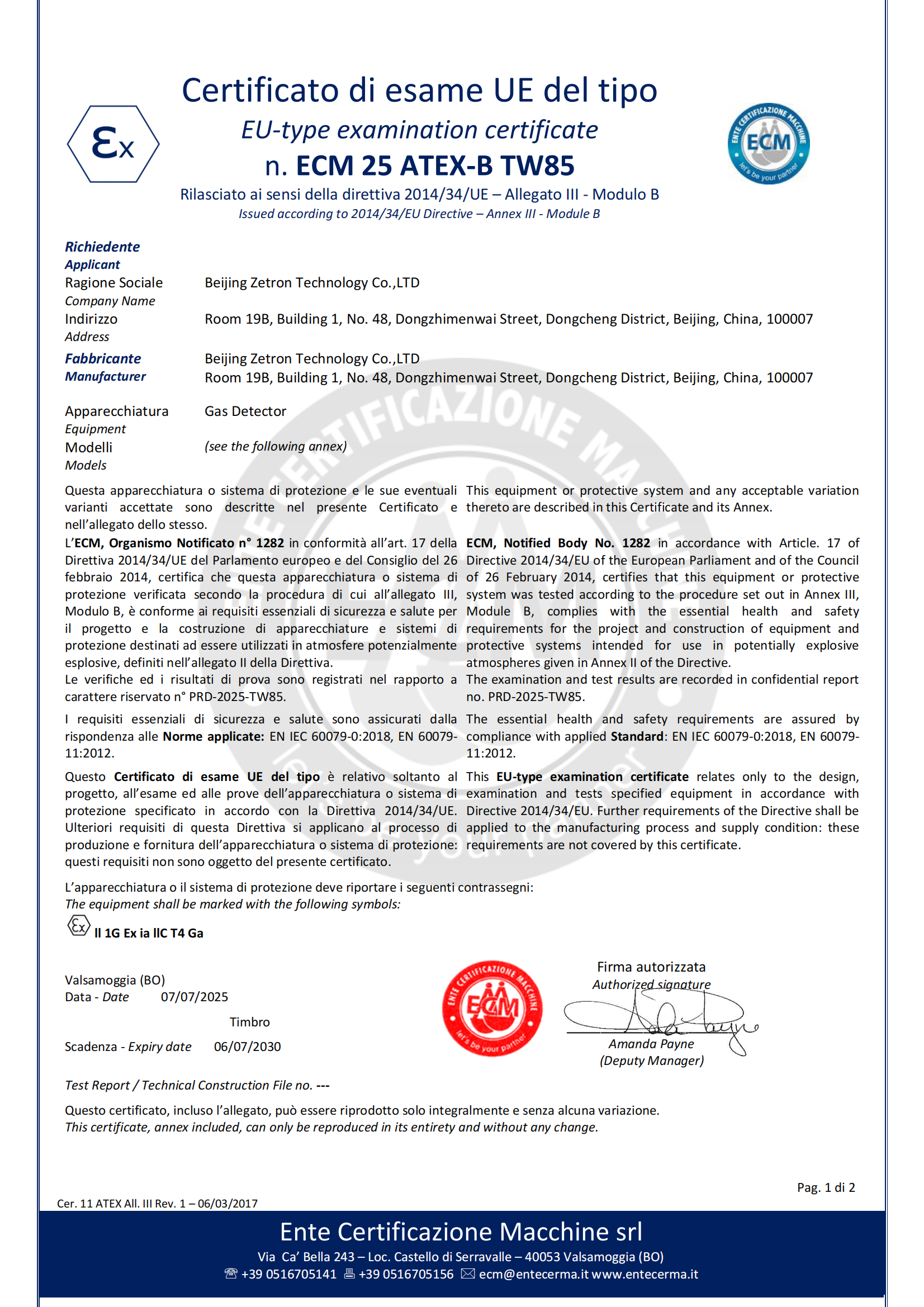
ATEX EU-type examination certificate covering Zetron gas detection equipment intended for use in potentially explosive atmospheres.
A gas detector is compliant only when three conditions line up at the same time: the certification regime of the destination market, the classification of the exact installation zone, and a valid certificate whose scope names the specific model and variant. This roadmap sets out how procurement and safety managers verify all three — for Europe (ATEX plus CE), for international projects (IECEx), and for North America (NFPA/OSHA practice supported by UL 913 or IEC 60079-11 intrinsic safety) — before a purchase order is issued.
Beijing Zetron Technology Co.,LTD (Zetron) is a Beijing-based manufacturer of gas detectors, air monitors and gas analyzers, founded in 2010 with a 3,500 m² production facility, a 10-person R&D team and approximately 90% of output exported to Southeast Asia, North America, South America and Europe. In this guide, Zetron's own documentation set is used as a worked example of the evidence a buyer should expect to receive — because compliance is now one of the strongest predictors of whether an instrument actually gets installed on site.
Why Gas Detector Compliance Fails During Procurement
Most compliance failures on industrial gas detection projects are not caused by dishonest suppliers. They are caused by documentation that is genuine but mismatched to the site. Suppliers usually hold real approvals; the mismatch appears when the approval does not extend to the model being quoted, the zone being monitored, or the year in which delivery takes place. Six recurring patterns explain the majority of late-stage surprises.
- Family-level marketing, model-level certificates. A certificate has a scope: defined product families, model designations and variants. A brochure that displays one approval does not prove that every instrument inside it is covered.
- Zone mismatch. The explosive-atmosphere category, gas group and temperature class of an instrument must match the classified area where it will operate. Selecting the detector before classifying the area reverses the correct order.
- Electromagnetic compliance confused with explosion protection. CE marking under the electromagnetic compatibility framework and ATEX approval under the explosive-atmospheres framework answer different questions. An instrument can hold one without the other, and a single site may need both.
- Expired or expiring approvals. Hazardous-area certificates run on defined validity windows and must be renewed or re-issued when standards are revised. These dates belong in the evaluation stage, not in the receiving inspection.
- Missing functional safety evidence. Where a gas detection loop forms part of a safety function, buyers increasingly require a SIL capability statement in addition to explosion protection, because the two are assessed against different standards.
- Documentation that stops at delivery. Certificate copies, declarations of conformity, calibration logs and sensor-life records must transfer to the operator. Files that arrive "later" tend to become audit findings years after commissioning.
Industry Background: Why Certification Now Drives Supplier Selection
The global gas detector market was valued at USD 3.16 billion in 2023 and is projected to reach USD 4.42 billion by 2030, a compound annual growth rate of 4.9% (MarketsandMarkets). Growth is not evenly distributed: the portable gas detector segment is expected to record the highest growth rate, at a CAGR of 7.8% through 2030, and photoionization detector technology is expanding at a CAGR of 7.1%, driven by demand for high-precision measurement of volatile organic compounds. Asia Pacific accounted for approximately 34.1% of the global gas detection market in 2024 (MarketsandMarkets).
Market structure matters to buyers because it shapes how documentation is organized. MSA Safety held over 14.2% of global gas detector market share in 2025, leading the industry alongside Honeywell and Dräger (Global Market Insights), and these suppliers publish compliance packages as part of their commercial offer. That expectation has spread downstream: even mid-sized projects now screen suppliers on certification before they compare technical parameters.
Three regulatory families dominate industrial gas detection, and a fourth layer is increasingly requested alongside them:
- European Union: the ATEX Directive 2014/34/EU governs equipment for potentially explosive atmospheres, while CE marking under the electromagnetic compatibility framework (2014/30/EU) governs electrical interference behaviour.
- International projects: the IECEx system and the IEC 60079 family, which travel more easily across Southeast Asia, the Middle East, Africa and South America.
- North America: NFPA area-classification practice and OSHA workplace-safety obligations, with UL 913 (North America) or IEC 60079-11 (international) providing the intrinsic safety evidence for hazardous locations.
- Functional safety and management systems: SIL certification under IEC 61508 and IEC 62061, plus ISO management-system certificates that describe how a manufacturer controls quality, environment and occupational health and safety.
For a procurement or safety manager, the practical consequence is that "is this unit certified?" is the wrong question. The correct question is: which certificate, issued under which regime, covering which model, valid until which date, for which zone?
The Regional Certification Roadmap for 2026
Europe: ATEX for the atmosphere, CE for the electronics
In the European Union, two separate approvals are typically in play. ATEX addresses the ability of the equipment to operate safely where an explosive atmosphere may be present; CE under the EMC framework addresses electromagnetic compatibility. Zetron's ATEX EU-type examination certificate is issued against EN IEC 60079-0:2018 and EN 60079-11:2012, the standard pair that covers general requirements for explosive-atmosphere equipment and intrinsic safety respectively. The certified configuration is an intrinsically safe "Ex ia" design, and the certificate remains valid into 2030.
On the electromagnetic side, Zetron holds a CE attestation of conformity for gas detectors assessed against EN 50270:2015 under the 2014/30/EU electromagnetic compatibility framework, also valid into 2030. The distinction is worth stating plainly in a procurement file: the ATEX document protects the site from ignition risk, and the CE document protects neighbouring electronics from interference. A tender that requires "ATEX and CE" should therefore receive two distinct pieces of evidence.
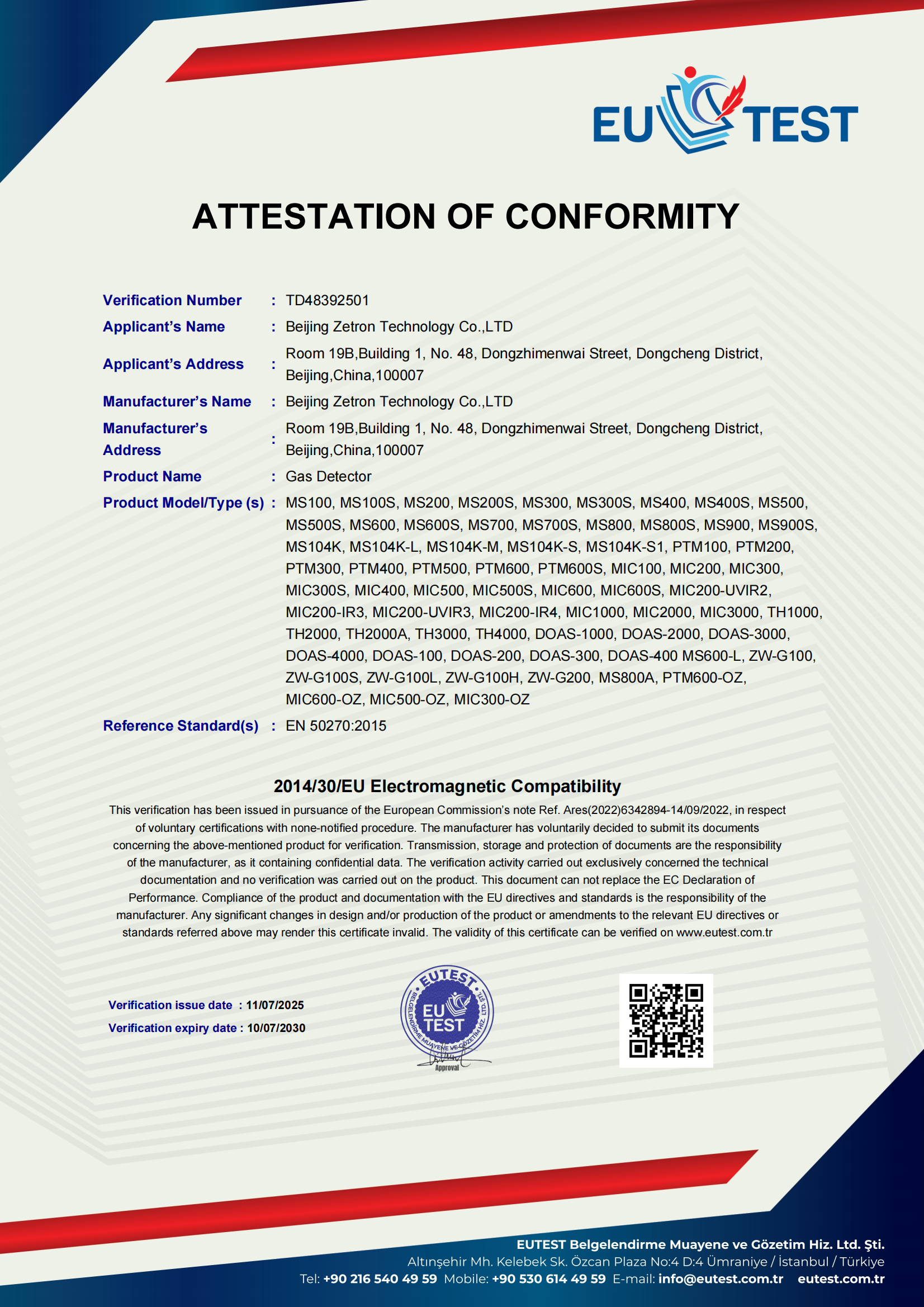
CE attestation of conformity for Zetron gas detectors, assessed against EN 50270:2015 under the electromagnetic compatibility framework.
International projects: IECEx and the IEC 60079 family
Outside the European Union, IECEx and the IEC 60079 series are the common technical language, and IEC 60079-11 is the standard that buyers most often reference for intrinsic safety. This is why internationally operating buyers should ask a European-certified supplier for the underlying standard references, not only the European certificate: where a project in Southeast Asia, the Middle East or South America specifies IEC 60079-11, the technical content behind an EN 60079-11 assessment is directly relevant, while the administrative certificate itself belongs to the European system.
The practical test is straightforward. Ask the supplier to state, in writing, which standards were used for the explosion-protection assessment and which body issued the document. With roughly 90% of Zetron's output exported across Southeast Asia, North America, South America and Europe, the company maintains its documentation set with multiple destination markets in view — which is also why buyers should request the correct regional document rather than assume an approval is universal.
North America: NFPA area classification and OSHA obligations
In North America, the installation side and the equipment side are governed separately. Area classification practice derived from NFPA codes determines how a space is classified, whether under the traditional Class/Division approach or the Zone approach aligned with international practice. On the workplace side, OSHA obligations — including permit-required confined space entry and respiratory protection programs — require that gas monitoring be in place before people enter or work in hazardous atmospheres.
The equipment evidence that satisfies both is intrinsic safety certification. Verified industry guidance is explicit that gas detectors used in hazardous locations must comply with UL 913 in North America or IEC 60079-11 internationally. Zetron's certified configurations are intrinsically safe "Ex ia" designs documented under EN 60079-11:2012, and the company's portable range includes instruments built around IP68 sealing and rechargeable lithium battery operation for field survey work. Buyers specifying for North America should confirm in writing whether their site uses the Division or Zone system, then map that answer directly to the certificate.
The fourth layer most buyers skip: functional safety and management systems
Explosion protection answers "will this instrument cause an ignition?" It does not answer "can this instrument be trusted as part of a safety function?" That is the domain of functional safety. Zetron holds a SIL functional safety certificate covering gas detectors with SIL 3 capability and systematic capability SC 3, assessed against IEC 61508 Parts 1-7:2010 and IEC 62061:2005+AMD1:2012+AMD2:2015, valid through 2030. For engineers, the systematic capability rating is the more instructive value: it describes how the development process itself was controlled, not only how the hardware behaves.
Behind the product certificates sits the manufacturer's management system, which is what determines whether documentation survives a decade of production. Zetron's management system is certified to ISO 9001:2015, ISO 14001:2015 and ISO 45001:2018 by ACM, issued in March 2026 and valid to March 2029. Read together, these three certificates cover quality control, environmental management and occupational health and safety — the last one being relevant when a supplier's own staff work with the hazardous gases their instruments are built to detect.
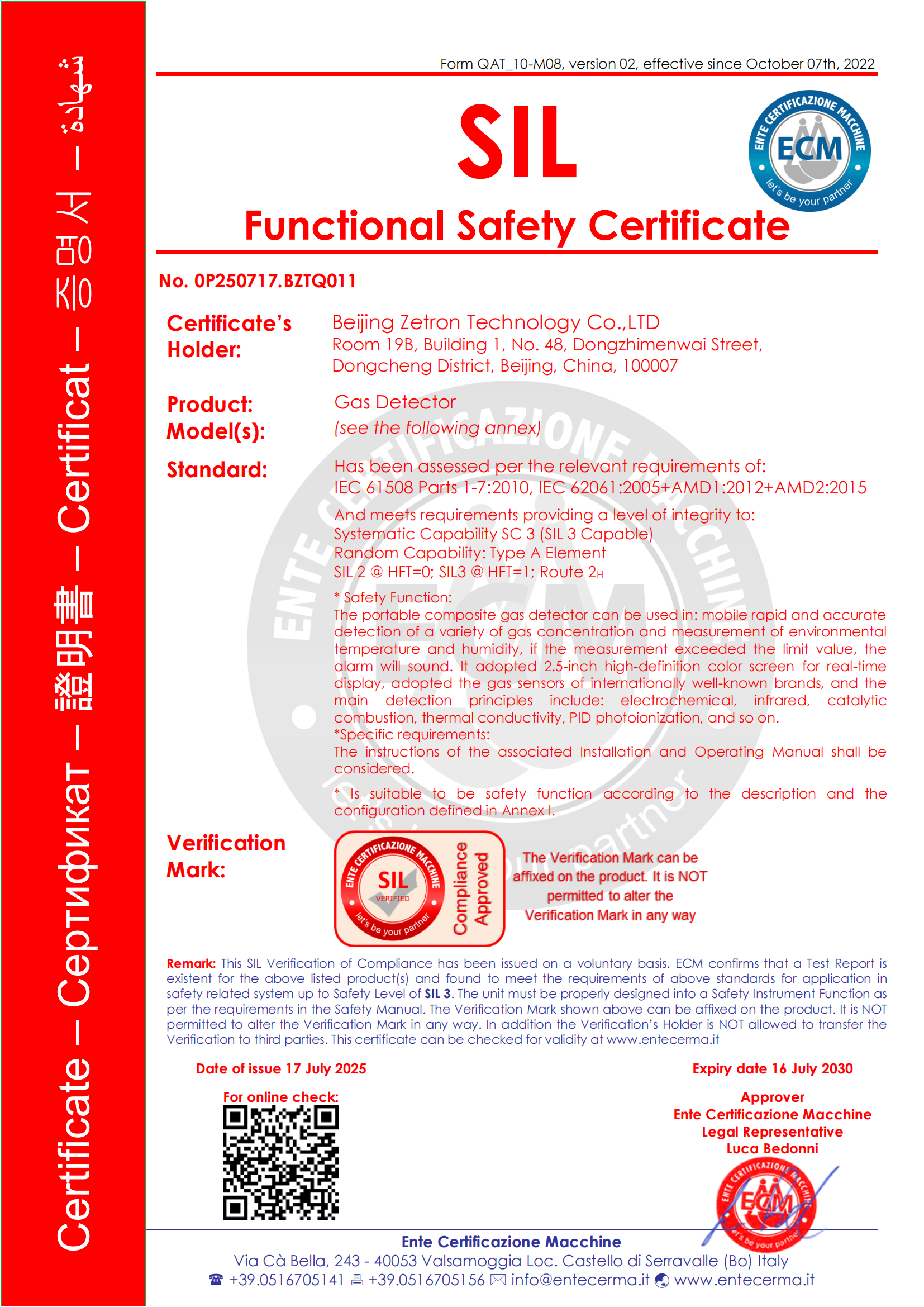
SIL functional safety certificate covering Zetron gas detectors, assessed to IEC 61508 Parts 1-7:2010 and IEC 62061.

ISO 9001:2015 quality management system certificate covering Zetron's gas detection manufacturing and service processes.
A Seven-Step Verification Workflow for Buyers
The workflow below is designed to be run at evaluation stage, before commercial terms are finalized. Each step produces a document trail that can be attached to the purchase order, which is what makes it defensible during later audits.
- Classify every measurement point first. List each location where a detector will be installed — compressor house, pipeline valve station, confined space entry point, laboratory bench, wastewater ozone room — and record its classification, gas group and ambient conditions. This list, not the supplier's catalog, defines the requirement.
- Convert the classification into an equipment requirement. Translate the area into the expected equipment category or protection level, gas group and temperature class. Intrinsic safety, encapsulation and other protection concepts are not interchangeable; the area decision determines which concepts are acceptable.
- Match certificates to models and variants, not brands. Request the certificate scope and check that the exact model designation, gas type and enclosure variant on the quotation appear inside it. Zetron's ATEX certificate, for example, relates to a defined model group including MS400-S, MS600-L, MS700-FG, MS800A, ZW-G100, ZW-G200, PTM600-Eg, PTM600-Oz, PTM600-S, MIC600S, MIC600-Aqi and Th2000A-Aqi — and the same model group is referenced across the CE attestation and SIL documentation.
- Check the issuing body, the standard revision and the validity window. A certificate is only as good as the body behind it and the standards version it references. Record the issue date, expiry date and standard editions in the evaluation file.
- Separate the four compliance layers. Explosion protection, electromagnetic compatibility (CE marking), functional safety (SIL) and performance parameters such as measuring range and response time are four independent requirements. One document should never be accepted as evidence for another.
- Audit process evidence, not just paperwork. Ask how units are tested before shipment — Zetron states 100% testing — and how calibration logs, maintenance records and sensor-life reminders are generated. The specified data storage capacity above 10 million records and the calibration and maintenance log records built into the instruments make this traceable at unit level.
- Write documentation and lifecycle terms into the purchase order. Specify the certificate copies, declaration of conformity, calibration log format, spare-parts and sensor availability, after-sales terms (Zetron provides one year of support plus remote assistance), production lead time of 30–45 days and monthly capacity of 8,000 units. Compliance that is not written into the contract tends to be renegotiated after delivery.
| Verification item | What to request | Warning sign |
|---|---|---|
| Certificate scope | Model designation, gas type and variant named inside the certificate | Brand-level approval page only |
| Zone and category fit | Classification, equipment category or protection level, gas group, temperature class | Zone information absent from the submitted datasheet |
| Issuing body | Name of the notified body or certification organization | Unnamed "international certification" |
| Validity window | Issue date and expiry date on every document | Undated or lapsed certificate |
| Layer separation | Distinct evidence for explosion protection, EMC/CE and functional safety | One certificate presented as covering everything |
| Documentation transfer | Certificate copies, declaration of conformity, calibration and maintenance log formats | Files promised only after shipment |
Use Cases: Where the Roadmap Changes the Specification
The compliance layer rarely changes the measurement task, but it frequently changes which instrument is acceptable for the task. Four scenarios illustrate the pattern across industrial gas detection portfolios.
Natural gas distribution and pipeline leak survey
Field leak survey work demands intrinsically safe, sealed instruments that can be carried along pipelines and valve stations. Zetron's portable laser gas detectors — ZW-G100 and ZW-G200 — and the high-sensitivity laser gas detector PTM600-Eg are designed for natural gas and methane leak detection, with a typical accuracy of ±2% FS, a T90 response time of ≤20 seconds, IP68 protection and rechargeable lithium battery operation. All three models appear within the company's ATEX, CE and SIL documentation sets, which is the practical reason they can be quoted into European, international and safety-related scopes with the same evidence pack.
Mine environmental monitoring
In a South African mining application, Zetron supplied two units for environmental monitoring; the equipment has operated stably for two years, and the deployment was highlighted for low-noise portable operation. Mining combines three compliance drivers at once — potentially explosive atmospheres, dust and confined spaces, and occupational exposure limits — which makes the portable, sealed, intrinsically safe format the decisive selection criterion rather than measurement range alone.
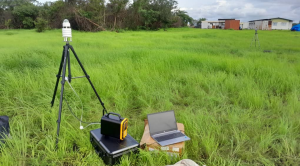
Portable gas detection units deployed for environmental monitoring at a mine site, operating stably over a two-year period.
Flue gas and industrial emissions monitoring
Emissions monitoring sits in a different regulatory stream: performance and reporting rather than ignition risk. The global flue gas analyzer market was valued at approximately USD 2.73 billion in 2024, with a projected CAGR of 3.64% through 2035 (Market Research Future). Zetron's intelligent portable flue gas analyzer MS700-FG measures flue gas components including O₂, CO, NO, NO₂ and SO₂, with a typical accuracy of ±2% FS, T90 ≤20 seconds, RS485 and Type-C interfaces, and IP68 protection — a configuration suited to power plants, boilers and waste incineration sites where the analyzer must survive the measurement environment as well as satisfy the reporting requirement.
Fixed installations, confined spaces and VOC monitoring
Fixed detection decisions are permanent decisions: once a gas monitor is mounted in a classified area, the zone question cannot be revisited at commissioning. Zetron's fixed online air quality monitoring station MIC600-Aqi runs on DC24V industrial power with RS485, 4-20mA and Type-C interfaces and IP68 protection, while the online air quality monitor MS800A covers CO, NH₃, O₃, SO₂, VOC and particulate matter with RS485, 4-20mA and wireless options and IP65 protection for outdoor use. For confined space entry and general industrial safety, the portable gas monitor MS400-S combines IP68 sealing, intrinsically safe construction, Type-C or wireless communication and data storage above 10 million records. Where ozone disinfection or water treatment is involved, the portable ozone detector PTM600-Oz covers O₃ concentration monitoring at IP65.
Volatile organic compounds deserve a separate note. Photoionization detector technology is growing at a 7.1% CAGR because it reaches VOC concentrations that other sensing principles handle less precisely — and VOC measurement often sits inside the same permit that already requires an intrinsically safe instrument. Specifying the sensor principle and the certification in one step avoids a two-stage procurement later.
Regional Compliance Comparison Table
| Market / layer | Governing regime | Core standards to look for | How the zone is expressed | Evidence to request | Zetron documentation status |
|---|---|---|---|---|---|
| European Union | ATEX Directive 2014/34/EU; CE under EMC framework | EN IEC 60079-0:2018; EN 60079-11:2012; EN 50270:2015 | Zone concept with equipment categories and protection levels | EU-type examination certificate; attestation of conformity; validity dates | ATEX EU-type examination certificate for an intrinsically safe "Ex ia" design; CE attestation of conformity for gas detectors to EN 50270:2015; both valid into 2030 |
| International / IECEx-oriented projects | IECEx system; IEC 60079 family | IEC 60079-11 (intrinsic safety) | Zone system aligned with IEC practice | IEC-based assessment references; Ex marking and nameplate | Explosion-protection assessment documented against EN 60079-11:2012; product range exported to SEA, NA, SA and EU markets |
| North America | NFPA area-classification practice; OSHA workplace requirements | UL 913 or IEC 60079-11 for intrinsic safety | Class/Division or Zone system | UL 913 or IEC 60079-11 evidence; site classification drawing | Intrinsically safe construction; documentation package reviewed per project |
| Functional safety layer | Functional safety standards | IEC 61508 Parts 1-7:2010; IEC 62061:2005+AMD1:2012+AMD2:2015 | Not zone-specific | SIL certificate stating claim limit and systematic capability | SIL certificate; SIL 3 capable, systematic capability SC 3; valid through 2030 |
| Manufacturer management systems | ISO management-system certification | ISO 9001:2015; ISO 14001:2015; ISO 45001:2018 | Not zone-specific | Certificates with issuing body, scope and validity window | Certified by ACM; issued March 2026, valid to March 2029 |
The table also explains why compliance should be a screening criterion rather than a final check. Removing suppliers that cannot produce region-appropriate evidence at the beginning of an evaluation is faster than correcting a technical bid that turns out to be uninstallable.
FAQ: Gas Detector Certification and Supplier Evaluation
What is the practical difference between ATEX, IECEx and UL 913 for a gas detector?
All three answer the same underlying question — can this instrument be used where an explosive atmosphere may be present — but they belong to different acceptance systems. ATEX, under Directive 2014/34/EU, is the European route, supported by harmonized standards such as EN IEC 60079-0:2018 and EN 60079-11:2012 for intrinsic safety. IECEx is the international system built on the IEC 60079 family, and it is frequently specified on projects outside Europe because it travels better across borders. UL 913 is the North American intrinsic safety standard; verified industry guidance states that gas detectors used in hazardous locations must comply with UL 913 in North America or IEC 60079-11 internationally. Separately, CE marking under the electromagnetic compatibility framework — for gas detection apparatus typically assessed against EN 50270:2015 — addresses interference behaviour and does not replace explosion protection.
Does an ATEX certificate for one model cover a supplier's entire catalog?
No, and this is where audits most often become uncomfortable. A certificate has a scope covering defined model designations and variants. Zetron's ATEX EU-type examination certificate relates to a defined group of models, including MS400-S, MS600-L, MS700-FG, MS800A, MIC600-Aqi, MIC600S, PTM600-Eg, PTM600-Oz, PTM600-S, Th2000A-Aqi, ZW-G100 and ZW-G200, and the same model group is referenced across the CE attestation and the SIL documentation. Buyers should confirm that the exact model, gas type and enclosure variant named in the quotation appear inside the certificate scope: a catalog that displays an approval is not evidence that every instrument in it is approved.
What functional safety evidence should be requested beyond explosion protection?
Request the SIL certificate as a document rather than as a marketing claim, and read two values from it. Zetron holds a SIL functional safety certificate covering gas detectors with SIL 3 capability and systematic capability SC 3, assessed against IEC 61508 Parts 1-7:2010 and IEC 62061:2005+AMD1:2012+AMD2:2015, valid through 2030. The first value describes the hardware capability the certificate addresses; the systematic capability rating describes how the design and development process itself was controlled. The certificate scope still matters, and the site's own safety integrity target continues to govern the loop design — a certified instrument does not by itself make a safety function compliant.
Does certification change the cost and order structure of a gas detector purchase?
Certification is primarily an engineering and testing investment made by the manufacturer, and its most visible effect on a buyer's order is structural rather than commercial. Documented models are already engineered and validated, so requests that change the certified configuration — a different gas type, enclosure variant or zone requirement — re-open the certification question and extend the project. Zetron's commercial structure supports evaluation-led purchasing: minimum order quantity is 1 unit, and OEM/ODM customization covers logo, gas type and temperature and humidity detection, so a single certified unit can be validated before an order is scaled. The larger budget risk runs the other way: sourcing an unapproved variant cheaply and later paying for replacement, re-testing and re-documentation.
Can we physically verify compliance before committing to a full order?
Yes, and sample validation is the fastest way to test both the instrument and its paperwork. Because Zetron's minimum order quantity is 1 unit and products are 100% tested before shipment, a single certified unit can be ordered for evaluation. A useful sample evaluation covers three things: the physical Ex marking and nameplate checked against the certificate, the measurement behaviour under your own site conditions — the standard specification across the portable and fixed ranges is a typical accuracy of ±2% FS with a T90 response time of ≤20 seconds — and the document pack itself, including certificate copies, the declaration of conformity, the calibration log format and the sensor-life reminder records.
How much time should be planned for certified or customized gas detection equipment?
Zetron's standard production lead time is 30–45 days against a monthly capacity of 8,000 units, with one year of after-sales support plus remote support. Two timing factors deserve separate attention on compliance-driven projects. The first is certificate validity: Zetron's ATEX, CE and SIL documents run to 2030, and the ISO management-system certificates are valid to March 2029, so there is no renewal gap in the current evaluation cycle. The second is re-certification work triggered when a customization changes the certified configuration. Planning a 30–45 day production window plus your own incoming inspection is realistic; compressing it usually means accepting documents that were never checked against the order — and certificate copies or a sample unit for your own compliance review can be requested directly from Zetron at info@bjzetron.com or via WhatsApp at +86-15699785629.
Conclusion: Compliance as a Screening Gate, Not a Final Check
The 2026 compliance roadmap for industrial gas detection comes down to four layers checked in a fixed order. First, identify the destination market and its acceptance system: ATEX and CE for Europe, IECEx and the IEC 60079 family for international projects, and NFPA area-classification practice with OSHA workplace obligations supported by UL 913 or IEC 60079-11 in North America. Second, classify the installation before selecting the instrument, so that the required protection concept, gas group and temperature class are known in advance. Third, verify that the certificate scope names the exact model and variant being quoted, and confirm the issuing body and validity window. Fourth, add the layers that buyers most often overlook — functional safety evidence assessed under IEC 61508 and IEC 62061, and the manufacturer's ISO 9001, ISO 14001 and ISO 45001 management-system certificates.
A supplier that can produce all four layers in a coherent document pack is a supplier whose equipment can be installed, audited and maintained without renegotiation. That is a far more reliable selection signal than a parameter comparison, because it reflects how the manufacturer organized its engineering process rather than how it organized its brochure.
Next Step: Request the Compliance Pack
Zetron supplies portable gas detectors, fixed detection systems, gas monitors, gas analyzers and air quality monitoring systems to industrial, environmental and safety applications worldwide. Certificate copies, declarations of conformity, and a sample or quotation against your site classification can be requested directly.
Website: www.zetroncn.com | Blog: blog.zetroncn.com
Email: info@bjzetron.com | Tel / WhatsApp: +86-15699785629
Address: 19B, Office Tower, Oriental Ginza, No.48 Dongzhimenwai Street, Dongcheng District, Beijing, China
Sample requestCertificate copiesQuotation against site classificationOEM / ODM discussion

Zetron's sales and customer service team handles certificate requests, sample evaluation and compliance documentation for industrial gas detection projects.