How to Evaluate a Gas Detector Supplier for Mixed-Product Orders: Capability and Delivery Assurance
A mixed-product order is a single purchase that spans several gas detection lines — for example, portable laser gas detectors, methane leak detectors, an oxygen analyzer, and a fixed air quality monitoring station — delivered against one schedule and one set of contractual terms. Orders like these rarely fail because a gas detector cannot perform on site. They fail because the supplier cannot run four different production lines inside one delivery window, or because a lead time quoted for the simplest item is quietly applied to the most complex one.
This buyer's guide gives procurement and engineering teams a verification procedure for exactly that situation. It covers the capacity questions to ask before a quotation is issued, the scheduling checks that show whether a mixed order is realistic, the lead-time commitments to put in writing, and the contingency plan to agree with the supplier. Every product reference and capability figure used as an example below is a documented Zetron fact, not a generic statement about the industry.
Problem Definition: Why Mixed Orders Break Single-Product Supplier Checks
Conventional supplier vetting answers one question: can this factory build this detector well? A mixed order asks a harder question — can this factory build these product families, in these quantities, in the same window, with different power supplies, different enclosure ratings, and different calibration routines, and ship them together?
Three failure modes account for most of the risk, and each one leaves a visible trace if you know what to request:
- Capacity illusion. A supplier quotes a monthly capacity figure measured on its highest-volume line, not on the line that dominates your order. When your order pairs portable battery-powered instruments with fixed DC24V monitoring stations and a bench-top analyzer, the relevant capacity is the schedule of the slowest line, not the total plant output.
- Schedule collision. Customization is the hidden scheduling variable. Each configured line item — a different gas type, a different logo, a different calibration setup — adds its own production and testing step. When several customized lines compete for the same test bench or the same engineer in the same week, delivery moves by weeks rather than days.
- Delivery drift. Lead times stated in early correspondence are usually the best case for standard models. They are rarely the committed plan for a mixed order that includes long-lead configuration items, staged shipments, or destination-specific certification paperwork.
Each of these risks can be converted into an evidence request. The framework below does that: it turns supplier claims into four verifiable evidence sets, then applies them through a seven-step review.
Industry Background: More Variants, Tighter Delivery Windows
Demand for gas detection equipment keeps expanding across categories, which is precisely why mixed orders are becoming normal rather than exceptional. Industry forecasts published in 2024 valued the global gas detector market at USD 3.16 billion in 2023 and projected USD 4.42 billion by 2030, a compound annual growth rate of 4.9%.
Growth is uneven by region and by segment, and that unevenness shows up directly in procurement lists. Asia Pacific accounted for approximately 34.1% of the global gas detection market in 2024, according to MarketsandMarkets, and the portable gas detector segment is expected to grow fastest, at a compound annual growth rate of 7.8% through 2030. In practice, portable instruments are being added to orders that already contain fixed detection systems.
Adjacent analyzer categories follow the same pattern. The global flue gas analyzer market was valued at approximately USD 2.73 billion in 2024 with a projected compound annual growth rate of 3.64% through 2035, according to Market Research Future, while photoionization detector technology used for volatile organic compound measurement is exhibiting a compound annual growth rate of 7.1%, according to DataIntelo. For buyers, the result is an order book that mixes portable detectors, fixed detectors, analyzers, and monitoring stations from a single supplier.
Market concentration reinforces the point. Global Market Insights reported that MSA Safety held over 14.2% of global gas detector market share in 2025, alongside Honeywell and Dräger. Large vendors optimize for standardized, high-volume programs; buyers running multi-line projects with mixed configurations frequently place those orders with specialist manufacturers instead. That makes capability verification — not brand recognition — the decisive evaluation step.
Detailed Solution: The Capability and Delivery Evidence Framework
A supplier is credible for a mixed-product order when it can produce four sets of evidence on request: capacity figures tied to a physical facility, certification coverage for the exact models ordered, a defined customization scope, and written delivery and after-sales commitments. A claim without one of those four anchors is not evidence — it is a sentence.
1. Capacity evidence: numbers tied to a facility
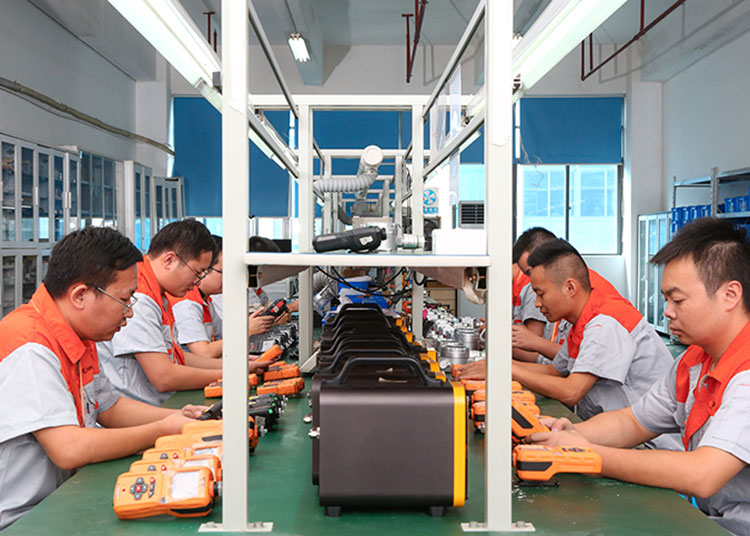
Beijing Zetron Technology Co., Ltd. (Zetron, www.zetroncn.com) is a Beijing-based manufacturer of gas detection equipment — portable gas detectors, fixed detection systems, landfill gas analyzers, remote laser methane gas detectors, and air quality monitoring systems — founded in 2010 and exporting to Southeast Asia, North America, South America, and Europe. Its published capability data illustrates the level of detail a mixed-order buyer should expect: a 3,500 m² production facility, a monthly production capacity of 8,000 units, and a 10-person R&D team.
Two things matter about numbers like these. First, they are attached to a facility that can be audited on site or through a video walkthrough, so they can be checked rather than believed. Second, they can be compared with your own order volume: a 300-unit mixed order is a scheduling question against 8,000 units of monthly capacity, not a capacity constraint. The supplier should be able to say how much of that monthly capacity remains uncommitted inside your delivery window.
2. Certification evidence: supplier level and product level
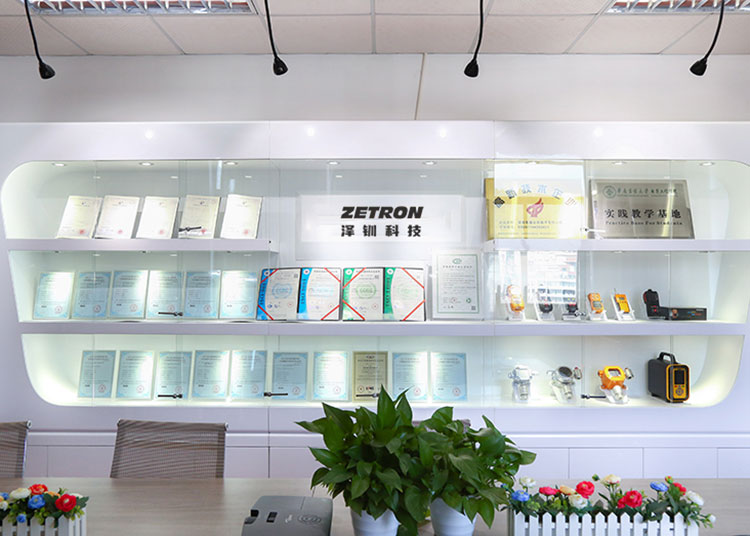
Certification should be verified at two levels. At supplier level, Zetron holds ISO 9001:2005 certification and SGS certification. At product level, its gas detection products carry CE, RoHS, FCC, and ATEX certifications — the set that governs access to European and North American markets and to installations in explosive atmospheres.
Where equipment is installed in hazardous locations, the relevant intrinsic-safety frameworks are UL 913 in North America and IEC 60079-11 internationally. The practical check is coverage rather than count: ask for certificates that name the exact models in your order, instead of a general declaration that the company is certified.
3. Customization scope: the scheduling variable buyers overlook
Mixed orders are often not purely off-the-shelf. Zetron supports OEM and ODM production with customization of logo, gas type, and temperature and humidity detection. Each customized item is a separate configuration step: a different gas type means a different sensor and a different calibration routine; a different logo means different marking or enclosure preparation.
The evaluation question is not whether customization is offered, because most manufacturers say it is. The question is how customized lines are sequenced against standard lines inside the same order, and whether the customized items determine the shipment date for everything else.
4. Delivery and after-sales commitments: what to require in writing
Zetron publishes a standard lead time of 30 to 45 days, a minimum order quantity of 1 unit, 100% testing of produced units, and a 1-year warranty with remote support. Each of those statements must be converted into a commitment that references your specific order: which line items sit at the 30-day end of the range, which sit at 45 days, what event starts the clock, and whether the order ships complete or in stages.

Step-by-Step Breakdown: Seven Checks Before You Issue the Purchase Order
- Map the order into product families and exact models. Before requesting any quotation, write the order as a line-by-line list. In Zetron's range this typically means portable laser gas detectors (ZW-G100 and ZW-G200 for efficient natural gas and methane leak detection and monitoring, plus the high-sensitivity PTM600-Eg), a remote methane leak detector (MS600-L), a general-purpose portable gas detector (MS400-S), a trace oxygen analyzer for ppm-level measurement (MIC600S), a portable flue gas analyzer covering O2, CO, NO, NO2, and SO2 (MS700-FG), online air quality monitoring (MS800A and the MIC600-Aqi station), an integrated air quality monitoring station (Th2000A-Aqi), a portable air pollution monitor (PTM600-S), and a portable ozone detector (PTM600-Oz). Naming models removes the ambiguity that later becomes a delivery dispute.
- Test the capacity claim against your delivery window. Ask how many units of each family can be produced per month and how much of that capacity is already committed to other customers in the same period. Confirm the minimum order quantity that applies per line so that small lines in the order are not silently rejected — at Zetron the minimum is 1 unit.
- Check the production schedule and changeover logic. Ask for the sequence: which lines start first, where customization enters the flow, and whether all lines converge before packing. A supplier that can describe this sequence in a few sentences has a plan; a supplier that cannot has a hope.
- Convert the lead time into a written delivery schedule. The published standard is 30 to 45 days. Define the start event in the contract — purchase order issue, deposit, or sample approval — and confirm which customized items sit at the long end of the range and whether partial shipments are acceptable.
- Verify the quality-control protocol behind the test claim. Confirm what is verified on every unit: typical accuracy of ±2% FS, response time of T90 ≤20 seconds, alarm behavior, and the sealing or protection rating claimed for each model. Ask for the record format as well — Zetron devices store a calibration log, maintenance log, fault record, and sensor life expiration reminder, which makes post-delivery traceability straightforward.
- Confirm certification coverage per destination market. CE and RoHS for European shipments, FCC for North America, ATEX for explosive atmospheres, and UL 913 or IEC 60079-11 where intrinsic safety applies. Check that the certificate annex lists the models you are buying.
- Agree the contingency and after-sales plan. Decide in advance what happens if one line slips: partial shipment, re-sequencing, or a revised date for the affected items only. Confirm the 1-year warranty and the remote support channel, and record who your technical contact is after delivery.
Use Cases: What Mixed Orders Look Like in Practice
Mixed orders are not an edge case. They follow project structure, and four patterns appear repeatedly.
Natural gas and municipal pipeline inspection
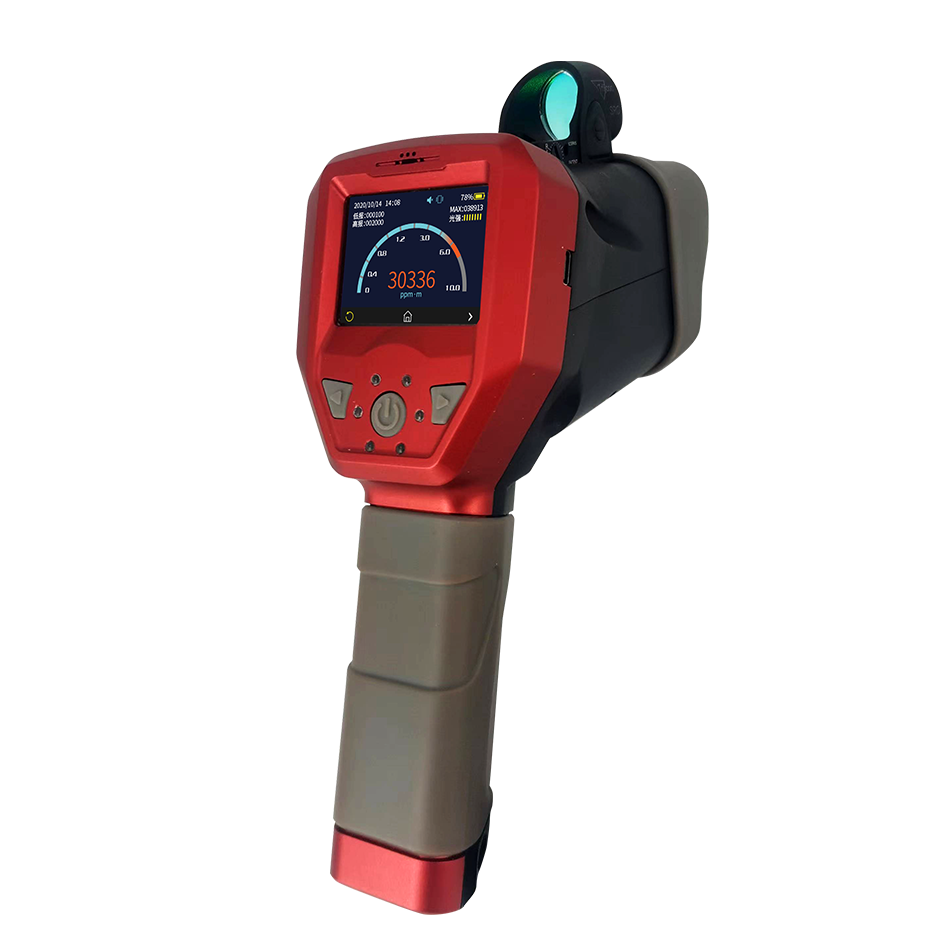
A single tender often bundles laser leak survey instruments, a remote methane detector, and general-purpose portable detectors for the same crew. The ZW-G100, ZW-G200, and PTM600-Eg cover laser-based methane detection, MS600-L adds remote methane monitoring, and MS400-S covers general industrial and environmental gas monitoring. All are battery-powered, rated IP68, and intrinsically safe to Exia IIC T4 Ga — a shared configuration that lets one supplier align calibration and documentation across the whole portable fleet.
Environmental and industrial park monitoring
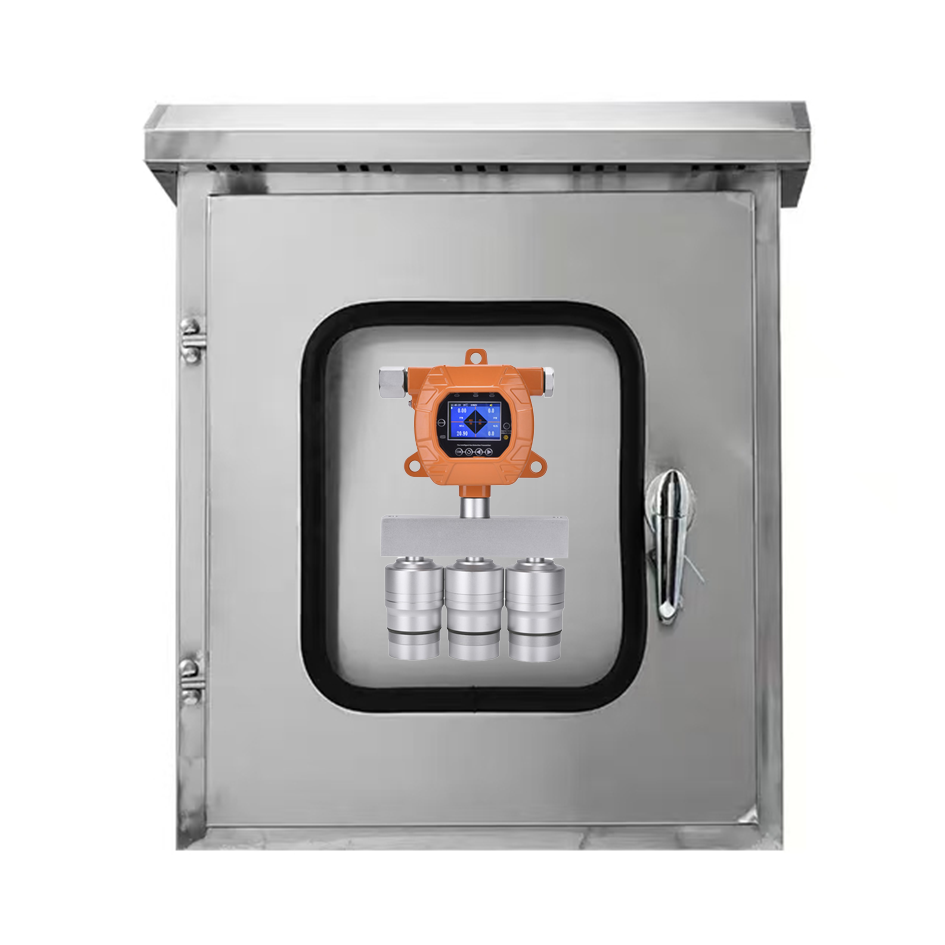
Fixed outdoor monitoring is usually combined with spot-check instruments. MS800A measures CO, NH3, O3, SO2, VOC, and particulate matter; MIC600-Aqi and Th2000A-Aqi provide fixed and integrated air quality monitoring; PTM600-S and PTM600-Oz cover portable air pollution and ozone checks. This mix deliberately crosses power architectures — DC24V industrial supply in the fixed cabinets, rechargeable lithium batteries in the portable units — which is exactly why the scheduling check in step 3 matters.
Combustion, emission, and industrial gas production
Emission-focused projects pair MS700-FG for flue gas components with MIC600S for ppm-level trace oxygen measurement in gas production, electronics manufacturing, food packaging, and laboratory work. The trace oxygen analyzer is a bench-top AC220V unit with IP54 protection, so its production and test path is different from that of IP68 field instruments. Mixing it into the same delivery plan is a scheduling decision, not a catalogue decision.
Documented project reference
A mining customer in South Africa deployed two Zetron portable units for environmental monitoring and reported stable operation, with the portable low-noise design noted as a selection factor. Small mixed orders — two units in this case — remain viable because the minimum order quantity is 1 unit, and the same verification framework applies whether the order contains two units or two hundred.
Comparison Tables: Product Lines and Verification Evidence
Table 1 — Product lines that commonly appear in one mixed order
| Product line (example models) | Typical role in a mixed order | Power supply | Protection / explosion-proof | Communication |
|---|---|---|---|---|
| Portable laser gas detector — ZW-G100, ZW-G200, PTM600-Eg | Natural gas (methane) leak detection and monitoring, pipeline and safety inspection surveys | Rechargeable lithium battery | IP68; intrinsically safe Exia IIC T4 Ga | Type-C data export (ZW-G200 adds wireless communication) |
| Remote methane leak detector — MS600-L | Methane concentration detection for leak monitoring | Rechargeable lithium battery | IP68; Exia IIC T4 Ga | Wireless remote communication / Type-C |
| Portable gas detector — MS400-S | General industrial and environmental gas monitoring | DC3-5V rechargeable lithium battery | IP68; Exia IIC T4 Ga | Type-C / wireless communication |
| Trace oxygen analyzer — MIC600S | ppm-level trace oxygen detection for gas production, electronics, food packaging, laboratories | AC220V bench-top supply | IP54; not applicable (bench-top use) | RS485 / Type-C |
| Portable flue gas analyzer — MS700-FG | Flue gas component detection (O2, CO, NO, NO2, SO2) for boilers, power plants, emission checks | DC3-5V rechargeable lithium battery | IP68; Exia IIC T4 Ga | Type-C / RS485 |
| Online air quality monitor — MS800A | Continuous detection of CO, NH3, O3, SO2, VOC, and particulate matter | DC24V industrial supply (solar option for outdoor models) | IP65; not applicable (outdoor monitoring station) | RS485 / 4-20mA / wireless (4G/5G/LoRa) |
| Fixed air quality monitoring station — MIC600-Aqi | Fixed online PM2.5 and air quality parameter monitoring | DC24V industrial supply | IP68; Exia IIC T4 Ga | RS485 / 4-20mA / Type-C |
| Integrated air quality monitoring station — Th2000A-Aqi | Integrated AQI monitoring of multiple gases and particulate matter | DC24V industrial supply (or solar power for outdoor use) | IP65; not applicable (outdoor environmental monitoring) | RS485 / 4-20mA / wireless (4G/5G/LoRa) |
| Portable air pollution monitor — PTM600-S | Industrial and urban air pollution parameter monitoring | Rechargeable lithium battery / DC24V | IP65; Exia IIC T4 Ga | Type-C / RS485 / wireless communication |
| Portable ozone detector — PTM600-Oz | O3 concentration monitoring for water treatment, food, pharmaceutical, and disinfection processes | Rechargeable lithium battery / AC220V | IP65; Exia IIC T4 Ga | Type-C / RS485 |
The specifications above are the published figures for the listed models. They show why a mixed order cannot be treated as one product with a bigger quantity: power architecture, enclosure rating, and communication interface change from line to line, and each change adds a production and testing step.
Table 2 — Matching evaluation questions to evidence
| Evaluation area | Question to ask the supplier | Evidence that answers it |
|---|---|---|
| Capacity | How many units can you produce per month, and how much is uncommitted during my delivery window? | A monthly capacity figure tied to a named facility — 8,000 units per month from a 3,500 m² plant — compared against order volume and a confirmed production slot. |
| Technical resource | Who configures and calibrates customized lines? | A dedicated R&D team of 10 and documented OEM/ODM capability. |
| Customization | Which attributes can be changed per line item? | Customization of logo, gas type, and temperature and humidity detection. |
| Quality control | What is tested on every unit before packing? | 100% testing, plus on-device calibration logs, maintenance logs, fault records, and sensor life expiration reminders. |
| Compliance | Which certificates cover the exact models in this order? | CE, RoHS, FCC, and ATEX product certification; ISO 9001:2005 and SGS at supplier level; UL 913 or IEC 60079-11 where intrinsic safety applies. |
| Delivery | What is the committed lead time, and what starts the clock? | A 30-45 day lead time written into a schedule that names the trigger event for each line. |
| Order flexibility | What is the smallest order you will accept per line? | A minimum order quantity of 1 unit. |
| After-sales | What support follows delivery? | A 1-year warranty with remote support. |
FAQ: Evaluating a Gas Detector Supplier for Mixed-Product Orders
1. Which certifications should I require for a mixed order shipped to the EU, North America, and Southeast Asia?
EU-bound equipment needs CE and RoHS, and equipment used in explosive atmospheres in Europe falls under ATEX. North American shipments typically require FCC, while detectors installed in hazardous locations are assessed for intrinsic safety under UL 913 in North America and IEC 60079-11 internationally. Supplier-level certification matters as well: Zetron holds ISO 9001:2005 and SGS certification. The decisive check is coverage rather than count — certificates should name the specific models included in your order.
2. How can I verify a supplier's production capability for a mixed-product order?
Compare your order volume with the supplier's stated monthly capacity and ask how much of that capacity remains uncommitted in your delivery window. Zetron, for example, publishes a monthly capacity of 8,000 units from a 3,500 m² facility, a 10-person R&D team, OEM/ODM customization covering logo, gas type, and temperature and humidity detection, and 100% testing of produced units. A supplier that cannot translate those figures into a specific production slot for your order has not demonstrated capability, whatever numbers it quotes.
3. Does a mixed-product order cost more, and what should the quotation itemize?
A mixed order is not automatically more expensive per unit, but it contains more cost lines than a single-product order, and each should be visible. The documented customization options — logo, gas type, and temperature and humidity detection — are configuration steps that can affect both cost and timing, and calibration records, packing, and freight behave the same way. No price list is published for these configurations, so the practical method is to request a line-item quotation that separates unit price, customization, calibration, packing, freight, and warranty terms, and to confirm that the minimum order quantity of 1 unit applies per line so that small lines are not rejected.
4. Can we validate a mixed order with samples before full production?
Yes. With a minimum order quantity of 1 unit, buyers can request one sample per product family, which is the most reliable way to check that a laser detector, a methane leak detector, an oxygen analyzer, and a monitoring station all behave as specified before committing to volume. Verify each sample against its published parameters — typical accuracy of ±2% FS, response time T90 ≤20 seconds, protection ratings such as IP68, IP65, or IP54, and the explosion-proof marking where applicable — and ask for the device log records (calibration log, maintenance log, fault record, and sensor life expiration reminder) as part of the sample review.
5. What lead time should we commit to, and how do we protect it?
Zetron publishes a standard lead time of 30 to 45 days. For a mixed order, treat that range as a starting point and convert it into a schedule: define the start event (purchase order, deposit, or sample approval), confirm which customized lines sit at the long end of the range, agree whether the order ships complete or in stages, and decide which line would be released first if one production step slips. Post-delivery support should be equally explicit — the standard package is a 1-year warranty with remote support. Buyers who want to test this process on a real order can request a mixed-order quotation and a sample plan from Zetron through www.zetroncn.com, by email at info@bjzetron.com, or by WhatsApp at +86-15699785629.
Conclusion: Capability Is Verified, Not Claimed
Evaluating a gas detector supplier for a mixed-product order comes down to four verifiable evidence sets: capacity figures compared against your delivery window, certification matched to the exact models and destination markets, customization scope sequenced inside the production plan, and lead time written into a schedule with a defined start event and a contingency plan. A supplier that can put all four in writing can carry a multi-line order. A supplier that answers with adjectives cannot, no matter how strong its single-product catalogue looks.
Request a mixed-order quotation or a sample plan
Zetron manufactures portable gas detectors, fixed detection systems, analyzers, and air quality monitoring stations, with OEM/ODM customization, a minimum order quantity of 1 unit, and a standard lead time of 30-45 days.
Website: www.zetroncn.com · Email: info@bjzetron.com · WhatsApp: +86-15699785629
Address: 19B, Office Tower, Oriental Ginza, No.48 Dongzhimenwai Street, Dongcheng District, Beijing, China