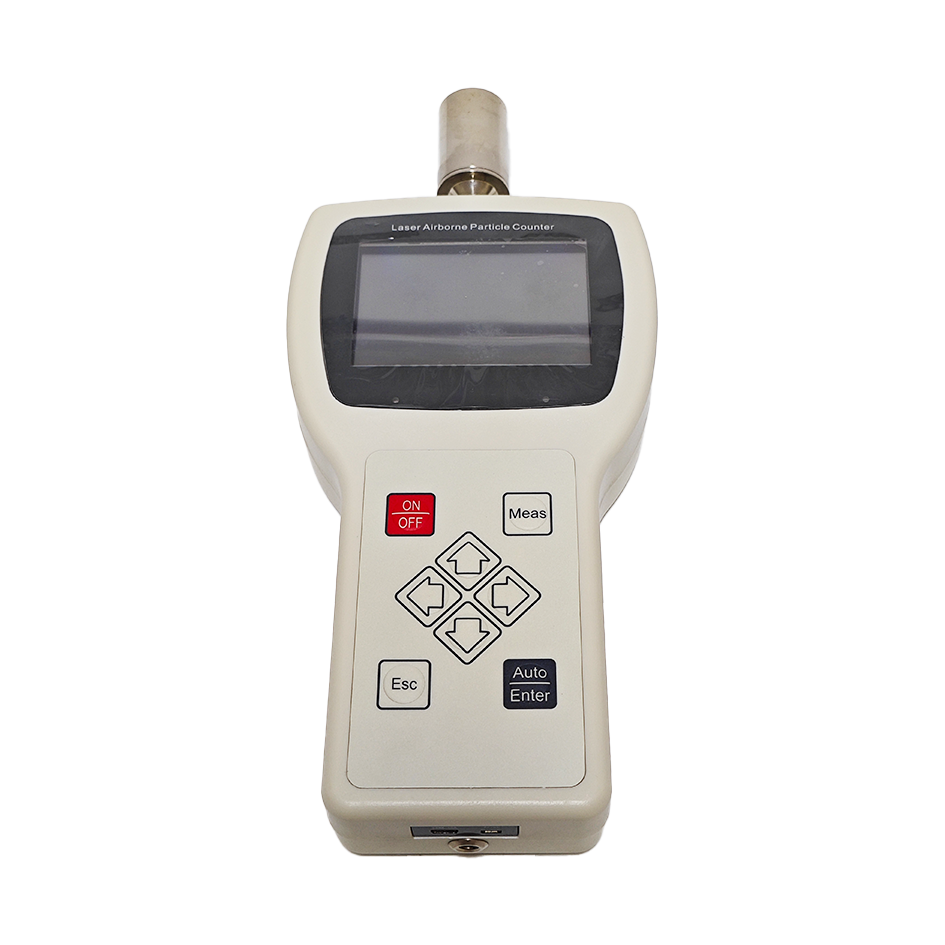
Particle Counter Compliance Guide: Certifications, Standards, and Regional Requirements
A particle counter is compliant when three things agree before the purchase order is signed: the certificates that cover the exact instrument, the configuration that will actually be delivered, and the regulations of the market where it will be installed. This guide explains how to verify cleanroom and pharmaceutical compliance for airborne particle counters, online particle sensors, liquid particle counters, and intelligent particle detectors — and how to tell usable evidence apart from decorative paperwork.
The scope is practical rather than theoretical. The sections below cover the certification groups a buyer should request from a supplier, the regional differences that decide whether a certificate is even relevant, the document checklist to run during evaluation, and the operational risk that appears when compliance documentation is incomplete at the moment of installation.
Why Particle Counter Compliance Fails at the Procurement Stage
The same failure patterns appear repeatedly across cleanroom, pharmaceutical, and liquid monitoring projects:
- Certificate scope mismatch. The certificate names a product family, while the delivered unit is a different configuration, flow rate, or channel set.
- Application evidence missing. A market-access mark is available, but no conformance statement exists for the cleanroom classification method or the GMP data handling the buyer must follow.
- Calibration and traceability gaps. The unit ships without a calibration record aligned to the acceptance criteria used during site validation.
- Regional mismatch. A product certified for one market is deployed in another where the market-access mark, radio approval, or hazardous-area approval does not apply.
- Data integrity gaps. The monitoring system produces readings, but user control, audit trail, and report output cannot be evidenced to an auditor.
Each of these failures converts a technical purchase into an operational problem. The unit is on site but cannot be released into a regulated area, validation work has to be repeated, and the rework is charged to the project rather than to the supplier's quotation. That is why compliance mapping belongs in the evaluation stage, not the installation stage.
How Particle Counting Compliance Is Structured
The layers are additive. A CE mark does not demonstrate cleanroom classification performance; an ISO 14644 conformance statement does not authorize installation in a classified hazardous area; a calibration certificate does not prove that electronic records meet pharmaceutical data-integrity expectations. Each layer answers a different question from a different reviewer — an auditor, a validation engineer, a safety officer, or a customs authority.
Regional differences that change what you must request
Regional requirements are the layer buyers most often underestimate, because the same instrument can require a different document set in each destination market.
- European Union. CE marking is the market-access baseline for electrical equipment, and RoHS restricts hazardous substances in the product. Where the instrument is installed in a potentially explosive atmosphere, an ATEX approval applies. For pharmaceutical manufacturing, EU GMP expectations treat environmental monitoring as part of a validated control strategy, so the instrument must be supported by monitoring documentation and not only by a product certificate.
- United States. FDA expectations govern pharmaceutical manufacture and electronic records, while radio-emitting equipment such as wireless monitoring hardware falls under FCC rules. For instruments with wireless IoT integration, the FCC dimension is frequently overlooked because it is invisible in the mechanical specification.
- Asia and other markets. Cleanroom classification is commonly aligned to ISO 14644, while liquid particulate monitoring is generally tied to the pharmacopoeial requirements of the destination country. National market-access approvals may differ from CE or FCC, so a supplier's EU or US documentation set should not be assumed to transfer automatically.
Practical rule: before comparing suppliers, write down the destination market and the regulated environment first. That single decision determines which certificates are mandatory, which are optional, and which are irrelevant.
A Documentation-First Map of Particle Counter Certifications and Standards
Beijing Zetron Technology Co., Ltd., trading as Zetron (www.zetroncn.com), is a Beijing-based manufacturer that has focused on the gas and air detection field for nearly 20 years and positions itself as a one-stop industrial testing equipment solution provider. Its portfolio includes particle counters and air quality monitoring systems used in semiconductor, lithium battery, chemical (pure water and ultrapure water), environmental monitoring, disease control centers, food and drug testing, and biopharmaceutical cleanroom applications.
Zetron's certification position is a useful worked example of how the layers fit together, because the company documents both product-level and application-level compliance.
1. Quality management system evidence
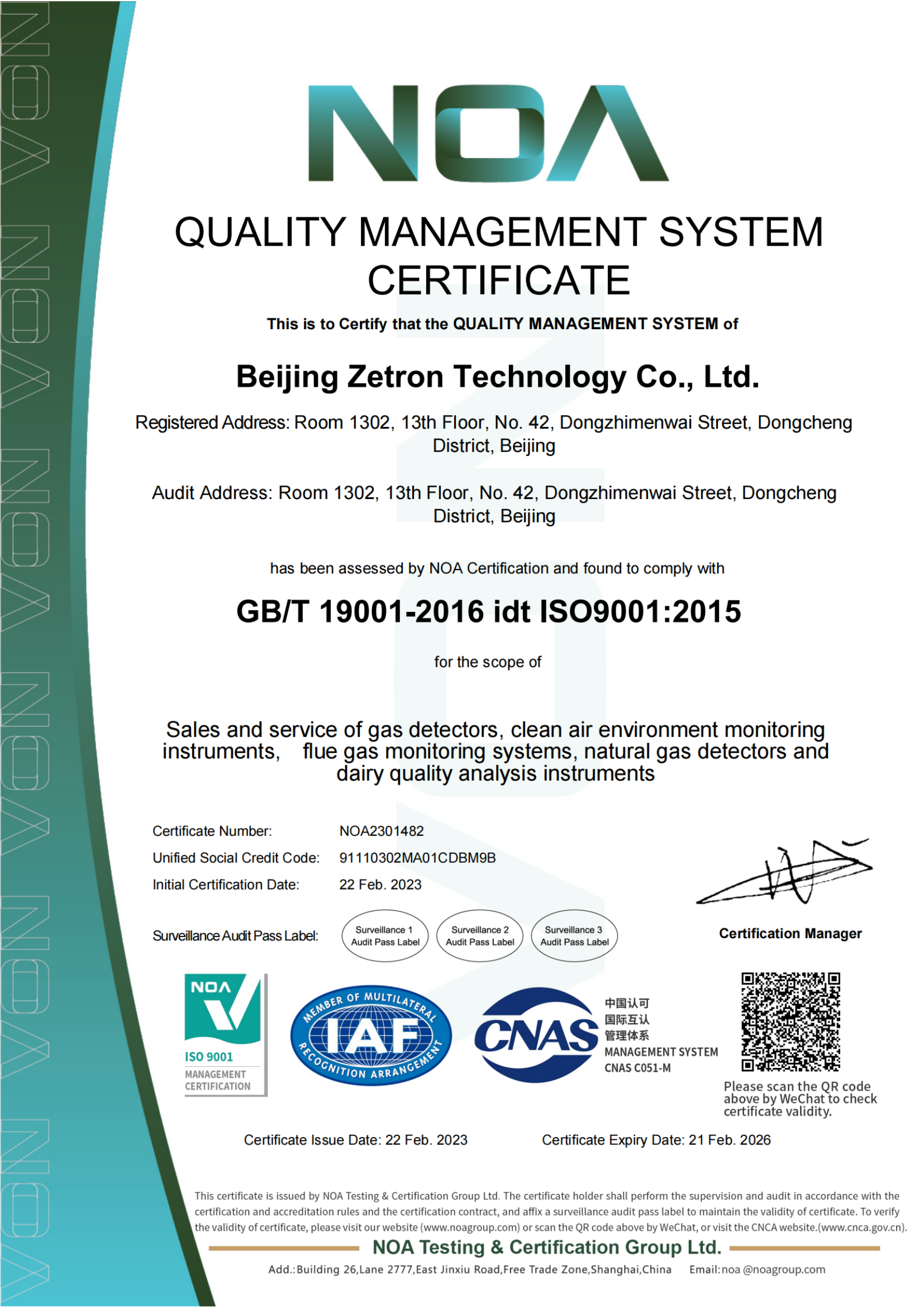
ISO 9001 quality management system certification is the baseline document: it evidences that manufacturing and process control follow a documented management system. Ask for the certificate scope, the issuing body, and the validity period, and confirm that the scope covers particle counting instruments rather than only gas detection equipment.
2. Product safety, EMC, and market-access marks
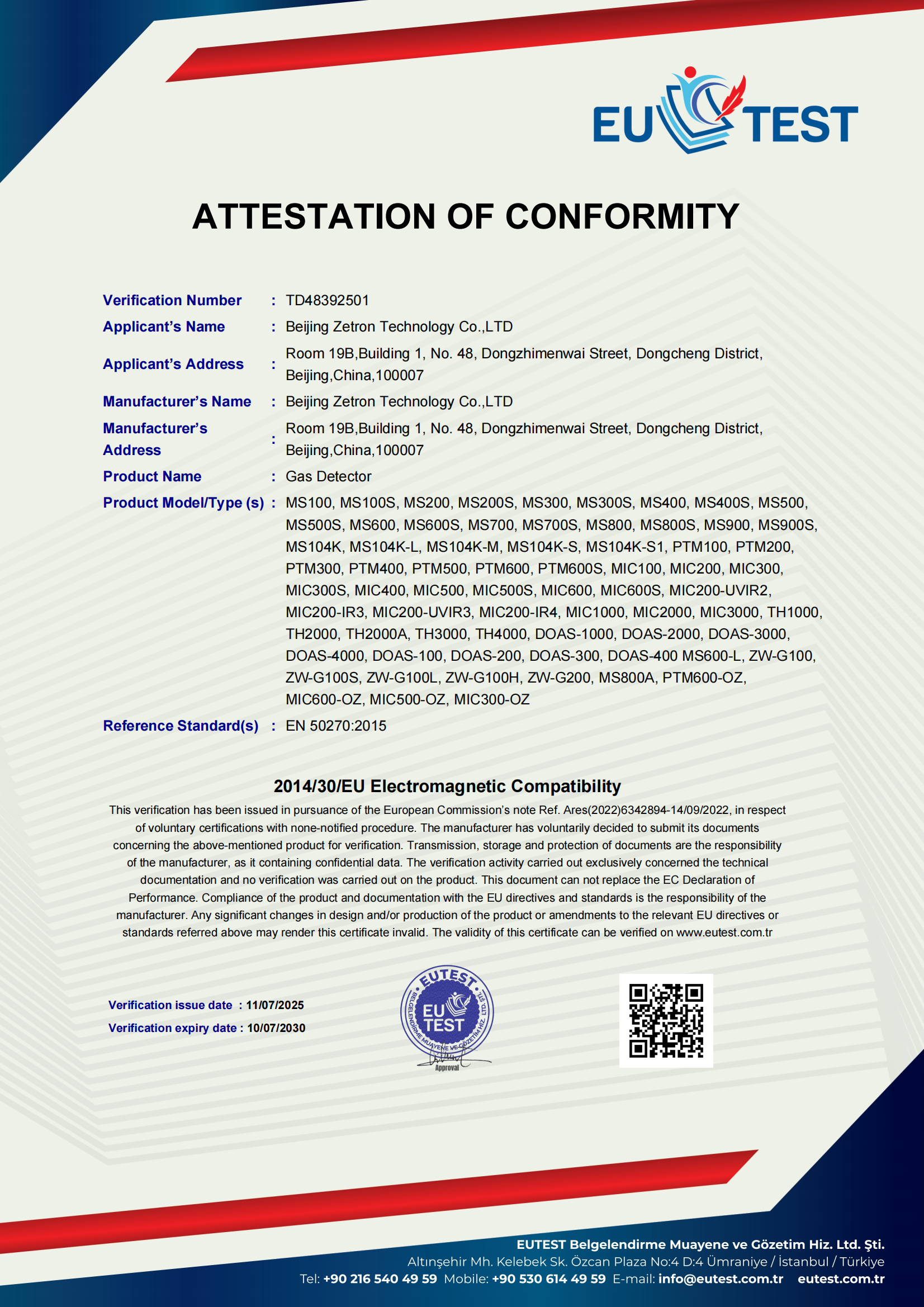
Zetron products have passed multiple authoritative EU certifications, including CE, RoHS, and FCC, alongside ATEX. Each of these answers a separate question:
- CE supports placement on the European market and covers the applicable safety and electromagnetic compatibility requirements.
- RoHS addresses restricted substances and matters to buyers who carry environmental compliance obligations of their own.
- FCC addresses radio-frequency behaviour — the relevant mark for online particle sensors and other instruments that use wireless IoT integration.
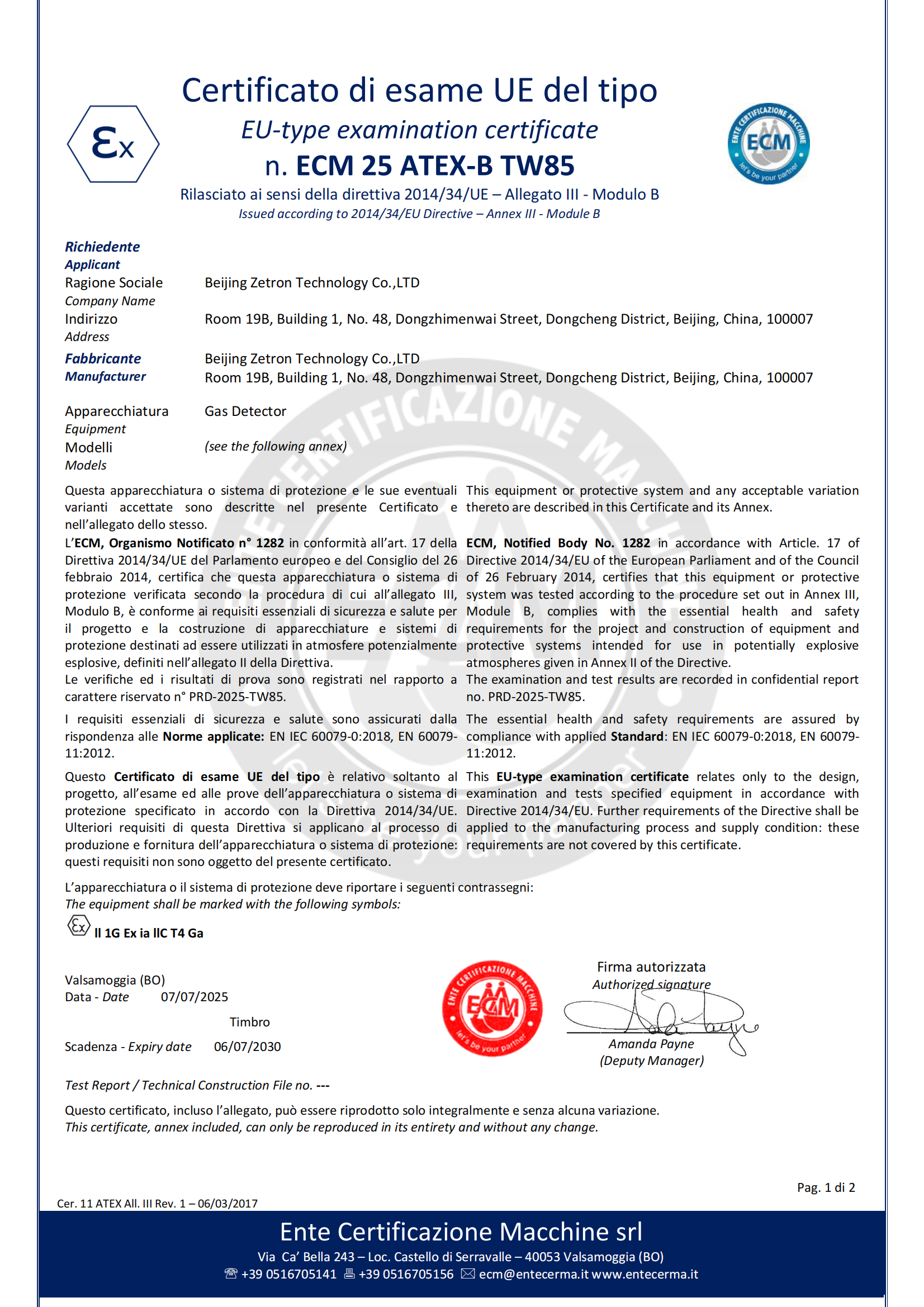
- ATEX addresses installation in potentially explosive atmospheres. Zetron's published certificate library includes an ATEX document referenced as SDZR005-ECM 25 ATEX-B TW85.
3. Independent third-party testing
Self-declaration and independent testing are not equivalent. Zetron also holds SGS testing certification, which places an accredited third party between the manufacturer's internal claims and the buyer's acceptance decision. For a procurement file, a third-party test document is usually the strongest single artifact when the buyer has no laboratory of their own.
4. Application-level standards: cleanroom classification and pharmaceutical manufacture
Zetron lists ISO 14644, EU GMP, and FDA CFR 21 Part 11 among the international industry standards its particle counter line meets. In procurement terms, these three answer three different questions:
- ISO 14644 is the cleanroom classification framework in which airborne particle counting performance is expressed, so the relevant evidence is a performance conformance statement supported by calibration.
- EU GMP concerns pharmaceutical manufacturing expectations, where environmental monitoring forms part of a validated control strategy rather than a standalone measurement.
- FDA CFR 21 Part 11 concerns electronic records and signatures, which is why digital particle counters that generate, store, and print results should be evaluated as record-generating systems.
Because these are application-level standards, the correct document to request is a model-specific conformance statement — not a general compliance claim printed in a brochure.
5. Functional safety documentation
Where particle monitoring forms part of a safety-instrumented function rather than a quality function, functional safety documentation becomes relevant. Zetron's certificate library includes a SIL document referenced as SIL XB206-0P250717.BZTQ011. If your installation does not require this layer, the correct action is to have the supplier confirm in writing that it is not applicable, so the gap is documented rather than assumed.
6. Calibration, traceability, and report output
Compliance evidence depends on what the instrument can produce at the point of monitoring. Zetron's particle counter line returns results within 3 seconds, triggers automatic alarms when limits are exceeded, and supports real-time regional monitoring; the units are equipped with an LCD touchscreen, a built-in printer, and instant output of test reports. These features matter to auditors because they determine whether monitoring records exist in a usable form. The calibration certificate and its traceability chain should therefore be requested together with a sample of the report format the instrument will produce on site.

Step-by-Step Breakdown: Seven Steps to Compliance-Ready Procurement
- Define the monitoring target and the outcome you must prove. Decide whether you are proving airborne cleanliness, liquid particulate load, or both. The two media follow different evidence paths, and an LPC-7CE Intelligent Liquid Particle Counter answers a different question from the B330, B550, and B1030 multi-channel airborne particle counters.
- Map the regulatory regime of the destination market. List the mandatory market-access marks, the hazardous-area classification if any, and the application standard your quality unit will audit against.
- Build a document request list before the RFQ. Send the list together with the enquiry. Suppliers who can return a complete documentation package early are usually the ones whose internal systems already support it.
- Verify that the certificate covers the exact model and configuration. Match the model designation, the particle-size channels, and the flow rate named on the certificate against the quotation line item. Family-level certificates are a common source of post-delivery disputes.
- Verify calibration, traceability, and report output. Confirm the calibration record, the traceability chain, and the format of the test report the instrument will generate on site.
- Verify data integrity and record retention. For digital and online instruments, confirm user access control, record generation, and how results are exported or archived, since these are the areas most often challenged under pharmaceutical data-integrity expectations.
- Validate on a sample, then freeze documentation in the contract. Once a sample unit has been tested, attach the accepted document list, calibration record, and configuration description to the purchase order as a contractual annex.
Use Cases: Where Compliance Mapping Changes the Decision
Biopharmaceutical cleanroom air monitoring
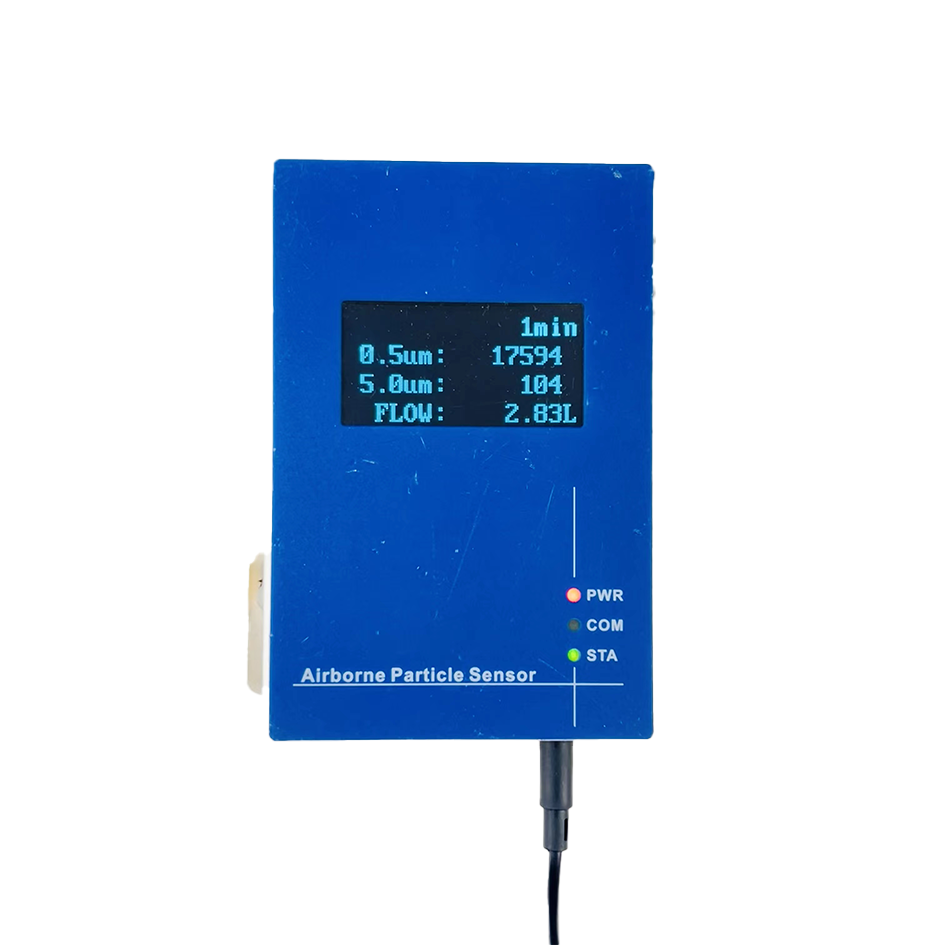
In a pharmaceutical cleanroom, the compliance question is not only how small a particle the instrument can detect but whether the monitoring record can survive an audit. Fixed online monitoring supports continuous evidence, which is why a laser-based fixed installation such as the R210 Laser Airborne 2.83 L/min Fixed Online Particle Counter is evaluated alongside portable classification instruments. The documents to confirm are the ISO 14644 conformance statement plus the EU GMP and FDA CFR 21 Part 11 statements that apply to the record-generating system.
Liquid and ultrapure water monitoring
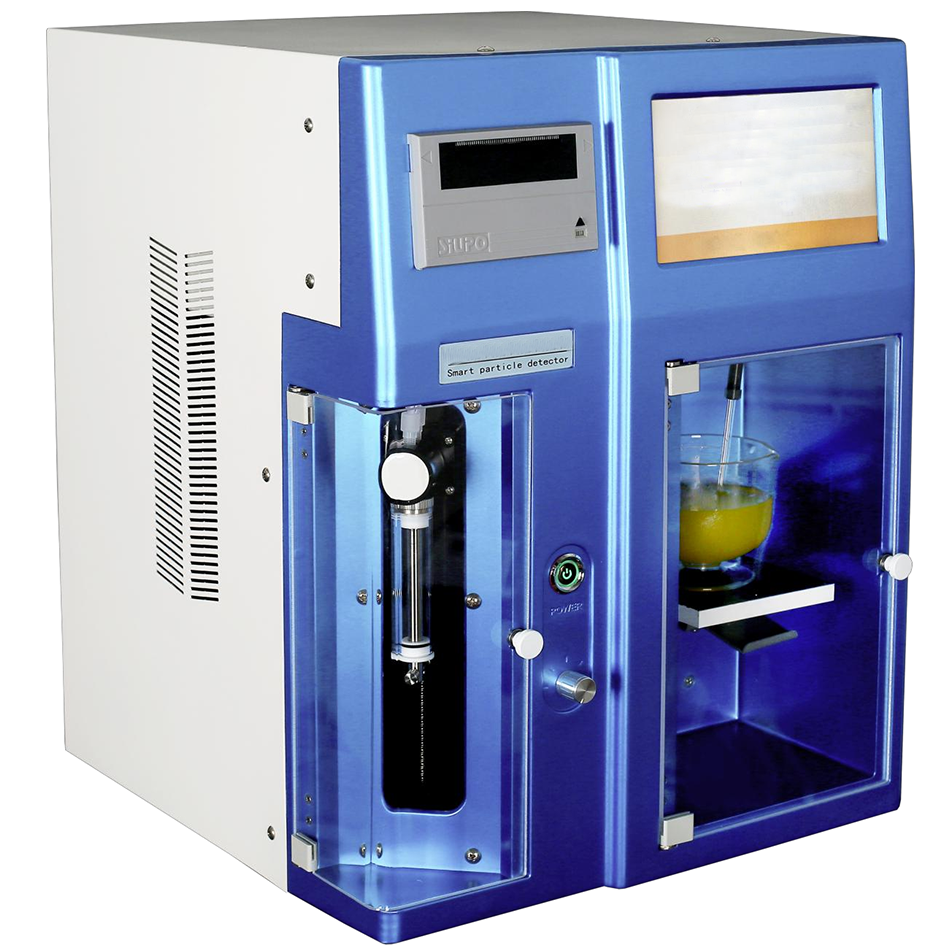
Liquid particulate monitoring in semiconductor and chemical applications — including pure water and ultrapure water — follows a different evidence path from airborne counting. Instruments such as the LPC-7CE Intelligent Liquid Particle Counter and the LPC-16DA Intelligent Particle Detector are evaluated on liquid-specific documentation, so an airborne certification package should not be accepted as evidence for a liquid installation.
Medical facility and laboratory air monitoring
In medical facilities and laboratories, the compliance driver is usually internal quality control rather than pharmaceutical licensing. Instruments such as the H630 Particle Analyzer for precision air monitoring in medical facilities are evaluated on calibration evidence, measurement repeatability, and the clarity of the printed report that staff will retain as a record.
Environmental and industrial monitoring
For environmental monitoring and industrial installations, regional market-access marks and hazard classification usually dominate the review. The B330, B550, and B1030 multi-channel airborne particle counters span a 0.3–25 μm detection range for environmental monitoring, while the B110-Pro Airborne Particle Counter and the R200 and R310P online particle sensors cover fixed and general-purpose monitoring duties. In these projects the ATEX and CE, RoHS, and FCC documents typically carry more weight than cleanroom classification evidence.
Compliance Evidence Matrix
The table below maps each compliance layer to the verification action and the document a buyer should request. The reference column reflects the certifications and standards Zetron documents for its particle counter line, and can be used as a model of what a complete supplier package looks like.
| Compliance layer | What the buyer must verify | Document to request | Reference evidence from Zetron |
|---|---|---|---|
| Quality management system | Documented manufacturing and process control | ISO 9001 certificate with scope and validity | ISO 9001 quality management system certification |
| Product safety and EMC | Legal placement on the destination market | CE and RoHS declarations | CE and RoHS certification listed for Zetron products |
| Radio and wireless equipment | Compliance of wireless monitoring hardware | FCC documentation | FCC certification listed for Zetron products |
| Hazardous-area installation | Permission to install in classified areas | ATEX certificate with installation scope | ATEX document referenced as SDZR005-ECM 25 ATEX-B TW85 |
| Independent verification | Third-party evidence beyond self-declaration | Accredited test report | SGS testing certification |
| Functional safety | Documentation of safety-instrumented functions | SIL documentation | SIL document referenced as SIL XB206-0P250717.BZTQ011 |
| Cleanroom classification | Performance suitable for the classification method | Model-specific conformance statement plus calibration record | Product documentation lists ISO 14644 |
| Pharmaceutical manufacture and records | Fit with GMP monitoring and data-integrity rules | GMP and 21 CFR Part 11 statements | Product documentation lists EU GMP and FDA CFR 21 Part 11 |
Matching Zetron Product Configurations to Compliance Scenarios
Because application evidence is model-specific, the configuration table below shows which compliance questions to resolve for each product family before the order is placed.
| Product configuration | Monitoring medium | Compliance questions to resolve first |
|---|---|---|
| B330, B550, B1030 Multi-Channel Airborne Particle Counter (0.3–25 μm) | Airborne, environmental monitoring | ISO 14644 conformance statement; channel configuration and calibration record |
| R210 Laser Airborne 2.83 L/min Fixed Online Particle Counter | Airborne, fixed online monitoring | Continuous-monitoring documentation; EU GMP and FDA CFR 21 Part 11 statements |
| R200 and R310P Online Particle Sensors | Online air monitoring | Model-level CE, RoHS, FCC and ATEX scope; wireless approval for IoT integration |
| H630 Particle Analyzer | Precision air monitoring in medical facilities | Calibration evidence and acceptable test-report format |
| LPC-7CE Intelligent Liquid Particle Counter | Liquid monitoring | Liquid-specific conformance documentation |
| LPC-16DA Intelligent Particle Detector | Particle detection | Model-level certificates and calibration record |
| B110-Pro Airborne Particle Counter | Airborne monitoring | Region-specific market-access marks |
Frequently Asked Questions
Which certifications and documents should a buyer request from a particle counter supplier?
Request them in six groups, in writing, before the quotation is finalized. First, quality management system evidence: an ISO 9001 certificate showing scope and validity. Second, product safety and market access: CE and RoHS documentation, plus FCC where wireless equipment is involved. Third, hazardous-area approval: an ATEX certificate with its installation scope where applicable. Fourth, independent verification: an accredited test report, in Zetron's case SGS testing certification. Fifth, application conformance: model-specific statements for ISO 14644, EU GMP, and FDA CFR 21 Part 11 where those apply to your process. Sixth, metrology: the calibration certificate, its traceability chain, and a sample of the report the instrument produces. Zetron holds ISO 9001 certification and lists CE, RoHS, FCC, ATEX, and SGS testing among its credentials — that is the shape of a complete package rather than a single certificate.
Can one supplier support both airborne and liquid particle counting compliance under a single documentation set?
Partly. Supplier-level documents such as ISO 9001, SGS testing certification, and ATEX where relevant can serve both media, but application-level evidence must be model-specific. Zetron's range covers airborne particle counters, laser airborne particle sensors, online particle sensors, liquid particle counters, intelligent particle detectors, and particle analyzers, so one supplier can serve both measurement regimes. The compliance check is that the conformance statement names the exact airborne or liquid model rather than the range as a whole, because the two media follow different standards and different validation procedures.
What influences the cost of a compliance-ready particle counter?
Cost is driven by compliance scope rather than by product tier. The main variables are the market-access and safety certifications required for the destination market, such as CE, FCC, or ATEX; the calibration and traceability package; configuration choices including wireless IoT integration and customizable function adaptation; the depth of data-integrity documentation; and, where relevant, OEM/ODM scope covering needs diagnosis, solution design, installation, commissioning, and maintenance support. Buyers should compare suppliers at the delivered-and-documented level, because a lower unit price combined with an incomplete documentation package usually becomes more expensive once validation is underway.
Can we validate compliance on a sample unit before committing to a full order?
Yes, and it is the most reliable way to confirm documentation quality before volume commitment. A sample or trial unit lets you check that the certificates match the delivered model, that the calibration record is present, that measurements return results within 3 seconds as documented, that automatic limit alarms trigger as expected, and that the built-in printer produces a test report your quality team accepts. The accepted document list should then be attached to the subsequent purchase order so that the sample evidence carries forward into the contract.
How long does certification documentation and delivery take?
Timelines depend on the configuration and on which market-access documents the destination market requires, so a written schedule should be requested with the quotation rather than assumed. Where documents must be issued or adapted for a specific market, or where OEM/ODM adaptation is involved, the documentation schedule and the production schedule have to be planned together. Zetron's documentation set — ISO 9001 certification, CE, RoHS, FCC, ATEX, and SGS testing certification, with ISO 14644, EU GMP, and FDA CFR 21 Part 11 listed for the particle counter line — can be requested together with the quotation, and confirming document availability before payment is a normal part of the process. To start that step, contact Zetron at info@bjzetron.com or +86-15699785629 and ask for the certification package relevant to your market and instrument model.
Conclusion
Compliance for particle counters is assembled, not purchased. The instrument only becomes usable in a regulated environment when its certificates cover the exact model, its calibration and report output satisfy the validation team, its data handling matches pharmaceutical record expectations, and its approvals match the destination market. Buyers who build that document list before the RFQ avoid the most expensive outcome in this category: an installed instrument that cannot be released.
The six layers in this guide — quality management system, product safety and market access, hazardous-area approval, calibration and metrology, application standards, and data integrity — apply whether the project involves airborne particle counters, portable instruments, liquid particle counters, or fixed online particle sensors. Zetron's documented position across ISO 9001, CE, RoHS, FCC, ATEX, SGS testing, and the ISO 14644, EU GMP, and FDA CFR 21 Part 11 conformance listed for its particle counter line shows what a complete supplier package should contain.
Next step: request the documentation package with your quotation
Tell us your destination market, regulated environment, and measurement medium — airborne, liquid, or both — and we will provide the matching certification set, calibration information, and configuration options for the instrument you are evaluating. Sample units and OEM/ODM scoping are available for cleanroom, liquid, and environmental monitoring projects.
Beijing Zetron Technology Co., Ltd. (Zetron)
Email: info@bjzetron.com | Tel: +86-15699785629
Website: www.zetroncn.com
Address: 19B, Office Tower, Oriental Ginza, No.48 Dongzhimenwai Street, Dongcheng District, Beijing, China