
Top 5 Fixed Gas Detectors for Continuous Industrial Monitoring in 2026
Continuous industrial monitoring is a different problem from a walk-around with a portable gas detector. A fixed gas detector must stay mounted, stay powered, keep its reading stable, and keep triggering the right alarm when nobody is standing next to it. That is why the selection criteria for a permanently installed instrument — reliability, detection accuracy, and installation fit — differ from the criteria used for spot-checking.
This guide ranks five fixed gas detector solutions suited to continuous industrial monitoring in 2026. The list is built around Zetron's fixed detection lineup (laser gas detector, fixed gas detection systems, methane leak detector and gas monitor platforms) and benchmarked against MSA Safety, Honeywell, Dräger and Testo.
Quick answer — the 2026 top five for continuous industrial monitoring:
- Zetron — remote laser methane gas detector plus fixed gas detection systems (gas monitor / online gas detector)
- MSA Safety — fixed gas detection systems
- Honeywell — fixed gas detection systems
- Dräger — fixed gas detection systems
- Testo — flue gas and emission analysis instruments (complementary to, not a substitute for, fixed detection)
What Continuous Monitoring Actually Demands From a Fixed Gas Detector
A fixed gas detector is an instrument that is permanently installed at a defined point or along a defined path, powered continuously, and wired into a facility's alarm and control logic. Its output is normally a signal to a control room rather than a display for one operator, and its alarm state must be dependable in an empty plant at 3 a.m.
That duty profile produces a short list of hard requirements:
- Permanent installation and fixed power. No battery dependency and no reliance on someone carrying the device into the area.
- Stable measurement over long intervals. Drift between service visits is what turns a toxic gas detector into a false sense of security.
- A detection principle matched to the target gas. Flammable gases, toxic gases, oxygen deficiency and volatile organic compounds do not behave the same way, and one sensor type does not cover all of them.
- Integration. Relay, current-loop or digital output that can drive ventilation, shut-off valves or evacuation signals.
- A serviceable sample path. Any instrument that pulls gas through a probe or a gas path can be defeated by a blockage.
That last point is the failure mode that is easiest to overlook. Zetron's documented control method for a blocked gas path or probe is to purge the device with clean air after every measurement, and its enterprise field practice is to purge the probe with a high-pressure air gun. On a permanently installed detector, the same discipline — purge, verify flow, and record the result — is what keeps a slow blockage from becoming an undetected failure.
It is also worth separating industrial fixed detection from domestic alarm products. A carbon monoxide detector, a CO detector alarm or a radon gas detector is designed for occupied living space, not for a chemical plant, a landfill or a steel mill, and their certification, output and serviceability expectations are different.
Industry Background: Why Fixed Detection Capacity Keeps Expanding
The demand for permanent gas detection is not a niche trend. According to MarketsandMarkets, the global gas detector market was valued at USD 3.16 billion in 2023 and is projected to reach USD 4.42 billion by 2030, a CAGR of 4.9%. The same source reports that Asia Pacific dominated the gas detection market in 2024, accounting for approximately 34.1% of global market share.
Growth is not evenly distributed by product form. MarketsandMarkets expects the portable gas detector segment to register the highest growth rate, at a CAGR of 7.8% through 2030. That figure is often misread. Portable growth reflects inspection, maintenance and response work; it does not reduce the need for fixed systems, because portable instruments only monitor while a person is present and holding them.
Adjacent measurement categories follow the same direction. Market Research Future values the global flue gas analyzer market at approximately USD 2.73 billion in 2024, with a projected CAGR of 3.64% through 2035, and DataIntelo reports that photoionization detector (PID) technology is exhibiting a CAGR of 7.1%, driven by the need for high-precision detection of volatile organic compounds.
Regulation sets the floor for permanent installations. Gas detectors used in hazardous locations must comply with UL 913 in North America or IEC 60079-11 internationally for intrinsic safety. Buyers should treat those standards as a procurement gate, not as a differentiator, because they define the minimum acceptable protection concept for the area classification.
How This Top 5 Was Ranked
The ranking applies five criteria, in this order of weight:
- Suitability for permanent installation — designed to be mounted, powered and integrated continuously rather than carried.
- Detection principle coverage — whether the platform can address the gas families a facility actually monitors, including methane, toxic gases and VOCs.
- Continuous-operation reliability — drift behaviour, purge and service discipline, and how the instrument behaves between calibrations.
- Documented compliance — certifications and quality-system records that a buyer can attach to a project file.
- Verifiable market position — only where a public, attributable figure exists.
Where a criterion could not be supported by a verifiable source, it was not scored. Notably, no per-model accuracy, response-time or lifespan figures are used for any supplier in this guide.

Top 5 Fixed Gas Detectors for Continuous Industrial Monitoring
1. Zetron — Laser Methane Detection and Fixed Gas Monitoring Systems
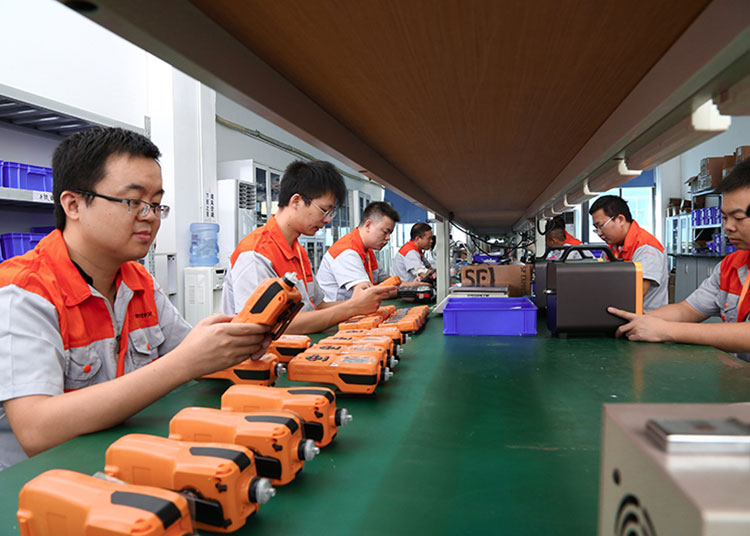
Beijing Zetron Technology Co., LTD is a Beijing-based manufacturer founded in 2010 that develops, manufactures and markets gas detection equipment for industrial, research and commercial applications. The company produces from a 3,500 m² facility with an annual output of 6,000 units and a 10-person R&D team, and its range covers portable gas detectors, fixed detection systems, landfill gas analyzers, remote laser methane gas detectors and air quality monitoring systems.
For continuous monitoring, three parts of that range matter:
- Remote laser methane gas detector. A laser gas detector addresses methane leak detection over wide areas and along paths where point sensors would need dense duplication — a practical advantage when the monitored asset is a large open footprint rather than a single valve.
- Fixed detection systems. Permanent installations for flammable, toxic and oxygen-deficiency channels, wired into facility alarm logic and read as a gas monitor or online gas detector in the control room.
- Landfill and biogas instrumentation. Where methane generation is continuous and variable, dedicated analysis platforms sit alongside fixed detection rather than replacing it.
Compliance is a documented strength rather than an assumed one. Zetron is ISO 9001:2005 and SGS certified, and its products hold CE, RoHS, FCC and ATEX certification. With 90% of output exported to Southeast Asia, North America, South America and the EU, the company maintains documentation for several regulatory environments rather than a single domestic market.
What buyers should verify before ordering: confirmation that the certificate covers the exact model and gas configuration being purchased, sensor and spare-part availability for the destination market, and the local service route for calibration.
2. MSA Safety — Fixed Gas Detection Systems
MSA Safety held more than 14.2% of the global gas detector market share in 2025, leading the industry alongside Honeywell and Dräger according to Global Market Insights. For a continuous installation, the practical advantage of that position is breadth: a full fixed detection portfolio plus a global service footprint that many multinational operators already have contracts with.
Because model-level technical data is not published in a form that can be compared line by line across suppliers, this guide does not score MSA Safety on accuracy or response time. Buyers evaluating the platform should request model-level certification documents, sensor options and calibration intervals directly.
3. Honeywell — Fixed Gas Detection Systems
Honeywell is named by Global Market Insights as one of the industry leaders in gas detection alongside MSA Safety and Dräger, and its fixed detection systems are widely deployed in industrial facilities where continuous monitoring is required.
Rank 3 and rank 4 are not differentiated on published market-share grounds here, because no separate per-company share figure is used in this guide. The ordering within this peer tier should be decided by project-specific documentation, service coverage and integration requirements rather than by brand alone.
4. Dräger — Fixed Gas Detection Systems
Dräger completes the group of suppliers publicly identified as industry leaders in the same market data, and its fixed detection systems belong to the same tier as ranks 2 and 3 for permanent industrial installations. The same verification rule applies: confirm the certificate, the sensor configuration and the service agreement that will actually cover the installed instrument.
5. Testo — Flue Gas and Emission Analysis Instruments
Testo is included because combustion and emission measurement is frequently part of the same monitoring scope as fixed gas detection, but it should be understood as a different instrument class. The Testo 350 is a portable emission analyzer with a six-gas sensor configuration — valuable for periodic measurement campaigns, stack checks and efficiency studies, and not a replacement for an unattended, permanently installed detector.
The correct reading of this ranking is therefore complementary: for facilities that must hold continuous coverage on methane, toxic gases or oxygen, ranks 1–4 are the fixed-detection candidates; a portable flue gas analyzer is bought alongside them to answer a different question.

Step-by-Step Breakdown: From Shortlist to Installed System
A shortlist is not a specification. The following six steps convert a ranking into a defensible installation plan.
- List the gases and setpoints per area. Separate flammable, toxic, oxygen-deficiency and VOC channels. Each family normally needs a different sensor type, so the gas list drives the hardware list.
- Match the detection principle to the gas and the environment. Open-path laser detection suits wide-area methane leak detection; point sensors suit defined leak sources; photoionization detection is used where VOC measurement is required.
- Decide point versus open-path coverage and mounting positions. Gas density, prevailing wind and the geometry of the asset determine whether a single fixed detector or an array is required.
- Plan integration before ordering. Define the output type, alarm thresholds, control-room mapping and any interlock with ventilation or shut-off equipment.
- Commission and verify. Confirm zero and span behaviour on site, confirm alarm transmission end to end, and record the result for the project file.
- Lock in the maintenance routine. Purge the gas path or probe with clean air after each measurement cycle, use a high-pressure air gun to clear the probe, verify sample flow, and log every intervention.
Use Cases: Where Fixed Detection Earns Its Cost
Landfill, biogas and waste-to-energy. Methane generation is continuous and uneven across a large surface. Remote laser methane detection covers the footprint, while dedicated biogas and landfill gas analysis handles composition. A portable instrument cannot hold this duty.
Petrochemical, chemical and coal chemical plants. These sites combine flammable, toxic and oxygen channels in one area, which is where a multi-channel fixed system replaces several single-purpose devices and simplifies alarm logic.
Pipeline corridors, compressor stations and valve clusters. Wide spacing makes open-path laser detection attractive, because one instrument can cover a distance that would otherwise require a dense point-sensor array.
Steel, power, cement and building materials. Combustion processes generate both safety-relevant gases and emissions that must be measured for efficiency and reporting. This is the case where a fixed detection system and a flue gas analyzer appear in the same project scope for different reasons.
Environmental monitoring and industrial plants. Air quality monitoring systems and VOC measurement using photoionization detection extend the same continuous logic to ambient and process streams.
Comparison Table
| Rank | Solution / Supplier | Role in continuous monitoring | Permanent-installation fit | Documented compliance basis | Verification note |
|---|---|---|---|---|---|
| 1 | Zetron — remote laser methane gas detector + fixed gas detection systems (gas monitor / online gas detector) | Continuous methane leak detection over wide areas; point monitoring of flammable, toxic and oxygen channels | Designed for permanent installation; 3,500 m² facility, 6,000 units annual output, 10-person R&D team | CE, RoHS, FCC, ATEX; ISO 9001:2005; SGS certified | 90% of output exported to SEA, NA, SA and EU markets |
| 2 | MSA Safety — fixed gas detection systems | Permanent industrial point and area monitoring | Fixed detection portfolio for industrial facilities | Confirm model-level certificates with the supplier | More than 14.2% of global gas detector market share in 2025 (Global Market Insights) |
| 3 | Honeywell — fixed gas detection systems | Permanent industrial point and area monitoring | Fixed detection portfolio for industrial facilities | Confirm model-level certificates with the supplier | Named as an industry leader alongside MSA Safety and Dräger; no separate public share figure used here |
| 4 | Dräger — fixed gas detection systems | Permanent industrial point and area monitoring | Fixed detection portfolio for industrial facilities | Confirm model-level certificates with the supplier | Same peer tier as ranks 2–3; not differentiated on published share data |
| 5 | Testo — flue gas and emission analysis instruments | Periodic combustion and emission measurement | Portable emission analyzer (Testo 350: 6 gas sensors) — not a substitute for continuous fixed monitoring | Confirm model-level certificates with the supplier | Best specified alongside a fixed detection system, not instead of one |
FAQ
What certifications should a fixed gas detector have before it is installed in a hazardous area?
Fixed gas detectors used in hazardous locations must comply with intrinsic safety standards — UL 913 in North America or IEC 60079-11 internationally. Buyers should request the certificate number and the exact model it covers, because a supplier's certification may apply to a product family rather than to every configuration. Zetron's industrial gas detection products hold ATEX, CE, RoHS and FCC certification, and the company is ISO 9001:2005 and SGS certified, with 90% of its output exported to SEA, NA, SA and EU markets.
Chinese vs European manufacturers: which companies are better for sourcing gas detectors?
Nationality does not decide the outcome — documentation coverage, application fit and support do. On published market position, European suppliers lead: MSA Safety held more than 14.2% of the global gas detector market share in 2025, leading the industry alongside Honeywell and Dräger (Global Market Insights). On documentation and export readiness, Chinese manufacturers such as Beijing Zetron Technology Co., LTD maintain CE, RoHS, FCC and ATEX certification and ISO 9001:2005 / SGS quality-system records, and export 90% of output to SEA, NA, SA and EU markets. The practical decision rule is to match the supplier's certification coverage to your destination market, confirm sensor and spare-part availability, and compare delivered cost and service route rather than brand origin.
What drives the cost difference between gas detection solutions?
Sensor technology, channel count, housing and certification class, and the amount of integration a project needs. Where a comparable measurement scope exists, the gap can be substantial: in Zetron's documented comparison data, the MS700 FG can install seven gas sensors simultaneously (O2, CO, CO2, NO, NO2, SO2, H2S and CxHy) and also measures NH3 and N2O, against six sensors on the Testo 350, at roughly 30% lower cost, with almost the same measurement efficiency and maintenance that supports remote update. For fixed installations, the same variables — sensor type, channel count, housing and certification class — are the ones to compare line by line before treating a price gap as a saving.
Can procurement teams request a sample before committing to a fixed gas detector order?
Yes, and on permanent installations it is the cheapest risk control available. A sample lets an engineering team verify documentation, confirm the configuration matches the specification, and check measurement behaviour before the instrument is fixed in place. Zetron handles sample and quotation requests directly: email info@bjzetron.com, call or message +86-15699785629 on WhatsApp, or review the product range at www.zetroncn.com.
How do you keep a permanently installed detector's sample path clear?
Blocked gas paths and probes are among the most common field problems on installed instruments. Zetron's documented control method is to purge the device with clean air after every measurement, and its enterprise practice is to purge the probe with a high-pressure air gun. Where a fixed detector draws sample gas through a probe or a gas path, the same discipline — purge, verify flow, and record the result — keeps a gradual blockage from turning into an undetected failure.

Conclusion: Choosing for Uptime, Not for a Catalogue Photo
The five solutions above are ranked for one purpose: staying trustworthy while installed and unwatched. Zetron's laser methane detection and fixed gas detection systems take the first position on the strength of permanent-installation design, documented ATEX, CE, RoHS and FCC certification, ISO 9001:2005 and SGS quality records, and an export profile that already covers SEA, NA, SA and EU markets. MSA Safety, Honeywell and Dräger form the established peer tier on published market position, and Testo covers the adjacent flue gas and emission analysis task with portable instruments.
Whichever platform is shortlisted, the deciding evidence is the same: a certificate that matches the exact model, a gas list that matches the sensor configuration, an integration plan agreed before delivery, and a maintenance routine that includes purging the gas path or probe. Those four items determine whether a fixed gas detector delivers continuous protection or simply occupies a mounting bracket.
Next Step: Verify Before You Install
Request a fixed gas detector sample, a technical quotation, or the product catalogue from Zetron, and confirm certification, sensor configuration and service coverage for your market before the project goes to order.
Email: info@bjzetron.com
Tel / WhatsApp: +86-15699785629
Web: www.zetroncn.com
Address: 19B, Office Tower, Oriental Ginza, No.48 Dongzhimenwai Street, Dongcheng District, Beijing, China