
Screw Press Sludge Dewatering in 2026: How to Rank, Compare, and Select the Right System for Your Plant
Screw Press Sludge Dewatering in 2026: How to Rank, Compare, and Select the Right System
Buyers evaluating screw press sludge dewatering systems in 2026 face a crowded market, shifting performance claims, and a growing number of metrics—market share, energy use, dry solids output, wash water consumption, and supplier credibility. This guide explains how the global screw press sludge dewatering market is shaping up, what the equipment ranking signals actually mean, and how to compare machines such as the Benenv MDS series against real alternatives using verifiable criteria.
Why Screw Press Sludge Dewatering Is Under the Spotlight
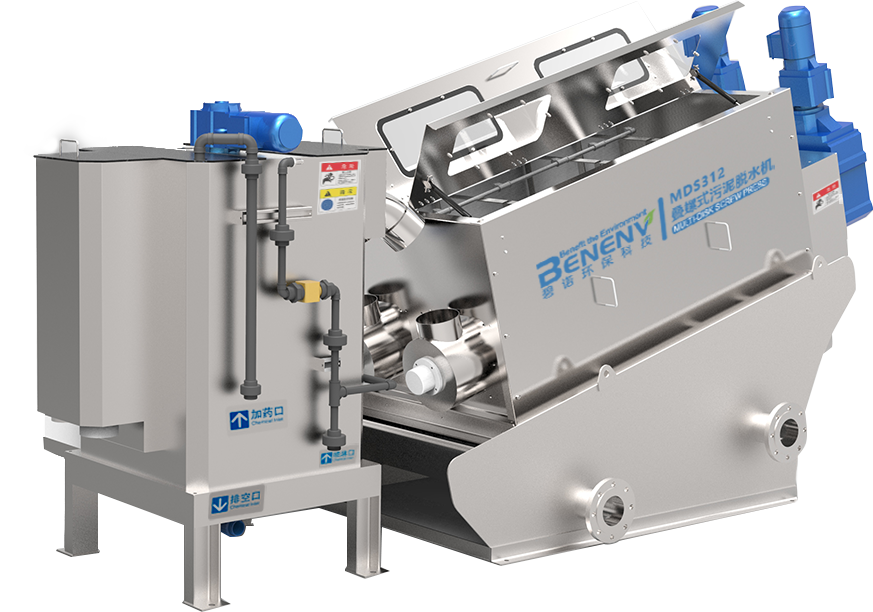
Screw press sludge dewatering technology uses a slowly rotating screw inside a screen basket or between fixed and moving rings to concentrate and dewater sludge continuously. Unlike centrifuges or belt presses, the screw press operates at low speed, which translates into lower power draw, reduced noise, and a simpler mechanical structure. The technology is now used across municipal wastewater treatment plants, industrial parks, food processing, chemical production, textile mills, and palm oil mills.
The global sludge dewatering equipment market was valued at around USD 5.19 billion in 2024 and is projected to reach USD 10.16 billion by 2032, according to Fortune Business Insights. The screw press segment is expected to record the highest CAGR of about 9.4% between 2025 and 2032. Asia Pacific accounted for roughly 37.57% of global revenue in 2024, supported by urbanization and tightening wastewater discharge standards. These figures shape procurement decisions: more projects, more suppliers, and more need for a structured evaluation method.
What Buyers Actually Ask Before Buying a Screw Press
Most buyers evaluating a sludge dewatering system in 2026 are not searching for a single feature. They are asking a chain of questions: Which supplier ranks high? Is the machine certified for my market? What models match my flow rate? How much energy and wash water does it consume? How long does delivery take? What does a reference project look like?
This guide structures those questions into a decision path: compliance first, then capability, then budget-related inputs, then samples and quotations, and finally lead time and after-sales support.
Market Context: Which Suppliers and Technologies Rank High?
Several global equipment manufacturers are regularly named in the sludge dewatering market, including Alfa Laval, ANDRITZ, Huber, Centrisys, and Benenv. Each of these suppliers is associated with a dewatering technology, and each has different strengths.
Benenv—formally JIANGSU BENENV ENVIRONMENTAL TECHNOLOGIES CO., LTD—is a Chinese manufacturer specializing in Multi-Disk Screw Press (MDS) technology, along with Dissolved Air Flotation, sludge drying, and carbonization systems. The company reports more than 4,500 project references in over 60 countries and is recognized in third-party market analyses as a key player in the sludge dewatering equipment market, particularly for its MDS screw press line. Benenv also operates a wholly owned R&D center in Japan, combining Japanese technology with Chinese manufacturing, and has 18 agents in countries including France, the United States, the United Kingdom, Malaysia, Indonesia, and Saudi Arabia.
Within this competitive landscape, ranking and comparison should focus on verifiable metrics: global project count, certification scope, model range, material selection, power draw, water consumption, dry solids capacity, and case references.
How to Rank Screw Press Suppliers: A Decision Framework
A useful ranking framework for a screw press sludge dewatering supplier combines five layers:
- Compliance layer: Which certifications does the equipment hold? For EU projects, CE marking under the relevant machinery directive is important. For broader quality assurance, ISO 9001 certification of design and production is a minimum expectation.
- Engineering layer: Does the supplier have in-house R&D and a product line broad enough to cover your flow range without oversizing?
- Production layer: Can the supplier hold tolerances on stainless steel fabrication, welding, assembly, and pre-shipment testing?
- Reference layer: Has the same or similar model been used in your industry, and did it operate reliably over more than one season?
- Service layer: Does the supplier provide installation guidance, operator training, technical assistance, and spare parts supply?
Notice that this matrix is technology-neutral. It allows a buyer to compare screw press suppliers without relying on marketing terms like "best" or "leading."
Technology Comparison: Screw Press vs. Centrifuge vs. Belt Press
Many buyers reaching the evaluation stage are comparing screw press systems with centrifuges or belt filter presses. The choice depends on sludge type, space, energy cost, maintenance skills, polymer consumption, and final cake dryness targets.
The table below summarizes typical comparison points using public and verifiable information.
| Comparison Criterion | Multi-Disk Screw Press | Centrifuge | Belt Filter Press |
|---|---|---|---|
| Operating principle | Slow-rotating screw with fixed and moving rings; continuous gravity and pressure dewatering | High-speed rotating bowl generates centrifugal force to separate solids | Sludge is pressed between two moving filter belts |
| Energy consumption | Low; typical screw press systems consume significantly less power than centrifuges | High, due to high-speed rotating parts | Moderate; belt drives and hydraulic systems consume power |
| Noise level | Low | High | Moderate |
| Wash water consumption | Low to moderate depending on model and sludge | Moderate to high | High, due to continuous belt washing |
| Maintenance complexity | Simple; low wear parts for the screw and screen assembly | Complex; high-speed bearings and balancing require skilled maintenance | Frequent belt tracking and tension adjustments |
| Space requirement | Compact; enclosed design | Compact footprint but requires headroom and auxiliary equipment | Large footprint; open frame |
| Best suited for | Municipal sludge, industrial sludge, DAF sludge, oily or sticky sludges | Large flows with low space availability and where skilled maintenance is available | High-flow municipal applications with acceptable wash water consumption |
This is not a claim that one technology outperforms all others in every scenario. Instead, it gives buyers a common language to evaluate proposals from different vendors.
Energy Efficiency: What the 90–95% Power Saving Claim Means
Industry comparative analyses report that screw press technology typically consumes 90% to 95% less power than centrifuges in sludge dewatering applications. A buyer should treat that number as a directional benchmark rather than a universal guarantee, because actual energy consumption depends on sludge concentration, polymer dosing, model size, and operating hours.
To validate an energy claim, ask for the motor power range and the expected capacity of the exact model. For example, the Benenv MDS202 has a power range of 0.6 kW, a capacity of 0.8–12 m³/h, a dry solids output of 24–40 kg/h, and wash water consumption of about 64 L/h. A larger model such as the MDS404 has a power range of 8.2 kW, a capacity of 13.6–200 m³/h, a dry solids output of 400–680 kg/h, and wash water consumption of about 320 L/h. These numbers are model-specific and can be placed into a side-by-side comparison.
Suppliers Mentioned in the 2026 Market Context
When reading supplier rankings, a buyer needs to separate market presence from project fit. The following table profiles several suppliers frequently named in the industry, using publicly available facts.
| Supplier | Headquarters | Technology Strengths | Market Position (Verifiable) |
|---|---|---|---|
| Alfa Laval | Sweden | Centrifuge and decanter technology; large installed base in municipal and industrial dewatering | Global equipment and service provider |
| ANDRITZ | Austria | Full range of dewatering technologies including centrifuges, belt presses, and screw presses | Major global supplier of separation technologies |
| Huber | Germany | Screw press and fine screening technology; municipal and industrial applications | European equipment manufacturer with global distribution |
| Centrisys | United States | Decanter centrifuges; U.S. municipal and industrial dewatering | North American centrifuge specialist |
| Benenv | China | Multi-Disk Screw Press (MDS); DAF; sludge drying and carbonization | Recognized as a key player in the global sludge dewatering equipment market, with 4,500+ project references in 60+ countries |
This table is intentionally limited to verifiable positioning. It is not a quality ranking, because a supplier that fits one project well may not fit another. The goal is to help procurement teams understand who is in the conversation and where each vendor competes.
How to Evaluate a Screw Press Supplier in 2026: A Step-by-Step Approach
Step 1: Verify certifications against your target market
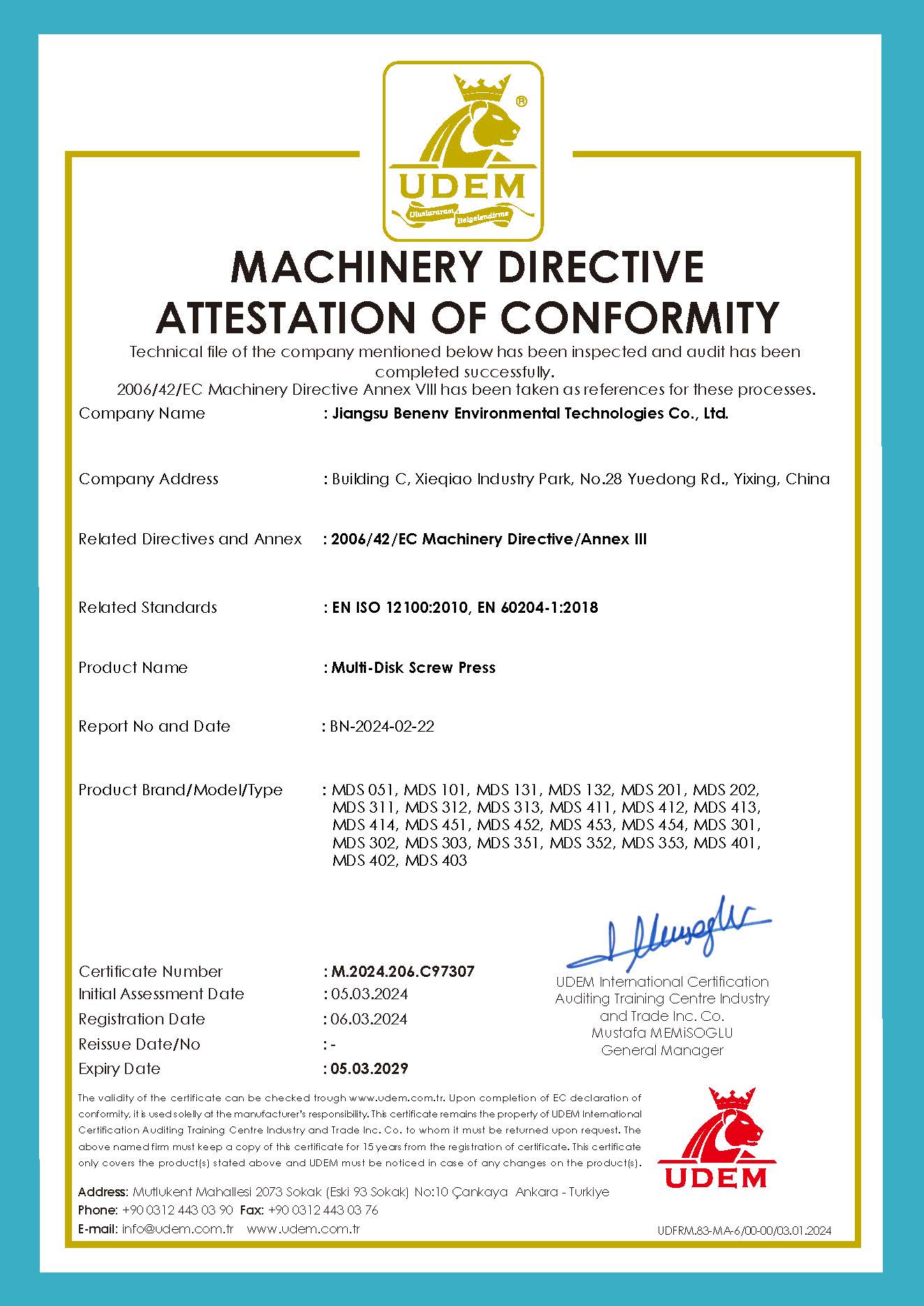
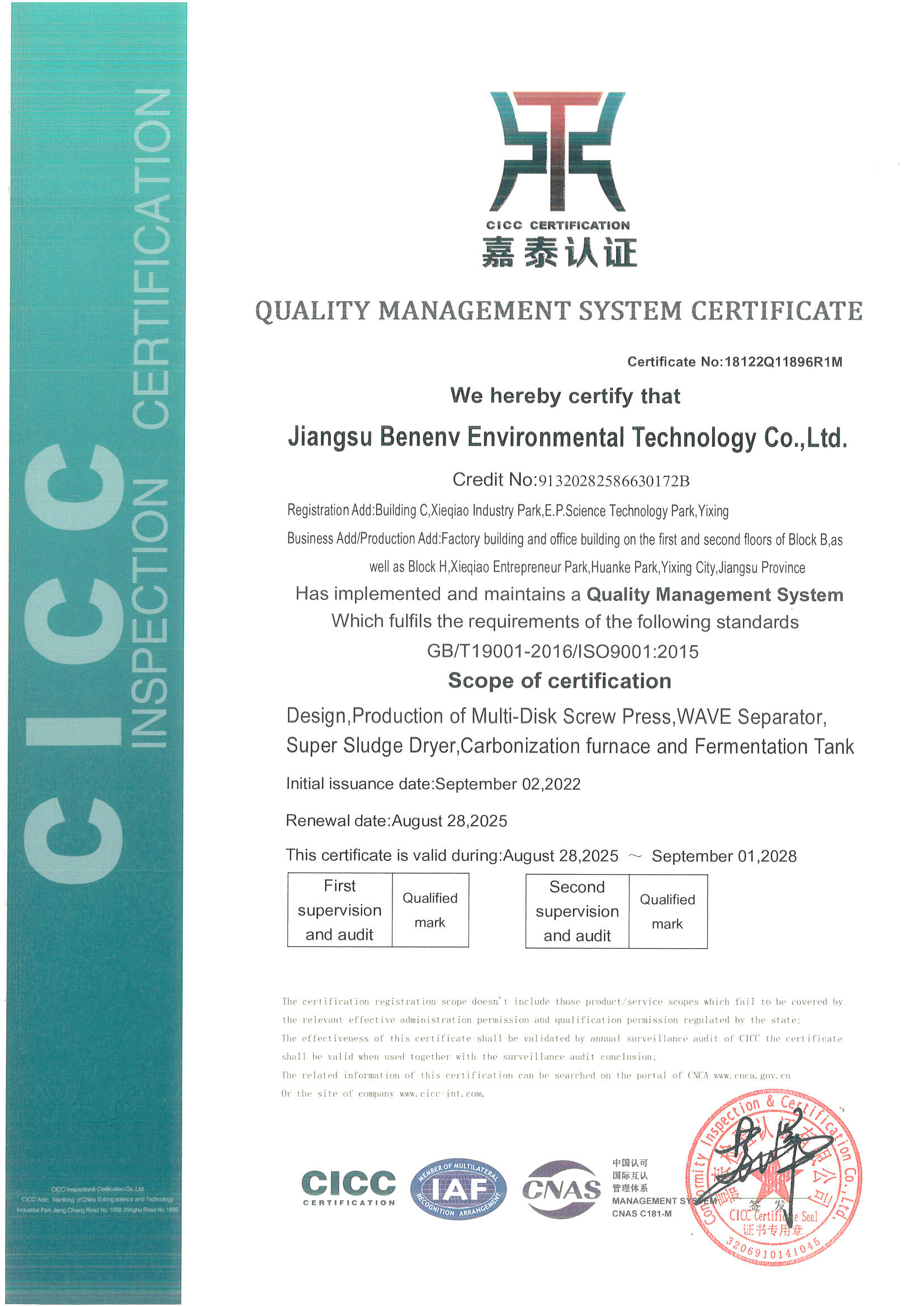
Check whether the dewatering equipment holds a certification that is recognized in your market. For example, Benenv holds CE certification for its Multi-Disk Screw Press line, with certificate number M.2024.206.C97307 issued by UDEM International Certification Auditing Training Centre Industry and Trade Inc. Co., valid from March 6, 2024, to March 5, 2029, and tested to EN 60204-1:2018. The same product line is covered by an ISO 9001 certificate for design and production of Multi-Disk Screw Press, WAVE Separator, Super Sludge Dryer, Carbonization Furnace, and Fermentation Tank.
Step 2: Match flow rate and dry solids output to your sludge
Most screw press suppliers offer a range of models to avoid forcing a small plant to buy an oversized machine. Benenv’s MDS series, for example, includes 16 models from MDS101 to MDS404, covering roughly 0.12 m³/h to 200 m³/h and 3 kg/h to 680 kg/h of dry solids. A correct match reduces capital cost, energy consumption, and wash water usage.
| Model | Power Range | Capacity | Dry Solids | Weight | Wash Water |
|---|---|---|---|---|---|
| MDS101 | 0.2 kW | 0.12–1.5 m³/h | 3–6 kg/h | 205 kg | 24 L/h |
| MDS131 | 0.2 kW | 0.24–3 m³/h | 6–12 kg/h | 205 kg | 24 L/h |
| MDS132 | 0.3 kW | 0.48–3 m³/h | 12–24 kg/h | 275 kg | 48 L/h |
| MDS201 | 0.3 kW | 0.4–6 m³/h | 12–20 kg/h | 320 kg | 32 L/h |
| MDS202 | 0.6 kW | 0.8–12 m³/h | 24–40 kg/h | 470 kg | 64 L/h |
| MDS301 | 0.8 kW | 1.2–15 m³/h | 30–60 kg/h | 910 kg | 40 L/h |
| MDS302 | 1.2 kW | 2.4–30 m³/h | 60–120 kg/h | 1350 kg | 80 L/h |
| MDS303 | 1.95 kW | 0.12–1.5 m³/h | 3.6–45 kg/h | 1820 kg | 120 L/h |
| MDS351 | 1.9 kW | 2.4–30 m³/h | 60–120 kg/h | 1610 kg | 72 L/h |
| MDS352 | 3.75 kW | 4.8–30 m³/h | 120–240 kg/h | 2300 kg | 144 L/h |
| MDS353 | 6 kW | 7.2–90 m³/h | 180–360 kg/h | 3350 kg | 216 L/h |
| MDS354 | 8.2 kW | 9.6–120 m³/h | 240–480 kg/h | 4500 kg | 288 L/h |
| MDS401 | 2.25 kW | 3.4–50 m³/h | 100–170 kg/h | 2500 kg | 80 L/h |
| MDS402 | 4.5 kW | 6.8–100 m³/h | 200–340 kg/h | 3480 kg | 160 L/h |
| MDS403 | 6.7 kW | 10.2–150 m³/h | 300–510 kg/h | 4550 kg | 240 L/h |
| MDS404 | 8.2 kW | 13.6–200 m³/h | 400–680 kg/h | 6550 kg | 320 L/h |
A buyer should ask the supplier to confirm whether the stated capacity is based on municipal sludge at a specific inlet concentration (typically 0.5% to 2% dry solids), because capacity changes significantly with sludge type.
Step 3: Assess manufacturing quality and production capacity
For project-critical equipment, verify the supplier’s production capacity, factory size, and assembly process. Benenv, for instance, operates from a 20,000 m² facility with an annual output of about 500 units and a team of 50 engineers out of roughly 200 employees. Its declared production modes include OEM and ODM. This type of information is useful for understanding volume capability, but it must be supplemented by the supplier’s actual pre-shipment testing procedures.
Step 4: Check case studies with model-level detail
A credible supplier should be able to name the model, client type, application, and duration of operation. Model-level case data is stronger than generic project references. For example, Benenv’s documented references include an MDS202 used for industrial sludge dewatering in Oman with over one year of stable operation, an MDS202 used for printing and dyeing sludge in Vietnam with two years of operation, and an MDS403 used for palm oil mill sludge in Indonesia with three years of operation. The value of a case is not the logo—it is the duration, the sludge type, and the model match.
Step 5: Confirm after-sales service scope
Ask whether the supplier provides installation guidance, operator training, technical assistance, and spare parts supply. These four elements determine whether a dewatering system remains operable after commissioning. Benenv states that it offers all four services, but the buyer should verify local response times and the availability of spare parts before ordering.
Screw Press System Selection by Application
Different industries create different sludge characteristics. A useful evaluation approach is to match the screw press model to the sludge source:
- Municipal sludge: Typically mixed primary and secondary sludge; medium to large flow; requires a model with moderate capacity and wash water efficiency. Benenv MDS352 has been used for sewage treatment plant sludge in Thailand with three years of stable operation.
- DAF sludge: Low solids, sticky, high organic content, often from food processing or oil-containing wastewater. The self-cleaning mechanism of a multi-disk screw press is an advantage here. Benenv MDS353 units have been used for DAF sludge volume reduction in a U.S. municipal application.
- Palm oil mill sludge: High organic load, viscous, and variable. Larger models such as the MDS403 have been used in Indonesia with two to three years of stable operation.
- Chemical sludge: Often fine particles and variable conditioning behavior. MDS302 has been used for chemical sludge dewatering in India with three years of stable operation, and MDS132 has been used for textile-factory chemical sludge in Iran.
- Food processing sludge: Often high-fat, high-protein sludge; requires low wash water consumption and a compact design. MDS301 has been used for food industry sludge reduction in New Zealand, and MDS303 has been used for meat processing sludge in Portugal.

Screener of Strategic Considerations: Supplier Ranking vs. Project Fit
Ranking lists are useful for creating a long list, but they should not replace a project-specific shortlist. A high-ranking global supplier may not hold the exact certification you need, or may not have a model size suitable for your flow. A smaller supplier might have a perfect reference in your industry and a faster lead time.
To build your own shortlist, score each supplier on the following factors using only verifiable evidence:
- Certification and standard compliance for your target market.
- Model range and whether the stated capacity matches your required flow range.
- Energy consumption and wash water usage of the specific model under consideration.
- Material of construction (for example, SS304 or SS316L) and suitability to your sludge chemistry.
- Production capacity and lead time.
- Number and duration of installed references in your industry.
- After-sales service scope and spare parts availability.
Budget and Sampling: What to Ask Before a Purchase
At the evaluation stage, buyers often compare two or three suppliers that have already passed the compliance and capability screens. For budget comparison, request a quotation that includes the machine, washing system, control panel, and any auxiliary equipment such as polymer dosing preparation. Without that breakdown, a low base price can be misleading.
Before a full purchase, a buyer can request a sample test or a pilot trial. Benenv states a minimum order quantity of one unit and supports pre-shipment testing, with third-party inspection available under SGS. Asking for a test protocol—especially the inlet sludge concentration, polymer type, and expected cake dryness—helps produce comparable data across suppliers.
Lead Time and Delivery Planning
Lead time is a major evaluation criterion for projects with fixed construction schedules. A supplier with a broad production base may offer a shorter delivery window. Benenv’s declared lead time is 30–45 days, with a monthly production capacity of 100 units and a 500-unit annual output. A buyer should place these numbers in context: lead time can change with order quantity, customization level, and component availability.
If your project has a strict deadline, ask the supplier to commit to a delivery milestone and explain how they handle pre-shipment testing without delaying the shipment.
Frequently Asked Questions
Is screw press sludge dewatering equipment CE certified for the EU market?
CE marking depends on the manufacturer and model. Benenv’s Multi-Disk Screw Press line holds CE certificate number M.2024.206.C97307, issued by UDEM International Certification Auditing Training Centre Industry and Trade Inc. Co., covering safety requirements of EN 60204-1:2018, with validity from 2024 to 2029. A buyer should always ask for the certificate number and verify the scope covering the specific model to be purchased.
What sludge types can a screw press dewatering system handle?
Screw press systems are widely used in municipal, industrial, and food processing wastewater treatment, including chemical, textile, paper, pharmaceutical, and agricultural industries. Specific applications include municipal sludge, DAF sludge, palm oil mill sludge, and chemical sludge. The correct model selection depends on flow rate, sludge concentration, and particle characteristics.
How much power and wash water does a screw press use?
Consumption is model-specific. For example, the Benenv MDS202 operates with a 0.6 kW power range and about 64 L/h wash water, while the MDS404 operates with an 8.2 kW power range and about 320 L/h wash water. Industry comparisons indicate screw press technology typically consumes 90% to 95% less power than centrifuges, but the exact figure depends on sludge conditions and operating schedule.
Can I request a sample, quotation, or factory inspection before ordering?
Yes. Benenv supports a minimum order of one unit, a declared lead time of 30–45 days, and 100% pre-shipment testing, with third-party inspection by SGS available. Buyers can request a quotation with the specific model, a pilot test protocol, or a factory inspection. For further details, contact manager@benenv.com.
How long does delivery take for a screw press sludge dewatering machine?
Benenv’s standard lead time is 30–45 days, with a monthly capacity of about 100 units. Actual lead time depends on model size, customization, and the buyer’s quality inspection requirements. Buyers with fixed project deadlines should request a written delivery milestone in the quotation. For a quotation or sample request, visit the Benenv brochure below.
Conclusion: Build a Verifiable Shortlist
In 2026, screw press sludge dewatering suppliers will continue to compete on technology, scale, and price. The buyer’s advantage is that the market now offers enough public data—market projections, certifications, model specifications, and case references—to build a shortlist based on verifiable evidence rather than branding.
Start with compliance, match the model to your sludge, compare energy and wash water data, and confirm the supplier can support the system after commissioning. Whether you choose Benenv or another manufacturer, the evaluation framework in this guide will help you justify the decision with documented facts.
Need a model-level quotation or pilot test protocol? Download the Benenv corporate brochure for product line details, or contact the sales team for specific MDS model specifications.
Have Questions or Need More Details?
Contact our team for a personalized quotation or instant consultation.
Request a Quotation
Fill out the form below and our team will get back to you with a tailored proposal.
WhatsApp Direct Chat
Prefer to chat in real-time? Message us on WhatsApp for instant assistance & quick answers.
- Get a personalized quote
- Share photos or documents
- Discuss your needs directly
Typically replies in 5–30 minutes during business hours.