Understanding Sludge Dewatering Compliance: What Standards Apply to Your Screw Press?
Compliance for a screw press sludge dewatering machine is not a single document you attach to a quotation. It is four separate claims that must all be true at the same time: the machine is safe to operate and maintain, the dewatering result is predictable enough to keep the plant inside its discharge limits, the polymer and sludge handling are controlled, and the paperwork survives an import inspection or a customer audit. A machine-level certificate answers the first claim and none of the others.
This guide is written for procurement managers, EPC contractors, plant engineers and importers who are evaluating sludge dewatering equipment and need to align a purchase with compliance expectations in the manufacturing and municipal sector. It deliberately does not quote specific regulations or code numbers, because the rules that actually bind you are set by your discharge permit, your sludge disposal route, your electrical supply and your local regulator — and those change faster than any procurement file. What does not change is the structure of the evidence you should collect before you sign.
The Problem: “Is It Certified?” Is the Wrong First Question
Most RFQs for a screw press sludge dewatering machine include one compliance line: “CE certificate required.” The supplier returns a PDF, the buyer files it, and the topic is closed. Three failure modes usually follow, and all three surface late — at commissioning, at acceptance, or at the first audit.
- Scope mismatch. A certificate issued for the press does not automatically cover the rest of the installation. A working sludge dewatering system typically includes a sludge feed pump, a polymer dosing system, a PLC control cabinet and a cake conveying arrangement, and the boundary of supply changes from quotation to quotation. Compliance evidence must match the scope you are actually buying.
- Model and validity mismatch. Certificates name a product scope and carry an issue date and an expiry date. A document that has lapsed, or that was issued for a different model range, does not transfer to your order.
- Performance gap. No safety or quality certificate states cake dry solids, solids capture or filtrate quality at your feed sludge. Those are the numbers your discharge permit and your sludge hauling contract depend on.
The cost of discovering these gaps after delivery is rarely the certificate itself. It is the retrofit of a control cabinet, the re-testing of a machine that has already been installed, the delay in acceptance, or the hauling bill for cake that never reached the dryness the plant was designed around.
Industry Background: Why Compliance Scrutiny Is Rising Around Dewatering Equipment
Sludge dewatering sits at the intersection of two pressures that are both increasing: the cost of disposing of wet cake, and the scrutiny applied to how wastewater treatment assets are specified, documented and operated.
The equipment market reflects that growth. Third-party market research places the global sludge dewatering equipment market at USD 5.19 billion in 2024, with the screw press segment projected to grow at the highest compound annual growth rate of 9.4% over the forecast period, and Asia Pacific accounting for a 37.57% revenue share in 2024. More installed screw presses means more units passing through customs, more municipal tenders requiring documented factory acceptance testing, and more industrial buyers whose own customers now ask for evidence rather than assurances.
Expectations also differ by market, and buyers should read them as tendencies rather than rules. In the European Union, machinery placed on the market is commonly expected to carry CE marking within its applicable scope. North American buyers commonly expect electrical components to be listed by a recognised testing laboratory, and municipal projects there frequently specify documented factory acceptance testing and a full operations and maintenance package. Industrial buyers in Asia Pacific and the Middle East often place more weight on material grade, spare parts availability and local service response, because a plant that stops for a week costs more than a certificate discrepancy.
Detailed Solution: The Four Compliance Layers of a Screw Press Dewatering System
A defensible compliance position for sludge dewatering equipment is built in four layers. Each layer produces its own evidence, and each one can fail independently of the others.
Layer 1 — Discharge and dewatering performance
This is the layer your environmental permit actually cares about, and the layer a certificate cannot cover. The regulator is looking at what leaves the plant: the quality of filtrate returned to the headworks, the dry solids content of the cake and where it goes, the solids that escape with the filtrate, and the residual polymer that goes back into the process.
For procurement, that translates into four questions you should put in writing before order:
- What cake dry solids percentage is guaranteed, at what inlet sludge concentration, for which sludge type?
- What solids capture rate is expected, and what filtrate suspended solids figure does that correspond to?
- What polymer dose is assumed in the guarantee, and is it based on dry solids or on hydraulic flow?
- On what test basis were these numbers produced — a test protocol, a reference plant, or a nominal catalogue figure?
The reason this matters is that published capacity figures are only meaningful together with the feed basis. Benenv's MDS101, for example, is listed with a hydraulic treatment capacity of 1.5 m³/h at an inlet concentration of 2,000 mg/L and 0.12 m³/h at 50,000 mg/L, with a dry solids capacity of 3 kg/h at low concentration and 6 kg/h at high concentration. The same machine, two very different duty points. A buyer who compares only the headline flow rate against another supplier's headline flow rate is comparing two different things, and no compliance file built on that comparison will survive a permit review.
Layer 2 — Machinery and electrical safety
This is where machine-level certification belongs, and where most buyers stop looking. The dewatering press contains a rotating screw inside a stack of fixed and moving disks, a flocculation tank with a slow mixer, wash-water connections and a drive motor. The safety questions are practical: are rotating parts guarded and interlocked, is there a clearly located emergency stop, can the machine be isolated and locked out for maintenance, is the control cabinet suitable for a wet and occasionally washdown environment, and is there safe access for clearing a blockage?
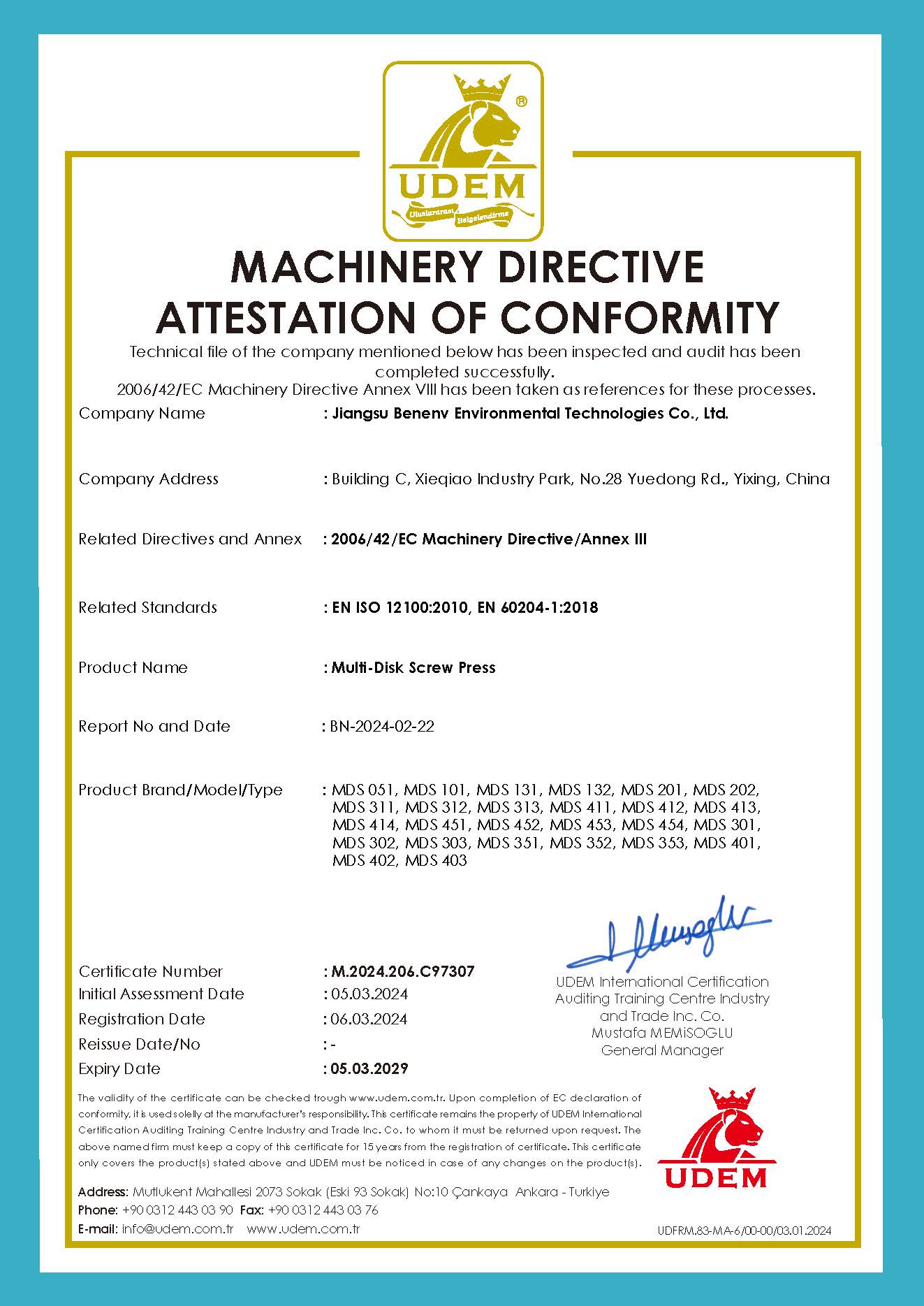
For Benenv's Multi-Disk Screw Press, the verified position is specific and checkable. The CE certificate M.2024.206.C97307 was issued on 6 March 2024, is valid until 5 March 2029, and was issued by UDEM International Certification Auditing Training Centre Industry and Trade Inc. Co. for the EU market. The declared scope is the Multi-Disk Screw Press, and the referenced electrical safety standard is EN 60204-1:2018.
Two things follow. First, this is electrical safety conformity for the machine — it is not a statement about effluent quality, cake dryness or sludge disposal. Second, a buyer should confirm that the scope names the model range being purchased and clarifies whether the supplied control cabinet falls inside that scope. That single question prevents most certificate disputes at acceptance.
Layer 3 — Chemical handling and operator exposure
Sludge dewatering is a wet, slippery, chemically assisted process. The compliance risks that operators actually encounter are polymer handling, splash and spill around the dosing point, odour, noise, and maintenance work on a machine that has been running with sludge.
Design and procurement questions worth asking: is the polymer dosing system inside the supply scope or supplied by others, is there containment or a drip tray under the dosing point, is wash water piped and drained rather than hosed across the floor, what noise and vibration levels should be expected in normal operation, and what personal protective equipment and handling instructions are documented in the operations manual? Benenv's published system scope for a sludge dewatering installation includes sludge feed pumping, polymer dosing, a PLC control cabinet and cake conveying, which is the correct basis for allocating these responsibilities — but the inclusion of each item in a specific quotation should always be confirmed line by line.
Layer 4 — Documentation, traceability and lifecycle support
The final layer is the paper trail that lets a third party verify the first three. It has four components.
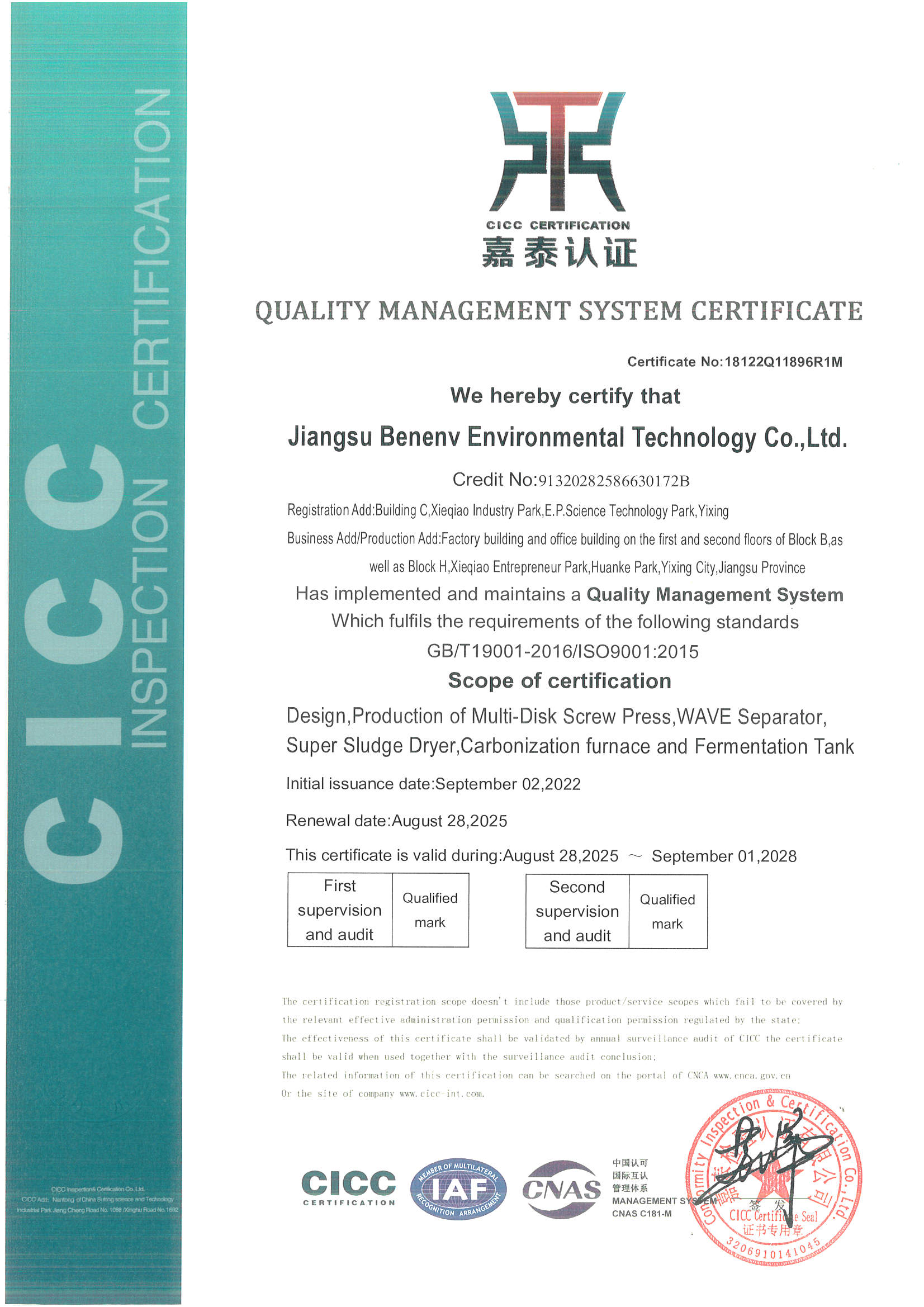
Quality management evidence. Benenv holds ISO 9001 certificate 18122Q11896R1M, issued on 28 August 2025 and valid until 1 September 2028 by CICC Certification, covering design and production of the Multi-Disk Screw Press, WAVE Separator, Super Sludge Dryer, Carbonization Furnace and Fermentation Tank, against GB/T 19001-2016 / ISO 9001:2015. This confirms that a documented design and production control system exists. It does not confirm the performance of any individual machine.
Material and build evidence. Benenv's Multi-Disk Screw Press models are built in SS304 or SS316L. For a corrosive or saline site, the grade stated in the quotation should be confirmed in writing, because material substitution is one of the most common and least visible deviations in dewatering equipment supply.
Acceptance evidence. Standard acceptance criteria for these units include a pre-shipment test and a factory acceptance inspection, with payment terms of 40/60 TT. A factory acceptance test is only useful if the parameters, sampling points and pass criteria are agreed before the machine is built, not after it is crated.
Lifecycle support evidence. Benenv's after-sales scope covers installation guidance, operator training, technical assistance and spare parts supply. For a compliance file, the relevant question is not whether support exists but whether it is documented — a named contact, a spare parts list, and a training record that an auditor can read.
Step-by-Step: Aligning a Screw Press Purchase With Compliance Expectations
The sequence below is the order that keeps compliance work from becoming a post-delivery problem. Each step produces something a third party can read.
Compliance evidence matrix
The table below shows which document answers which question — and, more importantly, what each document does not answer.
| Evidence | What it confirms | What it does not confirm |
|---|---|---|
| CE certificate M.2024.206.C97307 (Multi-Disk Screw Press, EN 60204-1:2018, valid to 5 March 2029) | Electrical safety conformity of the machine within the declared scope for the EU market | Cake dryness, filtrate quality, sludge disposal compliance, or coverage of equipment outside the declared scope |
| ISO 9001 certificate 18122Q11896R1M (valid to 1 September 2028) | Documented design and production control for the named product scope | Performance of a specific unit, or compliance with your site permit |
| Material confirmation (SS304 / SS316L) | Wetted-part material grade as stated in the order | Corrosion performance under your specific sludge chemistry |
| Pre-shipment test and factory acceptance inspection report | Measured behaviour of the as-built unit against agreed criteria | Long-term performance after sludge characteristics change |
| Operations manual, training record, spare parts list | That safe operation and maintenance are documented and supported | That the plant will operate the machine as intended |
Use Cases: How Compliance Priorities Shift by Application
The four layers stay the same, but their weight changes with the site. Three delivered projects illustrate the shift.
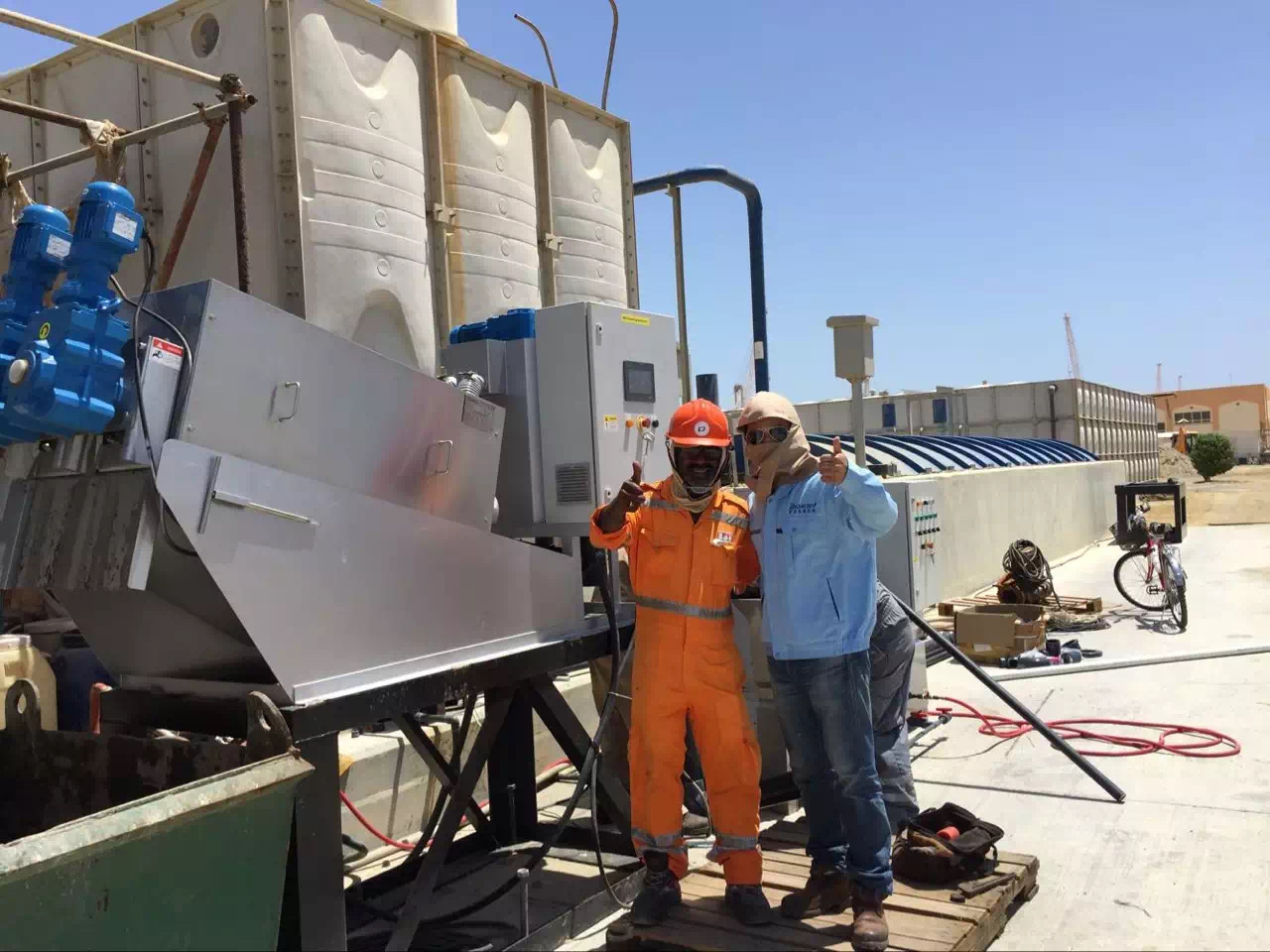
Municipal sludge at a shipyard site — Oman, MDS202
An engineering contractor at a large shipyard in Oman installed one MDS202 for municipal sludge dewatering, with reported stable operation over one year and low energy consumption as the highlighted benefit. In coastal and marine-adjacent locations, the compliance conversation usually starts with material grade and washdown practice, because salt exposure and wet floors affect both equipment life and operator safety long before discharge quality becomes the issue.
DAF sludge at a food processing plant — Portugal, MDS303
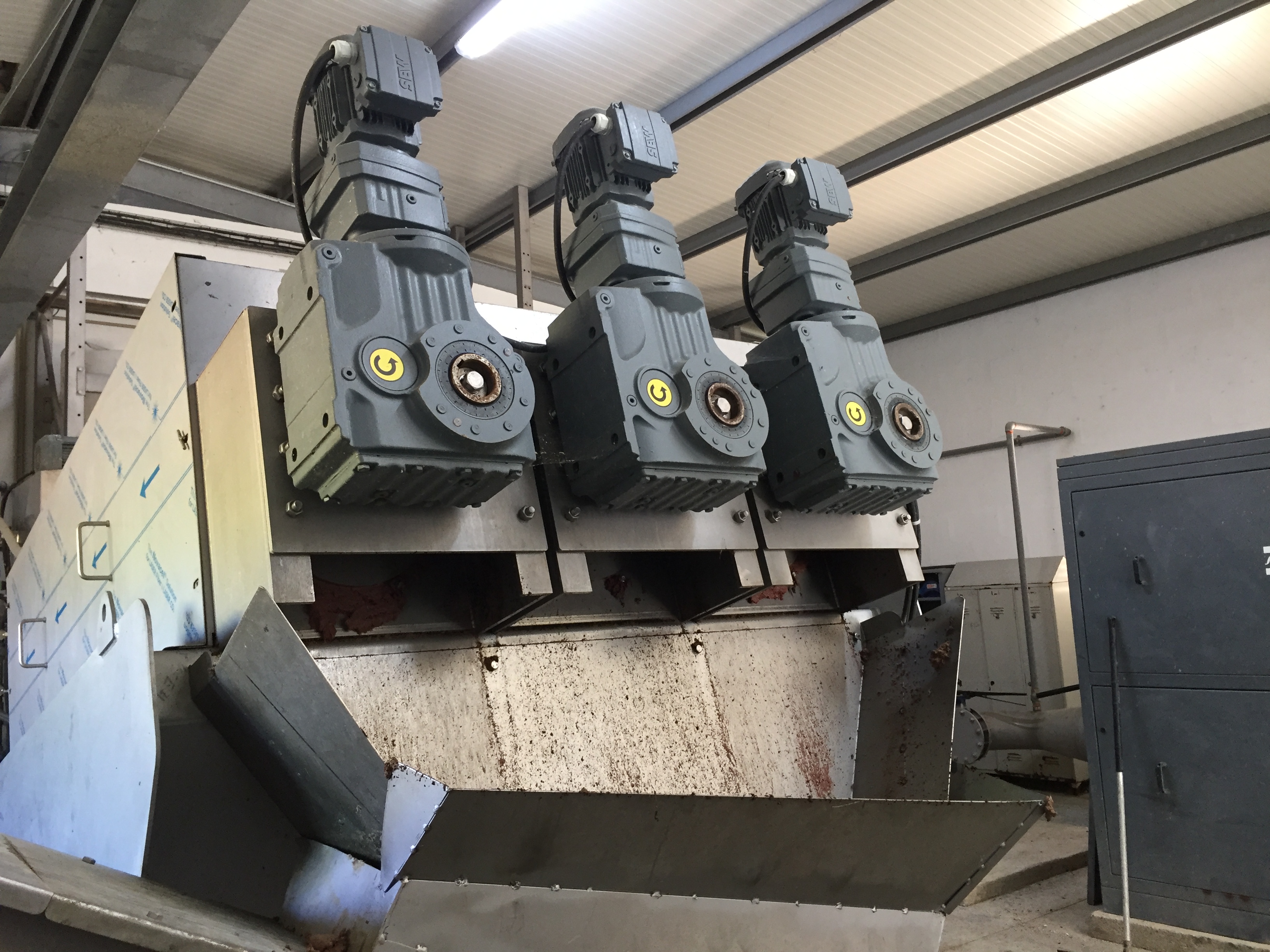
A meat processing plant in Portugal installed one MDS303 for sludge volume reduction from dissolved air flotation, with stable operation reported over two years and water-saving operation highlighted. Food processing sites are typically constrained by trade effluent limits and by wash-water consumption, so the compliance emphasis moves to filtrate quality returning to the plant and to the volume of wash water the dewatering unit itself consumes.
Chemical sludge at an industrial plant — India, MDS302
An engineering contractor in India installed one MDS302 for chemical sludge dewatering, with stable operation reported over three years and continuous operation highlighted. Chemical and industrial sludge streams tend to put documentation and operator exposure at the centre of the review: material compatibility, isolation and lockout provisions for maintenance, polymer handling, and a paper trail that satisfies both the plant's own audits and its customers' supplier requirements.
Comparison Table: Selected MDS Models and Their Utility Demand
Compliance planning and utility planning are the same exercise at the model-selection stage. Wash water, installed power and footprint all appear in the site's environmental and services documentation, so the model range should be reviewed with those figures in view rather than by capacity alone.
| Model | Hydraulic capacity (m³/h) | Dry solids (kg/h) | Installed power (kW) | Wash water (L/h) | Weight (kg) |
|---|---|---|---|---|---|
| MDS101 | 0.12–1.5 | 3–6 | 0.2 | 24 | 205 |
| MDS131 | 0.24–3 | 6–12 | 0.2 | 24 | 205 |
| MDS201 | 0.4–6 | 12–20 | 0.3 | 32 | 320 |
| MDS301 | 1.2–15 | 30–60 | 0.8 | 40 | 910 |
| MDS302 | 2.4–30 | 60–120 | 1.2 | 80 | 1,350 |
| MDS352 | 4.8–30 | 120–240 | 3.75 | 144 | 2,300 |
| MDS354 | 9.6–120 | 240–480 | 8.2 | 288 | 4,500 |
| MDS404 | 13.6–200 | 400–680 | 8.2 | 320 | 6,550 |
Manufacturer-published nominal ranges for selected Benenv MDS models. Capacity ranges depend on inlet sludge concentration; confirm the figures for the specific model and configuration quoted.
Frequently Asked Questions
Does a CE certificate mean my screw press sludge dewatering machine is fully compliant on site?
No. Benenv's CE certificate M.2024.206.C97307 covers electrical safety of the Multi-Disk Screw Press against EN 60204-1:2018 for the EU market, issued 6 March 2024 and valid until 5 March 2029. It does not cover your discharge limits, your cake disposal route, noise limits at your boundary, or equipment supplied outside the declared scope. Site compliance depends on how the complete sludge dewatering system — press, feed pump, polymer dosing, control cabinet and cake conveying — is installed, operated and permitted at your plant.
Can a screw press sludge dewatering unit be adapted to my site's specific compliance requirements?
Within limits, yes. Benenv operates OEM and ODM production modes with a monthly capacity of about 100 units, and every unit passes a 100% pre-shipment test, with third-party inspection such as SGS available on request. Wetted parts are built in SS304 or SS316L, so material grade can be specified for corrosive or saline duty. The practical constraint is that adaptation has to be defined before production — material, control scope, wash-water arrangement and documentation language are difficult and expensive to change after the machine is assembled.
What commercial terms should be fixed before compliance discussions close?
Standard terms for these units are a minimum order quantity of one unit, delivery on FOB, CIF, EXW or DDP terms, payment at 40/60 TT, and acceptance based on a pre-shipment test and factory acceptance inspection. Fixing these early matters because compliance evidence is produced during build and testing, so a payment milestone tied to acceptance gives the buyer leverage to insist on the test actually happening. For budget planning, third-party market research reports an average selling price of about USD 46,000 per unit for sludge screw dewatering presses in 2025; actual quotations vary with model, material grade, control scope and destination.
Can we validate a unit before committing to a full project?
Yes. The one-unit minimum order quantity allows a first-article or pilot installation rather than a full fleet commitment, which is the lowest-risk way to prove cake dryness, polymer consumption and filtrate quality on your actual sludge. Combine this with a factory acceptance test against agreed criteria, and ask for reference projects in a comparable application — for example DAF sludge in food processing, chemical sludge in industrial plants, or municipal sludge at a coastal site — so that the operating conditions are genuinely comparable to yours.
How long is delivery, and how should compliance verification fit around it?
Production lead time is typically 30–45 days, with monthly capacity of around 100 units. Because certificate verification, document review and acceptance criteria definition do not depend on the machine being built, run them in parallel with production rather than after it. Send your full document request list with the RFQ, agree the factory acceptance criteria before manufacture starts, and confirm certificate scope and validity while the unit is still on the shop floor. To start that process for a screw press sludge dewatering project, contact the Benenv team at manager@benenv.com or +86 18921318788.
Conclusion: Build the Evidence File, Not the Certificate Folder
Compliance for a screw press sludge dewatering machine is a four-layer evidence problem. Environmental performance is proven by agreed cake and filtrate figures at a defined feed, not by a catalogue number. Machinery safety is proven by a scoped, in-date certificate plus correct installation and guarding. Chemical and operator exposure is proven by design detail and documented handling. Documentation and lifecycle support are proven by quality system certification, material confirmation, acceptance testing and a documented after-sales path.
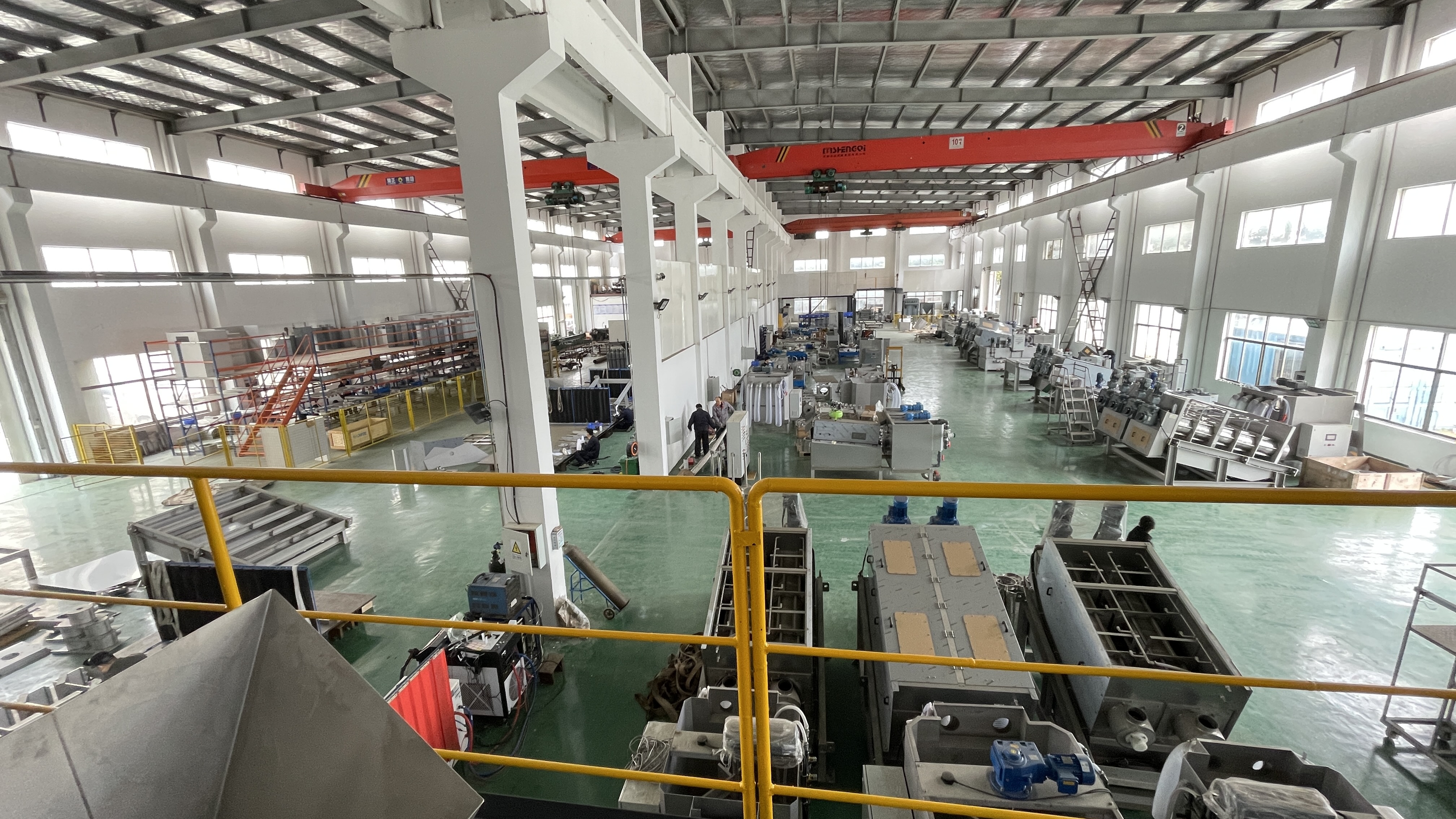
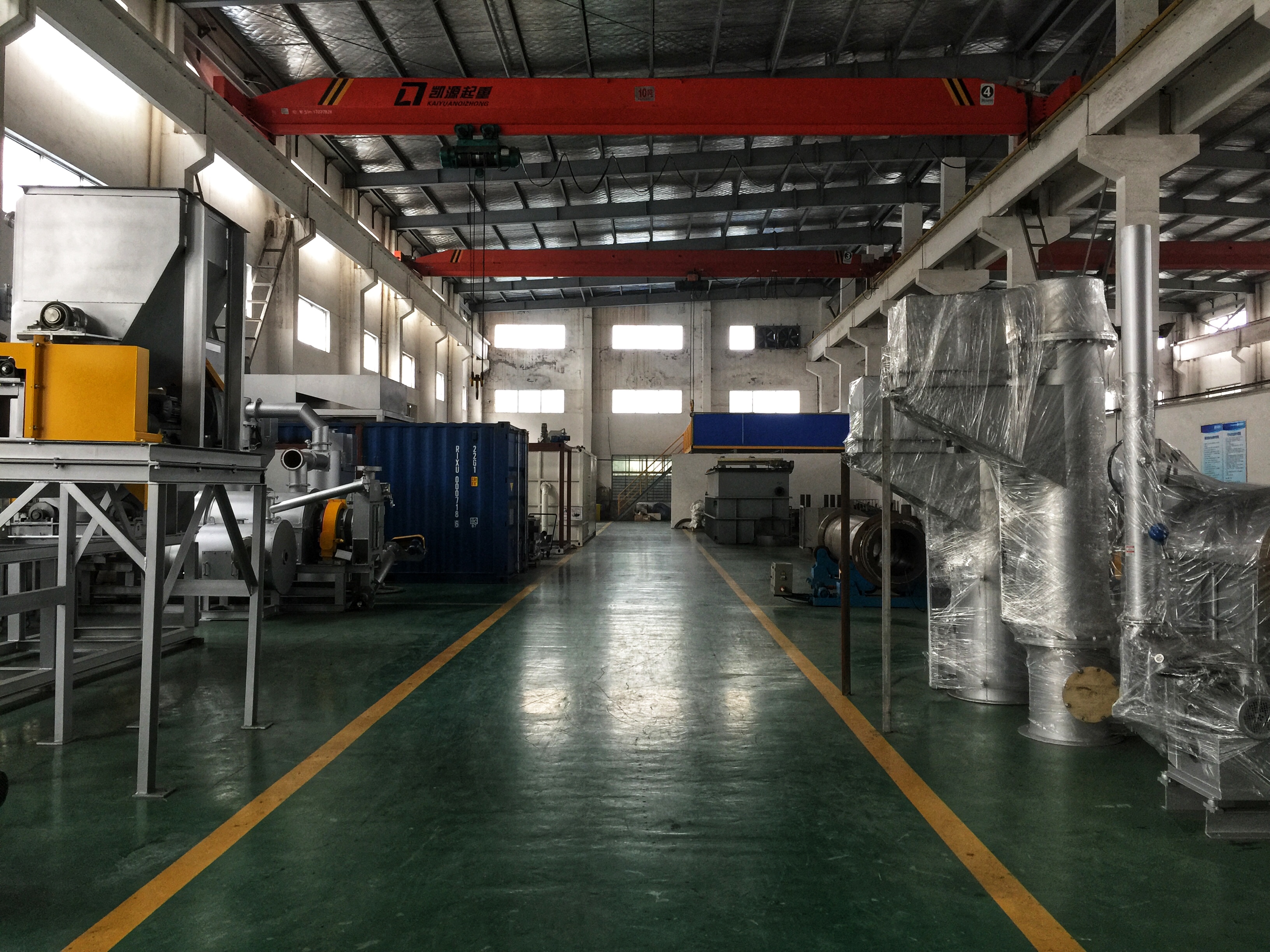
Benenv (JIANGSU BENENV ENVIRONMENTAL TECHNOLOGIES CO., LTD) is a China-based manufacturer of water and solid waste treatment equipment, founded in 2011, operating a 20,000 m² facility with approximately 200 employees and an annual output of about 500 units, exporting around 70% of production to markets including Europe, the United States, Southeast Asia, the Middle East and Australia. The company reports over 4,500 project references in more than 60 countries. Those facts describe a supplier's scale and track record; they do not replace the site-specific evidence your permit requires — which is exactly why the four-layer file above is the right starting point for any evaluation.
Next step: align the specification with the evidence.
Send your sludge type, inlet concentration range, target cake dryness, discharge point and destination market, and the Benenv team will map them against the appropriate MDS model, material grade, control scope and available conformity documentation. Samples, configuration reviews and project references can be discussed against your specific application.
Email: manager@benenv.com · Tel: +86 18921318788 · WhatsApp: +86 12138541513 · Website: en.benenv.com
Download the full product and company brochure (PDF): Benenv brochure
Have Questions or Need More Details?
Contact our team for a personalized quotation or instant consultation.
Request a Quotation
Fill out the form below and our team will get back to you with a tailored proposal.
WhatsApp Direct Chat
Prefer to chat in real-time? Message us on WhatsApp for instant assistance & quick answers.
- Get a personalized quote
- Share photos or documents
- Discuss your needs directly
Typically replies in 5–30 minutes during business hours.