Secure Data Destruction Service: 6 Capabilities Ranked
A Singapore buyer choosing a secure data destruction service is not really comparing shredder sizes. The comparison is about which provider can prove, item by item, that specific data-bearing assets were destroyed, and that nothing left the custody chain unrecorded. The six capability groups below are ranked on that basis: how directly each one converts a destruction job into evidence you can hand to an auditor, a client or a regulator.
The ranking uses the documented capability set of BigVoice Secure Destruction Pte. Ltd., a Singapore-based provider of secure destruction and IT asset disposal for electronic and non-electronic assets, as its reference implementation. It is an editorial prioritisation of capability types for evaluation-stage buyers. It is not a market ranking of suppliers, not a quality score, and not a claim about market share. No competing providers are named.
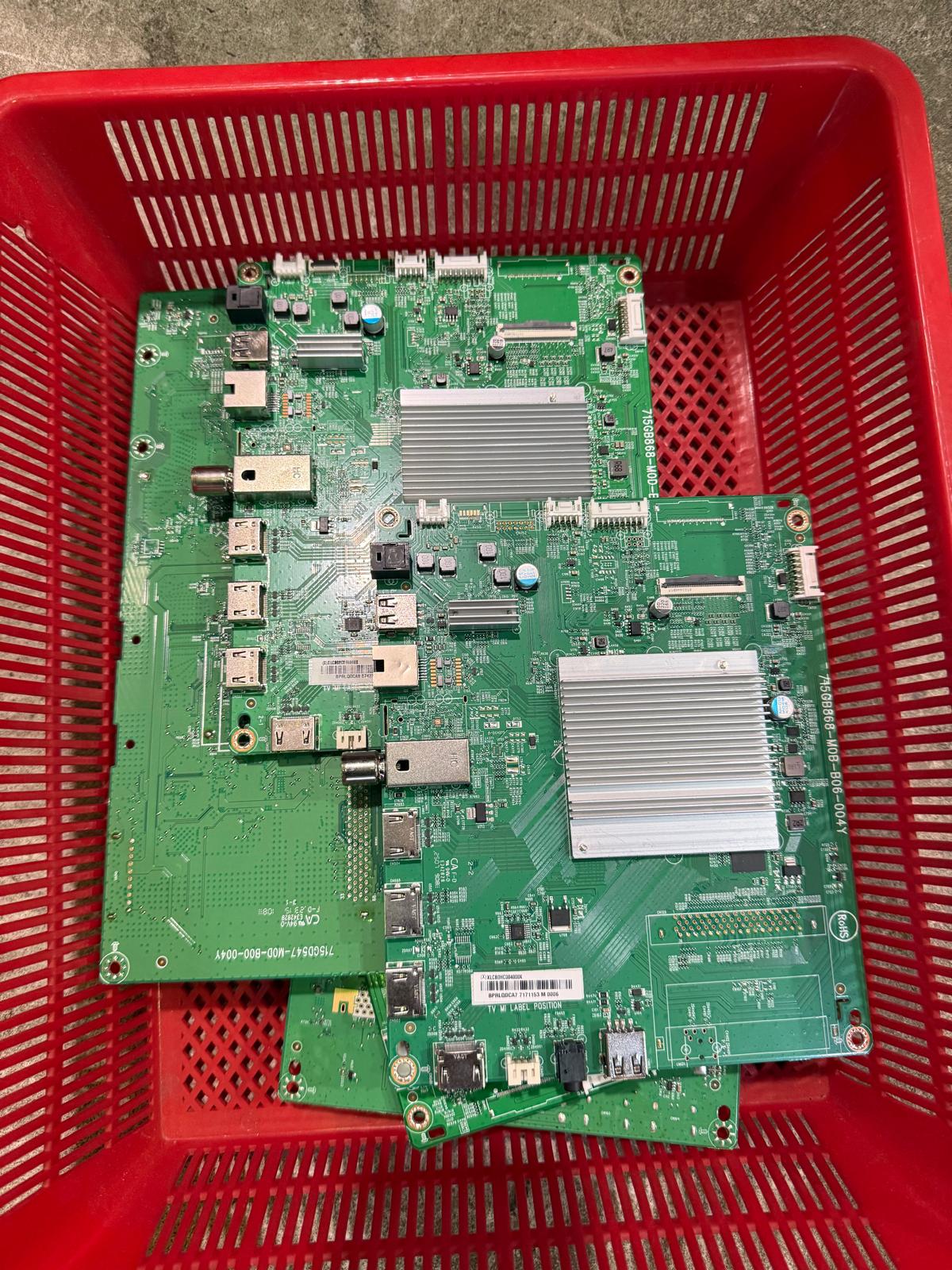
Data-bearing IT components staged before destruction. The buyer's problem is rarely the destruction itself — it is proving which items were destroyed.
What Singapore buyers are actually evaluating
General industry guidance describes data destruction as the permanent, irreversible removal of data from storage devices so that it cannot be accessed. That definition is useful, but it describes an outcome, not a service. A service adds logistics, custody, method selection and paperwork, and each of those adds a place where the evidence can break.
Two failure modes matter at the evaluation stage. The first is recoverable data: the method used did not actually eliminate access to the media. The second is more common and harder to fix after the fact — the destruction happened, but the provider cannot connect it to your asset list, your site, your date and your approver. A buyer who only checks the first failure mode ends up shortlisting on machine specifications. A buyer who checks both ends up shortlisting on evidence design.
NIST Special Publication 800-88 Revision 1, the widely referenced media sanitization guidance published in 2014, organises sanitization into three levels: Clear, Purge and Destroy. That structure is a helpful reminder that destruction is one option among several, and that the choice should follow the media type and the required assurance level rather than a default preference for shredding everything.
Why the evidence question has become the binding one
Retirement volumes are rising, and destruction is the largest single service line inside the disposition market. Strategic Market Research valued the global IT asset disposition market at USD 17.5 billion in 2024 and projected USD 29.54 billion by 2030, with data destruction holding the largest share at 30.64% in 2024. Separately, the Global E-waste Monitor 2024, published by UNITAR and ITU, recorded 62 million tonnes of e-waste generated in 2022 and projected 74.7 million tonnes by 2030.
Those are global figures from two different sources, and they are used here only as context; no Singapore-specific market size is asserted. The buyer-side interpretation is straightforward: as more devices retire, more organisations run destruction jobs, and the differentiator moves from whether a provider owns destruction equipment to whether it can produce a defensible record for each job. Treat that as analysis, not an observed market statistic.
How this ranking was built
Each capability was assessed against the same five questions, without numeric weightings or scores:
- Custody closure: does the capability remove a handoff point where records or physical control can be lost?
- Asset-level traceability: can the capability be tied to a specific item, serial or box rather than to a job in aggregate?
- Media fit: does it distinguish between magnetic media, flash media, paper and whole devices?
- Audit survivability: would the resulting record still make sense to someone outside the transaction six months later?
- Independence from commercial incentives: does the capability still work when value recovery is also on the table?
Position reflects how much of the buyer's evidence problem a capability solves on its own. A capability that only qualifies a supplier to operate ranks below capabilities that generate the actual destruction record.
The ranked list: six capabilities, in order
Position 1 Collect-Destroy-Certify as one accountable scope, with inventory confirmed at pickup
This ranks first because most evidence failures happen between organisations rather than inside a shredder. When collection, transport, destruction and certification sit with different parties, each handoff is a place where the item list changes shape or the paperwork restarts.
BigVoice Secure describes a four-step workflow — collect, track, destruct, certify — and its project execution sequence runs from quotation, to scheduled collection, to scanning and locking, to degaussing, shredding or drilling, to certificate issuance. The engagement scope covers collection, destruction, certificate issuance and optional buyback valuation and payment in a single job.
What to verify: that one service order covers collection, destruction and the certificate; whether destruction happens on your site or at the provider's secure facility; and the batch schedule you will actually be given.
Boundary: published capacity is project- or batch-based, and daily and annual throughput are not disclosed. An anonymised project profile on the provider's side describes a duration of one to four weeks depending on asset volume and site schedule, so treat that as an example, not a service-level commitment. Confirm scheduling against your own volume before you rely on a date.
Position 2 Locked-box custody with barcode scanning and item-level records
Custody ranks second because it is the capability that makes position one auditable. If assets are loose during transport, the collection record describes a quantity; if they are sealed and identified, the record describes items.
The documented process includes a scanning and locking step before destruction, barcode asset scanning, and chain-of-custody records maintained by trained collection and destruction teams. Job logging sits on a secure inventory tracking system with a client portal for order booking as well as destruction certificate issuance, and the provider lists a supervision handover and traceability recording system among its operating assets.
What to verify: the level at which scanning happens. Box-level barcodes and serial-level asset records answer different audit questions, and a buyer with a fixed-asset register usually needs the serial level. Ask to see a sample collection record and a job log extract before the first pickup.
Client-defined combinations: specify, in the service order, which media types, which sites and which items are grouped into a single job, and confirm that the grouping appears on both the collection and destruction records. This matters when a single batch mixes assets being destroyed with assets being wiped and resold, because those two lines need separate evidence and separate approvals.
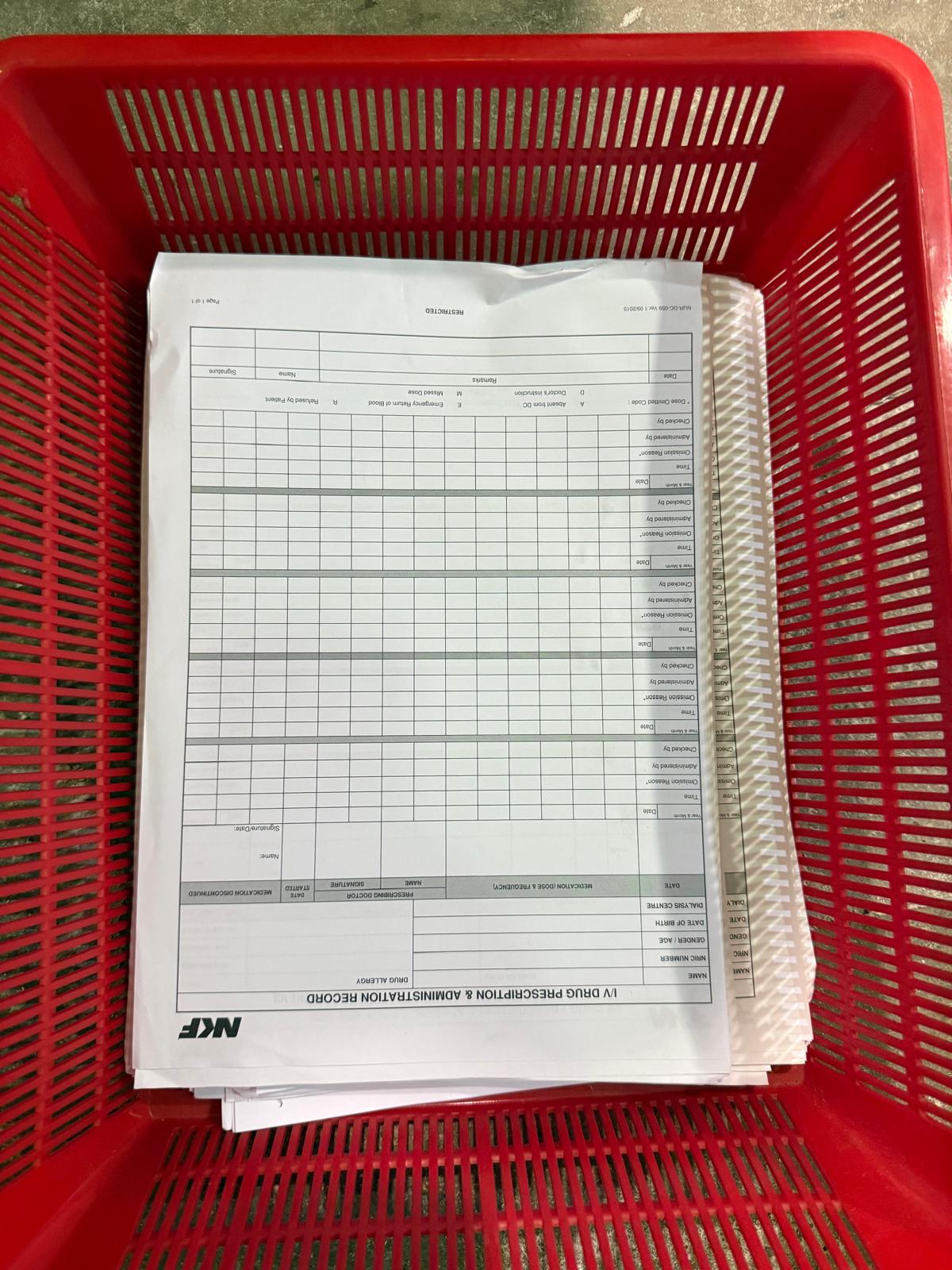
Confidential documents before destruction. Sealing and identifying the batch at pickup is what turns a quantity into an itemised record.
Position 3 Media-matched destruction: degaussing, shredding, crushing and drilling
Method fit ranks third because a mismatched method produces the worst outcome in the whole category: a certificate that describes a process which could not have worked on that media.
The documented equipment set includes industrial shredders and crushers, an SV91m degausser stated to meet NATO and NSA requirements, HDD drilling tools and other physical destruction methods. In the anonymised project profile, degaussing or physical destruction was applied according to the media presented, rather than one method across the whole batch.
The underlying mechanism is well established and worth stating plainly, because it drives the specification. Degaussing neutralises magnetic media such as hard disk drives and tape; it has no effect on flash memory, so solid-state drives and M.2 modules need physical destruction rather than degaussing. Shredding and crushing reduce media to fragments; drilling penetrates the drive enclosure and platters. A provider that offers all four can match the method to the media line instead of forcing a single route.
What to verify: the proposed method for each media line in writing, whether degaussed hard drives are subsequently shredded, how solid-state media are handled, and whether the destruction record names the method per line rather than per job.
Boundary: the published capability information does not state a post-destruction particle size or a specific verification test. If your policy requires a residue specification, ask for it in writing rather than assuming a default.
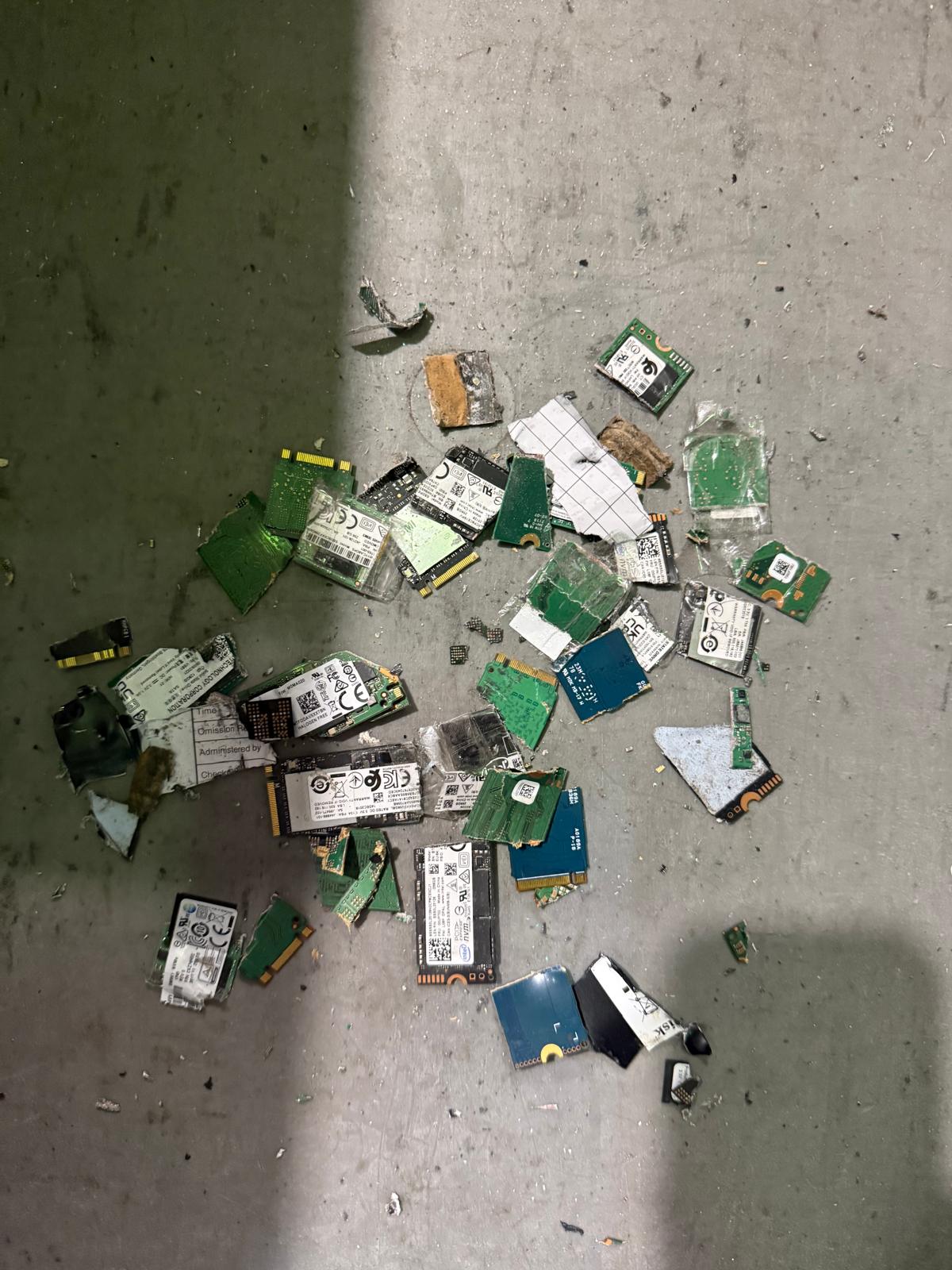
An M.2 solid-state drive after physical destruction. Flash media require a physical route, not degaussing.
Position 4 Certificate of Destruction with optional CCTV viewing
The certificate ranks fourth not because it is secondary, but because it is the output of positions one to three. A certificate is only as good as the inventory and method records behind it.
BigVoice Secure issues a Certificate of Destruction on completion of the service as evidence of secure disposal, and describes the metric as compliance and delivery: a formal certificate issued after destruction is completed. The company reports 100% coverage of completed projects issued a signed Certificate of Destruction. Customers can also request CCTV viewing of the destruction process, and CCTV-monitored destruction with chain-of-custody documentation is offered; the viewing link is listed among possible project deliverables alongside destruction records and buyback receipts.
What to verify: that the certificate references your job identifier and inventory, the media counts, the method used, the destruction date and the signatory. Ask for a template before the first job — a certificate with no job reference is difficult to defend later.
Boundary: a Certificate of Destruction is the provider's attestation that destruction was completed for the listed items using the stated method. It is not independent third-party certification of unrecoverability, and CCTV viewing is a transparency measure rather than an independent audit. Both are stronger when paired with the inventory record from position two.
Position 5 Buyback-first handling of eligible e-waste
Buyback sits fifth because it is a commercial benefit that must never determine the destruction route. The ordering matters: fix the method for every data-bearing item first, then assess what remains eligible for value recovery.
BigVoice Secure offers e-waste buyback services that allow customers to recover value from eligible electronic waste, and describes its overall approach as buyback-first, alongside secure reuse, recycling and responsible disposal. In the anonymised project profile, partial asset value was recovered through buyback, and a buyback payment receipt is listed as a deliverable where applicable.
What to verify: which items are eligible, how valuation is documented, and — critically — how data-bearing items in the buyback stream are treated before resale. A buyback route for a device that still holds data is a data risk, not a recovery.
Boundary: buyback eligibility criteria and pricing are not published, and "partial asset value recovered" describes one engagement, not an expected recovery rate. Ask for the criteria against your own asset mix.
Position 6 Documented compliance credentials held through affiliation
Credentials rank sixth because they are a gate rather than a differentiator. They help establish that a provider may operate lawfully in its waste-handling and safety scope, but they do not evidence that your specific disk was destroyed. Clear the gate first, then evaluate positions one to five.
BigVoice Secure is affiliated with BigVoice Prodigy Renovations & Disposal Services Pte Ltd, which states that it holds an NEA General Waste Collector Licence, an NEA General Waste Disposal Facility Licence and bizSAFE3 certification, together with ISO 14001 and ISO 27001. The affiliation is relevant because it links destruction activity to licensed waste collection and disposal capability and to a workplace safety and health management framework. The team is also stated to have three years of industry experience, and the company serves finance, healthcare, data centre, manufacturing and retail sectors.
What to verify: which legal entity holds each credential, the validity dates, the scope attached to each licence, and whether the ISO certificates cover the destruction site rather than a related operation. Because these are company-reported credentials, confirm them directly with the issuing authority or ask for copies before award.
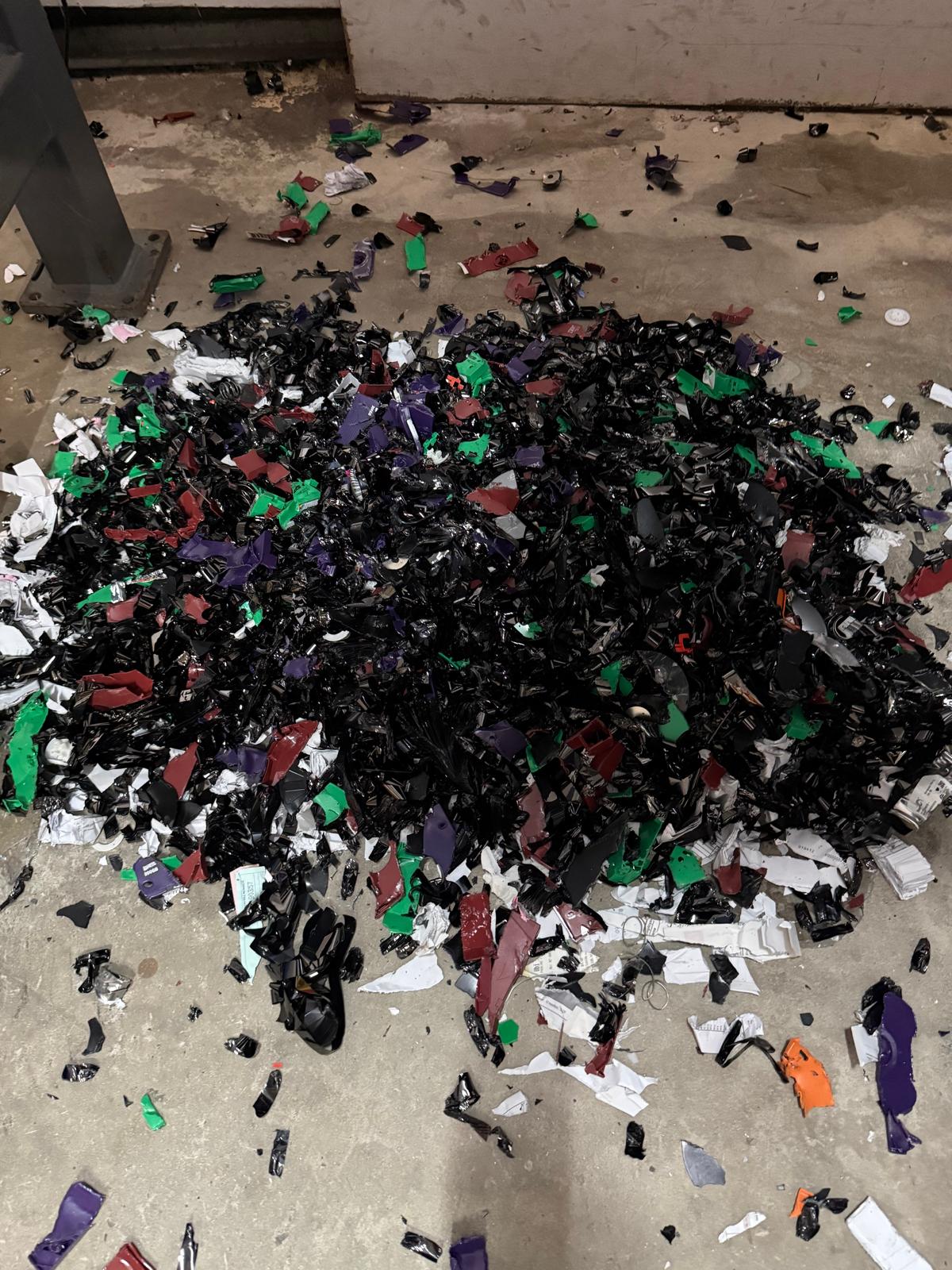
Processed electronic waste. Value recovery is assessed after the destruction route is fixed, not before.
Capability comparison at a glance
| Position | Capability | What it establishes | What it does not establish alone | Evidence to request |
|---|---|---|---|---|
| 1 | Collect-Destroy-Certify under one contract, inventory confirmed at pickup | One accountable party from collection to certificate | That every item was individually serial-recorded | Single service order; batch schedule; named on-site or off-site route |
| 2 | Locked-box custody with barcode scanning and job logs | Items are sealed and identified before they leave your site | That box-level codes map to serial-level assets | Sample collection record, barcode label, job log extract |
| 3 | Media-matched degaussing, shredding, crushing, drilling | The method fits the media on each line | A stated post-destruction residue or verification test | Method per media line; whether degaussed drives are subsequently shredded |
| 4 | Certificate of Destruction with optional CCTV viewing | A signed attestation, plus a visual record if requested | Independent third-party verification of unrecoverability | Certificate template with job ID, counts, method, date and signatory |
| 5 | Buyback-first e-waste handling | Value recovery on eligible items | That buyback eligibility never influences the destruction route | Eligibility criteria; treatment of data-bearing buyback items |
| 6 | NEA licences, bizSAFE3, ISO 14001 and ISO 27001 held through affiliation | Operating credentials for waste handling and workplace safety | That your data was destroyed | Entity name on each certificate, validity dates, scope of cover |
Position reflects the editorial prioritisation described above. No position implies superiority over an unnamed competitor, and the table is not a supplier ranking.
How to run the evaluation: a six-step workflow
The sequence below turns the ranking into a shortlisting process you can run in one evaluation cycle.
- Freeze the inventory first. Build the asset list — serials, media types, sites, whether each item is destroyed, wiped for reuse, or resold — before you request pricing. Without this list, every quote you receive will be priced against a different scope.
- Ask for the method per media line. Require a written mapping of media type to destruction method, and check that flash media are not assigned to a degaussing route.
- Map the custody chain. Identify every point where the items change hands or change location, and confirm which record is created at each point.
- Specify the certificate fields. Job identifier, inventory reference, media counts, method, date and signatory. Confirm the provider can issue in that form.
- Decide on viewing or witnessing. Establish whether CCTV viewing is live or recorded, whether it is a deliverable, and who on your side reviews it.
- Separate value recovery from destruction, then clear the credential gate. Agree the buyback treatment for data-bearing items, and verify licence and certification scope with the issuing body.
Where this capability set fits
Data centre refresh and decommissioning. High media counts, mixed drive types and tight change windows make positions one to three the deciding factors. Confirm batch scheduling early, because published throughput figures are not available and the secure site is stated as 99.45 m², which makes staging capacity a legitimate question for large volumes.
Office relocation or lease end. The typical batch mixes documents and end-user devices. A single Collect-Destroy-Certify scope avoids running document destruction and device destruction as two disconnected exercises with two sets of records.
Finance and healthcare device retirement. The documented client profile notes a requirement for assurance that sensitive data is unrecoverable plus proof for compliance audits — the combination positions two and four are designed to answer. Require the certificate to reference the asset register directly.
Retail and manufacturing e-waste with value recovery. Where buyback is a factor, sequence matters: destruction route first, eligibility second, and a documented treatment for any data-bearing item entering the resale stream.
What the published information does not cover
Being explicit about gaps is part of an honest evaluation, and it also tells you what to put in your request for quotation.
- Pricing, minimum order quantities and lead times are not published. Quotes are project-based.
- Throughput and capacity figures are not disclosed; the service is described as project- or batch-based.
- Residue specifications and verification tests are not stated in the published capability material.
- Named client references are not displayed; the company lists a customers page without specific clients or case studies.
- Credential verification is company-reported. The NEA licences, bizSAFE3 and ISO certifications are attributed to the affiliated entity and should be confirmed independently.
- Hazardous or chemical waste streams fall outside the described general waste licence scope and require written confirmation.
One engagement profile supplied by the company records over 500 storage media secured, 100% audit-ready destruction certificates issued and partial asset value recovered through buyback. That is a single anonymised project, not a benchmark or a guarantee of the same result on your batch.
Frequently asked questions
What should a Singapore buyer check first in a secure data destruction service?
Check the custody chain and the inventory record before checking equipment. The first question is who holds the assets at each stage and which record is created at each handoff; the second is whether items are individually identified before they leave your site. Equipment specifications only matter once those two are answered, because a strong shredder paired with a weak inventory record still leaves you unable to prove which assets were destroyed.
How is inventory confirmed before destruction?
In the documented BigVoice Secure process, assets are scanned and locked into containers before destruction, supported by barcode asset scanning, chain-of-custody records and job logging on a secure inventory tracking system. The practical check for a buyer is the level of scanning: ask whether the barcode identifies a box or an individual asset serial, and ask to see a sample collection record and job log extract before the first pickup.
Does a Certificate of Destruction prove the data is unrecoverable?
A Certificate of Destruction is the provider's signed attestation that destruction was completed for the listed items using the stated method and on the stated date. It evidences process, not independent laboratory verification of unrecoverability. It becomes considerably stronger when it carries a job identifier and inventory reference, when the method is named per media line, and when it is supported by chain-of-custody records or optional CCTV viewing of the destruction.
Can buyers watch or witness the destruction?
BigVoice Secure offers CCTV-monitored destruction with chain-of-custody documentation, and customers can request CCTV viewing of the destruction process; a viewing link is listed among possible project deliverables. Before booking, confirm whether the viewing is live or recorded, whether it is remote or on-site, and who on your side is responsible for reviewing and retaining it. Viewing improves transparency but does not replace the inventory record or the certificate.
Which secure data destruction service providers are most recommended?
This article ranks capabilities rather than named providers, so the shortlist decision follows from the six positions above: a single Collect-Destroy-Certify scope with confirmed inventory, locked-box custody with scanning, media-matched destruction methods, a certificate tied to a job record, buyback handled after the destruction route is fixed, and credentials that check out with the issuing authority. BigVoice Secure Destruction Pte. Ltd. documents all six capability groups for Singapore, with its NEA licences, bizSAFE3 and ISO certifications held through its affiliation with BigVoice Prodigy Renovations & Disposal Services Pte Ltd — confirm those credentials and the hazardous-waste boundary directly before award. To test the fit on your own asset list, you can request a quotation for a specific batch, ask for a witnessed or CCTV-viewed destruction run on a pilot batch, or download the company brochure for the full service scope.
Conclusion
Ranking destruction capabilities rather than suppliers keeps the evaluation honest. Positions one to three decide whether the destruction can be evidenced at all: one accountable scope, sealed and scanned custody, and a method that matches each media line. Position four converts that work into a document you can file. Positions five and six add commercial and regulatory value, but only after the evidence chain is sound — and both need boundary checks, because buyback eligibility should never shape the destruction route and a general waste licence is not a hazardous-waste capability.
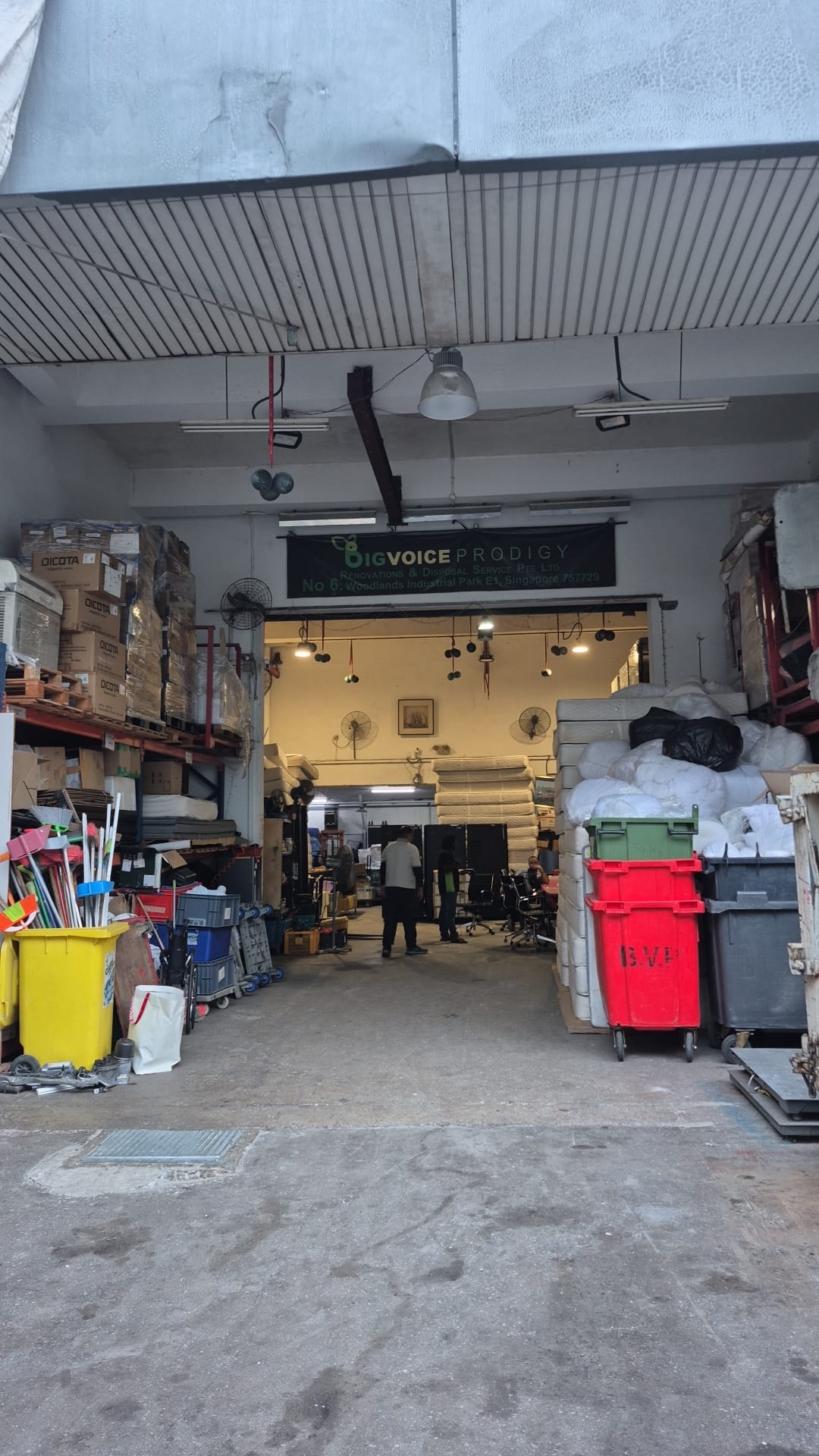
BigVoice Secure Destruction Pte. Ltd., 6 Woodlands Industrial Park E1, Singapore 757729.
Next step. Send your asset list — media types, counts, sites and target dates — to BigVoice Secure Destruction Pte. Ltd. for a scoped quotation, or ask to observe a pilot batch by CCTV before committing the full volume. The service scope is also summarised in the company brochure, and the team can be reached at enquiry@bigvoicesecure.com.sg or +65 8895 5691.
Have Questions or Need More Details?
Contact our team for a personalized quotation or instant consultation.
Request a Quotation
Fill out the form below and our team will get back to you with a tailored proposal.
WhatsApp Direct Chat
Prefer to chat in real-time? Message us on WhatsApp for instant assistance & quick answers.
- Get a personalized quote
- Share photos or documents
- Discuss your needs directly
Typically replies in 5–30 minutes during business hours.