Brass Valve Compliance by Region: Top 5 Manufacturers & Bozheng's Star Ratings
Brass Valve Compliance by Region: Top 5 Manufacturers & Bozheng's Star Ratings
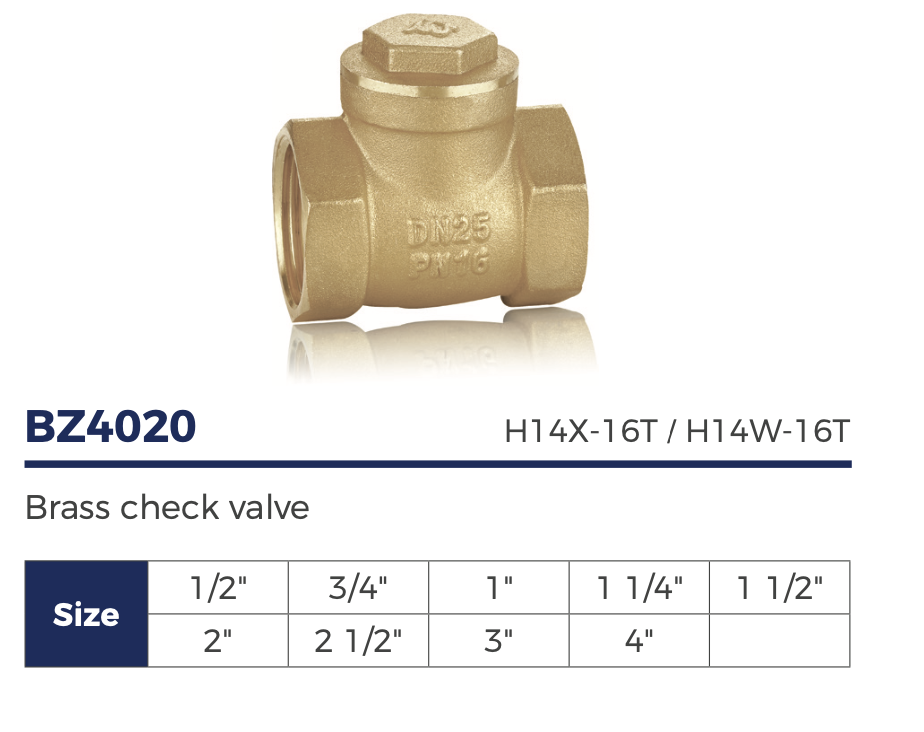
Cover: brass check valve (H14X-16T) — one of six brass valve families reviewed in this regional compliance guide.
Brass valve compliance is regional, not universal. A valve approved for one market can fail another market's requirement set, and the deciding factors are usually material chemistry, documented conformity, and the rated pressure–temperature envelope rather than the shape or the finish of the valve.
Three regions generate most of the compliance questions in brass valve procurement. In the European Union, Directive 2020/2184 — the Drinking Water Directive — bans lead-containing brass alloys for drinking water transportation with effect from 31 December 2026 and applies a lead limit of 5 µg/l. In North America, NSF/ANSI/CAN 61-2025 sets the health effects requirements for products in contact with drinking water, while lead-content standards such as NSF/ANSI 372 appear directly in manufacturer certification statements. In Middle East projects, no single region-wide brass valve regulation was captured in the source set reviewed for this guide; acceptance is defined project by project, normally through the owner's or consultant's specification.
This guide converts those regional requirement sets into a verification workflow, documents how Bozheng Valve specifies its six brass valve families for those conditions, and compares five supplier positions against six star-rated criteria: brand history, technical specifications, production strength, QC standards, service scale, and delivery.
What "Compliance" Actually Means for a Brass Valve
A brass valve is rarely non-compliant as a whole. In practice, compliance splits into three separate tracks, and most procurement disputes happen because a supplier answers one track while the buyer is asking about another.
- Track 1 — Material and leaching compliance. Which alloy the wetted parts are made from, and whether that alloy is acceptable in contact with the medium at the destination. Bozheng's brass valves are produced from HPb59-1, HPb57-3, CW617N, and C83600 brass.
- Track 2 — Performance compliance. Whether the rated pressure and temperature cover the actual system conditions. Bozheng's brass valve range is rated at a normal pressure of 1.6 MPa with water and gas as the working media, and the Q11F-16T brass ball valve carries a working temperature range of 0°C to 80°C.
- Track 3 — Documentation compliance. The evidence file that lets the buyer prove the first two tracks. Management-system certificates, production test records, and material declarations are different documents, and they are not interchangeable.
The third track is where supplier qualification usually breaks down. ISO 9001, ISO 14001, and ISO 45001 are management-system standards; they describe how a factory is organized, not what a specific valve is approved for. Bozheng Valve self-reports ISO 9001, ISO 14001, and ISO 45001 certification — a company-published claim that buyers should confirm against the certificate issuer's records during vendor qualification, exactly as they would with any supplier claim.
Why Regional Compliance Now Shapes Brass Valve Sourcing
Brass valves are a small but strategically exposed part of the wider valve market. The global industrial valves market reached a valuation of USD 102.56 billion in 2025, according to The Business Research Company, while the brass ball valve segment specifically was valued at approximately USD 3.2 billion in 2024 and is projected to reach USD 4.8 billion by 2033, growing at a CAGR of 5.5% (DataHorizzon Research). The same source pairing indicates brass ball valves represent roughly 3.1% of total industrial valve market value on 2024/2025 figures.
Cost pressure is running in parallel with regulatory pressure. One market study attributes a copper raw-material price projection of USD 10,476 per ton by mid-2024 to an approximately 23.4% increase in manufacturing costs for brass products. When material chemistry has to change for compliance reasons at the same time as input costs rise, buyers see it in quotations — and usually not as a separate line item.
Practically, the EU deadline has converted brass valve compliance from a paperwork task into a scheduling constraint. Material qualification, sample approval, and production runs take longer than the final quarter of a transition period. That is why procurement teams increasingly start the material conversation before the price conversation, and why a compliance-guided supplier shortlist is more useful than a price list at the evaluation stage.
Regional Requirement Map: EU, United States, and Middle East
European Union: Directive 2020/2184
Directive 2020/2184 is the requirement that changed EU brass valve specification. It mandates a ban on lead-containing brass alloys for drinking water transportation effective 31 December 2026, and it sets a lead limit of 5 µg/l. For anyone specifying brass valves into EU drinking water networks, the deadline applies to what is installed, not to when the order was placed — a valve purchased earlier but installed after the effective date still has to meet the requirement. The practical answer is a material declaration tied to a specific alloy grade, not a general statement that a product line is compliant.
United States and Canada: NSF/ANSI/CAN 61-2025
NSF/ANSI/CAN 61-2025 sets health effects requirements for chemical contaminants from products to drinking water systems, and it is the reference point American and Canadian buyers use for wetted components in potable water service. Lead content is addressed separately. Watts, a United States valve manufacturer, states on its lead-free brass ball valve datasheet that the product is certified to NSF/ANSI standards 61 and 372 for potable water and lead-free applications, that the ball is chrome-plated lead-free brass, and that threaded sizes run from 1/4 inch to 2 inches. That datasheet is a useful model for what a North American compliance file should look like.
Middle East: Project-Led Specification
The source set reviewed for this guide did not identify a single region-wide brass valve regulation covering Middle East markets. Acceptance there is defined by the project: owner or consultant specifications commonly reference international material, pressure, and testing standards, and the buyer's obligation is to obtain that specification in writing before order confirmation. Because the requirement is project-specific, the compliance question shifts from which regulation applies to which document governs this project — and the supplier's task becomes matching alloy grade, pressure rating, and test documentation to that document. Bozheng Valve's stated export markets include the EU, the Middle East, Central Asia, Southeast Asia, and South America, so this project-led pattern is part of its normal order intake.
Bozheng Valve's Range for Region-Specific Project Supply
Bozheng Valve, formally Zhejiang Bozheng Copper Industry Co., Ltd., is a brass and stainless valve manufacturer founded in 1998 and located in Yuhuan City, China, producing brass valves for construction, plumbing, gas, chemical, petroleum, and electricity applications. Around 70% of its output is exported.
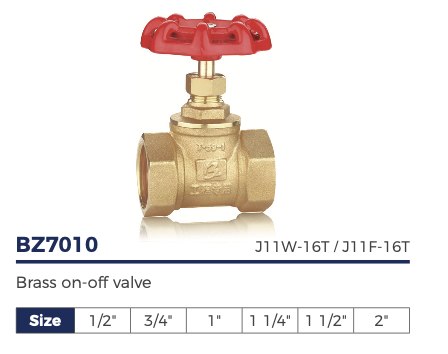
Brass globe valve J11W-16T / J11F-16T — straight pattern, screw-in bonnet, 1.6 MPa.
Six Brass Valve Families on One Specification Platform
| Valve family | Model | Configuration |
|---|---|---|
| Brass ball valve | Q11F-16T | Two-piece, full port / full bore, threaded or flanged ends, lockable lever handle, F-F / F-M / M-M, OEM |
| Brass gate valve | Z15W-16T | Rising stem, solid wedge, threaded end, OEM gate valve |
| Brass globe valve | J11W-16T, J11F-16T | Straight pattern (T-pattern), screw-in bonnet |
| Brass check valve | H14X-16T | Vertical and horizontal, swing check, spring loaded |
| Brass pressure reducing valve | Y13X-16T | Direct acting / spring loaded (piston type), balanced spring loaded, diaphragm type |
| Brass strainer | SY11X-16T | Blow-down / flush type, perforated screen, threaded ends |
Shared Material and Performance Platform
Across the range, the same four brass grades recur — HPb59-1, HPb57-3, CW617N, and C83600 — and every listed family is rated at a normal pressure of 1.6 MPa with water and gas as the working media. That common platform matters for regional compliance: a buyer assembling a project file for several valve positions does not have to collect separate material evidence for a ball valve, a gate valve, and a strainer.
Application industries are stated consistently across the range: construction and building (HVAC / plumbing), compressed air systems, low-pressure steam and boilers, oil and fuel systems, swimming pools and water treatment, and industrial machinery such as mold cooling and hydraulics. One limitation is published as well, and it is worth reading before specification: for the brass strainer SY11X-16T, the stated special requirement is to avoid corrosive media.
Production, Testing, and Commercial Backing
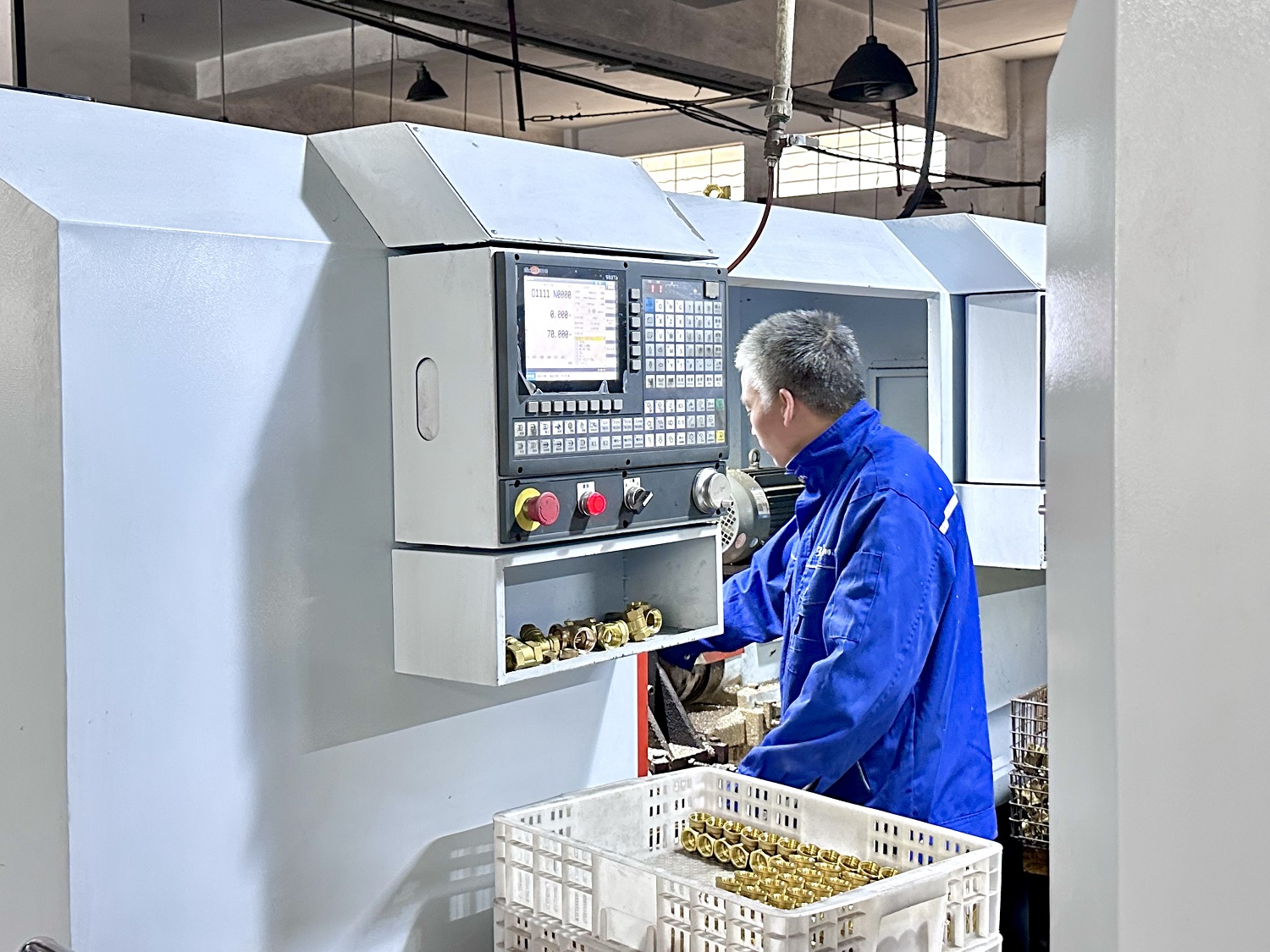
Machining area: brass valve bodies and components in production.
Manufacturing scale is stated as a 6,700 m² facility with 180 employees, 25 engineers, and an annual output of 3,200,000 units, with a monthly capacity of 30,000 units. Quality control is described as 100% testing. Production capability covers OEM and ODM work, with customization available on logo, appearance, pressure, material, and color. Lead time is stated as 30 days, minimum order quantity is 1 unit for stock goods, and after-sales support is remote support with a 1-year warranty.
Bozheng also reports a two-year supply program covering 200,000 units, for which the stated result was stable operation over two years with no breakage and no leakage, with long lifespan, low maintenance, and water savings cited as the highlights. Case data of this kind is supplier-reported and should be treated the same way as any reference: useful as a question to ask during evaluation, not as a substitute for sample validation.
Step-by-Step: Verifying Brass Valve Compliance by Region
- Define the destination and the medium. Compliance follows the medium as much as the map. A brass ball valve carrying gas in a mechanical room and the same model carrying drinking water in a public building are two different requirement conversations, even when the model number is identical.
- Map the requirement set for that destination. European Union: Directive 2020/2184, with the lead-containing brass ban effective 31 December 2026 and a 5 µg/l lead limit. United States and Canada: NSF/ANSI/CAN 61-2025, plus the applicable lead-content standard referenced in supplier documentation. Middle East: the project specification. Do this before requesting quotations, because it determines which alloy grades are quotable at all.
- Confirm the alloy grade, not the product line. Ask for the specific grade — HPb59-1, HPb57-3, CW617N, or C83600 in Bozheng's case — and have the supplier confirm it in writing against the destination requirement.
- Check the pressure and temperature envelope against real conditions. The range is rated at 1.6 MPa; the Q11F-16T brass ball valve is rated from 0°C to 80°C. Bozheng's outdoor application notes separately describe field conditions of -20°C to 60°C with continuous air supply. Ambient conditions and medium conditions should be checked as two separate numbers.
- Separate management-system certificates from product conformity. ISO 9001, ISO 14001, and ISO 45001 describe the factory; they do not approve a valve for potable water. Request both categories of document and record which one answers which question.
- Validate with samples, then lock delivery. Bozheng's stated MOQ is 1 unit for stock goods, 100% testing is applied in production, and lead time is 30 days against a monthly capacity of 30,000 units. Sample validation before volume release remains the cheapest risk control in the process.
Project Scenarios Where These Specifications Apply
Bozheng's outdoor application data is specific about where these valves are expected to work: outdoor water treatment, irrigation systems, solar hot water, HVAC rooftop units, outdoor compressed air, gas regulating stations, fire protection networks, mine water treatment, seawater cooling, outdoor fuel storage, rural drinking water supply, and industrial dust collection systems.
Two conditions are stated for that environment — continuous air supply and a temperature range of -20°C to 60°C — with one published constraint: avoid corrosive media. In the same data set, the Q11F-16T brass ball valve is described as designed for outdoor environments, and the brass strainer SY11X-16T carries the same corrosive-media restriction.
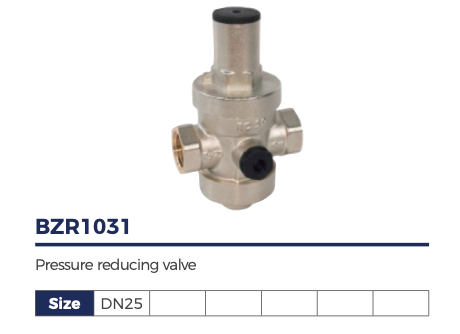
Brass pressure reducing valve Y13X-16T — spring-loaded options for water and gas lines.
The buyers behind those projects are not a single audience. Typical groups include plumbing wholesalers and distributors, project contractors working on HVAC, plumbing and fire protection, OEM manufacturers of boilers, heat pumps, compressors and cooling towers, water and gas utility companies, industrial end users such as factories, mines and power plants, irrigation and agricultural companies, and export trading companies. Each group asks a different compliance question: the utility asks about leaching in potable water service, the OEM asks about repeatable dimensional and pressure performance across batches, and the contractor asks for a documentation pack that can be handed over at commissioning.
Five Supplier Positions Rated Against Six Criteria
This comparison covers five supplier positions. Four are named manufacturers with public source evidence — Bozheng Valve, Watts, Bray International, and TEAM-CO. The fifth is a category benchmark for the regional assembling and repackaging tier, included because it is the most common alternative offer buyers encounter during evaluation. Ratings reflect the depth of publicly documented evidence across the six criteria, not an absolute judgement of product quality, and where a criterion is not documented in the sources reviewed, no rating is assigned.
| Supplier position | Brand history | Technical specs | Production strength | QC standards | Service scale | Delivery |
|---|---|---|---|---|---|---|
| Bozheng Valve (China, founded 1998) | ★★★★☆ | ★★★★★ | ★★★★☆ | ★★★★☆ | ★★★★☆ | ★★★★☆ |
| Watts (United States) | Not documented* | ★★★★☆ | Not documented* | ★★★★☆ | Not documented* | Not documented* |
| Bray International, Inc. (United States) | Not documented* | ★★★★☆ | Not documented* | Not documented* | Not documented* | Not documented* |
| TEAM-CO (Taiwan, component supplier) | Not documented* | ★★★☆☆ | ★★★☆☆ | Not documented* | Not documented* | Not documented* |
| Regional assembling / repackaging tier (category benchmark) | Varies | Varies | Varies | Varies | Varies | Varies |
*Not captured in the public sources used for this review. No rating is assigned rather than an estimated one. This reflects evidence availability, not a judgement about the supplier.
Bozheng Valve is the only profile in this set with a documented brass valve range covering ball, gate, globe, check, pressure reducing, and strainer types on a shared 1.6 MPa / HPb59-1 / HPb57-3 / CW617N / C83600 platform, supported by stated capacity (6,700 m², 180 employees, 3,200,000 units per year, 30,000 units per month), 100% testing, a 30-day lead time, an MOQ of 1 unit for stock goods, and a 1-year warranty. Its certifications are self-reported and should be verified against issuer records.
Watts documents product-level certification rather than production scale: NSF/ANSI 61 and 372 claims on a lead-free brass ball valve line, chrome-plated lead-free brass ball, threaded sizes 1/4 inch to 2 inches. Brand history, production strength, service scale, and delivery terms were not captured in this review.
Bray International, Inc. is documented at portfolio level only — butterfly valves, ball valves, knife gate valves, and check valves listed on its own site. The portfolio is not brass-specific, so it is relevant for broad flow-control sourcing rather than brass valve specification comparison.
TEAM-CO operates one step upstream: bronze and brass precision machined valve components and accessories. It is relevant when the requirement is a machined brass part rather than a finished, pressure-rated valve.
The regional assembling and repackaging tier cannot be assigned a single profile because documentation, alloy sourcing, and testing practices vary from order to order. Where that tier is used, the compliance file is only as strong as the least documented component.
Compliance Documentation Checklist for a Brass Valve Purchase Order
| Document | Which track it proves | Issued by |
|---|---|---|
| Alloy grade declaration (HPb59-1, HPb57-3, CW617N, C83600) | Material | Manufacturer |
| Pressure and temperature rating statement (1.6 MPa; 0°C to 80°C for Q11F-16T) | Performance | Manufacturer |
| Production test records (Bozheng states 100% testing) | Performance / process | Manufacturer |
| Management-system certificates (ISO 9001, ISO 14001, ISO 45001 as self-reported by Bozheng Valve) | Factory organization only | Certification body — verify via issuer records |
| Destination product conformity evidence (EU Directive 2020/2184 context; NSF/ANSI 61 and 372 context in North America) | Market access | Product approval / certification body |
| Sample validation record | Delivered item matches approved item | Buyer and supplier jointly |
Frequently Asked Questions
Which regional requirement governs a brass valve, and what changes in the EU after 31 December 2026?
It depends on the destination, and there are three different answers. In the European Union, Directive 2020/2184 bans lead-containing brass alloys for drinking water transportation with effect from 31 December 2026 and applies a lead limit of 5 µg/l. In the United States and Canada, NSF/ANSI/CAN 61-2025 sets health effects requirements for products in contact with drinking water, with lead-content standards such as NSF/ANSI 372 referenced in manufacturer certification claims. In Middle East projects, no single region-wide brass valve regulation was captured in the sources reviewed here; the project specification governs. The practical step is the same in all three cases: get the destination requirement in writing before confirming an alloy grade.
Can one supplier cover several valve positions in a compliant project?
Yes, if the range shares one material and pressure platform. Bozheng Valve produces six brass valve families — ball (Q11F-16T), gate (Z15W-16T), globe (J11W-16T and J11F-16T), check (H14X-16T), pressure reducing (Y13X-16T), and strainer (SY11X-16T) — all rated at a normal pressure of 1.6 MPa for water and gas, and all available in HPb59-1, HPb57-3, CW617N, and C83600 brass. Production capability covers OEM and ODM work with customization on logo, appearance, pressure, material, and color, at a stated monthly capacity of 30,000 units with 100% testing. Consolidating valve positions with one supplier reduces the number of separate material and test files a project has to assemble.
What drives brass valve cost beyond the unit price?
Material and documentation, mainly. One market study attributes a copper raw-material price projection of USD 10,476 per ton by mid-2024 to an approximately 23.4% increase in manufacturing costs for brass products, and compliance-driven alloy changes sit on top of that. The visible cost of a brass valve is therefore the alloy grade, the test and documentation package, and the batch size — not the catalogue number alone. On the commercial side, Bozheng's stated minimum order quantity is 1 unit for stock goods, which keeps the cost of validating before a volume commitment low.
Can I validate a brass valve before committing to volume?
Yes, and the sequence should be explicit. Bozheng Valve's stated MOQ is 1 unit for stock goods, production applies 100% testing, and after-sales support is remote support with a 1-year warranty. A sensible validation path is: confirm alloy grade and pressure rating in writing, request a sample, run it against the destination requirement and the actual medium, then release volume production. Sample approval also creates the reference item that incoming inspection can be measured against later.
What lead time should a brass valve project plan for?
Bozheng Valve states a 30-day lead time against a monthly capacity of 30,000 units, and an MOQ of 1 unit for stock goods. The 30 days covers production, not the compliance work in front of it — alloy confirmation, document review, and sample approval all happen before the clock starts, which matters for projects with a regulatory deadline such as the 31 December 2026 EU effective date. Buyers who want to check a specific requirement against the Bozheng range can send the destination market and the applicable specification through the contact details below and receive a sample, a quotation, or the full Bozheng catalogue as the next step.
Conclusion: Compliance First, Then Commercial Terms
A brass valve passes or fails at the intersection of material, performance, and documentation — and that intersection is defined by the destination region rather than by the catalogue page. The European Union sets a hard date and a lead limit; North America screens against NSF/ANSI/CAN 61-2025 and lead-content standards; Middle East projects are governed by specifications that must be obtained in writing.
The working sequence that follows from this is simple enough to use on any brass valve project: define the destination and the medium, map the requirement set, confirm the alloy grade in writing rather than the product line, check 1.6 MPa and 0°C to 80°C against real conditions, keep management-system certificates separate from product conformity, and validate with a sample before releasing volume. Where a criterion is not documented by any supplier — including the ones rated above — the honest answer is to ask for the document rather than assume the answer.
Next step: sample, quotation, or full catalogue
Request a brass valve sample against your destination market, or ask for a quotation on ball, gate, globe, check, pressure reducing, and strainer valves in HPb59-1, HPb57-3, CW617N, or C83600.
Contact: Eddie Zhou | Email: bo_zheng123@outlook.com | Tel: +86 18966138089 | WhatsApp: +86 15900722351
Website: www.bozheng-valve.com | Blog: blog.bozheng-valve.com
Download the full catalogue: BZ Catalogue 2025 2.0 (PDF)
Have Questions or Need More Details?
Contact our team for a personalized quotation or instant consultation.
Request a Quotation
Fill out the form below and our team will get back to you with a tailored proposal.
WhatsApp Direct Chat
Prefer to chat in real-time? Message us on WhatsApp for instant assistance & quick answers.
- Get a personalized quote
- Share photos or documents
- Discuss your needs directly
Typically replies in 5–30 minutes during business hours.