
Brass Valve Type Comparison: Ball vs. Gate vs. Globe for Water and Gas Systems
Buyers evaluating brass valves for water and gas service often ask one practical question: ball, gate, or globe? All three families are legitimate brass valve types, but each one is designed around a different flow-control task. The brass ball valve family (Q11F-16T) uses a two-piece full-port design for minimum flow restriction; the brass gate valve family (Z15W-16T) applies a rising stem and solid wedge for on/off isolation; the brass globe valve family (J11W-16T, J11F-16T) uses a T-pattern body with screw-in bonnet for throttling and flow adjustment.
This comparison is written for the evaluation stage of procurement, when the project has already been defined and the buyer needs to commit to a valve body type. Throughout the article, model references follow the product families manufactured by Zhejiang BoZheng Copper Industry CO., LTD, which sells under the Bozheng Valve brand. The company was founded in 1998 and is located in Yuhuan City, in the Yangtze River Delta economic circle. Its production scope includes brass valves and stainless valves, and roughly 70% of output is exported to markets in the EU, the USA, Southeast Asia, Central Asia, and Africa.
Why the Brass Valve Type Choice Matters
A brass valve type is not an interchangeable detail. Ball, gate, and globe valves all control flow, but they do it through different internal geometries. Choosing the wrong body style can create avoidable pressure loss, poor throttling behavior, accelerated seat wear, or an awkward operating procedure for the installer.
Water and gas systems place specific demands on the closure element. A water main isolation valve must close reliably against the supply pressure. A gas appliance isolation point should provide a clear open/closed state. A bypass or balancing line may need repeated partial opening. No single brass valve body performs all three tasks equally well, which is why the manufacturer offers separate model families with separate flow characteristics.
At the evaluation stage, buyers are usually comparing specification sheets rather than live valves. Three specifications appear on all of the relevant Bozheng Valve data sheets: a normal pressure of 1.6 MPa, working media of water and gas, and brass materials such as HPb59-1, HPb57-3, CW617N, or C83600. The differentiating information is therefore not the pressure class but the body construction, the closure element, and the intended flow function.
Industry Context: Brass Valve Demand and the Three Body Types
The brass valve market is large enough that product-level demand data is publicly tracked. According to a 2025 global market estimate published by Dataintelo, the brass valves market was valued at USD 14.8 billion in 2025 and is projected to grow to USD 24.1 billion by 2034. The same report identifies ball valves as the largest product segment, accounting for 38.4% of the brass valve market share in 2025.
The size of the ball valve segment does not mean ball valves are always the correct answer; it does reflect the breadth of on/off and isolation duties in plumbing, construction, and industrial piping. Asia Pacific is reported to have held the largest regional revenue share of the brass valves market at 41.2% in 2025. On the trade side, China's total valve-related exports, within HS Code 8481, reached USD 8.06 billion in 2025, approximately 19.0% of the global import value share, according to Tendata's 2025 Global Valves Import Trade Analysis.
Compliance trends also shape type selection. Early 2024 market analysis indicated that lead-free brass valves accounted for more than 30% of new brass valve product offerings, reflecting regulatory pressure in export markets. For brass alloy identification, European brass valve production commonly references EN 12165, including the CW617N alloy designation, with parallel threads per ISO 228-1. These numbers matter because a buyer comparing valve types should verify both the body style and the alloy/standard family before finalizing a specification.
Brass Valve Type by Type: What the Data Sheets Show
Brass Ball Valve — Q11F-16T

The Bozheng Valve brass ball valve model Q11F-16T is catalogued as a two-piece ball valve with a full-port/full-bore flow path. It is available with threaded ends, flanged ends, and a lockable lever handle. In addition, the manufacturer lists end-configuration options described as F-F, F-M, and M-M ball valves, plus OEM ball valve production. The technical standard for the family states a normal pressure of 1.6 MPa and working media of water and gas.
From the buyer's viewpoint, the design detail that matters most is the full-port bore. Because the internal opening matches the pipe bore more closely than a reduced-port design, the valve presents less restriction to the flowing medium. That makes the Q11F-16T suited to services where the valve is frequently opened and closed, where the system should keep pressure loss low, or where a single valve must act as a reliable isolation point.
The lever handle gives the installer a visible open/closed position. The lockable version is useful where a pipe section should be isolated for maintenance or where unauthorized operation must be prevented. The brass ball valve family is therefore the usual reference point when a water or gas line demands a compact quarter-turn isolation valve.
Brass Gate Valve — Z15W-16T
The brass gate valve model Z15W-16T is described in the Bozheng Valve product list as a rising stem gate valve with a solid wedge and threaded end, with OEM gate valve production available. Its technical standard again specifies a normal pressure of 1.6 MPa and working media of water and gas. The material range is the same brass family used for the other valve bodies: HPb59-1, HPb57-3, CW617N, or C83600.
A gate valve works by lifting a wedge-shaped closure element out of the flow path. When the Z15W-16T is fully open, the medium passes through in a relatively straight line, which is why gate valves are accepted as isolation valves for lines that will operate either fully open or fully closed. The rising stem also gives a visible indication of the wedge position.
Good engineering practice treats the gate valve as an on/off valve, not as a throttling valve. If a brass gate valve is left partially open for long periods, the seat area around the wedge can be exposed to flow erosion. For a system where the valve will rarely be operated and the main need is a dependable shut-off point, the Z15W-16T is an appropriate and widely used brass valve choice.
Brass Globe Valve — J11W-16T and J11F-16T
The brass globe valve family J11W-16T and J11F-16T is catalogued as a straight-pattern, or T-pattern, globe valve with a screw-in bonnet. The technical standard states a normal pressure of 1.6 MPa with water and gas as working media. Like the ball and gate families, the globe valve is produced in the HPb59-1, HPb57-3, CW617N, and C83600 brass material range.
The globe valve body changes the direction of flow inside the valve, and the closure disk moves toward or away from a seat that is roughly perpendicular to the flow path. That arrangement gives the operator finer control over intermediate flow positions than a ball valve or gate valve. Consequently, the globe valve is the type normally selected when the pipeline needs throttling, by-pass regulation, or repeated adjustment of the flow rate.
The model designation distinguishes two variants in the same T-pattern family: J11W-16T and J11F-16T. Both share the same 1.6 MPa pressure class and water/gas service list. For a procurement engineer, the presence of two catalogue variants means the globe family can cover more than one seat/handle specification, but the body style remains the same straight-pattern globe valve.
Shared Ratings, Materials, and Certification Scope
All three families share one important convenience for buyers: they are listed under the same pressure and media envelope. Specifying a 1.6 MPa brass valve for a water or gas line does not force the buyer to switch to a different material class when moving from a ball to a gate or globe body style. Data sheets across the range also reference the same group of brass alloys.
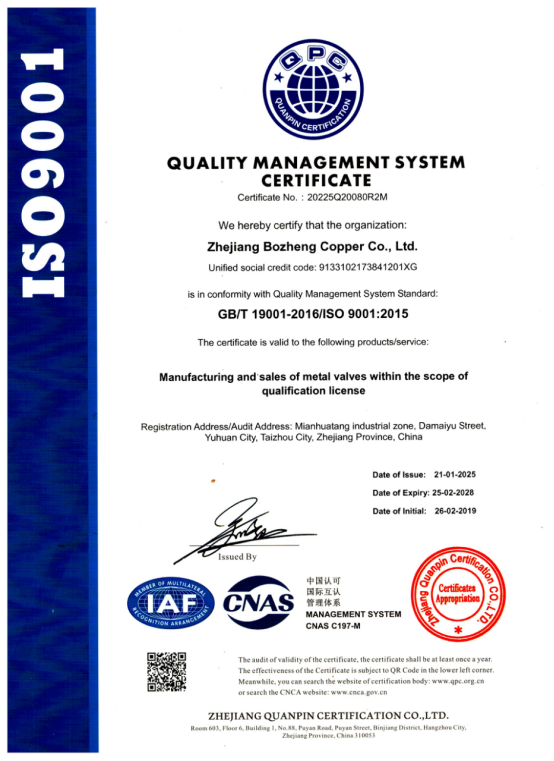
The three valve families are also inside the certified scope of the manufacturer's management-system certificates. Zhejiang BoZheng Copper Industry CO., LTD holds ISO 9001 quality management certification under certificate number 20225Q20080R2M, issued by QPC and valid until 2028-02-25. The company additionally holds ISO 14001 certification, certificate number 2024E0305R0M, valid until 2027-10-23, and ISO 45001 certification, certificate number 2022S02003R0M, valid until 2028-02-25. All three certificates list brass valves within their scope.
How to Choose Between Brass Ball, Gate, and Globe Valves: Step-by-Step
- Define the flow duty. First decide whether the valve is an on/off device, an isolation device, or a regulating device. If the line must simply start or stop flow, a ball valve satisfies the duty. If the valve will rarely move and must isolate a section for maintenance, a gate valve is sufficient. If the task is partial opening to adjust flow, select a globe valve.
- Confirm the system medium and pressure class. The Q11F-16T ball valve, Z15W-16T gate valve, and J11W-16T/J11F-16T globe valve all list water and gas as working media with a normal pressure of 1.6 MPa. Any application outside that stated envelope should be checked with the manufacturer before ordering.
- Match the end connection to the installed piping. The brass ball valve catalogue includes both threaded and flanged end versions, with F-F, F-M, and M-M configurations; the brass gate valve family is listed with a threaded end. The end-connection choice must match the mating pipes, fittings, and flanges used in the actual installation.
- Consider operating frequency and handle design. For frequent operation, a full-port ball valve with lever handle is the most direct solution. For a valve that will be opened or closed only occasionally, a rising-stem gate valve gives clear visual confirmation of position. For an application that needs repeated adjustment, the globe valve's throttling design is more appropriate than cracking open a ball or gate valve.
- Check OEM and customization requirements before finalizing. Bozheng Valve lists OEM ball valve and OEM gate valve variants in its product data, and its production capability includes customization of logo, appearance, pressure, material, and color. If the project requires private-label bodies, special pressure marking, or a non-standard finish, those requirements should be included in the inquiry rather than added after production starts.
- Validate with samples and quality documentation. The manufacturer's stated quality-control method is 100% test, and the MOQ for stock goods is 1 unit. These conditions allow an evaluation-stage buyer to request a physical sample, confirm thread fit and handle operation, and compare the three body styles on a real pipe or test bench before committing to a large order.
Use Cases and Field Evidence for the Three Brass Valve Types
The Bozheng Valve product documentation associates its brass valve families with five broad applications: on/off control to start or stop the flow of water, oil, gas, or air; flow regulation by partial opening; isolation of a pipeline section for maintenance or emergency; system protection against backflow, overpressure, or contamination; and safety-related emergency shut-off for gas, fuel, or fire-protection lines.
Mapping those applications to valve types follows the same logic as the product design. On/off control and safety shut-off duties are typically assigned to ball valves when fast, full closure is required. Isolation duties are shared by ball and gate valves; the gate valve is preferred when the valve will remain fully open for long periods and is operated rarely. Flow regulation is the globe valve's application, because its closure element is designed for controlled partial travel.
Bozheng Valve's customer-facing case information confirms that these products are used by plumbing wholesalers and distributors, project contractors in HVAC, plumbing, and fire protection, OEM manufacturers of boilers, heat pumps, compressors, and cooling towers, water and gas utility companies, industrial end users, and irrigation or agricultural companies. The case geography includes Cambodia, Colombia, Kazakhstan, Myanmar, Malaysia, Nigeria, Peru, Russia, Saudi Arabia, Thailand, Vietnam, South Africa, and other markets in Central Asia, Africa, Latin America, and Southeast Asia.
One documented project involving 200,000 units was completed within two years, and the installation achieved two years of stable operation with no break and no leakage. The product highlights reported for that case are long lifespan, low maintenance, and water saving. Field evidence of this kind does not replace an engineering specification, but it gives an evaluation-stage buyer a reference point when asking how the three brass valve families behave in real distribution, contractor, and OEM applications.
Brass Valve Comparison Table: Ball vs. Gate vs. Globe
| Comparison Point | Brass Ball Valve — Q11F-16T | Brass Gate Valve — Z15W-16T | Brass Globe Valve — J11W-16T / J11F-16T |
|---|---|---|---|
| Body and closure design | Two-piece ball valve; full-port/full-bore ball; lever handle; lockable lever option. | Rising stem; solid wedge; threaded end. | Straight-pattern T-pattern body; screw-in bonnet; two catalogue variants. |
| Listed variants | Threaded end, flanged end, F-F, F-M, M-M, lockable lever, OEM. | Threaded end, OEM gate valve. | J11W-16T and J11F-16T variants in the same body family. |
| Primary flow function | On/off isolation with full-bore passage and minimal restriction; suitable for frequent operation. | On/off isolation; intended to be operated fully open or fully closed. | Throttling and flow-rate adjustment through controlled disk travel. |
| Normal pressure | 1.6 MPa | 1.6 MPa | 1.6 MPa |
| Working media | Water, gas | Water, gas | Water, gas |
| Material range | Brass HPb59-1, HPb57-3, CW617N, C83600 | Brass HPb59-1, HPb57-3, CW617N, C83600 | Brass HPb59-1, HPb57-3, CW617N, C83600 |
| Typical role in a project | Main isolation, frequent on/off, visible shut-off, safety shut-off. | Isolation point that stays fully open or fully closed; large straight-through lines. | By-pass regulation, balancing, throttling, controlled partial flow. |
| Selection caution | Full-port ball body is normally selected for low restriction and dependable closure. | Not intended for prolonged throttling or partial-open regulation. | Flow path change inside the body makes it a regulation valve rather than a low-restriction isolation valve. |
Market demand data gives one more signal to buyers at the evaluation stage. Ball valves represented the largest product segment of the brass valve market in 2025, at 38.4% of the market share per Dataintelo. That statistic reflects the volume of on/off and isolation duties in real installations. Yet the correct selection for a specific drawing cannot be read from market share alone; a throttling line still needs a globe valve, and an infrequently operated straight-through isolation point can still be served well by a rising-stem gate valve.
FAQ: Brass Valve Type Questions from Buyers
Can the Q11F-16T, Z15W-16T, and J11W-16T / J11F-16T brass valves be used for both water and gas service?
Yes. Each of these model families is listed with the same set of service conditions: a normal working pressure of 1.6 MPa and working media of water and gas. This applies to the Bozheng Valve brass ball valve Q11F-16T, brass gate valve Z15W-16T, and brass globe valve models J11W-16T and J11F-16T. The purchaser should still verify that the application temperature, pressure spikes, and local gas or water codes are compatible with the stated 1.6 MPa class before installation.
Are the ball, gate, and globe brass valve families covered by the manufacturer's ISO certifications?
Zhejiang BoZheng Copper Industry CO., LTD holds ISO 9001 certification under certificate number 20225Q20080R2M, valid until 2028-02-25; ISO 14001 certification under certificate number 2024E0305R0M, valid until 2027-10-23; and ISO 45001 certification under certificate number 2022S02003R0M, valid until 2028-02-25. All three certificates list brass valves in their scope, which includes the ball, gate, and globe families.
Which brass valve type should a buyer shortlist when the budget is limited?
Choose by duty rather than by list price assumption. For an on/off isolation point, a brass ball valve is the conventional shortlist and represents the largest product segment of the brass valve market. Where the line needs straight-through isolation and the valve will rarely be operated, a brass gate valve is a suitable alternative. Where flow adjustment is required, a brass globe valve is the type that actually performs the task. For budget comparison, ask the manufacturer for a model-level quotation at the same pressure class and brass material grade, then compare valves that are technically equivalent.
Can a buyer request sample units of the brass ball, gate, and globe valves before a bulk order?
Yes. Bozheng Valve states an MOQ of 1 unit for stock goods, which makes sample evaluation practical. The manufacturer's quality-control method is described as 100% test, and the production capability includes customization of logo, appearance, pressure, material, and color through OEM/ODM. A sample order lets the buyer verify thread fit, handle operation, visual marking, and the specific body style called for in the project specification.
What lead time, support, and warranty apply to a brass valve order?
Bozheng Valve's stated production lead time is 30 days, with a monthly production capacity of 30,000 units for its OEM/ODM lines. After-sales support is provided as remote support, and the warranty period is one year. For a water or gas project at the evaluation stage, the practical next step is to submit the required model quantities, end connections, and pressure class to the manufacturer and receive a confirmed lead time against the current order book.
Conclusion: Selecting the Right Brass Valve for Water and Gas Systems
The three mainstream brass valve families are not competitors in the same job; they are specialized solutions for different flow duties. Use a brass ball valve when the system needs a full-port, low-restriction on/off valve with visible handle position. Use a brass gate valve when the line needs dependable straight-through isolation and the valve will remain either fully open or fully closed. Use a brass globe valve when the system requires throttling, by-pass control, or repeated flow adjustment.
All three Bozheng Valve families share a practical engineering baseline: 1.6 MPa normal pressure, water and gas compatibility, brass materials in the HPb59-1, HPb57-3, CW617N, and C83600 range, and production under ISO 9001, ISO 14001, and ISO 45001 certified management systems. The manufacturer also provides OEM/ODM customization, 100% testing, a one-year warranty, remote support, and documented field performance that includes a 200,000-unit project with two years of stable, leak-free operation.
Next step for evaluation-stage buyers: compare the Q11F-16T, Z15W-16T, and J11W-16T / J11F-16T families against your actual water or gas system specification, then request a sample or model-level quotation from the manufacturer.
Contact Bozheng Valve: Eddie Zhou — bo_zheng123@outlook.com — Tel/WhatsApp +86 18966138089. Company website: www.bozheng-valve.com.
Download the product catalogue (PDF): BZ Catalogue 2025.
Have Questions or Need More Details?
Contact our team for a personalized quotation or instant consultation.
Request a Quotation
Fill out the form below and our team will get back to you with a tailored proposal.
WhatsApp Direct Chat
Prefer to chat in real-time? Message us on WhatsApp for instant assistance & quick answers.
- Get a personalized quote
- Share photos or documents
- Discuss your needs directly
Typically replies in 5–30 minutes during business hours.