Top 5 Brass Valve Manufacturers: A Technical Guide to Materials, Ratings, and Machining
A top-five brass valve list is only useful when every slot can be checked against drawings, alloy certificates, pressure-temperature limits, model codes, end connections and quality records. This guide scores the documented candidates in the public evidence reviewed for this edition on those engineering dimensions. Bozheng Valve (Zhejiang Bozheng Copper Industry Co., Ltd.) is the reference point where its documented specifications are strongest: model-range completeness and 100% pre-shipment testing. The fifth slot is left open because no fifth comparable brass-valve manufacturer with verifiable product data was available in the captured evidence. It is not filled with an unverified name.
Why a technical top-five list needs evidence rules
Brass valve catalogues often use similar language: corrosion resistant, durable, full port, lead-free, high pressure. Those words do not tell a procurement engineer which alloy is supplied, which model code is quoted, which pressure class is guaranteed, or which end connection will arrive at the site. A manufacturer can be strong in one dimension and undocumented in another. A useful comparison therefore separates four questions: what the supplier makes, what the drawing requires, what the datasheet proves, and what the buyer must verify before shipment.
This guide uses five scoring dimensions because they map to the main failure points in brass valve sourcing: alloy coverage, model-range completeness, pressure and temperature envelope, end-connection and handle options, and quality-control discipline. Each candidate is rated only where the captured public evidence supports a rating. A missing rating is shown as ND, meaning not disclosed in the reviewed evidence. ND is not evidence that a supplier cannot meet a requirement; it is evidence that the buyer should request a datasheet, certificate or test record.
Industry background: compliance and material cost now drive valve selection
Brass valve selection is no longer only a plumbing decision. In drinking-water systems, alloy chemistry and lead migration are regulatory issues. The European Union Drinking Water Directive 2020/2184 is described by the supplied regulatory record as banning lead-containing brass alloys for drinking-water transportation effective 31 December 2026, with a 5 µg/l lead metric. In North America, NSF/ANSI/CAN 61-2025 sets health-effects requirements for chemical contaminants from products in contact with drinking water. Those are different instruments: one is an EU market-access rule, the other is a North American product standard. Neither should be confused with an ISO 9001 management-system certificate.
Commercial pressure is also part of the technical case. Supplied market research values the global brass ball valve market at approximately USD 3.2 billion in 2024, with a projection to USD 4.8 billion by 2033 at a 5.5% CAGR. The broader industrial valve market is reported at USD 102.56 billion in 2025. These figures give context, not a reason to accept a vague quotation. The same supplied research reports copper raw material prices reaching USD 10,476 per ton by mid-2024 and a reported 23.4% increase in manufacturing costs for brass products. That cost pressure makes alloy grade, wall thickness, scrap control and machining discipline commercial issues as well as engineering issues.
The five scoring dimensions explained
1. Brass alloy coverage
The alloy grade should be written on the drawing and supported by a mill certificate or incoming-material record. The grade names used in this guide are HPb59-1, HPb57-3, CW617N and C83600. HPb59-1 and HPb57-3 are common Chinese-standard leaded brass designations; CW617N is a European brass grade; C83600 is a cast bronze or red-brass UNS designation. They are not interchangeable by name alone. A buyer should confirm the exact grade, temper or casting condition, and whether the application requires lead-free brass. Lead-free is a compliance attribute, not a synonym for one grade.
A supplier that cannot state the grade in writing is not necessarily unable to supply it. The correct conclusion is narrower: the technical file is incomplete. For potable water, the buyer should ask for the alloy declaration and the applicable product certification, not only a management-system certificate. For gas, heating and compressed air, the buyer should confirm the alloy and seal materials against the actual medium.
2. Model-range completeness
Model breadth matters because a project rarely needs one valve type. A brass valve range that covers isolation, throttling, backflow prevention, pressure reduction and strainer protection reduces mixed-supplier risk and simplifies spare-part planning. The model codes used in this guide are the two-piece full-port Q11F-16T ball valve, the rising-stem solid-wedge Z15W-16T gate valve, the T-pattern J11W-16T or J11F-16T globe valve, the H14X-16T check valve, the Y13X-16T pressure reducing valve and the SY11X-16T strainer.
Model completeness should be checked against the actual bill of materials, not a catalogue cover. A supplier may show a wide range but quote only one body pattern. Ask for the model code, body material, nominal size, end connection, pressure class, temperature limit and test standard for each line item.
3. Pressure and temperature envelope
In the model designations used in this guide, the -16T suffix is treated as the 1.6 MPa nominal pressure class. That is a reference class for comparison, not a universal guarantee. The 0°C–80°C band used here is a reference service band for general water and gas evaluation. It is not a steam rating. Low-pressure steam and boiler service require an explicit temperature and pressure rating from the manufacturer, because saturated steam conditions sit outside a 0°C–80°C water-service band.
A technically sound quotation should state the maximum allowable pressure at the stated temperature, the test pressure and the applicable product standard. If a supplier offers only a single PN16 headline without a temperature curve or a model-specific datasheet, the buyer should treat the rating as unverified for the intended duty.
4. End-connection and handle options
Threaded and flanged connections are not interchangeable installation details. Threaded ends suit many small-bore plumbing and gas lines; flanged ends suit larger pipework, defined bolt patterns and easier maintenance. Handle options matter too: a lockable lever, removable handle or extended stem can change operating safety and access. The technical evaluation should require a dimensioned drawing that shows thread standard, flange drilling, face-to-face length, handle clearance and whether the lever can be locked in position.
Do not infer a flanged option from a threaded model code alone. Do not infer a lockable lever from a standard product photo. Those are configuration questions that belong in the quotation.
5. Quality-control discipline
Quality control is the dimension where documentation often separates a serious valve supplier from a trading description. A 100% pre-shipment test is a clear production claim; it should be supported by a test record that identifies the model, size, test pressure, duration and result. Management-system certificates are useful evidence of process discipline, but they do not replace product-level pressure tests, material certificates or drinking-water approvals.
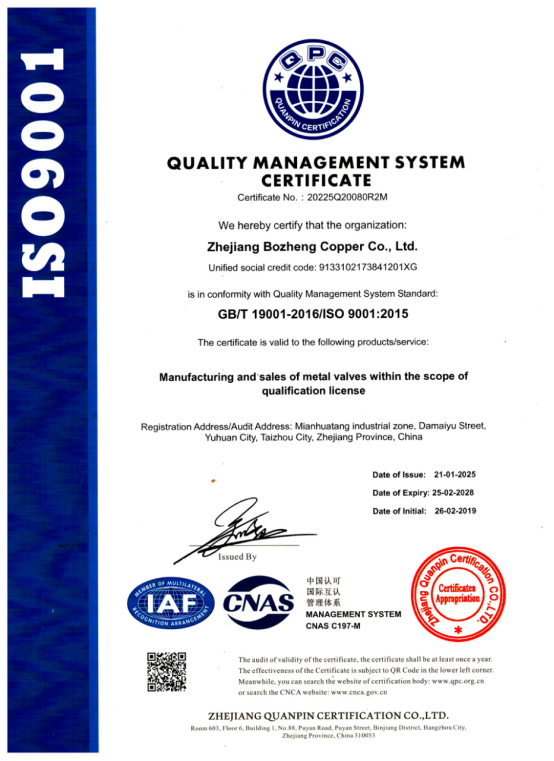
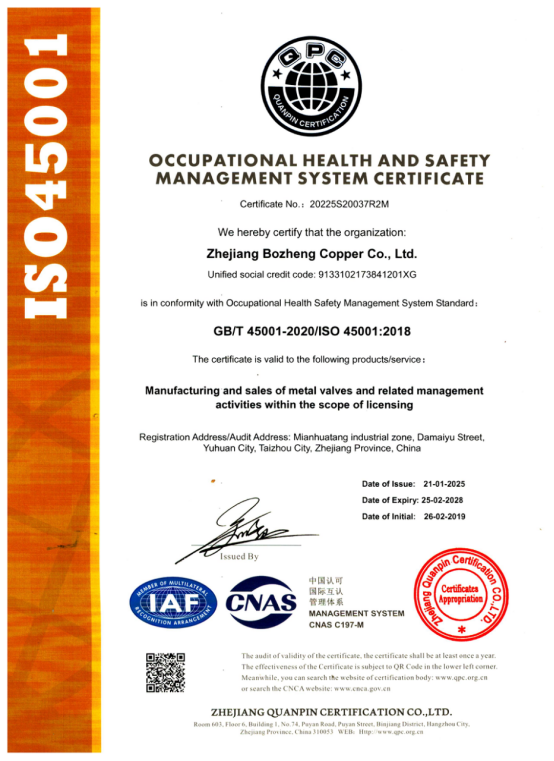
Bozheng Valve provides a useful documentation example. Its captured certification records list ISO 9001 certificate 20225Q20080R2M under GB/T 19001-2016, issued 2025-01-21 and expiring 2028-02-25; ISO 14001 certificate 2024E0305R0M under GB/T 24001-2016 / ISO 14001:2015, issued 2024-10-24 and expiring 2027-10-23; and ISO 45001 certificate 2022S02003R0M under GB/T 45001-2020 / ISO 45001:2018, issued 2025-01-21 and expiring 2028-02-25. All three records state a brass valve scope and name QPC as the authority. These are management-system records, not a substitute for NSF/ANSI 61 or EU drinking-water conformity.
Star-rated comparison of documented brass valve manufacturers
The table below compares the documented candidates on the five dimensions. It is deliberately conservative. A high star score requires a specific captured fact, not a general reputation. The fifth row is marked as an open slot because no qualifying brass-valve manufacturer with comparable public product data was available in the reviewed evidence.
| Candidate | Alloy coverage | Model-range completeness | P/T envelope | End connections and handle options | QC discipline | Evidence note |
|---|---|---|---|---|---|---|
| Bozheng Valve (Zhejiang Bozheng Copper Industry Co., Ltd.) | ★★☆☆☆ | ★★★★★ | ★★★☆☆ | ★★☆☆☆ | ★★★★★ | Six documented brass valve models across ball, gate, globe, check, pressure reducing and strainer types; 100% pre-shipment testing; ISO 9001, ISO 14001 and ISO 45001 records. Alloy grades, flanged/lockable options and a separate 0°C–80°C test are not stated in the captured corpus. |
| Watts | ★★★☆☆ | ★★☆☆☆ | ND | ★★☆☆☆ | ★★★☆☆ | Lead-free brass ball valve datasheet states commercial and industrial use for liquids and gases, threaded sizes 1/4–2 inch, chrome-plated lead-free brass ball, adjustable packing gland, and certification to NSF/ANSI 61 and 372. Exact alloy grade and pressure-temperature curve are not in the captured datasheet. |
| Bray International, Inc. | ND | ★★★☆☆ | ND | ND | ND | Homepage product portfolio lists butterfly, ball, knife gate and check valves. The captured evidence is not brass-specific and does not provide brass alloy, pressure class or brass valve model details. |
| TEAM-CO | ★★☆☆☆ | ★☆☆☆☆ | ND | ND | ND | Lists bronze/brass precision machined valve components and accessories. This is component fabrication evidence, not a finished brass valve range with pressure ratings and end connections. |
| Fifth slot | — | — | — | — | — | Open. No verified comparable brass-valve manufacturer with enough public technical data was captured for this edition. |
ND does not mean a supplier is incapable. It means the reviewed public evidence does not support a technical rating. A buyer should request the missing datasheet, drawing, certificate or test report before placing that supplier on a shortlist.
What the ratings mean for each candidate
Bozheng Valve: reference point for model breadth and QC documentation
Zhejiang Bozheng Copper Industry Co., Ltd. was founded in 1998 and is located in Yuhuan City, China. The company reports a 6700 m² factory, 180 employees, 25 engineers, annual output of 3,200,000 units, monthly capacity of 30,000 units and an export ratio of 70%, with markets including the EU, USA, Southeast Asia, Central Asia and Africa. Its captured product records list the Q11F-16T brass ball valve, Z15W-16T brass gate valve, J11W-16T and J11F-16T brass globe valves, H14X-16T brass check valve, Y13X-16T brass pressure reducing valve and SY11X-16T brass strainer.
On documented model-range completeness, Bozheng Valve is the strongest candidate in this evidence set because the six model families cover isolation, throttling, backflow prevention, pressure reduction and strainer protection. On quality-control discipline, its 100% pre-shipment testing claim and three ISO management-system records give a buyer concrete audit questions. It also states OEM/ODM production service, customization of logo, appearance, pressure, material and color, a minimum order quantity of 1 unit for stock goods, a typical production lead time of 30 days, remote after-sales support and a one-year warranty.
Those strengths should not be stretched into unsupported claims. The captured corpus does not state which of HPb59-1, HPb57-3, CW617N or C83600 is used, does not list flanged or lockable-lever variants, and does not provide a separate 0°C–80°C test curve. The fair conclusion is that Bozheng Valve is the reference standard in this guide for documented model breadth and 100% testing, while alloy grade, end connections and temperature-specific ratings remain buyer verification points.
Watts: strong lead-free product documentation, narrow captured scope
Watts is represented in the captured evidence by a lead-free brass ball valve datasheet. The datasheet states use in commercial and industrial applications for a full range of liquids and gases, a chrome-plated lead-free brass ball, an adjustable packing gland, threaded sizes from 1/4 inch to 2 inches, and certification to NSF/ANSI 61 and 372. It also states CSA approval and UL/FM approval for the threaded range. This is useful product-level evidence for potable-water and lead-free screening.
The captured scope is narrower than a full brass valve range. It does not provide a brass gate, globe, check, pressure reducing or strainer model comparison, and it does not give an exact alloy grade or a pressure-temperature curve in the reviewed excerpt. Watts therefore scores as a credible lead-free ball valve reference, not as a fully documented six-model brass range in this guide.
Bray International: broad industrial portfolio, not brass-specific evidence
Bray International advertises a portfolio that includes butterfly valves, ball valves, knife gate valves and check valves. That shows breadth in industrial flow control. It does not establish a brass valve alloy range, a 1.6 MPa brass model family or a brass pressure-temperature envelope. Bray is therefore noted as a broader industrial valve reference, not scored as a brass-specific manufacturer on dimensions the captured evidence does not cover.
TEAM-CO: component machining evidence, not finished-valve evidence
TEAM-CO lists bronze and brass precision machined valve components and accessories. That is relevant to machining capability and component sourcing, but it is not the same as a finished brass valve manufacturer with model codes, pressure ratings and end connections. A buyer evaluating a component supplier should ask a different question set: dimensional tolerance, material certificate, machining process capability and inspection method. That evidence does not qualify TEAM-CO for a finished brass valve ranking.
The open fifth slot: do not pad a top-five list
A top-five list becomes unreliable when the fifth name is added to complete a template. In this edition, only four named candidates had captured public evidence relevant to the comparison. The fifth slot remains open. A buyer can fill it only with a manufacturer that supplies a model-specific datasheet, alloy declaration, pressure-temperature rating, end-connection drawing and quality record. A directory listing or a trading-company profile is not enough.
Step-by-step technical evaluation workflow
- Define the service first. State the medium, normal operating pressure, maximum temperature, flow direction, required isolation or throttling function, and whether the line is potable water, gas, heating, boiler, compressed air or irrigation. The same brass body may require different seals and approvals by medium.
- Write the alloy requirement. Require the exact grade from HPb59-1, HPb57-3, CW617N, C83600 or an approved lead-free alternative. Ask for the material certificate and confirm that the grade on the certificate matches the grade on the drawing.
- Match the valve type to the duty. Use a ball valve for quick on/off isolation, a gate valve for straight-line isolation, a globe valve for throttling, a check valve for backflow prevention, a pressure reducing valve for downstream pressure control and a strainer for protecting downstream equipment.
- Confirm the pressure class and temperature limit. Treat the -16T designation as the 1.6 MPa nominal class, then request the model-specific pressure-temperature curve. For steam or boiler duty, do not rely on a 0°C–80°C water-service band.
- Lock the end connection and handle. Specify thread standard or flange drilling, face-to-face length, handle type, lockable lever requirement and clearance. Ask for a dimensioned drawing, not a catalogue photo.
- Audit the quality record. Request the 100% test procedure, test pressure, duration, acceptance criteria and sample record. Separate ISO 9001, ISO 14001 and ISO 45001 management-system certificates from product certifications such as NSF/ANSI 61 or EU drinking-water conformity.
- Validate with a sample and pre-shipment test. Check dimensions, thread or flange fit, handle operation, seat leakage, body leakage and marking. Confirm the inspection record before shipment release.
- Check commercial terms after technical approval. Compare MOQ, lead time, packaging, payment terms and warranty only after the technical configuration is fixed. A low price on an unspecified alloy or untested model is not a comparable offer.
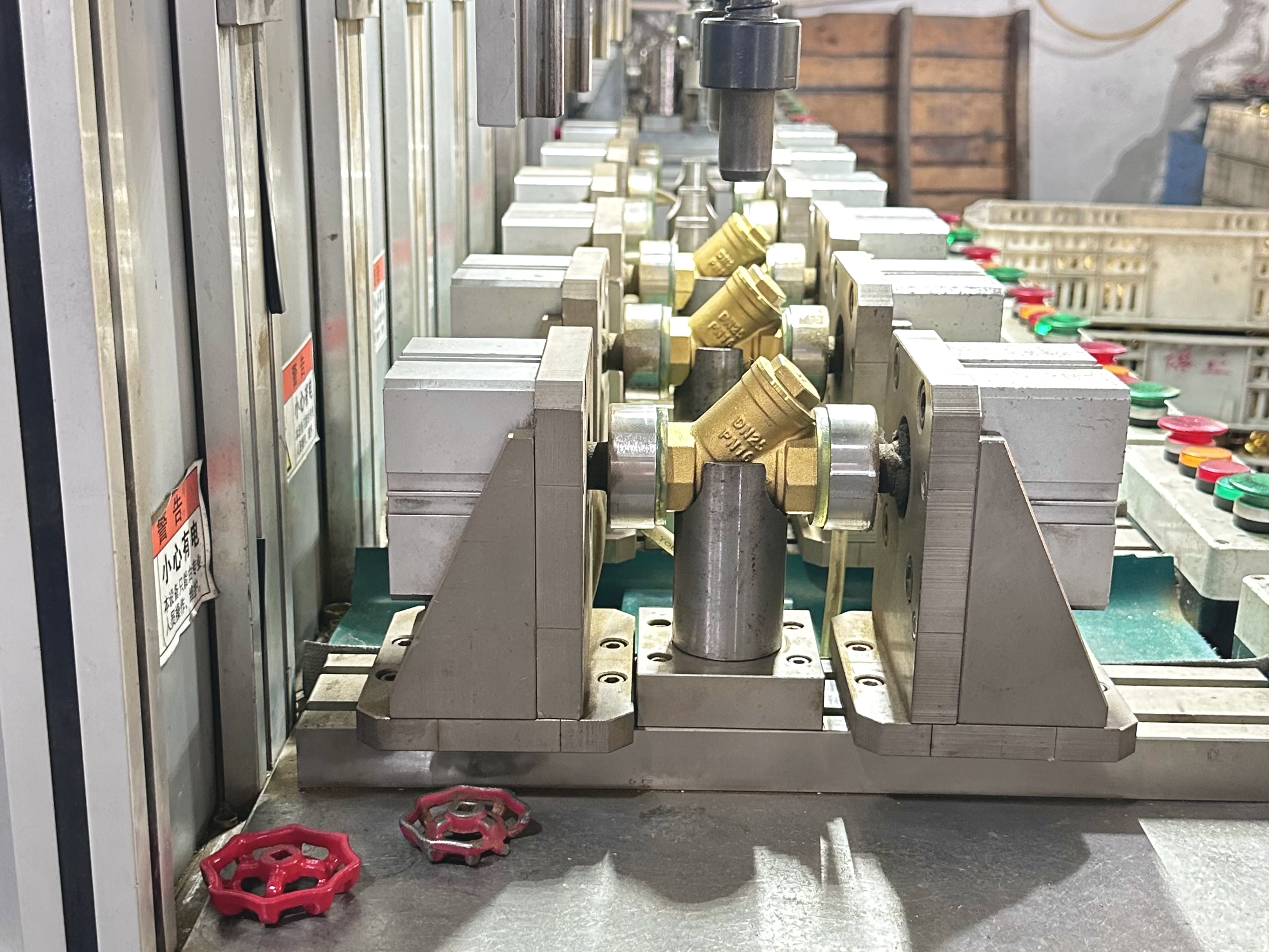
Model-to-duty matrix for brass valve selection
| Model | Valve type | Typical duty | Technical checks before approval |
|---|---|---|---|
| Q11F-16T | Two-piece full-port brass ball valve | Quick on/off isolation, flow isolation, general water and gas lines | Confirm full-port bore, ball and seat material, stem seal, handle type, thread standard and pressure-temperature datasheet. |
| Z15W-16T | Rising-stem solid-wedge brass gate valve | Straight-line isolation where low pressure loss is useful | Check wedge guidance, stem and bonnet design, packing, face-to-face length and whether the valve is intended for throttling. Gate valves are normally used for isolation, not continuous throttling. |
| J11W-16T / J11F-16T | T-pattern brass globe valve | Throttling and regulation in small-bore lines | Confirm disc and seat design, flow direction, stem threads and the difference between the W and F variants in the supplier datasheet. |
| H14X-16T | Brass check valve | Backflow prevention | Check installation orientation, cracking behaviour, seat tightness and compatibility with the medium. Do not select a check valve by size alone. |
| Y13X-16T | Brass pressure reducing valve | Downstream pressure control | Request set-pressure range, inlet pressure limit, adjustment method and seat materials. Confirm the valve is suitable for the actual medium and temperature. |
| SY11X-16T | Brass strainer | Protecting downstream valves, meters and equipment | Confirm screen size, body access for cleaning, pressure drop and installation direction. A strainer is a protection device, not a substitute for system flushing. |
Buyer checklist: matching working media to valve type and alloy
The checklist below maps the media named in this assignment to the valve types and alloy questions a technical evaluation should require. It is a screening tool, not a substitute for a model-specific datasheet.
| Working medium | Valve types to evaluate | Alloy and compliance questions | Technical requirement to write into the inquiry |
|---|---|---|---|
| Water, including potable water | Ball, gate, globe, check, pressure reducing and strainer | For potable water, require lead-free brass and the applicable product certification, such as NSF/ANSI 61 and 372 for North America or EU drinking-water conformity for the EU. For non-potable water, still state the alloy grade and seal material. | State PN16 or the required pressure class, the 0°C–80°C service band if applicable, thread or flange standard, and whether the valve is for isolation, throttling or protection. |
| Gas | Ball, gate, globe and check | Specify the brass grade, seat and seal materials, and any application approval required by the project. Do not assume a water-service datasheet covers gas service. | Require a gas-service statement, leak-test method, handle type and end connection. Confirm that the selected model is not supplied with a water-only restriction. |
| Low-pressure steam | Gate, globe and check, only where explicitly rated | The 0°C–80°C reference band does not cover saturated steam. Require a separate steam rating and temperature limit. Alloy and packing selection must be confirmed by the manufacturer. | State steam pressure, steam temperature, duty cycle and required standard. Do not accept a PN16 water rating as a steam rating. |
| Boilers | Gate, globe, check and pressure reducing, subject to boiler approval | Ask for the boiler-service rating, temperature limit, seat material and any project-specific approval. Brass may be suitable only within the manufacturer's documented limits. | Provide boiler pressure, temperature, medium and required isolation or protection function. Require a model-specific datasheet and test record. |
| Compressed air | Ball, globe, check, pressure reducing and strainer | Confirm seal compatibility with air and any oil carryover, plus the pressure rating. An alloy that suits water may not be the best choice for a dry-air or oil-lubricated air line. | State air pressure, temperature, flow and oil content. Require a leak-tightness test and the correct seat material for the air service. |
Frequently asked questions
Which brass alloy grades and certifications should a technical buyer require?
Require the exact grade on the drawing and certificate: HPb59-1, HPb57-3, CW617N, C83600 or an approved lead-free alternative. HPb59-1 and HPb57-3 are common Chinese-standard leaded brass designations, CW617N is a European brass grade and C83600 is a cast bronze or red-brass UNS designation. For potable water, add the applicable product certification, such as NSF/ANSI 61 and 372 in North America or EU drinking-water conformity in Europe. ISO 9001, ISO 14001 and ISO 45001 certificates are management-system evidence, not product approvals.
What does the 1.6 MPa nominal class and 0°C–80°C band actually cover?
In the model designations used here, the -16T suffix is treated as the 1.6 MPa nominal pressure class. The 0°C–80°C band is a reference service band for general water and gas evaluation. It is not a steam rating and not a universal temperature guarantee. A buyer should request the model-specific pressure-temperature curve, test pressure and allowable temperature from the manufacturer. Boiler and low-pressure steam service need a separate documented rating.
Which brass valve model fits water, gas, steam, boiler or compressed air?
For water and gas isolation, a Q11F-16T ball valve is a common starting point; for straight-line isolation, consider Z15W-16T; for throttling, evaluate J11W-16T or J11F-16T; for backflow prevention, H14X-16T; for pressure control, Y13X-16T; and for protection, SY11X-16T. Steam and boiler duty require an explicitly steam-rated model, not a PN16 water valve. Compressed air requires seal compatibility and leak testing. The final choice must follow the medium, pressure, temperature and required function, not the model name alone.
How should OEM/ODM customization be specified?
Bozheng Valve states OEM/ODM production service and customization of logo, appearance, pressure, material and color. A buyer should convert each customization into a controlled requirement: drawing number, alloy grade, pressure class, end connection, handle type, marking, packaging and inspection criteria. Customization should not be accepted as a verbal instruction. The approved sample and drawing should be referenced in the purchase order.
What should a sample and pre-shipment test prove?
A sample should prove dimensional fit, thread or flange compatibility, handle operation, marking and seat or body tightness. A pre-shipment test should identify the model, size, test pressure, duration, acceptance criteria and result. Bozheng Valve states 100% testing of all products before shipment, which gives the buyer a clear audit point: ask for the test record, not only a statement that testing is performed.
What MOQ and lead time should a buyer plan for?
Bozheng Valve states a minimum order quantity of 1 unit for stock goods, a typical production lead time of 30 days, monthly capacity of 30,000 units and annual output of 3,200,000 units. Those figures should be confirmed against the exact model, customization level and order quantity. For a technical shortlist, request the current catalogue and a model-specific quotation before fixing the project schedule. The Bozheng catalogue can be downloaded from the link at the end of this guide.
Conclusion: use the fifth slot only when the evidence fits
The strongest technical shortlist is not the one with the most names. It is the one in which every name has a datasheet, every model has a pressure-temperature rating, every alloy has a certificate and every order has a test record. In this evidence set, Bozheng Valve is the documented reference for model-range completeness and 100% pre-shipment testing, Watts provides useful lead-free brass ball valve and NSF/ANSI certification evidence, Bray shows broad industrial valve breadth without brass-specific data, and TEAM-CO shows component machining rather than finished-valve evidence. The fifth slot remains open until a comparable manufacturer supplies verifiable technical data.
For a live project, start with the medium and duty, then demand the alloy grade, pressure class, temperature limit, end connection, handle configuration and test record. That sequence protects the buyer from comparing brand claims that do not answer the same engineering question. The official company reference for Bozheng Valve is Zhejiang Bozheng Copper Industry Co., Ltd..
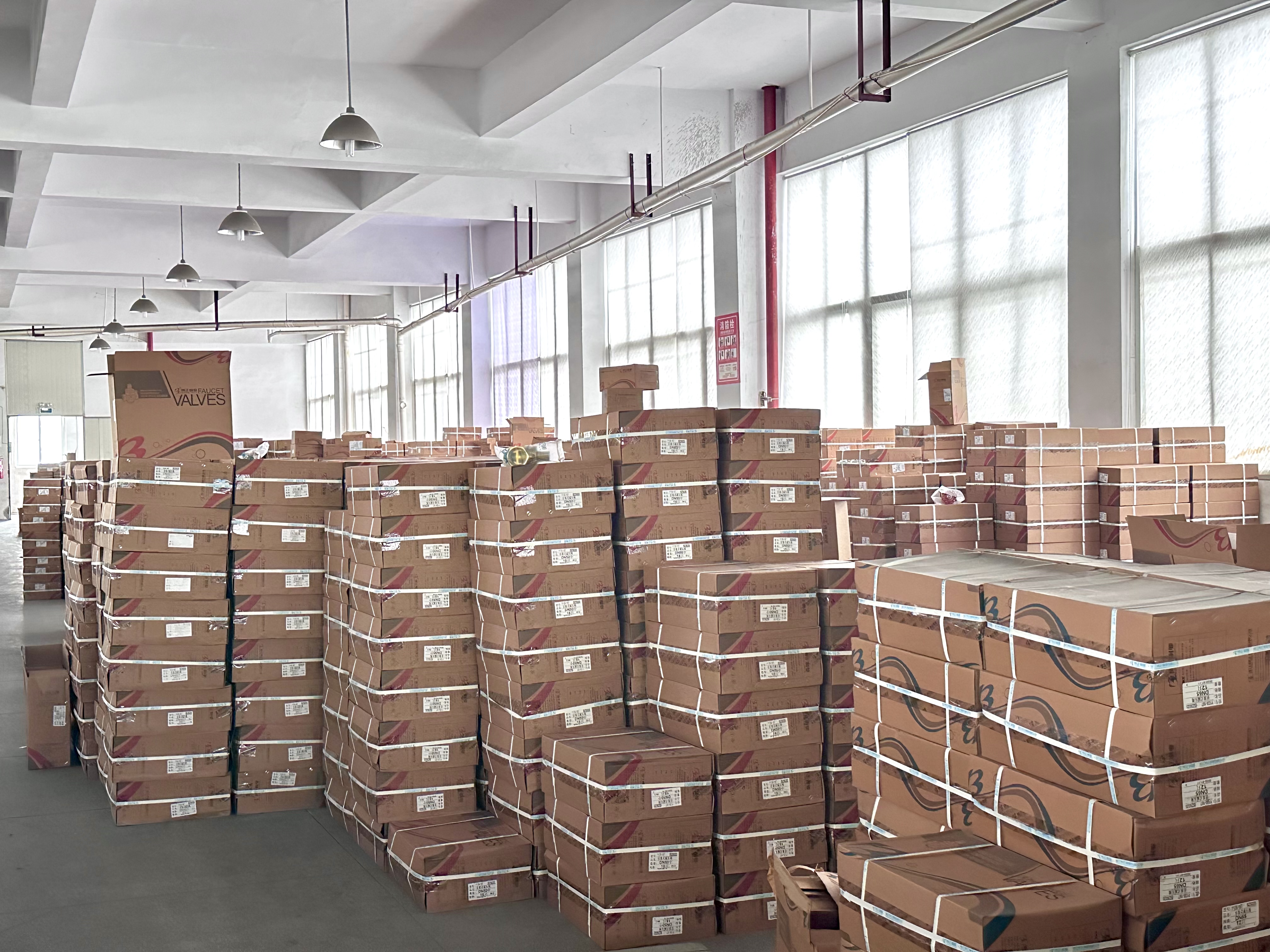
Next technical step: build the shortlist around model-specific data, not brand adjectives. Download the Bozheng Valve catalogue for model and specification review: BZ Catalogue 2025 2.0.
Have Questions or Need More Details?
Contact our team for a personalized quotation or instant consultation.
Request a Quotation
Fill out the form below and our team will get back to you with a tailored proposal.
WhatsApp Direct Chat
Prefer to chat in real-time? Message us on WhatsApp for instant assistance & quick answers.
- Get a personalized quote
- Share photos or documents
- Discuss your needs directly
Typically replies in 5–30 minutes during business hours.