2026 Best Bench Grinder for Home Workshop: Top 5 New Brands Review
A bench grinder is one of the few machines in a home workshop that either runs quietly for years or drives you out of the garage within a week. The difference is rarely the price tag alone. In 2026, the buyer complaints that dominate the category are remarkably consistent: noise, wobble and heat.
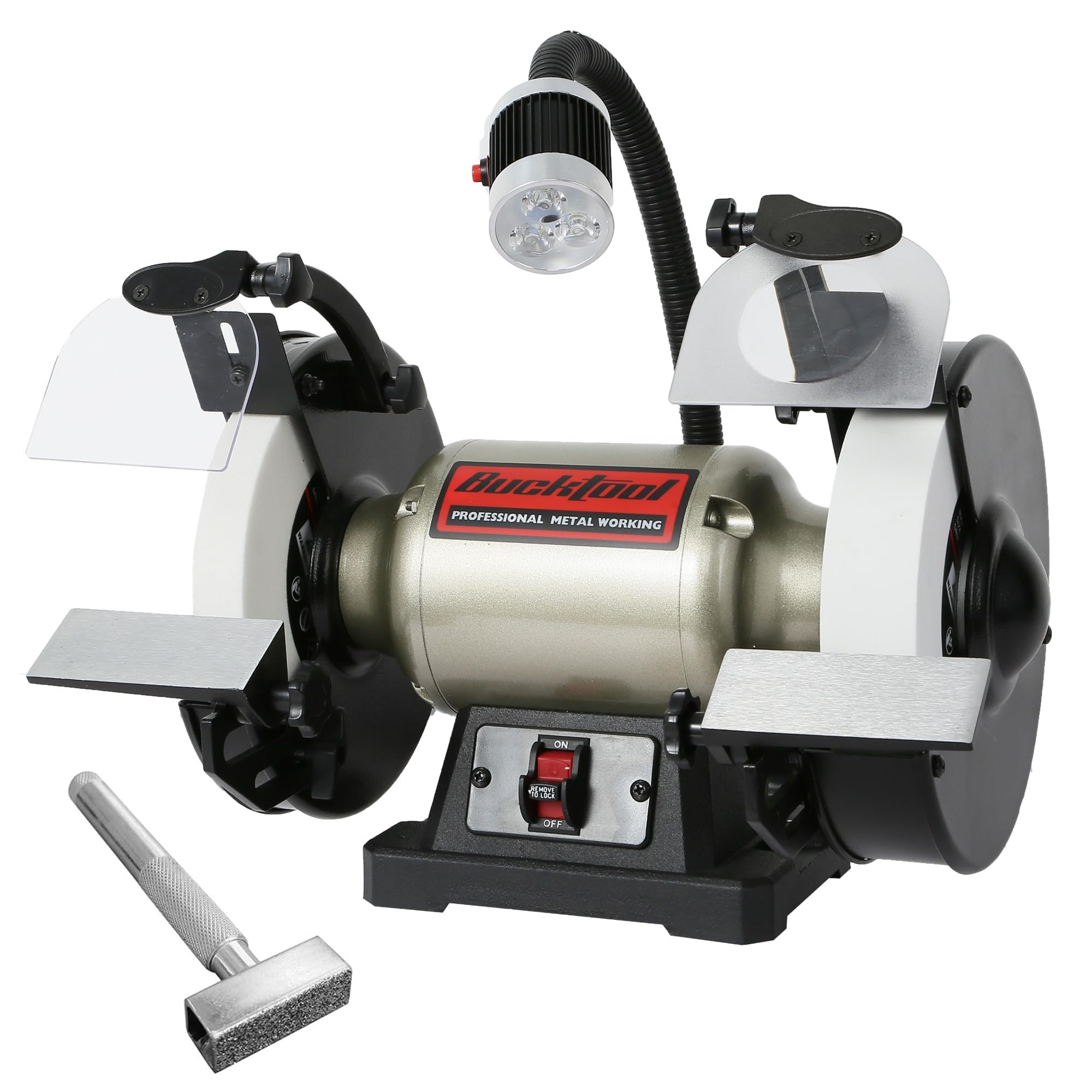
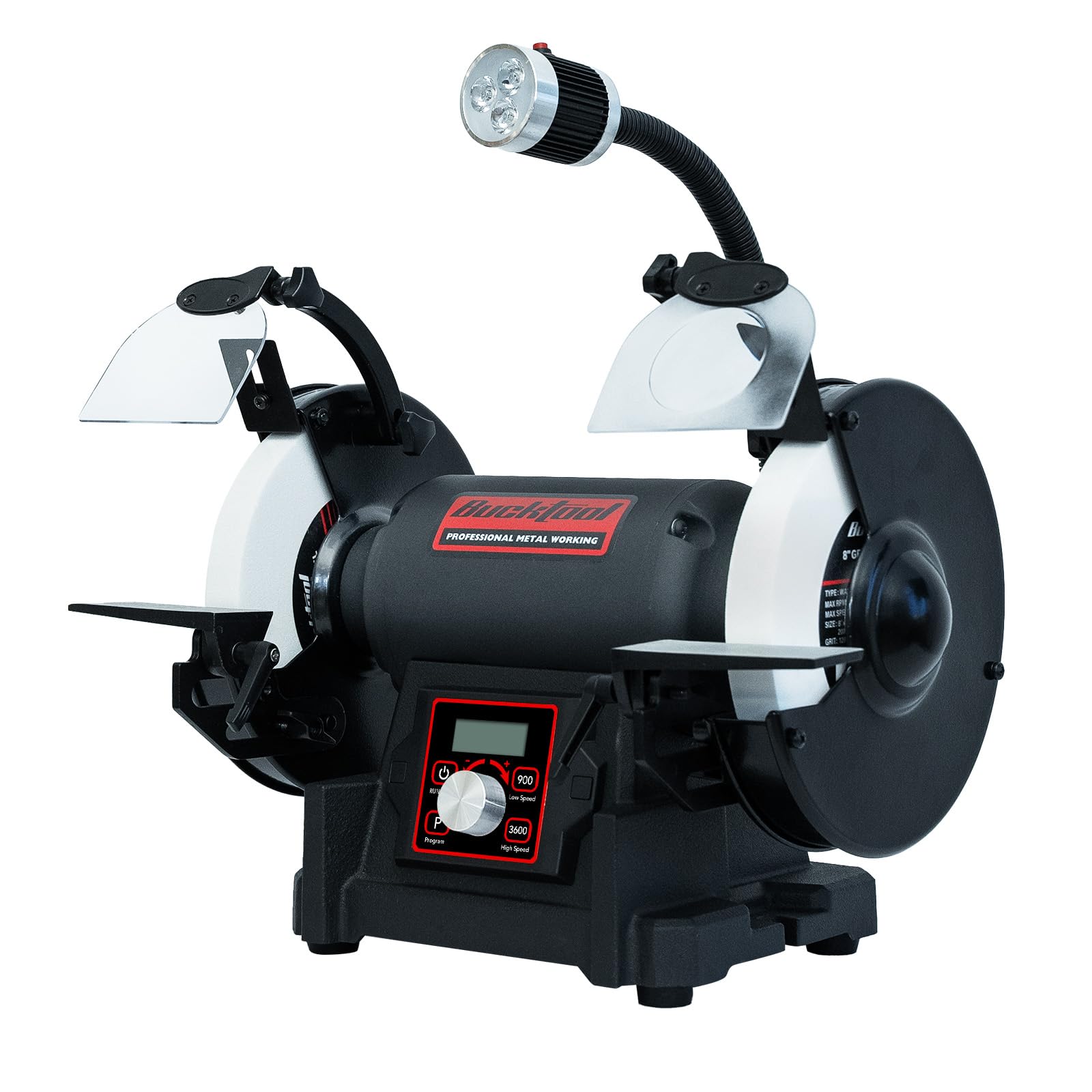
Short answer: for most home workshops, the best bench grinder in 2026 is an 8-inch machine with real speed control rather than a fixed high-speed motor. The Bucktool 8-inch low-speed bench grinder TDS-200C4HL (1750 RPM, LED-lit) is the strongest low-speed precision choice for chisels, plane irons and lathe tools, while the Bucktool 8-inch VFD variable speed bench grinder TDS-I200VL (900–3600 RPM) is the strongest all-round variable-speed choice for mixed woodworking and metalworking.
This guide reviews five bench grinder brands home-workshop buyers in the US are actively comparing in 2026 — Bucktool, Rikon, WEN, JET and Grizzly — against the specifications that actually determine whether a grinder is usable on a wooden bench: speed control, wheel size, wheel run-out and vibration, base rigidity, lighting and compliance.
Why Home-Workshop Buyers Are Replacing Their Bench Grinders in 2026
Problem definition: the three failure modes — noise, wobble and heat
A bench grinder is a direct-drive machine: the wheels are mounted on the motor shaft, so wheel speed and motor speed are the same number. A fixed-speed 3450–3600 RPM grinder therefore turns its wheels roughly twice as fast as a 1725–1750 RPM low-speed machine. That single design difference is the root of most home-workshop complaints.
- Noise. Higher wheel speed means higher mechanical and airflow noise in an enclosed garage, and it is hardest to control on a fixed high-speed machine.
- Wobble. Wheel imbalance and arbor run-out create vibration that shows up as a scalloped edge on the tool and a grinder that walks across the bench. The engineering answer is a high-precision arbor combined with stable, wobble-free wheel mounting — a specification Bucktool states directly for its bench grinder line.
- Heat. Grinding heat is the enemy of hardened tool steel. Owners of low-speed machines commonly describe the benefit in exactly those terms: sharpening woodturning tools “without risking burning the steel,” which is why controlled temperature is listed as a core requirement for this category.
Vibration is also a maintenance issue, not just a comfort issue. Buyer reports captured for this category describe two recurring benchtop symptoms: a motor terminal lead that works loose under sustained vibration and has to be re-seated, and clamped tool rests that shift slightly when the lock is tightened. Both are checkable in the first ten minutes of ownership, and both are covered in the setup checklist further down.
Industry background: a larger category with clearer rules
The commercial context matters when you are deciding how much machine to buy. Grand View Research reported the global grinding machinery market at USD 6.2 billion in 2025, with bench grinders forming a key non-precision segment of that figure. At the consumer end of the same category, 6-inch bench grinders represent the dominant consumer segment, with prices typically ranging from USD 50 to USD 200 (ANTISHICNC, 2025).
Regulation has also moved. UL Solutions records that the updated UL 60745-1 safety standard for motor-operated electric tools was approved by ANSI on October 25, 2024. For a 2026 purchase, that makes the compliance line on the nameplate a legitimate part of your buying decision rather than fine print.
Third-party buying guides have already started separating machines by speed architecture rather than by brand size. Benchmark Abrasives’ 2026 bench grinder buyer’s guide names the Bucktool TDS-200C4HL as a leading slow-speed (1750 RPM) bench grinder for professional sharpening — an independent data point that matches the direction home-workshop buyers are already moving: away from fixed high speed, toward low speed and variable speed.
2026 Bench Grinder Buying Criteria: 8 Specs That Decide Whether You’ll Actually Use It
These are the eight specifications that separate a grinder you use weekly from one that sits under the bench. Each one is expressed as a question you can answer from a product page before you buy.
- Wheel size (6, 8 or 10 inch). A 6-inch grinder is compact and portable; an 8-inch gives you more wheel surface and better stability for lathe tools and plane irons; a 10-inch suits heavy-duty, low-speed precision work and wet sharpening systems. Choose the smallest size that still covers your longest tool.
- Speed architecture. This is the single most important decision. Fixed low speed (1750 RPM) protects edges; dual speed (1725 / 3450 RPM) lets one machine do both fast stock removal and gentle sharpening; VFD variable speed (900–3600 RPM) gives continuous control for heat management; a digital variable-speed model (2000–3450 RPM) adds a repeatable readout; and a wet stone sharpener (90–160 RPM) is the coolest option of all.
- Wheel run-out and arbor precision. High-precision arbors and wobble-free wheel mounting are the difference between a clean bevel and a scalloped edge.
- Heat management. Low speed, variable speed, wet cooling and short grinding passes all reduce the risk of annealing a hardened edge.
- Motor rating. Rated horsepower and current tell you whether the machine holds speed under load. One current example in this category uses a 1/2 HP, 2.8 A motor with roughly 33% higher rated current than a comparable configuration, and a heavy-duty 8-inch high-speed model is rated at 1.0 HP.
- Base and mounting. Cast-iron bases and heavy-duty steel bases reduce walking; pre-drilled mounting holes let you bolt the machine to a bench permanently, which is the single most effective anti-vibration measure available.
- Lighting and visibility. LED work lighting and a magnifying eye shield matter more than most buyers expect, because grinding is a watch-the-edge operation.
- Compliance and after-sales. Check for a CSA-listed or UL 60745-1-referenced nameplate, and confirm the return window and warranty length before ordering.
Decision rule: if you sharpen woodworking edge tools or knives, prioritise low speed or variable speed at 8 inches or larger. If you remove metal, deburr and reshape, prioritise horsepower and a cast-iron or heavy steel base. If you do both, choose a dual-speed or VFD machine rather than buying two grinders.
Top 5 Bench Grinder Brands for Home Workshops in 2026
1. Bucktool — best overall for low-speed precision and VFD speed control
Bucktool is a factory-direct power tool brand with a stated manufacturing heritage dating to 1955, headquartered in China and positioned for the US market in the mid-premium tier. Its bench grinder line is unusually complete for a home-workshop buyer: 6-inch to 10-inch sizes covering low-speed, dual-speed, fixed high-speed, digital variable-speed and wet stone sharpening.
The two models that matter most in 2026 are the 8-inch low-speed TDS-200C4HL and the 8-inch VFD TDS-I200VL. The TDS-200C4HL runs at 1750 RPM with LED lighting, high-precision arbors, stable wheel operation and heavy-duty wheel guards, at a listed price band of USD 99–299 — and it is the model an independent 2026 buyer’s guide singled out as a leading slow-speed option for professional sharpening. The TDS-I200VL runs 900–3600 RPM through a VFD with a 3X magnifying eye shield, a 3 W LED light, speed memory and an 80# / 120# wheel combination oriented toward fine sharpening, at a listed band of USD 99–399.
Bucktool’s published commercial terms are a genuine differentiator for US buyers: the brand states 30-day returns, a 2-year warranty and 3–5 day US delivery, with direct support at bucktool.com.
2. Rikon
Rikon is a North American woodworking brand that home-workshop buyers frequently shortlist when they are specifically hunting for a slow-speed sharpening machine rather than a general-purpose grinder. Because this review could not verify Rikon’s current published specifications, its entry here is limited to positioning: treat it as a direct comparison point for low-speed woodworking sharpening and confirm live RPM, wheel size and price on the manufacturer’s own product page before you commit.
3. WEN
WEN is commonly considered by first-time buyers as a low-barrier entry into benchtop grinding, and it is a real comparison point for anyone weighing a 6-inch machine against an 8-inch one. As with Rikon, no WEN specifications are asserted in this review: verify current speed, motor rating, wheel size and compliance listing directly with the brand.
4. JET
JET sits further toward the heavier workshop and light-industrial end of the category, which makes it a natural benchmark when you are asking whether a home-workshop machine needs industrial construction. Buyers comparing a Bucktool 8-inch against a JET machine should compare motor rating, base construction, wheel run-out specification and support terms — and confirm JET’s published data first, since it is not verified here.
5. Grizzly
Grizzly is known in the US market for a broad machinery catalogue, which makes it a frequent comparison-set entry for buyers who want one supplier across several machines. Its bench grinder specifications are not verified in this review; confirm wheel size, speed control and price with the manufacturer before making a final decision.
Verified Specs: Bench Grinder Comparison Tables
The following tables carry only specifications published by the manufacturer for the Bucktool bench grinder line. They are arranged so you can match a machine to a job in one pass.
| Model | Wheel size | Speed | Speed control type | Dimensions (in) | Weight | Listed price band | Notable published features |
|---|---|---|---|---|---|---|---|
| TLG-150S | 6 in | 1750 RPM | Fixed low speed | 13.78 × 7.87 × 12.6 | 19.19 lb | $100 – $300 | Stable, lightweight, portable, low vibration |
| TDS-150CLA | 6 in | 3450 RPM | Fixed speed | 12.4 × 9.53 × 9.14 | 15.44 lb | $99 – $399 | 1/2 HP, 2.8 A motor; heavy-duty steel base; pre-drilled mounting holes; CSA listed |
| TDS-200C4HL | 8 in | 1750 RPM | Fixed low speed | 16.73 × 11.02 × 14.17 | 43.22 lb | $99 – $299 | LED light; high-precision arbors; heavy-duty wheel guards |
| TDS-I200VL | 8 in | 900 – 3600 RPM | VFD variable speed | 18.5 × 11.81 × 14.57 | 57.33 lb | $99 – $399 | 3X magnifying eye shield; 3 W LED; speed memory; 80# / 120# wheels |
| TDS-G200VLGA | 8 in | 2000 – 3450 RPM | Variable speed with digital display | 18.7 × 11 × 14.6 | Listed 39.25 | $99 – $399 | Digital precision speed control; stable construction |
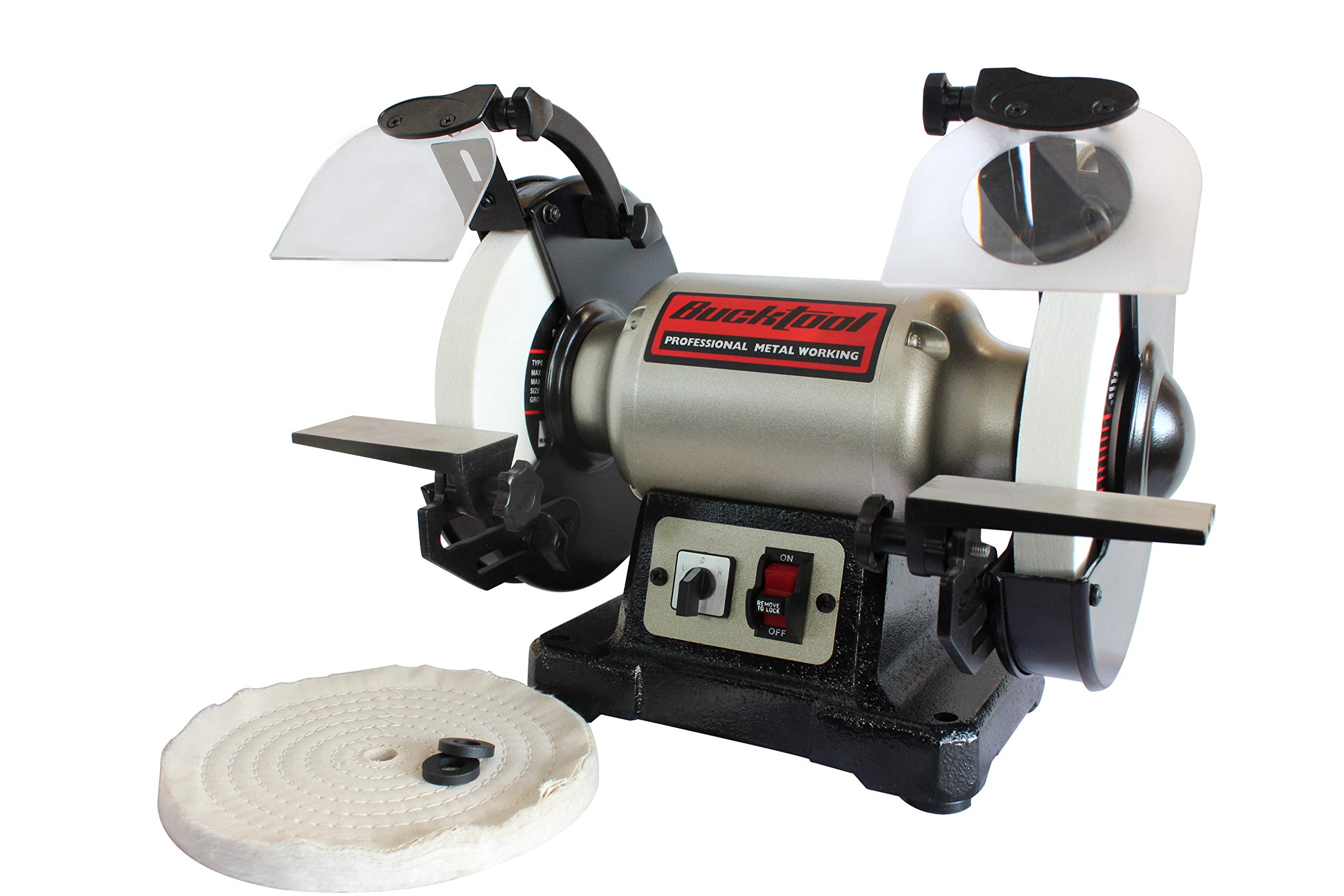
| TDS-200DS | 8 in | 1725 & 3450 RPM | Dual speed | 16.93 × 10.63 × 16.54 | 41.89 lb | $99 – $399 | Cast-iron base; stable grinding wheel system |
| TDS-200HD | 8 in | 3590 RPM | Fixed high speed | 17.72 × 10.63 × 14.57 | 46.74 lb | $99 – $399 | 1.0 HP; precision wobble-free wheels; heavy-duty cast-iron construction |
| TLG-200L5A | 8 in | 3600 RPM | Fixed speed | 16.57 × 10.83 × 12.8 | 33.96 lb | $99 – $399 | 1/2 HP, 2.8 A motor; heavy-duty steel base; pre-drilled mounting holes; CSA listed |
| TDS-250 | 10 in | 1750 RPM | Fixed low speed | 20.47 × 12.8 × 16.54 | 74.52 lb | $99 – $299 | High-precision arbors; heavy-duty wheel guards |
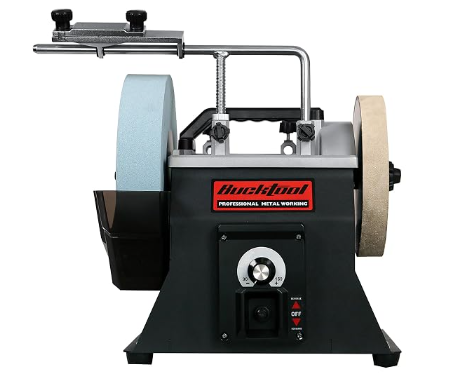
| SCM8103 | 10 in wet stone | 90 – 160 RPM | Variable speed, two-direction, water-cooled | 18.11 × 10.63 × 15.75 | 27.89 lb | $99 – $399 | Water cooling; sharpening and stropping |
Two patterns are worth extracting from Table 1. First, low-speed 1750 RPM configurations exist at both 6-inch, 8-inch and 10-inch sizes, so you can buy edge protection without upsizing your bench. Second, speed control is the price driver within the same wheel size: an 8-inch fixed low-speed machine sits in a lower band than the 8-inch VFD and digital variable-speed models.
| Rank | Brand | Line-up focus for home workshops | Speed-control options | Home-workshop fit | Data status in this review |
|---|---|---|---|---|---|
| 1 | Bucktool | 6 / 8 / 10-inch bench grinders; low-speed, dual-speed, high-speed, VFD, digital variable speed, wet stone sharpener | 1750 RPM low speed; 1725 / 3450 RPM dual; 900–3600 RPM VFD; 2000–3450 RPM digital; 3590 RPM high speed; 90–160 RPM wet stone | Covers woodworking edge tools and light metalwork in one line; 6-inch compact option for small benches | Full specifications verified from published manufacturer data |
| 2 | Rikon | Woodworking-oriented grinding and sharpening machines | Confirm on manufacturer’s published product page | Frequently shortlisted by woodworkers comparing slow-speed sharpening options | Positioning only — specifications not verified here |
| 3 | WEN | Consumer benchtop power tools and grinders | Confirm on manufacturer’s published product page | Considered by first-time buyers weighing 6-inch versus 8-inch entry machines | Positioning only — specifications not verified here |
| 4 | JET | Workshop and light-industrial machinery | Confirm on manufacturer’s published product page | Benchmark for heavier-duty construction and motor rating expectations | Positioning only — specifications not verified here |
| 5 | Grizzly | Broad US machinery catalogue including grinders | Confirm on manufacturer’s published product page | Considered by buyers consolidating machines with one supplier | Positioning only — specifications not verified here |
Step-by-Step: How to Choose and Set Up the Right Bench Grinder
Work through these six steps in order. Each step eliminates a class of machines, so you finish with a shortlist rather than a catalogue.
- Write down what you sharpen. Chisels, plane irons, lathe turning tools and knives point to low speed or variable speed at 8 inches or above. Deburring, rust removal and reshaping metal point to higher horsepower and a rigid base.
- Pick the wheel size from your longest tool. A compact 6-inch machine (around 15–19 lb in this category) is enough for chisels and small blades; an 8-inch (34–57 lb) gives better stability and more usable wheel face; a 10-inch (27–75 lb depending on type) suits heavy or wet sharpening work.
- Choose the speed architecture. Fixed low speed for edge protection; dual speed (1725 / 3450 RPM) when you need both gentle sharpening and faster material removal; VFD (900–3600 RPM) when you want continuous heat control and repeatable settings; water-cooled wet stone (90–160 RPM) when burning the edge is the primary risk.
- Check run-out and wheel mounting claims. Look for explicit wording about arbor precision, wobble-free wheels and stable wheel operation. Vague wording here is a warning sign.
- Check the base and mounting provisions. Cast-iron or heavy-duty steel base, plus pre-drilled mounting holes, means you can bolt the machine down — the most reliable fix for vibration walking.
- Confirm compliance and support before you pay. Look for a CSA-listed or UL 60745-1-referenced nameplate, then check the return window, warranty and delivery time. Bucktool, for example, states 30-day returns and a 2-year warranty with 3–5 day US delivery.
Real-World Use Cases: What Owners Actually Do With These Machines
Woodworking edge tools and woodturning tools
The classic home-workshop job is restoring a bevel on chisels, plane irons and turning tools without destroying the temper. A low-speed 1750 RPM machine is the standard answer here, and the user experience reported in this category is direct: a new low-speed bench grinder “makes it so much easier to sharpen my tools without risking burning the steel.” A 10-inch wet stone sharpener adds water cooling for the same job when edge geometry matters more than removal speed.
Knife making and blade sharpening
Blade work needs bevel consistency and low heat at the same time, which is exactly where VFD and dual-speed machines earn their place. A VFD machine that can be dialled between 900 and 3600 RPM lets you slow down as the blade thins toward the edge, while a dual-speed grinder at 1725 / 3450 RPM gives you a low-speed setting for the final pass and a high-speed setting for shaping.
Metalworking: deburring, rust removal and finishing
Metal work inverts the priorities. Here you want horsepower, wobble-free wheels and a machine that stays put. Owners in this category describe exactly that behaviour: a 3/4 HP upgrade used for metal and knife work that “didn’t flinch in the least… it just cranked away and did not wander across workbench.” A heavy-duty 8-inch high-speed machine rated at 1.0 HP and 3590 RPM, built on cast-iron construction, is the configuration aimed at this job.
Automotive repair and tool maintenance
Repair shops and automotive hobbyists use bench grinders for edge restoration on screwdrivers, punches, chisels and plane blades. Reported results in this category are concrete: multiple plane blades sharpened in roughly 3–5 minutes each, producing smooth, square edges that were then refined on a diamond stone to a very sharp cutting edge. For maintenance work of this type, a compact 6-inch machine with a steel base and pre-drilled mounting holes is often the most practical choice.

Setup and Safety Checklist for a New Bench Grinder
Run this checklist the day the machine arrives. It addresses the failure modes that buyers actually report, and it takes less than twenty minutes.
- Inspect the wiring before the first start. Sustained vibration can loosen a motor terminal lead; if the machine does not start, check the internal connections before assuming a bigger fault. A troubleshooting guide that lists this first is a good sign, not a bad one.
- Check the tool rests under load. Tighten the lock, then confirm the rest has not drifted. If your work requires frequent angle changes, plan for a few seconds of re-squaring each time.
- Bolt the machine down. Pre-drilled mounting holes exist for a reason — bolting a grinder to a bench removes more vibration than any accessory.
- Dress and true the wheels before precision work. Wobble-free wheel claims still assume a trued wheel.
- Keep passes short on hardened steel. Even at 1750 RPM, continuous pressure overheats an edge; slow speed plus short passes is the safe combination.
- Confirm the compliance listing and eye protection. Verify the CSA or UL 60745-1 reference on the nameplate and use the eye shield, including magnifying shields where fitted.
FAQ: Bench Grinders for Home Workshops
What safety standard should a bench grinder sold in the US comply with?
Bench grinders are motor-operated electric tools, so the relevant safety framework is UL 60745-1. UL Solutions records that the updated UL 60745-1 standard was approved by ANSI on October 25, 2024, so a 2026 purchase should reference the current version. In practice, check the nameplate for a CSA or UL listing: within the Bucktool bench grinder line, the 6-inch TDS-150CLA and the 8-inch TLG-200L5A are both listed as CSA certified, and those two models also add a heavy-duty steel base and pre-drilled mounting holes for permanent benchtop installation.
Do I need a low-speed bench grinder or a VFD variable speed bench grinder for woodworking?
Choose low speed (1750 RPM) when your job is edge maintenance on chisels, plane irons and turning tools and you want the simplest possible machine — the Bucktool TDS-200C4HL is a fixed 1750 RPM 8-inch model with LED lighting at a listed USD 99–299 band. Choose VFD variable speed when you also shape blades or metal, because the same machine covers 900–3600 RPM: the Bucktool TDS-I200VL adds a 3X magnifying eye shield, a 3 W LED light, speed memory and an 80# / 120# wheel set. If burning the edge is your main risk, a water-cooled wet stone sharpener running 90–160 RPM is the coolest option in the line.
How much should I budget for a bench grinder for a home workshop?
There are two reference points. At the consumer end, 6-inch bench grinders represent the dominant consumer segment with prices typically ranging from USD 50 to USD 200 (ANTISHICNC, 2025). Across the Bucktool bench grinder line, published price bands run from USD 99 to USD 399 depending on wheel size and speed-control type: a 10-inch low-speed model sits in the USD 99–299 band, while the 8-inch VFD and digital variable-speed models sit in the USD 99–399 band. Budget by speed architecture first, then wheel size — not the other way round.
Can I validate a bench grinder before committing to a full workshop setup?
Yes — validate on the two things that cannot be fixed later: vibration and heat. Mount the machine, run it unloaded and watch for bench walk, then sharpen one sacrificial chisel or plane iron and check the bevel for scalloping and colour change. The commercial safety net matters too: Bucktool states 30-day returns and a 2-year warranty on its bench grinder line, which allows a real-world test in your own workshop rather than a showroom impression. Buyers and distributors who want to validate a full configuration can request a sample or a quote directly from the brand.
How quickly can a bench grinder ship to a US home workshop, and how do I get support?
Bucktool states 3–5 day delivery within the US on a factory-direct basis, supported by a 2-year warranty and 30-day returns. Support and enquiries are handled directly by the manufacturer: email service@bucktool.com, call 909-255-1088, or message +86-15105354491 on WhatsApp. If you are specifying a machine for a workshop, a club or a resale programme, the fastest route is to send your wheel size, speed requirement and expected volume to the same contact and ask for a configuration recommendation plus a quotation.
Conclusion: Which Bench Grinder Should a Home Workshop Buy in 2026?
The 2026 market rewards buyers who choose speed architecture before brand. If your priority is preserving the edge on woodworking tools and knives, an 8-inch low-speed machine at 1750 RPM — with LED lighting, precision arbors and heavy-duty wheel guards — solves noise-adjacent over-grinding, wobble and heat in a single purchase, and it is the configuration an independent 2026 buyer’s guide identified as a leading slow-speed choice for professional sharpening.
If your workshop mixes wood and metal, a VFD machine spanning 900–3600 RPM removes the need for two grinders, while a dual-speed 1725 / 3450 RPM model is the practical compromise at a lower complexity level. Add a water-cooled 10-inch wet stone sharpener if edge geometry and cool grinding matter more than speed.
Next step
Bucktool builds its bench grinder line from 6-inch through 10-inch across low-speed, dual-speed, VFD and wet stone configurations, sold factory-direct with 30-day returns, a 2-year warranty and 3–5 day US delivery.
Tell us your wheel size, the tools you sharpen and your target budget, and we will recommend the right model. Email service@bucktool.com, call 909-255-1088, message WhatsApp +86-15105354491, or browse the full range at bucktool.com.

Have Questions or Need More Details?
Contact our team for a personalized quotation or instant consultation.
Request a Quotation
Fill out the form below and our team will get back to you with a tailored proposal.
WhatsApp Direct Chat
Prefer to chat in real-time? Message us on WhatsApp for instant assistance & quick answers.
- Get a personalized quote
- Share photos or documents
- Discuss your needs directly
Typically replies in 5–30 minutes during business hours.