BUCKTOOL Bench Grinder Ranking: 6 Models by User Profile
Short answer: in the BUCKTOOL bench grinder lineup, the 8-inch Bench Grinder with LED Light (TDS-200C4HL) is the widest-fit choice for a mixed home or professional shop, the two 6-inch models are the beginner and small-bench options, the 8-inch variable-speed pair is for users who need to repeat a setting, and the 10-inch Wet Stone Sharpener (SCM8103) is the specialist pick when sharpening is the whole job. Bench grinder choice goes wrong when it starts with wheel diameter alone, because the six models here are built around different working methods, not different quality tiers.
This ranking orders those six models by how closely each one matches a defined user profile — beginner, compact-bench owner, sharpening-first woodworker, metalworker, and speed-control user. It is an editorial ordering built from BUCKTOOL's published lineup and the recurring themes in its collected owner reviews. It is not a laboratory test, a sales ranking or a third-party award, and the order runs from widest fit to narrowest fit for a reader still in research and evaluation, not from highest to lowest performance.
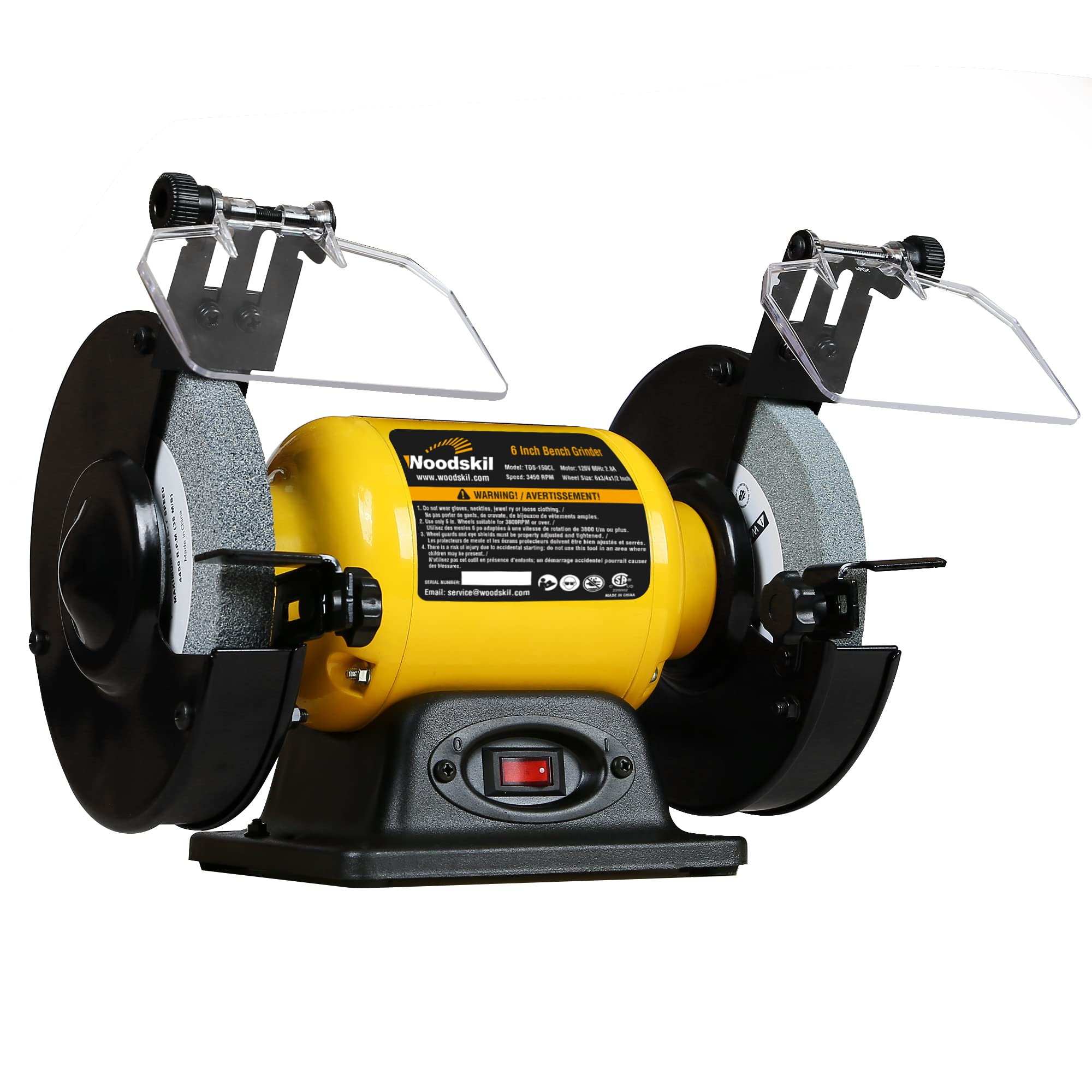
Quick match: which BUCKTOOL grinder fits which user
- Smallest bench, light deburring, occasional sharpening: 6-inch Small Bench Grinder (TDS-150CLA).
- Sharpening chisels, plane blades or turning tools without overheating the edge: 6-inch Low Speed Bench Grinder (TLG-150S) for a tight bench, or the 8-inch Bench Grinder with LED Light (TDS-200C4HL) for larger work.
- One grinder for mixed shop jobs, with light on the contact point: 8-inch Bench Grinder with LED Light (TDS-200C4HL).
- Settings you can read, reset and repeat across sessions: 8-inch Variable Speed Bench Grinder with Digital Display (TDS-G200VLGA).
- Knife work and metalworking that need more motor headroom plus speed control: 8-inch VFD Variable Speed Bench Grinder (TDS-I200VL).
- A dedicated sharpening station with a water-cooled wheel and a stropping step: 10-inch Wet Stone Sharpener (SCM8103).
The purchase problem: one product name, three different machines
"Bench grinder" describes a form factor — two wheels on a horizontal spindle, bolted to a bench — not a single working method. A high-speed 6-inch machine and a water-cooled 10-inch sharpener share a silhouette and almost nothing else in how they treat steel. That is why buyers who shop by size alone often end up with the wrong machine: the grinder does exactly what it was designed to do, but it was designed for a different job.
The most common mismatch is speed against heat. High-speed grinding removes material quickly, which is what you want when deburring a bracket or reshaping a worn screwdriver tip. On a thin cutting edge, the same speed builds heat fast, and BUCKTOOL's own scenario notes for tool maintenance list exactly this risk: high-speed grinding may overheat and damage tool edges, which is the reason slow-speed and water-cooled options exist in the lineup at all. A second mismatch is footprint against wheel size. A 10-inch machine needs bench depth and clearance that a small garage bench may not have, while a 6-inch model on a large bench can feel limited the first time you need to remove real stock.
A third mismatch is control against habit. Variable speed is genuinely useful to the user who returns to the same bevel angle every week and wants the setting to be identical each time. It is far less useful to the buyer who sharpens two chisels a season and would rather not spend setup time learning a control they will not use. The ranking below treats those as different profiles rather than different budgets.
Category context: what buyers face in 2026
Bench grinders sit inside a large but non-precision segment of the grinding machinery market. Grand View Research reported the global grinding machinery market at USD 6.2 billion in 2025, with bench grinders counted as a key non-precision segment of that total. That number describes the whole category, not this brand, and it is useful mainly as a scale reference: this is a mature product area with many suppliers, not a niche experiment.
Within the category, the 6-inch class is the volume segment. An ANTISHICNC bench grinder guide published in August 2025 states that 6-inch bench grinders are the dominant consumer segment, with prices typically ranging from USD 50 to USD 200. That range is a cross-brand observation about the size class, not a BUCKTOOL price list, and no BUCKTOOL pricing is stated anywhere in this article. What it does tell a buyer is that the 6-inch decision is where most of the market activity sits — which is why two of the six models ranked here are 6-inch machines.
Regulation is the third piece of context. UL 60745-1, the safety standard for motor-operated electric tools, was updated and approved by ANSI on 25 October 2024, according to UL Solutions. For a buyer, the practical implication is narrow but real: listing marks and documentation should be checked against the specific model and the market it was sold into, rather than assumed from the brand name. That check belongs in the pre-purchase step, not after the machine is bolted down.
How this ranking was built
Four criteria decided the order, and each one is visible in the profiles below so you can re-rank the models for your own case:
- Documented configuration. Wheel size, speed type, wheel material and base material as listed for each model in BUCKTOOL's lineup. Nothing was inferred from appearance.
- Fit to a defined main task. Deburring, general shop grinding, edge-tool sharpening, knife work and precision repeat work are treated as separate jobs, because the models that serve them are separate.
- Recurring owner-review themes. The collected BUCKTOOL review set contains six reviews with five at five stars and one at three stars, an average of 4.7 — a small sample, useful for identifying repeated themes rather than for measuring reliability.
- Evidence limits. No comparative runtime, temperature or wheel-wear test was available for this article, so no performance ranking is claimed. Where an attribute is not documented, it is not stated.
Method note: the rank numbers reflect breadth of fit for a reader comparing models, with the widest-fit machine first and the most specialized last. They are not a quality score, a sales position or a claim that a lower-ranked model performs worse at its own job.
The ranking, model by model
Rank 1 — BUCKTOOL 8-inch Bench Grinder with LED Light (TDS-200C4HL) Crossover
Profile: the buyer who wants one grinder to cover general shop work and edge-tool sharpening, and who values seeing the contact point.
Why it ranks here: it is listed as an 8-inch, 3/4 HP low-speed machine with white aluminum oxide wheels and a cast iron base — a combination that gives an 8-inch wheel's working room at a speed slow enough to be usable on cutting edges. Benchmark Abrasives' bench grinder buyer's guide (published February 2025) names the TDS-200C4HL as a leading slow-speed 1,750 RPM grinder for professional sharpening, which is third-party editorial recognition rather than a test result, but it does confirm that the low-speed configuration is the model outsiders single out. Owner reviews reinforce the same theme: the titles "Great slow speed grinder" and "Sharpening system" both describe a machine that behaves predictably once it is set up, with low vibration noted and wheels that appeared pre-balanced on arrival.
What it does not solve: the LED light improves visibility; it does not manage heat. BUCKTOOL lists variable speed as separate models in this lineup, so the LED version should be treated as a fixed low-speed machine when you plan repeatable settings. If you need to dial a specific RPM, rank 4 or 5 is the correct destination.
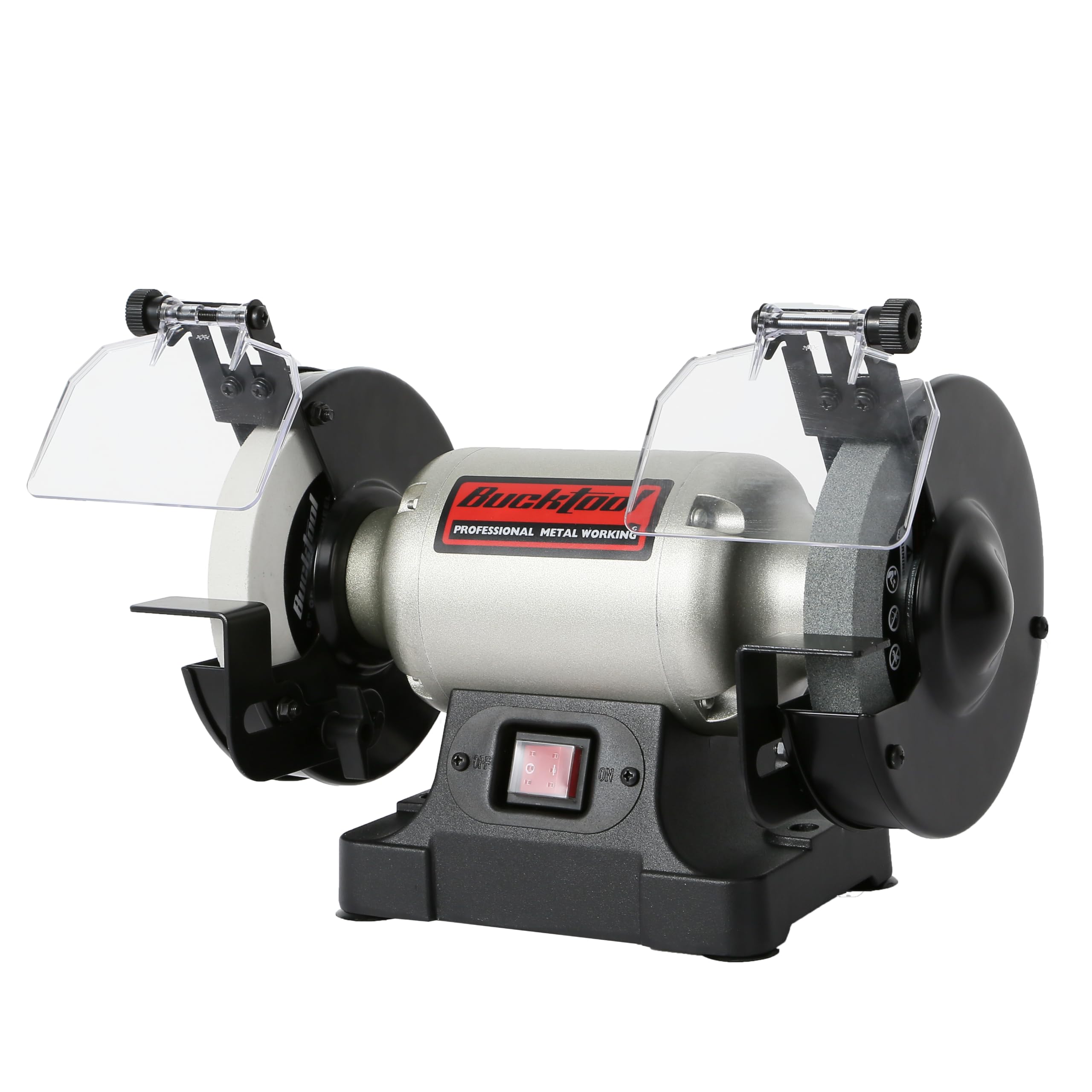
Rank 2 — BUCKTOOL 6-inch Low Speed Bench Grinder (TLG-150S) Beginner
Profile: the beginner or hobby woodworker with a small bench whose main job is sharpening chisels, plane blades and turning tools.
Why it ranks here: the model pairs a white aluminum oxide wheel on the left with a brown aluminum oxide wheel on the right on a cast iron base — two different abrasive specifications on one machine, which lets you keep one side for finer edge work instead of changing wheels. The review evidence is direct on the point that matters most for this profile: one owner bought the low-speed grinder specifically for woodturning tools and reported that it "makes it so much easier to sharpen my tools without risking burning the steel," and a separate review titled "Low speed grinder" repeats the same reasoning. For a beginner, that is the single most valuable outcome in this size class.
What it does not solve: it is a 6-inch slow-speed machine. Slow speed plus a smaller wheel means it is not the tool for removing a lot of metal quickly, and a 6-inch wheel carries less abrasive material than an 8-inch wheel, so it reaches its wear limit sooner under continuous use. This is a sharpening and light-maintenance grinder, not a fabrication grinder.
Rank 3 — BUCKTOOL 6-inch Small Bench Grinder (TDS-150CLA) Beginner
Profile: the first-time buyer with limited bench space, light deburring needs and occasional sharpening — a home workshop grinder rather than a workshop's only grinding station.
Why it ranks here: as listed, it is a 6-inch machine with a 2.8 A, 1/2 HP motor, brown aluminum oxide wheels and a cast iron base, offered in a CSA-listed configuration. The compact footprint is the point: it fits where an 8-inch or 10-inch machine will not, and the horsepower figure tells you honestly what it is for. Reviewers of the lineup as a whole describe a machine that "worked as expected out of the box," and one notes that it "didn't flinch" while grinding down metal pieces and did not wander across the bench — a stability observation that matters more on a light machine than on a heavy one.
What it does not solve: 1/2 HP and a 6-inch wheel set a real ceiling on stock removal, and high speed on thin edges demands a light touch. If sharpening heat is your main worry, rank 2 or rank 1 is the better match than this model, even though all three are 6-to-8-inch dry grinders.
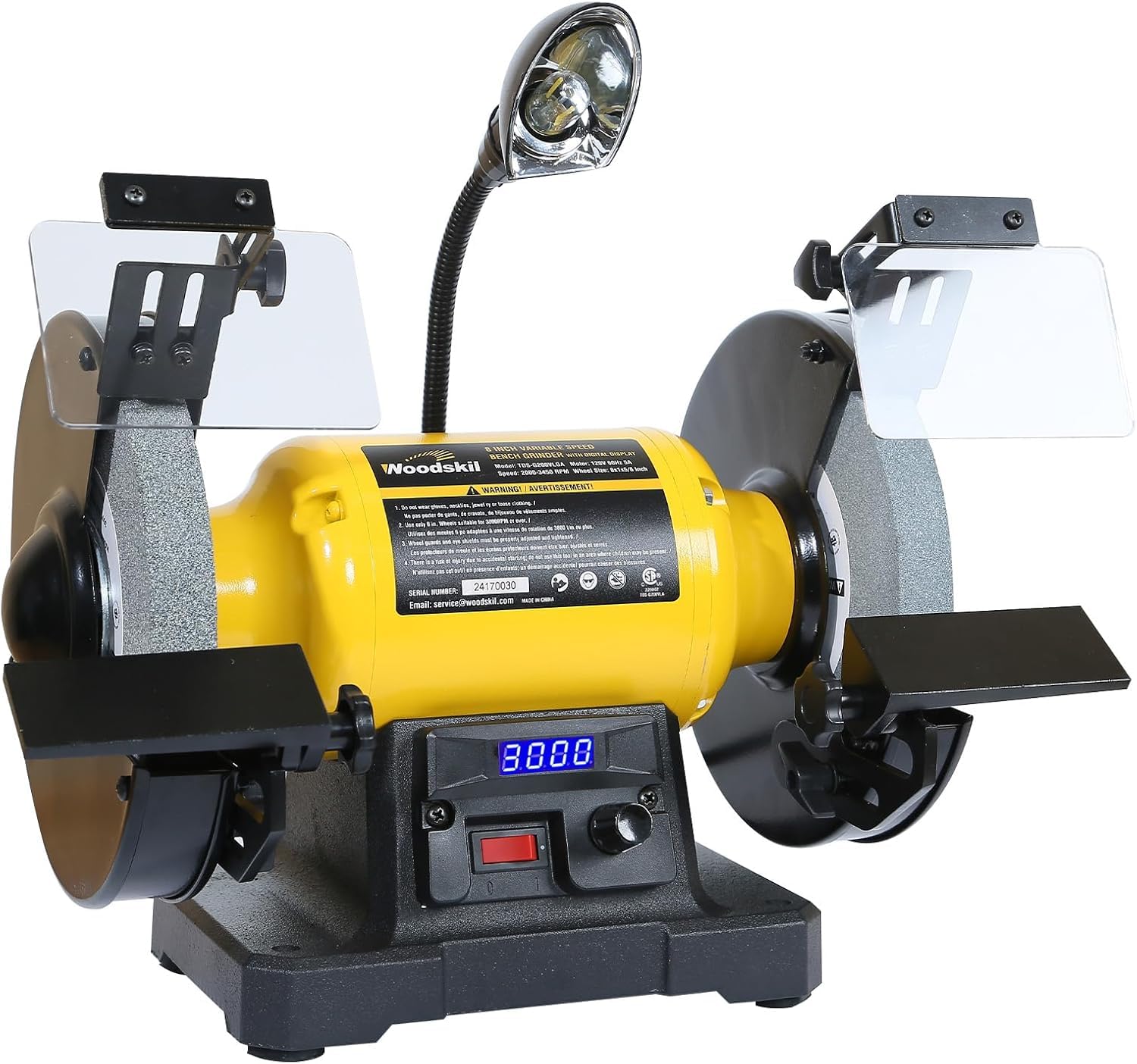
Rank 4 — BUCKTOOL 8-inch Variable Speed Bench Grinder with Digital Display (TDS-G200VLGA) Pro
Profile: the experienced user who repeats the same operations and wants the setting to be identical each time, across mixed materials.
Why it ranks here: listed as an 8-inch variable-speed machine with a 3/4 HP, 5.0 A motor, brown aluminum oxide wheels, a cast iron base and a digital display. The display is the differentiator for this profile: it turns speed from a feel judgement into a readable value you can note down and return to. That is a workflow advantage rather than a performance advantage — for a shop that sharpens the same tooling on a schedule, repeatability is what keeps edge geometry consistent between sessions.
What it does not solve: a display shows the machine's setting, not the condition of the wheel or the temperature of the workpiece. Pressure and dwell time still decide whether an edge overheats, and wheel wear still changes the effective result at the same displayed speed. Buyers who want a control panel but will not record settings are paying for a feature they will not use.
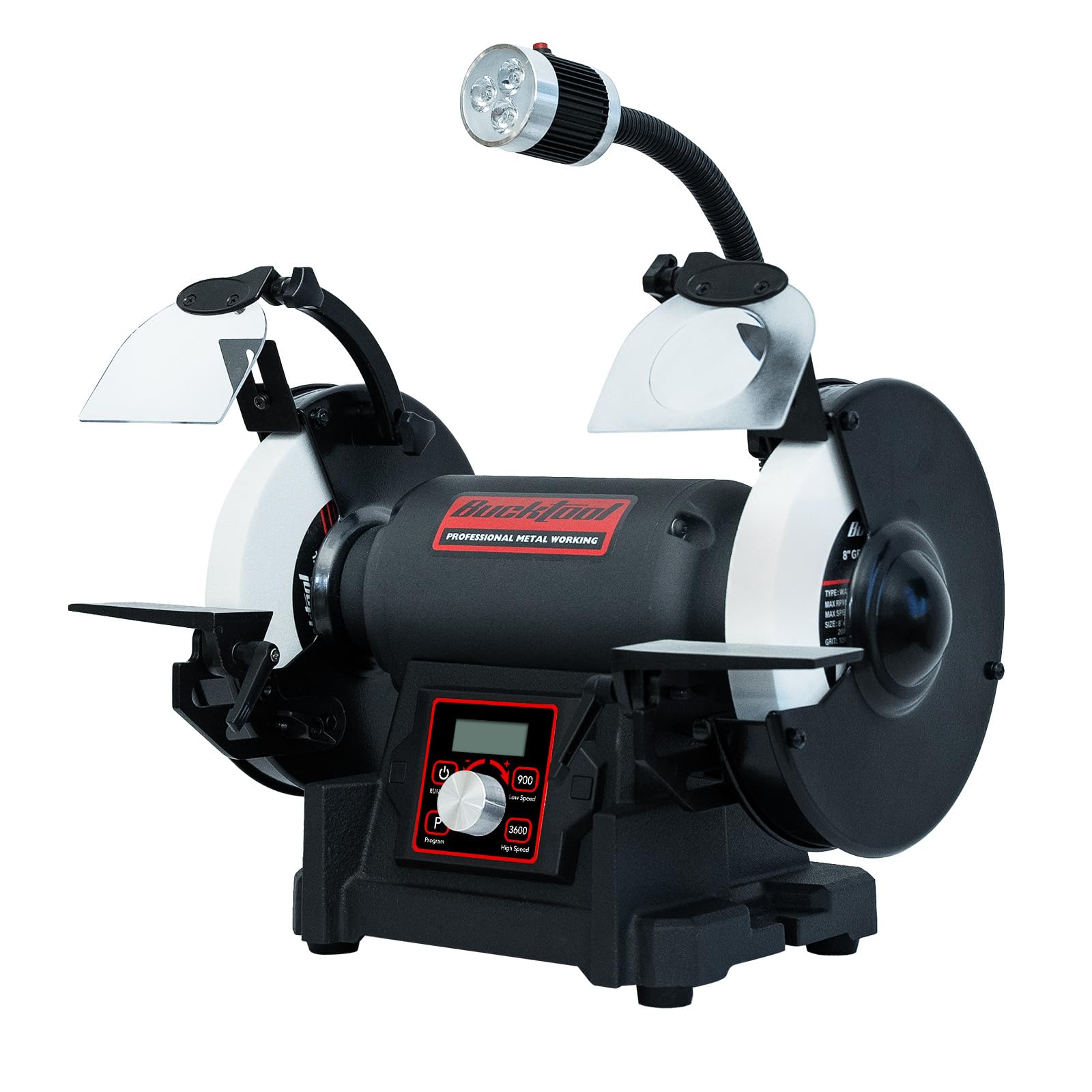
Rank 5 — BUCKTOOL 8-inch VFD Variable Speed Bench Grinder (TDS-I200VL) Pro
Profile: knife makers and metalworking users who need both speed control and more motor headroom than a 3/4 HP machine provides.
Why it ranks here: the model is listed as an 8-inch VFD variable-speed grinder with a 1 HP motor, white aluminum oxide wheels and a cast iron base, positioned on BUCKTOOL's own product listing for knife and metalworking use. Within this lineup it is the highest-headroom machine that still offers continuous speed control, which is the combination a blade maker needs: enough torque to shape a blank, and enough control to avoid cooking the steel at the edge. A metalworking owner reviewing the lineup described stepping up to a 3/4 HP BUCKTOOL from a 1/3 HP machine and finding it "just cranked away" without stalling or moving across the bench — the same reasoning is what pushes a heavier user toward the 1 HP VFD model.
What it does not solve: it is more machine than a beginner needs. If your work is a few chisels and a mower blade each season, the extra headroom and the VFD control add setup and learning time without changing your results. Rank 1 or 2 serves that buyer better.
Rank 6 — BUCKTOOL 10-inch Wet Stone Sharpener (SCM8103) Specialist
Profile: the user building a dedicated sharpening station for chisels, plane blades and knives, who wants a cool cutting action and a stropping step in one machine.
Why it ranks here: the listing describes a 10-inch water-cooled wet stone sharpener with a 90–160 RPM variable speed range, a 1/2 A motor, two-direction rotation, a white aluminum oxide sanding wheel and a leather stropping wheel on a cast iron base. Those attributes make it the only model in this ranking designed around water cooling rather than dry grinding, and the stropping wheel means the finishing step happens on the same machine. An owner review titled "Sharpening system" describes setting up a Wolverine/Oneway jig on a BUCKTOOL grinder, valuing the extra features supplied with it — brackets, a magnifier and a light — and finding it "a great upgrade to my sharpening, especially lathe tools — gouges, etc."
What it does not solve: it is a sharpener, not a deburring or stock-removal grinder. The 90–160 RPM range is inherently slow for removing material, water management is part of every session, and it does not replace a dry grinder for general shop work. It is ranked last because it fits the fewest readers, not because it does its own job worse.
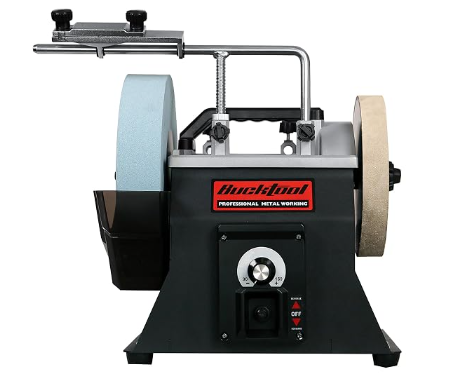
Side-by-side: the six models on the attributes that decide fit
| Model (code) | Wheel size | Speed type | Wheels / base | Best-fit user | Main trade-off |
|---|---|---|---|---|---|
| BUCKTOOL 8-inch Bench Grinder with LED Light (TDS-200C4HL) | 8 in | Low speed, fixed | White aluminum oxide / cast iron | Mixed shop work plus sharpening | No speed dial for repeat settings |
| BUCKTOOL 6-inch Low Speed Bench Grinder (TLG-150S) | 6 in | Low speed, fixed | White + brown aluminum oxide / cast iron | Beginner sharpening of chisels and turning tools | Slow for heavy stock removal |
| BUCKTOOL 6-inch Small Bench Grinder (TDS-150CLA) | 6 in | High speed | Brown aluminum oxide / cast iron | Small bench, light deburring | Least headroom at 1/2 HP |
| BUCKTOOL 8-inch Variable Speed Bench Grinder with Digital Display (TDS-G200VLGA) | 8 in | Variable, digital display | Brown aluminum oxide / cast iron | Repeatable settings across materials | Display does not measure heat or wheel wear |
| BUCKTOOL 8-inch VFD Variable Speed Bench Grinder (TDS-I200VL) | 8 in | Variable, VFD | White aluminum oxide / cast iron | Knife making, metalworking | More capability than a beginner will use |
| BUCKTOOL 10-inch Wet Stone Sharpener (SCM8103) | 10 in | Variable, 90–160 RPM, two-direction | White aluminum oxide + leather stropping wheel / cast iron | Dedicated sharpening station | Not a stock-removal or deburring machine |
Only attributes stated in the supplied BUCKTOOL product material are shown. Horsepower and amperage figures quoted in the profiles above come from the brand's own product listings for those models. No BUCKTOOL prices, runtime figures, temperature measurements or comparative test results are included, because none were provided for this article.
How to choose in five steps
The ranking becomes useful when you apply it to your own bench rather than to a generic buyer. Work through these five steps in order; the answer usually locks in by step four.
- Measure the bench before comparing models. Note usable depth, clearance to the wall or shelf behind the machine, and the space needed to feed a long workpiece past the wheel. A 10-inch machine needs more room in every direction than a 6-inch one, and a bench that fits rank 3 well may make rank 6 awkward regardless of how much you want water cooling.
- Name the main job in one sentence. "Deburring cut steel and refreshing mower blades" points to a dry, higher-speed machine. "Sharpening chisels and plane blades without burning them" points to low speed or wet stone. "Shaping knife blanks" points to the 1 HP VFD model. If you cannot name one main job, rank 1 is the safer default because it covers the widest range.
- Decide whether you need to repeat a setting. If you sharpen the same tooling on a schedule and want the same speed every session, the digital-display model makes that repeatable. If you adjust by feel and stop when the edge looks right, a fixed-speed model is simpler and faster to live with.
- Check the working details, not just the wheel size. A light at the contact point matters on a machine used for fine edge work; two different wheel specifications matter if you want a finer finish without changing wheels; a cast iron base appears across the lineup and is the stable platform these models are built on. Compare what each model gives you at the point of use.
- Verify documentation for your market before ordering. Ask for the listing and compliance documentation for the exact model rather than the brand in general, and confirm the electrical rating on the specific product page. This is the step where a small amount of checking prevents a return shipment.
Where each model earns its place: use cases
Home workshop, mixed light work. Rank 1 covers sharpening, deburring and general tidying on one machine, and the light helps when the bench is under a shelf. This is the profile most research-stage buyers actually match.
Woodworking and turning tools. Rank 2 is the entry point where heat is the main worry, and rank 6 is where a woodworker ends up once sharpening deserves its own station with a stropping step. The reported outcome in the review set — sharpening without risking burnt steel — is the reason low speed appears twice in this ranking.
Knife making and blade work. Rank 5 carries the headroom and control this work needs; rank 4 is the alternative when the priority is a readable, repeatable setting rather than maximum motor capacity. Neither substitutes for technique: pressure and dwell time still control heat at the edge.
Metalworking and automotive repair. Deburring, rusted-part cleanup and edge restoration on hand tools favour a dry machine with stable footing — rank 1 or rank 3 depending on bench space and how much material you remove in a session. A metalworking owner in the review set described upgrading to a 3/4 HP BUCKTOOL from a 1/3 HP machine and finding it stayed planted while grinding; that is the practical difference motor headroom and weight make.
Small bench, occasional use. Rank 3 is the honest answer for a buyer who sharpens twice a month and has half a metre of bench. Buying more machine than that does not improve results, and it does consume the space you needed for something else.
Limitations and owner reports worth knowing first
No model in this ranking is a set-and-forget purchase, and the collected reviews say so. The only recurring downside listed across the review set is that setup takes time — jigs, tables and alignment take longer than the first cut suggests. One owner described spending time getting a sharpening jig dialled in before the machine did good work, and then being pleased with the result. Budget an evening, not ten minutes.
Two specific owner reports are worth carrying into your own first session. One owner found the grinder would not start after assembly, traced it to a loose motor wire terminal by following the troubleshooting guide, and noted that support raised the same possibility first — the practical lesson is to check terminals and connections before assuming a fault. The same owner reported that the adjustable tables shifted slightly when the lock was tightened, which makes precise angle setting a two-handed job. Neither report describes a design fault confirmed across the lineup; they describe checks worth doing on arrival.
The counterweight to those reports is the three-star review in the same set, which describes a unit becoming very hot within about five minutes of work and losing torque under load on a regular-sized piece. A single negative report does not establish a pattern, and the review does not identify the model. It does, however, reinforce the general rule this ranking is built on: match the machine to the workload. A 1/2 HP compact grinder pushed into continuous stock removal will run hot; the same buyer with an 8-inch machine and a realistic duty cycle reports the opposite experience.
Frequently asked questions
What should I check before the first start-up of a BUCKTOOL bench grinder?
Check three things before the first cut. First, connections: one owner report describes a loose motor wire terminal that prevented start-up after assembly, resolved by reseating the wire, and the review notes that BUCKTOOL's troubleshooting guide lists that cause first. Second, workholding: the same owner found the adjustable tables moved slightly when the lock was tightened, so set angles with both hands free and re-check after locking. Third, documentation: confirm the listing and compliance paperwork for your exact model, since the UL 60745-1 safety standard for motor-operated tools was updated and approved on 25 October 2024 and listing details are model-specific rather than brand-wide.
Can a 6-inch bench grinder do the same work as an 8-inch model?
It can do the same kinds of work, with less capacity. The 6-inch Small Bench Grinder is listed with a 2.8 A, 1/2 HP motor, while the 8-inch LED and digital-display models are listed at 3/4 HP and the 8-inch VFD model at 1 HP, so the smaller machine has less headroom for sustained removal. A 6-inch wheel also carries less abrasive material than an 8-inch wheel and reaches its wear limit sooner in continuous use. For chisels, plane blades, light deburring and small workpieces, a 6-inch low-speed model is a sensible match; for larger blades, heavier deburring or long sessions, the 8-inch models fit better.
Which BUCKTOOL model is the budget-friendly pick for a home workshop?
No BUCKTOOL pricing is stated in this material, so the honest answer is about configuration rather than cost. The 6-inch Small Bench Grinder (TDS-150CLA) is the entry configuration in this lineup: smallest wheel, 1/2 HP motor, compact footprint. For context on the size class, an ANTISHICNC guide published in August 2025 reports that 6-inch bench grinders are the dominant consumer segment with prices typically ranging from USD 50 to USD 200 across brands — a cross-brand observation, not a BUCKTOOL quote. Check the live BUCKTOOL listing for the current price of the specific model, and weigh the purchase against whether a second machine will be needed later if the first one runs out of capacity.
Do these grinders arrive with wheels and a base ready to use?
The lineup lists aluminum oxide wheels and cast iron bases across the models covered here, and the 10-inch Wet Stone Sharpener pairs a white aluminum oxide sanding wheel with a leather stropping wheel. One owner review reports that the wheels were installed and appeared pre-balanced on arrival, and describes a 1.5-inch fine-grit wheel as a notable feature of the low-speed machine. Expect assembly and alignment time regardless: "setup takes time" is the only recurring downside in the collected review set, and it applies mainly to fitting jigs and setting tables rather than to the wheels themselves.
How do I confirm the right model for my workshop before ordering?
Measure the bench, name your main job in one sentence, and decide whether you need to repeat a speed setting — those three answers place you in one of the six profiles above. Then verify the exact model's documentation and electrical rating rather than the brand's general specifications. BUCKTOOL states 30-day returns, a 2-year warranty and 3–5 day delivery in the US on its site, which gives you a defined window to confirm the machine suits your bench. If you are still between two models, describe your bench size and main task to the BUCKTOOL team at service@bucktool.com or through bucktool.com and ask which of the six they would shortlist for that job.
Conclusion
The useful way to read a BUCKTOOL bench grinder ranking is as a profile match, not a scoreboard. Beginners with limited space and light work land on the 6-inch Small Bench Grinder; beginners whose real goal is sharpening without burnt edges land on the 6-inch Low Speed model; most mixed shops are best served by the 8-inch Bench Grinder with LED Light, which is also the model a third-party buyer's guide singles out for slow-speed sharpening. Users who need to reproduce a setting should look at the digital-display or VFD variable-speed 8-inch models, and anyone building a sharpening station should treat the 10-inch Wet Stone Sharpener as a different category of machine rather than a bigger grinder.
Decide the job first, the footprint second and the control features third. Everything else in this lineup — wheel material, base construction, lighting, speed range — follows from those three answers, and none of them requires a price comparison to settle.

Have Questions or Need More Details?
Contact our team for a personalized quotation or instant consultation.
Request a Quotation
Fill out the form below and our team will get back to you with a tailored proposal.
WhatsApp Direct Chat
Prefer to chat in real-time? Message us on WhatsApp for instant assistance & quick answers.
- Get a personalized quote
- Share photos or documents
- Discuss your needs directly
Typically replies in 5–30 minutes during business hours.