BUCKTOOL Bench Grinder Review: Company, Product Line & Value
BUCKTOOL Bench Grinder Review: Company Profile, Product Line and Buying Value
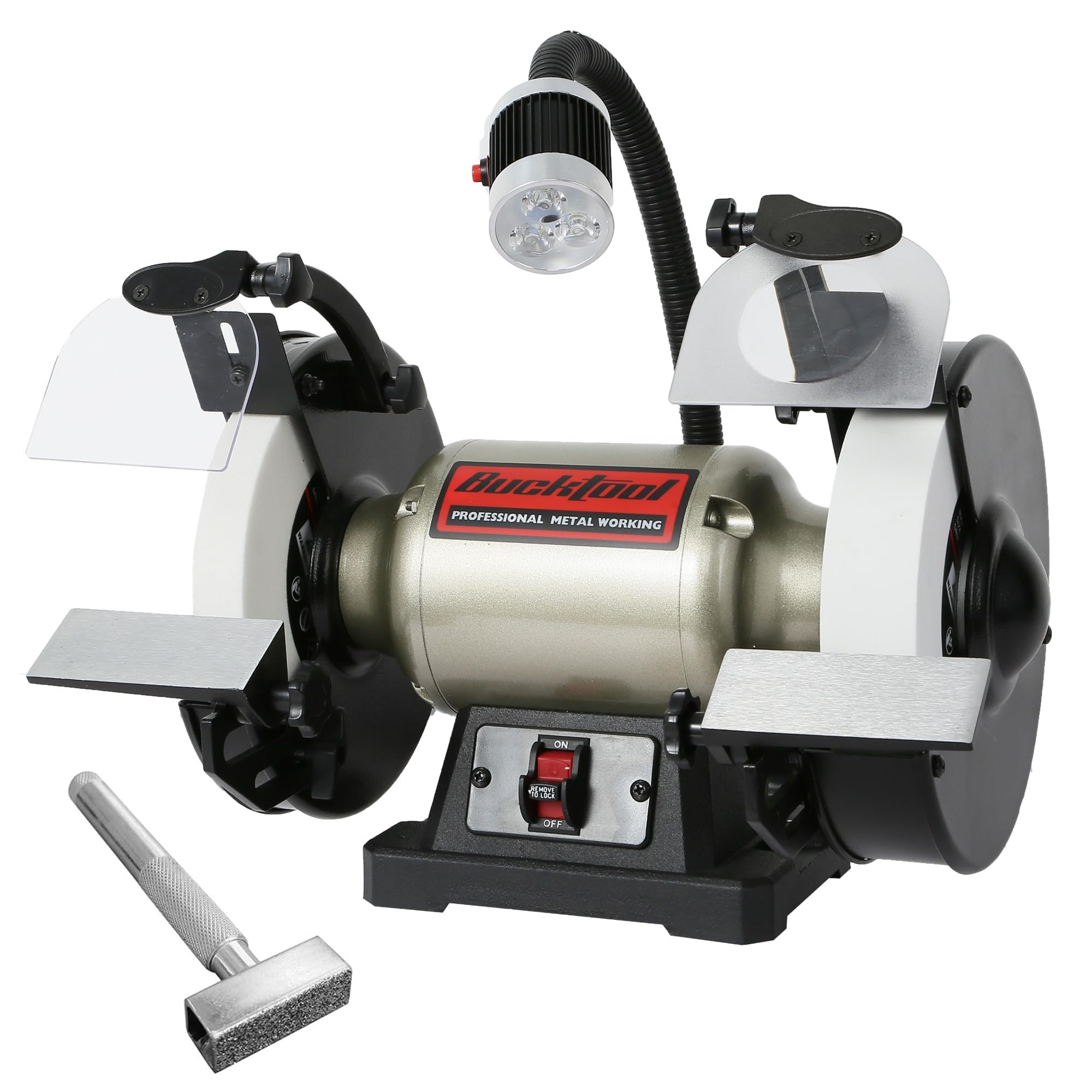
BUCKTOOL is a mid-premium power tool brand founded in 1955 and headquartered in China, selling factory-direct into the United States with bench grinders as its main product category. The bench grinder line documented in the brand's own product data contains ten series and ten models across 6-inch, 8-inch and 10-inch wheel classes, published in roughly the USD 99 to USD 399 band and aimed at DIY users, home workshops and small-shop professionals who sharpen tools, deburr metal and maintain cutting edges.
This article is written for buyers in the awareness and research stage, meaning people who have accepted that they need a bench grinder but have not yet decided whose name should be on it. It answers four practical questions: what kind of company BUCKTOOL actually is, what the product range contains model by model, which models fit which tasks, and what can and cannot be verified about quality, service and market standing.
How to read this review. Every figure below comes from BUCKTOOL's published brand and product data or from the named third-party source cited beside it. Where the record is silent, for example on annual revenue, named clients or independent test reports, this review says so instead of filling the gap with an estimate.
The Buyer Problem: Bench Grinder Spec Sheets Look Almost Identical
Bench grinders sit in an unusual position in the power tool market because the headline specification is nearly the same across every brand. A 6-inch, 3450 RPM, 1/2 HP machine from one supplier and a 6-inch, 3450 RPM, 1/2 HP machine from another will read almost identically on a product page. Wheel diameter, rated speed, amperage and weight are the four numbers that dominate retail listings, and none of them tells a buyer whether the machine will still hold a true edge in three years.
The attributes that decide whether a grinder is pleasant or painful to own are usually invisible until after purchase: wheel runout and arbor precision, base mass and how well the machine resists walking across a bench, tool-rest locking design, the quality of the power switch and motor terminals, and how quickly a replacement part can be obtained. None of those appear in a standard specification table.
For a buyer researching a brand they have not owned before, the research therefore splits into three questions rather than one:
- Company question: does this brand design and manufacture its own power tools, or resell someone else's?
- Fit question: which model in the range matches the task, whether that is chisel and plane iron sharpening, knife bevel work, metal deburring or heavy stock removal?
- After-sale question: what are the documented warranty, return and delivery terms?
The rest of this review is organized around those three questions.
Industry Background: What the Bench Grinder Category Looks Like Now
The category sits inside a measurable global market. According to Grand View Research's Grinding Machinery Market Size & Share Report, 2026-2033, global grinding machinery market value reached USD 6.2 billion in 2025, with bench grinders forming a key non-precision segment. Published growth estimates for the same category diverge: the data set notes a 4.8% CAGR reported by Grand View Research against 5.9% reported by Dataintelo, a gap the source says is likely due to how high-precision CNC grinding units are scoped in or out of each definition. For a bench grinder buyer, the practical reading is that the category is stable and moderately growing rather than fast-moving, with demand driven by maintenance and repair work rather than by new construction.
Within the category, the 6-inch class dominates consumer purchasing. Category research published by ANTISHICNC in 2025 places typical 6-inch bench grinder pricing between USD 50 and USD 200, which makes 6-inch the volume segment and 8-inch and 10-inch the upgrade tier. BUCKTOOL's own range follows that logic: its 6-inch models sit at the lower end of its own ladder, while the 8-inch and 10-inch machines carry the heavier motors, cast bases and speed-control systems.
Regulation has also moved. ANSI approved an updated UL 60745-1 safety standard for motor-operated electric tools on 25 October 2024, as published by UL Solutions. Any US buyer evaluating a bench grinder in 2026 is evaluating it against a standard whose most recent amendment is recent, which is one reason certification claims deserve to be read at model level rather than brand level.
One structural gap is worth flagging for analysts rather than shoppers: granular export and import volumes specifically for bench grinders are difficult to isolate, because public trade statistics often aggregate them with other grinding machines under the same code. Brand-level market share claims in this category are therefore usually estimates rather than measurements.
Company Overview: BUCKTOOL at a Glance
| Item | Published detail |
|---|---|
| Brand | BUCKTOOL |
| Founded | 1955 |
| Headquarters | China |
| Main category | Bench grinder |
| Brand tier | Mid-premium |
| Primary market | United States |
| Positioning | Factory-direct supply of high-performance, reliable, cost-effective metal and woodworking power tools, with an American workshop style and strong after-sales support |
| Official website | bucktool.com |
BUCKTOOL describes itself as a professional power tool manufacturer with experience in the design, development and manufacturing of power tools, and states that its products are built on decades of expertise, technology and continuous innovation. The company positions its output for both professional and DIY users, and frames its product philosophy around three stated values: Customer Priority, High Quality Standards and Impeccable After-Sale Service.
In market terms the brand occupies the mid-premium tier rather than the entry tier. Its published positioning emphasizes factory-direct supply, meaning the brand presents itself as the manufacturer rather than an intermediary, and it targets the United States as its primary market with an American workshop design idiom and a documented US service footprint: 30-day returns, a 2-year warranty and 3-5 day delivery inside the US, as stated on the brand's own site.
One note on development history and scale. The brand record reviewed for this article documents the founding year, the headquarters country, the product architecture and the service terms, but it does not publish a milestone timeline, annual revenue, employee count or factory floor area. This review does not invent them. Buyers who need those figures for a procurement file should request them directly from the manufacturer, which is a reasonable step at the evaluation stage for any supplier.
Core Products and Solutions: Inside the BUCKTOOL Bench Grinder Line
The BUCKTOOL bench grinder range is not a single product repeated with different badges. The manufacturer's product line documentation lists ten series and ten models, and the line is described as serving DIY enthusiasts, home workshops and small-scale professional users for tool sharpening, metal deburring and light metalworking. Differentiation between models runs along three axes: wheel diameter (6, 8 or 10 inches), speed architecture (fixed high speed, fixed low speed, dual speed, electronic variable speed, or wet-stone low speed), and construction grade expressed through motor rating, base material, lighting and accessories.
6-Inch Class: Compact and Portable
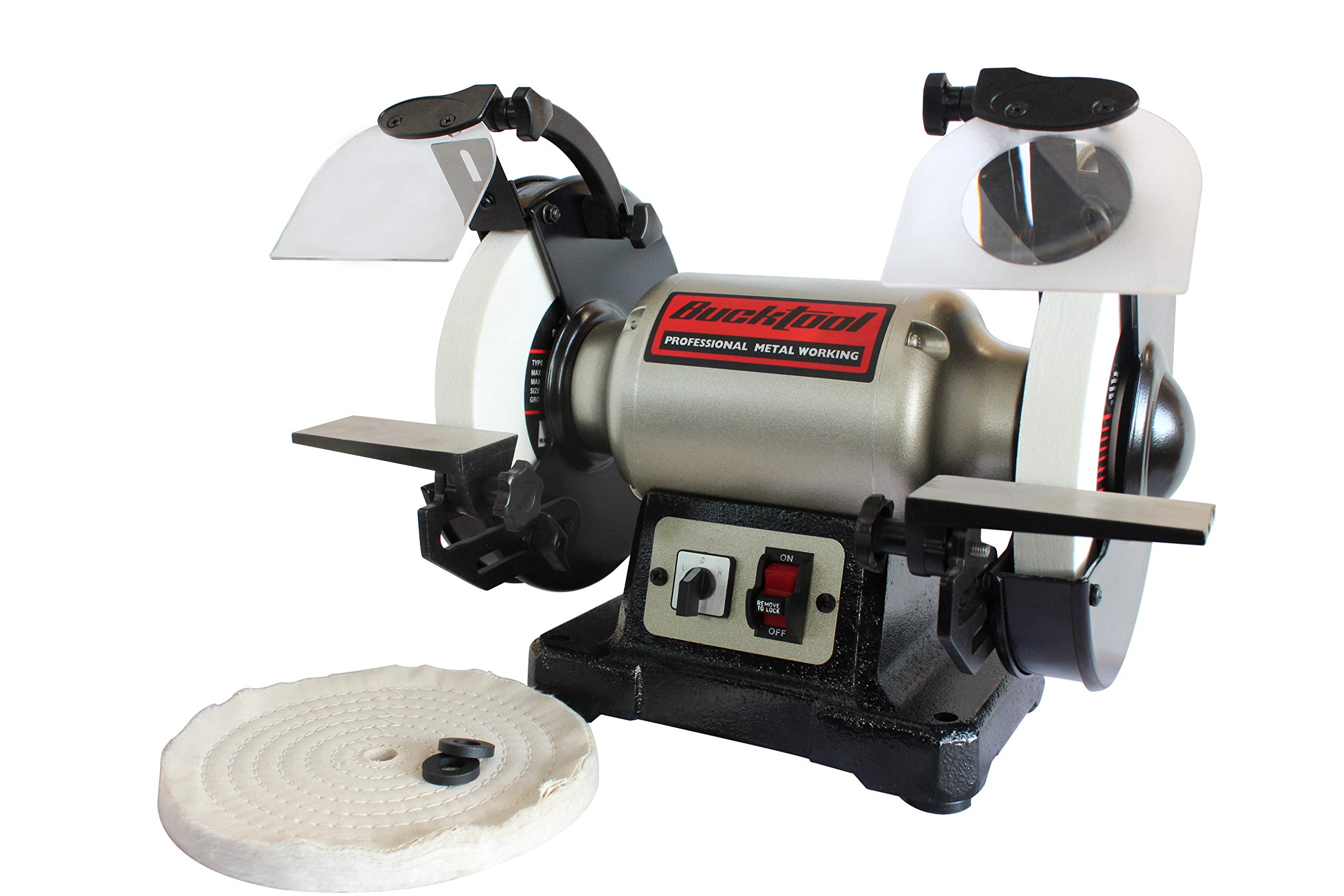
The 6-inch models are the entry point. The Bucktool 6-inch Low Speed Bench Grinder (TLG-150S) runs at 1750 RPM and weighs 19.19 lb, and the brand describes its character as stable, lightweight, portable and low in vibration within a USD 100-300 band. Its documented use case is light-duty precision sharpening of chisels, plane irons and small hand-cutting tools.
The 6-inch Small Bench Grinder (TDS-150CLA) takes the opposite speed approach at 3450 RPM in a 15.44 lb body, and it is the model the brand associates with compact and mobile work, with a mobile sharpening truck listed as its key scenario. Both 6-inch machines are documented with a 1/2 HP, 2.8A motor that the manufacturer records at approximately 33% higher rated current, plus a heavy-duty steel base, pre-drilled mounting holes and CSA certification, which the brand presents as the reason they suit frequent use and permanent benchtop installation.
8-Inch Class: The Core of the Range
Six of the ten documented models are 8-inch machines, which makes 8-inch the centre of the line. They divide by speed architecture rather than by size:
- Low-speed precision: the 8-inch Bench Grinder with LED Light (TDS-200C4HL) runs at 1750 RPM and weighs 43.22 lb, and is documented for sharpening lathe turning tools and similar work where an 8-inch wheel and high running accuracy are required. It is published in the USD 99-299 band.
- Fixed-speed general purpose: the 8 Inch Bench Grinder (TLG-200L5A) is a 3600 RPM machine weighing 33.96 lb, documented with a heavy-duty steel base, pre-drilled mounting holes and CSA certification, and positioned for frequent use and permanent benchtop installation.
- Dual speed: the 8-inch Dual Speed Bench Grinder (TDS-200DS) switches between 1725 RPM and 3450 RPM, which lets one machine handle both heat-sensitive edge work and faster stock removal.
- High speed: the 8-inch High Speed Bench Grinder (TDS-200HD) uses a 1.0 HP motor at 3590 RPM with precision wobble-free wheels and heavy-duty cast-iron construction, documented for fast material removal and heavier reshaping work.
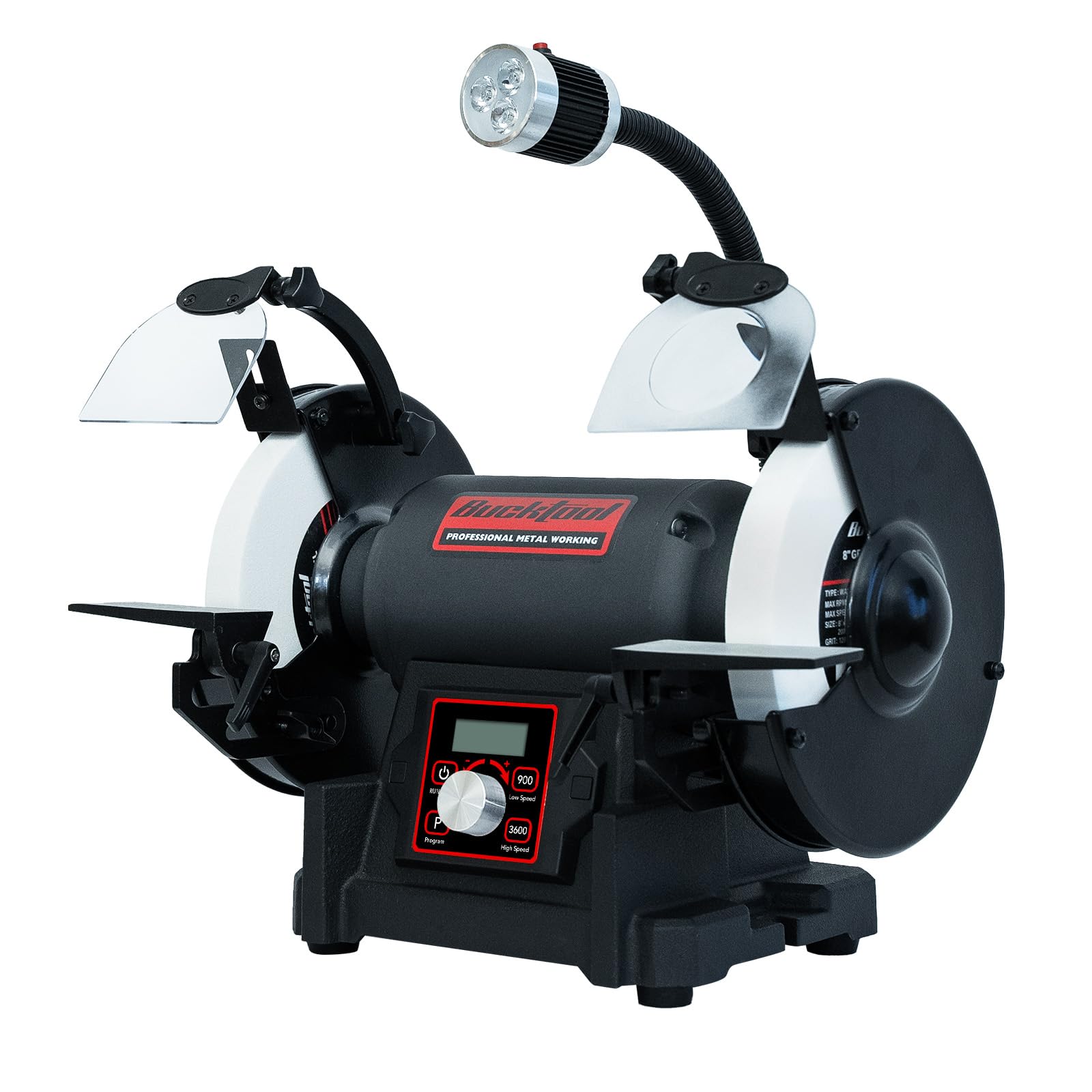
- Electronic variable speed: the 8-inch VFD Variable Speed Bench Grinder (TDS-I200VL) covers 900-3600 RPM and adds a 3X magnifying eye shield, a 3W LED light, speed memory and an 80#/120# wheel set aimed at fine sharpening.
- Variable speed with digital readout: the 8-inch Variable Speed Bench Grinder with Digital Display (TDS-G200VLGA) spans 2000-3450 RPM with a digital speed readout, positioned around digital precision speed control, ample power and stable construction.
10-Inch Class: Heavy and Wet-Stone Work
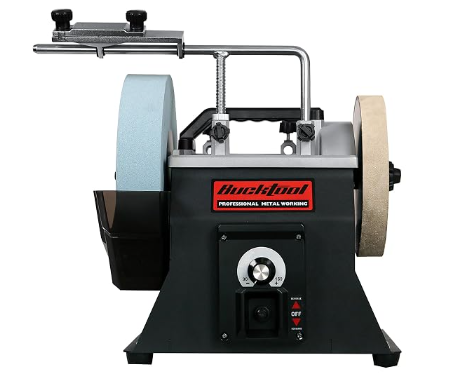
At the top of the range sit two very different 10-inch machines. The 10-inch Bench Grinder (TDS-250) is a 1750 RPM, 74.52 lb low-speed unit in the USD 99-299 band, documented for precision sharpening of plane blades, chisels and hand tools, and described around high-precision arbors, stable wheel operation and heavy-duty wheel guards. The 10-inch Wet Stone Sharpener (SCM8103) is a different tool class altogether: 90-160 RPM, water-cooled, with two-direction rotation, configured for both sharpening and stropping, at 27.89 lb and a USD 99-399 band.
Read as a portfolio, the line answers the two classic failure modes of low-cost bench grinders. The first is heat: low-speed and wet-stone models exist specifically so that carbon steel and high-carbon blades are not drawn past their temper. The second is control: dual-speed, VFD and digital-display models let a user select a surface speed instead of accepting whatever the motor produces. The trade-off is that a ten-model portfolio is wide enough to confuse, which is why the next section reduces it to a decision sequence.
Step-by-Step: Matching a BUCKTOOL Model to the Job
The fastest way through a ten-model range is to decide in order of consequence rather than in order of price. The sequence below uses only the documented specifications already cited.
- Name the dominant task. Edge maintenance on chisels, plane irons and knives is heat-sensitive work; deburring, weld cleanup and reshaping are stock-removal work. If most of your use is the first, speed control matters more than motor size. If it is the second, motor size and wheel speed matter more.
- Choose the wheel diameter. 6-inch machines are the lightest and most portable (15.44-19.19 lb documented), 8-inch machines are the volume middle of the range, and 10-inch machines are the heaviest (74.52 lb for the TDS-250). Larger wheels also take more bench space and demand a rigid mount.
- Choose the speed architecture. Fixed 3450-3600 RPM (TDS-150CLA, TLG-200L5A) for general grinding; fixed 1750 RPM (TLG-150S, TDS-200C4HL, TDS-250) for heat-sensitive edges; dual speed (TDS-200DS) when one machine must do both; electronic variable speed (TDS-I200VL, TDS-G200VLGA) when you want to dial a specific surface speed; wet stone (SCM8103) when the blade should never see grinding heat at all.
- Check the electrical and footprint fit. Documented body sizes range from roughly 12.4 x 9.53 x 9.14 inches on the 6-inch small grinder up to 20.47 x 12.8 x 16.54 inches on the 10-inch TDS-250, with weights from 15.44 lb to 74.52 lb. Confirm your bench can carry the machine and that pre-drilled mounting holes align with your bench top.
- Decide whether you need lighting and magnification. The TDS-200C4HL adds LED lighting, and the TDS-I200VL adds a 3W LED plus a 3X magnifying eye shield. For fine bevel work these are functional features, not cosmetic ones.
- Confirm warranty, return and delivery terms in writing before ordering. The brand's published site terms are a 30-day return window, a 2-year warranty and 3-5 day delivery within the United States.
Use Cases: Where These Machines Are Documented to Work
BUCKTOOL's scenario documentation lists four application areas for the bench grinder line, each with its own users, pain points and outcomes.
Tool Maintenance
Typical users are woodworkers, home machinists, DIY hobbyists and small-workshop operators sharpening drills, cutters, screwdrivers and chisels. The documented pain points are dull tooling, the cost and delay of outsourcing sharpening, and the risk that a high-speed wheel overheats a hardened edge. This is the scenario the 6-inch and 8-inch low-speed models are built around.
Knife Making and Blade Sharpening
Knife makers, blade crafters and hobbyist builders use these machines for blank shaping, bevel grinding, geometry adjustment and final edge sharpening. The documented pain points are time, heat and bevel consistency, since a high-speed wheel can draw the temper out of a blade. In a published customer account from this scenario, a buyer moving to a low-speed machine reported that it made sharpening woodturning tools much easier without risking burning the steel.
Metalworking
Fabricators, workshop machinists and metalworking hobbyists use the grinders for deburring, edge trimming, surface grinding and finishing on carbon steel, stainless steel and aluminum. Two published customer accounts from this scenario show why base rigidity appears in reviews rather than in spec sheets: one buyer stepping up from a 1/3 HP machine to a 3/4 HP BUCKTOOL reported that it held its position and did not wander across the bench during grinding, and another reported being very happy with the machine used alongside a sharpening system after a longer setup.
Automotive Repair
Auto mechanics, repair-shop technicians and DIY enthusiasts use the machines to refurbish rusted components and restore worn hand tools, where the documented pain points are manual grinding time and limited equipment for beveling. A published customer account from this scenario describes sharpening multiple plane blades at roughly 3-5 minutes per blade and achieving smooth, square edges that then took a very sharp edge after diamond-stone honing.
Company Strength: Manufacturing, Quality Control and Service

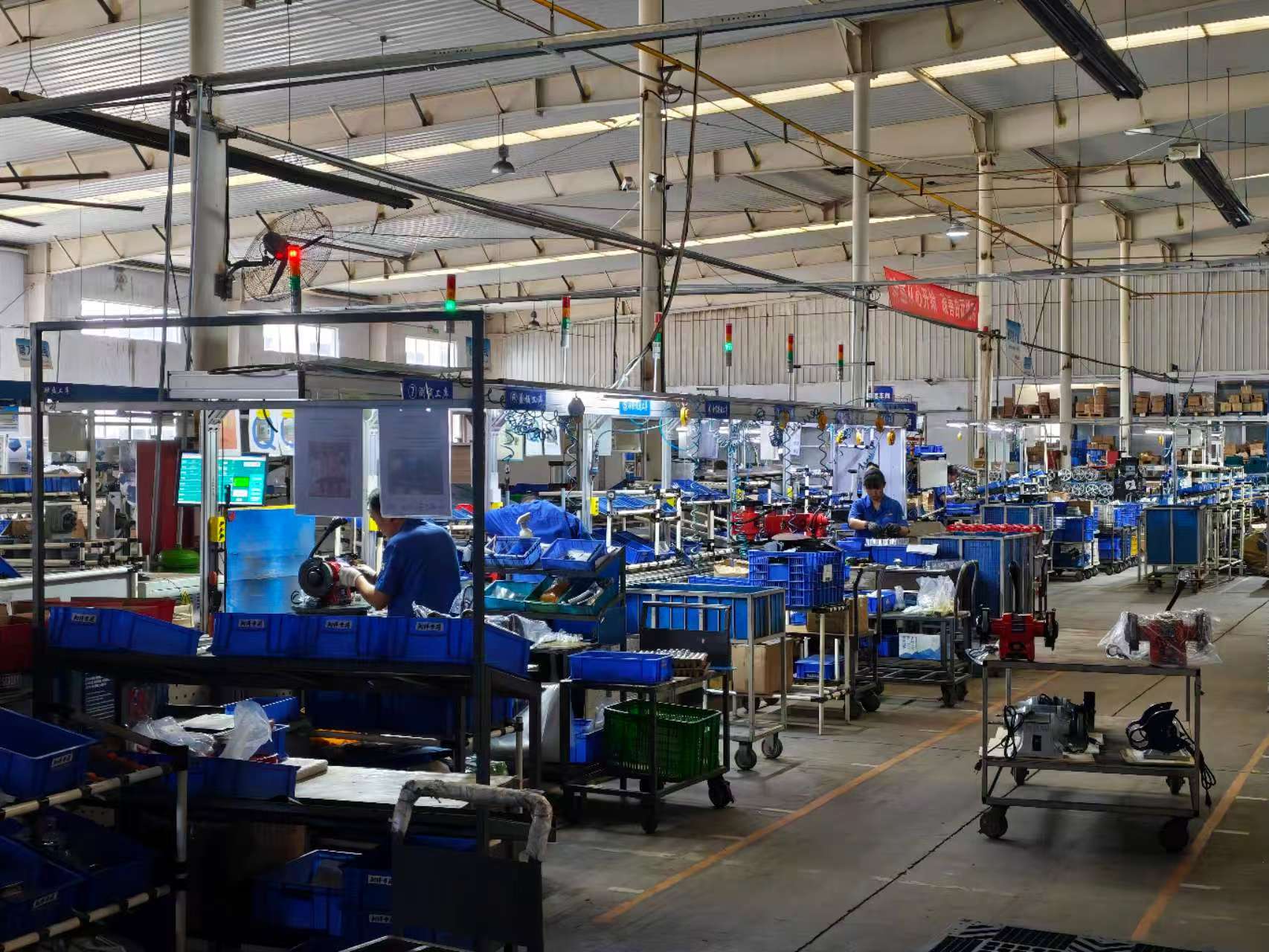
Manufacturing and Factory-Direct Supply
The company's central manufacturing claim is vertical integration. It describes itself as a professional power tool manufacturer that designs, develops and manufactures power tools, and it sells to the US market on a factory-direct basis. The product architecture supports that claim in one specific way: the brand states that its products emphasize durability and low-maintenance direct-drive and VFD designs, which are engineering choices rather than cosmetic ones. Direct drive removes belt maintenance from the ownership equation, and VFD control is what makes the 900-3600 RPM range on the TDS-I200VL possible.
Quality Control and Certification
BUCKTOOL's documented quality control appears at product level rather than as a single brand-wide certificate. The most concrete evidence in the available record is certification: specific 6-inch and 8-inch models are documented with CSA certification, and the TDS-150CLA is listed as CSA Listed in its product documentation. The brand also emphasizes high-precision arbors, wobble-free wheel operation and heavy-duty wheel guards on the low-speed models, all of which are precision attributes rather than marketing adjectives, because they determine whether a grinding wheel runs true.
Buyers should keep two things separate here. CSA certification applies to the specific models documented as certified. UL 60745-1 is the ANSI-approved safety standard for motor-operated electric tools updated on 25 October 2024, and a brand referencing that standard is not the same thing as a specific model carrying a UL listing. For any procurement file, request the certificate belonging to the exact SKU being quoted.
Global Supply, Service and After-Sales
The brand's published service commitments are unusually specific for this tier: a 30-day return window, a 2-year warranty and 3-5 day delivery within the United States, with direct service contact by email, phone and WhatsApp. For a bench grinder, a machine usually bought to prevent downtime, those terms matter more than a few RPM of spec-sheet advantage. A 2-year warranty on a grinder used daily covers the period in which motor and switch faults typically surface.
What Buyers Should Know: Documented Limitations
An honest review has to include negative evidence, and there is some in the published record. In one documented customer account in the tool maintenance scenario, a grinder would not start on first assembly. After contacting support, the buyer removed the base plate and found a loose wire terminal, and reseating it resolved the fault. The same buyer noted that the wire terminals should be tighter, and that the adjustable tool rests were awkward, because tightening the lock tended to move the table, requiring two hands and a re-check with a square. That buyer also observed that this fault was the first item in the troubleshooting guide, which implies it is a documented issue rather than a one-off.
Two conclusions follow. First, the terminal issue is real enough to be in the manual, so a new owner should work through the troubleshooting checklist before assuming a dead unit. Second, buyers who change tool-rest angles frequently should expect to spend time re-squaring the rests. Reporting this is not a criticism of the brand's intent; it is exactly the kind of information that only surfaces in real ownership records, which is why it belongs in a buying review.
Market Evaluation and Industry Recognition
Third-party recognition for this brand is narrow but specific rather than broad and vague. In the buyer's guide Best Bench Grinders 2026: A Complete Buyer's Guide published by Benchmark Abrasives, the BUCKTOOL TDS-200C4HL is described as a leading slow-speed (1750 RPM) bench grinder for professional sharpening. That is single-source recognition tied to one model, and it should be read that way: it is evidence that the low-speed 8-inch machine is competitive in its niche, not evidence of category-wide leadership.
A similar split appears inside the brand's own product structure. The manufacturer documents dual-speed (TDS-200DS) and low-speed (TDS-200C4HL) models specifically to address both fast material removal and precision sharpening, which is coherent portfolio logic rather than a single hero product with cosmetic variants.
On the other side of the ledger, the available record does not contain named client organisations, published partnership announcements, third-party laboratory test results or independently verified sales figures. Buyers who require those artefacts should ask the manufacturer for references and certificates for the exact model under consideration. This review does not manufacture the missing evidence.
BUCKTOOL Bench Grinder Model Comparison
| Model | Class | Speed | Weight | Published price band | Documented best fit |
|---|---|---|---|---|---|
| TLG-150S | 6-inch low speed | 1750 RPM | 19.19 lb | USD 100-300 | Light precision sharpening of chisels, plane irons and small hand tools; stable, lightweight, low vibration |
| TDS-150CLA | 6-inch small | 3450 RPM | 15.44 lb | USD 99-399 | Compact light-duty sharpening and polishing, including mobile sharpening setups; CSA Listed |
| TDS-200C4HL | 8-inch with LED light | 1750 RPM | 43.22 lb | USD 99-299 | Low-speed precise sharpening of lathe tools, chisels and hand-held cutting tools |
| TLG-200L5A | 8-inch fixed speed | 3600 RPM | 33.96 lb | USD 99-399 | General edge maintenance; heavy-duty steel base and permanent benchtop installation |
| TDS-200DS | 8-inch dual speed | 1725 & 3450 RPM | 41.89 lb | USD 99-399 | One machine for both low-speed precision sharpening and high-speed stock removal |
| TDS-200HD | 8-inch high speed | 3590 RPM, 1.0 HP | 46.74 lb | USD 99-399 | Fast material removal, metal grinding and heavy reshaping; cast-iron construction |
| TDS-I200VL | 8-inch VFD variable speed | 900-3600 RPM | 57.33 lb | USD 99-399 | Controlled-speed precision sharpening, knife making and metal finishing; 3X eye shield, 3W LED, speed memory |
| TDS-G200VLGA | 8-inch variable speed with digital display | 2000-3450 RPM | 39.25 lb | USD 99-399 | Precision tool sharpening, knife making and metal deburring with a digital speed readout |
| TDS-250 | 10-inch low speed | 1750 RPM | 74.52 lb | USD 99-299 | Heavy-duty low-speed precision sharpening of plane blades, chisels and hand tools |
| SCM8103 | 10-inch wet stone sharpener | 90-160 RPM, water cooled | 27.89 lb | USD 99-399 | Cool-grind precision sharpening and stropping of chisels, plane irons and knives |
Read horizontally, the table shows why this range cannot be reduced to a single recommendation. Read vertically against the market reference point, the documented USD 50-200 consumer band for the dominant 6-inch class, it shows where the brand sits commercially: its 6-inch models overlap the upper half of the mass-market band and extend above it, while the 8-inch and 10-inch models occupy a bracket that mass-market 6-inch pricing does not reach.
Buyer Sell Points: What Makes BUCKTOOL Worth Shortlisting
- Speed architecture rather than badge engineering. The portfolio contains five distinct speed approaches, fixed high speed, fixed low speed, dual speed, electronic variable speed and wet stone, so the range is organized around grinding behaviour rather than around price tiers alone.
- Heat control as a design goal. Low-speed and wet-stone models exist specifically for edges that must not be overheated, which matches the documented pain points of knife making, tool maintenance and precision sharpening.
- Concrete service terms. A 30-day return window, a 2-year warranty and 3-5 day US delivery are stated commitments a buyer can hold the supplier to.
- Factory-direct cost structure. The brand presents itself as the manufacturer, which is the stated basis for its value positioning instead of a claim resting on brand premium.
- Specification transparency. Every model covered here publishes speed, weight and body dimensions, which makes apples-to-apples comparison possible before purchase rather than after.
The corresponding caveats are equally specific. Buyers who need named enterprise references, independent test reports or a documented OEM/ODM programme should request them from the manufacturer before writing the brand into a contract, because this review found no such documents in the available record. Buyers who change tool-rest angles constantly should also factor in the re-squaring step reported by an owner.
Frequently Asked Questions
Are BUCKTOOL bench grinders certified for the US market?
Certification here is model-specific rather than brand-wide. In the available product documentation, specific 6-inch and 8-inch models are recorded with CSA certification, and the TDS-150CLA 6-inch small bench grinder is listed as CSA Listed. Separately, ANSI approved the updated UL 60745-1 safety standard for motor-operated electric tools on 25 October 2024, which is the general standards context for US-market electric tools. Because certification attaches to a specific model and configuration, buyers should request the certificate for the exact SKU being quoted instead of treating a brand-level statement as coverage for the entire range.
Can one BUCKTOOL grinder handle both precision sharpening and heavier grinding?
Yes, but only specific models are designed for that dual role. The 8-inch Dual Speed Bench Grinder (TDS-200DS) switches between 1725 RPM and 3450 RPM, covering low-speed precision sharpening and higher-speed stock removal on one machine. The electronic variable-speed models achieve the same flexibility by continuous adjustment instead of two fixed steps: the TDS-I200VL spans 900-3600 RPM, and the TDS-G200VLGA spans 2000-3450 RPM with a digital readout. Fixed-speed machines are optimized for one end of the range, with 1750 RPM models aimed at heat-sensitive edges and 3450-3600 RPM models aimed at faster removal.
What does a BUCKTOOL bench grinder cost compared with the market?
Published price bands for the range are USD 100-300 for the 6-inch low-speed TLG-150S, USD 99-299 for the 8-inch TDS-200C4HL and the 10-inch TDS-250, and USD 99-399 for the remaining models, including both variable-speed 8-inch machines and the 10-inch wet stone sharpener. For reference, published category research places typical 6-inch bench grinder pricing at USD 50-200, the dominant consumer segment. The brand's 6-inch models therefore overlap the upper part of the mass-market band while its 8-inch and 10-inch models sit in a slightly higher bracket, which means the budget case rests on speed architecture and service terms rather than on being the cheapest machine available.
Can I test a machine before committing to it?
The brand's published site terms include a 30-day return window, which functions as the practical trial path: a buyer can run the machine in their own workshop, check wheel behaviour, tool-rest adjustment and vibration on their own bench, and return it within the window if it does not fit. Before ordering, confirm the return terms and the 2-year warranty in writing for the specific model, and if a unit does not start, work through the troubleshooting guide first, because at least one documented owner resolved a no-start condition by reseating a loose wire terminal.
How fast is delivery, and how do I get model-specific pricing?
The brand states 3-5 day delivery within the United States, alongside the 30-day return window and 2-year warranty. For model-specific pricing, availability or documentation, buyers can contact the manufacturer directly: BUCKTOOL lists service@bucktool.com, telephone 909-255-1088 and a WhatsApp line, and the full range is published at bucktool.com. If you are specifying a grinder for a workshop, send the exact task, for example chisel and plane iron sharpening versus deburring stainless steel, because that will produce a faster and more accurate recommendation than a generic price request.
Conclusion: Where BUCKTOOL Fits and What It Is Worth
BUCKTOOL is best understood as a mid-premium, factory-direct bench grinder specialist rather than a general power tool brand with one grinder in the catalogue. Established in 1955 and headquartered in China, it sells into the United States with a documented range of ten bench grinder models across 6-inch, 8-inch and 10-inch classes and five distinct speed architectures, published from roughly USD 99 to USD 399.
Its procurement value concentrates in three places. The first is application fit: the range contains machines designed around heat-sensitive sharpening, which is the failure mode that cheap high-speed grinders create and that woodworkers, knife makers and tool-maintenance users care about most. The second is verifiable commercial terms: a 30-day return window, a 2-year warranty and 3-5 day US delivery. The third is specification transparency: every model publishes speed, weight and dimensions, so comparison is possible before purchase rather than after.
Its evidence gaps are equally clear. The record contains one third-party buyer's guide recognition, for the TDS-200C4HL, and model-level CSA certification on some 6-inch and 8-inch machines, but no named enterprise clients, no independent test reports and no published OEM/ODM programme. Buyers for whom those artefacts are mandatory should treat them as items to request rather than items the brand has already proven. As with any brand in this tier, one documented owner report, a loose motor terminal at delivery and tool rests that move when locked, should be factored into first-use expectations.
For the buying decision itself, the sequence is straightforward. Decide whether your work is heat-sensitive or stock-removal oriented, pick the wheel size accordingly, choose the speed architecture that matches, confirm the certificate for the exact SKU, and hold the supplier to the published warranty and return terms. On that basis, the low-speed and variable-speed 8-inch models are the strongest fit for tool maintenance, knife work and light metalworking, while the 10-inch TDS-250 and SCM8103 serve buyers who need heavy low-speed or wet-stone sharpening.

Next Step
If you are evaluating a bench grinder for a home workshop or a small professional shop, BUCKTOOL publishes its full range and model pages at bucktool.com. For pricing, availability or documentation on a specific model, contact the manufacturer directly: email service@bucktool.com, telephone 909-255-1088, or WhatsApp at +86-15105354491. Tell them the task, the material and the bench space you have, and ask for the certificate and warranty terms for the exact SKU. Those three pieces of information turn a browsing decision into a purchasing decision.
Have Questions or Need More Details?
Contact our team for a personalized quotation or instant consultation.
Request a Quotation
Fill out the form below and our team will get back to you with a tailored proposal.
WhatsApp Direct Chat
Prefer to chat in real-time? Message us on WhatsApp for instant assistance & quick answers.
- Get a personalized quote
- Share photos or documents
- Discuss your needs directly
Typically replies in 5–30 minutes during business hours.