Bench Grinder Buyer's Guide: Choosing Size, Speed and Setup
Bench Grinder Buyer's Guide: Choosing Size, Speed and Setup
A bench grinder is a bench-mounted power tool that drives one or two abrasive wheels to sharpen, shape, deburr and polish metal tools and parts. Most buyers get stuck because three separate decisions — wheel diameter, wheel speed, and how adjustable that speed is — get folded into one. This guide separates them, shows which configuration fits which job, and maps the choices onto the Bucktool bench grinder range: a factory-direct line from a power tool manufacturer founded in 1955 and headquartered in China that sells into the United States market through bucktool.com.
Quick answer
- 6-inch — compact and light, easier to store; suited to a home workshop, light sharpening and small-part work.
- 8-inch — the middle ground for tool maintenance, knife making and general metal work.
- 10-inch — heavy and stable, with more wheel surface for low-speed sharpening and larger tools.
- Low speed (1750 RPM) for heat-sensitive edges; high speed (3450–3600 RPM) for faster stock removal; variable speed when you need both on one machine.
Why Choosing a Bench Grinder Is Harder Than It Looks
The right bench grinder is determined by the material you grind and the edge you want to end up with — not by wheel diameter alone. That distinction matters because the most common workshop problems trace back to a mismatch between wheel, speed and task rather than to build quality.
Four pain points show up repeatedly in real workshop use:
- Dull tools and recurring cost. Hand tools lose their edge after frequent use, and sending them out for sharpening costs both time and money.
- Heat damage. High-speed grinding can overheat an edge and damage hardened steel, which is exactly why low-speed and wet-cooled machines exist.
- Slow manual work. Hand grinding a bevel, or deburring a batch of parts, is slow and hard to keep consistent.
- Repeatability. Holding a consistent bevel angle by hand is difficult, and that is a machine-and-tool-rest problem as much as a skill problem.
Those four problems pull in different directions, so a grinder that is right for reshaping a mower blade is often wrong for honing a chisel. The rest of this guide works through the trade-offs in the order a first-time buyer should think about them: what the tool is for, how the category is built, which configurations exist, and how to narrow the field.
Industry Background: Market, Standards and the Consumer Segment
Bench grinders sit inside the wider grinding machinery category. Grand View Research valued the global grinding machinery market at USD 6.2 billion in 2025, with bench grinders forming part of the non-precision segment of that total. Published growth figures for the category differ depending on whether high-precision CNC grinding units are included in the scope, so any single growth rate is definition-dependent rather than absolute.
On the demand side, 6-inch bench grinders are the dominant consumer segment, with prices typically ranging from USD 50 to USD 200 globally. That band sets the expectation most first-time buyers arrive with, and it explains why so much of the entry-level market is built around 6-inch machines.
Safety rules are a live topic too. ANSI approved an updated UL 60745-1 safety standard for motor-operated electric tools on October 25, 2024, and that standard family covers the motor-driven tools buyers meet in this category. Wheel guards, eye shields and a stable base are therefore not decorative add-ons — they are part of what makes a grinder usable in a working shop.
Third-party coverage of the category is selective. In its 2026 bench grinder buyer's guide, Benchmark Abrasives highlighted the Bucktool TDS-200C4HL, an 8-inch slow-speed (1750 RPM) machine, as a top-rated option for professional sharpening. That recognition is a useful cross-check, but it is one data point: specification and use-case fit still decide whether a given grinder suits your bench.
The Bucktool Bench Grinder Range, Explained by Configuration
BUCKTOOL is a power tool manufacturer that designs, develops and manufactures metal and woodworking power tools, with bench grinders as its main category and the United States as its primary market. The range is sold factory-direct, and the models fall into five practical configuration groups rather than one undifferentiated list.
Low-speed grinders (1750 RPM) for heat-sensitive edges
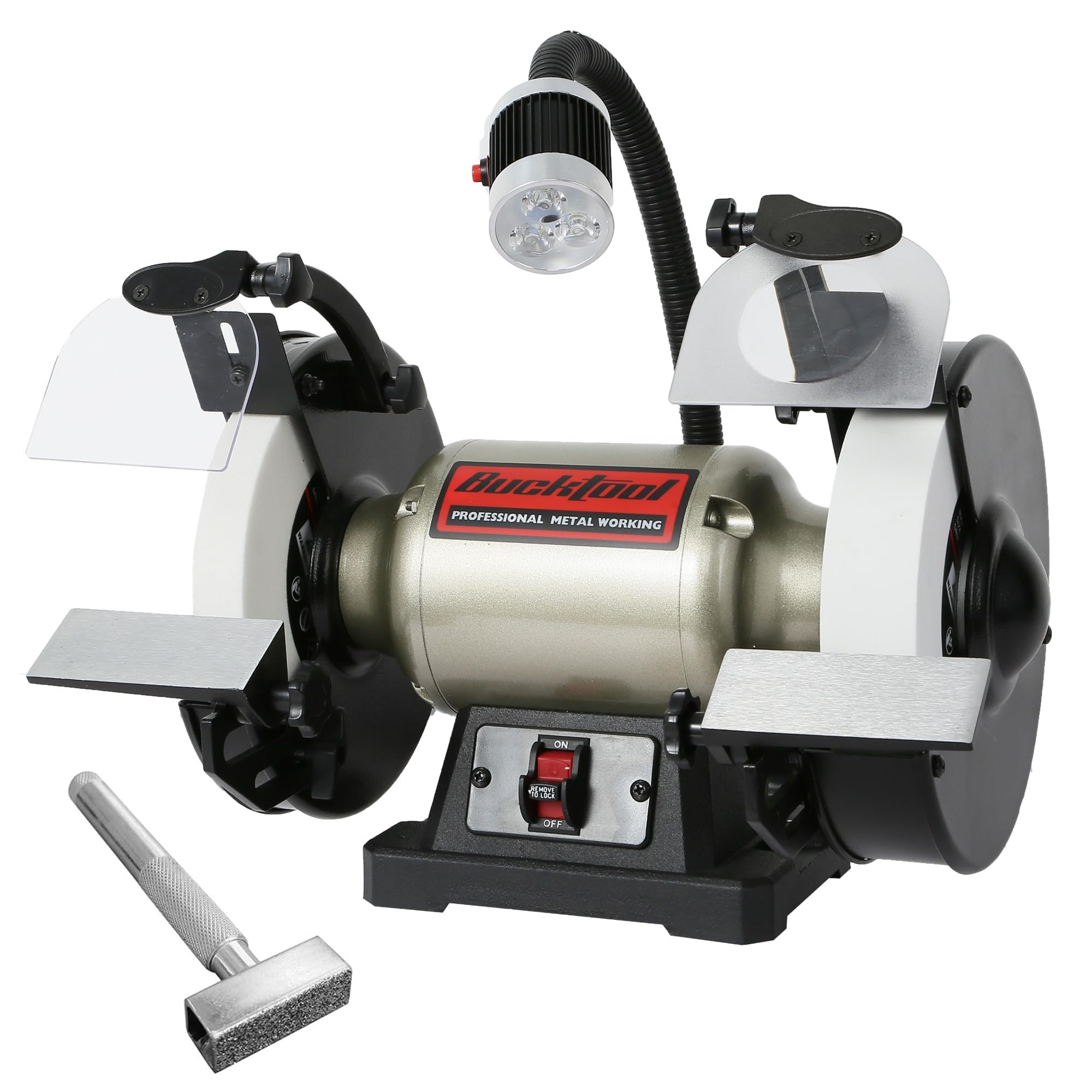
- Bucktool 8-inch Bench Grinder with LED Light (TDS-200C4HL) — 1750 RPM, 16.73 × 11.02 × 14.17 in, 43.22 lb, USD 99–299. A 3/4 HP low-speed machine aimed at lathe tools, chisels and hand-held cutting tools where running accuracy matters. See the 8-inch low-speed model.
- Bucktool 6-inch Low Speed Bench Grinder (TLG-150S) — 1750 RPM, 13.78 × 7.87 × 12.6 in, 19.19 lb, USD 100–300. The lightest machine in the range, described as stable, lightweight, portable and low vibration — a fit for small studios and benches where space is tight. View the 6-inch low-speed grinder.
- Bucktool 10-inch Bench Grinder (TDS-250) — 1750 RPM, 20.47 × 12.8 × 16.54 in, 74.52 lb, USD 99–299. The heaviest model in the line-up, built around high-precision arbors, stable wheel operation and heavy-duty wheel guards for low-speed precision sharpening of plane blades, chisels and hand tools.
High-speed grinders (3450–3600 RPM) for stock removal
- Bucktool 6-inch Small Bench Grinder (TDS-150CLA) — 3450 RPM, 12.4 × 9.53 × 9.14 in, 15.44 lb, CSA listed. A compact machine that also fits mobile sharpening setups. See the 6-inch CSA-listed grinder.
- Bucktool 8 Inch Bench Grinder (TLG-200L5A) — 3600 RPM, 16.57 × 10.83 × 12.8 in, 33.96 lb, USD 99–399. A 36#/60# wheel configuration with a heavy-duty steel base, pre-drilled mounting holes and CSA certification, aimed at frequent use and permanent benchtop installation. See the 8-inch 3600 RPM model.
- Bucktool 8-inch High Speed Bench Grinder (TDS-200HD) — 3590 RPM, 1.0 HP, 4.8 A motor, 17.72 × 10.63 × 14.57 in, 46.74 lb, USD 99–399. Wobble-free wheels and heavy-duty cast-iron construction for fast material removal and heavier tool reshaping. View the 1.0 HP high-speed grinder.
Dual-speed: one motor, two working speeds
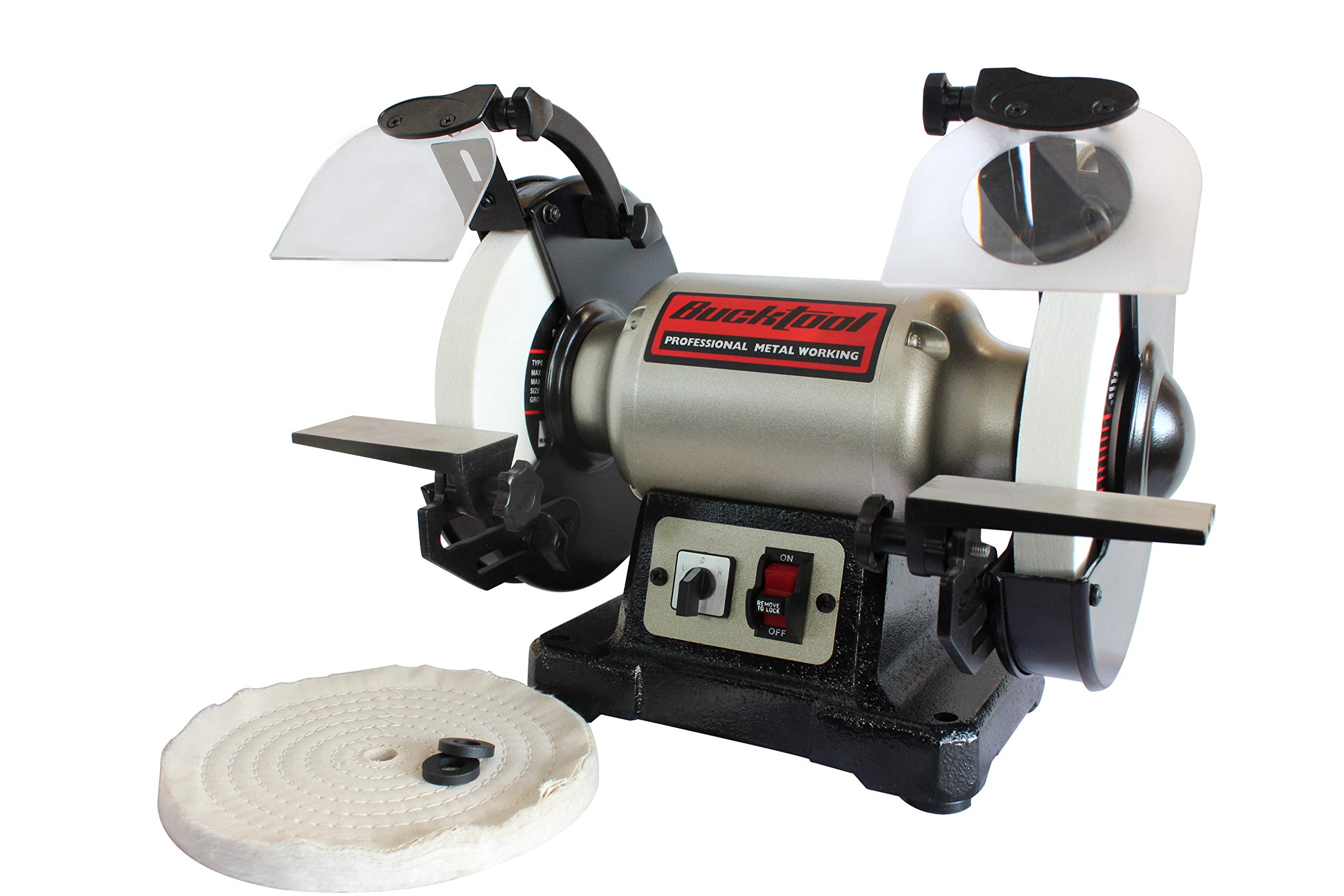
The Bucktool 8-inch Dual Speed Bench Grinder (TDS-200DS) runs at 1725 RPM and 3450 RPM (16.93 × 10.63 × 16.54 in, 41.89 lb, USD 99–399). The practical value is that low-speed precision sharpening and high-speed stock removal stop competing for bench space: you change the speed instead of changing machines. See the dual-speed cast-iron base model.
Variable speed and digital readout
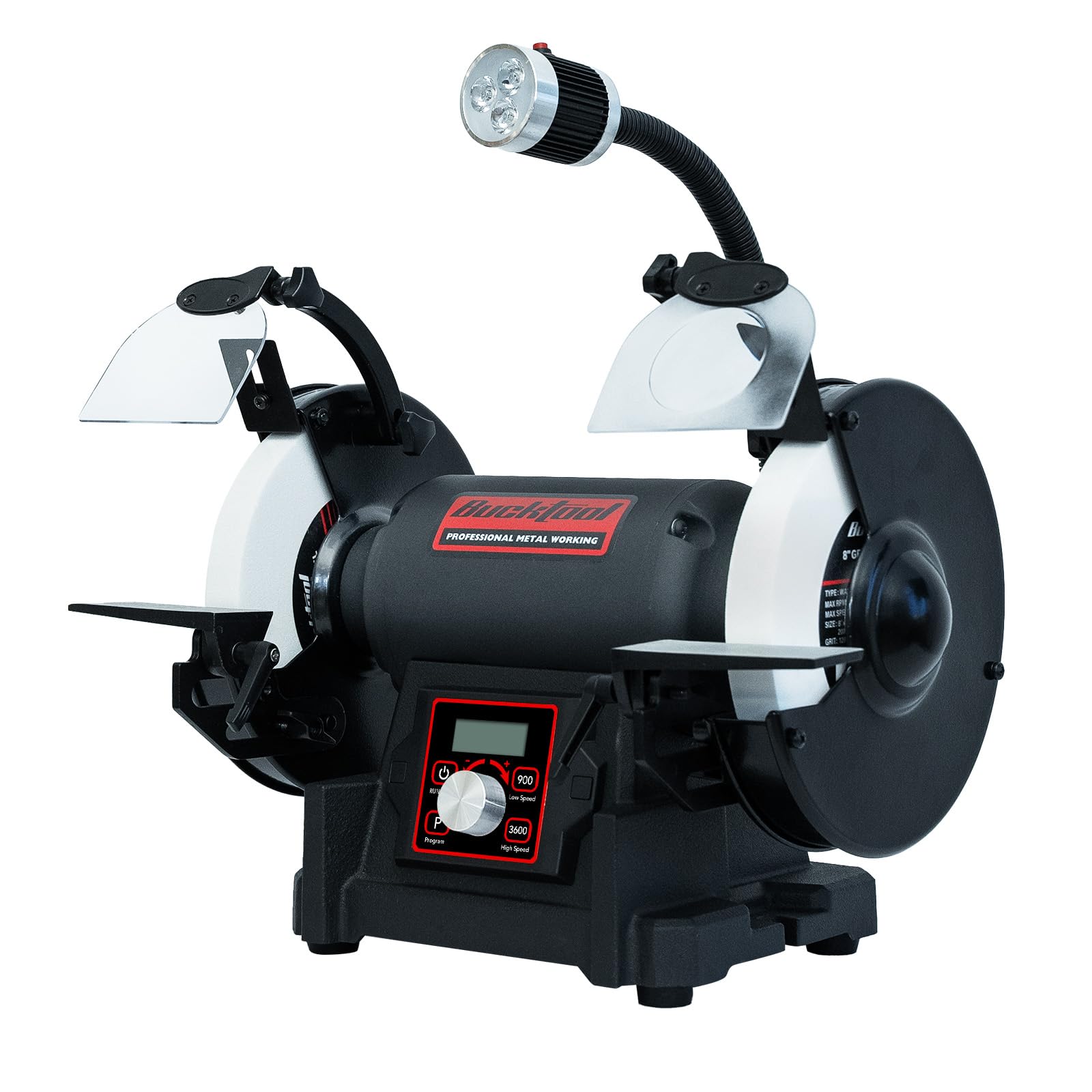
- Bucktool 8-inch VFD Variable Speed Bench Grinder (TDS-I200VL) — 900–3600 RPM, 18.5 × 11.81 × 14.57 in, 57.33 lb, USD 99–399. VFD speed control with speed memory, a 3X magnifying eye shield, a 3W LED light and an 80#/120# wheel configuration oriented toward fine sharpening. See the VFD variable-speed model.
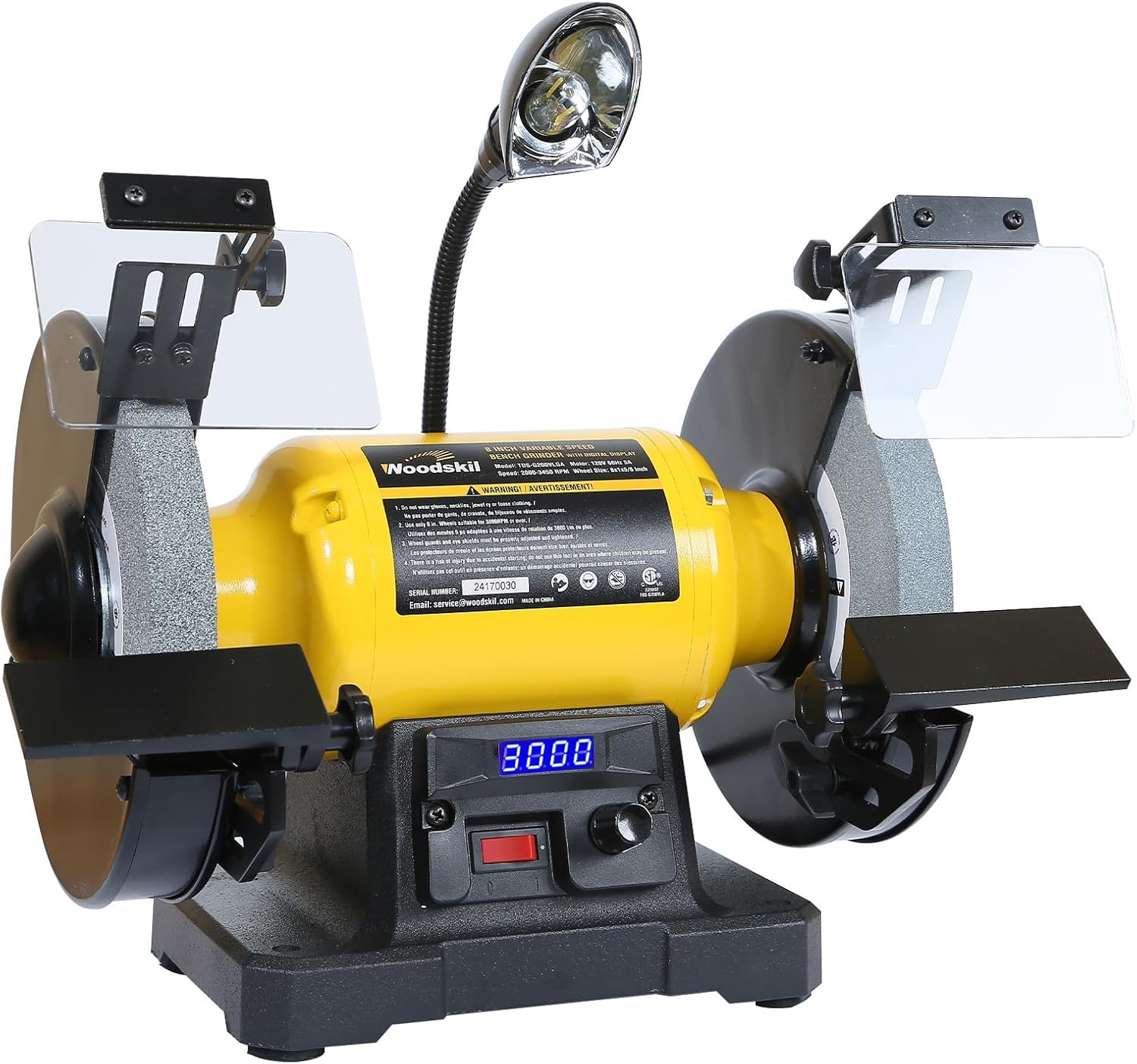
- Bucktool 8-inch Variable Speed Bench Grinder with Digital Display (TDS-G200VLGA) — 2000–3450 RPM, 18.7 × 11 × 14.6 in, 39.25 lb, USD 99–399. Digital speed control with an 8-inch wheel for precision tool sharpening, knife making and metal deburring. See the digital display model.
Wet stone sharpening
The Bucktool 10-inch Wet Stone Sharpener (SCM8103) runs at 90–160 RPM with water cooling and two-direction rotation, and covers both sharpening and stropping (18.11 × 10.63 × 15.75 in, 27.89 lb, USD 99–399). Water cooling is the mechanism that keeps heat out of the edge on plane blades, knives and other woodworking tools. See the 10-inch wet stone sharpener.
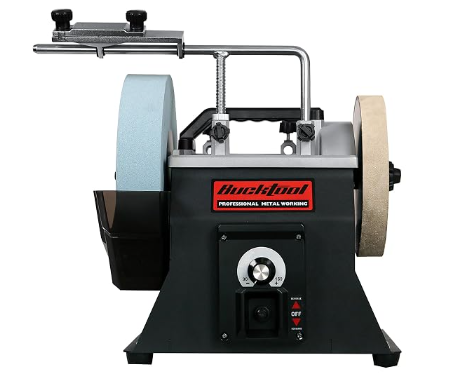
The full range is listed in the Bucktool bench grinder collection.
How to Choose a Bench Grinder in Seven Steps
- Start from the material and the finished edge. Heat-sensitive hardened steel — chisels, plane irons, knife blades — points toward 1750 RPM low speed or wet cooling. Mild steel parts that only need a burr removed are fine at high speed. Tasks that need both usually point toward a dual-speed or variable-speed machine.
- Pick the wheel diameter from the work, not the other way round. 6-inch suits compact benches, small parts and light sharpening; 8-inch is the general-purpose middle for tool maintenance and knife work; 10-inch makes sense when you need a wider wheel, more mass and steadier behavior on long edges. The Bucktool 10-inch TDS-250 weighs 74.52 lb, which is a benefit on long grinding passes and a consideration for a crowded bench.
- Decide the speed class. Fixed low speed, fixed high speed, dual speed or full variable speed. Variable speed gives the widest working range: the TDS-I200VL spans 900–3600 RPM with speed memory, while the TDS-G200VLGA covers 2000–3450 RPM with a digital readout that makes a chosen setting easier to repeat.
- Check the wheels and grit you actually get. A 36#/60# coarse-and-medium configuration suits general grinding and edge re-profiling. An 80#/120# configuration, as supplied on the TDS-I200VL, is oriented toward finer sharpening work. The wheel you receive determines the first task you can do without buying anything extra.
- Look at the base and how it mounts. Cast-iron bases and heavy-duty steel bases with pre-drilled mounting holes reduce walking and vibration. Stability is a specification, not a slogan: it is the difference between a grinder that stays put during a heavy pass and one that drifts across the bench.
- Check guards, shields and lighting. Wheel guards, adjustable eye shields, a magnifying shield such as the 3X unit on the TDS-I200VL, and LED lighting such as the TDS-200C4HL's light all matter if you grind regularly. Lighting in particular affects how accurately you can follow an existing bevel.
- Confirm support, warranty and delivery before you buy. Bucktool states a 30-day return window, a 2-year warranty and 3–5 day delivery within the United States, factory-direct. For a first machine, those terms decide how much risk you carry if the grinder turns out to be the wrong size for your bench.
Where Bench Grinders Earn Their Bench Space: Four Use Cases
Tool maintenance and edge upkeep
Sharpening drills, cutters, screwdrivers, chisels and similar hand tools is the most common reason a bench grinder enters a home workshop. In reported use, one owner sharpened several plane blades on a low-speed machine at roughly 3–5 minutes per blade, producing smooth, square edges that reached a fine cutting edge after a follow-up diamond stone hone. That sequence — machine grind, then hone — is what low-speed and wet-cooled models are designed to support.
Knife making and blade work
Blade work is where heat control matters most. Blank shaping, bevel grinding and geometry adjustment all risk overheating a blade if the wheel is too fast for the steel and the pressure applied. Low-speed machines reduce that risk, and the 10-inch wet stone sharpener adds water cooling on top of a 90–160 RPM range. One owner described the change plainly: sharpening woodturning tools on a low-speed grinder removed the risk of burning the steel.
Metalworking, deburring and finishing
In metalworking shops, bench grinders handle deburring, edge trimming, surface grinding and finishing on carbon steel, stainless steel and aluminum. This is where the high-speed models do their work: the TDS-200HD delivers 3590 RPM from a 1.0 HP, 4.8 A motor on a cast-iron frame for fast material removal. An owner who moved up from a 1/3 HP machine to a 3/4 HP Bucktool for metal and knife work reported that it kept grinding without stalling and did not wander across the workbench — the two things that matter most when the machine is doing real stock removal.
Automotive repair and part refurbishment
Rusted components, worn hand tools and small fabricated parts all need edge restoration or surface cleanup, and manual grinding for those jobs is slow. A bench grinder with a stable base is often enough to turn a refurbishment task into a few minutes of work rather than an afternoon.
Bench Grinder Comparison Table: The Bucktool Line at a Glance
| Model | Wheel size | Speed | Key build facts | Price range (USD) | Typical fit |
|---|---|---|---|---|---|
| Bucktool 6-inch Low Speed Bench Grinder (TLG-150S) | 6 in | 1750 RPM | 13.78 × 7.87 × 12.6 in, 19.19 lb; stable, lightweight, portable, low vibration | 100–300 | Home workshops and small studios with limited bench space |
| Bucktool 6-inch Small Bench Grinder (TDS-150CLA) | 6 in | 3450 RPM | 12.4 × 9.53 × 9.14 in, 15.44 lb; CSA listed; compact footprint | 99–399 | Light-duty sharpening, small-part grinding, mobile setups |
| bucktool 8 Inch Bench Grinder (TLG-200L5A) | 8 in | 3600 RPM | 16.57 × 10.83 × 12.8 in, 33.96 lb; 36#/60# wheels; heavy-duty steel base, pre-drilled mounting holes; CSA certified | 99–399 | Frequent use and permanent benchtop installation |
| Bucktool 8-inch Bench Grinder with LED Light (TDS-200C4HL) | 8 in | 1750 RPM | 16.73 × 11.02 × 14.17 in, 43.22 lb; LED lighting; 3/4 HP low-speed design | 99–299 | Low-speed sharpening of lathe tools, chisels and hand cutting tools |
| Bucktool 8-inch High Speed Bench Grinder (TDS-200HD) | 8 in | 3590 RPM | 17.72 × 10.63 × 14.57 in, 46.74 lb; 1.0 HP, 4.8 A motor; wobble-free wheels; cast-iron construction | 99–399 | Fast stock removal, metal grinding, tool reshaping |
| Bucktool 8-inch Dual Speed Bench Grinder (TDS-200DS) | 8 in | 1725 / 3450 RPM | 16.93 × 10.63 × 16.54 in, 41.89 lb; dual-speed motor; cast-iron base | 99–399 | Shops that need low-speed sharpening and high-speed grinding on one machine |
| Bucktool 8-inch VFD Variable Speed Bench Grinder (TDS-I200VL) | 8 in | 900–3600 RPM | 18.5 × 11.81 × 14.57 in, 57.33 lb; speed memory; 3X magnifying eye shield; 3W LED light; 80#/120# wheels | 99–399 | Controlled-speed precision sharpening, knife making, metal finishing |
| Bucktool 8-inch Variable Speed Bench Grinder with Digital Display (TDS-G200VLGA) | 8 in | 2000–3450 RPM | 18.7 × 11 × 14.6 in, 39.25 lb; digital precision speed control; 3/4 HP, 5.0 A | 99–399 | Precision tool sharpening, knife making, metal deburring |
| Bucktool 10-inch Bench Grinder (TDS-250) | 10 in | 1750 RPM | 20.47 × 12.8 × 16.54 in, 74.52 lb; high-precision arbors; heavy-duty wheel guards | 99–299 | Heavy-duty low-speed precision sharpening of plane blades and chisels |
| Bucktool 10-inch Wet Stone Sharpener (SCM8103) | 10 in | 90–160 RPM | 18.11 × 10.63 × 15.75 in, 27.89 lb; water cooling; two-direction rotation; sharpening and stropping | 99–399 | Cool-grind sharpening of chisels, plane irons and hand tools |
What to Check in the First Hour — and Where a Bench Grinder Has Limits
Two setup items come up often enough in owner reports to be worth checking as soon as the machine is on the bench.
- Wiring terminals. At least one owner received a unit that would not start because a wire terminal on the bottom plate had come loose in transit; reseating it restored power and the manufacturer's own troubleshooting guidance lists the same check first. Inspect the terminals before the first run.
- Tool rest locking. The same owner found that tightening the adjustable tables could shift the angle, so setting a precise angle takes a little back-and-forth with a square. If you change angles constantly, plan for that adjustment time.
It is also worth being clear about what a bench grinder is not. It is a general-purpose grinding machine, not a dedicated tool and cutter grinder, so very fine geometry work still benefits from a follow-up hone or a wet stone system. Larger 10-inch machines are heavy — the TDS-250 is 74.52 lb — and they need a solid bench and permanent mounting to be comfortable to use. And a low-speed machine will remove material more slowly than a high-speed one by design; that trade is what protects the edge.
Frequently Asked Questions
What safety standard applies to bench grinders in the United States?
The relevant standard family is UL 60745-1, the safety standard for motor-operated electric tools, and ANSI approved an updated version on October 25, 2024. In practical buying terms, look at the physical safeguards as well: wheel guards, eye shields and a stable base. Where a model carries a certification, it is usually stated openly — the Bucktool 6-inch TDS-150CLA is CSA listed, and the 8-inch TLG-200L5A carries CSA certification alongside its heavy-duty steel base.
What is the difference between a low-speed, high-speed and variable-speed bench grinder?
Low-speed machines run at 1750 RPM and are used where heat control protects the edge; Bucktool's low-speed models include the 8-inch TDS-200C4HL, the 6-inch TLG-150S and the 10-inch TDS-250. High-speed machines run at 3450–3600 RPM for faster material removal, such as the 8-inch TDS-200HD at 3590 RPM with a 1.0 HP, 4.8 A motor. Variable-speed machines let the operator select the range: the TDS-I200VL spans 900–3600 RPM with speed memory, and the TDS-G200VLGA covers 2000–3450 RPM with a digital display.
How much should an affordable bench grinder cost?
Globally, 6-inch bench grinders — the dominant consumer segment — typically sell for USD 50 to USD 200. Bucktool's bench grinder pricing sits inside the USD 99–399 band: the 8-inch low-speed TDS-200C4HL and the 10-inch TDS-250 are listed at USD 99–299, the 6-inch low-speed TLG-150S at USD 100–300, and the 8-inch dual-speed and variable-speed models at up to USD 399. Budget-wise, the deciding factor is usually speed control rather than wheel size.
Can I evaluate a bench grinder before committing to it long term?
Bucktool states a 30-day return window and a 2-year warranty on its tools, which provides a practical evaluation period for a first machine: set it up, run a few real sharpening or deburring jobs, and check for vibration, wheel wobble and tool-rest accuracy while the return window is open. Importers, dealers and workshop buyers evaluating several units can contact service@bucktool.com to discuss current models and configuration before ordering.
How long does delivery take for a bench grinder order?
Bucktool states 3–5 day delivery within the United States, shipped factory-direct from its own supply chain, which is why the range is priced consistently across models. If you need to confirm stock, configuration or timing before a project starts, the fastest route is the support team: email service@bucktool.com, call 909-255-1088, or message Bucktool on WhatsApp.
Match the Machine to the Job Before You Buy
Size sets how much wheel surface you have; speed decides whether the edge survives. For most home workshops and small shops, the practical shortlist is a 6-inch or 8-inch machine, and the real decision is whether you need fixed high speed, fixed low speed, dual speed or true variable speed. Bucktool builds all four configurations in the USD 99–399 band, factory-direct, with a 30-day return window, a 2-year warranty and 3–5 day US delivery.
Start with the Bucktool bench grinder collection, compare the models against the comparison table above, or send your requirements to service@bucktool.com for a model recommendation and a quote.