Bench Grinder Certifications and Standards: What Buyers Must Verify Before Purchase
Before you pay for a bench grinder, verify four things: an electrical safety certification that is valid for the market where the machine will actually be used, the guarding and tool-rest hardware as shipped, documentation your supplier can send on request, and warranty terms that sit entirely outside certification. None of the four can be confirmed from a product photo, a badge on a marketplace listing, or a speed rating alone.
This guide is written for buyers in the evaluation stage — people comparing 6-inch, 8-inch and 10-inch machines, low-speed and high-speed units, or weighing a factory-direct supplier against a distributor. It explains what each compliance area covers, which documents to request, how to read a certificate number, and exactly where certification stops and commercial warranty begins. BUCKTOOL, a bench grinder manufacturer founded in 1955 and headquartered in China, is used as a worked example because its published material includes specific certificate numbers and motor specifications that can be checked.
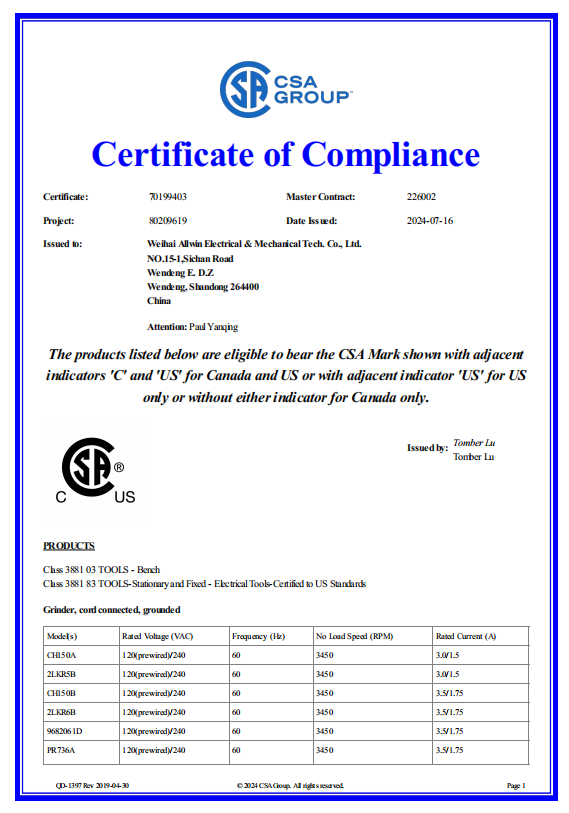
Certification documentation is the first thing to request and the easiest thing to fake with a badge. Ask for the certificate, not the logo.
The Real Problem: Two Identical Bench Grinders, Two Different Compliance Stories
Two 8-inch bench grinders can share the same wheel size, the same colour scheme and the same $180 price tag, and still be sold under completely different compliance positions. Certification is issued to a specific product, a specific voltage and a specific market. It is not a brand-wide property that automatically transfers to every model a factory makes, and it is not something a buyer can assume from a familiar-looking housing.
The failure mode is consistent. A buyer compares motors, wattage and wheel diameter, decides the units are equivalent, and orders. Months later, the workshop insurer, a distributor's retail compliance team, or a corporate procurement auditor asks for the certificate — and the buyer discovers that the paperwork covers a different model number, a different input voltage, or a revision of the standard that has since been updated.
There is a second, subtler problem: buyers frequently confuse certification with warranty. These are unrelated. Certification is a third-party conformity assessment that the machine meets a defined safety standard. Warranty is a commercial promise from the seller about repair, replacement or refund. A machine can hold valid certification and still carry a warranty that excludes the motor, or a return window measured in days. Searches for the BUCKTOOL bench grinder warranty are a good illustration: the question is commercial, and the answer has to come from the seller's published terms, not from a certificate.
The regulatory reference point also moves. In the United States, UL 60745-1, the general safety standard for motor-operated electric tools, was updated, and ANSI approved that revision on 25 October 2024 according to UL Solutions. Because a bench grinder is a stationary machine rather than a hand-held tool, buyers should ask the supplier which standard — and which revision of it — the unit's certificate actually references. A certificate is only useful if you know what it covers.
Industry Background: Why Certification Questions Are Getting Louder
Bench grinders sit inside a large and still-growing category. Grand View Research put the global grinding machinery market at USD 6.2 billion in 2025, with bench grinders forming part of the non-precision segment. Within that, 6-inch machines dominate the consumer end of the market, and industry pricing references place them typically in the USD 50 to USD 200 range, according to a 2025 bench grinder guide published by ANTISHICNC. That price band is the reason compliance questions matter commercially: a buyer spending under $200 often assumes certification is a given and skips the verification step entirely.
Three structural shifts are pushing certification higher up the evaluation list.
- Factory-direct buying has become normal. Buyers increasingly deal with manufacturers and online brand stores rather than regional distributors who used to absorb documentation handling. When the distributor is removed, the documentation duty moves to the buyer.
- The same machine ships to different regimes. Bench grinder brands serving North America, Europe and Asia Pacific work across markets with separate conformity frameworks. A document valid in one market does not automatically satisfy another.
- Third-party reviewers now weigh certification and safety hardware. Benchmark Abrasives' bench grinder buyer's guide names the BUCKTOOL TDS-200C4HL as a top-rated slow-speed (1,750 RPM) model for professional sharpening — a reminder that the machines buyers are told to prefer are also machines whose specifications are publicly checkable.
The practical consequence for an evaluating buyer is straightforward: certification verification is now a pre-purchase task, not a post-purchase surprise.
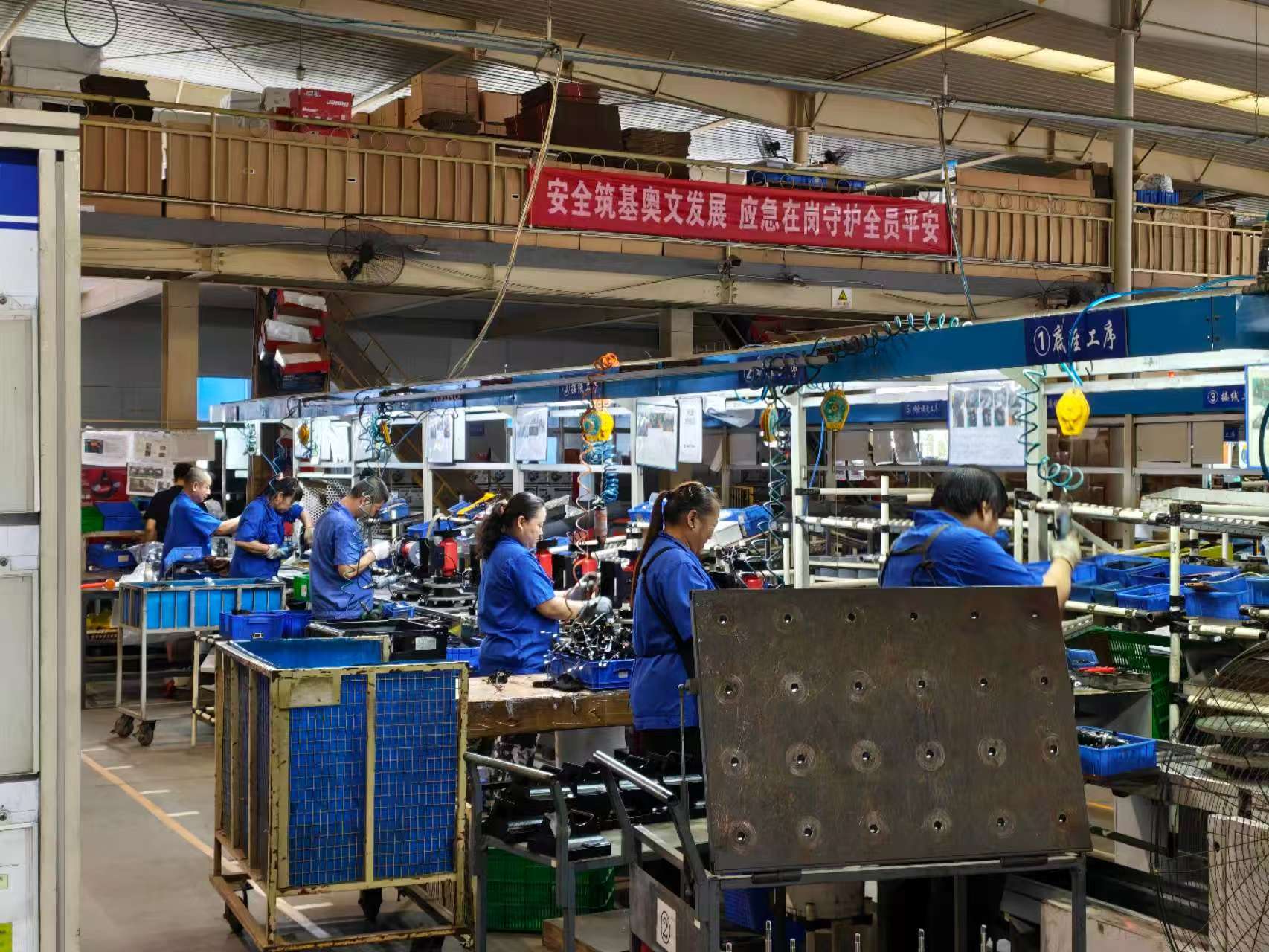
Certificates only stay valid when the production record behind them stays consistent. Ask which facility and which line builds your units.
What Buyers Must Verify: Five Compliance Areas for Bench Grinders
Compliance on a bench grinder is not one document. It is five overlapping areas, each with its own evidence and its own failure mode. Buyers who work through them in order reach a defensible purchasing decision; buyers who skip to the price comparison do not.
1. Electrical Safety Certification and the Certificate Number
The first document to request is the electrical safety certificate, and the first thing to look at is whether it carries a number. A number is what makes a certification claim checkable — it can be traced to an issuing body and to a list of covered models.
BUCKTOOL's bench grinder motor platform is covered by two verified certificates: CSA 1936834 and CSA 70199403. Those certificate numbers sit behind a motor design that uses an induction motor with a fully enclosed ball bearing structure, which the supplier describes as eliminating wheel wobble during operation. For a buyer, the significance is not the number itself — it is that the number exists, is specific, and can be requested before purchase.
What to ask for: the certificate number, the name of the issuing body, the exact standard and revision referenced, the complete list of covered model numbers, and the rated input voltage (for example 120V for the US market). If a supplier cannot supply a number, the correct conclusion is that no traceable certification is available — not that the unit is fine because the listing shows a logo.
2. Guarding, Tool Rest and Operator Safety Hardware
Guarding is the area where two visually similar machines most often diverge. Wheel guards, tool rests and eye shields are physical safety hardware, and they are the components most likely to be downgraded to hit a price point — sometimes removed, sometimes simplified, sometimes left off the shipped configuration even when the catalogue render shows them.
On the verified BUCKTOOL specification, the platform includes a lockable adjustable tool rest, a key-controlled safety switch, a 3X magnifier eye-shield, and an 8-inch grinding wheel on a cast iron base. The key-controlled switch is the detail worth pausing on: the supplier's own comparison notes state that many consumer bench grinders in this class are supplied without a key-lock safety switch. That is precisely the kind of difference you cannot detect from a thumbnail.
Buyers should request a written description of the shipped guarding configuration — guard type, tool rest type and adjustment, eye shield magnification, and switch type — as part of the quotation, so that what arrives can be checked against what was promised.
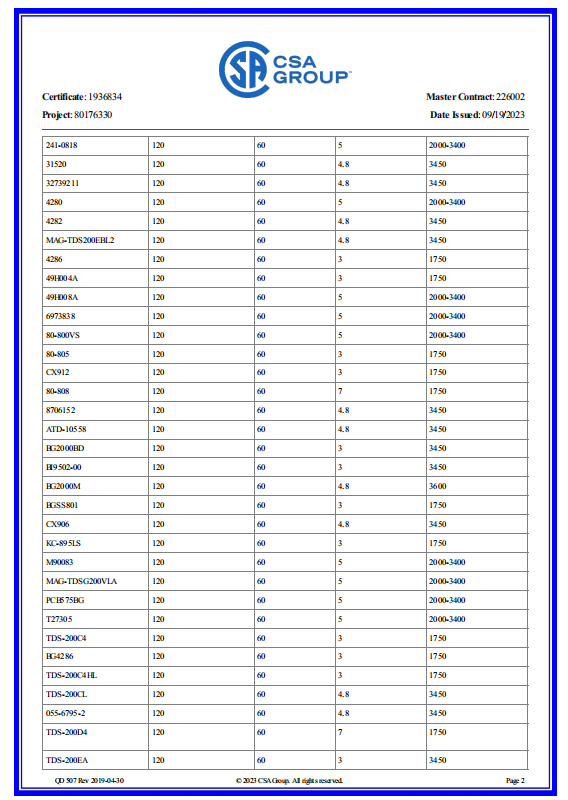
Electrical certification covers the machine as built. Guarding, tool rests and switches must be verified separately.
3. Motor and Speed Documentation
Motor data is where compliance and performance overlap, and where mismatches create risk. The verified BUCKTOOL motor specification is 1.0 HP at 120V with 4.8A input current, a maximum spindle speed of 3,590 RPM, an 8-inch grinding wheel diameter, and a cast iron base for vibration reduction. The supplier's stated industry comparison is a general maximum speed around 3,450 RPM, with obvious wheel wobble commonly reported on consumer bench grinders.
Why this matters for verification: a grinding wheel has its own maximum rated speed, and the wheel must be matched to the spindle. A buyer who checks the motor rating but not the wheel rating has checked half the machine. Ask for the spindle speed, the wheel diameter and the wheel's rated maximum, and confirm they are consistent. Ask also whether wheels arrive pre-balanced — BUCKTOOL's published customer reviews specifically note the wheels appeared pre-balanced and that the grinder showed a lack of vibration.
4. Regional Market Requirements
Certification is geographically scoped. The same bench grinder sold into North America, Europe and Asia Pacific will typically need to satisfy different conformity frameworks in each destination, and the paperwork follows the destination, not the brand.
For North American buyers, CSA certification is a commonly requested route: the verified BUCKTOOL certificates (CSA 1936834 and CSA 70199403) belong to this family. For European buyers, the CE marking regime governs machinery placed on the EU market. Rather than assuming a badge means worldwide validity, the practical instruction is to state your destination market and your input voltage in the request, and ask the supplier to confirm in writing which certificate applies to that combination. If the supplier's certificate covers only one market, that is not a defect — it is information you need before you commit to a container.
5. Warranty, Returns and After-Sales — The Part Certification Does Not Cover
Certification tells you the machine meets a safety standard. It tells you nothing about what happens if the motor fails in month fourteen. That is the warranty question, and it must be answered by the seller's published terms.
For BUCKTOOL, the brand site states a 30-day return window, a 2-year warranty, and 3–5 day delivery within the United States. Those are commercial terms verified against the brand's own published information. When comparing suppliers, request the same four items in writing: warranty length, what is excluded (motor versus consumables such as grinding wheels), who pays return freight, and the spare parts or wheel availability commitment.
Honest limits belong in this section too, because a compliance article that only lists strengths is not useful. BUCKTOOL's published review set carries an average rating of 4.7, and the most frequently cited drawback is that setup takes time. One three-star reviewer reported that the unit became very hot during a sustained cut on a large piece and stalled. A buyer evaluating any bench grinder — this one included — should treat duty cycle and workpiece size as real constraints and match the machine to the work, not to the specification sheet alone.
Step-by-Step: How to Verify Bench Grinder Certification Before You Buy
Verification is a sequence. Running it out of order produces gaps that only appear after payment.
- Define the market and the voltage first. Write down the destination country and the input voltage you need (120V for the US). Every document request that follows is scoped by these two facts.
- Request the certificate, not the badge. Ask for the certificate number, issuing body, standard and revision, and the covered model list. If the seller responds with a logo image, ask again.
- Cross-check the certificate against the exact model. Confirm the model number you intend to buy appears on the certificate, and that the wheel size on the certificate matches the wheel size being shipped.
- Request the guarding and switch configuration in writing. Guard type, tool rest type and adjustment range, eye shield magnification, and switch type. For the verified BUCKTOOL platform this is a lockable adjustable tool rest, a key-controlled safety switch and a 3X magnifier eye-shield.
- Request motor and spindle data. Motor power, input current, maximum spindle speed, wheel diameter and base material. For BUCKTOOL's verified specification this is 1.0 HP at 120V, 4.8A, 3,590 RPM maximum spindle speed, an 8-inch wheel and a cast iron base.
- Separate the warranty conversation. Ask for warranty length, exclusions, return window, delivery time and spare part availability as a distinct item. BUCKTOOL publishes a 2-year warranty, 30-day returns and 3–5 day US delivery.
- Keep the pack. Store the certificate, the guarding specification and the warranty terms with the purchase record. This is what you produce for an insurer, an audit, or a resale enquiry two years later.
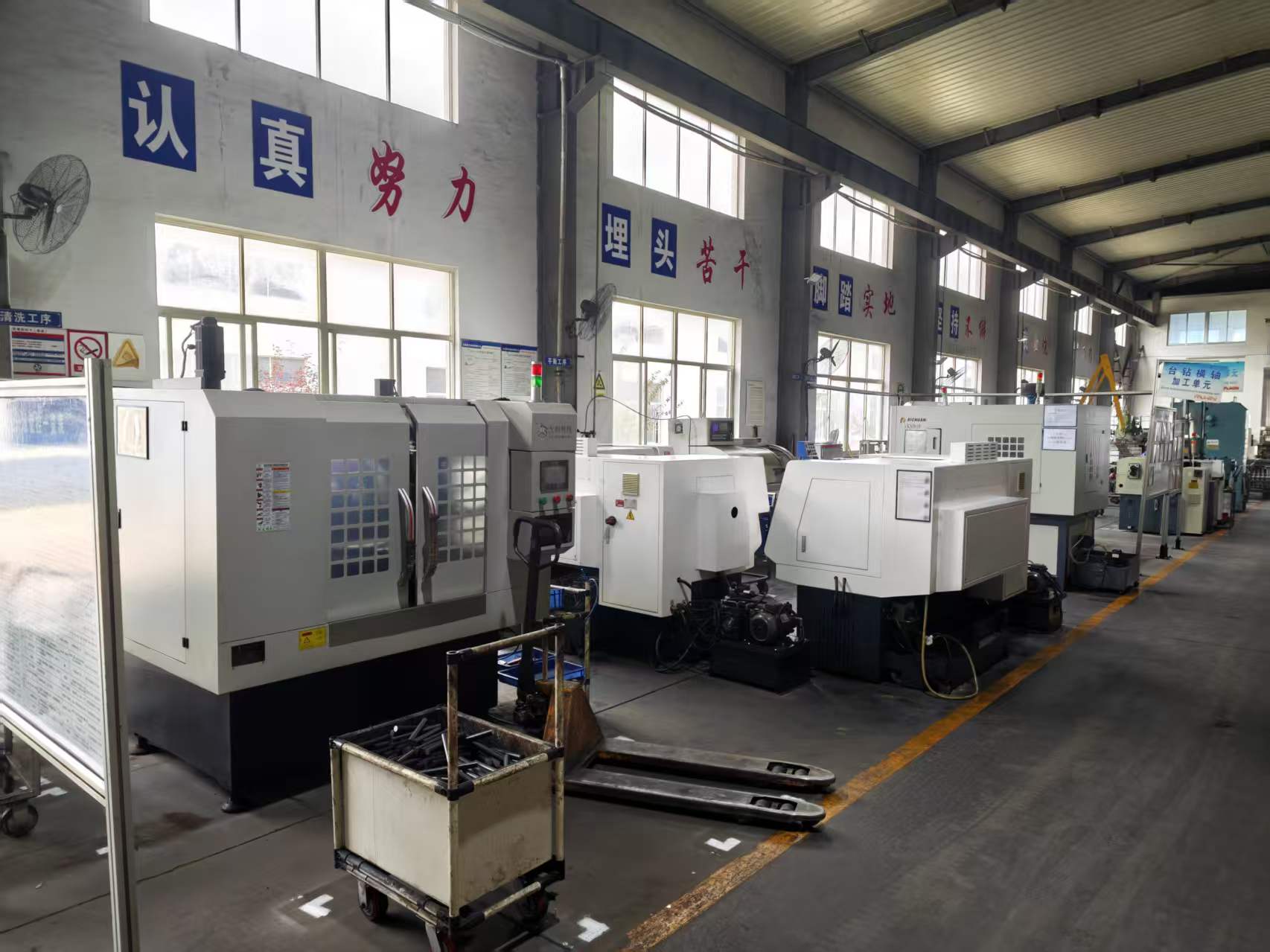
Inspect the delivered unit against the written specification: guarding, switch type, wheel condition and spindle data.
Certification Priority Order: What Buyers Ask For First
When buyers have limited time or limited leverage with a supplier, the verification items should be requested in order of risk, not in the order they appear on a product page. This is a decision framework, not a product ranking.
- Electrical safety certification for the destination market. Highest risk, hardest to remedy after delivery, and the item an insurer or retailer will ask for first.
- Guarding and switch configuration. Physical hardware that is difficult to retrofit at a distance and directly tied to operator safety during grinding, sharpening and deburring.
- Motor and spindle documentation. Required to confirm wheel-to-spindle compatibility and to judge whether the machine suits your duty cycle.
- Warranty and returns in writing. Determines your financial exposure if the first three items check out but the machine fails.
- Spare parts and consumables supply. Wheels, rests and shields wear; a machine with no parts path becomes scrap sooner.
Verification Checklist and Comparison Data
The table below maps each verification area to the evidence to request and to the verified BUCKTOOL data point where one exists publicly.
| Verification area | What to request from the supplier | Verified BUCKTOOL data point | Why it matters |
|---|---|---|---|
| Electrical safety certification | Certificate number, issuing body, standard and revision, covered model list, rated voltage | CSA 1936834; CSA 70199403 | A badge without a number cannot be traced or verified |
| Guarding and operator hardware | Guard type, tool rest type and adjustment, eye shield, switch type | Lockable adjustable tool rest; key-controlled safety switch; 3X magnifier eye-shield | Safety hardware is commonly simplified to hit a price point |
| Motor and spindle data | Motor power, input current, maximum spindle speed, wheel diameter, base material | 1.0 HP at 120V; 4.8A input; 3,590 RPM maximum spindle speed; 8-inch wheel; cast iron base | Wheel rating must match spindle rating; base affects vibration |
| Vibration and wheel condition | Wobble behaviour, pre-balancing, wheel specification | Fully enclosed ball bearing induction motor; wobble-free design | Vibration affects finish quality and wheel life |
| Regional market documents | Market-specific declaration for the destination country | Certification held under the CSA family; brand target market includes the US | Certificates are issued per market and do not transfer automatically |
| Warranty, returns and delivery | Warranty length, exclusions, return window, delivery time, spare parts path | 2-year warranty; 30-day returns; 3–5 day US delivery (per brand published terms) | Certification does not cover after-sales obligations |
The second comparison is narrower and more useful during evaluation: how the verified BUCKTOOL motor platform measures against the supplier's own stated industry baseline for consumer bench grinders.
| Parameter | BUCKTOOL verified specification | Typical consumer bench grinder baseline |
|---|---|---|
| Maximum spindle speed | 3,590 RPM | Around 3,450 RPM |
| Wheel wobble | Wobble-free design; fully enclosed ball bearing induction motor | Obvious wheel wobble commonly reported |
| Safety switch | Key-controlled safety switch | Key-lock safety switch often not fitted |
Each row is checkable. That is the point of a comparison table in a compliance context — it converts a marketing claim into a specification you can put next to a certificate.
How Verification Priorities Change by Use Case
The five compliance areas do not carry equal weight for every buyer. What changes is which document you push hardest on.
Home workshop and compact setups
Budget-driven buyers in the 6-inch class — a segment where industry references place typical pricing between USD 50 and USD 200 — most often need the electrical certificate and the guarding confirmation. For BUCKTOOL's range, the 6-inch Small Bench Grinder and the 6-inch Low Speed Bench Grinder sit in this part of the catalogue.
Knife sharpening and tool sharpening
Sharpening buyers care about speed and heat. BUCKTOOL publishes a 6-inch Low Speed Bench Grinder, and third-party coverage by Benchmark Abrasives highlights the TDS-200C4HL as a top-rated slow-speed (1,750 RPM) model for professional sharpening. The verification item here is the spindle speed documentation, because low speed is the feature that prevents burning an edge — and it should appear on the specification, not just in the copy.
Woodworking
Woodworking buyers running chisels, gouges and lathe tools prioritise vibration control and wheel condition. Published BUCKTOOL customer reviews note a wide fine grit wheel (1.5 inches), pre-balanced wheels and a lack of vibration, and describe using the machine with a sharpening jig system. The 8-inch Variable Speed Bench Grinder with Digital Display and the 8-inch VFD Variable Speed Bench Grinder are the relevant models for buyers who want adjustable speed on this type of work.
Metalworking
Faster material removal usually means higher speed and heavier duty. BUCKTOOL's catalogue covers this with the 8-inch High Speed Bench Grinder, the 8-inch Dual Speed Bench Grinder (TDS-200DS) and the 8-inch Bench Grinder with LED Light. Here the verification priority shifts to motor documentation and duty cycle: the input current, the base material and the wheel rating all need to line up with the work the machine will actually do.
Importers, distributors and private-label buyers
For channel buyers, documentation is a retail requirement, not a personal preference. The priority list becomes: certificate package for the destination market, model list on the certificate, guarding configuration consistency across the shipment, and a written warranty position that can be passed down to end customers. BUCKTOOL is a factory-direct manufacturer, which means this documentation conversation happens directly with the producer rather than through an intermediary.
Frequently Asked Questions
What certifications should a bench grinder have before I buy it for the US or Canadian market?
A bench grinder sold into North America should be supported by an electrical safety certification issued for that market, and you should be able to obtain the certificate number and the issuing body. BUCKTOOL's bench grinder motor platform is covered by two verified certificates, CSA 1936834 and CSA 70199403. Because the US safety framework for motor-operated electric tools was updated when ANSI approved the revised UL 60745-1 on 25 October 2024, per UL Solutions, buyers should also ask which standard and which revision the certificate references. A number you can trace is worth more than a badge you cannot.
Does a certification tell me how well a bench grinder performs?
No. Certification confirms conformity with a safety standard; it says nothing about speed, vibration or finish quality. Performance has to be verified from published specifications. BUCKTOOL's verified motor data is 1.0 HP at 120V, 4.8A input current, a maximum spindle speed of 3,590 RPM, an 8-inch grinding wheel and a cast iron base for vibration reduction, against a stated industry baseline of around 3,450 RPM with wheel wobble commonly reported. The two checks are complementary: certification for safety, specifications for capability.
Does certification push the price of a bench grinder up, and what should I expect to pay?
Testing and certification are cost items inside the manufacturing price, so they are already embedded in whatever you pay. What matters is knowing which segment you are buying in. Industry references place 6-inch bench grinders, the dominant consumer segment, typically between USD 50 and USD 200, according to a 2025 guide published by ANTISHICNC. Higher speed, variable-speed drives and larger wheels move a machine out of that band. The practical rule is not to assume that a higher price means better documentation — ask for the certificate number regardless of the price point.
Can I request certification documents or a sample unit before placing an order?
Yes, and in most evaluation processes you should. Request the certificate number and covered model list, the guarding and switch specification, the motor and spindle data, and the warranty terms as a single documentation pack, then evaluate a sample unit against that written specification. BUCKTOOL's differentiation is factory-direct manufacturing, which makes this request straightforward: the same organisation that builds the grinder holds the certificate record. Buyers assessing the 6-inch Low Speed Bench Grinder, the 8-inch Dual Speed Bench Grinder or the 10-inch Wet Stone Sharpener can request the corresponding documents for the specific model rather than for the brand in general.
What does the warranty cover, and how fast is delivery?
Warranty is separate from certification and must be confirmed in writing before purchase. BUCKTOOL's published terms state a 2-year warranty, a 30-day return window and 3–5 day delivery within the United States. Two details are worth confirming with any supplier: whether the motor and the consumable grinding wheels are treated the same way, and who carries return freight. As a next step, you can request the certification pack, a specification sheet or a sample by emailing service@bucktool.com, messaging WhatsApp +86-15105354491, or visiting bucktool.com.
Conclusion: Verify the Document, Not the Badge
Bench grinder certification is a five-part verification task, not a single checkbox. Electrical safety certification with a traceable number and a defined market scope comes first. Guarding, tool rest and switch hardware come second, because that is the equipment most likely to be simplified and the hardest to retrofit. Motor and spindle documentation come third, since a wheel must match the spindle it is mounted on. Regional market applicability comes fourth, because certificates are scoped to destinations. Warranty and after-sales terms come last — a commercial promise that no certificate can make on a seller's behalf.
The buyers who get this right are not the ones who read the most reviews. They are the ones who send one structured document request before ordering, keep the reply on file, and check the delivered machine against it. BUCKTOOL's published data — CSA 1936834 and CSA 70199403, 1.0 HP at 120V, 4.8A, 3,590 RPM maximum spindle speed, a lockable adjustable tool rest, a key-controlled safety switch, a 2-year warranty and 30-day returns — exists precisely so that a buyer can run that check. Whether the supplier is BUCKTOOL or anyone else, the verification sequence is the same, and it is cheaper to run before the order than after it.
Get the Documentation Pack Before You Decide
Request the certificate numbers, guarding specification, motor data and warranty terms for the specific BUCKTOOL bench grinder model you are evaluating — or ask for a sample unit to check against the written specification.
Email: service@bucktool.com | WhatsApp: +86-15105354491 | Website: bucktool.com

Samples and documentation packs for BUCKTOOL bench grinders are issued from the same factory-direct supply chain.
Have Questions or Need More Details?
Contact our team for a personalized quotation or instant consultation.
Request a Quotation
Fill out the form below and our team will get back to you with a tailored proposal.
WhatsApp Direct Chat
Prefer to chat in real-time? Message us on WhatsApp for instant assistance & quick answers.
- Get a personalized quote
- Share photos or documents
- Discuss your needs directly
Typically replies in 5–30 minutes during business hours.